The coffin of King George VI had been waiting for years. When the new memorial chapel was finally ready, the workmen moved his remains out of the royal vault on the 24th of March 1969. A week later, a ceremony was held inside the small building attached to St George’s Chapel at Windsor Castle. The Queen Mother stood with her daughter, Queen Elizabeth II, and her son-in-law, Prince Philip, along with their eldest children.
Knights of the Garter attended as well. George VI’s coffin was carried into the chapel and lowered into the burial chamber beneath the floor. A ledger stone was set in place, carved with his name, his dates of birth and death. At last, the king who had led Britain through the Second World War had a permanent home.
The story of that chapel began years earlier, in 1962, when Queen Elizabeth II ordered the commissioning of the George VI Memorial Chapel. She asked her architects to design a small addition to St George’s Chapel that could hold the coffins of three monarchs and their consorts. She did not want a huge extension, because such a project would have cost a fortune. Her private secretary made two specific requests to the Dean of Windsor, and the second of these was that a proper resting place be found for the Queen’s father.
When George VI died suddenly in 1952, there had been no plans for where he would be buried. His death had come so unexpectedly that the funeral arrangements had not even been drawn up. After the funeral, his coffin was placed inside the royal vault beneath St George’s Chapel, left in limbo with no permanent grave. Wreaths were still laid on it.
The Queen wanted to give her father a decent burial, and she wanted a place where the family could come and pay their respects. She also wanted her mother to avoid the pain of burying her husband a second time. She did not want her father placed in a marble tomb with a lifelike effigy, the kind of monument common to royals in St George’s Chapel and Westminster Abbey. Even the medieval kings had such tombs, but Elizabeth II found them distasteful.
She preferred the idea of laying monarchs to rest beneath a simple stone slab in the floor. The request to expand St George’s Chapel was not acted upon for five years. The royal vaults below the chapel had no room for additional burial spaces. So the plan settled on a chantry chapel, a small extension built on the exterior of St George’s Chapel.
It would be the first addition to the chapel in roughly 450 years. Many designs were proposed and rejected. Eventually one was accepted, and the chapel, complete with its burial vault, was finished in 1969. The cost came to roughly £500,000 in today’s money, paid by the royal family themselves.
For decades, George VI lay undisturbed in the new vault. But when Princess Margaret, the Countess of Snowdon, died, a decision had to be made about her remains. Margaret had never been intended for burial in the memorial chapel. The original plan called for only three monarchs and their consorts.
Yet Margaret became the first member of the royal family to be cremated. Her funeral service took place in a crematorium, which was unusual. One reason it is thought she was cremated was so that her ashes could be accommodated inside the small burial chamber alongside her father. But they were not placed there immediately.
Opening the vault was a lengthy process, so Margaret’s ashes waited. When the Queen Mother died, she was buried beside her husband. On the 9th of April 2002, the ledger stone was removed, and her coffin was lowered into the vault next to that of George VI. At that same moment, Princess Margaret’s ashes were placed in the same chamber, set next to the coffins of her parents.
Margaret’s tombstone, however, is separate from the updated ledger stone that carries the names of George VI and the Queen Mother. It stands in the right-hand corner of the chapel. An epitaph on it reads: “We thank thee Lord who by thy Spirit doth our faith restore when we with Wordly things commune and prayerless close our door we lose our precious gift Divine to worship and adore then thou our Saviour fill our hearts to love thee ever more. ”
By 2002, the vault held the remains of King George VI, Queen Elizabeth the Queen Mother, and the ashes of Princess Margaret.
The plan, however, had always included two more people. Prince Philip, the Duke of Edinburgh, died in 2021. Following his funeral, his coffin was lowered into the traditional royal vault beneath the floor of St George’s Chapel. It was left there for some time.
The intention was to bury Philip and his wife, the Queen, together when she died. Many people did not realize that Prince Philip’s coffin was not initially buried in its final resting place. It simply rested inside the older vault, waiting. Queen Elizabeth II died on the 8th of September 2022.
After her state funeral, her committal service saw her coffin lowered into the royal vault below St George’s Chapel. Many who watched assumed this marked her final resting place. It did not. Hours later, on the evening of the 19th of September 2022, members of the close royal family were invited into the George VI Memorial Chapel.
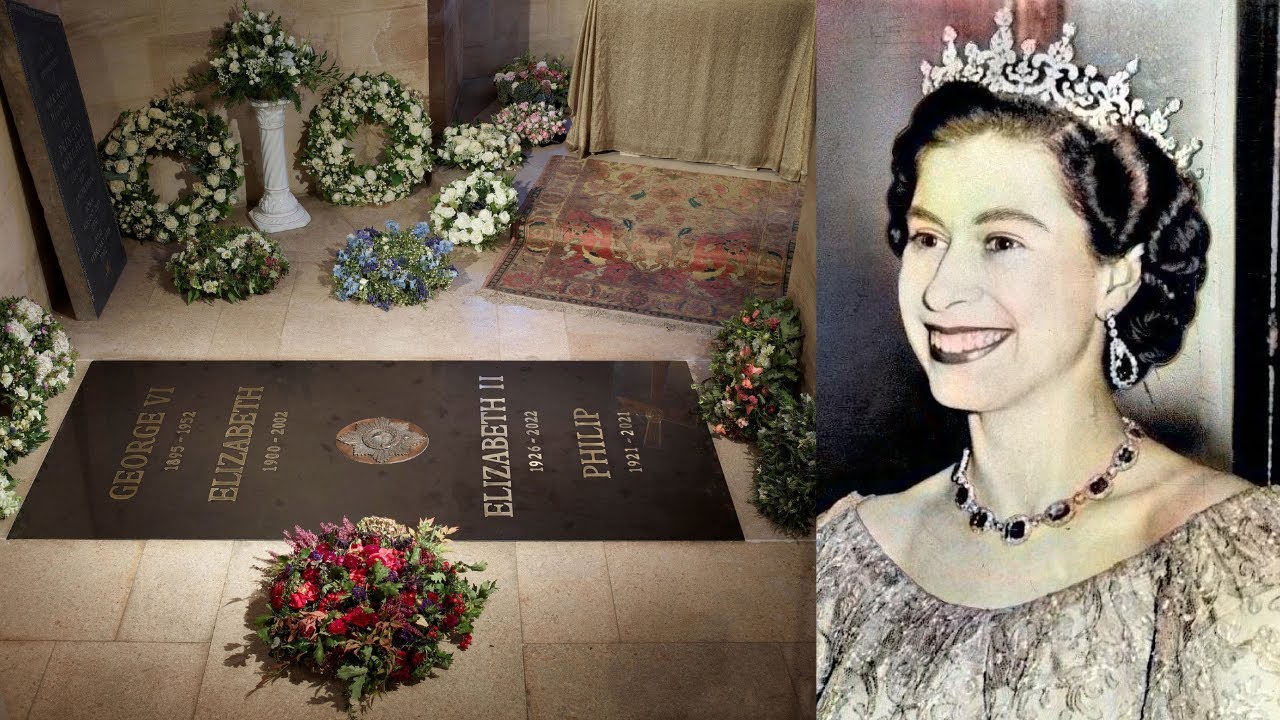
The chapel had been prepared, and the vault for Elizabeth II and Philip had been exposed. Prince Philip’s coffin was brought in and lowered into the ground. Then the coffin of Elizabeth II was placed beside him. The ledger stone was altered to include the names of both Philip and Elizabeth, along with their dates of birth and death.
Today, inside the George VI Memorial Chapel lie King George VI, the Queen Mother, Queen Elizabeth II, Prince Philip, and the ashes of Princess Margaret. But the chapel still has space for one more monarch and a consort. It is most probable that this space will one day be taken by King Charles III and his wife, Queen Camilla. Upon their deaths, it is likely they will be buried there as well.
After that, the future royals will have to be interred elsewhere. A new burial space will be needed, and it is possible that the royal burial ground at Frogmore will become more heavily used. The vault beneath the small chantry chapel at Windsor will then be full, its story complete.






