On Tuesday, October 16th, 1962, McGeorge Bundy knocked on the door of the President’s bedroom in the family quarters of the White House. He was 43 years old, the National Security Advisor, and he had been carrying this news since the night before. He had chosen to wait until morning. Now he said it plainly: Soviet missiles in Cuba, 90 miles from Florida.
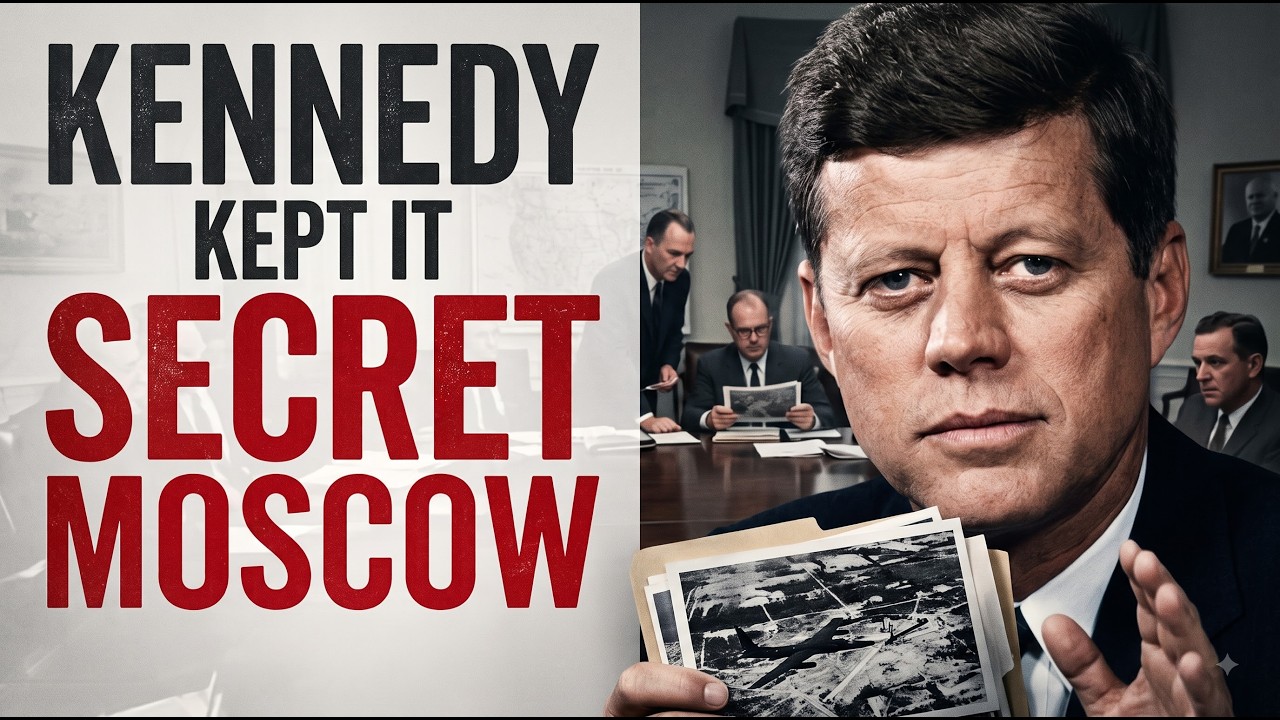
According to those who were there, the President’s first reaction was disbelief, then anger—anger that Nikita Khrushchev would do this to him. By noon, a tape recorder hidden in the Cabinet Room would begin to turn. Because of that machine, we can still hear what happened next in the voices of the men themselves. For six days, those men would keep the biggest secret in American history.
They would make speeches and smile for cameras. The President would even pretend to have a cold. And the American people would go to work and to school and to church with no idea that the clock was running. Then, on the seventh evening, at 7:00, the President would come on television, and every American alive that night would remember exactly where they were standing.
But to understand that morning, you have to start earlier, because by October of 1962, America was already a frightened country. In the summer of 1961, the Soviets and the Americans were locked in a standoff over Berlin. In July, President Kennedy went on television and asked the country to take civil defense seriously. “Build fallout shelters,” he said.
Families dug into their backyards. Schools taught children to duck under their desks and cover their heads. In August, the East Germans began to build a wall across Berlin—barbed wire first, then concrete—and families were cut off from each other overnight. American and Soviet tanks stood face-to-face at Checkpoint Charlie, guns pointed for hours.
And in October of 1961, the Soviets exploded the largest nuclear bomb in history, a device of about 50 megatons over an Arctic island, thousands of times more powerful than the bomb that destroyed Hiroshima. Khrushchev wanted the world to know what he had. What Americans did not know in October of 1962 was that the wondering was about to become real. Back in the Cabinet Room, the tape begins with a child.
Before the advisers arrive, before the maps and the photographs and the grim faces, a small voice can be heard. It is Caroline, the President’s four-year-old daughter, keeping her father company while he waits. He speaks to her gently, with light, ordinary words. Then the door opens, and the ordinary morning is over.
It is just before noon. The men take their places around the long table, the President at the center with his back to the Rose Garden. Easels stand along the walls holding enlarged photographs—grainy, gray, the kind that make you squint. How did they get here?
The story of those photographs begins with a failure and a hunch. All summer, American intelligence had watched Soviet ships arriving in Cuba. Refugees told wild stories of huge trucks moving at night. Republicans in Congress, led by Senator Kenneth Keating of New York, charged that the Soviets were building missile bases on the island.
The administration pointed out that no one had proof. In September, the intelligence community produced an official estimate concluding that the Soviets would probably not place offensive missiles in Cuba. It would be too reckless, the analysts reasoned. It did not fit the way the Soviets had behaved before.
One man disagreed. John McCone, the new director of the CIA, had a hunch. He had married that August and spent his honeymoon on the French Riviera sending cables back to Washington. Why, he asked, would the Soviets build such heavy air defenses in Cuba unless they were protecting something worth protecting?
He had no evidence—only a feeling and a habit of asking why. The flights that might have settled the question were slow in coming. Cloud cover, bureaucratic quarrels, and fear of losing another spy plane all held them up. Only after weeks of delay did a U-2 finally get the go-ahead to cross the western end of Cuba.
That was Sunday, October 14th. The pilot was an Air Force major named Richard Heyser. He flew at more than 70,000 feet and did not know what he had found. He flew home and handed over his film.
The U-2 is a strange, beautiful machine—a black aircraft with long, thin wings, more like a glider than a fighter, built to fly higher than almost anything else in the sky. The pilot sits alone in a pressure suit, like a spaceman, for eight or nine hours at a stretch, staring at a sky that is nearly black. Its cameras are so powerful that from more than 13 miles up, they can pick out objects only a couple of feet across. It is lonely work, and dangerous.
In 1960, the Soviets had shot down a U-2 over their own territory and captured its pilot, Francis Gary Powers. Every man who flies one knows that. Analysts worked through Monday. That evening, they matched the shapes on the film to the Soviet R-12 missile.
They called Ray Cline, a senior CIA official, who called Bundy. Bundy chose not to wake the President that night. The President had been campaigning hard and would need his strength. Bundy would tell him in the morning.
Now, Arthur Lundahl of the CIA, the man who led the photo analysts, stands beside the easels and points with a steady hand. The President looks. He sees a forest, country lanes, something that looks a bit like a football field. Lundahl points out the rest: long, narrow shapes, trailers, clearings in the trees, erector equipment, tent areas.
They are the beginnings of a nuclear missile base being built by the Soviet Union, 90 miles from Key West. The room goes very quiet. To understand that silence, you have to understand the men in it. John Fitzgerald Kennedy is 45, the youngest man ever elected president—handsome, wealthy, and in nearly constant pain from a back that has troubled him since youth.
He hides it well. In August of 1943, a Japanese destroyer cut through his torpedo boat, PT-109, in the dark waters of the Solomon Islands. Two of his crew were lost. Kennedy led the survivors through hours of swimming and days of hunger until they were rescued.
Back home, they called him a hero. He preferred a dry joke. “It was involuntary,” he said. “They sank my boat.
” What that night gave him was quieter than glory. He knew how fast a small mistake becomes a lost life. His first two years in office had been rough. In April of 1961, a force of Cuban exiles, trained and backed by the CIA, landed at the Bay of Pigs and was crushed in three days.
Kennedy had approved the plan and took the blame. Then came Vienna that June. Kennedy met Khrushchev for the first time, and Khrushchev bullied him, especially over Berlin. Kennedy told a reporter afterward that it was the worst thing in his life.
He suspected the Soviet premier had taken his measure and decided he was weak. In one exchange, Khrushchev said he would sign a separate treaty with East Germany that year, putting Western access to Berlin in danger. “If that is true,” Kennedy replied, “then there will be war. It will be a cold, cold winter.
” He walked out into the Vienna afternoon knowing that Khrushchev did not believe he would fight. And Khrushchev, for his part, went home convinced that the young American president was inexperienced and perhaps too weak to stand up to pressure. That belief helps explain the missiles in Cuba. Now meet the other man.
Nikita Sergeyevich Khrushchev is 68—short, round, loud. A peasant’s son who rose through Stalin’s terror by being useful and lucky. He was a political commissar at Stalingrad. He has seen cities turned to rubble.
The Soviet Union lost some 27 million people in the last war. He is not a fool. He is a gambler, and he is proud, and he is under pressure. At home, his generals rumble.
Abroad, the Chinese call him soft. And in the arms race, he is far behind. The United States has many more nuclear weapons and better ways to deliver them. American Jupiter missiles sit in Italy and Turkey, close enough to reach Moscow in minutes.
And there was a bigger problem: the numbers. In 1962, the United States had far more nuclear weapons than the Soviet Union, with bombers on constant alert, submarines armed with Polaris missiles, and well over a hundred long-range missiles in silos across the American West. The Soviets had only a handful of long-range missiles that could reach America—clumsy, slow to fuel, and easy to spot. Khrushchev knew it.
American officials had said so publicly the year before. So in his mind, the missiles in Cuba were not only a way to defend Castro. They were a shortcut—a way to put America under the same shadow, almost overnight, without building thousands of new weapons. By his own later account, the idea came to him in May of 1962 during a visit to Bulgaria.
He was walking along the Black Sea coast with his defense minister, Marshal Malinovsky. Across that sea lay Turkey, and in Turkey stood American missiles aimed at his country. Malinovsky pointed out how quickly they could strike. Khrushchev wondered why America should be the only one with such a luxury.
He said he wanted to throw a hedgehog into Uncle Sam’s trousers. It was high time, he felt, that Americans learned what it was like to have enemy weapons pointed at them from close by. So he would put Soviet missiles in Cuba. It would protect Fidel Castro’s revolution from another American invasion and even the scales.
Why would Castro agree? Because he was afraid, and he had reason to be. In January of 1959, Castro and his bearded rebels had rolled into Havana and overthrown the dictator Fulgencio Batista. Within two years, Castro had seized American-owned property, declared himself a Marxist-Leninist, and drawn close to Moscow.
Washington broke off relations in January of 1961. Then came the Bay of Pigs. Castro watched an invasion land on his beaches, planned and paid for by the CIA. He beat it in three days, but he did not believe it was the last.
In February of 1962, America imposed a nearly total embargo on trade with Cuba. Behind the scenes, the Kennedy administration was running Operation Mongoose, a program of sabotage and plots meant to bring the revolution down. Cuban leaders knew something was coming. They just did not know when.
There was a military reason, too: in the spring of 1962, the Pentagon staged large exercises in the Caribbean that looked to Castro very much like rehearsals for an invasion. So when the Soviets offered missiles, he saw them as insurance. If Moscow’s weapons were on the island, America would think twice. His colleagues on the Presidium agreed.
A delegation flew to Havana, and Castro, after talking it over with his own leaders, accepted. One of the Soviet officials, a marshal named Sergei Biryuzov, assured Khrushchev that the missiles could be hidden under the palm trees. He was wrong—the palm trees did not hide much from a camera at 70,000 feet. The operation was code-named Anadyr, after a river in Siberia.
Even the men who sailed did not know their destination. They were told to pack winter gear. Ships loaded with skis and fur hats set out for the tropics. Khrushchev planned to reveal the missiles in November, after the American elections, when it could not be undone.
All the while, through diplomats and private channels, the Kremlin sent Washington safe assurance: “Nothing offensive is going to Cuba. ”
Kennedy believed it, or wanted to. In September, he warned in public that if the Soviets placed offensive weapons in Cuba, the gravest issues would arise. He drew a line and said it aloud.
Now he was looking at photographs proving the line had been crossed. In the Cabinet Room, the questions come fast. When will the missiles be ready to fire? Nobody knows.
Can we destroy them? Perhaps, but nobody knows how many sites there are. General Maxwell Taylor, chairman of the Joint Chiefs, 61, lean and precise, presses for air strikes on the sites followed by an invasion. The President listens.
His voice is calm, but the men who know him hear the anger underneath. The midterm elections are three weeks away, and the Republicans have hammered him on Cuba all autumn. Then he says something the country will not hear for decades. “Last month,” he says, “I should have said we don’t care.
” He means he should never have drawn the line. But he did. And if he does nothing now, the whole world will see it. It is no longer a question of geography.
It is a question of who blinks. That evening, the men gather again. The President’s brother, Robert Kennedy, is there—36, the attorney general, fierce, loyal, impatient. He is furious.
Through private channels, the Soviets lied to him directly. His first instinct is to hit back. At one point on the tapes, he muses about finding a pretext, some incident that would justify going in. Something like, he says, sinking the Maine again—thinking of 1898, when an American battleship exploded in Havana Harbor and pushed the country into war with Spain.
It is a bad idea. Before the week is out, he will know it. Then the President asks the questions circling in his head. Why?
Why would Khrushchev do this? He offers his own answer, half to himself: “It is just as if we suddenly began to put a major number of missiles in Turkey. ” Bundy, sitting nearby, does not soften it. “Well,” he says, “we did, Mr.
President. ” For one moment, the room sees the world as Khrushchev sees it—ringed by American weapons, watched by American bombers. It is not an excuse, but it is a warning that this will not be simple. Around the table, Secretary of Defense Robert McNamara, 46, a numbers man and former Ford executive, is the first to press for slowing down.
“Think through every option,” he says, “and what happens after each one. ” He talks about a blockade, and he says something that hangs in the air: “He does not know what kind of world we live in after we have struck Cuba. ”
By the end of that first day, nothing is decided. Only a handful of officials know.
The public does not know. Congress does not know. The Soviet ambassador, Anatoly Dobrynin, does not know either—Khrushchev has kept even him in the dark. The President decides to keep it that way.
He wants time to think, and time to be sure that when he speaks, he has something to say. So the next morning, he goes back to his schedule. He flies to Connecticut to campaign for Abraham Ribicoff, an old cabinet colleague running for the Senate. He gives a speech, smiles for the cameras, plays a man with nothing on his mind.
The crowds cheer. He waves. He tells the jokes he always tells. Between stops, he takes calls from Washington.
And every so often, someone in the motorcade notices that the President has gone quiet, looking out the window, a man carrying something heavy that no one else can see. And every hour, the missiles in Cuba get closer to ready. Now let us go to the place where all this is happening. Take a map of the Caribbean and find Florida.
Follow the keys southwest until the land runs out, then look south. Across a strip of blue water less than a hundred miles wide lies another shore: Cuba, long and thin, more than 700 miles from end to end. This is a green country. Royal palms lift above the fields.
Sugarcane grows thick along the roads. Tobacco hangs in the drying barns of the west, where the soil is a deep, rusty red. Low, steep, wooded mountains rise in the western interior. A man can hide a great deal in such country.
And in the autumn of 1962, thousands of Soviet soldiers are doing exactly that. They came by sea. Through the summer, ship after ship left Soviet ports with hatches sealed and crews sworn to silence. The soldiers were dressed as civilians and kept below decks in the heat, sometimes for weeks.
At night, at deep harbors like Mariel, west of Havana, the unloading began. Long crates came out of the holds onto trucks. Convoys rolled out in darkness over roads never built for such loads. The Soviet R-12 missile was more than 70 feet long.
Some village corners were simply too tight, and crews had to find another way around. Locals watched from doorways. They were told nothing. They saw only the trucks and young men who looked nothing like Cubans.
By October, there were more than 40,000 Soviet troops on the island—roughly the size of a full army. Washington’s best estimate was about 10,000. Their commander was General Issa Pliyev, 59, a cavalryman of the old school, twice a hero of the Soviet Union—calm, experienced, trusted by Moscow because he follows orders. That spring, when workers rose up over price increases in the city of Novocherkassk, Pliyev was there, and the revolt ended in blood.
Now he is somewhere he has never been, doing what no Soviet officer has ever done: operating in the Western Hemisphere with nuclear weapons 90 miles from the United States. He goes by a false name, Ivan Pavlov, a simple technical advisor. The heat wears him down, and his health is poor. An old horseman in charge of the most dangerous operation of the age.
Now look at what he has built. The first missile sites are in the hills near San Cristobal in the west—that is where Major Heyser’s camera found the shape that looked like a football field. Farther east, near Sagua La Grande on the northern coast, is a second group—quiet sugar country with small roads and no big cities. The missiles are R-12s, medium-range ballistic missiles with a range of about 1,300 miles.
From western Cuba, that puts Washington in range. It puts Dallas in range. With warheads attached, they would reach their targets in roughly ten or fifteen minutes. But a missile without its warhead is only a tube.
Here the story turns. The nuclear warheads are stored apart in a guarded depot near Bejucal, just south of Havana. American cameras have flown over it and seen a construction site and a fenced perimeter. What they cannot see is what it holds: the central storage point for Soviet nuclear warheads on the island.
The Americans do not know it. Between the depot and a launch site lies many hours on the road. That gap is the difference between a weapon that is deployed and a weapon that is fired. The warheads need to be kept cool and dry, and Cuba is neither.
Soviet officers scrounge for air conditioning wherever they can find it. And besides the warheads for the long-range missiles, Soviet forces on Cuba also hold short-range tactical nuclear weapons—more than a hundred warheads in all. No one in Washington knows. In the days after October 16th, the U-2 cameras find something worse: construction for a second kind of weapon, the R-14, an intermediate-range missile.
From Cuba, it could reach most of the continental United States. For a day in the Cabinet Room, the news lands like a blow. But look closely: the sites are real, but the missiles for them are not there. They are still at sea, or still in Soviet ports.
That matters. It means the greater threat is still to come. It means the President still has a window. There is one more thing about this island, and it is the reason any of this was possible.
For weeks, American reconnaissance over Cuba had been thin. In September, a Chinese missile had shot down a Taiwanese-flown U-2 over China, and nobody in Washington wanted to lose another. Meanwhile, Soviet anti-aircraft missiles were going up across Cuba, built to shoot down exactly the plane Heyser flew. It was a race.
Every day, the sky above the island grew more dangerous. And on the day Heyser flew, the Americans caught the sites while they were still being built. Back in Washington, the President now has a problem that has nothing to do with missiles. By Wednesday, October 17th, he has to keep a secret in the most watched building in America.
Reporters wait at the gates. Black cars pull in at odd hours. Lights burn late. So the men who will soon be known as the Executive Committee—or ExComm—learn to be clever.
Some pile into a single car so that fewer vehicles are seen. It is almost comic: cabinet officers and generals squeezing together like schoolboys on a field trip on their way to talk about the end of the world. Who are they? Secretary of State Dean Rusk, Secretary of Defense McNamara and his deputy Roswell Gilpatric, Treasury Secretary Douglas Dillon, the President’s brother and his special counsel Theodore Sorensen—the man who writes his words—General Taylor for the Joint Chiefs, CIA Director McCone, Ambassador Llewellyn Thompson, who knows Khrushchev better than any American, Under Secretary George Ball, and Vice President Lyndon Johnson, who sits mostly in silence watching.
The President makes a decision that shapes everything that follows. He will not attend every meeting. If his schedule empties, the press will notice, and he knows that when the President is in the room, men tend to say what the President wants to hear. He wants them to argue.
His brother Robert becomes his eyes and ears and a driving force in the room. At one point, the group splits in two. One team writes the case for an air strike; the other writes the case for a blockade. Then they trade papers and tear each other’s arguments apart.
It is an old trick for finding the weak spot in a plan, and it works. Now something changes in Robert Kennedy. He listens. He sees what an air strike would really mean: bombs falling on Cuba, Soviet soldiers dying, perhaps thousands, a reply from Moscow, a war.
He thinks of Sunday, December 7th, 1941—American ships at anchor at Pearl Harbor, Japanese planes coming out of the sun, more than 2,400 Americans killed in a single morning. That is what a surprise attack looks like. America has always called it a crime. Others say it aloud.
Llewellyn Thompson warns that a surprise attack would kill Soviet troops without warning and that no one can predict the response. George Ball calls it Pearl Harbor in reverse. Robert Kennedy will later write that he passed a note to a colleague saying he now knew how Tojo felt when he was planning Pearl Harbor. That is the turn.
He does not become soft. He still wants the missiles gone. But he begins to argue with real passion that a surprise attack by a great nation on a small one would betray what America stands for. It is worth pausing over because it is easy to miss.
Robert Kennedy did not begin as a peacemaker. He began as a hawk. Even that same week, he was pressing the officials running Operation Mongoose. He was not a saint.
He was a man in a hurry, under terrible pressure, willing to change his mind. That is the rare thing. At the table there are four choices: do nothing, negotiate, strike from the air, or blockade the island. Doing nothing is almost never spoken aloud.
Negotiation risks giving the Soviets time to finish the sites. An air strike is tempting, but the Air Force cannot promise to destroy every missile, and if one survives, a city could be lost. A blockade does nothing about the missiles already there. The Joint Chiefs press for force, as do CIA Director McCone and Dean Acheson, the former Secretary of State whom the President asks for his views.
Acheson wants the missiles bombed. Adlai Stevenson, the Ambassador to the United Nations, is one of the few who urges a diplomatic path, and some in the room think him too soft. The President listens. He is a careful man with a historian’s habits.
As a young man, he wrote a book about how Britain failed to prepare for Hitler. He knows about Munich. He knows the price of weakness. But he has read another book more recently: Barbara Tuchman’s The Guns of August, about how the great powers of Europe stumbled into a world war none of them wanted.
He does not want to be a man who stumbles. So he holds two fears at once. He is afraid of looking weak, and he is afraid of being reckless. The whole crisis is the struggle between those two fears.
And behind every option there is a shadow: Berlin. West Berlin sits like an island deep inside Communist East Germany, and Khrushchev has threatened for years to swallow it. If America strikes Cuba, what will the Soviets do to Berlin? Kennedy and his advisers fear a blow for a blow and a war that starts in Europe instead.
There are Allied troops in West Germany and Soviet tanks a few miles away. No one in that room can say where the first shot would be fired, or how it would end. Meanwhile, in Moscow, nothing has changed. Khrushchev is still planning his reveal, still looking for reassurance.
On Thursday, October 18th, at 5:00 in the afternoon, Soviet Foreign Minister Andrei Gromyko comes to the Oval Office. He is 53, famous for a stone face and endless patience in saying no—the West calls him Mr. Nyet. With him is Ambassador Dobrynin, 42, who still has no idea about the missiles.
Khrushchev never told him. Some in the White House have urged the President to confront Gromyko with the photographs. He decides against it. He has not yet decided what to do.
If he shows the pictures and Gromyko denies it, he will be boxed in. So he chooses to wait and listen. Gromyko delivers a rehearsed line: Soviet aid to Cuba is purely defensive, nothing that threatens the United States. He also carries a message on Berlin: the Soviet Union will take no action there until after the American elections.
It is meant to sound like a courtesy. Kennedy hears it and understands. Khrushchev is waiting for November. He is waiting to spring something.
Kennedy listens, slow and deliberate. He repeats his warnings from September. He tells Gromyko the situation could become very serious. In a drawer only a few inches from his hand lie the U-2 photographs.
He could lay them on the desk and watch Gromyko’s face change. He does not. Gromyko leaves. Two men in a room, each holding a secret, and each believing he is the only one who knows.
Gromyko’s report to Khrushchev is reassuring. The Americans seem calm. The plan is working. That is the mistake that will haunt Moscow.
In the Kremlin, some intelligence officers are uneasy. They see the American fleet gathering in the Caribbean for an exercise called Orsac. Read it backward: it spells Castro. But a warm report is easier to believe than a worried spy.
Friday, October 19th. The President is supposed to be on the road—midterms are less than three weeks away, and a campaign trip to Ohio and Illinois has been planned for weeks. If he cancels, reporters will ask why. But first, one meeting he cannot skip: the Joint Chiefs of Staff.
Most fought in the last war. They are used to command, and they agree on one thing. He should strike. General Curtis LeMay, the Air Force Chief of Staff, is 55, blunt, with a cigar always near.
In the last war, he ran the firebombing of Japanese cities. He says a blockade and political talk would look weak to allies and neutrals alike. “You are in a pretty bad fix,” he tells the President. “What did you say?
” the President asks. “You’re in a pretty bad fix,” LeMay repeats. “Well,” Kennedy says, “you’re in it with me. ” Then LeMay says the word every man in that room has carried since 1938: “A blockade would be almost as bad as the appeasement at Munich.
”
The tape is still running in the walls of the Cabinet Room. The generals do not know. Neither does history, not for years. Here is a strange fact about that tape: most of the men in that room did not know they were being recorded.
In the summer of 1962, the President had quietly had a record system installed, first in the Oval Office and then in the Cabinet Room, with microphones hidden in the furniture. He could switch it on himself. Only a few people in the White House knew. Kennedy was a historian by habit and a politician by instinct, and he wanted a record.
He wanted to be able to say, afterward, what had really been said. The tape stayed locked away for years. Historians would spend decades listening and transcribing. What they reveal is startling: the candor, the doubt, the way a man like LeMay could speak with such certainty, and a man like Kennedy could hold himself back.
Afterward, the President turns to his aide Dave Powers. According to Powers, Kennedy says those brass hats have one great advantage: if we listen to them and do what they want, none of us will be alive later to tell them they were wrong. It is grim humor, and it may be the truest thing anyone says all week. Then he goes to the airport.
He flies to Cleveland, speaks, shakes hands, and says not a word about Cuba. The next morning in Chicago, his brother calls. The ExComm has moved toward a blockade. He should come home.
But he cannot simply leave. So his press secretary announces that the President has a cold with a slight fever and is cutting the trip short on doctor’s advice. The most powerful man in the world, on the day he may decide the fate of civilization, pretending to have the sniffles. He lands in Washington on Saturday afternoon, October 20th.
The men have done their work. Momentum is with the blockade, but there is a problem, and it comes from a lawyer at the State Department. Under international law, a blockade is an act of war. So the men look for another word.
They find one: quarantine. Same ships. Same guns. Same threat.
But it sounds like something a doctor would do. It says to Moscow and to the world that America will use force, but no one has been killed and no one has lost face. There is still room to talk. Kennedy chooses the quarantine.
But he makes a promise to those who wanted more: if it does not work, he will follow with an air strike and then an invasion. He orders the military to prepare for both, and the preparations are not small. Around 100,000 troops begin to gather in Florida. Ships leave port by the dozen.
Bombers are ready at bases across the South. In a matter of days, America will have one of its largest military buildups since the Second World War. The decision itself was reached in the Cabinet Room that afternoon at half past two. The President hears the two cases one more time.
Adlai Stevenson makes an argument that not everyone wants to hear: the United States should be ready to offer something in return—perhaps a promise on Cuba alone, perhaps a deal over the Jupiter missiles in Turkey, perhaps the American base at Guantanamo. Some in the room bristle. The President does not take up the idea yet, but he does not forget it. Within a week, that very question will decide everything.
Meanwhile, in a small office nearby, Ted Sorensen has been writing. For days, he has worked on the speech that will tell the country. He is a careful writer, a lawyer by training, who has spent his career turning the President’s thoughts into words. Draft after draft goes to the President and comes back with changes in the President’s own hand.
What should be said about the Soviets’ lies? How firm should the warning be? How do you scare a nation into seriousness without making it panic? Everything has to be right.
The wrong word at a moment like this could start a war. Sunday, October 21st. More briefing. General Walter Sweeney of the Tactical Air Command tells the President the truth: even the most careful bombing cannot be counted on to destroy every missile.
If even one survives, and one American city is lost, the blame will fall on the man who ordered the strike. That settles it. The quarantine goes forward. The strike stays ready.
Six days have gone by—six days of lights burning late, false smiles, and strained voices in the Cabinet Room. And yet, the secret has begun to leak. Reporters from the New York Times and the Washington Post have picked up the scent. They sense that something enormous is happening.
At the President’s request, their editors agree to hold what they know. It is one of the rarest acts of restraint in the history of the American press. Monday, October 22nd. It begins with a long list of chores.
First, the allies. Dean Acheson flies to Paris to brief President de Gaulle and offers to show the photographs. De Gaulle waves them off. He does not need pictures.
If there is to be a war, he says, France will stand with America. The President also picks up the telephone and speaks with former President Eisenhower, who offers his support. It matters. The country is about to be asked to trust one man, and it helps to know that a general who once led the Allied Armies stands behind him.
Second, Congress. At 5:00 in the afternoon, the President tells the congressional leaders everything. The reaction is not gentle. Senator Richard Russell of Georgia, the powerful chairman of the Armed Services Committee, calls the quarantine too timid.
Kennedy hears them out and does not change his mind. Third, the Soviets. At 6:00, Secretary of State Rusk hands Ambassador Dobrynin a copy of the President’s message. Dobrynin reads it, and something changes in his face.
Rusk would remember that he seemed to have aged in front of him. In that instant, a decent man learns that his own country has used him to lie. Fourth, the Armed Forces. Bomber crews are moved to alert.
Aircraft are dispersed. Ships slip out to sea. And now it is 7:00. In diners, in barber shops, in kitchens across America, people stop what they are doing and gather around the television.
A man who was a boy in the Depression sits in an armchair and thinks about the war he fought. A woman sets down her dish towel. A child asks a question and is hushed. In Moscow, it is 2:00 in the morning.
The President clears his throat. “Good evening, my fellow citizens. ” The voice is steady. The accent is Boston.
For the next 17 minutes, Americans hear something they have never heard from a president. He tells them about the missile sites and the photographs. He tells them what he will do: a strict quarantine on all offensive military equipment bound for Cuba. Then the words every listener will remember: “It will be the policy of this nation to regard any nuclear missile launched from Cuba as an attack by the Soviet Union on the United States, requiring a full retaliatory response.
” A full retaliatory response. Everyone understands what that means. He does not hide the danger. He tells them the path ahead is full of hazards, and that America does not want to risk the costs of nuclear war, a war in which even the fruits of victory would be ashes in our mouths.
But to do nothing would be worse. Then he speaks to Khrushchev directly, calling on him to halt and eliminate this clandestine, reckless, and provocative threat to world peace. The screen goes dark, and across the country, no one moves. Some go to church that night.
Some buy more groceries than they need, and supermarket shelves begin to empty. Some lie awake thinking about their children in schools the next morning. Teachers will talk about what to do if the sirens sound. That week the country holds its breath.
Families call relatives. At colleges, students gather in dormitory lounges around a single radio. Churches hold special services and stay open late. In Washington, government workers stay late at their desks and wonder whether they should send their families out of town.
And yet most of the country carries on. People still go to work and buy the paper and put out the trash. On Saturday the college teams will still play football. The strange thing about a crisis like this is how ordinary it looks from the outside.
The danger is not in the streets. It is in the silence between two capitals. In the Kremlin, Khrushchev reads the text. He is angry and afraid and shows neither.
His forces are put on alert. But he makes one thing clear to his colleagues: he does not want a war. Around that table are the men of the Presidium, and they meet through the night. Some argue that the Americans are bluffing.
Others fear the opposite. By the accounts that have surfaced since, Khrushchev tells them they must not panic and they must not provoke. The missiles are already in Cuba, and he wants to keep them there. But he does not want his ships or his soldiers to fire the first shot.
He tells the military to prepare and to avoid any action that could be called an attack. It is a tightrope, and he knows it. Tuesday, October 23rd is a strange, tense day. The world knows now, and the world waits.
The Organization of American States votes to support the quarantine 19 to none. The Soviet government calls the quarantine an act of piracy, and that evening at about 7:00, the President signs the proclamation that sets it in motion, to take effect the next morning. The Navy has drawn a line in the ocean about 800 miles from Cuba. That evening, the British ambassador, David Ormsby-Gore, a close friend of the President’s, makes a suggestion: if the line is pulled closer to about 500 miles, the Soviet ships will have a little more time to think before they arrive.
Kennedy agrees and orders the change. It is a small gesture, and it may be one of the smartest of the whole crisis. Every extra hour is an hour for Khrushchev to look at the map and change his mind. And what of Cuba itself during these days?
On Monday night, as the President speaks, Castro puts his armed forces on full alert. Across the island, reserve units are called up, and civilians join the militia. Sandbags go up along the seawall. Anti-aircraft guns are wheeled into the parks of Havana.
The Cubans have heard for years that an American invasion is coming. Now they believe it. Hundreds of thousands are under arms. They do not have the best weapons.
They have determination and a fierce sense that this is their country and no one else’s. Around them, the Soviet soldiers wait in the hills tending machines that have not yet been used, wondering whether the next order will be to fire. Some are barely 20 years old. They have never seen the country they are now defending.
They know only that if the Americans come, they will be the first to meet them. In the air over the Atlantic, something else is happening. Since Monday night, Strategic Air Command has kept B-52 bombers circling on airborne alert, loaded with nuclear weapons, so that no surprise attack on their bases could catch them on the ground. It is a precaution.
It is also a message. On Wednesday, October 24th, at 10:00 in the morning, the quarantine takes effect. Strategic Air Command bombers go to the highest alert level they have ever reached. A line has been drawn in the Atlantic, hundreds of miles from Cuba.
On one side, American destroyers, cruisers, and an aircraft carrier. On the other, Soviet cargo ships steaming toward the island. Kennedy is determined not to lose control. In these days, he presses the Navy on the smallest details: how will ships be hailed, what signal will be used, what happens if a ship refuses to stop?
He wants no shot fired without his approval, and he wants every ship given every chance to turn away. He knows that a nervous captain, or a mistranslated word, could do what no general has yet decided to do. He is trying to keep the war in a box, and to keep the key in his own pocket. In the White House, the ExComm crowds around the table.
Word comes in. Soviet ships are nearing the line. A Soviet submarine has been spotted nearby. For a few terrible minutes, no one breathes.
Out on the water, the men who carry out the orders are mostly young. Sailors on the destroyers, some barely out of high school, stand watch through the night, straining to see over the black swell. Pilots run through checklists on the flight deck of a carrier. Radiomen listen to static, waiting for a code.
Many of them do not know the details. They know only that this is not an exercise. For the men who sail and fly and wait, the fear is a physical thing, cold in the gut and quiet. Somewhere below the surface, Soviet submarines are listening, too.
Then a message. Some of the Soviet ships have stopped dead in the water. Others are turning around. Dean Rusk will describe it in a sentence that becomes famous: “We’re eyeball to eyeball, and I think the other fellow just blinked.
”
But it is not over. The missiles already in Cuba are still there, and the work goes on. That same day, Khrushchev writes to Kennedy, and he is not conciliatory. He accuses the President of banditry and of issuing an ultimatum.
He says Soviet ships will not stop. And yet, in the Kremlin that afternoon, he receives an American businessman named William Knox and uses him as a messenger. “He does not want war,” he says. He will not give in to threats, but he does not want war.
At the United Nations, Secretary-General U Thant appeals to both sides for a cooling-off period. Khrushchev says yes. Kennedy says he will talk, but the quarantine will stay until the missiles are gone. On Thursday, October 25th, the Soviet tanker Bucharest approaches the line.
The Navy wants to stop her. The President, wary of any spark, orders that she be allowed through. It is a signal and a risk. He is choosing his fights.
That same day, at the United Nations, Adlai Stevenson confronts the Soviet ambassador, Valerian Zorin. “Do you deny that the USSR has placed missiles in Cuba? Yes or no? Don’t wait for the translation.
” Zorin will not answer. So Stevenson unrolls the photographs and shows them to the world. The man summoned to the White House, thought too soft, has just given the performance of his life. The next day, Friday, October 26th, a second ship is stopped.
A Lebanese freighter called the Marucla, hired by the Soviets, is boarded by sailors from two American destroyers, one of them bearing the name of the President’s late brother, Joseph P. Kennedy Jr. The crew is polite. The cargo is trucks and spare parts.
The Marucla is allowed to sail on. But there is a problem the quarantine cannot solve. The missiles already in Cuba are not sitting still. Since Tuesday, American planes have been flying low over the island at treetop level, snapping pictures of the sites.
What they bring home is worrying: the work has not stopped. Crews are still pouring concrete and stringing cables. Camouflage nets are going up. Every day, more launchers look ready.
By Friday, the President’s advisers fear that some of the R-12 missiles could be operational within days. The quarantine can stop new missiles from arriving. It cannot stop the ones already there. A clock is ticking, and everyone in the Cabinet Room can hear it.
Plans for an air strike and for an invasion are being readied, and the moment they may be needed is not far off. Quietly, officials begin to think about how Cuba might be governed afterward. That is how close it feels. In Moscow, Khrushchev has stopped going home.
He is sleeping in his Kremlin office on a couch in his clothes, ready to take a call in the middle of the night. The ships are turning back. The Americans are ready to fight, and he is beginning to understand that he has made a terrible mistake. He dictates the letter to Kennedy himself, late into the night, without the usual army of officials rewriting each line.
It is personal. It is the plea of a man who has seen war and does not want another. When it is done, it goes to the American embassy in Moscow, and then, in pieces, to Washington, where it will take hours to be translated and read. By then, Khrushchev is already having second thoughts about parts of it.
The following day, his colleagues will press him to ask for more. He will listen to them, and it will complicate everything. That afternoon, a Soviet diplomat named Alexander Fomin lunches with ABC News reporter John Scali at a Washington restaurant. He floats an idea: the missiles come out in exchange for a promise not to invade Cuba.
Scali carries it to the State Department, and that evening, a letter arrives from Khrushchev, in pieces over several hours. It is long, rambling, clearly written by one man, and filled with fear. “He knows what war is,” he writes. “He has seen it.
” He describes two men pulling on the ends of a rope with a knot in the middle. “The harder they pull, the tighter the knot, until not even the man who tied it can undo it. And then, the only answer is to cut it. And that would mean the end.
” He offers a deal: if America promises not to invade Cuba, the missiles can go. For a few hours, the White House dares to hope. Then comes Saturday, October 27th—remembered as the darkest day. It begins with a second letter, broadcast on Moscow radio.
It is colder and harder. Now the Soviets say they will remove the missiles only if America removes its missiles from Turkey. Some historians believe Khrushchev may have taken the idea from a newspaper column two days earlier, in which the respected journalist Walter Lippmann suggested such a swap. No one knows for sure.
The Jupiters in Turkey are, in a sense, the very thing Bundy mentioned on the first day. But the President cannot agree in public. Those missiles belong to NATO, and Turkey is an ally. If America is seen trading away an ally’s defense under pressure, the alliance could crack.
There is an irony here, and the President knows it. The Jupiters are already obsolete—so slow to fuel, easy to find, vulnerable to attack. American submarines carrying Polaris missiles can do the same job far more safely. Kennedy himself had asked earlier in his term that the Jupiters be removed, but the request got tangled in diplomacy, and the missiles stayed.
Now the very weapons he had wanted to be rid of have become the price of peace, and he cannot be seen to pay it. The ExComm argues for hours. At the Pentagon, reserve units of the Air Force are called up. In Cuba, gunners open fire on low-flying American planes.
And Fidel Castro in Havana is writing a letter of his own to Khrushchev. He is sure that an American attack is near. “If the Americans invade,” he says, “the Soviets should not wait for the first blow. ”
Then the worst news of the week.
An American U-2 has been shot down over Cuba. The pilot is Major Rudolf Anderson Jr. , 35, a veteran who had flown reconnaissance over the island since the missiles were found. A Soviet surface-to-air missile hit his plane.
He did not survive. He is the only American killed by hostile action in the entire crisis. He leaves behind a young family. Years later, Soviet accounts would suggest that the order to fire was given by commanders on the island without clear approval from Moscow.
When Khrushchev learned of it, he was reportedly alarmed. It was exactly the kind of escalation he feared: a decision made in the heat of the moment by men far from the Kremlin, and it could not be taken back. In the Cabinet Room, the Joint Chiefs press for retaliation. The plan had always been that if a plane were fired on, the site that fired would be destroyed.
The President asks for time. Some of his advisers will criticize that choice for years. It may be the one that saves them all. Far to the north, another U-2 strays off course over Siberia.
Soviet fighters scramble. American fighters guide the plane home. A collision of mistakes that could have gone badly. It does not.
But the worst moment of the day is under the sea. In the western Atlantic, a Soviet submarine, B-59, is being hunted. She is one of four diesel submarines sent into the Atlantic in secret. She is running deep and hot, batteries weak, air foul, cut off from Moscow.
Her crew does not know whether war has begun. Above her, American destroyers are dropping practice depth charges—small signal charges meant to force her to the surface. But the Soviets do not know that. To the men aboard, it sounds like an attack.
Her captain, Valentin Savitsky, is exhausted, afraid, and angry. And B-59 carries a torpedo with a nuclear warhead. Accounts differ on what happened next. What is generally told is that the officers argued, and that one of them, Vasily Arkhipov, the flotilla’s chief of staff, urged the captain to hold back.
In the end, the submarine surfaced. It was not fired upon. It went home. Historians still debate the details, including who had authority to order a launch, and how close it truly came.
This is not a story about one lone hero. It is a story about how fragile the line was, and how many things had to go right. Now it is evening. The President has made up his mind.
He will answer the first letter—the one that offers a promise not to invade—and let the second lie. Some of his advisers will later call this the trollop ploy, after the novels in which a young woman treats a casual gesture as a proposal of marriage. It is a clever way to accept the offer you want and ignore the one you do not. At the same time, Rusk quietly arranges a fallback: if the Soviets refuse, the United Nations Secretary General might publicly propose a swap of the missiles in Cuba and Turkey.
A former UN official, Andrew Cordier, is asked to be ready to put the idea forward. It is never needed. But there is another channel. At 7:45 that night, Robert Kennedy meets Ambassador Dobrynin at the Justice Department.
He is blunt. Time is running out. The military is pressing for action. If the missiles are not removed, the United States will act.
Then he says the thing that will stay secret for years: the Jupiter missiles in Turkey will be removed. Not immediately. Not as a trade. It cannot be public, but the President has already decided, and it will happen within a few months.
Dobrynin sends the message to Moscow. The clock by now is running out. The military is ready. If there is no answer soon, an air strike could begin early in the coming week, and an invasion would follow within days.
The President has not given the order, but he has made it clear to his advisers that if the Soviets do not move, he may have no choice. Around midnight, the lights are still burning in the West Wing. In the White House, no one is sleeping. And in Moscow, a tired man on a couch in the Kremlin is reading a cable from his ambassador and making up his mind.
When the meeting at the White House ends that evening, Robert McNamara steps outside. It is a beautiful autumn night. He would later recall looking up at the sky and thinking he might never see another Saturday. He was not being dramatic.
He was one of the men who knew how close they were. Sunday, October 28th. In Moscow on a Sunday morning, Khrushchev has called his colleagues to a government dacha outside the city. He has Dobrynin’s cable in his hand, and Castro’s letter, and reports from his own intelligence that an American attack may come within days.
He does not wait for the meeting to argue. He tells them the missiles will come out. At 9:00 in the morning Washington time, a broadcast begins on Radio Moscow. The President does not hear it from a diplomat.
He hears it from the radio. Khrushchev announces that the weapons the Americans call offensive will be dismantled, crated, and sent home. Why the radio? Because in 1962, there was no faster way.
There was no hotline. Messages between the two capitals went by cable, and cables took hours. Soviet diplomats in Washington sometimes sent their most urgent telegrams through Western Union, handed to a messenger who carried them off, and delays of half a day were not unusual. Khrushchev had no time to spare.
He knew that if his answer traveled by the ordinary channels, an American attack might come before it arrived. So he sent it to the whole world at once. It is over. There is no cheering in the White House.
Kennedy warns his advisers not to gloat. He does not want Khrushchev humiliated. He does not want a headline that says the Americans won. That restraint, more than anything, may be the wisest thing he does in Cuba.
Castro is furious. He was never consulted. His island had been used as a chess piece and then set aside. Within days, Moscow will send one of its most senior men, Anastas Mikoyan, to Havana to calm him.
Mikoyan will stay for weeks, and while he is there, his wife will die back in Moscow. He will stay at his post, grieving, trying to keep an angry ally on side. The missiles come out, and the Soviets do something remarkable: they leave the missiles uncovered on the decks of the departing ships so that American planes and warships can count them. The Americans count 42.
It matches. By November, the Soviets agree to remove their bombers too. And on November 20th, the quarantine is lifted. In the spring of 1963, the American Jupiters are quietly withdrawn from Turkey.
For years, most Americans do not know. They believe the Soviets simply backed down. Only later does the truth emerge: it was a bargain made in secret between two men who could not afford to let the world know. And Kennedy’s promise not to invade Cuba, though honored, was never formally completed, because Castro would not accept the inspections that the deal required.
That is the cost of ending it: a story told for years in a form that was not entirely true. In Moscow, Khrushchev tried to present the outcome as a victory, and he had something to point to. Cuba had been saved from invasion. The American missiles in Turkey and Italy were on their way out.
But not everyone was convinced. The Soviet military was humiliated at being forced to withdraw. And in Beijing, the Chinese leadership, who had once called him a reckless adventurer for putting the missiles there, now called him a coward for taking them out. He could not win with either audience.
The Soviets took their own lesson. A Soviet diplomat told an American negotiator that America would never be able to do this to them again. In the years that followed, Moscow poured resources into its missile forces and its navy, determined never to be caught so far behind. But something else had changed as well.
In 1963, a direct line was set up between Washington and Moscow, so leaders will never again have to trust the radio. In June, Kennedy gave a speech at American University in which he called on Americans to re-examine their attitude toward the Soviet Union and toward peace. Khrushchev was said to have called it the best speech by an American president since Roosevelt. In August, the two nations signed a treaty banning nuclear tests in the atmosphere, in space, and underwater.
Then, in November of 1963, John Kennedy is killed in Dallas. He is 46. In October of 1964, Khrushchev is removed from power by his own colleagues. Cuba is one of the reasons they give.
Robert Kennedy will be shot in Los Angeles in 1968. General Pliyev will die in 1979. Vasily Arkhipov will die in 1998. Major Anderson is buried in South Carolina and is awarded the Air Force Cross after his death.
Some of what we now know, we learned only much later. In 1989 and again in 1992, former American, Soviet, and Cuban officials sat down together at conferences to compare notes. For the first time, the Americans learned how many Soviet troops had really been in Cuba, and that the Soviets had brought tactical nuclear weapons with them. Robert McNamara, who had been Secretary of Defense in 1962, said he was shaken to hear it.
An American invasion launched in the belief that the long-range missiles were the only nuclear threat would have run into short-range nuclear weapons in the hands of Soviet commanders. It could well have meant nuclear war. And in 2002, at another conference in Havana, veterans of the Soviet submarine force told their story of October 27th. It was then that the world learned how close a single submarine had come to using its nuclear torpedo.
One American historian went so far as to say that a man named Vasily Arkhipov had saved the world. That may overstate it, but it captures how thin the margin was. The missiles are gone, but the questions are not. What if Khrushchev had waited?
What if the Navy had fired? What if one man on one ship had made a different choice? The men who led the world in those days had all lived through one great war. They had seen Munich.
They had seen Pearl Harbor. They had seen cities burn. Some historians say that memory pulled them toward the brink. Others say it pulled them back.
Perhaps it did both. Ask anyone who lived through that week, and they will tell you what they remember. Not the diplomacy. Not the code names.
They remember the ordinary things. A mother holding a child a little tighter at bedtime. A father driving home the long way just to see the neighborhood once more. A radio left on low in the kitchen at night.
A teacher trying to sound calm. A young soldier writing a letter home and tearing it up and writing it again. And then on Sunday morning, the news. It is over, and a whole country breathes out.
That is what these days were about—not only the leaders in the room, but all the rest of us waiting on the side. We were lucky. We were far luckier than we knew. What we know is this.
On the morning of October 16th, 1962, a man in a dressing gown was told the world had changed. For 13 days, he and a small group of tired, frightened, imperfect men made choice after choice with the fate of the world in the balance. They made mistakes. They told lies.
They took risks no one had the right to take. But at the end, when it counted, they stepped back. And we are here to tell it.
