On the night of September 23, 1779, hundreds of people gathered on the chalk cliffs along the Yorkshire coast of England. Below them, in the moonlit waters off Flamborough Head, two warships lay locked together, hull against hull, firing cannon into each other at point-blank range. Flames spread across both decks. Men screamed, and timbers cracked and splintered.
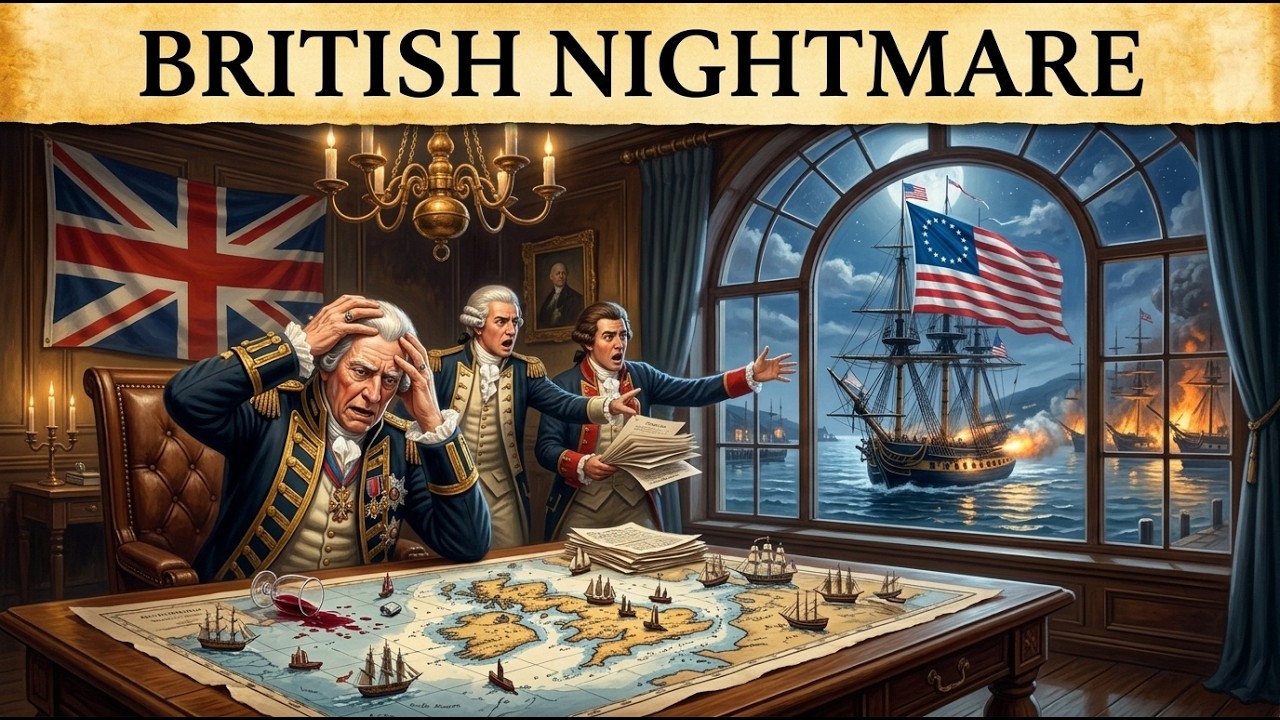
The smaller ship, an old converted merchantman flying the American flag, was already taking on water. Her gun deck was shattered. Half her crew lay dead or wounded. The British captain of the larger warship called across the smoke and chaos, demanding surrender.
The American captain, a stocky Scotsman with a sharp jaw and a fiercer temper, answered with a phrase that would become one of the most famous in military history. He told the British he had not yet begun to fight. That captain was John Paul Jones. The story of how he came to those waters, commanding a sinking ship against a force of the British Royal Navy, stands as one of the greatest struggles of the American Revolution.
It involves murder, false names, raids on sleeping English towns, an attempted kidnapping of a nobleman, and a sea battle so vicious that even the British admitted they had never seen anything like it. Kirkbean, Scotland, 1747. John Paul Jones was not born with that name. He was born simply John Paul, the son of a gardener on a wealthy Scottish estate.
Nothing in his childhood hinted that he would one day terrorize the British Empire. His father tended the grounds of Arbigland Estate near the Solway Firth, and young John grew up watching merchant ships and Royal Navy frigates sail to and from the Irish Sea. He was fascinated by the ocean from the start. At thirteen, through sheer competence, he secured an apprenticeship aboard a merchant ship in Whitehaven, a busy port town in northwest England.
He crossed the Atlantic for the first time as a teenager. During visits to his older brother William, who had settled in Fredericksburg, Virginia, he learned the shipping trade. He mastered navigation by the stars and soon proved his skill at commanding vessels. By his early twenties, John Paul was a ship’s captain in the West Indies trade, moving goods between the Caribbean and Britain.
He was capable and ambitious, but he had a reputation for being difficult. He ran his ships with an iron hand and tolerated no disobedience. In 1770, while his ship lay anchored at Tobago, he flogged a ship’s carpenter so severely that the man later died. An inquiry cleared him, but the incident followed him.
Three years later, something far worse happened. During a dispute over wages in Tobago, John Paul killed a mutinous crewman with a sword. This time he did not wait for a verdict. He fled the island, crossed to the American colonies, and disappeared.
When he reappeared, he had added a new surname. He was now John Paul Jones. No one is entirely sure where the name Jones came from. Some historians believe he borrowed it from a North Carolina family that sheltered him.
Others think he simply chose it because it was common enough to disappear behind. Either way, the man who arrived in Virginia in 1773 was a fugitive from a killing, rebuilding himself, looking for a second chance. He found it in the least likely place. Within two years, a full-scale revolution had broken out in the American colonies against Britain, and the new Continental Congress realized it faced a serious problem.
Britain controlled the seas. The Royal Navy was the largest, best-funded, most experienced naval force in the world, with hundreds of warships and tens of thousands of trained sailors. America, by comparison, had almost nothing. A few converted merchant ships, some armed gunboats, no naval tradition, no shipyards, no admirals.
John Paul Jones walked into this chaos and volunteered. He was commissioned as a first lieutenant in the Continental Navy in December 1775, and from the first day, he was not interested in defense. While other American commanders focused on protecting harbors and running from British frigates, Jones had a very different idea. He wanted to attack, not just British merchant ships in American waters.
He wanted to sail across the Atlantic and carry the war to the shores of Britain itself. The Continental Navy was barely a navy at all. When Jones joined, Congress had authorized converting a few merchant ships and buying a few more, but the officers commanding them were chosen mostly through political connections rather than competence. Jones, a foreigner with no ties to any Congressman, ranked eighteenth in seniority.
He was furious. He believed, rightly, that he had more sea experience than almost all the officers above him. He spent months writing angry letters to anyone in Congress who would listen, demanding a higher rank and a real command. His letters were blunt, almost rude, and that is exactly what turned influential men against him.
Jones never understood that being right and being diplomatic were two different skills. But when he finally got a ship, he made sure no one could argue with the results. He was given command of the sloop Providence in 1776 and set out on a hunting cruise. During a six-week voyage in the Atlantic, he captured sixteen British ships, escaped a Royal Navy frigate that chased him by sailing directly into shallow waters where the larger ship could not follow, and returned to port having done more damage to British commerce than any other American captain.
That year, he caught the attention of Congress. To anyone with a reasonable understanding of naval warfare at the time, his larger ambitions still looked like madness. Britain had not been invaded or raided by an enemy naval force since the Dutch sailed up the Medway in 1667, more than a century earlier. The idea of a single American ship crossing three thousand miles of open ocean and threatening the English coast was laughable.
The Royal Navy would certainly hunt it down before it got anywhere near land. Jones did not care. He was given the Ranger, a fast eighteen-gun warship built in Portsmouth, New Hampshire. In November 1777, he sailed her across the Atlantic to France.
The voyage itself was miserable. The crew was mutinous. The officers resented Jones’s demands for discipline, and the ship, despite her speed, was not well fitted for an Atlantic crossing. Still, Jones drove them across.
His mission was to make contact with American agents in Paris, resupply the ship, and begin attacking British shipping in European waters. France was secretly supporting the American cause at the time, and Jones found an enthusiastic ally in Benjamin Franklin, the American ambassador in Paris. Franklin was immediately impressed by Jones. He saw in this audacious Scotsman the boldness the revolution needed.
Jones was reckless, fearless, and completely unafraid of the British. Franklin would eventually give him something far more valuable than encouragement. But that was still a year away. First, Jones had the Ranger, and he had a plan.
In April 1778, he sailed from Brest, France, into the Irish Sea, heading straight for the English coast. His destination was Whitehaven, the same port town where he had first gone to sea as a boy of thirteen. He knew the harbor, the layout of the docks, the positions of the fort’s guns. On the night of April 22, he led two boats of armed sailors ashore in the darkness.
For a moment, he considered what this meant. An American warship had just landed an armed raiding party on English soil. That had not happened in over 110 years. The people of Whitehaven had no idea it was possible.
They had assumed the war was three thousand miles away. Jones and his men spiked the guns of the harbor fort so they could not be fired, then set fire to the ships lying at anchor. The raid itself caused only limited damage, with just one ship burning significantly before the locals woke up and organized a response. But the psychological effect was enormous.
Britain panicked. Newspapers across England ran stories about the American pirate who had attacked Whitehaven. Coastal towns from Scotland to Wales suddenly feared they would be next. The Royal Navy rushed ships to protect ports that had never needed protection before.
One man with one ship had made the entire British coast feel vulnerable. Jones was not finished. That same day as the Whitehaven raid, he crossed the Solway Firth to St. Mary’s Isle in Scotland, the home of the Earl of Selkirk.
Jones had a wild idea. He planned to kidnap the earl and use him as leverage to force Britain to treat American prisoners of war humanely instead of throwing them into prison ships to rot. When he arrived, the earl was not there. His crew, frustrated at missing their target, wanted to loot the estate.
Jones tried to preserve his honor, eventually allowing them to take the family silver, which he later bought back with his own money, and returned it to Lady Selkirk with a polite letter of apology. Looking back, it seemed either extreme chivalry or a very strange act for a man the British were calling a pirate. The next day, Jones encountered HMS Drake, a Royal Navy warship of twenty guns, off Belfast. The Drake came out to fight, and Jones gave it exactly what it was looking for.
After a sharp engagement lasting about an hour, the Drake surrendered. Jones sailed her back to France as a prize of war and arrived in Brest as a celebrity. The French loved him. He was handsome.
He was daring. He made the British look foolish. American newspapers celebrated him as a hero. The British put a price on his head.
For a while, things could not have looked better for John Paul Jones. He had proven the British coast was not invulnerable. He had captured an enemy warship in its own waters. He had made a name for himself on two continents.
But Jones wanted something greater. He wanted a real warship, a real squadron, a mission that would truly shake the British Empire. Benjamin Franklin delivered. In early 1779, the French government, now officially at war with Britain, gave Jones command of an old East India Company merchant ship called the Duc de Duras.
She was large but slow, carrying forty-two guns spread across several decks. Jones renamed her the Bonhomme Richard, in honor of Franklin’s famous publication Poor Richard’s Almanack. It was a gesture of thanks to the man who had championed his cause in Paris. The Bonhomme Richard was not a great warship.
She was old. Her timbers were rotten in places. Many of her heaviest guns, a set of ancient eighteen-pounders on her lower deck, were in dubious condition at best. Jones knew this.
He also knew she was the ship he had, and complaining would not win him a war. He assembled a crew that was, by any measure, one of the strangest collections of sailors ever put aboard a warship. The crew included Americans, Frenchmen, Irishmen, Portuguese, Norwegians, Malays, and men from dozens of other countries. Many were former prisoners of war who had volunteered to escape British jails.
Some of them barely spoke the same language. Jones drilled them relentlessly, turning this ragged international crew into something like a fighting force through sheer stubbornness. His squadron was not much better. He had the frigate Alliance, mostly crewed by Americans but commanded by a French captain named Pierre Landais, who was arrogant, possibly mentally unstable, and openly contemptuous of Jones.
He also had the French frigate Pallas, the cutter Cerf, and the armed merchant ship Vengeance. From the first day at sea, the other ships’ commanders ignored Jones’s signals, sailed wherever they pleased, and treated the fleet not as a coordinated force but as a collection of independent privateers that happened to be heading in the same direction. Jones was furious, but he pressed on. In August 1779, the squadron sailed on a cruise around the British Isles.
They went north along the west coast of Ireland, around the northern tip of Scotland, through fierce autumn gales, and into the North Sea. Along the way, they captured merchant ships, disrupted trade routes, and kept the Royal Navy guessing where they would strike next. Jones even tried to raid the port of Leith near Edinburgh, Scotland, intending to hold the city for ransom. But a sudden storm scattered his ships before the attack could begin, and the opportunity was lost.
The British coastal defenses were exhausted. Jones was everywhere and nowhere, and the patience of the Admiralty in London was wearing thin. On September 23, 1779, off the chalk cliffs of Flamborough Head in Yorkshire, Jones spotted a convoy. A fleet of more than forty British merchant ships was sailing south from the Baltic, loaded with timber, iron, and naval stores that the Royal Navy desperately needed.
Two warships guarded this convoy. The smaller was the Countess of Scarborough, a little twenty-gun ship. The larger was HMS Serapis, a brand-new fifty-gun frigate commanded by Captain Richard Pearson. The Serapis was the complete opposite of the Bonhomme Richard.
She had a copper-sheathed bottom, was newly built, carried eighteen-pounders on her lower deck and nine-pounders above, and had a crew of over three hundred trained Royal Navy sailors who had drilled together for months. By every measure, the Serapis was the superior ship. Captain Pearson knew the Americans were coming. Lookouts had spotted Jones’s squadron earlier that day, and Pearson had signaled the merchant convoy to make sure it stayed safe before he moved to intercept the threat.
Pearson was a capable, experienced officer, confident in himself. He had a better ship and a better crew, and he knew Royal Navy reinforcements were hours away. He had every reason to believe this would be an easy fight. Jones attacked anyway.
The battle began around seven in the evening, with the sun setting over the Yorkshire coast and a nearly full moon rising in the east. The two ships closed and opened fire. Almost immediately, the Bonhomme Richard ran into trouble. Two of the old eighteen-pounders on her lower deck burst on the first broadside, killing their crews and blowing holes in the hull from the inside.
Jones ordered the entire lower deck evacuated. He had lost his heaviest weapons before the battle had really begun. The Serapis rained broadside after broadside into the Bonhomme Richard. Cannonballs punched through her hull below the waterline.
Water poured in, and fire broke out all across her decks. The American ship was being systematically destroyed, and Captain Pearson knew it. At a moment during the slaughter, Pearson called out to Jones and asked the question that would decide the whole battle. Had the American struck his colors?
Had he surrendered? Jones shouted back, “I have not yet begun to fight. ”
Historians disagree on the exact wording. Some accounts say he phrased it differently, while others say the quote was polished later for the history books, but the intention is beyond dispute.
Jones had no intention of surrendering, even with his ship collapsing beneath him. What he did next was either genius or madness, and frankly, it may have been both. Jones ordered the Bonhomme Richard to close with the Serapis until the two ships literally touched. Amid the chaos of wind and current, the Serapis’s jibboom tangled in the Bonhomme Richard’s rigging.
Jones personally helped lash the two ships together with hooks and ropes. The ships were locked side by side, their gun ports almost interlocking. This changed everything. Over the long term, the Serapis had a huge advantage.
Her guns were better, her hull was stronger, her maneuverability was more effective. But when the ships were bound together at such close range, the battle became a brawl, and Jones was a ferocious brawler. For the next two and a half hours, the two crews fought at point-blank range. Cannon fired directly into the hull of the opposing ship from a few meters away.
Marines fired muskets at enemy decks. Sailors hurled grenades across the gap between them. The decks were slick with blood. Fires spread everywhere.
At one point, an American sailor crawling along the yardarm of the Bonhomme Richard dropped a grenade through an open hatch onto the Serapis. It fell into a pile of powder cartridges that the British had stacked near their guns. The explosion ripped through the Serapis’s lower gun deck, killing or maiming dozens of men in an instant. Meanwhile, the Bonhomme Richard was sinking, water pouring through holes below the waterline.
The ship’s carpenter ran to Jones and told him the ship was going down. One of Jones’s own officers, apparently accepting defeat, tried to strike the American flag in surrender. Jones reportedly knocked him down with a pistol and ordered the flag re-raised. The Alliance, the Franco-American frigate that was supposed to support Jones, spent most of the battle sailing around the edges.
Her captain, the possibly deranged Frenchman Pierre Landais, fired broadsides into both ships. Several shots hit the Bonhomme Richard instead of the Serapis. Jones was being shot at by his own ally while fighting the enemy and keeping his own ship from sinking. It is hard to imagine a worse tactical situation.
Yet somehow, it was Captain Pearson aboard the Serapis who broke first. The explosion below deck had been devastating. Her mainmast was damaged and about to collapse. American sharpshooters had cleared her upper deck, and still the Bonhomme Richard kept fighting.
After more than three hours of combat, Pearson personally struck the British flag and surrendered the Serapis. The cheers for the American ship likely did not last long. Jones hurriedly transferred his surviving crew and wounded to the captured Serapis because the Bonhomme Richard was finished. They tried to save her.
Pumps worked all night. Repair crews did their best, but on the morning of September 25, two days after the battle, the Bonhomme Richard finally slipped beneath the waves of the North Sea and sank. Jones watched her go down from the deck of the Serapis, which now flew the American flag. The Battle of Flamborough Head was a catastrophe by every physical measure.
Jones had lost his flagship. His crew had taken terrible casualties. His allied frigate had been completely useless. But in every other way that mattered, it was one of the most important naval victories of the American Revolution.
Jones had done what no one thought possible. He had sailed an old, decrepit warship into British territorial waters, fought a single-ship duel against a brand-new Royal Navy frigate, and won. He did it through sheer will, refusing to surrender when any sensible commander would have given up. And the battle had been fought within sight of the English coast, watched by hundreds of civilians who saw the fire and heard the guns from the cliffs above.
For Britain, it was humiliating. The Royal Navy, the pride of the empire, had been defeated in its own backyard by a converted merchantman. King George III honored Captain Pearson for his bravery during the battle, which prompted Jones to joke that if he ever met Pearson again, he would make him a lord. For America and France, Jones became an instant legend.
He sailed the captured Serapis to the Dutch port of Texel, and what followed was an international diplomatic mess. Britain demanded the Dutch hand over Jones and his prize, calling him a pirate. The Dutch, theoretically neutral, did not want to anger either side. Jones was stuck at Texel for weeks while diplomats argued over his fate.
Franklin worked behind the scenes to free Jones, and eventually the French arranged for him to slip away aboard another ship. When Jones finally reached Paris, the welcome was extraordinary. Benjamin Franklin called him the boldest man in the American cause. King Louis XVI personally presented him with a gold-hilted sword inscribed with praise for his courage and made him a Chevalier of the Order of Military Merit, the French equivalent of a knighthood.
Songs were written about him in both French and English, and his portrait was painted. He became one of the most famous men in Europe. The ladies of Paris were said to be charmed by him, and Jones, who had always enjoyed being the center of attention, did not mind at all. Upon his return to America, Congress thanked him and awarded him the only gold medal given to a Continental Navy officer during the entire Revolution.
He was given command of the America, a massive 74-gun ship of the line being built in Portsmouth, intended to be the most powerful warship in the American fleet. Then Congress gifted the ship to France. Jones was left standing on the docks with nothing. Fame is a strange currency, and for Jones, it bought him no lasting happiness.
After the war, the Continental Navy was disbanded. America had no need for a fleet in peacetime, and Jones found himself without a command, without a country to serve, without purpose. He drifted for years, writing letters, lobbying for a new navy, growing more bitter by the day. Then, in 1788, he accepted a commission from Empress Catherine the Great of Russia and traveled to St.
Petersburg to serve as a rear admiral in the Black Sea fleet during Russia’s war against the Ottoman Turks. The commission was a poor fit from the start. Russian naval politics were vicious, full of jealousy and betrayal among the foreign officers Catherine had hired. Jones, never skilled at diplomacy or patience, made enemies at every turn.
A rival admiral named Nassau-Siegen took credit for victories Jones had won. Russian courtiers spread rumors about him. He was recalled from service under false accusations and left Russia angry and embittered, stripped of a command he had earned and denied the recognition he deserved. He returned to Paris, the city that had celebrated him a decade earlier.
But Paris in 1790 was very different. The French Revolution was tearing the country apart, and no one had time for an aging American naval hero. Jones spent his last years in a small apartment on the Rue de Tournon, increasingly isolated, his health failing. He was only forty-five years old.
On July 18, 1792, John Paul Jones was found dead in his apartment, lying face down on his bed. The cause was most likely kidney disease, possibly worsened by pneumonia. His body was preserved in alcohol and placed in a lead coffin, then buried in a small cemetery in Paris that was later built over and forgotten. For more than a century, no one knew exactly where his remains lay.
The small Protestant cemetery in Paris where he was buried was sold and developed. Buildings were constructed over the graves. The man who had once been America’s most famous naval officer was literally lost beneath the streets of a foreign city. The coffin was not found until 1905, thanks to painstaking research led by the American ambassador to France, Horace Porter.
Porter spent six years and a considerable amount of his own money on the project, digging tunnels under buildings and searching old burial records. He finally located the lead coffin beneath what was then a laundry on one side and a grocery store on the other. When it was opened, the body was remarkably well preserved, kept intact by the alcohol for over a century. An autopsy confirmed the identity of John Paul Jones by comparing the body to a bust sculpted during Jones’s lifetime.
President Theodore Roosevelt sent a squadron of American warships to France to escort the coffin home. Jones was given a grand funeral procession across the Atlantic to the United States Naval Academy at Annapolis, Maryland, where he lies today in an ornate marble and bronze sarcophagus beneath the Academy chapel. The irony is almost perfect. The man who spent his life fighting for recognition, who begged for ships, who struggled against envy and bureaucracy and bad luck at every turn, finally received the honor he craved, but only 113 years after his death.
What endures in the memory of John Paul Jones is not just his famous quote or his single great battle, but what he represented at a moment when America was a fragile experiment with no army to speak of and no navy at all. He took the fight to the enemy’s doorstep. He proved that audacity could make up for a lack of resources. He showed the British and the rest of the world that American independence was not just an idea debated in Philadelphia, but a reality being enforced with cannon fire on their own shores.
The United States Navy considers him its founder, its spiritual father, the man who established the tradition that American warships do not surrender. His tomb at Annapolis is one of the most visited sites at the Academy, and naval students still study his tactics, his leadership, and his stubborn refusal to give up more than 240 years after the Bonhomme Richard went down. One man, one decrepit ship, and enough courage to confound the greatest navy in the world.
