In the autumn of 1991, a young nurse named Darlene Pruitt vanished from Kernersville, North Carolina, leaving behind a half-eaten plate of Sunday dinner, a porch light still burning, and a 4-year-old daughter who would spend the next three decades asking questions no one in that county would answer. Authorities initially treated it as a domestic matter that had resolved itself, and within 18 months the case was quietly filed away. But Darlene’s mother, Ruth Coggins, never accepted that. In the winter of 1992, she stood in the parking lot of the Forsyth County Sheriff’s Office and told a deputy she knew exactly what had happened to her daughter, and who had done it.
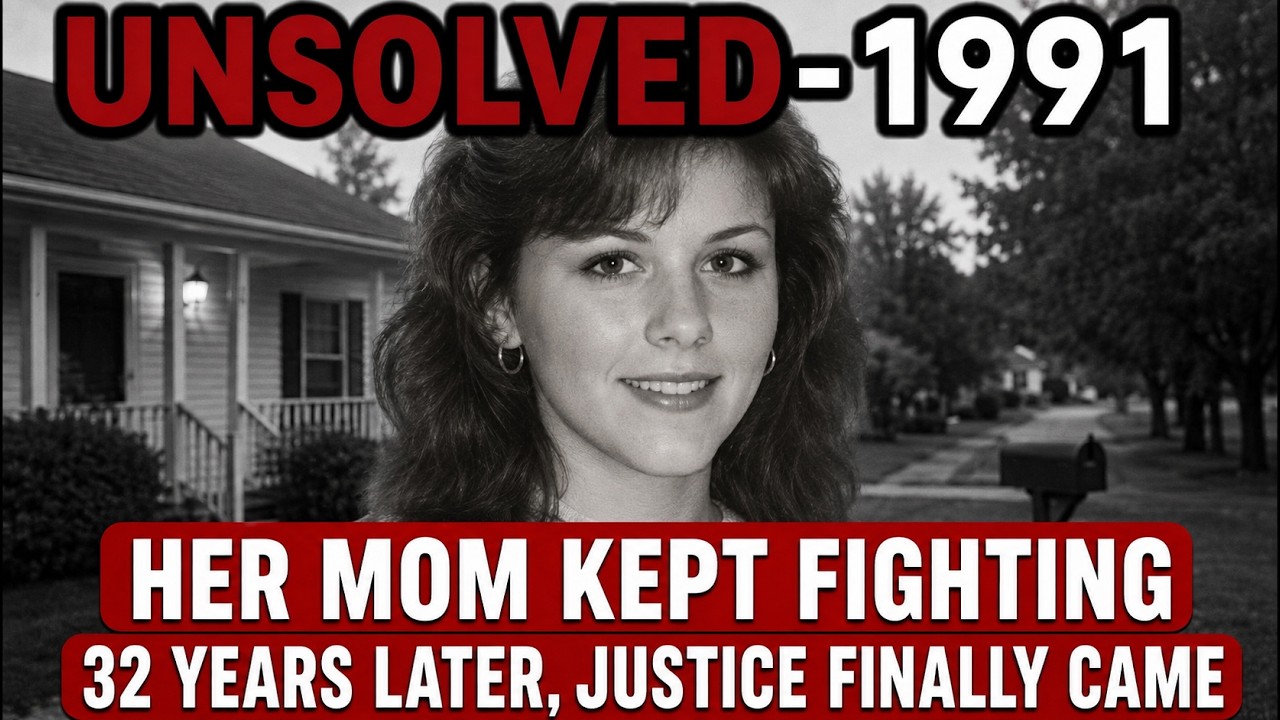
They thanked her and showed her out. Ruth spent the next 31 years writing letters, attending county meetings, and taping missing person flyers to the corkboards of every diner and laundromat between Kernersville and High Point. She refused every suggestion to let go, refused to sell Darlene’s things, and kept a box of her daughter’s belongings sealed in a closet with a handwritten label: “For when we find her. ” In the spring of 2023, Ruth died at 81 without ever getting her answer.
But what investigators found inside her home after her death cracked the case wide open. Darlene Pruitt had grown up in Kernersville, a town of about 15,000 people at the edge of North Carolina’s Piedmont Triad. She was 27 years old, worked as a licensed practical nurse four days a week, and sang in the second soprano section at Mount Calvary Baptist. She drove a 1988 Ford Escort, kept a vegetable garden well into October, and was known by everyone who knew her best as the one who remembered things: birthdays, the grieving, the elderly woman three houses down who took her coffee with exactly one and a half sugars.
Her daughter Cassie was 4 that fall. On the morning of Sunday, October 19th, 1991, Cassie’s last clear memory of her mother was the two of them eating scrambled eggs in the kitchen while Darlene promised that if Cassie finished her breakfast, they could walk down to see if the neighbor’s cat had finally had her kittens. Cassie finished her breakfast. By the time they reached the corner, the day had shifted entirely.
The call came into the Forsyth County Sheriff’s Office that evening at 6:14. The man on the line was Gary Pruitt, Darlene’s estranged husband. He reported stopping by the house to pick up Cassie’s clothing and finding the back door open. Darlene’s purse was on the kitchen counter, her keys on the hook beside the door, her plate barely touched.
Cassie had been alone in the house, watching television, for an estimated four to six hours. Deputies arrived at 6:40. They documented the scene and interviewed Gary, who was cooperative, visibly distressed, and said his separation from Darlene had been amicable. By the following morning, the working theory was that Darlene had left voluntarily.
She had left her purse. She had left her car. She had left her daughter. Ruth Coggins never believed it for a single day.
She came to the sheriff’s office the following Tuesday with a handwritten list of concerns. Her daughter had no reason to leave. In the weeks before her disappearance, Darlene had been frightened, lowering her voice on the phone as if unsure she was alone. Ruth described a bruise on Darlene’s forearm she had noticed at a church function, which Darlene dismissed as a door frame accident.
And she described Gary Pruitt, not as a monster, but as a man with a temper that appeared and disappeared without warning, who had never quite accepted that Darlene had asked him to move out in September. The deputy took Ruth’s statement and noted her concerns in the file. That was where it stayed. The original investigation did document one thing without understanding its significance.
A neighbor across the street, Paulette Bowen, told investigators she had seen Gary Pruitt’s truck in front of the house at approximately 1:30 that afternoon. He had not mentioned that visit when he called at 6:14. It was noted in a supplemental report. It was never followed up.
The lead investigator, Detective Harold Stout, built what he could from what he had. Gary’s alibi for the early afternoon was thin: he claimed he had been at a friend’s house in High Point, and the friend confirmed it, though the timeline had inconsistencies Stout could not resolve. There was no physical evidence, no body, and a cooperative husband with a partial alibi and an air of genuine devastation. The case reached a wall.
Stout pushed on it for three years, never formally clearing Gary but never able to charge him. By 1994, the case went into a cold case file. Stout retired in 2001, keeping in his garage a photocopy of the original file, including Mrs. Bowen’s statement about the 1:30 truck.
Gary Pruitt remarried in 1995, moved to Guilford County, and raised a second family. He became a drywall contractor, a deacon at a small Baptist church, and a grandfather by 2009. In Kernersville, Darlene’s photograph faded in the diner window until Ruth brought a new printout and taped it up herself. Cassie grew up, earned a nursing degree in 2008, following her mother into medicine, and never stopped asking questions.
She paid out of her own pocket for genealogy database subscriptions and wrote emails to anyone who would reply. The reward poster in the diner window still said $5,000. It had said $5,000 since 1992. Nobody ever called.
The case had been cold for nearly 30 years when Ruth developed congestive heart failure in 2020. She was not expected to see another winter, but she was stubborn in the way only people who have been waiting a very long time can be. She made it through that winter and the next two. In the spring of 2023, at 81, she finally let go.
She left behind a small house, a lifetime of correspondence, and Cassie, who flew in from Greensboro to settle the estate. It was Cassie who found the letters. They were in a shoebox in Ruth’s bedroom closet, stacked in rubber-banded bundles, each labeled with a year. Not letters Ruth had sent.
Letters she had received between 2009 and 2021 from a woman named Marlene Hobbs. Gary Pruitt’s sister. Cassie read the first letter standing in her grandmother’s closet, then sat down on the floor and read the rest. Marlene Hobbs had known with certainty since 1991.
In careful ballpoint pen on lined notebook paper, she described what her brother had told her on the night of October 19th. She described the phone call, what he had said, and her own terror, shame, and the decision she had made: not to go to the police. He was her brother. She told herself she wasn’t certain.
She told herself the letters to Ruth were a form of penance. She carried that guilt to her own grave in 2021, two years before Ruth died. But she had left Ruth with everything: dates, details, and the name of the location where Gary had said he took Darlene that afternoon, a stretch of woods off Shack Town Road in Davidson County where he had hunted as a teenager. Cassie called the Forsyth County Sheriff’s Office at 7:22 that evening.
She was 36 years old. She had been waiting her entire life. The detective who took the call was Sandra Tull, a cold case investigator assigned to the county’s reinstated cold case unit in 2018 as part of a statewide forensic genealogy initiative. She had read the Pruitt file twice and had flagged in her own notes Mrs.
Bowen’s 1991 statement about the 1:30 truck. She listened to Cassie for 34 minutes without interrupting. The following morning, Tull contacted the Davidson County Sheriff’s Office. Within 72 hours, a team with ground-penetrating radar began scanning wooded acreage off Shack Town Road.
On the fourth day, around 11:40 in the morning, they found her. Darlene Pruitt had been buried less than a quarter mile from a hunting trail, the ground so settled and overgrown after 32 years that nothing marked the place except the truth preserved in a letter written to a mother who kept a box labeled for a day she never lived to see. Gary Pruitt was 71 and living in a subdivision outside of Burlington when Sandra Tull knocked on his door on a Wednesday morning in August 2023. He answered in a bathrobe, holding a cup of coffee.
He had been a deacon for 18 years, had 12 grandchildren, a woodworking shop, and a vegetable garden in his backyard. His neighbors described him as quiet, helpful, the kind of man who shoveled your driveway before you asked. Tull presented him with a warrant. He said nothing.
He set down his coffee cup very carefully and sat down in a chair in his own foyer and looked at the floor. He did not speak again without an attorney present. Gary Pruitt was charged with first-degree murder in October 2023. Forensic evidence recovered from the burial site, including trace material consistent with Darlene’s known physical profile and items identified by Cassie, supported the indictment.
Marlene Hobbs’s letters, authenticated through handwriting analysis and cross-referenced with postmark dates, were entered as evidence. Cassie sat in the second row of the courtroom for the arraignment, wearing her mother’s locket, a small gold oval found with the remains, still clasped. In February 2025, Gary Pruitt accepted a plea agreement. He was sentenced to life in prison without the possibility of parole.
He was 72. He read a statement lasting 90 seconds and used the word regret four times without once looking at the family section of the courtroom. The community in Kernersville gathered at Mount Calvary Baptist the week after sentencing and held a candlelight service. People who had known Darlene as a child sat next to people who had only ever seen her face on a missing person flyer.
Her daughter stood at the front of the sanctuary and spoke for 12 minutes about a woman who sang in the second soprano section, checked her door lock twice every night, and believed you could winter over the kale if you paid enough attention. Darlene Pruitt was 27 years old. She had a whole life taken from her on a Sunday afternoon in autumn, and for 32 years the man responsible drove to work, coached Little League, shoveled neighbors’ driveways, and sat in a pew every Sunday morning, telling himself the secret was buried. It was.
But Ruth Coggins never believed buried meant gone. Justice came because a woman who was dying still believed truth needed a witness, because her daughter read every letter and understood what they meant, because a cold case detective had written four words in her notes years earlier and kept that file open in her mind even after the department had closed it, and because Marlene Hobbs, who carried her guilt for 32 years and never found the courage to go to the police herself, chose to leave a record anyway. It was not the courage it should have been.
But it was, in the end, enough.
