The surveyor’s shovel struck something solid just under two feet of packed dirt. Elijah Moore, a county surveyor mapping a proposed extension of Route 52 through McDowell County, West Virginia, had noticed the disturbed patch of floor in the ruined cabin almost by accident—a section of earth near the eastern corner that looked as if it had been dug up and then filled back in, the soil discolored and looser than the ground around it. He had come back to the site on May 20, 1957, three days after first stumbling on the collapsed structure in a grove of old oak trees in Blackwood Hollow, to finish his measurements. Now, with a small folding shovel from his kit, he was digging into the floor of a single-room shack that no one had touched in nearly half a century.
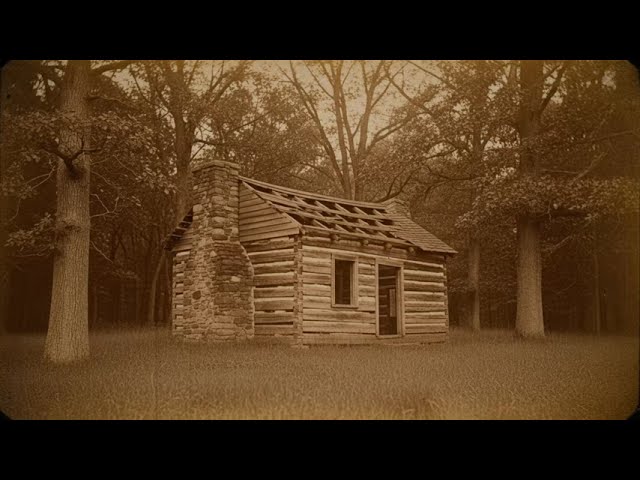
What he uncovered was a metal box about the size of a bread tin, corroded by decades in the soil, closed with a simple metal clasp. Inside lay a leather-bound notebook with yellowed, brittle pages, a pocket watch stopped at 3:47 with a cracked face, three tarnished silver coins dated 1897, a small faded key that would later prove to open none of the building’s locks, and a folded paper bearing what appeared to be a hand-drawn map of the surrounding area, marked with several small X’s. The box was later identified as a standard ammunition case from the early twentieth century. Moore reported the discovery to the local authorities, and the items were handed over to Sheriff William Hatfield.
When the sheriff examined the notebook, he found a name written on the first page: Thomas Harkins. The entries were dated from March 1907 to August 1908, and the final entry, dated August 17, 1908, would become the focus of everything that followed. The first recorded mention of what would later be called the Harkins cabin appeared in the land records of McDowell County in April 1907. The records indicated that Harkins, a coal miner who had saved enough from five years of dangerous work in the Welsh mines to buy a modest property, intended to build a small dwelling about four miles northeast of the mining town of Bradshaw, in a densely forested area the locals called Blackwood Hollow.
He lived alone on his remote holding for approximately sixteen months before apparently abandoning it without warning in late summer 1908. There was no official record of his departure. More strangely, no subsequent record of Thomas Harkins appeared in any register, census, or municipal document in McDowell County or the surrounding areas after August 1908. For decades, the small wooden structure Harkins built with his own hands sat abandoned, gradually reclaimed by the dense Appalachian forest.
Property taxes went unpaid, but due to an administrative error—not uncommon in the poorly organized county systems of early twentieth-century Appalachia—the land was never officially seized. It simply faded from the official records, becoming just another anonymous patch of woodland in the vast, undeveloped mountain terrain. The sheriff ordered a full excavation of the cabin site and the surrounding area. No human remains were found.
But the search uncovered several other buried metal boxes similar to the one Moore had found. These contained an assortment of items: more coins, all dated before 1908; a pocket knife with the initials TH carved into its wooden handle; a small glass bottle containing what was later identified as a common herbal sleeping tincture of the era; and, most suspiciously, pieces of what appeared to be a larger map drawn in the same hand as the one in Moore’s original discovery. The investigation also attempted to track Thomas Harkins through official channels. Investigators found his original land purchase record and several entries in the employment rolls of the Welsh mining company from 1902 to 1907.
There was also a single mention of Harkins in the Welsh Daily News in June 1905, noting that he had been briefly trapped during a minor cave collapse but survived without serious injury. After August 1908, there was nothing. No death certificate, no record of property transfer, no mention in any census or tax register. Interviews with elderly residents of the area yielded little additional information.
Most had no memory of Thomas Harkins specifically, though many recalled stories about a hermit who lived in the woods near Blackwood Hollow in the early twentieth century. One woman, who had been a small child during that period, recalled her grandfather speaking of a miner who went to live in the woods and was taken by the woods. When pressed to explain, she said this was simply how people in the region described those who ventured too far into the wilderness and never returned. Perhaps the most curious thread came from attempts to locate Old Henry, the only friend mentioned in Harkins’s diary.
County records identified Henry Blackburn, another former coal miner, who owned a small property about four miles from Harkins’s cabin. Like Harkins, Blackburn appeared to have vanished, though in his case there was at least an official notification. A death certificate for Henry Blackburn was filed in October 1908, with the cause listed as an accidental incident in the wilderness. No body was ever found; the certificate was issued based on a report from a hunting party that found Blackburn’s cabin abandoned, with signs of a struggle and a large amount of blood on the floor and walls.
The timing of Blackburn’s disappearance, so close to Harkins’s own, struck investigators as significant and suspicious. But without bodies, witnesses, or any clear evidence of a crime beyond the disturbing contents of Harkins’s diary, the investigation eventually stalled. In 1958, the case was officially classified as unsolved due to lack of evidence and filed away in the archives. The diary itself told a more detailed story.
The first entry, dated March 10, 1907, was filled with optimism: “I have finally obtained my own plot of land, far from the mines and the constant fear of being buried alive. The land is good, covered with trees, with a small stream running through the eastern part. I will begin building my home tomorrow. It will be modest, but it will be mine alone.
”
Subsequent entries detailed Harkins’s construction of his simple dwelling, his exploration of the surrounding wilderness, and his initial attempts at self-sufficiency. He wrote about hunting, fishing in the nearby stream, and gathering wild plants for food. There was a sense of pride and accomplishment in these early entries—the satisfaction of a man who had escaped the drudgery of the dangerous coal mines for a life of independence in the mountains. By June 1907, Harkins had completed his cabin and established a small garden patch.
His entries during this period reveal a man who valued solitude but was not entirely cut off from human contact. He mentioned occasional trips to Bradshaw for supplies, brief interactions with other residents, and a particular friendship with a man known only as Old Henry, apparently another former coal miner who lived in similar relative isolation a few miles away. The first hint of unease appeared in the entry of July 23, 1907. Harkins described hearing unusual sounds in the woods surrounding his property at night.
Initially, he attributed them to natural wildlife—bears, wildcats, or perhaps the wolves that still roamed the remote parts of Appalachia in that era. But there was a noticeable shift in his tone, a new tension in his descriptions of the nocturnal wilderness. The entry of August 5, 1907, marked a more significant change: “The sounds returned last night, closer to the cabin than before. I am not sure now.
They are not animal sounds. There is deliberation in them, a pattern no ordinary beast could create. There is someone moving through the woods around my property after dark. I cannot say for what purpose.
”
Throughout August and into September, Harkins’s diary became increasingly preoccupied with these nocturnal disturbances. He began suffering from lack of sleep, noting that he often stayed up all night with his gun across his lap. He described footprints found near his garden, broken branches in patterns he believed were deliberate, and small objects in his cabin being moved when he returned from hunting trips. The solitude that had once brought Harkins so much satisfaction now seemed to be feeding a growing paranoia.
By October 1907, his handwriting had changed, becoming more rushed and less orderly. The content of his entries also shifted, focusing less on his daily activities and more on elaborate theories about who might be watching him and why. On October 17, he wrote: “I am being watched. Of this, I am now certain.
The question that consumes me is by whom and for what purpose? I do not have much of value here. My gun, my tools, my small stock of preserved food—nothing that would tempt a thief to such constant surveillance. No, this is something else entirely.
There is malice in this watching. I feel it with the same certainty with which I feel the coming winter in my bones. ”
The winter of 1907–1908 was particularly harsh in the Appalachian region, with heavy snowfall and bitter cold. Harkins’s entries during this period were sporadic, often separated by weeks of silence.
When he did write, he noted that the mysterious nighttime activities had ceased, which he attributed to the difficulty of moving through the snow-covered forest. There was a brief return to his earlier, more practical concerns: maintaining his fire, rationing his dwindling food supplies, and enduring the isolation imposed by the winter weather. By March 1908, with the snow beginning to melt and the forest slowly waking, Harkins’s mood seemed to improve. His entries again detailed his interactions with the natural world, his plans to expand his garden, and his renewed determination to be fully self-sufficient in the coming year.
There was no mention of his invisible watchers or the disturbing incidents of the previous autumn. This period of relative calm extended through April and into early May. Harkins wrote about successful hunting trips, the first plantings in his garden, and even a visit to Old Henry, who had survived the winter in his isolated cabin. But on May 23, 1908, the tone of the diary changed dramatically again.
“I found it today,” Harkins wrote, “while clearing a new section for my garden. My shovel struck something hard beneath the soil, not a stone or a root as I first thought, but something man-made. A box similar to those used in the mines to store blasting caps, but older. Its metal is so corroded as to be barely recognizable.
Inside, a piece of cloth folded carefully, perhaps part of a garment. What troubles me is that it was deliberately buried on my land, and not long ago. The soil above it was loose, easy to dig. Someone has been on my land, digging, hiding things.
The surveillance has returned, but now with a new and incomprehensible purpose. ”
The entries following this discovery reveal a rapid deterioration in Harkins’s mental state. He began sleeping outside in different locations each night, convinced his cabin was being entered while he was away. He devised elaborate systems of marks—threads stretched across doorways, patterns of small stones on window ledges—to detect intruders.
He reported almost daily finding evidence that these primitive alarms had been triggered. By June 1908, Harkins began venturing deeper into the surrounding forest, convinced that the source of his torment must have a base of operations somewhere nearby. He drew crude maps in his diary, marking the areas he had searched and planning future expeditions. It was clear from his writing that he was sleeping very little, his paranoia feeding on itself in a vicious cycle of fear and exhaustion.
On June 17, Harkins made another discovery that further deteriorated his mental state. About a mile northwest of his cabin, in a small clearing surrounded by dense pine trees, he found what he described as a circle of stones arranged with clear purpose. Inside the circle were the charred remains of a fire and, more troubling to Harkins, the bones of small animals arranged in what he saw as a pattern. “This is not a hunter’s camp,” he wrote.
“This is something else. The bones were not discarded but placed deliberately. The circle of stones is too perfect, too precise. This is ritual.
This is deliberate purpose, directed at me. I am now completely convinced of this. ”
After this discovery, Harkins’s diary entries became increasingly erratic. Some were no more than disjointed fragments.
Others contained long, rambling passages spanning multiple pages. He described hearing voices at night, distant at first but gradually drawing closer to his cabin. He began interpreting natural phenomena—the flight patterns of birds, the way shadows fell across his garden, the rhythm of raindrops on his roof—as coded messages directed specifically at him. By July 1908, Harkins had largely abandoned his routines of hunting and tending his garden.
His entries indicate he was living on stored food and whatever he could gather in the immediate vicinity of his cabin, unwilling to venture far from his refuge for fear of what might await him in the deeper woods. He described barricading himself behind his door at night, sitting with his back against the wall, his gun in his hand, staring at the entrance until dawn. On July 23, Harkins recorded a decision: “I can no longer remain passive in this torment. If they will not show themselves, then I must force a confrontation.
Tomorrow I will go to the stone circle and wait. I will be the watcher now. I will learn who is stalking my solitude. ”
Then came a gap in the diary—ten days in which Harkins wrote nothing.
When the writing resumed on August 3, his handwriting was barely recognizable as that of the same man. The text ran across the page, sometimes vertically, sometimes at an angle. The pressure of the pen varied wildly, tearing the paper in places. “I have seen them,” the entry began.
“Not clearly, never clearly, always at the edges, moving between the trees, hiding behind rocks. They resemble humans in form, but their movements are wrong, too fluid in moments, too jerky in others, as if they have not fully mastered the mechanics of their bodies. I chased one yesterday, followed it for what seemed like miles through the deepest parts of the forest until I realized I was being lured. I stopped then and turned back, finding my way home by following the sun.
They want me to follow them. They want me to go deeper. But deeper into what? This is no longer about my land or my solitude.
This is about something older, something that was here before me, before the mines, before Bradshaw or McDowell County or even West Virginia itself. I have intruded upon something ancient, and it wants me to understand. ”
The next entry, dated August 7, was brief: “The voices are clearer now, still distant, but distinct. They call my name at night.
They know me. ”
August 10: “I found another box today, similar to the first, but newer. The metal is still shiny in parts. This one was at my doorstep when I woke.
Inside was a paper with markings I first took for writing, but I now realize it is a map. It shows this area, the ridgelines and streams matching what I know of the terrain, and it shows a place marked with a symbol I do not recognize, miles toward the north. They are directing me, guiding me, but to what end? ”
August 12: “I have decided that I will follow their map.
I will face whatever awaits me at the marked location, not out of courage, but from the knowledge that I will have no peace until I do. If I am not meant to return, I leave this diary as a witness to my experience. Let someone find it. Let them know that Thomas Harkins did not simply vanish or abandon his home.
He was summoned away. ”
The final entry in the diary was dated August 17, 1908, and read simply: “I will leave at dawn. ”
No further entries appeared. According to all available records, Thomas Harkins was never seen or heard from again.
In 1962, a geologist named Dr. Martin Groves, conducting a survey for the West Virginia Department of Natural Resources, was working in an area about three miles north of the former Harkins property—roughly matching the location marked on the map fragment found in one of the buried boxes. There, Groves discovered what he described in his official report as an unusual geological formation not appearing on any existing survey. The formation consisted of a series of narrow vertical fissures in a limestone outcrop, creating a maze-like network of cracks ranging from a few inches to several feet in width.
Many of these fissures extended deep into the ground, their depths beyond the range of Groves’s equipment. What drew particular attention was Groves’s observation that the fissures seemed to form a pattern when viewed from certain angles, a pattern that appeared too regular to be entirely natural. Most geologists who reviewed Groves’s findings attributed this apparent regularity to pareidolia—the human tendency to perceive meaningful patterns in random stimuli. However, Groves remained convinced something was unusual about the site.
In a personal letter to a colleague, discovered among his papers after his death in 1969, Groves wrote: “There is design here, not just geological coincidence. And there is something else, a feeling that permeates the site. I am not one given to fanciful imaginings, as you well know. Yet I cannot shake the feeling that I was being watched the entire time I was at the fissures.
Science has no instruments to measure such subjective impressions, of course, but I would wager that anyone standing alone at that site would experience the same unsettling feeling of being observed. ”
Groves’s discovery sparked renewed interest in the Harkins case among a small circle of local historians and amateur investigators. Several expeditions to the fissure site were organized in the mid-1960s, but none yielded any tangible connection to Thomas Harkins’s disappearance. The site was difficult to reach, requiring a strenuous hike through dense forest, and by 1966 nature had reclaimed Groves’s trail, making the location nearly impossible to find without his original survey coordinates, which were unfortunately not preserved in his official report.
In 1967, the McDowell County Historical Society attempted to revive interest in the case with a small booklet titled “The Blackwood Hollow Mystery,” which included excerpts from Harkins’s diary and summaries of the various investigations. The publication received little attention outside the immediate area and soon went out of print. A copy was preserved in the society’s archives, where the story of Thomas Harkins was eventually encountered by a researcher studying folklore and mysterious disappearances in the Appalachian region. The researcher later traveled to McDowell County in 1968 to conduct a personal investigation.
Much had changed in the decade since the events described. The proposed Route 52 extension that had led to Moore’s initial discovery of the cabin had long since been completed, cutting through a different section of Blackwood Hollow than originally planned. The area where Harkins’s cabin had stood was now private property, part of a larger tract purchased by a timber company in the early 1960s. With permission from the company, the researcher was able to visit the site, though little remained to indicate anyone had ever lived there.
The forest had reclaimed the clearing, and no trace of the structure was visible among the trees that had grown where Harkins built his isolated dwelling. The researcher also attempted to locate Dr. Groves’s fissures using the vague descriptions in his reports and the memories of a retired forest ranger who had accompanied one of the expeditions in the 1960s. After two days of arduous hiking, they reached what the ranger believed was the approximate location.
The area was dominated by a limestone outcrop matching Groves’s description, but they found no trace of the fissures he had documented. The ranger speculated they might have been closed off by natural processes over the years, or that they had simply failed to identify the exact location. The researcher’s final effort involved tracing individuals connected to the case. Sheriff Hatfield had died in 1962, and Elijah Moore in 1964.
None of the deputies involved in the 1957 investigation still lived in the area. The elderly residents interviewed had only vague memories of the case, mostly based on the historical society booklet rather than direct knowledge. The researcher was about to conclude the investigation when a chance encounter led to the most disturbing discovery of all. In a local restaurant in Welch, two elderly men were overheard discussing the old Blackwood case.
After being introduced as a researcher interested in the region’s history, the researcher was invited to join the conversation. One of the men, who identified himself as Robert Collins, claimed his father had been part of the hunting party that discovered Henry Blackburn’s abandoned cabin in 1908. According to Collins, his father had told him details about the discovery that were never included in the official report. The hunting party had indeed found signs of struggle and blood in Blackburn’s cabin, but they had also found something else—markings on the walls described as symbols unlike anything they had ever seen.
Collins’s father also mentioned that the cabin door had been barricaded from the inside with stacked furniture, as if Blackburn had been trying to keep something out. Most significantly, Collins claimed the hunting party had followed a trail of disturbed underbrush and intermittent blood drops leading away from the cabin. The trail led north for about a mile before ending at what Collins’s father described as a crack in the earth, like a gateway into the ground. The men did not explore further; they were frightened by what they had found and were eager to report to the authorities.
Collins could provide no documentation to support his father’s account, and with sixty years having passed since the events described, there was no way to verify the details. However, the alignment of his story with the established facts of the case—and, more disturbingly, with the location of Groves’s fissures—suggested at least the possibility that Thomas Harkins and Henry Blackburn had met similar fates, drawn to the same mysterious location in the northern wilderness. The researcher’s investigation ended without definitive answers. The case remains one of the many unsolved disappearances in the vast Appalachian wilderness, a region whose dense forests and rugged terrain have swallowed countless individuals throughout its history.
What distinguishes Harkins’s story is the documentation he left behind—a real-time record of his descent into paranoia, or perhaps of a genuine encounter with something inexplicable in the remote valleys of West Virginia. The researcher also uncovered several additional details that, while perhaps not directly relevant to solving the mystery of his disappearance, provided a clearer picture of the man and the circumstances surrounding his brief time in Blackwood Hollow. In the county clerk’s office in Welch, buried among early twentieth-century property tax records, the researcher found the receipt for Harkins’s purchase of the land. The document revealed he paid $87 for his plot, a substantial sum for a coal miner of that era, suggesting he had been planning his escape from the mines for some time, systematically saving his earnings.
More interestingly, the seller was the Blackwood Timber Company, a small logging operation that had acquired vast tracts of land in McDowell County in the 1890s but had gone bankrupt by 1906. The company’s remaining assets, including large land holdings, were liquidated in a series of sales to individuals and larger corporations. According to contemporary newspaper reports, the Blackwood Timber Company’s bankruptcy followed a series of accidents and labor disputes in its operations. The most notable of these occurred in 1899, when three lumbermen disappeared while working in a remote part of the company’s property, about five miles north of what would later become Harkins’s holding.
The official explanation was that the men had left their jobs, but local rumors suggested they had come to harm, perhaps at the hands of labor agitators or rival timber workers. No bodies were ever found, and no formal investigation went beyond a superficial search of the immediate area where they were last seen. Census and church records revealed that Thomas Harkins was not a native West Virginian. Born in 1878 in a small coal-mining community near Scranton, Pennsylvania, he moved to the Welch area around 1902, presumably seeking work in the expanding mining operations there.
Before his arrival in McDowell County, Harkins had no known history of mental illness or unusual behavior. The few official documents that mention him—employment records, a voter registration card from 1904, a receipt for the purchase of a hunting rifle—paint the picture of an ordinary, hardworking man, indistinguishable from the hundreds of others who came to the coal fields seeking work. This background makes his psychological deterioration, as documented in his diary, all the more striking. There is no indication that Harkins had any preexisting predisposition to paranoia or delusional thinking.
He appears to have been a practical, level-headed individual who saved his money, planned his future carefully, and successfully executed his plan to escape the dangerous work of the mines. Something in his experience in Blackwood Hollow transformed him from that stable, forward-thinking person into the disturbed figure revealed by his later diary entries. Weather records from the region during 1907 and 1908 provided another intriguing discovery. The winter of 1907–1908, which Harkins described as particularly harsh, was indeed unusually cold.
Total snowfall was among the highest recorded in the region, with temperatures remaining below freezing for weeks at a time. This extreme weather made Harkins’s isolated cabin even more disconnected from human contact, potentially exacerbating any psychological stress he was experiencing. More striking was an unusual atmospheric phenomenon recorded in August 1908, the same month Harkins disappeared. On the night of August 14, three days before the final diary entry, weather stations in southern West Virginia reported an unusual aerial event described as aurora-like illumination, pulsing lights in the northern sky, and a crimson glow that seemed to emanate from the earth rather than the sky.
The phenomenon lasted approximately twenty minutes and was visible across a wide area, though it appeared most intense near what is now known as the border between McDowell and Wyoming counties—the region containing Blackwood Hollow. Scientists of the time attributed the event to an unusual type of lightning storm or a meteor disintegrating in the atmosphere. Modern meteorologists who reviewed the historical accounts suggested it may have been a rare form of ball lightning or an electromagnetic phenomenon related to the region’s geological composition. What is certain is that this unusual event occurred just days before Harkins set out to follow his mysterious map, and it was centered around the region he was heading toward according to the coordinates later assembled from the fragments found in the buried boxes.
Whether any connection existed between this atmospheric event and Harkins’s fate remains pure speculation. The diary makes no mention of unusual lights or celestial phenomena in its final entries. However, it is worth noting that the phenomenon would have been visible from his property, and had he witnessed it, it may have reinforced his belief that something extraordinary was happening in the northern wilderness. The researcher also sought information about any similar disappearances or unusual events in the region over the years.
While missing-person cases are not rare in the rugged Appalachian wilderness, where hikers and hunters sometimes become lost and are never found, several cases bore striking similarities to the Harkins incident. In 1923, a forest ranger named James Tillman disappeared while conducting a survey about seven miles northeast of Blackwood Hollow. His equipment was found carefully arranged beside a small campfire, as if he had stepped away for a moment intending to return. A search party tracked his footprints for some distance before they vanished at the edge of a limestone outcrop similar to the one where Dr.
Groves later discovered his strange fissures. No trace of Tillman was ever found. In 1941, two amateur archaeologists failed to return from an expedition investigating reports of Native American artifacts in the region. Their car was found parked at the trailhead of a path leading into what was locally known as Blackwood Hollow.
The search discovered their camp with tents still standing and supplies intact about three miles into the wilderness. There was no sign of struggle or animal disturbance, no indication of where they might have gone. The only unusual element was a series of small stone cairns leading away from the camp toward the north—constructions none of the search party had ever seen before, not matching any known trail-marking system in the area. In 1956, just one year before Moore’s discovery of the Harkins cabin, a local hunter named Raymond Fraser became separated from his companions while tracking a deer in the northern part of what is now the protected watershed area.
His fellow hunters reported hearing a strange echoing call that they initially took for Fraser signaling his location. However, when they tried to move toward the sound, it seemed to retreat, always maintaining the same distance no matter how far they traveled. After several hours of fruitless searching, they returned to their vehicles to summon additional help. A more thorough search over the following days yielded no trace of Fraser, except for his rifle found leaning against a tree about two miles north of where he was last seen.
The weapon was in excellent condition with no indication it had been dropped or left in haste. These cases, spanning decades, shared certain elements: the absence of any clear indication of what happened to the missing individuals; the lack of remains despite thorough searches; the suggestion of movement toward the northern part of the region; and, in some cases, the presence of unusual markings or sounds. It was impossible to determine whether they were connected to what happened to Thomas Harkins, but they suggested that something genuinely unusual might be occurring in this particular part of the Appalachian wilderness, something that had been drawing people into its depths and preventing their return for over a century. In 1978, a graduate student in folklore studies from West Virginia University conducted interviews with several descendants of original residents of the Blackwood Hollow area.
These interviews, preserved in the university’s archives, revealed an interesting pattern. Multiple families reported traditions of avoiding a certain part of the northern forest, referred to by various names: the Whispering Woods, the Hollow Place, the Watching Ground. When asked why these areas were avoided, most respondents cited vague warnings passed down from previous generations rather than specific incidents or beliefs. The phrase “My grandfather just told us never to go there” was a recurring refrain.
One said, “The forest watches you differently there. ”
Such folk beliefs are common throughout Appalachia and other mountainous regions around the world, where isolation and rugged terrain have fostered rich traditions of local superstition and cautionary tales. What makes the Harkins case unusual is the documented paper trail—the land purchase records, the diary, the subsequent investigations—that provides a factual framework onto which these folk beliefs have accumulated. One final aspect of the case worth considering is the psychological impact of Harkins’s former profession.
Coal mining in the early twentieth century was notoriously dangerous and psychologically taxing. Miners spent long hours in near-total darkness, in constant danger of cave-ins, explosions, or the invisible threat of toxic gases. Harkins specifically mentions in his first diary entry his relief at escaping the constant fear of being buried alive. It is not unreasonable to speculate that this experience may have left psychological scars, perhaps even a form of what is now known as post-traumatic stress disorder.
In this context, Harkins’s growing paranoia about being watched, about hidden threats, about forces closing in on him, takes on a different dimension. Perhaps the darkness of the forest at night triggered associations with the darkness of the mines. Perhaps the sounds of the wilderness recalled the ominous creaking of timber supports under pressure. His perception of being led deeper into the forest toward something ancient and unknowable mirrors the experience of following mine tunnels deep into the earth.
None of this, of course, explains the physical evidence uncovered by the 1957 investigation—the buried boxes, the maps, the disappearance of both Harkins and his friend Henry Blackburn under closely timed circumstances. But it suggests that the boundary between external reality and internal perception may have been more fragile for Harkins than for someone without his particular history. In time, the McDowell County Historical Society’s booklet became a minor collector’s item, and the case occasionally resurfaced in regional publications and academic papers on Appalachian folklore. The sites associated with the case—the Harkins cabin, the Blackburn cabin, the Groves fissures—were all reclaimed by the wilderness or reshaped by human development.
The physical evidence faded with time, the witnesses passed away, and the official documents yellowed in their archival files. In 2002, a development briefly reignited interest in the Harkins case. A retired forester named Samuel Jenkins contacted the McDowell County Historical Society with an unusual story. Jenkins claimed that in the summer of 1965, while conducting a timber survey in an area still known to some locals as Blackwood Hollow, he encountered an elderly man living alone in a primitive shelter deep in the woods.
The man, who appeared to be in his eighties, refused to give his name and was extremely suspicious of Jenkins’s presence in the area. The man spoke with what Jenkins described as an old-fashioned accent, reminiscent of the way people spoke before the wars, and repeatedly warned Jenkins to leave before dark. What made Jenkins’s story particularly intriguing was his description of the man’s shelter. According to Jenkins, the shelter was constructed partly of natural materials—branches, stones, earth—but it incorporated pieces of what appeared to be very old wooden planks, so weathered they were nearly crumbling.
Inside the shelter, Jenkins glimpsed what he described as a collection of old metal boxes, rusted in places, arranged around the edges of the space as if they held particular significance. Jenkins completed his survey and left the area, reporting the encounter to his superiors as a potential trespasser on protected land. A follow-up visit by forest rangers a week later found no trace of the man or his shelter, though they noted an area where the ground appeared recently disturbed, as if something had been removed or dismantled. At the time, Jenkins had not given the incident much thought, assuming the man was one of the many hermits and back-to-the-land seekers who sometimes settled in remote parts of the Appalachians.
It was only decades later, after his retirement and growing interest in local history, that Jenkins came across a mention of the Harkins case in a regional history magazine. The description of the location and the details about the buried metal boxes brought back memories of that strange encounter. Could the elderly man Jenkins met in 1965 have been Thomas Harkins? The timeline posed some difficulties but was not impossible.
Harkins would have been about eighty-seven years old in 1965, assuming he was born around 1878 as the census records suggested. The location, while difficult to pinpoint precisely after all these years, roughly corresponded to an area a few miles from where Harkins’s cabin was believed to have stood. The metal boxes Jenkins described were particularly suspicious, given the similar containers found buried at the cabin site in 1957. If the man was indeed Harkins, it would mean that rather than disappearing into the wilderness never to return, he remained in the remote forests of McDowell County for decades, living a life of complete isolation from recorded society.
Critics of Jenkins’s account pointed to several inconsistencies and the large gap between the alleged encounter and the time of reporting. They argued that memory is remarkably malleable, and Jenkins may have incorporated elements of the Harkins story he read later into his recollections of a brief encounter with an unrelated forest dweller. Others wondered why, if the man was Harkins and had survived all those years in the wilderness, there had been no other recorded sightings during the decades before or after Jenkins’s encounter. Jenkins himself remained convinced until his death in 2007 that he had met the long-vanished Thomas Harkins, insisting that the details of the shelter and its occupant were too specific and unusual to be confused with information he encountered later.
He told a local newspaper reporter in his final interview: “I know what I saw. That man had been out there for a very long time. He had the look of someone who had seen things the rest of us will never see. ”
Whether one finds Jenkins’s story credible or not, it adds another layer to the complex fabric of the Harkins case.
It raises the possibility that Harkins did not die in the wilderness but was transformed, shedding his previous identity and documented existence to become something else entirely—a creature of the forest, a living ghost, a man who crossed the boundary between the civilized world and the wilderness and chose to remain on the other side. This interpretation aligns with certain elements of Harkins’s diary. His final entries suggest not fear but a kind of fascination, even acceptance, of whatever he felt was calling him into the depths of Blackwood Hollow. He wrote: “I will face whatever awaits at the marked location, not out of courage, but from the knowledge that I can have no peace until I do.
” These are not the words of a man fleeing in terror, but of a man preparing to face a revelation, to cross a threshold. Perhaps what Harkins found behind that threshold was not death but a different mode of existence, one that required him to abandon the trappings of his former life, including his name and his place in human society. Perhaps the voices calling to him were not symptoms of mental deterioration but expressions of a truth he had been seeking since he first left the mines. That true independence, true escape, required more than just physical distance from civilization.
It required a fundamental reordering of one’s relationship to the world. From this perspective, Harkins’s story becomes not a tragedy but a kind of transcendence—a deliberate withdrawal from the documented, ordered existence we all inhabit into something more primal and immediate. The isolation that many interpreters of his diary considered a trigger for mental illness may have actually been a necessary condition for a profound shift in perception, opening him to aspects of reality that remain inaccessible to those of us immersed in the noise and distractions of social life. If this interpretation has merit, the real mystery of Thomas Harkins is not what happened to him after he walked into the forest on that August morning, but what he became, and how his experience in the wilderness transformed not only his mind but the very essence of his being.
Perhaps the reason his story continues to fascinate more than a century after his disappearance is that it touches a longing we all feel but rarely express—the desire to step outside the constraints of our ordered, documented lives and face the world on its own terms, raw and unmediated. Blackwood Hollow, as it was in Harkins’s time, is gone, transformed by a century of development, resource extraction, and environmental change. The forest he entered has been cut and regrown, cut and regrown. Stream courses have been altered and polluted, then partially restored.
Wildlife populations have declined and, in some cases, returned in different forms. Even the night sky he saw, free of light pollution, is now obscured by the glow of distant cities and highways. Yet something of the essence of that place remains, as it does in all wilderness areas that have resisted complete taming. There is still darkness in the depths of the Appalachian forest, still a silence broken only by the sound of wind and water, the movement of hidden creatures.
There are still places where cell phones lose their signal, where GPS fails, where the technologies that connect us to our documented existence falter and fade. In such places, if one is very still and very attentive, it is possible to sense something of what Thomas Harkins may have experienced in the summer of 1908—that feeling of being watched by non-human eyes, that awareness of patterns in nature suggesting intention rather than chance, that subtle shift in perception that occurs when one truly listens to the voice of the wilderness. And perhaps, if one ventures far enough into those remote hollows and dark valleys, one might hear the whispers that called to Harkins, drawing him deeper into the forest, beyond the reach of history and records, into a world where the boundaries between self and world, between observer and observed, dissolve into something older and deeper than our modern categories can contain.
