The order came on the morning of 25 April 1945: the Royal Air Force was to bomb Obersalzberg. For years the mountain had been Hitler’s refuge, a place the war had barely touched, but now the Allies meant to erase it from the map. On 28 April, the bombers arrived. Fifteen sirens wailed across the valley, and a thirteen-year-old boy found himself on the road, half an hour from home, as a British aircraft opened fire on him from above.
When the bombs stopped falling, six people were dead, every building on the surface lay in ruins, and the mountain itself had been torn open. Yet beneath the devastation, deep inside the rock, Hitler’s bunker complex had survived intact. It was waiting. The Obersalzberg had begun as nothing more than an ordinary Bavarian mountain, a quiet wooded rise of a thousand meters above the town of Berchtesgaden, seven hundred kilometers from Berlin.
In the early 1920s, Germany was a country shattered by war and economic collapse, and in Munich a new far-right party was growing: the National Socialist German Workers’ Party, known by the black swastika on its red-and-white banner. Its leader was a former army corporal in his early thirties named Adolf Hitler. An anti-Semitic, anti-communist orator with a gift for simple language and persuasive arguments, he traveled across Bavaria building his propaganda machine. In the spring of 1923, Hitler came to Berchtesgaden for the first time.
He arrived to meet Dietrich Eckart, an anti-Semitic writer, one of his most fervent supporters and soon to become a friend. Hitler checked into the Moritz boarding house under the assumed name of Herr Wolf. The house stood on the Obersalzberg, a small mountain overlooking the Untersberg, the great massif that ran along the border between Austria and Germany. On the morning of 29 April 1923, Hitler woke, looked out the window, and, as he later put it, fell in love with the landscape, especially the Untersberg.
That spring morning changed the fate of Obersalzberg forever. A year later, after serving nine months in prison for his failed attempt to seize power in Bavaria, Hitler returned to the mountain to stay. In his cell he had begun writing Mein Kampf, and he decided that once free he would return to nature to finish it. During his imprisonment, Dietrich Eckart died of alcohol and morphine addiction.
Hitler completed the second volume of his book and dedicated it to his friend, the man who had given him his venomous hatred of the Jewish people. Eckart was one of the most underestimated figures in Hitler’s life, the man who shaped him as a person. Whether it was true or simply part of Nazi legend, Eckart was said to have declared on his deathbed that Hitler danced, but he was the one who played the tune. The first evidence of Hitler’s presence in the Obersalzberg area dates to Eckart’s death.
In the archive of the local newspaper, the Berchtesgadener Anzeiger, the first death notice for Dietrich Eckart appeared on 29 December 1923, written by his friends. A few pages later, a second notice carried the swastika, printed in reverse, perhaps due to the type used in the press. That two notices existed, one from friends and one from the party, showed that a political party had already grown there with deep roots. Beginning in 1924, Hitler’s steady rise brought irreversible change to the quiet mountain.
On its slope, he made his home in a small chalet, the Kampfhaus, where he used the forest as a writing retreat, completing the rest of Mein Kampf. During the Nazi era, the house was preserved as a shrine to Hitler and his book, one of the special sites visitors came to see. The stones that remain today are all that is left of its foundation. In 1928, Hitler rented the Wachenfeld house, a typical Bavarian building a few hundred meters below the chalet, for a hundred marks a month.
Before 1933, it was his private retreat. He interacted with the locals; one of them, Josefa Mitzi Reiter, was a girlfriend with whom he had a serious romantic interest in those early years. But in 1933, when he became Chancellor, the house became a place of pilgrimage. Hundreds and even thousands of people came from all over Germany to walk before his home.
Hitler bought the Wachenfeld house outright with income from the enormous sales of Mein Kampf. Quickly overwhelmed by adoring crowds and his duties as Chancellor, he decided to expand the building and strengthen its security. Between 1935 and 1937, construction proceeded in three main phases. First came a winter garden and a garage.
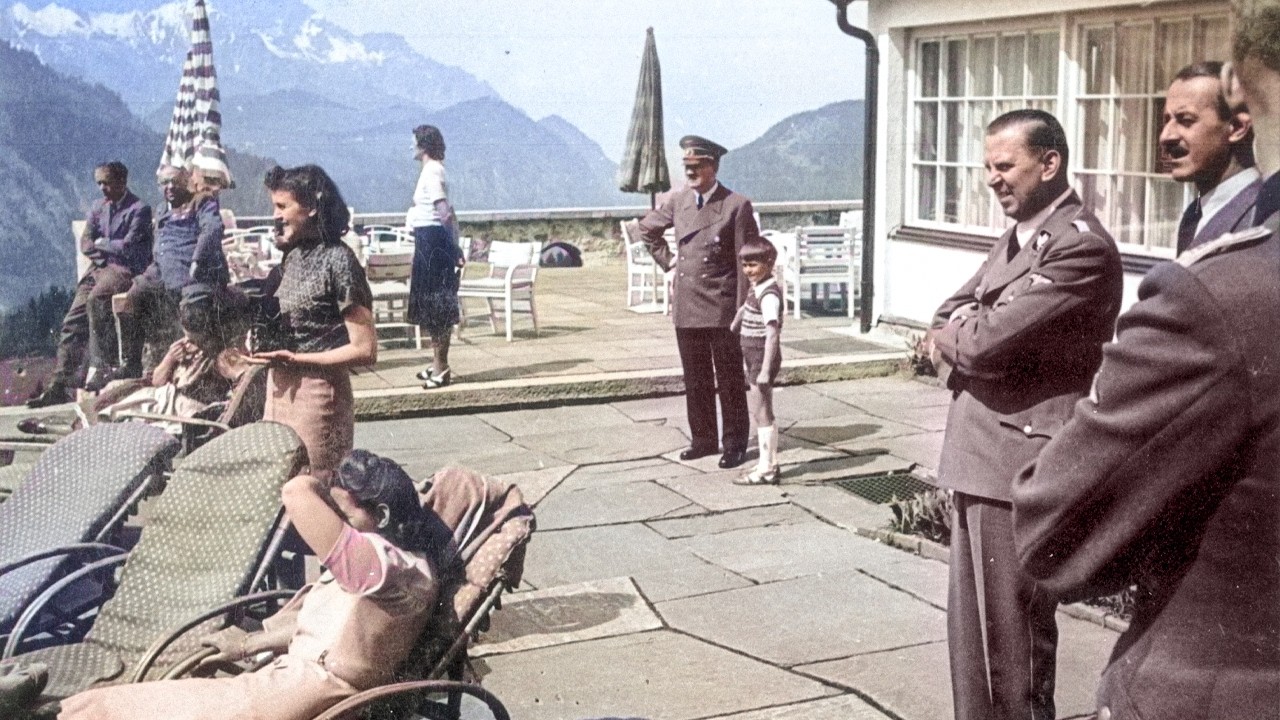
In 1936, the largest phase swallowed the neighboring building, and a terrace was built over the garage. The final phase extended the left wing and created another on the right. By 1937, the small Wachenfeld house had been replaced by a vast residence called the Berghof. Its thirty rooms housed Hitler’s apartments, his photographer, his mistress Eva Braun, and all the staff.
The centerpiece of the house was the great hall and its panoramic bay window. Made of ninety small panes, it stretched seven meters wide and four meters high, twenty-eight square meters of glass offering Hitler’s guests a spectacular view of the Untersberg. Hitler once said he had designed the Berghof around the window. He would bring political leaders there, seat them before it, and let the view announce that this was his power and his kingdom.
Bombed at the end of the war by the British and then the Americans, the buildings were finally destroyed completely by the Bavarians themselves to prevent Obersalzberg from becoming a Nazi pilgrimage site. Today, very little evidence of the famous Berghof remains. The most significant thing to see is the retaining wall behind where the house stood, a great concrete structure placed there to support the hill. Visitors would arrive at the driveway, climb the grand staircase where SS honor guards lined up, and pass through one of three arches into the Berghof itself.
A piece of stone lying nearby is believed to be the base of one of the columns that formed the main entrance. Hitler’s bedroom was there, the famous terrace above the garage. Above the Berghof, the Hotel Zum Türken was converted into barracks for Hitler’s personal bodyguards. Higher still lived Martin Bormann, the man who oversaw everything and managed Hitler’s property, the dreaded master of Obersalzberg.
His old house had been a children’s sanatorium, typically Bavarian on the outside to keep the feel of a holiday home, but lavishly furnished within, with the most expensive metal collection and luxurious fittings confirmed by invoices in the Munich archives. Bormann knew that if Hitler was to keep coming to the Berghof, his inner circle had to follow and his loyal followers had to be near him to plan the future of the Reich. He would either renovate or build houses and barracks to shelter them. Under Bormann’s direction, sixty thousand workers were sent to Obersalzberg, and the mountain became a colossal construction site.
He forced all the inhabitants to surrender their property; when they would not leave, he threatened them. It was a brutal construction site, and architects complained about a man who had no idea what he was doing yet placed enormous pressure on everyone. Part of Bormann’s success was always being two thoughts ahead of Hitler: the Führer never had to ask, because Bormann had already provided the answer. Within a few years, Obersalzberg had changed beyond recognition and become the second center of Nazi decision-making after Berlin.
The entire area was closed off, protected by two or three security rings fenced with wire, some of which still exists today. The safe zone covered ten square kilometers. Guard posts were placed around the perimeter, and thirty-five new buildings went up, including homes for Hermann Göring, commander in chief of the Luftwaffe, and Albert Speer, the party’s chief architect. There was also a theater, built in 1937 to entertain the workers stationed there, with films and free seats for all.
The hall was thirty-five meters wide and perhaps sixty-five or seventy meters long, designed to hold two thousand people, with a swastika eagle visible everywhere as propaganda. The building was massive, with its auditorium floor supported on concrete pillars above a basement. To keep the Nazi elite and their staff self-sufficient, Bormann converted a building into a huge farm called the Gutshof. Today it is a golf course, but in the 1930s and 1940s it was a meadow belonging to the model farm.
Bormann was a farmer at heart, and agriculture remained one of his hobbies, so he had to have his farm there. The existing farmers were driven out, and everything was replaced by Bormann’s experimental farm, which never actually worked because its workers lacked the local farmers’ knowledge of the land. A greenhouse built near the Berghof stretched 119 meters long and 26 meters wide, shaped like a crescent. They tried to grow vegetables and flowers there, but it was not enough.
The Nazis never managed to grow sufficient food for everyone. With his passion for grandeur and his admiration for the Führer, Bormann wanted to do more: he wanted to offer Hitler a physical metaphor of his supremacy. In 1937, he decided to build a house on the peak of the Kehlstein mountain, 1,824 meters above sea level. Built by three thousand men in less than thirteen months, it later became known as the Eagle’s Nest.
From Obersalzberg, a mountain road of 6. 5 kilometers led up through five tunnels to a plateau. From there, a long tunnel bored into the rock led to an elevator shaft with two cars, one for the Nazi elite and one for equipment. They climbed the final 120 meters in about forty seconds, arriving inside the house itself.
The elevator with its bronze car survives today, and the Eagle’s Nest, untouched by the bombing of 1945, became a high-altitude restaurant. This legendary place became a symbol of Hitler’s supremacy during the war, yet it played almost no role in the conflict. Hitler suffered from claustrophobia and disliked heights; he went there only a few times. In the end, the house was used mostly by Hitler’s most private companion, Eva Braun.
In one of her home movies, she filmed the wedding of her sister Gretl to Hermann Fegelein, an SS general, on a summer day in 1944, by which time he was already responsible for tens of thousands of deaths. When Hitler came to spend a few days at the Berghof, it seemed as though time stood still. His days were actually rather dull. Hitler lived at night, getting up very late and often skipping breakfast and lunch.
He usually held his first meetings late in the morning. After a late lunch, Hitler and his retinue walked to the teahouse on the Mooslahnerkopf mountain. During these ritual walks, the path was narrow, with room for only two people side by side, and he would seek out a trusted companion to discuss purely political subjects. The walk took an hour from the Berghof.
The teahouse was bombed in 1945 and finally demolished by local authorities in 2006, now overgrown by forest. People would drink tea and coffee, eat cakes, and talk innocently; it was said, though never confirmed, that Hitler once or twice fell asleep during his monologues. After an hour and a half, everyone returned by car to the Berghof. After dinner, the guests gathered in the great hall to listen to Hitler’s long monologues, sometimes watching a film.
The evenings lasted until four in the morning. Hitler was a great fan of American films, officially banned in Germany but his favorites; he was also fond of Mickey Mouse. Life at the Berghof was the opposite of life in Berlin. The ferocious dictator gave way to a simple man with a love of nature and mountain folklore.
The decoration was typically Bavarian, down to the smallest objects, all bearing witness to the Chancellor’s glory. French soldiers brought many pieces back to Paris as war booty when they came to liberate the mountain in May 1945. Among them was a tablecloth with Hitler’s initials, made in Munich and decorated with floral motifs. There were other matching tablecloths and napkins, many with the swastika, and a knife from Hitler’s personal silver set, ornate with Greek-style decoration, the German eagle, and the initials AH.
Every item in the Berghof, including the Kehlsteinhaus, was systematically marked with Hitler’s initials. He used a personal writing case that sat on his desk, holding his official papers, envelopes, and calling cards bearing his name and the Nazi emblem. One card remained from his secretary, reminding him of Bormann’s mother’s birthday. The locals of Berchtesgaden called the residents of Obersalzberg “those up there.
” The waiters wore white gloves, and everything was organized with a high level of protocol for visits by heads of state. As the Berghof was a place of power, dignitaries offered gifts to show their friendship, such as a gold-and-silver box presented to Hitler for his fiftieth birthday on 20 April 1939, illustrating his role as the savior of the nation. Over time, Obersalzberg became the second capital of the Reich. Between the trinkets and the attentive men, politics continued to function.
The mountain became a true second seat of power operating entirely outside the normal bureaucracy. In that quiet, green setting, Heinrich Himmler and Hitler did not talk about the weather; they discussed the deportation of Hungarian Jews or how many people would be killed in the gas chambers, all decided orally, mixed with their ordinary daily conversations. Major decisions were made there. As a symbol of the absolute power of the Chancellor, the mountains of Obersalzberg and the Berghof became key places in diplomatic relations between Germany and the rest of the world.
Hitler staged the arrival of his visitors with exacting theatricality. When the Prince of Wales visited, Hitler met him at the bottom of the stairs and accompanied him up. When Chamberlain came, Hitler descended halfway. On other occasions, he stood at the top of the stairs and simply waited for the visitor to come to him.
From writing Mein Kampf to the final decisions of war, Hitler planned his major strategies at this astonishing place. The summer of 1939 was planned entirely there. Across from the Berghof stood the Untersberg, where legend held that the spirit of Frederick Barbarossa slumbered, waiting to rise again to conquest and power. Hitler named his invasion of Russia Operation Barbarossa after it.
This was the place of his “inspiration,” where he said he spent his happiest times and conceived his great ideas. The list of those ideas is long. It was at the Berghof that he ordered the boycott of Jewish businesses in 1933, prepared the Munich Agreement in 1938, ordered the euthanasia program for the disabled in 1941, and finally ordered the deportation of half a million Hungarian Jews in 1944. Behind these horrific scenes stood Eva Braun, Hitler’s mistress.
She had begun living there secretly in 1936 because Hitler wanted to show the world he had no private life. But when he was absent or had no guests, she ran the household and filmed her comfortable daily life. For Eva Braun, the Berghof was a refuge. She was the mistress of the house there, and Hitler always asked her to go to the mountain with her friends and sisters.
She wrote letters to her close friend Herta Schneider, notes that read: “How are you, little Herta? Would you like to spend a few days in the mountains? I’m a little lonely here. I’d enjoy your company.
My sisters are coming next week. ” On her death, Eva Braun left many of her belongings to Herta Schneider, and an antiques dealer in Berchtesgaden later handled their sale: suitcases and clothes, nightgowns, stockings, gloves, everything, along with some furniture. A dressing table from Eva Braun’s room remained in the Berghof until the end. When the war ended, a local resident took it from the house, pillaging it, though it was perhaps fair game since Martin Bormann had stolen it in the first place.
In 1943, when bombs fell on Munich, only twenty minutes away by air, Obersalzberg shuddered. Hitler and his loyal secretary Martin Bormann knew their mountain was vulnerable. Despite all the precautions taken to build a highly secure area, an air raid could easily destroy their Bavarian retreat. To protect them, Bormann launched a vast new project: a network of bunkers and tunnels buried deep inside the mountain.
One emergency exit from Hitler’s personal tunnel remains the only entrance to the system today; all the others are buried or sealed. The network contained about seventeen rooms, counting the toilets, with quarters for Hitler, Eva Braun, his personal physician Dr. Morell, his servants and closest aides, and staff rooms for SS guards. The Berghof bunker was first built in 1943 in three distinct phases.
Section A, completed around Christmas 1943, ran from a staircase directly behind the Berghof to the cellar of the former Hotel Zum Türken, housing the Führer’s private apartments and those of his entourage. Section B, built in 1944, extended westward with all the operational facilities: a communications room, archives, kitchen, and control rooms for electricity and air conditioning. Section C, never completed, included a tunnel reaching deeper into the mountain to escape potential attackers. The Führer’s bunker had several emergency exits and connected via a tunnel to Martin Bormann’s bunker.
Between the two, a shelter designed for four hundred men was built beneath the SS barracks. Göring’s and Speer’s houses each had their own burrows. In total, in less than two years, an extensive network covering six kilometers and 22,000 square meters was dug into the Obersalzberg. Rare footage from 2004 shows one of the few times the Bavarian government permitted a full exploration of the bunkers, led by a German archaeologist with a cameraman.
Even after the Allies passed through these tunnels after the war, traces of the German occupation remained. Here they called it the casino, which served as a living and dining room. There was some ointment, they noted, heading toward the emergency exit, passing over the air ducts, and there on the floor lay an old armored door. To avoid a new Nazi pilgrimage, the Obersalzberg bunkers are now sealed, though one section a few hundred meters long remains accessible.
This second seat of power was meant not only as an air-raid shelter but as a secret government headquarters, which is why it had to be so enormous from the start. One room was originally intended for surgical operations, hence its great hall appearance. Many rooms were meant to house the families of senior party officials for long periods, livable but modest, not luxurious, with small rooms usable as bedrooms, offices, and control rooms. The idea was to continue the war from here, with everything designed so that occupants could remain underground for as long as possible, isolated from the surface.
In the 1940s, Goebbels had called for total war, and the logical result was that, since ideological frenzy no longer worked on the surface, they buried themselves underground. The network had two levels: one filled with livable shelters, and another directly below it containing electricity, heating, water, and especially a highly advanced ventilation system. At a rate of 3,000 cubic meters per hour, air was drawn in, filtered, dehumidified, and ventilated through the corridors. A slight overpressure then pushed the stagnant air out, making it possible to refresh the air and, crucially, to prevent any contaminated air from seeping in.
In the event of a chemical attack or bombardment, sealing valves prevented chemicals and vapors from entering the tunnels. The underground complex could operate in a closed circuit for several hours. This colossal construction mobilized the Reich’s best engineers and made the bunkers almost indestructible. The tunnels were built from several materials: solid concrete against the rock, then a first brick wall to drain seeping water, then a layer of plastic insulation, and finally a second wall of a double row of bricks covered in plaster.
In 1945, as the war ended, the network was still under construction. Hitler’s goal had been to create another, deeper level. Behind it still stands an elevator shaft, completed but never fitted with an elevator. Imagine elevators capable of carrying trucks; it was meant to be a real underground city.
At the entrance to one shelter, reached by a staircase, SS soldiers armed with machine guns kept watch. On the surface, the Luftwaffe added classic defensive lines: a battalion of anti-aircraft artillery, a fog machine, and camouflage for the main buildings. In the spring of 1945, with the German army suffering heavy losses on all fronts and the country under intense Allied bombing, the Royal Air Force decided to bomb Hitler’s Alpine retreat as a symbolic gesture. On 28 April 1945, a salvo of bombs fell on Obersalzberg.
It was almost the only place in Germany that had never been bombed. It was a strategic decision to bring the war to that specific site. The early warning system gave fifteen minutes to reach safety once the fifteen sirens sounded; you had to go home. On the day of the bombing, the thirteen-year-old boy did not want to go down into the bunker because he wanted to get home, but he was half an hour away on foot.
On the road, a plane opened fire on him, a small child on the road. The locals of Berchtesgaden were deeply traumatized. One of them later recalled: “I was convinced the Führer was the greatest and the strongest. I didn’t understand why my parents didn’t agree.
At the end of the war I was thirteen. You have to understand that for me, as a child, losing the war was a catastrophe, a humiliation. We were the perfect country. The Nazis were the best, the purest, without flaws.
I knew nothing at that time. ”
While the locals finally ventured into the mountains, French forces under General Leclerc, the 2nd Armored Division, moved toward the essential symbol of Nazi power. American troops were arriving at the same time. Even today, the two versions of history disagree over who reached the Berghof first.
Berlin had fallen a few days earlier, and the ground forces did not know that Hitler had committed suicide; they believed he might be there, so it was a race for victory. The Americans reached Berchtesgaden town on 4 May. They thought they had reached their objective, Hitler’s house. They were close but far away; unfamiliar with the area, they stopped in the town center.
The 2nd Armored Division arrived two or three hours later, according to railway records. The French knew more about the area because one of their officers, captured and transported through there in 1940, led them to the Berghof. So the French reached Obersalzberg first. Hours earlier, the last SS soldiers on the site had set fire to the buildings, so the French soldiers found the Berghof still smoking.
Alain Raphaël was one of the first soldiers to enter Hitler’s lair. He was twenty-four years old. “We traveled to it via a very damaged road,” he recalled. “We parked our tanks under the terrace.
I can still see myself entering that room overlooking the Alps. I had seen photos and films of Hitler displaying his power. I found myself in that room. I enjoyed it.
Under the staircase, we broke down a door and discovered a small room. There were things so vulgar as to be unimaginable. Everyone helped themselves as much as they could. But since I lost my tank afterwards, I couldn’t keep anything.
” The French soldiers discovered the vast network of tunnels built beneath the Berghof. To mark their passage, three of them carved their initials and the Cross of Lorraine, the symbol of the Free French Forces. The Americans quickly followed the French onto the mountain, finding the smoking remains of the Berghof. After living under the suffocating grip of Nazism, the village was about to live under American military control for forty-five years.
The last remnants of the Berghof were completely destroyed in 1952, and until 1995, American soldiers went to Obersalzberg to relax in their free time. After German reunification, Bavaria tried to make the mountain attractive to tourists again. The area was reforested, and the last remains of the Nazi buildings were demolished to make way for new structures like a huge luxury hotel. Today, Obersalzberg is quiet once more, but what little remains from the war years offers precious evidence of that period.
The ruins tell, in their own way, the story of twenty years of Nazi occupation, when Adolf Hitler and his followers seized a small Bavarian mountain to satisfy their thirst for power.
