By the summer of 1944, the American Marines on Saipan were witnessing something they would never forget. Japanese mothers, holding their children in their arms, walked calmly to the edge of a two-hundred-foot cliff and jumped. Fathers threw their children over first, then followed. Entire families chose the rocks below over surrendering to the Americans, because their officers had told them the Americans were devils.
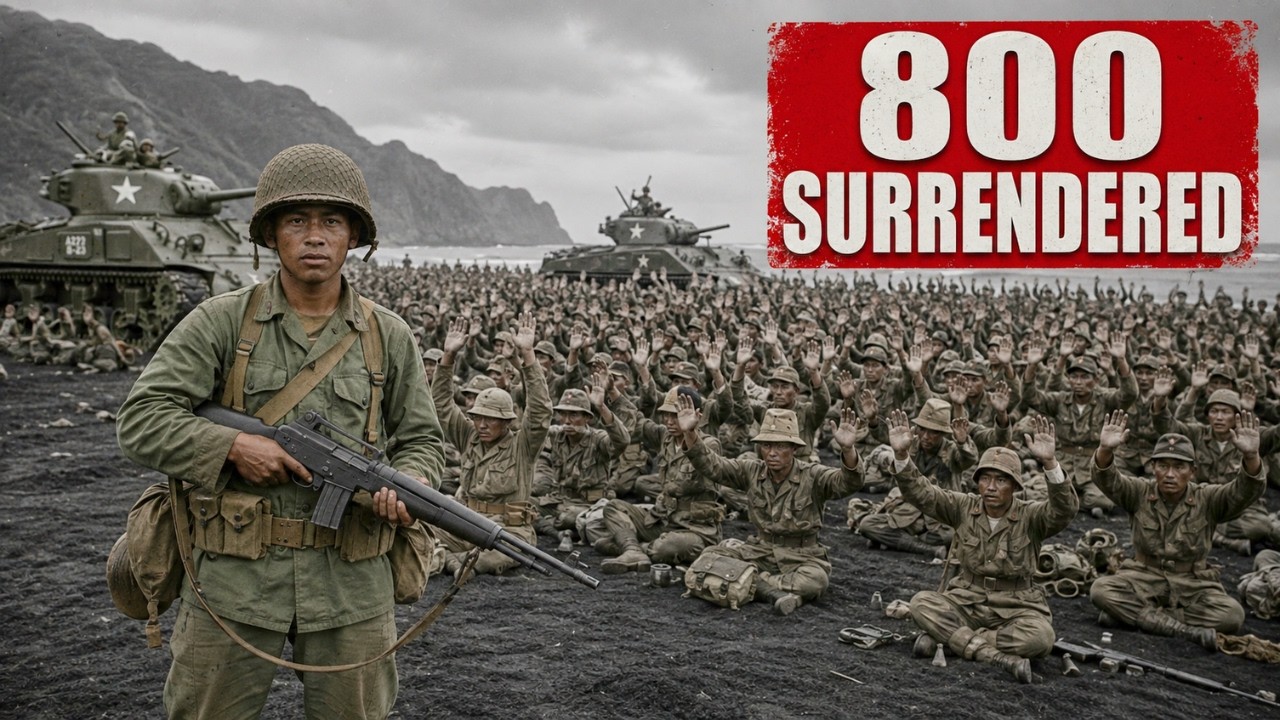
This is the story of the young Marine who tried to stop it. He was eighteen years old. He stood five feet four inches tall and weighed one hundred and thirty pounds. He carried an M1 rifle he had barely learned to fire and a broken street Japanese he had picked up as a child in the alleys of East Los Angeles.
He had no permission to be where he was going. He had no support. He had no radio. On the morning of July 8, 1944, he planned to walk alone to the base of a cliff filled with hundreds of enemy soldiers who had been trained from childhood to die before surrender.
He was going to talk to them. What happened next would become the largest capture of enemy combatants by a single American soldier in the history of the United States Army. His name was Guy Louis Gabaldon. To understand how he ended up at the base of that cliff, you have to go back eight years, to a neighborhood called Boyle Heights in East Los Angeles, 1936.
The Great Depression was in its seventh year. The Gabaldon family lived in a small wooden house crowded with nine people: two parents and seven children. Guy was the fourth. His father worked as a mechanic and welder for Pacific Freight Express.
His mother stayed home. Money was scarce, meals were beans and tortillas. At age ten, Guy discovered the streets of downtown Los Angeles paid better than the classroom. He jumped onto freight cars, rode trolleys for free, and ended up on Skid Row with a wooden shoeshine box.
A shine cost five cents. On a good day, he made a dollar, real money for a kid in 1936. He learned fast. He learned which bar girls gave good tips and which police officers would trade candy for a quiet report on after-hours activity.
He learned which men on the sidewalk were drunk, which were con men, and which would hurt you if you turned your back. At some point he joined a street gang. The kids called it the Moo Gang, after a character from The Three Stooges. The members were Mexican, Jewish, Armenian, Italian, Russian, and Japanese American.
In Boyle Heights in the 1930s, that was not unusual. Poverty did not respect race. Two members of the gang were brothers. Their surname was Nakano, but their first names were Lane and Lyle, and they were about to change Guy Gabaldon’s life.
The Nakano brothers did not fit the neighborhood pattern. They got good grades. They stayed out of trouble with the police. They came home for dinner on time.
Guy was fascinated by them. He had never met kids who acted that way. He started spending afternoons at their house, then evenings, then nights. By age twelve, he had practically moved in.
The Nakano family never formally adopted him, there was no ceremony. He simply became one of them. His parents did not object. In the Nakano home, Guy learned to eat with chopsticks.
He learned to bow when greeting elders. He learned to take off his shoes at the door. He learned the meaning of giri, obligation. He learned Japanese, not the polite Japanese taught in universities, but the slang of the alleys and shops of Little Tokyo: rough, direct, and full of idioms.
He also learned something else, something he would not fully understand until years later. He learned that the people the newspapers were beginning to call the enemy of tomorrow were just people. They ate. They laughed.
They worried about their children. They prayed before small wooden shrines in the corners of their living rooms. For seven years, Guy was a son of two families. Then, on December 7, 1941, planes carrying the red disc of the Japanese Empire flew over Pearl Harbor.
Everything changed. Ten weeks later, President Roosevelt signed Executive Order 9066. Every person of Japanese ancestry on the West Coast was ordered to move. The Nakano family was given a few days to pack.
They were allowed to take only what they could carry. Everything else, their home, their furniture, their photographs, was left behind. They were sent to a place called Heart Mountain in the high desert of Wyoming. Barbed wire, guard towers, wooden barracks with tarpaper roofs.
Their only crime was the shape of their faces. Lane and Lyle Nakano did something extraordinary. They volunteered for the United States Army. They volunteered for the 442nd Regimental Combat Team, a segregated unit made up entirely of Japanese Americans.
They would fight for the country that had imprisoned their parents. Guy watched them leave. He was fifteen, too young to enlist, but the war had entered his home and scattered the family that had raised him. He dropped out of high school, took a ship to Alaska, and worked in a fish cannery.
He grew up fast. On March 22, 1943, Guy Gabaldon turned seventeen. He walked into a Marine Corps recruiting office in Los Angeles. The recruiter asked if he had any special skills.
Guy said he spoke Japanese. That was not entirely true. What Guy spoke was a simple slang dialect, a hybrid street language built on idioms and gestures. It would never pass an official test.
But the recruiter’s eyes lit up. The Marine Corps desperately needed Japanese speakers. In a Pacific war spreading like fire across the ocean, a man who could talk to the enemy was worth ten who could not. Guy signed the papers.
At boot camp in San Diego, the Marines stripped away his old identity and rebuilt him. He was smaller than the other recruits and younger than most, but he did not quit. Nothing on the parade ground matched the cruelty of Skid Row on a bad Saturday night. In July 1943, command sent him to the Marine Corps Japanese Language School at Camp Elliott.
Instructors corrected his grammar, his accent, and his vocabulary. They told him his street-learned Japanese was embarrassing. They also quietly told him it was the most authentic Japanese they had ever heard from an American mouth. Upon graduation, he was assigned to headquarters and service company, Second Marines, Second Division.
His direct commander was a captain named John Schwabe. Throughout the fall of 1943 and into the spring of 1944, Guy trained. He trained for amphibious landings. He learned to swim in full combat gear.
He waited. In the spring of 1944, the waiting ended. The division was loaded onto ships in Hawaii. The destination was not announced, but the men felt the weight of the order.
This was not another exercise. This was real. The target was an island called Saipan. Saipan is a small piece of volcanic rock in the Northern Mariana Islands, fourteen miles long and six miles wide, but its location was priceless.
It sits thirteen hundred miles south of Tokyo, within range of the new American heavy bomber, the B-29 Superfortress. If the United States could take Saipan, fleets of bombers could begin striking the Japanese home islands from concrete runways just two hours from the battle. Tokyo knew this. Tokyo had fortified the island for years.
More than thirty-two thousand Japanese soldiers waited on Saipan under Lieutenant General Yoshitsugu Saito, nearly double what American intelligence had estimated. But there were others on the island too: more than twenty thousand civilians, Japanese settlers, farmers from Okinawa, Korean laborers, indigenous Chamorro families, women, children, and the elderly. For weeks, Japanese officers had been telling them a very specific story. If the Americans come, they will torture you.
They will rape your daughters. They will pour gasoline down your throats. They will run over your children with tanks. The story was a lie, but the people hearing it did not know that.
And when the moment came, they would believe it enough to jump from cliffs holding their children in their arms. On June 15, 1944, the American Fifth Amphibious Corps arrived off the coast. At dawn, warships opened fire. The horizon turned into a wall of smoke and thunder.
Battleships and cruisers bombarded the beaches for hours. Then landing craft lowered their ramps and eight thousand Marines poured into the surf. Private Guy Gabaldon was one of them. He waded toward the shore under mortar fire.
Sand erupted around him in black fountains. Men fell on both sides. He did not fall. He kept running.
By dusk, the beachhead was secured. The cost was two thousand American casualties on the first day alone. On the Japanese side, more than five thousand. The battle had not lasted a day, and it had already killed more men than most American towns contained.
That first night, Guy lay awake in a fighting hole and listened. He could hear the Japanese in the distance. Voices carried through the wet tropical air. Officers shouting orders, men laughing, men praying, and men singing songs whose words he half understood.
They did not sound like enemies. They sounded like the Nakano family on New Year’s Eve. They sounded like the memories of his childhood. Before dawn, without permission, without orders, and without telling anyone where he was going, Private Guy Louis Gabaldon crawled out of the American perimeter and disappeared into the darkness.
He was walking toward the enemy, and he was walking alone. He moved through the jungle like a street kid slipping through an alley at two in the morning. Slowly. Low.
Listening for anything out of place. He carried his M1 rifle at the ready. He was not thinking about medals. He was not thinking about history.
He was thinking about a promise he had made to himself while lying in his hole listening to Japanese voices in the dark. The men on the other side seemed exactly like the family that had raised him. He walked nearly a mile before he found three Japanese soldiers moving through the brush near the mouth of a cave. They did not know anyone was watching.
Guy stepped out of the bushes with his rifle raised. He spoke to them in Japanese, street Japanese, rough and direct. Drop your weapons. Do not move.
Two of the soldiers froze. The third reached for his rifle. Guy fired once. The soldier dropped.
The other two raised their hands. An hour later, at dawn, Private Guy Gabaldon walked back into the American perimeter with two enemy prisoners in front of him. Captain John Schwabe was not smiling. Schwabe was an old-school Marine officer.
He believed in orders, chain of command, and a soldier who left his post without permission deserving a dressing down. A soldier who left his post to fight his own private war deserved a court-martial. He told Guy exactly that. Guy nodded and took the lecture.
Then, that night, he did it again. He slipped out. He found another cave. He shot a guard outside.
He threw a grenade near the entrance. Then he pressed himself against the rock and shouted in Japanese. You are surrounded. There are Marines above you and below you.
Come out. You will not be harmed. I give you my word. There was a long silence.
Then a young Japanese soldier came out with empty hands and a face full of tears. Another followed, then another. By the time the last one emerged under the moonlight, there were fifty Japanese soldiers standing disarmed in the volcanic dust. Guy escorted them back to camp.
Captain Schwabe stared at the line of prisoners, fifty men brought in by one private, using broken Japanese and a lie about being surrounded. This time Schwabe did not threaten a court-martial. He said four words: do it your own way. From that morning on, Private Guy Gabaldon became what the Marines would call the lone wolf.
He worked alone. At night he answered to no one, and what he was doing had never been done by a single American soldier in any war. The method was deceptively simple, the product of two things almost no other soldier on Saipan possessed: language and empathy. He approached a cave.
He listened. If he heard voices, he estimated the numbers. If he heard crying, he estimated the number of children. Then he chose his moment to intervene.
Sometimes he fired at a guard. Sometimes he threw a smoke grenade to make them think the cave entrance was under gas attack. Sometimes he threatened flamethrowers he did not have. And sometimes he simply spoke: I am one Marine, but there are hundreds behind me.
Come out and you will drink water. You will eat rice. Your children will be safe. I promise this on my honor.
He was lying. There were no hundreds of Marines behind him. There was only Guy Gabaldon, one hand on his rifle and the other on a canteen of water he sometimes offered as a sign of good faith. The trick worked because of what was inside the caves: thirst, hunger, wounded men who had not seen a bandage in a week, children who had not eaten in two days, and mothers who had been told Americans were devils and were beginning to wonder if the devil standing outside their cave might at least be a devil who spoke their language.
Guy kept his promises. Every prisoner he brought in was fed. Every prisoner was given water. Every prisoner received treatment for his wounds.
He walked along the lines afterward and checked on them personally. He made sure the Marines guarding them did not steal their personal belongings. He made sure the wounded were taken to the aid station. Word began to spread through the Japanese positions.
There is a small Marine. If you go with him, you will live. By the end of June, Guy had brought in more than one hundred prisoners, an unprecedented number. In two and a half years of the Pacific War, most Marine divisions had not captured that many Japanese combined.
But while Guy was entering caves and bringing out prisoners, the larger battle was turning into a slaughter that would define the Pacific War. On June 19 and 20, a hundred and eighty miles west of Saipan, the Imperial Japanese Navy made a stand. The battle became known as the Battle of the Philippine Sea. American pilots remembered it by another name: the Great Marianas Turkey Shoot.
When it was over, the Japanese navy had lost three carriers and more than six hundred aircraft. The pilot cadre that had attacked Pearl Harbor was annihilated in two days. For the Japanese soldiers still fighting on Saipan, the meaning was simple. No one was coming to save them.
They were alone on a rock in the middle of the ocean and they had been ordered to die. The final chapter began in the last week of June in the volcanic highlands of the island’s center. The Second and Fourth Marine Divisions and the Army’s Twenty-Seventh Infantry Division pushed north toward terrain designed to destroy men. Fields of sugarcane taller than a soldier, hills riddled with hidden caves, and Mount Tapochau rising fifteen hundred feet above sea level.
The Americans gave these places names that would later be carved on headstones, such as Death Valley and Purple Heart Ridge. In Hell’s Pocket, fighting was measured in yards per day. By July 5, the Japanese had been pushed into the northern quarter of the island. Their commander, fifty-three-year-old Lieutenant General Yoshitsugu Saito, was ill and out of options.
He wrote a final message to his troops. That night, in a cave near Makunsha, Saito turned his ceremonial sword on himself. His adjutant finished the scene with a pistol shot. In another nearby cave, Vice Admiral Chuichi Nagumo, the naval commander who had launched the Pearl Harbor attack, also ended his life.
The two men who had ignited the Pacific War died within hours of each other, in caves on a small island, while American artillery grew closer. Saito left one final order: attack. At 4:45 on the morning of July 7, 1944, the largest banzai charge of World War II screamed out of the darkness. Between three and four thousand Japanese soldiers surged across the Tanapag plain.
Some carried rifles. Some carried only bayonets fixed to wooden sticks. Some carried ceremonial swords inherited from grandfathers. Some carried nothing at all.
They were drunk on sake. They were singing. They were already dying and they knew it. The line they hit belonged to the 105th Infantry Regiment of the Army’s 27th Division.
The charge lasted fifteen hours. When the sun set on July 7, 4,311 Japanese soldiers lay dead in a field the size of a few American farms. Four hundred and six Americans died beside them. Another 512 were wounded.
Guy Gabaldon heard the attack. He heard something else in the following days, something worse. At the northern tip of Saipan, at a place called Marpi Point, the civilians the Japanese officers had spent two years lying to began acting on those lies. The Marines advanced north and found the cliffs.
What they saw there would haunt them for the rest of their lives. Women in kimonos carrying children walked calmly to the edge of the volcanic cliff and jumped. Fathers threw their children first, then followed. Grandchildren helped their elderly grandmothers reach the edge and jumped with them.
Some tried to surrender, and Japanese soldiers hidden in the rocks above shot them in the back. American Marines on the deck of a destroyer offshore used loudspeakers to beg the civilians in Japanese not to jump. Interpreters were sent to the cliff edges to plead with them. It did not work.
By the time it was over, hundreds of civilians had thrown themselves from the two cliffs the Americans would remember as Suicide Cliff and Banzai Cliff. Guy Gabaldon walked along the beaches below in the days that followed. He saw the bodies washed up by the tide. He saw a Japanese mother still holding her pale infant in the waves.
He turned his face away and vomited into the sand. He did not sleep that night. Something changed inside him. It was not anger.
It was not exactly grief. It was closer to purpose. He had been lying his way into caves for two weeks. He had been convincing men to surrender.
What he decided that night, alone in his tent, was that he would do something greater. Something no single American had attempted in this war. He would walk to the largest concentration of Japanese survivors on the island. He would speak to them and see how many he could bring out alive.
At dawn on July 8, 1944, he took two Japanese prisoners he had captured the previous day. Two men who had already surrendered to him. Two men who had eaten his rice, drunk his water, and been treated with dignity by that small Marine who did not lie. He told them what he needed from them.
They would walk up the cliff path ahead of him. They would enter the caves. They would tell their countrymen the truth: the Americans offered terms of surrender, the small Marine kept his promises, inside those caves there was only death, and outside there was water, food, and life. The two prisoners looked at him.
One of them stared at the ground for a long time. Then he nodded. At seven-thirty in the morning, Guy Gabaldon watched two unarmed Japanese men slowly climb the volcanic cliff path toward the caves. He stayed below, alone.
Thirty minutes passed. Nothing. Forty-five minutes. Nothing.
Then, at the mouth of the largest cave, a hundred and fifty feet above him, Guy saw the first person step into the light. Then a second. Then a third. Then twenty.
Then two hundred. They were coming down. Guy raised his rifle, then slowly lowered it. His hands were trembling.
He ordered them in Japanese to line up at the base of the cliff so soldiers could be separated from civilians. He ordered them to place their weapons in a pile. They obeyed, all of them. By the time the last person came down the cliff path, Private Gabaldon stood alone on the Pacific shore with more than eight hundred Japanese soldiers and civilians sitting on the sand around him.
Some soldiers still held their rifles. He was one Marine. He had one rifle. The entire operation now depended on his ability to move 804 enemies two miles along the coast to the American lines, with no radio, no escort, and no guarantee that an American patrol would not open fire.
A Japanese officer stepped forward from the crowd. He looked about forty. His uniform was dirty but intact. A ceremonial sword hung at his waist.
He walked slowly toward Guy. He stopped at proper distance. He bowed. Then he spoke in precise, formal Japanese: we accept your terms.
Guy bowed in return. He did not yet realize he had just achieved the largest capture of enemy combatants by a single American in any war in the history of the United States military. The hard part had not ended. The hard part was about to begin.
He climbed onto a piece of driftwood. He pulled off his white undershirt, soaked with sweat, tied it to a broken tree branch, and handed it to the tallest soldier in the front row. Wave it. Do not stop waving it.
If you stop, we all die. The column began to move. Eight hundred Japanese. One American walking along two miles of open beach.
After twenty minutes of marching, Guy saw three figures ahead. A Marine patrol. They spotted the column and took cover. Guy saw one Marine raise his rifle.
He saw the muzzle aimed at his chest. He ripped off the baseball cap he had been wearing since the landing and waved it over his head with both hands. He shouted in English, his language, his country: Marines, Second Division, prisoners, do not shoot. The rifles stayed raised.
For three seconds that felt like an eternity, an American Marine stared through his rifle scope at another American Marine leading a column of 800 armed Japanese and decided whether to pull the trigger. Then the rifle lowered slowly. Behind Guy, the column kept walking, silent, orderly, miraculously. A Marine captain came out from behind a rock, walked up to Guy, and asked the only question that seemed logical: where in the hell did you get all these prisoners?
East Los Angeles. Four hours later, the prisoners were processed at the holding area in Charan Kanoa. American intelligence interviewed the Japanese officer who had negotiated the surrender. He told them where the remaining two thousand Japanese soldiers were hiding in the northern half of the island.
He told them which caves were occupied. He told them where ammunition was stored. The intelligence report that moved up the chain of command that evening would save an unknown number of American lives in the final assault to secure Saipan. The report did not mention Guy Gabaldon’s name once.
Over the next three weeks, Guy continued his work. He went out at dawn. He went out at dusk. He went out at night with a flashlight, a canteen, and the language his second family had given him at a dinner table in Boyle Heights.
He came to know the caves the way a farm boy knows his father’s fields. He knew which ones had back exits. He knew which ones the tide flooded at high water. He knew which ones smelled of death and which smelled of rice.
He earned a reputation on both sides of the front line. American Marines began calling him the Pied Piper of Saipan. The name came from an old German legend about a man who played a flute to lead children out of town. On Saipan, the flute was the Japanese language, and the children were hardened rifle-armed men following that small Marine because he did not lie.
The Japanese had their own name for him. They simply called him the little one who keeps his promise. Small groups began sending emissaries to the American lines. They asked for him by name, not for any soldier, not for any interpreter, specifically for him.
By the end of July, the prisoner count reached nearly fifteen hundred. One soldier. One rifle. Fifteen hundred lives.
It is the largest capture of enemy combatants by a single American soldier in the history of the United States military. Not one of the largest. The largest. Captain John Schwabe, the officer who had once threatened to court-martial him for leaving his post, sat at a wooden table in a canvas tent and wrote a recommendation for the Medal of Honor.
The paperwork moved up the chain of command. On August 1, the Second Marine Division boarded ships and crossed four miles of blue water to a smaller island called Tinian. The mission was the same: advance north, clear the caves, end Japanese resistance. Guy Gabaldon went with them, and on Tinian he did what he had done on Saipan: approach caves, talk, bring men out.
But the Tinian mission ended, and the Saipan mission had not. In the weeks that followed, Guy was sent back to Saipan to help track down the remaining Japanese still hiding in the northern forests. These were no longer surrender operations. They were ambushes by small groups of hardened soldiers who had not come out of the caves in July and never would.
On a hot afternoon in mid-August 1944, Guy approached the mouth of a small cave with two Marines behind him and called out in Japanese. Come out. You will be treated well. I give you my word.
Three Japanese soldiers emerged into daylight with their hands raised. Then a machine gun opened fire from the hill above. It was a heavy Type 92 machine gun firing from a position 150 yards away. The first burst killed one of the surrendering Japanese soldiers before he could finish raising his hands.
Guy took cover behind a fallen log. Bullets shredded the vegetation above his head. For twenty minutes the hill and the jungle traded fire. The machine gun crew was disciplined and veteran, firing in short controlled bursts.
They were waiting for one of the Marines to move. Guy crawled sideways through the roots. He reached the two wounded Japanese soldiers who had tried to surrender and pulled them behind cover. He applied pressure bandages to their wounds with steady hands while the rest of his body trembled.
Then he felt the impact in his left leg, just above the knee. Sharp pain, then heat, then numbness. He looked down. Blood was spreading through the fabric of his trousers.
The bullet had passed cleanly through the leg above the bone. He tied a tourniquet with a strip of his shirt and continued working on the wounded prisoners. The other Marines finally flanked the machine gun position and silenced it with grenades. Two of them came back for Guy.
They lifted him onto a stretcher made of rifles and overcoats and carried him out of the jungle. At the battalion aid station, a Navy corpsman cleaned the wound and cut away the torn fabric. The bullet had missed the femoral artery by less than an inch. The corpsman did not tell him that.
He simply said Guy was lucky. Eighteen-year-old Guy Gabaldon was carried to the beach and lifted aboard a hospital ship anchored offshore. His combat career was over. He had been on the front line for less than three months.
Healing took time. The wound closed, but the muscle did not recover. He would walk again, but with a limp for the rest of his life. While he lay in a hospital bed in Hawaii, the paperwork written by Captain Schwabe reached the desk of Lieutenant General Holland Smith, the invasion commander, the man they called Howling Mad.
Smith read the recommendation. He looked at the numbers. Fifteen hundred prisoners. One soldier.
He picked up a pen. He crossed out the words Medal of Honor. He wrote Silver Star. He attached no written explanation.
None was required. In February 1945, in a small room at the Federal Building in downtown Los Angeles, a naval officer pinned the Silver Star to the chest of a nineteen-year-old boy in a Marine uniform. The ceremony lasted fifteen minutes. No press.
No photographer. No family in the folding chairs. Just Guy Gabaldon, the officer, and an empty room. After the war, he returned home to Boyle Heights and looked for work.
Employers saw his limp and shook their heads. He drifted from a machine shop to a warehouse to a construction site. Nothing lasted. He tried to find the Nakano family.
Lane and Lyle had survived Italy and come home from the 442nd. Their parents had survived Heart Mountain and come back from the desert. But families who enter camps do not come out the same, and childhood friendships do not always survive the fires of history. He stayed in touch, but the old closeness had faded.
He did not talk about Saipan. When he tried, people did not believe him. One Marine, fifteen hundred prisoners. It sounded like a movie.
It sounded like a lie. He stopped telling the story. For twelve years, Guy Gabaldon disappeared into the ordinary routine of American life. He worked.
He married. He raised children. He carried his limp. He carried the nightmares.
He carried the silence. Then, in 1957, he received a call from a television producer. The show was This Is Your Life, one of the most watched programs in America. Each week an ordinary person was brought to the stage and surprised with a review of their own history, presented by the people who had lived it alongside them.
Guy was the guest. Marines who had served with him on Saipan came out one by one and stood under the studio lights. They told the country what had happened. They confirmed the numbers.
They described the small Marine who walked toward the caves alone. For the first time since the war, millions of Americans heard the story of Guy Gabaldon. Hollywood took notice. In 1960, a film called Hell to Eternity opened in American theaters, based on Guy Gabaldon’s life.
The studio did not choose Guy Gabaldon for the role. The studio did not choose a Mexican American actor. The studio chose Jeff Hunter, six feet tall with blue eyes. A hero who looked nothing like the small dark boy from Boyle Heights who had actually climbed that cliff.
Guy worked as a technical adviser on the film. He fought for accuracy. He won some battles and lost more. He watched the premiere from a seat in the theater, watching a tall white blue-eyed man play his part on screen.
He did not say much to reporters afterward. Later, quietly, he named his son Jeffrey after the actor. A month after the film’s release, the Marine Corps upgraded Guy Gabaldon’s Silver Star to the Navy Cross, the second-highest award for valor the Navy and Marine Corps could give. The ceremony was held in San Diego.
Lieutenant General David Shoup presented the award. Shoup was the model Marine. He had fought at Tarawa. He knew the price of advancing on a cave in the kind of war they had just lived through.
He looked Guy Gabaldon in the eye and told him what everyone in the room knew: that negotiation, when it works, is sometimes braver than killing, and that Guy had saved American, Japanese, and civilian lives in a war that had almost forgotten how to save anyone. The Navy Cross was pinned to Guy’s chest, but it did not have the power to pin what should have been there instead. The Medal of Honor recommendation from July 1944 was already dead, killed sixteen years earlier by a stroke of a pen with no explanation. By the time the Navy Cross came, the law had closed the door.
The Medal of Honor has a strict statute of limitations: three years from the date of the heroic act. By the time serious campaigns to correct the record began in the 1990s, the door had been closed for nearly half a century. He spent the rest of his life fighting a war he could not win. He wrote to congressmen.
He wrote to senators. He wrote to every Commandant of the Marine Corps from 1960 onward. Hispanic veterans organizations took up his cause. Military historians took up his cause.
Nothing moved. Some suggested an unspoken reason: in 1944, when the pen crossed out Medal of Honor and wrote Silver Star, the hand holding the pen belonged to a general who did not believe a Mexican American boy from East Los Angeles could have done what the paperwork claimed. There is no way to prove it. Holland Smith never explained his decision.
He took his reason to the grave. In 1990, Guy published his memoir. He called it Saipan, Suicide Island. The book sold modestly.
Military historians used it. He moved to Saipan itself, living there for twenty years on the island that had defined him. He raised a family there. He built a business.
He started youth programs. Japanese tourists sometimes recognized him. Some of them wept. Some left flowers at a small memorial plaque that now stands in the American Memorial Park on Saipan in honor of the small Marine who kept his word.
Descendants came from Tokyo to shake his hand. They told him their grandparents had been in those caves. They told him their families existed only because he had climbed a cliff one July morning with the remnants of a childhood Japanese and a canteen of water. Guy Gabaldon died on August 31, 2006, in Old Town, Florida.
He was eighty years old. He was buried with full military honors. The Navy Cross went with him. The Silver Star went with him.
The Purple Heart went with him. The Medal of Honor did not go with him. Today, the United States Marine Corps teaches Guy Gabaldon’s methods to young Marines in cultural awareness courses. His name appears in psychological operations manuals.
His techniques are studied by intelligence officers who will never wear his uniform. In classrooms at Quantico, instructors tell his story to explain a truth the American military took decades to learn: that language can be a weapon, that a kept promise can move mountains of men, and that courage does not always look the way it is supposed to look. Sometimes courage is five feet four inches tall. Sometimes courage weighs one hundred and thirty pounds.
Sometimes courage wears a baseball cap and aviator glasses because the boy inside the uniform still wants to look like John Wayne. And sometimes courage is a Mexican American kid from Boyle Heights climbing alone up a volcanic cliff on an island seven thousand miles from home, carrying nothing but a promise and a broken Japanese learned in childhood at the table of the family that took him in. Guy Gabaldon once wrote a single sentence about what he did in the summer of 1944. He wrote it late in life, after the medals, the film, and the long letters that never received a reply from Washington.
He wrote it simply, as he did most things: my actions prove God takes care of fools. He was wrong about one word. Not fools.
The rest of us just call them heroes.
