On September 10, 1931, four men walked into a Park Avenue office building in midtown Manhattan carrying badges that identified them as IRS agents. Maranzano’s crew looked them over and waved them through. Tax investigators turning up at a real estate office was completely plausible. They were not IRS agents.
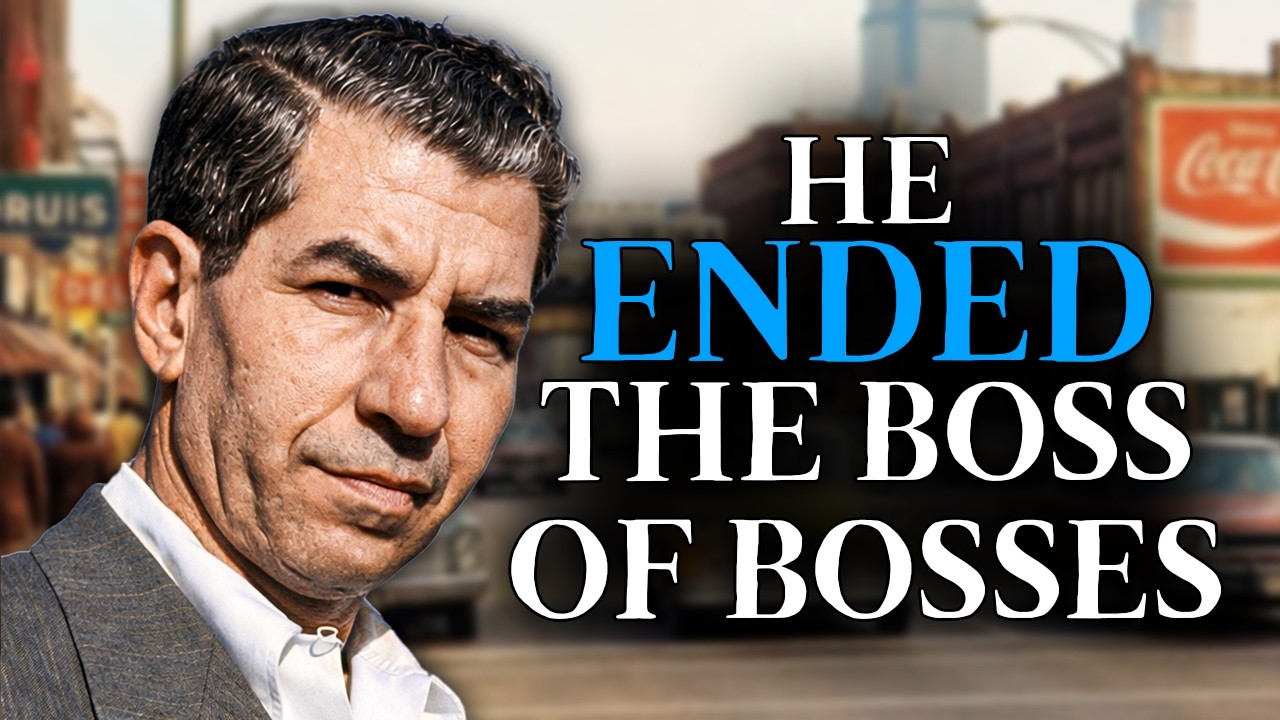
They were killers, recruited through Meyer Lansky’s network and Murder Incorporated, and they had come for the man who had crowned himself boss of all bosses. At almost the exact moment they were finishing their work, Vincent Mad Dog Coll—the killer Salvatore Maranzano had hired to murder his rivals—was walking toward the same building. He arrived. Maranzano was already dead.
Coll turned around and left. Less than five months earlier, the most powerful gangster in America had been shot four times in the back of the head in a Coney Island restaurant, with the man who ordered his death sitting across the table from him. The man who ordered both killings was Charles Lucky Luciano, and by the time the second one was done, he had murdered his way to the top twice over—and invented the American Mafia as the world would come to know it. To understand what Luciano did, you have to understand the world he inherited.
The American Mafia of the 1920s was not the slick, disciplined machine it would eventually become. It was a loud, bloody, old-world mess, run by men who had carried their Sicilian grudges across the Atlantic and planted them in American soil like they were something worth keeping. Cosa Nostra—our thing—had been embedded in Sicilian culture for centuries: codes of silence, loyalty, and violence. When the great wave of Italian immigration hit between the 1880s and the 1920s, all of that came with it.
Then Prohibition arrived in 1920 and poured gasoline on everything. Suddenly there was more money moving through these organizations than anyone had ever imagined. Bootlegging, speakeasies, politicians, judges, police captains—everyone had a price, and the mob had the cash to pay it. It should have been a golden era.
But all of that money was being managed by men whose entire worldview had been formed in nineteenth-century Sicily: men who measured respect in terms of lineage and village loyalty, who believed the old ways were the right ways, and that anyone who disagreed was an enemy. In New York, this mentality had two faces. Giuseppe Masseria—Joe the Boss—was heavy-set, crude, ruthless, a street survivor who had reportedly dodged bullets in broad daylight. His men literally called him the man who could dodge bullets.
Then there was Salvatore Maranzano: educated, cultured, arrogant. He spoke Latin, collected books about ancient Rome, and modeled himself explicitly after Julius Caesar. The younger generation—Luciano, Genovese, Costello, and Lansky—watched these two men and saw one thing clearly: they were about to destroy everything. Charles Lucania was born on November 24, 1897, in a sulfur mining town called Lercara Friddi in the province of Palermo, Sicily.
His family immigrated to the United States in 1907, settling on the Lower East Side of Manhattan, which at the time was one of the most densely populated neighborhoods on Earth. It was crowded, it was poor, and it was full of kids who were going to make a choice very early about which direction their lives would go. Young Charlie Lucania made his choice fast. By the time he was ten, he was running a protection racket on the neighborhood kids, charging them a penny or two a week to make sure he did not beat them up on the way to school.
A Jewish kid named Meyer Lansky was one of the few who refused to pay, saying he would rather fight. Luciano, instead of fighting him, made him a partner. That friendship, formed on a Lower East Side street corner sometime around 1908 or 1909, would shape the American underworld for the next four decades. Luciano was arrested for heroin possession in 1916, when he was eighteen, and served six months.
It was a turning point. He decided that pushing drugs on the street was not the way to get rich. The real money, he understood, was in running things—in being the man above the man who got arrested. By the early 1920s, Luciano had attached himself to Joe the Boss Masseria, then the most powerful criminal figure in New York.
Luciano became one of Masseria’s top earners, running bootlegging operations, gambling, and loan sharking. He brought in serious money, and that brought him serious respect. But Luciano was always watching, always calculating. He maintained relationships across ethnic lines that were almost unheard of at the time, counting among his closest associates not just Italians but Jewish gangsters like Lansky and Siegel, Irish criminals, and political fixers of every background.
He understood that in Prohibition-era New York, the color of your blood mattered a lot less than the color of your money. He also watched the older generation with a critical eye: their rigidity, the way they let personal vendettas override business logic, the way they treated younger men as soldiers and servants, never as partners. In his personal life, Luciano was not a patient man—he liked women, gambling, and expensive suits. But when it came to business, he was the most patient man in any room.
In 1929, someone had him grabbed, beaten, slashed with a knife, and left on Staten Island with his throat cut. He was found barely alive. He survived, and he never publicly identified who did it. Some said it was Masseria testing his loyalty or punishing him; some said it was a rival faction.
Whatever the truth, Luciano carried the scar on his face and the drooping eye from nerve damage for the rest of his life. If the beating was supposed to frighten him, it had the opposite effect. From that point forward, Luciano was done being anyone’s subordinate. He was going to run things.
He just needed the right moment. In 1930, the right moment arrived wearing a fedora, carrying a grudge, and calling itself the Castellammarese War. The war was, at its core, the stupidest conflict in the history of American organized crime—a factual assessment that the men who survived it, including Luciano himself, would have agreed with completely. It started because Joe the Boss Masseria decided he wanted to control all of New York’s underworld.
Every crew, every operation, every dollar. The Castellammarese faction—men who had come from Castellammare del Golfo in Sicily, including Maranzano—refused to be absorbed. Maranzano had been quietly building his power base since his arrival in New York in 1927. He saw himself as Masseria’s equal.
More than his equal, actually. He saw himself as Masseria’s superior, and he was not shy about it. The war officially began in 1930, fought in the streets of Brooklyn, Manhattan, and the Bronx. Men were shot coming out of barbershops, in restaurant doorways, walking to their cars.
Bodies turned up in alleys and in the trunks of automobiles. Neither side was winning in any meaningful sense, but both sides were killing, and the killing was relentless. For the younger generation, this was catastrophic. By 1930, the bootlegging operations run by these organizations were generating tens of millions of dollars annually.
They had established distribution networks, corrupt relationships with law enforcement and politicians, and sophisticated financial structures for laundering money. All of that was being jeopardized because two Sicilian men from rival towns could not agree on who was in charge of New York. The young guys were furious: Vito Genovese was furious, Frank Costello was furious, Joe Adonis was furious. And Lucky Luciano was especially furious, because he understood better than anyone that the potential of what they had built was essentially limitless—if anyone could be persuaded to stop shooting at each other long enough to run it like a business.
The war ground on through 1930. Bodies piled up on both sides. Masseria lost men he could not replace; Maranzano lost men he could not replace. Neither boss went to the front lines himself, of course.
That is not how bosses operated. They sent their soldiers and lieutenants to do the dying while they sat in their houses in Brooklyn, counted money, and gave orders. Luciano watched all of it. He ran his operations, kept earning for Masseria, kept his mouth shut.
And somewhere in the back of his ice-cold mind, a plan was forming—a plan so audacious, so coldly rational, so completely without sentiment that it would have been unthinkable to either of the men he was about to destroy. He was going to kill them both. What Luciano did in the months leading up to April 15, 1931, was not just planning a murder. He negotiated a peace agreement with the man his boss was at war with, using the murder of his boss as the opening offer.
Luciano made secret contact with Maranzano. The exact details of how the contact was made and who brokered it are murky, as you would expect from a meeting both parties were trying to keep from everyone on Earth. But the substance of what was discussed is clear enough from what happened afterward. Luciano’s offer was simple: he would deliver Masseria.
He would arrange for Joe the Boss to be killed, ending the Castellammarese War in one stroke. In exchange, Maranzano would recognize Luciano as the head of Masseria’s former organization and give him a position of prominence in the new order Maranzano was planning to create. Maranzano accepted. Why would he not?
He was in a war costing him men and money every week, and someone was offering to hand him the head of his enemy on a platter. What Maranzano did not fully appreciate—though he probably suspected—was that Luciano was not just making a deal. He was making a calculation. Luciano had already decided that Maranzano, for all his Caesar fantasies and organizational theories, was just another Mustache Pete in an expensive suit.
He was old world. He was a dictator by temperament. He was going to be impossible to deal with. If Luciano was going to build what he wanted to build—a rationalized, business-like, multi-ethnic criminal organization that operated more like a corporation than a street gang—then Maranzano was going to have to go, too.
He just had to go second. So Luciano played his role. He continued working for Masseria, eating dinner with him, playing cards with him, earning for him. And all the while, the plan was being put into place.
Luciano recruited four men for the actual job: Vito Genovese, one of his closest associates; Joe Adonis, a vain, handsome gangster who had once reportedly said he was too good-looking to go to jail; Albert Anastasia, a man of such volcanic violence that he would one day be nicknamed the Lord High Executioner and head what became known as Murder Incorporated; and Bugsy Siegel, Luciano’s old friend, who would one day try to build a casino empire in the Nevada desert. On April 15, 1931, they went to work. Nuova Villa Tammaro was a restaurant on West 15th Street in Coney Island, Brooklyn—a comfortable, unpretentious place where the food was good and the conversation was private, and the owner knew better than to ask too many questions about the men who came in for long lunches. That day, Luciano invited Joe the Boss Masseria to lunch there.
“Just the two of them,” Luciano said. “A good meal, some wine, maybe a card game afterward. ” Masseria was pleased. He trusted Luciano; more than that, he depended on him.
Luciano was his best earner, his most capable lieutenant, his bridge to the younger generation that Masseria vaguely sensed was growing restless under his leadership. The lunch went on for hours. They ate well—reportedly a tremendous amount of food, which is both very Italian and darkly appropriate given the circumstances. They talked business.
They talked about the war. After the meal was cleared, Luciano suggested a card game. Masseria agreed. And then, at some point during that game, Luciano excused himself to use the bathroom.
What happened next took approximately thirty seconds. The four gunmen—Genovese, Adonis, Anastasia, and Siegel—came through the door of the restaurant, walked to the table where Joe the Boss was sitting with his cards, and shot him. Four bullets, all finding their mark. Joe Masseria, the man who could dodge bullets, the most powerful criminal figure in New York, died in a Coney Island restaurant with a card in his hand—the ace of spades, depending on which version of the story you find most credible.
Whether that detail is true or embellished by someone with a flair for the dramatic, if you are going to die in a mob hit, dying with the ace of spades in your hand is about as good an exit as you are going to get. When the police arrived, they found Luciano in the bathroom. He said he had heard the shots and had no idea what had happened. He was questioned and released.
Nobody who was going to talk had seen anything; the gunmen were long gone. The famous crime scene photograph shows Masseria face down on the table, blood pooling around him, an expression of total surprise frozen on his features. He never knew it was coming. The man he trusted completely had handed him to his enemies, then stepped aside so they could finish the job.
The Castellammarese War was over. Salvatore Maranzano had won. And in winning, he had handed Luciano everything he needed. Maranzano wasted absolutely no time.
Within weeks of Masseria’s death, he called a meeting of several hundred organized crime figures from across the northeastern United States. The meeting was held in a large hall; accounts differ on the exact location, but most place it in the Bronx. Maranzano used it to announce the new structure of American organized crime. He organized New York’s criminal underworld into five distinct families.
Each family would have a boss, an underboss, a consigliere, and below them, capos who supervised crews of soldiers and associates. This is the structure, with minor variations, that governed the New York families for the next several decades. When you watch any mob movie or read any mob book and hear someone talking about bosses and underbosses and consigliere, you are hearing the echo of Salvatore Maranzano standing in a hall in the Bronx explaining his vision. At the top of this entire structure, Maranzano placed himself, with the title capo di tutti capi—boss of all bosses.
He told everyone at that meeting they were going to live by his rules now, and his rules were going to be strict. The organizational model he had in mind was based explicitly, and without a trace of irony, on the military structure of the Roman legions under Julius Caesar. The ambition is worth pausing over: this man had just won a bloody war for control of New York’s underworld, outmaneuvered a powerful enemy, reorganized an entire criminal infrastructure—and he was comparing himself to Julius Caesar. He was writing his own legend in real time.
What Salvatore Maranzano apparently did not remember about Julius Caesar is that Caesar was assassinated by people who were supposedly his allies, in a meeting he thought was safe, while he was at the height of his power. The historical parallel was more accurate than Maranzano intended. Luciano sat through the speech. He listened to the boss of all bosses explain his new world order, watched the man’s vanity on full display, and made his assessment: Maranzano was going to be a problem.
Not someday. Soon. The younger men had been willing to let Maranzano have his moment—the deal was the deal—but within weeks of the meeting it became clear that Maranzano’s vision of leadership was not the partnership model these men were hoping for. He wanted deference.
He wanted tribute. He wanted the boss of all bosses title to actually mean something. That was not going to work. Not for Luciano, not for the men around him, and not for the future they were trying to build.
The clock was already ticking on Salvatore Maranzano. He just did not know it yet. It did not take long for Maranzano to start feeling the pressure. He had won the war, but he had not solved the fundamental problem: the most capable men in his new organization did not fully respect his authority, and they were not particularly subtle about it.
Luciano was too independent. Genovese was too ambitious. Costello was too well-connected. These men had their own relationships, their own networks, their own sources of income that did not run through Maranzano’s hands.
So sometime in the late summer of 1931, Maranzano made the single greatest strategic error of his life. He decided that the solution to his problem was to kill the problem. He compiled a list: Lucky Luciano, Vito Genovese, Frank Costello, and several other men he had decided were too dangerous, too independent, or simply too likely to challenge him down the road. To carry out the murders, he hired a freelance killer, an Irish-American gangster feared across New York’s underworld for his combination of recklessness and competence.
His name was Vincent Coll. On the street they called him Mad Dog. Coll was one of the most genuinely dangerous men in 1930s New York—a killer for hire, unpredictable, violent, and apparently without loyalty to anything beyond his next paycheck. Maranzano contracted him to handle the murders once the targets had been lured to a meeting at his office under some pretense.
It was a reasonable plan. If it had worked, it would have eliminated Luciano and his allies in one stroke and cemented Maranzano’s control beyond any challenge. It did not work, because Luciano found out. The precise intelligence channel is one of those details told differently depending on who is telling the story, but what is consistently reported is that the information came through Jewish organized crime connections—specifically through the network Meyer Lansky maintained, connecting Jewish and Italian criminal enterprises across New York.
Lansky’s intelligence network was one of the most valuable assets Luciano possessed, and this was the moment it proved its worth most dramatically. Luciano learned about the hit list, learned about Mad Dog Coll, and may have even learned about the planned meeting Maranzano would use to lure the targets. He understood immediately what it meant: Maranzano was going to move against him, and soon. Luciano had a head start, but only a small one.
There was no room for patience now—no room for the methodical approach that had served him so well. The Maranzano problem had to be solved immediately, cleanly, unambiguously, finally. What happened next was the second act of a play Luciano had been writing since before Masseria’s body hit the floor of that Coney Island restaurant. Maranzano ran his operation out of a Park Avenue office building—real estate front, proper suite, receptionists, the whole performance.
A legitimacy costume. And it almost worked. The four men carrying IRS badges were shown into Maranzano’s private office, and there, surrounded by his real estate files and his Julius Caesar books, the boss of all bosses was disarmed, stabbed, and shot. Whether the stabbing came first or the shooting, at a certain point it stops mattering.
He was dead on Park Avenue. There is a legend that Luciano simultaneously ordered forty mob murders across the country that same night—the so-called night of the Sicilian Vespers. Tremendous story, almost certainly exaggerated. The mob was always happy to let mythology do what reality could not.
But the reality was already enough. Two bosses in five months. Luciano was thirty-four years old, and the American underworld was his. What separates Luciano from every criminal who came before him is not the killings—plenty of men had killed their way to power.
It is what he did next. He did not declare himself the new boss of bosses. He did not stand up at a meeting and announce he was the new Julius Caesar. He did not demand tribute or personal loyalty oaths or any of the old-world rituals Maranzano had been so attached to.
Instead, he called a meeting of his peers and proposed something no one in American organized crime had ever seriously proposed before: collective leadership. A governing body. A commission. By most accounts, the commission was established in the months following Maranzano’s death in 1931.
It included the bosses of the five New York families, along with representatives from other major organized crime centers, including Chicago. The rules were simple but revolutionary. There would be no boss of bosses. Each family would govern its own territory.
Major decisions affecting multiple families—wars, murders of significant figures—would be brought to the commission for collective resolution. No single man would have the power to unilaterally order the death of a boss from another family. Think about what this meant in practical terms: every war the mob had fought up to that point, including the Castellammarese War that had just killed dozens of men and disrupted millions of dollars in business, had ultimately been the product of one powerful figure deciding he wanted what someone else had. The commission structure was designed to make those unilateral decisions impossible—to force negotiation, to create a process.
Luciano also pushed for the integration of criminal enterprises across ethnic lines, formalizing the alliances he had been building informally for years with Lansky, Siegel, and others. Was the commission perfect? Not remotely. It broke down repeatedly in the decades that followed.
Bosses found ways to manipulate it, circumvent it, corrupt it. It did not prevent violence so much as provide a framework for negotiating around it, which is a different thing. But as a concept, as a structural innovation, it was extraordinary. Luciano had looked at the chaos of the American underworld and imposed on it something resembling a rational organization.
He had turned a street gang into a corporation—a bloody criminal corporation that dealt in drugs and extortion and murder, to be absolutely clear, but a corporation nonetheless, with rules, governance structures, and a mechanism for dispute resolution. He was thirty-four years old, and he had just reorganized American organized crime from the ground up. The man who brought Lucky Luciano down was not a rival mobster, nor a member of his own crew turning state’s evidence. It was a thirty-four-year-old Manhattan district attorney with presidential ambitions and an almost personal obsession with organized crime.
His name was Thomas Dewey. Dewey had made his name going after organized crime figures in New York, and by 1936 he had Luciano in his sights. The charge was not murder, extortion, or bootlegging. It was compulsory prostitution: running a network of brothels through intermediaries across New York City.
Luciano maintained he had nothing to do with the prostitution racket and had been framed. His defenders have made that argument in various forms for decades, with some legitimate points about the reliability of the witnesses Dewey used. What is not in dispute is the outcome. In June 1936, Charles Lucky Luciano was convicted on sixty-two counts of compulsory prostitution and sentenced to thirty to fifty years in prison.
He was thirty-eight years old. He ran his organization from prison for years. The connections, the structures, the relationships he had built were strong enough to function without his daily presence—in a way, the greatest testament to what he had built. He had constructed something that did not depend on any single person to operate.
In 1946, Luciano’s sentence was commuted by Governor Thomas Dewey—the same Dewey who had put him away and was now running for governor—in exchange for assistance Luciano had allegedly provided to the United States government during World War II. Specifically, his underworld connections on the New York waterfront had reportedly been used to prevent Axis sabotage of port facilities, and there were claims of assistance with the Allied invasion of Sicily in 1943. The nature and extent of that wartime assistance has been debated ever since. What is clear is that Luciano was released and immediately deported to Italy.
He was never allowed to return to the United States. He spent the rest of his life in Italy, primarily in Naples, maintaining whatever connections to the American organization he could manage from across the Atlantic. He reportedly continued to profit from narcotics trafficking and other enterprises. He died of a heart attack at Naples International Airport on January 26, 1962.
He was sixty-four years old. At the time of his death, the organization he had built was being run by men he had mentored and promoted. The commission he created was still functioning, after a fashion. The families he had helped organize were still operating.
The structures he had established in 1931 were still recognizable thirty years later. The man was gone. The machine kept running. So what do you do with a man like Lucky Luciano?
He was without question a criminal, a murderer, a man who built an empire on extortion and vice and violence, and who caused incalculable suffering to incalculable numbers of people over the course of his career. There is nothing romantic about that reality. But he was also, by any objective measure, one of the most consequential organizational minds in twentieth-century American history. He looked at a chaotic, self-destructive criminal enterprise and imposed rational structure on it.
He replaced old-world tribalism with something approaching modern management theory. He understood, before almost anyone around him, that the greatest threat to what they were building was not law enforcement or rival organizations. It was themselves—their own egos, their own greed, their own inability to get out of their own way. He solved that problem the only way he knew how: violently, ruthlessly, and completely.
Two bosses in five months. One empire from the wreckage. His name was Charles Lucky Luciano, and if you have ever watched a mob movie, read a mob book, or sat through a true crime documentary about the American Mafia, you have been living inside the world he built.
