On December 26, 1942, the second day of Christmas, Kitty Grande was visiting her husband’s parents in Oslo with her husband and their young son when the knock came. At twenty-three years old, she was arrested and taken into custody, first held at Grini, a concentration camp near the city. The woman who had spent months posing as a resistance fighter in Norway, welcoming patriots into her home and winning their trust, was now a prisoner of the very regime she had served. What followed would carry her far from Norway, into a camp for women north of Berlin, and eventually into one of the most closely watched trials of the postwar era.
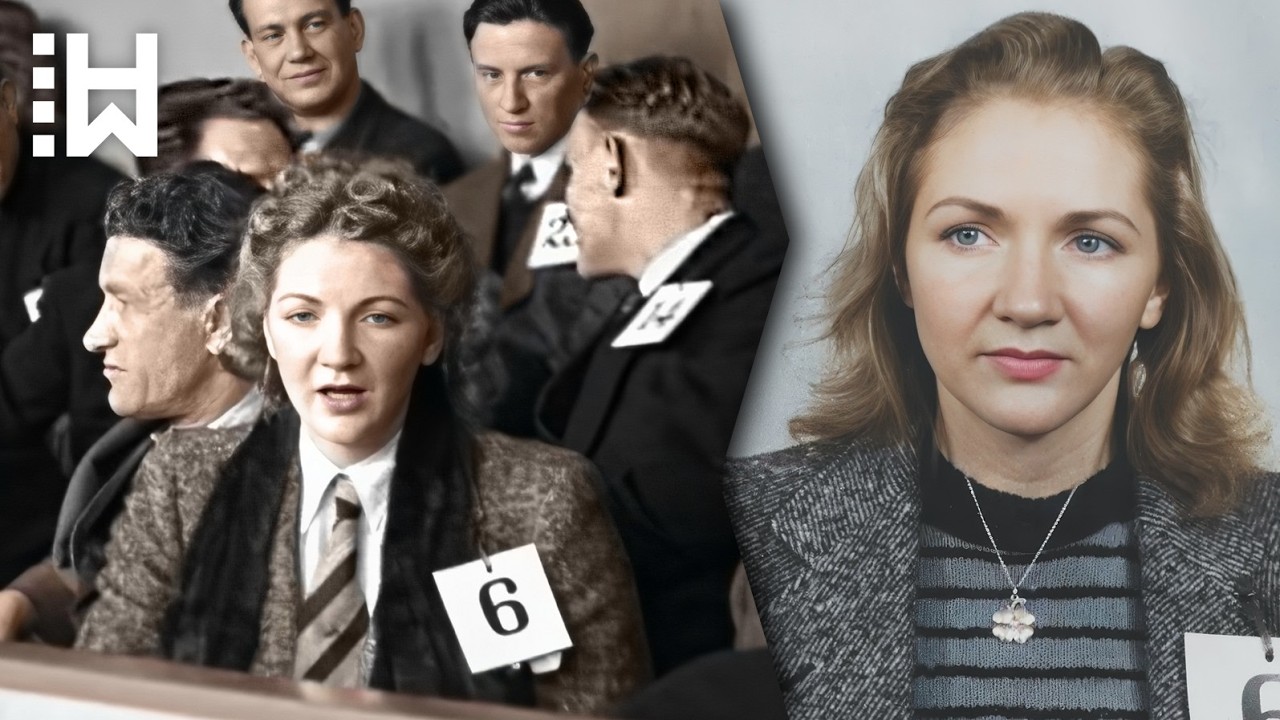
Kitty Grande was born Kitty Margareta Sørensen on March 22, 1919, in the municipality of Skaun, near the city of Trondheim in central Norway. She was the only daughter of Martin Theodor Sørensen, who ran a meat-smoking business, and his wife, Olga Maria. In October 1938, at the age of nineteen, Kitty married the architect and National Socialist Fredrik Grøntvigh Lawrence. The couple first lived in Stockholm, Sweden, where their son Vidar was born in the spring of 1939.
Kitty became a homemaker, tending to her young family. On September 1, 1939, the Second World War began when Nazi Germany invaded Poland. Norway declared its neutrality, but on April 9, 1940, German forces attacked the country anyway. Fighting lasted two months before the remaining Norwegian forces surrendered, leaving the country under German occupation.
By that time, Kitty and her family had returned to Norway, eventually settling into an apartment at Erling Skakkes gate 52 in Trondheim. The occupation transformed Norwegian politics. On September 25, 1940, the German commissioner Josef Terboven banned all political parties in Norway except Nasjonal Samling, the National Union. The party was a fascist movement founded in 1933 under the leadership of Vidkun Quisling, a former minister of defense.
Before the war, it had drawn negligible electoral support, but the German invasion changed its position dramatically. The party opposed parliamentary democracy, followed the principle of authoritarian leadership, and increasingly embraced Nazi racial ideology and antisemitism. Its members became deeply involved in administering occupied Norway and in efforts to reshape Norwegian society according to National Socialist principles. Along with her husband, Kitty became a supporter of the movement, and on May 14, 1941, she formally joined Nasjonal Samling.
The following month, on June 22, Nazi Germany launched Operation Barbarossa, the invasion of the Soviet Union. Fredrik, Kitty’s husband, later joined the Norwegian Legion, a military formation created to fight alongside German forces on the Eastern Front. While he was away, Kitty temporarily took over his local position within Nasjonal Samling. During the summer of 1941, her personal life changed radically as well.
Kitty began an affair with Ivar Grande, a married Norwegian policeman and fellow party member. Their relationship was hardly kept secret; Ivar even took Kitty with him on official trips related to his police work. His conduct led to disciplinary action, and in March 1942, Ivar was dismissed from the Norwegian State Police. That dismissal soon led both of them into contact with one of the most notorious collaborators in Norway.
His name was Henry Rinnan, a Norwegian agent working for the German security services. By 1942, Rinnan had established an intelligence group called Sonderabteilung Lola, better known as the Rinnan Gang, which operated under the supervision of the German Security Service, the SD, the intelligence arm of the SS and the Nazi Party. The organization specialized in penetrating the Norwegian resistance. Rather than simply arresting suspected opponents, Rinnan and his agents pretended to be resistance members themselves.
They created fictitious underground networks, offered help, and gained the trust of people involved in illegal activities. The information gathered through these operations was then passed to the German security services. In May 1942, two months after losing his police job, Ivar joined Rinnan’s organization. He quickly became one of its most important members, eventually serving as Rinnan’s deputy.
Kitty followed him into the organization the next month. She received a regular salary and began carrying out tasks for Rinnan. Within the group, she was known by the nickname Røkelaksen, the Smoked Salmon, a reference to her father’s meat-smoking business, where she had once worked in the office. Unlike some people who were initially deceived about the true nature of Rinnan’s organization, Kitty was a committed party member and fully aware of who she was working for.
Her first known mission came on June 16, 1942, when she traveled to the town of Meldal, about thirty miles, or fifty kilometers, east of Trondheim. There, she tried without success to establish contact with a man the Rinnan Gang hoped to lure into its network. Other missions soon followed. Kitty traveled as a courier, carrying messages between Rinnan and his agents.
During one operation, she went to Ålesund on Norway’s west coast and brought one of Rinnan’s agents to the neighboring town of Molde for a meeting with him. But some of Kitty’s most important work took place close to home. Her apartment at Erling Skakkes gate 52 in Trondheim became part of Rinnan’s system of deception. Using the assumed name Gerd Ingan, Kitty pretended to be a resistance member and received people who believed they were dealing with a genuine underground network.
Among them were resistance contacts from the Romsdal region who had been led to believe that Rinnan’s organization could help them escape across the border to neutral Sweden. Kitty welcomed them into her apartment, offered them food and drink, and helped maintain the illusion. Kitty was not the only member of her family drawn into the Rinnan Gang. Her mother, Olga Maria Sørensen, who had recently divorced, also began working for him.
When Kitty’s apartment became too well known as a meeting place, some of the group’s activities were moved to Olga’s home at Innherredsveien 125 in Trondheim. Rinnan was then able to meet resistance contacts there while posing as one of them. Conversations that seemed to take place between allies provided his organization with opportunities to gather information about real resistance activity. Kitty became an active participant in Rinnan’s penetration operations, using a false identity to win the trust of people fighting the German occupation.
For some, this kind of betrayal made collaborators like Kitty Grande seem worse than the Nazis themselves. The resistance expected treachery from the occupiers, but not from fellow Norwegians pretending to be people who could be trusted. By the autumn of 1942, Kitty’s loyalty to Rinnan began to change. During one of her missions, she was said to have fallen in love with a resistance member she was supposed to deceive.
Her work with the organization trailed off, and she eventually began working against it. Kitty warned two people who had become targets of Rinnan’s operations, allowing them to avoid arrest. At one point, she also revealed to a resistance contact that she was a member of Nasjonal Samling, compromising the false identity on which her work depended. For Rinnan, an agent who knew the organization from the inside but could no longer be trusted posed a serious danger.
By then, Kitty’s husband Fredrik had returned from service on the Eastern Front. On December 26, 1942, while visiting Fredrik’s parents in Oslo with her husband and their son, Kitty was arrested and initially imprisoned at Grini. Her situation soon became far worse. In February 1943, she was deported to Ravensbrück, a concentration camp for women north of Berlin.
Kitty was classified as a Nacht und Nebel prisoner, a designation meaning Night and Fog. This classification was used for prisoners the Nazi authorities wanted to isolate from the outside world, leaving their relatives uncertain of their fate. After the war, a former Norwegian prisoner claimed that Kitty had actually been sent to Ravensbrück to spy on the other inmates. However, no evidence was ever found to support this accusation.
While Kitty was imprisoned, her four-year-old son Vidar died in an accident. Despite this, Kitty spent only about six months at Ravensbrück. Ivar Grande reportedly intervened on her behalf, and in August 1943, she was released and returned to Norway. Despite her earlier involvement with the Rinnan Gang, Kitty did not return to the organization after her release.
She later divorced her first husband, and on June 3, 1944, Kitty married Ivar in Nidaros Cathedral in Trondheim. By that time, Ivar’s own relationship with Rinnan had deteriorated as well. The German authorities transferred him to the coastal town of Ålesund, where he was assigned to develop intelligence operations against the local resistance. In December 1944, while riding his bicycle home from work, Ivar was shot and killed by members of Milorg, the main Norwegian military resistance organization.
Kitty was pregnant with his child at the time, leaving her to face the final months of the occupation and the impending collapse of Nazi Germany without him. Several months later, on May 8, 1945, the surrender of Nazi Germany ended the Second World War in Europe. The Norwegian authorities began arresting and prosecuting those accused of collaborating with the German occupation. Kitty was arrested in the town of Ålesund in June 1945 and became one of the defendants in the postwar trials of the Rinnan Gang.
The proceedings attracted enormous public attention. Kitty and her fellow defendant Inga Lervald became particularly well-known figures in the dock, behaving like film stars, voluntarily posing for photographers with smiles and stylish clothes, an attitude some observers at the time considered arrogant, cynical, and provocative given the charges against them. The court considered Kitty’s involvement in Rinnan’s penetration operations, but it also took into account her later actions against the organization. She was credited with warning two intended targets, and her youth and lack of a prior criminal record were treated as mitigating circumstances.
In September 1946, the Frostating Court of Appeal sentenced Kitty to twenty years of hard labor for her wartime activities. Despite the length of the sentence, she served only a small part of it behind bars. She was imprisoned from August 1947 until her release from the women’s prison at Bredtveit in May 1951. After that, Kitty moved to Sweden and built a new life there.
She married a Frenchman named Hubert Vite in 1953 and took his surname, before later working in a hospital until her retirement. Her wartime past continued to attract attention, however. In 1989, Kitty appeared in a television interview about the Rinnan Gang and the occupation. Seven years later, the Norwegian newspaper Verdens Gang published another interview with her under the striking headline I regret nothing.
Kitty Grande was seventy-nine years old when she died on January 26, 1999, in Grödinge, southwest of Stockholm.
