In 2019, a team of geneticists set out on a task no one had attempted before. They gathered DNA from some of the oldest human remains found on six continents, and they tried to rank the ancient civilizations of the world—not by the size of their empires, not by the number of temples they built, not by the armies they defeated, but by their age, and by how deep their genetic roots ran in human history. Egypt was on the list. So was the Indus Valley, ancient China, the great kingdoms of West Africa, and the first peoples to set foot in the Americas.
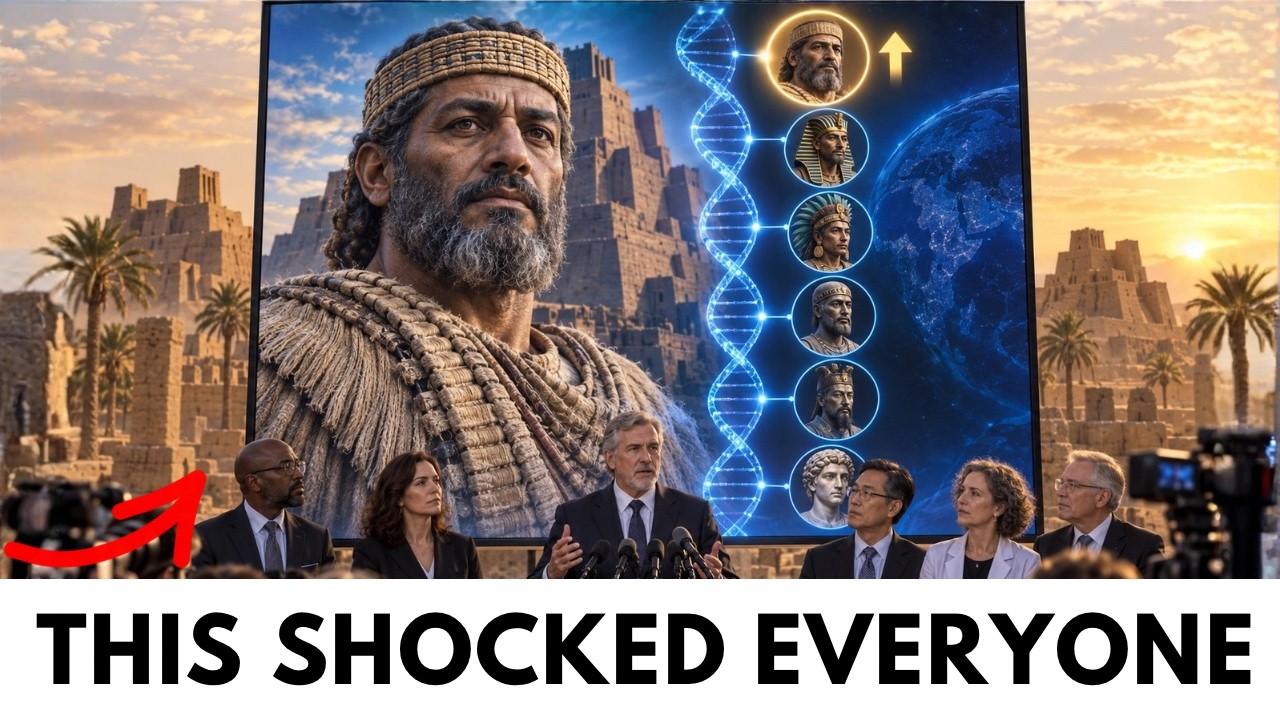
Almost everyone assumed they already knew how it would end. The famous ancient civilizations would take the top positions, while the younger ones would fall to the bottom, clearly and predictably. Then the data arrived, and it showed one civilization that turned the entire ranking upside down. A people who built the first cities on earth, invented writing, drew the first map of the night sky, and divided the day into hours as we still do today—then vanished almost completely from the genetic record.
The Sumerians. The results of the DNA analysis were not merely surprising to the researchers. They forced a complete rethink of what the beginning of such a ranking even meant. To understand why, one first had to be honest about what the age of DNA actually means, because it is not what most people imagine.
A civilization can be recent while the people who built it are ancient. The city of Uruk, for instance, is barely five thousand years old. The human lineage that stood inside its walls was hundreds of times older. Think of it as a river.
The city is the small town that grew up on its bank last week. The river has been flowing for a million years. When ranking by DNA age, what is being dated is the river, not the town. So a nation can be young in its present form yet carry a lineage older than the last ice age.
And a civilization can look ancient in a museum display while its builders were late arrivals, newcomers whose lineage had only been in that soil for a few generations. Age on a plaque and age in the blood are two entirely different things. This classification looked at only one of them. To do that, the researchers relied on a field called archaeogenetics.
They extracted tiny fragments of DNA from teeth, from the dense bone of the inner ear, from remains that had lain in the ground for thousands of years. That petrous bone, buried deep in the skull, is so hard and provides such superior protection that it can preserve genetic material long after the rest of the skeleton is gone. Still, most ancient DNA is eventually destroyed. Heat ruins it.
Water ruins it. Time ruins it. What remains is often a faint whisper of the original code. But even that whisper is enough.
Compare it to a world map of ancient and modern genomes, and patterns begin to emerge: where populations came from, who they mixed with, and whether their imprint fades or continues into the present. And there lay the danger of the classification, in the best possible way. Because the moment one starts measuring continuity instead of monuments, the familiar order of the ancient world begins to shift. Civilizations taught to be held in high regard start to decline.
Peoples told to be marginal start to rise. And some names refuse to find a place on the ranking at all. That last part was the key to the entire exercise. A civilization does not earn deep genetic age simply by being old.
It earns it through continuity—by proving that the same genetic thread runs from the deep past through the ancient city and into a person alive today. Break that thread, and the age collapses. Keep it intact, and its history extends far beyond any monument. The ranking began where everyone expected.
Near the top were civilizations whose genetic ties turned out to be surprisingly shallow, no matter how famous their names still echoed in history classes. As the list went down, the connections grew older, deeper, and harder to sever. Egypt was one of the first names mentioned, and Egypt came with a warning. When researchers extracted DNA from mummies found at a site called Abusir el-Meleq, the results did not match the picture most people carry in their minds.
The ancient Egyptians of that period leaned genetically toward the Near East, specifically toward the Levant and Anatolia, more than toward the rest of the continent around them. Then, in the centuries that followed the age of the pharaohs, the population composition of the region changed, and sub-Saharan African ancestry flowed into the population more than before. So the people living on the banks of the Nile today are not a direct extension of the pharaohs. The thread is real, but it has been tangled and renewed again and again by conquest, trade, and migration.
That is why the debate over the origins of particular pharaohs never ends. The honest answer is that ancient Egypt was a crossroads, and a crossroads gathers people from many cultures. That is what kept Egypt from reaching the position its monuments would suggest. A civilization five thousand years old does not automatically guarantee an ancient lineage.
To understand the weight of that, look at what a completely broken thread looks like. Ancient Europe is the clearest example. The hunter-gatherers who lived across the continent for tens of thousands of years were almost completely erased within a few thousand—first by farmers arriving from the east, then by pastoralists who swept across the continent. Each wave did not simply add to the older population; it largely replaced them.
So while Europe is rich in archaeological sites, the genetic links underlying most of them have been severed and reconnected more than once. In a classification based on continuity, being old is not enough. One must remain intact, preserving one’s structure while the world collapses around it. Then the researchers turned east, and the ranking became interesting.
Ancient China astonished the team for the opposite reason Egypt had. Along the Yellow River, in an area known as Yangshao, agricultural communities left remains dating back about eight thousand years. When their DNA was compared to that of people living in those regions today, the genetic links had barely changed. When researchers placed an ancient Yellow River genome beside that of a modern person from northern China, the match was so precise it seemed like the same family photographed thousands of years apart.
The genetic fingerprint of the earliest East Asian farmers extends almost unbroken to more than a billion living people. It is one of the most continuous stories in human history. Empires rose and fell, dynasties burned, but the underlying line held. East Asia did not just earn a high position; it set the standard against which everything else was measured.
But the discovery that caused the real shift was the Indus Valley. For a long time, the story of South Asia had been told as a story of newcomers, with the assumption that everything valuable in the region had arrived from outside, carried by later migrations. Then scientists managed to recover ancient DNA linked to the Indus Valley civilization from a site called Rakhigarhi, and the result was entirely different from expectations. The ancient genome pointed to a mixture of Iranian ancestry and a deeply rooted local lineage of South Asian hunter-gatherers.
What it did not show was the later origin everyone had assumed was there all along. The Indus Valley imprint had not faded. It ran directly into the blood of hundreds of millions of living South Asians today. For those millions, it meant their deep roots had never been foreign at all—they were indigenous and ancient.
In a way, that was the moment the search for India’s history stopped being imported from outside and began being read from within. The Indus Valley took a low position on the ranking, and dragged many assumptions down with it. By then, a pattern was forming, and the researchers could feel it. The deeper they went, the less the classification rewarded pyramids and palaces, and the more it rewarded something quieter: survival.
The ability of a thread to slip across thousands of years of chaos without breaking. Then came the Americas, and the Americas made that lesson unmistakable. The first peoples to enter both continents crossed from Asia during the last ice age, walking over a lost land bridge into a world no human foot had touched before. From an ancient child buried more than twelve thousand years ago in what is now Montana, scientists recovered a genome that links the indigenous peoples spread across both continents today.
One single ancient thread running from Alaska to the southern tip of South America, still carried by living descendants. For indigenous communities that had spent centuries being told their history only mattered after Europeans arrived, the genome said the opposite. You were here first, and the proof is written in your cells. West Africa forced the team to confront something they had quietly underestimated.
The great kingdoms there—Ghana, Mali, Songhai—are famous for gold, scholarship, and cities like Timbuktu. But beneath those kingdoms lay one of the broadest genetic stories on earth. A few thousand years ago, speakers of Bantu languages began expanding from the region near present-day Nigeria and Cameroon. Over the centuries, they spread across a third of the entire continent, carrying their agriculture, their languages, and their DNA as far south as the continent goes.
Today, hundreds of millions of Africans and a large part of the African diaspora in the Americas carry the imprint of West and Central Africa. In a classification measured by how far a thread extends and how many living people still carry it, West Africa was not merely central—it was at the front. For millions descended from those taken across the Atlantic in chains, this was not abstract theory. It was a direct line home.
Names were stolen and records burned, but the thread of blood was never erased, and it still points straight to the coast from which their ancestors were torn. And at that moment, the whole process began moving in one direction. Again and again, the deepest and most connected threads did not lead back to the famous capitals of the ancient world. They led back to where every human lineage ultimately descends: Africa.
In the lowest position on the ranking, at the most ancient level of all, lived the peoples of the sands of southern Africa. Their genetic lineage is one of the deepest branches in the entire human family. DNA studies indicate their lineage split from the rest of the population very early—by some estimates, between two hundred and three hundred thousand years ago. Consider that for a moment.
The pyramids are five thousand years old. The first cities are slightly older. But the lineage carried by the San people extends to the dawn of modern humanity. They did not build stone empires for tourists to photograph.
They carried something rarer: a connected lineage stretching almost to the beginning of our species. By the measure of DNA age, nothing the ancient world produced could match them. This did not make them primitive or frozen in time—that is an ugly old myth. They are every bit as modern as anyone watching.
Their branch simply split off from the rest of the family earlier than almost any other and never fully merged back in. Nor were the San alone in that region. Other African peoples, such as the Hadza in Tanzania and scattered communities across the Horn of Africa, carry some of the deepest and most complete genetic material on earth. In fact, there is more genetic diversity within Africa than in the rest of the world combined.
Two people from different African groups can be more genetically different from each other than a European is from an East Asian. The deepest roots of humanity do not lie in one place; they stretch across the entire African continent. That is why, when scientists want to understand the full range of human genes, they cannot do it by studying Europe alone. The true library of our identity is written across Africa.
Every living human on every continent carries ancestry that traces back to Africa. The oldest and deepest branches of the human tree are African branches. The peoples of the Nile, the peoples of India, the peoples of the Yellow River, the peoples who crossed into the Americas—all are branches that grew from a single African trunk. Above that deep African layer, the researchers placed another population that astonished ordinary observers: the indigenous peoples of Australia.
When their ancestors first reached the continent, they became one of the oldest continuous human groups on earth, carrying a thread tens of thousands of years long. By many estimates, they hold what many call the oldest continuous living culture on the planet—fifty to sixty-five thousand years, with songs and stories passed down across a span of time most nations cannot even imagine. Some of their oral traditions appear to describe coastlines and events from thousands of years ago. Memories older than most written history, passed on by word of mouth alone.
While civilizations rose and collapsed across the world, replaced by others, that thread held—isolated, intact, for a length of time almost impossible to conceive. That kind of continuity was exactly what the classification was designed to reward. By this point, the shape of the list was clear. Africa at the roots.
Australia’s ancient continuity near the base. East Asia, South Asia, West Africa, and the first Americans all carrying deep connected threads. And the famous civilizations of the ancient world, including Egypt, ranked higher on the list—stunning in stone, but shallower in human history than their reputations suggested. Only one name remained that no one on the team could place.
The name that had been quietly upsetting the ranking the entire time. The Sumerians. Here is why the researchers expected the Sumerians to rank very low on the list, at the shallowest level, like a margin note. On paper, the Sumerians looked like a dead end.
Their civilization appeared in southern Mesopotamia, in the land between the Tigris and the Euphrates, as if from nowhere. They built the first true cities. They invented cuneiform, the first writing system. They gave the world the prototype wheel, the sixty-minute hour, the first written laws, the first great epics.
Then, as a distinct people, they seemed to simply fade. The Akkadians absorbed them. The Babylonians and Assyrians rose above them. Then the Persians, then the Greeks, then the Arabs.
Wave after wave flooding the same land. Their language died. Their name vanished from living memory for thousands of years. And the hot, humid, salty plain of Mesopotamia is among the worst environments on earth for preserving ancient DNA.
For decades, geneticists had almost nothing directly from Sumerian bodies. Imagine inventing the very idea of writing history, and then having your own history become one of the hardest on earth to recover. By every obvious measure, the thread appeared cut—completely severed. A brilliant civilization that flourished, changed the world forever, then disappeared genetically.
That was the assumption. And that assumption is exactly what came crashing down. Because when the researchers examined the people still living in the marshes of southern Iraq—in the same wetlands that witnessed the birth of Sumer—they found something that could not exist if the thread had truly been severed: continuity. The Marsh Arabs of that region carry genetic markers linking them to the ancient peoples of Mesopotamia.
And they were not just any people. In the past few decades, their marshes were deliberately drained, their homes destroyed, their entire way of life nearly erased. Yet they endured. Their living descendants fish and build the same kind of reed houses their ancestors built when writing was still brand new.
The Sumerian thread had never disappeared. It had faded, become localized, hidden in that remote and stubborn environment that refuses to be completely wiped away. That was the first shock. The second was heavier, and it was the reason the classification could not place the Sumerians on any single rung.
The Sumerians did not appear from nowhere. They descended from the first farmers of the Fertile Crescent—those who, about ten thousand years ago, did something that changed the face of all humanity. They domesticated wheat and barley, tamed animals, and invented agriculture itself. And when farming spread out of that region, those first farmers did not just spread their ideas across the world.
They spread their DNA. Their genetic imprint went in every direction: into Europe, where it merged into the ancestry of most of the continent’s population; into North Africa; onto the Iranian plateau; and, as already seen, to the edge of the Indus Valley, reaching into South Asia. Realize what that means. The lineage behind the Sumerians is not a dead branch at the bottom of the tree.
It is one of the most widespread ancient imprints on the planet. It lies buried deep within billions of living people who have never heard a single word of the Sumerian language, who could not locate Uruk on a map to save their lives. The farmers who became the Sumerians helped shape the ancestry of Europe, the Middle East, North Africa, and South Asia all at once. It is one of the great historical facts still waiting to be widely understood.
A huge portion of the modern world is, genetically, descended from a few villages in the ancient Middle East. That is why the Sumerians broke the classification. The researchers had tried to place them on a single rung of a ladder—shallow or deep, recent or ancient, top or bottom. But the Sumerian thread refused to settle on any single rung.
It reached downward to the ancient farming past ten thousand years ago. It reached forward without interruption to the marsh people of Iraq today. And it reached sideways across half the ancestry of the modern world. The Sumerians were not a point on the ranking.
They were the hub. The entire ranking turned upside down. The team simply had no category for that. Their entire classification assumed each civilization represented one level.
The Sumerians were the final level. A people everyone considered genetically extinct turned out to be quietly rooted in more living humans than any ancient civilization ever studied. That was the discovery that stunned everyone. Not because the Sumerians were the oldest—they were not.
The African lineages hold that position, and nothing comes close. The shock was that the civilization everyone assumed had vanished genetically was in fact one of the most vital. The bottom of the list, the middle of the list, and the spread of the list all converged in a single people. And looking at the final classification as a whole, the real discovery was not about who came first.
It was about how connected everything is. Africa is the origin of every lineage. The first farmers spread until their blood ran beneath dozens of different banners. Ancient threads in China, India, and the Americas held firm through immense hardship.
And a lost people in the marshes of Iraq proved that a civilization can lose its language, its cities, and even its name—and still refuse to die. Because here is the truth. DNA repeats itself regardless of which ancient people one starts with. The threads do not stay separate.
Follow any of them back far enough, and they intertwine again and again until they all lead to the same African origin. No one is descended from a single ancient civilization. Everyone is the living endpoint of dozens of threads—some older than any city, some running directly through peoples history books swore had vanished. If one’s family is from West Africa, from the Nile, from the marshes of Iraq, from the plains of Asia, one does not carry a dead past.
One carries a thread that has outlasted empires. And for anyone who has ever spit into a small tube and mailed it off to learn their origins, this is the deeper version of that same question. Those tests give percentages and a colored map. What they cannot show is the age of the threads inside.
Some of what one carries is only a few centuries old. And some of it is older than agriculture, older than the wheel, older than any word ever written. A person is a moving record of time—and most of it is completely invisible.
That is the part that stays.
