In a climate-controlled storage room at the National Museum of African American History and Culture, Dr. Rachel Foster slid a photograph from an archival sleeve. The label read: “Thomas Family, Charleston, South Carolina, 1899. Studio portrait.
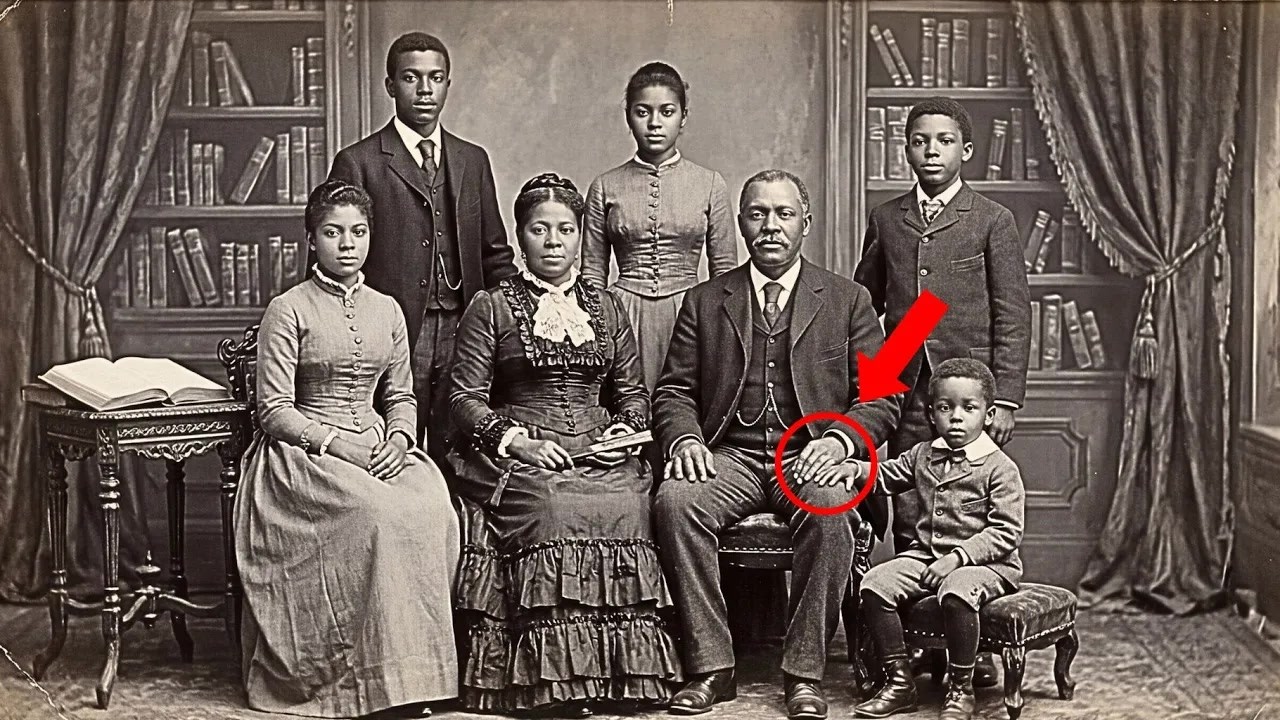
Donated 1987. ” She had seen the image before—a dignified Black family, formally dressed, eyes fixed on the camera with quiet pride. It was exactly the kind of photograph the museum treasured: proof of Black prosperity in an era that systematically erased such narratives. She placed it on the scanner bed.
The machine was new, capable of 4,800 dots per inch, fine enough to reveal the weave of fabric, the grain of paper, even the original silver halide crystals of the emulsion. It had been designed to preserve fragile images digitally while extracting every possible detail. The scan appeared line by line. Faces first, then clothing, the painted backdrop of a leather-bound library, the draped table.
Then the scan reached the bottom of the frame, where six-year-old Samuel stood. Rachel’s hand froze. She leaned closer, holding her breath. Something about the boy’s right hand was unexpected.
She zoomed in once, twice, a third time, until the pixels were unmistakable. “Oh my God,” she whispered. Samuel’s right hand, resting lightly against his father’s leg, had six fingers. Not a visual distortion, not a trick of light—six fully formed fingers, perfectly clear in the high-resolution scan.
She checked the left hand. Normal. Five fingers. She returned to the right.
Six. No ambiguity. The extra digit grew beside the pinky, a condition known as postaxial polydactyly. It was not a withered stub but appeared proportional, functional, simply another finger.
Rachel’s heart raced as she searched the museum database. Who was this family? Were there other images, medical records? Within an hour she had a name: Thomas, master carpenter in Charleston.
Within two, she made a phone call that would change everything. “Dr. Webb? This is Dr.
Rachel Foster from the National Museum of African American History and Culture. I need you to come to Washington immediately. I believe I’ve found something extraordinary. ”
Dr.
Marcus Webb arrived at the museum forty-eight hours later. As a geneticist at Johns Hopkins specializing in hereditary conditions among African American populations, he approached his work with deep respect for the painful history of Black bodies exploited in medical research. Rachel met him in the examination room, where the 1899 photograph lay flat in an archival sleeve on a light table. Beside it, her laptop displayed the high-resolution scan.
“Thank you for coming,” Rachel said. “I need you to tell me I’m not imagining this. ”
Marcus pulled on white cotton gloves and lifted the photograph, examining it with his naked eye. From normal viewing distance, the family looked exactly as expected: dignified, well-dressed, proud.
He could barely distinguish individual fingers at that level of detail. Then he looked at the digital scan. Rachel had enlarged Samuel’s right hand. Marcus’s eyes widened.
“Bilateral or unilateral? ”
“Unilateral. Right hand only. ”
Marcus studied the image with intense focus.
“Postaxial polydactyly. The extra finger beside the pinky. And look—it’s not malformed. It appears fully developed, with a complete joint.
” He sat back and removed his glasses. “This is remarkable. Polydactyly occurs in about one in every thousand births. But for it to be captured so clearly in an 1899 photograph, and to go unnoticed for over a century—”
“There’s more,” Rachel said, pulling out a thin file.
“The donor said this family were master carpenters in Charleston. Multiple generations of craftsmen, highly respected. ”
Marcus’s interest sharpened. “Multiple generations?
Do we know whether this trait appeared in other family members? ”
“That’s what I need your help discovering. ”
They began a painstaking historical investigation. The 1900 census gave them the essentials: Thomas, born about 1849, occupation carpenter.
Elizabeth, his wife, and five children, including Samuel, age seven. A property deed from 1897 showed Thomas had purchased a building on King Street—a significant achievement for a Black man in that era. The notary had noted: “Thomas, a skilled carpenter of good reputation. ”
“They weren’t struggling,” Rachel observed.
“They were a successful family. ”
Marcus nodded. “Which makes me wonder. If this child had a sixth finger and the family was well-off, they clearly didn’t hide it.
They seated him front and center in a professional portrait. ”
“What does that tell us? ”
“Perhaps they didn’t see it as a defect,” Marcus replied. “Or perhaps they knew about it and considered it normal because it ran in the family.
”
Rachel leaned forward. “Then we need to trace this lineage. ”
If it was hereditary, descendants might be alive today. The work was slow and frustrating.
Many post-Reconstruction records were incomplete, missing, or deliberately destroyed. Black family births were often unrecorded. The Great Migration had scattered families across the country, severing chains of documentation. But Rachel was persistent and Marcus patient.
They worked together for months, slowly piecing together the Thomas family story. Records from Morris Street Baptist Church in Charleston yielded the first breakthrough. Thomas and Elizabeth were active members, and the church’s meticulous record-keeping revealed their children’s births and baptisms. Samuel, born March 1893.
His older siblings: James, Clara, Margaret, and William. But there was something else—a note in Samuel’s baptismal record, written in delicate script: “Received the grace of the Lord, marked by his distinction, blessed by the Creator’s hand. ”
“The Creator’s hand,” Marcus repeated. “That’s specific language.
”
Rachel searched the church’s digitized records. “Look at this. A church bulletin from 1905 mentions that Thomas’s carpentry work took on apprentices. It reads: ‘Continuing the tradition of the Creator’s hand passing from father to son.
‘”
Marcus felt the thrill of discovery. “It’s a family phrase. Something inherited, something special about their hands. ”
The genetic trail led forward.
James, the eldest son, stayed in Charleston to continue the carpentry business. His children appeared in the 1920 census. One son, Robert, appeared in city directories through the 1940s as a carpenter. Then the trail went cold.
Robert vanished from Charleston records after 1947. Marcus checked Great Migration records, databases of Black Americans who moved north during the world wars. There, in a Philadelphia directory from 1948: Robert Thomas, carpenter, South Street. From Philadelphia the trail continued.
Robert’s children and grandchildren. Some remained in Pennsylvania; others scattered to Maryland, New Jersey, and New York. Each generation required hours of research. After three months of searching, Rachel found a genealogy forum post that made her hands tremble.
“Marcus,” she called out, “I think I’ve found him. ”
A living descendant. The post was from David Clark, researching his Charleston ancestors from the Thomas family, mentioning carpentry and a family story about special hands. Rachel sent a message immediately.
The reply came within the hour: “Yes, when can we meet? I’ve been waiting my whole life to understand my family’s story. ”
Dr. David Clark drove to the museum on a Saturday morning in early April.
He was forty-seven, an orthopedic surgeon at a Baltimore hospital, and had been researching his Charleston roots for nearly six years. “My grandfather died when I was fifteen,” David explained in the conference room. “But he used to tell stories about our ancestors, about Thomas the carpenter who made the finest furniture in Charleston, about hands capable of doing what other hands could not, about a gift passed through blood. ”
He paused, visibly moved.
“I thought it was just exaggeration. But when my daughter was born, everything changed. ”
Rachel leaned forward. “David, may I ask you a personal question?
Do you have any unusual genetic traits? ”
David extended his right hand, palm up. There, beside his pinky, was a sixth finger, fully formed, naturally positioned, clearly functional. “Only my right hand,” he said quietly.
“I was born with it. ”
Doctors urged my parents to have it surgically removed. They said it would make his life easier, but my grandfather refused. He said, “That hand is part of who we are.
Don’t you dare cut off what God gave and the blood bestowed. ”
Marcus stared in amazement, his mind racing. “Do you know whether other family members have this trait? ”
“My grandfather had it.
Same hand, same finger. ” He was a carpenter like his father and grandfather. He used to joke that the extra finger made him more skilled at his craft. David’s voice cracked.
“And my daughter has it too. She’s seven years old. When she was born and I saw that little sixth finger, I understood. It’s not a defect.
It’s part of our identity. ”
Rachel pushed the 1899 photograph toward David. “We believe this is your great-great-grandfather Thomas. And this,” she pointed to Samuel, “we believe is your great-grandfather.
”
David took the photograph with trembling hands. He studied the formal poses, the elegant clothing, the dignity. Then he looked at Samuel. Even in the original image, knowing what to look for, he could barely discern the subtle difference in the boy’s right hand.
“I’ve never seen his face before,” David whispered. “My grandfather described him, but no photographs survived. ”
He looked up, tears glistening. “How did you find this?
”
Rachel explained the scanning technology. Marcus explained the genetic implications. “We’d like to conduct genetic testing,” Marcus said carefully, “with your permission. If we can identify the mutation and trace it through your family, we may document one of the longest hereditary traits in American history.
”
David nodded. “What do you need? ”
“Blood samples from you, from willing family members, and from your daughter, if she agrees. That would be ideal.
”
David said without hesitation: “I’ll do it. My daughter is proud of her hand. She calls it her special finger. She’d want to be part of this.
”
The genetic testing took six weeks. Marcus collected blood samples from David, three consenting cousins, and with careful consent, David’s daughter Emma. The samples went to the genetics laboratory at Johns Hopkins for sequencing and analysis. While waiting, Marcus delved into medical literature.
Polydactyly was well documented, occurring in about one in a thousand births. It could be isolated or part of genetic syndromes. Postaxial polydactyly—extra digits beside the pinky—was more common among Africans and African Americans, suggesting ancient genetic origins. But what made a trait persist across generations?
Most polydactyly cases were sporadic, occurring randomly. There were hereditary cases, but rarely extending beyond three or four generations in documented medical literature. If David’s family truly traced the trait to Samuel in 1899, and if Samuel had inherited it from his father Thomas, and the family stories about earlier generations were accurate, they might be looking at one of the longest documented hereditary polydactyly lineages in medical history. The results arrived on a Tuesday morning.
Marcus called Rachel and David immediately, asking them to meet him in his office at Johns Hopkins. As they gathered around his desk, Marcus displayed the genetic sequencing data on his screen. “It’s confirmed,” he began, his voice charged with excitement. “The polydactyly in your family is caused by a specific mutation in the GLI3 gene, which regulates limb development during embryonic formation.
”
He displayed a molecular diagram. “This particular variant is extremely rare. I’ve searched global genetic databases. Fewer than twenty documented cases worldwide carry this exact mutation.
”
David leaned forward. “What does that mean? ”
“It means your family’s genetic lineage is exceptionally unique,” Marcus continued. “Based on the genealogical records Rachel compiled and the genetic testing we conducted, we can now trace this trait through at least six confirmed generations, from your daughter Emma, born in 2016, back to Samuel in the 1890s.
”
He displayed a family tree with red markers indicating confirmed polydactyly cases. “And based on family oral history and church records referring to the inheritance of ‘craftsman’s hands’ from father to son, the trait likely extends further, perhaps to Thomas’s father or grandfather, meaning eight to ten generations in total. ”
Rachel spoke quietly. “That would place the origin sometime in the early to mid-nineteenth century, possibly among enslaved populations.
”
Marcus nodded. “The GLI3 mutation likely originated in West Africa. When your ancestor was enslaved and brought to America, they carried that gene. Because polydactyly is a dominant trait, there was a high probability of it passing to every generation.
”
David sat back, absorbing the information. “My grandfather said this gift came from Africa, from ancestors who were craftsmen and builders. ”
Marcus said, “He was right. And there’s something else.
” He displayed comparative data. “I’ve been analyzing hand function and motor skills. David, your twelve-fingered hands don’t just give you extra digits. They grant you fine motor control that significantly outperforms in certain tasks.
Your ancestors weren’t proud simply because their hands were unique. They were proud because those hands made them truly exceptional craftsmen. ”
With the genetic confirmation, Marcus and Rachel intensified their historical research, determined to trace the trait as far back as possible. They returned to Charleston, visiting historical societies, church archives, and elderly community members whose families had lived in the city for generations.
Mr. James Washington, a ninety-one-year-old archivist at a small local museum, offered an unexpected insight. “Thomas with the six fingers? ” he said when Marcus mentioned the name.
“My grandfather used to tell stories. He said Thomas was the finest craftsman he ever saw in his life. He shaped wood like it was clay. ”
He pulled out a worn leather notebook containing his grandfather’s notes from the 1920s.
“My grandfather was a wheelwright. He worked sometimes with Charleston carpenters. He wrote this after Thomas died in 1923. ”
Marcus read aloud.
“Thomas died yesterday at age seventy-five. The finest carpenter Charleston has ever known. His son James continues the work, as does James’s son. Both have their grandfather’s blessed hands.
They say the gift goes back to Thomas’s father and his father before him, to the homeland before the chains. ”
Rachel’s eyes widened. “It goes back to Africa? The trait existed before slavery?
”
Mr. Washington nodded. “That’s what people believed. Something Thomas’s ancestors brought with them across the ocean.
Something the enslavers could not take from them. ”
Armed with this thread, Marcus contacted researchers specializing in African genetic populations. Through comparative databases and historical migration patterns, they identified a probable origin: a region in West Africa, specifically parts of present-day Nigeria and Cameroon, where certain wood and metal craft guilds had been documented by colonial ethnographers in the late nineteenth century. An obscure anthropological text from 1887, written by a British colonial officer, described his visit to the workshop of a master carver.
The craftsman possessed an unusual anatomical trait—six fingers on each hand—which he claimed was inherited in his family for generations, passed from master to apprentice through bloodlines. He attributed his exceptional skill to this inherited trait. Marcus presented the text to Rachel and David at their next meeting. “I cannot definitively prove this craftsman is your ancestor,” he told David.
“The historical record doesn’t allow that level of precision. But the geographic region, the time period, the craft tradition, and the hereditary nature of the trait all align. ”
David traced the words on the page with his finger. “My grandfather used to say we are makers, and it’s in our blood, passed through generations who refused to forget their identity, even in bondage.
”
Rachel added, “What makes your family’s story so powerful is that they didn’t just survive the horrors of slavery. They preserved their identity through their craft. Polydactyly became a marker of that identity, a physical embodiment of an unbroken lineage. ”
Marcus opened the 1899 photograph on his laptop, zooming in on young Samuel’s six-fingered hand.
“This wasn’t just a family portrait,” he said. “It documented a genetic and cultural legacy stretching from Africa to your daughter, Emma. Ten generations, perhaps twelve, of inherited continuity. ”
Marcus, Rachel, and David decided to publish their findings.
The paper, co-authored by all three, was titled: “Hereditary Polydactyly as Cultural and Genetic Legacy: A Multi-Generational African American Lineage. ” It was submitted to the Journal of Medical Genetics and Human Evolution. The response was immediate. The journal expedited peer review, and within two months, the research was accepted for publication.
But before publication, word spread through academic circles. Geneticists, historians, and anthropologists reached out, fascinated by the intersection of genetics, history, and cultural identity. The museum decided to mount a special exhibition titled “Hands of Legacy: The Thomas Family Story. ” Rachel curated it, featuring the 1899 photograph as the centerpiece, alongside high-resolution enlargements showing Samuel’s six-fingered hand.
The exhibition included Harris’s medical drawings from 1904, genealogical charts tracing ten generations, genetic diagrams explaining the GLI3 mutation, and contemporary photographs of David and Emma. David contributed his surgical instruments, displayed beside reproductions of Thomas’s carpentry tools. The visual parallel was striking: the same hands, separated by more than a century, both using their twelve fingers to create and heal. The exhibition opened in September 2023.
Thousands visited in the first month. Major media covered the story: the Washington Post, NPR, the New York Times, and international outlets. The photograph that had remained forgotten for 124 years now circulated globally. But something unexpected happened.
David began receiving messages—dozens, then hundreds, from other people with polydactyly. Parents of children born with extra fingers wrote that they had decided against surgical removal after reading about David’s family. Adults who had hidden their hands their entire lives sent photographs, many showing their faces beside their unique anatomy for the first time. One message moved David particularly, from a woman in Nigeria.
“My son has hands like yours. In our village, we have stories of ancestors with such hands, who were craftsmen and healers. Reading your family’s story helped me understand this is not a curse. It is a gift passed through blood.
”
David read the message to Marcus and Rachel during the exhibition’s opening night, his voice thick with emotion. “For a long time, I thought our story was only about my family. But it’s bigger than that. It’s about how difference can be strength, how what the medical world sees as an anomaly can be a source of identity, skill, and pride.
”
Marcus nodded. “Your family’s story challenges how we think about genetic variation. Not as defects to be corrected, but as diversity to be understood and sometimes celebrated. ”
The exhibition’s impact spread outward.
Medical schools began using David’s family story in genetics curricula, teaching students about hereditary traits through the lens of cultural competence and respect. Support groups for families affected by polydactyly cited the exhibition as a transformative experience, helping them reframe difference as distinction. Six months after the exhibition opened, David sat with his daughter Emma in the museum, standing before the 1899 photograph. Emma was now seven, old enough to understand what the image meant and what it said about her identity.
“That’s Samuel,” David said, pointing to the small figure in the foreground. “He’s your great-great-great-grandfather. He had hands like yours. ”
Emma studied the photograph thoughtfully, then looked at her right hand, moving her six fingers.
“Did people make fun of him? ”
David knelt beside her. “We don’t know for certain. But we know his family was proud of him.
They dressed him in their finest clothes and took him to the photographer’s studio. That was expensive back then. They placed him right in front where everyone could see him. They didn’t hide him.
”
“Just like you and Mom didn’t hide me,” Emma said. “Exactly like that. ”
Emma returned her gaze to the photograph. “Tell me again about the craftsman’s hands.
”
David smiled. “Your great-great-great-great-grandfather Thomas was a carpenter. He made things from wood. His father was also a carpenter, and his father before him.
They had hands like ours with the extra finger, and people said it made them the finest craftsmen in Charleston. They called them ‘craftsman’s hands’ because they could make things others couldn’t. ”
“Oh, and you’re a doctor,” Emma said. “You heal people’s hands.
”
“I do. And my extra finger helps me perform surgeries other doctors find difficult. It gives me better control, greater precision. ”
Emma moved her fingers again, watching them.
“When I grow up, what will I make with my craftsman’s hands? ”
The question hung in the air, beautiful in its spontaneity and openness. David felt a lump in his throat. “Anything you want, sweetheart.
Anything you dream of. ”
They stood together in silence, connected by three centuries of genetic inheritance to the small boy in the photograph. Samuel, frozen at age six, dressed in his finest clothes, his right hand resting against his father’s leg, his six fingers captured by silver halide crystals, waiting 124 years to be seen. Later that evening, Emma asked if she could write a letter to Samuel.
David helped her compose it. “Dear great-great-great-grandfather Samuel, my name is Emma. I am 7 years old. I have hands like yours, six fingers on my right hand.
Daddy says you were proud of your hands and your family was proud of you. I am proud too. I am proud of my hands and proud that we are one family. Thank you for not hiding.
Thank you for being in the photograph so we could find you. With love, Emma. ”
David framed the letter beside Emma’s photograph on his desk. Two children separated by 124 years, connected by six fingers and an unbroken bloodline.
Both photographed, both visible, both proud. A year after the exhibition opened, David returned to Charleston for the first time since childhood. He brought Emma, wanting her to see where her ancestors had lived and worked, to walk streets they had walked, to touch wood they might have shaped with their hands. They found the building that had housed Thomas’s carpentry shop on King Street.
It was a restaurant now, fully renovated, but the structure remained. The high ceilings, wide door frames, and thick support beams spoke of nineteenth-century craftsmanship. The restaurant owner allowed them to explore once he learned why David and Emma had come. In the basement, beneath layers of modern renovation, the original timber beams were still visible.
David ran his hand—his twelve-fingered hand—over the wood, feeling the marks of hand tools and the precision of joints fitted without nails or screws. “Your great-great-great-grandfather made this,” he told Emma, “with hands like ours. ”
They visited Morris Street Baptist Church, where Samuel had been baptized. The current pastor welcomed them warmly and brought out the original baptismal records to show Emma her ancestor’s name written in delicate script, with the note about the craftsman’s hands.
At the museum’s Charleston branch, they saw a traveling version of the exhibition. Local families came, descendants of the Black craftsmen and merchants who had built Charleston’s prosperity despite being denied its full benefits. They shared stories of their ancestors, their family traits, their resilience against history’s cruelties. An elderly woman approached David and Emma.
“My grandfather knew Thomas,” she said. “Used to tell stories about him. Said he was a quiet man, but his work spoke loudly. Said you could always tell furniture Thomas made because it was perfect.
Tight joints, flawless finish. Said Thomas had special hands. ”
Emma raised her right hand. “I have them too.
”
The woman’s eyes widened, then filled with tears. She gently took Emma’s hand between her palms. “Blessed child, you carry him with you. ”
That evening, sitting on a hotel balcony overlooking Charleston Harbor, David told Emma about the Middle Passage, about enslaved Africans brought across those waters in chains, about how her ancestor—perhaps Samuel’s great-great-great-grandfather—had survived that journey with his body, his memory, and the genes that would pass through generations.
“They took everything from him,” David said quietly. “His freedom, his home, his name, his language. But they could not take what was in his blood. And it passed through your great-great-great-grandfather, through Thomas, through Samuel, through my grandfather, down to me, then to you.
”
Emma looked at her hand in the fading light. “The gift that passes through blood. ”
“Yes. ”
“And I’ll pass it to my children.
”
“Perhaps. If you have children and if they inherit the gene. The trait is dominant, so there’s a good chance. ”
Emma smiled.
“I hope they do. I hope they have the craftsman’s hands too. ”
Six months later, the research paper won the Journal of Medical Genetics Award for Excellence in Historical Genetics Research. David, Rachel, and Marcus accepted the award together at a ceremony in Baltimore.
In his acceptance speech, David spoke not about science or genes, but about identity and survival. “For 124 years, my great-great-great-grandfather Samuel stood in that photograph, his six-fingered hand visible but unnoticed by anyone. The technology to see him didn’t exist yet. The framework to understand him didn’t exist yet.
But he was always there, waiting to be seen. Because his family was proud enough to photograph him, because archivists were careful enough to preserve that photograph, because researchers were curious enough to examine it, we finally saw him. We finally understood. And in seeing him, we saw ourselves.
”
He paused. “That is the power of not hiding. That is the legacy my family gave me, and the legacy I give my daughter. Be visible.
Be proud. Be exactly who you are. Because someone in the future may need to see you to understand themselves. ”
The photograph of Samuel and his family now rests permanently in the main hall of the National Museum of African American History and Culture, displayed prominently with interactive screens allowing visitors to zoom in on Samuel’s hand and learn his full story.
It has become one of the museum’s most viewed exhibits. And sometimes, late at night, David opens the high-resolution digital scan on his computer, zooms in on Samuel’s six-fingered hand, and feels the weight of connection across time. The same mutation, the same chromosomes, the twelve fingers linking him to a child who stood proud and dignified in a Charleston photography studio in 1899, never knowing his hand would speak across more than a century. Samuel would never know his photograph would be magnified and studied, his hand would become famous, his genetic legacy documented and celebrated.
He simply stood there that day, dressed in his finest clothes, being exactly who he was. But his hand spoke across the years, and finally, someone was listening.
