In the summer of 1927, a man whose name appears in no document, stood on a ledge of Navajo sandstone 180 feet above the floor of Zion Canyon. He set a steel drill bit against the rock face and waited for his partner to swing the hammer. The ledge beneath him had not existed the day before. His crew had blasted it out of the cliff that same morning.
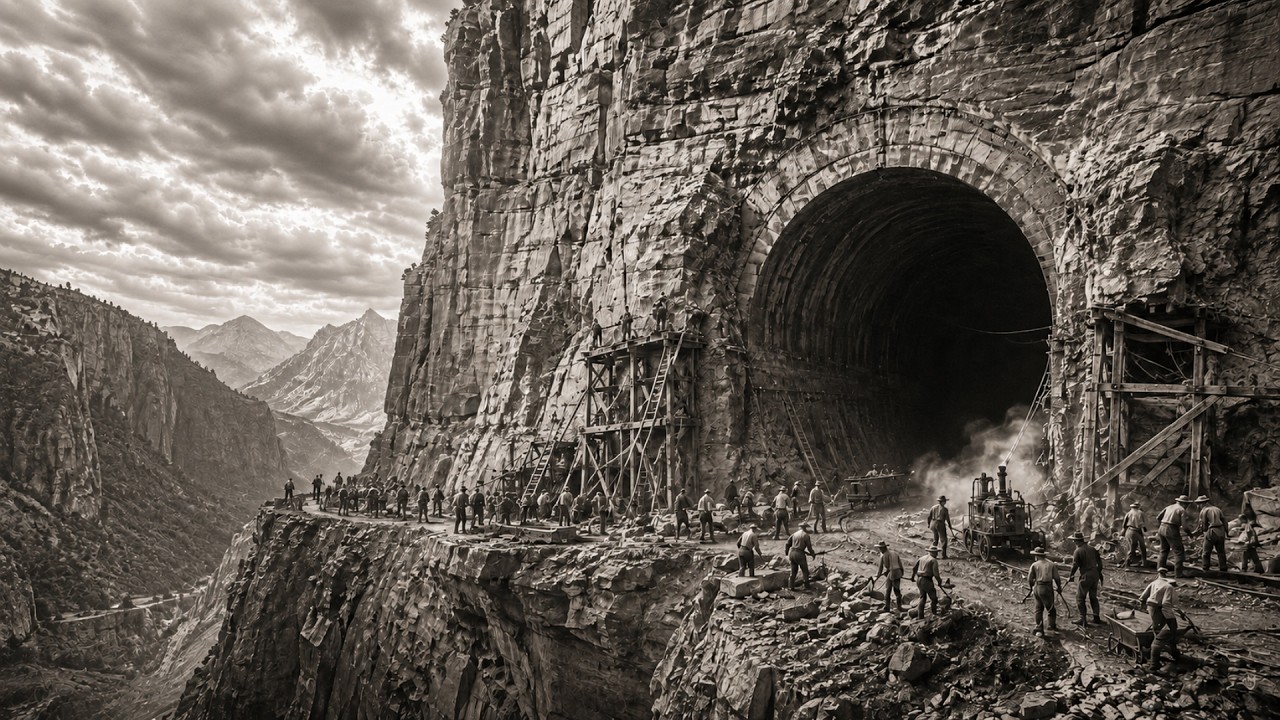
It was fourteen inches wide. Behind him, a void dropped 180 feet to the canyon floor. In front of him rose a wall of orange and cream sandstone, 160 million years old, harder than most people imagine, formed from ancient desert dunes compressed over millions of years into a material that does not break predictably under a drill bit and that releases silica dust so fine it is nearly invisible in the air. He was cutting the access route for the Zion-Mount Carmel Tunnel.
The tunnel would be 5,613 feet long, 1. 1 miles carved through a mountain of sandstone in the walls of Zion National Park. When completed in 1930, it would be the longest tunnel in the United States highway system. The men who built it finished the work in three years.
Their names appear on no marker at either portal. The tunnel opened on July 4, 1930, and the official dedication program listed engineers, administrators, and government officials. The men who held the drills were not mentioned. To understand why anyone would build a tunnel through a mountain in southern Utah in 1927, you have to understand what Zion was and what it was being turned into.
Zion Canyon had been a national monument since 1909 and a national park since 1919. It lay on the red rock plateau of southwestern Utah, a canyon carved 2,400 feet deep through Navajo sandstone, the Kayenta Formation, and ancient Wingate rock. The canyon walls were vertical in most sections. The canyon floor was narrow, and the park was essentially inaccessible.
The only road into Zion came from the south, up the canyon floor. It followed the Virgin River through the canyon on winding paths cut into the lower walls, reached the end of the canyon, a dead end of solid rock, and stopped. There was no road through. The plateau above the canyon, the high desert region known as the Zion and Markagunt plateaus, connected to Bryce Canyon National Park.
To create a tourist route between the two parks, the kind of route that would bring visitors by car rather than by mule, you needed a road across the top. And to reach the top from inside Zion Canyon, you had to go through the mountain. The Union Pacific Railroad understood this before the National Park Service fully did. The company had been developing Utah’s parks as a tourist destination since the early 1920s, running branch lines to Cedar City and busing tourists to the canyon rim.
Their investment logic was simple. The more parks a tourist could reach from a single rail hub, the longer they would stay and the more they would spend. The road linking Zion and Bryce was not just a scenic recreational amenity. It was a commercial infrastructure project funded by a railroad company’s budget.
The engineering survey for the tunnel began in 1924. The man who led the effort was a federal highway engineer named Thomas Meanes. Meanes spent several seasons scrambling along the canyon walls above the existing road, searching for the route the tunnel should take. Geology was the deciding factor, as it always was.
The Navajo sandstone forming most of Zion’s walls was not homogeneous. It was made of layers, the surfaces of ancient sand dunes preserved as sheets of varying hardness within the larger formation. Some layers were rich in silica and therefore harder. Others were less consolidated and crumbled when drilled.
The fracturing patterns in Navajo sandstone followed the cross-bedding of the ancient dunes, running at oblique angles, neither vertical nor horizontal, matching the shapes of the sand dunes that had turned to stone. Blasting in Navajo sandstone did not produce a clean, predictable break the way it did in granite. It tended to follow bedding planes, running along the old dune surfaces, rather than punching straight through them. Meanes needed a tunnel route that stayed within the harder layers as much as possible and avoided zones of weak rock that might collapse under the weight of hundreds of feet of mountain above the tunnel.
He also needed side openings, windows cut through the canyon wall at intervals along the tunnel, for two reasons. First, ventilation. A 5,600-foot tunnel without cross-ventilation would collect engine exhaust within minutes of cars entering it. Second, construction logistics.
The only practical way to remove broken rock from inside the tunnel was to cut openings in the canyon wall and push the debris out. The drop from the openings to the canyon floor below was several hundred feet. The rock fell there and stayed. It is still there today.
If you walk the lower road in Zion and look up at the canyon wall, you can see piles of rock below the side openings where they settled 94 years ago. There are six side openings in the Zion-Mount Carmel Tunnel. Each one is an arch carved into the canyon face, about 25 feet wide and 16 feet high. From the road below, they look like windows.
From inside the tunnel, they look like bright rectangular openings in the wall, the canyon showing through in full color and light. The construction crew used them at once as light sources, ventilation ports, and debris disposal routes. Rubble from the tunnel excavation was loaded into small rail cars inside the tunnel, then pushed to the nearest opening to be dumped. The canyon wall at each opening dropped anywhere from 100 to 400 feet down to the talus slope below.
The broken sandstone from excavating 5,600 feet of tunnel had to go somewhere, and it went straight down. This was the kind of problem that never appeared on engineering drawings. The drawings showed the dimensions of the openings, alignment angles, and structural specifications. They did not show how to cut an opening into a vertical cliff face 300 feet above the canyon floor, with no equipment access from below.
The answer was the same answer it always was. You start from the top. Think about what that required. The canyon walls above the tunnel route were not reachable by any existing road.
No trail reached the specific parts of the cliff where the window openings had to be cut. Before any opening could be drilled from above, the crew had to cut their way along the cliff face at opening level, blasting and chiseling a rock ledge by hand, wide enough to stand on. This was not the tunnel excavation itself. This was the preparation for the tunnel excavation.
Work began by cutting the ledge first. The rock ledge in Zion Canyon in 1927 was a shelf twelve to eighteen inches wide, blasted and trimmed by hand from the orange sandstone, 200 to 400 feet above the canyon floor. It connected to no road. Workers reached it by climbing down ropes anchored from the plateau above and by traversing from adjacent ledges along the cliff face itself.
They carried their tools with them. When a section of ledge was complete, the drilling crews moved onto it and began cutting the openings from the outside in. Each opening required the same sequence of steps: surveying the dimensions of the opening, running drills into the sandstone face, loading and blasting, removing debris, trimming the edges of the opening, advancing inward, and repeating until meeting the main tunnel line coming from inside the mountain. The moment an opening broke through to the inside of the tunnel was a unique moment in underground construction.
The men working from outside could hear the muffled blasts of the crew inside through the rock before the breakthrough came. The stone between them thinned with each round. Then, in one of the blasts, the wall opened and light leaked through. Canyon light, direct sunlight slanting at an angle through the opening’s arch into the darkness of the tunnel.
One of the few personal accounts of the project, a brief note in a construction supervisor’s diary, described it as sudden and absolute. Light appearing where there had been only a closed rock face. The inner tunnel excavation was a separate, equally difficult process. The main tunnel was driven from both portals at once, east and west, crews working toward each other through the mountain.
The east portal sat at the base of the plateau above the canyon. The west portal opened onto the canyon wall itself, above the switchbacks leading back down to the canyon floor. From the west, the crew worked inside the side of the mountain above a steep slope. From the east, they drove into the plateau rock from level ground.
The interior excavation used the same hand-drill-and-hammer method that had built the Grand Canyon trails and the Royal Gorge railway ledges. In 1927, pneumatic rock drills were available and used in parts of the work, especially for the larger-diameter rounds in the center of the tunnel, but pneumatic equipment required running compressed air lines through the tunnel from a compressor at the portal. In the early stages of excavation, before the openings were cut, the compressed air lines also served as the primary source of ventilation. The air you breathed inside the tunnel came from the same compressor that powered the drills.
Water made everything worse. Navajo sandstone holds large amounts of groundwater. As the tunnel advanced through the mountain, seepage appeared in the walls and ceiling wherever the drill penetrated water-bearing fracture zones. The seepage mixed with drill dust and coated the tunnel surfaces.
The floor became a mixture of fine sandstone dust and groundwater that had to be removed before the muck car tracks could operate. Men walked through it for the entire shift. Their boots never dried between the morning descent and the evening climb back to the portal. The heating and cooling cycle inside the tunnel was its own problem.
Summer temperatures outside in Zion reached 105 degrees on the canyon floor. Inside the tunnel heading, the temperature held at about 55 degrees Fahrenheit. Cold enough to stiffen hands already aching from vibration and wet with seepage. Men came in from the heat, worked for hours in cold and damp, then came back out into the heat.
The body does not handle that transition well over the course of months. There is no historical record of what it did to the men who did it daily for three years, because no one recorded it. The dust was the primary hazard, and it was the one that lasted longest. Navajo sandstone is about 90 percent quartz silica.
When drilled, it produces dust fine enough to stay suspended in the air for hours. In a tunnel with limited ventilation in its early stages, before the side openings were cut, dust density inside the heading reached levels now known to cause irreversible lung damage within years of continuous exposure. The men drilling inside Zion Tunnel in 1927 and 1928 did not know this. Silicosis was not officially recognized as a documented occupational disease in American law until the 1930s.
The relationship between silica dust and lung damage was known in the medical literature, but it had not reached the level of enforcement, or even general contractor awareness, that would have changed construction practices. They drilled without water to suppress dust at the bit for most sections. They wore no respirators. They breathed what the rock gave them, and the rock gave generously.
Wages on the project ranged from $3. 50 to $4. 50 a day for common labor, rising to $5 and above for skilled drilling and blasting work. In today’s terms, that is roughly $60 to $90 for a ten-hour shift in a tunnel where the temperature held at 55 degrees, where humidity was high from groundwater seeping through the sandstone, where the floor was a mixture of dust and water, and where the noise of drills, blasts, and compressed air lines made communication inside the heading nearly impossible without direct physical contact.
The workforce was drawn mostly from southern Utah. Washington, Iron, and Kane counties supplied most of the common labor. These were men from Mormon agricultural communities who had built their lives on land that did not reward easy effort. Men who understood rock and desert and heat, and who could be paid wages that reflected the lack of alternatives in the regional economy.
Some had worked on road construction elsewhere in Utah’s park system. A smaller number were Southern Paiute laborers whose knowledge of this exact terrain ran deeper than any survey crew that ever walked it. The Paiute had named the waterways here. They had moved through the canyon walls seasonally for generations.
They understood sandstone behavior in ways no engineering manual described. They appear in payroll records as laborers. That is the only word used. No further definition.
No distinction between a man who had never seen a canyon and a man whose grandfather’s name was on the canyon’s waterways. The contractor was Utah Construction Company, an Ogden firm that had built railroads and irrigation works throughout the interior West. They had experience with rock work in difficult terrain. They had no experience with a tunnel this long, in this geology, at a site with no road to the work area on one end and a 300-foot rock slope on the other.
Consider the specific problem they had to solve at the west portal, the problem no survey could predict until the crew stood in front of it. The west portal opened onto the canyon wall above a winding road descending back to the canyon floor. The switchbacks themselves had to be carved into the cliff face before the portal could be built, because they were the only access route for the west portal crew. The tunnel could not be driven from the west end until a road reached it, and that road could not be built until it was first cut into the canyon wall above the existing road at the bottom.
There are six switchbacks in the road leading to the tunnel’s west portal. They drop 800 feet over about 1. 2 miles, cut into a canyon wall that offers no natural ledge system, no suitable fracture planes, and no margin for error in grade calculations. Since the tunnel portal had to reach a specific elevation determined by the tunnel line inside the mountain, the road had to arrive at exactly the right height.
The switchback crew worked from the top down, cutting each switch into the cliff face before moving to the next. In the tightest switchbacks, the cliff overhung the road level so severely that blasting from outside the face was impossible without risking the overhang above. Those sections were handled from inside. A small drilling crew entered the cliff face on a narrow initial ledge and drilled from within a shallow cavity in the rock, blasting the rock outward instead of inward.
It is a technique that reverses the usual logic of road building and requires a precise understanding of how a blast propagates through stone, not just knowledge of which way the hole points. The men who made those calculations were not engineers. The engineer had set the road’s route and grade. The decision of where to place each hole, at what angle, and how much powder to load into it, was made by the head driller on site.
He probably made $5 a day. His name appears in no document. The tunnel breakthrough, the moment the east crew met the west crew inside the mountain, came in late 1929. The alignment error was less than eight inches over 5,613 feet of independent excavation from two portals through solid rock using hand tools and survey compasses.
That is a deviation of less than one hundredth of one percent over more than a mile of tunnel, achieved without laser guidance, without GPS, without any instrument more advanced than a surveyor’s level and a steel tape. The survey crew that achieved that alignment is documented by name in project correspondence. Their foreman, their rodman, and their tape man appear in the records. The drilling crews who held the line through 5,613 feet of bedded sandstone, who made the daily decisions that kept the heading on the survey angle round after round, blast after blast, appear in the payroll records as common laborers.
The final work after the breakthrough took months. The tunnel walls were smoothed by hand after every blast round. The trimming required a man to work across the blast face with a chisel and a short hammer, removing the rough protrusions left by the explosives and leveling the wall surface. The trimming marks are still visible today in the tunnel’s dim light, overlapping arcs across the orange sandstone, the pattern of a man’s arm swinging a tool in steady rhythm across a surface meant to last.
It has lasted. The chisel marks on the walls of Zion Tunnel are as sharp today as the drill marks in the Redwall limestone of the South Kaibab Trail. The sandstone is soft enough that the human trace of labor has not eroded. The rock preserves it as it preserves everything, without comment, without preference, without knowing whose hands made the marks.
The tunnel was finished in the spring of 1930. The access road, the openings, and the interior finishing work were complete by June. The official opening was set for July Fourth. Utah Governor George Dern attended.
National Park Service Director Horace Albright attended. Representatives of the Union Pacific attended. A program was printed for the ceremony. Speeches were given at both tunnel portals.
The ceremony was covered in newspapers as far away as New York. The program did not list the names of the workers who had spent three years inside the mountain. Many of them were present as spectators only. This is what I keep coming back to when I study construction records from that era.
The most precisely documented thing is the engineering, the survey calculations, the blast records, the materials invoices, the engineers’ weekly reports. These are detailed and carefully preserved. The least documented thing is the human beings. Names appear in payroll records and then disappear.
There are no photographs of the drilling crews who worked inside. There are no foremen’s memoirs. The documents that survive describe what was built. They do not describe who built it, or what building it cost them in the years that followed.
The National Park Service did not consider that documentation to be within its mission. The tunnel was the achievement. The process was an essential tool for that achievement. The men who carried out the process were essential to the process itself.
That is the logic by which a name disappears. Zion Canyon receives about 4. 5 million visitors a year. Nearly every visitor drives through or alongside the Zion-Mount Carmel Tunnel.
The tunnel carries traffic six days a week, eleven months a year. Vehicles longer than 13 feet require a permit because the side openings cut as ventilation shafts and debris chutes in 1927 and 1928 are also what allow large vehicles to pass through the tunnel’s 11-foot clearance. The openings are the reason modern vehicles can negotiate the tunnel at all. They were the solution to a logistical problem no one anticipated before the crew reached the cliff face.
They are now the feature that keeps the tunnel functional after 94 years. The National Park Service website describes the tunnel as a remarkable engineering achievement. It does not name a single person who built it. There is a memorial plaque at the east portal.
It lists the names of Utah highway officials and federal administrators who oversaw the project. It notes the year of completion. It does not mention Utah Construction Company. It does not mention a single worker.
The switchbacks at the west portal are often described in travel literature as one of the most beautiful stretches of road in the American Southwest. People stop to photograph them. The photographs show the red canyon wall and the pale ribbon of road crossing back and forth across the cliff face. They show the mountain and the light and the color of the stone.
They do not show the rock ledges from which the road was cut. They do not show the men who stood on those ledges before the road existed. The tunnel is 1. 1 miles long and has been in continuous use for 94 years.
The sandstone it passes through is 160 million years old. The difference between those two numbers, 94 years of use against 160 million years of formation, is the human interval. The tunnel exists in a gap between one geological time and another. It is three years of work inside that vast span.
And inside it, if you stop and look at the walls in the dim light of an opening before traffic starts up again, you can still see the drill marks pressed into the sandstone. Circular impressions left by star drills held by men on rope seats above the canyon floor. The sandstone is so soft that the marks have not faded in 94 years. They look fresh.
They look like someone was here this morning. Someone was here, in a season no one recorded, breathing dust that would take years to finish its work, carrying the face round after round toward a light they could not yet see on the other side. The canyon winds move through the openings in summer, through the cold interior of the tunnel and out the portal on the other side. You can hear it if the road is quiet.
It sounds like the canyon breathing. There is nothing in the wind that remembers the cost of opening those windows, but the drill marks on the wall remember. And if you put your hand over one in the dim opening light, it fits your palm exactly. It is hand-sized, which means someone was there.
And what they did inside that mountain, in the cold and the dust and the noise, while the rock resisted and the canyon waited below, is something that has not worn away in 94 years of trying. The canyon is patient. But so is the work.
