In the final week of December 1944, in a frozen pine forest east of Bastogne, a German soldier lay in a hole he had scratched into ground so hard his digging tools rang against it. He knew exactly what was keeping him alive. He knew the value of the fog, which had hung over the Ardennes for a week like a low gray roof, grounding every Allied aircraft in northwestern Europe. He knew the value of the hole.
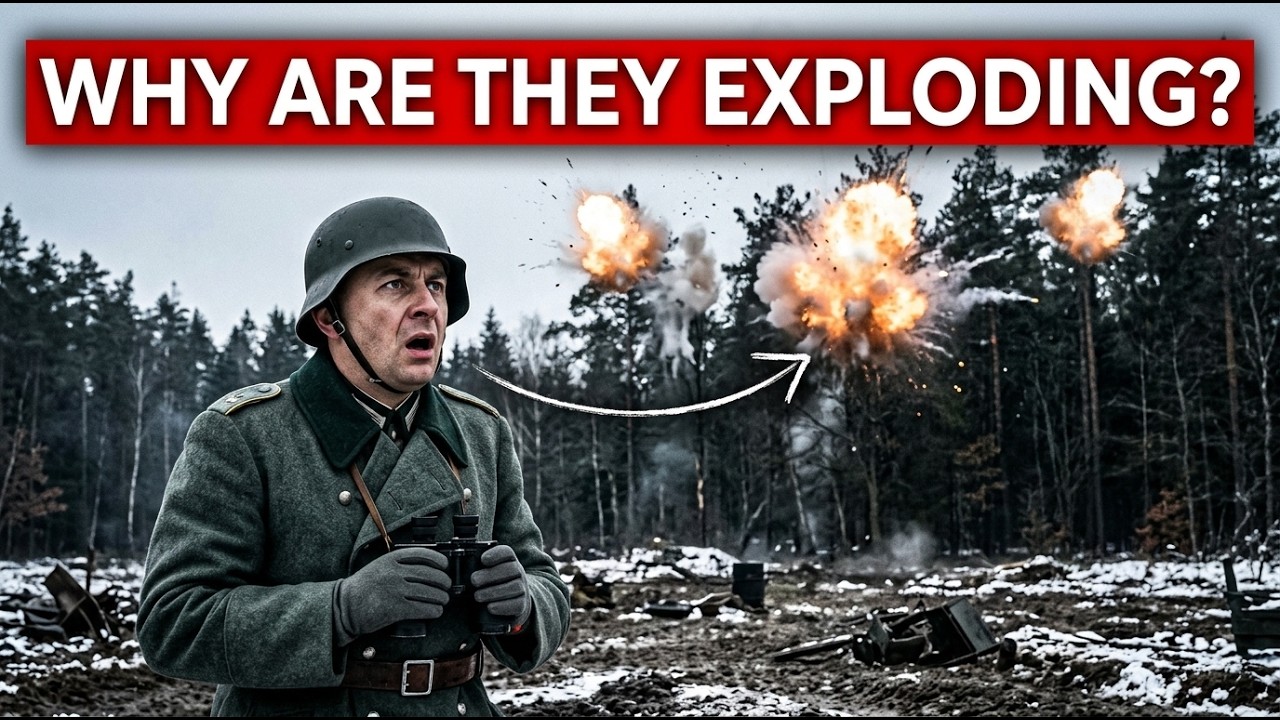
A shell that strikes the earth throws its fragments upward and outward in a flat, low fan, and anyone below that fan is safe. He had learned these calculations in training and relearned them through four years of survival. So when the American guns opened up, he did what he always did: he lay flat and waited. But the shells did not hit the ground.
Twenty feet up, or fifty, above the pines and above his hole, they burst in the air, over open ground where nothing stood to catch them. The fragments rained down. Not outward. Down.
Into the hole. Onto the men beside him. Every man on that hill reached the same conclusion, because it was the only one available. The Americans had found a way to make every shell explode in the treetops.
Every single one. Without ranging shots, in the fog, in the dark, over ground with no trees at all. They were wrong. What was above them was not a trick of artillery and not a new kind of tree burst.
It was a radio and a glass battery and five vacuum tubes the size of a man’s thumb, packed into the nose of an artillery shell, promoted to the world under a name that was a deliberate lie. This is the story of the proximity fuze, the two years it spent locked under a security order prohibiting the army from firing it over land, and the word that came over the wire in December 1944 to break the locks. The Ardennes in December 1944 was a country of steep wooded hills, narrow roads, and deep snow, in a weather system that behaved like a weapon. Fog every morning.
Low clouds that would not clear. Temperatures that froze the grease in machine guns and the fuel in trucks. From December 16, when the offensive began, until the sky finally opened on the twenty-third, Allied air power was effectively absent from the battlefield. Every German commander in the operation had planned for exactly that.
The weather was not luck. It was part of the plan. What remained was artillery. In fog and dark, an American observer could not see the target, fighter-bombers could not fly, a tank could not identify what it was shooting at.
But a howitzer could still fire, because a howitzer does not need to see anything. It needs a map, a survey, and a set of numbers. The problem was what the shell did when it got there. The German soldier’s confidence was not born of stupidity.
It was mathematics, and it had held every time he had tested it. A 105mm shell with an ordinary point-detonating fuze strikes the ground and bursts at ground level. Much of its energy goes into the earth, and much of its fragments go upward at an angle. Against men standing in the open, it is deadly.
Against men lying down, far less so. Against men in a hole, it is nearly useless unless the shell lands directly on top of them. Soldiers on every front had learned this and dug accordingly. The deeper the hole, the more the math favored the man inside it.
There was only one answer to the hole, and every artillery officer in every army knew it. You do not try to hit the hole. You burst the shell in the air above the target and let the fragments fall through the open top. The Americans had a way to do this, and it was a bad one.
It was called a time fuze, and it worked exactly as it sounded. Before firing, a crewman set a mechanical ring on the nose of the shell to a number of seconds, and the fuze burned down and detonated when the time elapsed. To get that explosion at the right height over the right spot, you needed an accurate range, a calibrated tube, knowledge of air temperature and powder temperature and upper winds, and then a forward observer who could see the bursts and correct them. You needed ranging shots first, then correction, then fire for effect.
Every part of that was costly. It took time, which nobody had in a mobile battle. It revealed intention, because ranging shots told the enemy something bigger was coming. It consumed ammunition on shells that had not yet hit anything.
And it depended entirely on an observer who could see the target, which in the fog of the Ardennes at three in the afternoon in a pine forest meant it depended on nothing. Even when done perfectly, it was inconsistent. Fuzes differed. Guns differed.
A battery firing a time fuze mission scattered its bursts across a range of altitudes. Some too high to matter, some low enough to hit the ground and waste themselves, and only a small fraction in the useful band. There was a second method, and it was the reason the Germans assumed treetops in the first place. In heavily wooded areas, you can fire ordinary impact shells into the crowns of trees and let trunks and branches do the work of the fuze.
The shell hits a tree at fifty feet, bursts there, and rains shrapnel and splintered wood on everything below. Both Americans and Germans used it and both feared it. In the Hürtgen Forest that autumn it had been horrible on both sides. So when shells began bursting overhead in the Ardennes, the German soldier reached for the explanation he had: tree bursts.
The Americans had gotten very good at tree bursts. The explanation collapsed the moment the same thing happened over a snowfield with nothing on it. What was in the nose of those shells had begun as an idea nearly everyone in the field considered impossible, and it had come to the Americans partly as a gift. In 1940, when Britain stood alone and expected invasion, a delegation led by Sir Henry Tizard crossed the Atlantic carrying the best of British military science in a black metal box and handed it to a country not yet at war.
Most attention goes to the cavity magnetron, which made centimetric radar possible. In the same package was British work on a fuze that could detect its approach to a target and detonate itself. The idea was old; the engineering was thought to be out of reach. Put a small radio transmitter-receiver in the nose of a shell.
Have it broadcast continuously and listen for its own signal returning from anything ahead. As the shell closes, the return signal shifts and strengthens in a recognizable way, and at the right moment the circuit closes a switch and detonates the shell. On a laboratory bench with unlimited time, this is hard. In an artillery shell, it borders on the absurd.
When a naval five-inch gun fires, everything inside the shell experiences acceleration of roughly twenty thousand times gravity. A glass vacuum tube weighing a few grams briefly weighs as much as a bag of cement. Then, once out of the muzzle, the shell spins at hundreds of revolutions per second for stability, which flings any loose component outward with ferocious force. The device had to survive both, then work reliably after seconds, having sat in an ammunition depot for a year beforehand.
The work moved to Section T of the National Defense Research Committee, then to the Applied Physics Laboratory at Johns Hopkins under a physicist named Merle Tuve. His team solved the problems one by one in ways that looked improvised but were not. The tubes came from the hearing aid industry, which made the smallest vacuum tubes in the world, then rebuilt them with sturdier internal supports and shorter elements until they could take the shock of launch. The battery was the most ingenious part.
An ordinary battery that sits in storage for months goes dead, and no army wants ammunition whose fuzes have quietly died inside their crates. So they built a battery with no electrolyte in it. The acid was sealed in a small glass ampoule inside the fuze, chemically separate and stable indefinitely. The shock of launch shattered the ampoule, and the shell’s spin drove the liquid onto the plates, bringing the battery to life within a fraction of a second of firing.
The fuze was inert in the box and inert in the loading chamber. It became a working electronic device only after the gun had already fired it. Then they named it. Someone decided its security would be strengthened by a name that misled the listener, so they called it the VT fuze, for variable time.
Anyone who heard that term would assume it was a development of the time fuze the world already knew. It was not that at all. The deception was built into the terminology from day one. The scale of what followed is not widely appreciated.
The program cost around a billion wartime dollars, and roughly twenty-two million fuzes were produced by companies such as Crosley, Sylvania, General Electric, Eastman Kodak, and RCA. Factories that had made radios and camera parts and hearing aids now produced precision electronic assemblies designed to destroy themselves on first use. Vannevar Bush, who ran American science during the war, ranked it alongside radar and the atomic bomb as the foremost contributions of the laboratories. And for two years, the army in Europe was forbidden to use it against ground targets.
The reason was sound, and everyone hated it. A fuze that bursts in the air destroys itself. A fuze that malfunctions, which always happens at some rate, falls to earth largely intact. Over water, it sinks and vanishes.
Over enemy-held land, it ends up in the hands of a German technician. The Germans had their own proximity fuze research and lacked only the manufacturing solutions the Americans had spent two years developing. The nightmare was specific and not paranoia. Allied bomber streams flew daily through German flak belts.
If German 88s fired shells that burst automatically at the right altitude inside a bomber formation, the cost of the air campaign would become unsupportable. So the fuze went to sea first, where duds sank. On January 5, 1943, the cruiser USS Helena shot down a Japanese plane in the Solomons with a five-inch shell carrying a proximity fuze, the first such kill. Within a year the Navy’s anti-aircraft artillery had been transformed.
Then it went to England. In the summer of 1944, V-1 flying bombs came over in large numbers, and the belt of guns on the south coast fired at a small, fast machine flying in a straight line at constant altitude, a perfect target for a fuze that required only proximity. Combined with the SCR-584 gun-laying radar and the M9 electrical director, the results by the end of that campaign were exceptional. The vast majority of bombs that entered the belt were destroyed before passing it.
The unexploded bombs fell into the Channel and into British fields under army control. Over the front lines in France and Belgium, it remained forbidden. Field artillery officers knew it existed. They knew what it would do to infantry in the open.
They were not permitted to have it. The Battle of the Bulge broke the ban. Accounts differ slightly on the exact date the authorization took effect, and it is worth noting rather than hiding that you will find different dates in different books. What is undisputed is that in the second half of December 1944, with two German armies advancing west through the American center and Allied air power grounded by weather, the restriction on land use in Europe was lifted and artillery battalions were informed they could fire it.
The word issued to describe it was “poose it. ” That was the code word included in firing missions and radio traffic, and for a battery officer who had spent months hearing rumors, it meant one thing. Fire it. Do not estimate range.
Do not adjust the burst height. Do not wait for an observer to walk corrections. Send it and it will burst where it should burst. What made it so violent in that particular battle was the set of things it eliminated.
It eliminated ranging. A time fuze mission announced itself. A proximity fuze mission arrived complete in the first volley, meaning the Americans could drop an entire battalion’s fire on a road junction with no warning, and combined it with the time-on-target technique the Third Army used heavily, where dozens of batteries from different distances fired at precisely calculated moments so every shell in the mission landed in the same few seconds. There was no first round to take cover from.
The first thing the target knew was everything at once, in the air above its head. It eliminated the observer. The fuze did not care whether anyone could see the target. It measured its own height above whatever was beneath it.
Fog, snow, dark, smoke, none of it mattered to a radio. It eliminated terrain. Tree bursts needed trees. This needed nothing.
Over bare snowy slopes, over a frozen field, over a crossroads, the burst occurred at the same height as anywhere else. The rifleman in his shallow hole in frozen ground, moving for days in an offensive, has no overhead cover because overhead cover means cut logs and hours of work, and you do not build that while advancing. Everything he learned to do was the correct response to a shell bursting at ground level. But this shell bursts eighty feet above his head, and the fragments arrive as a cone directed downward, making the hole he lies in a bowl collecting them.
There is no response available to him. He cannot dig deeper; the ground is frozen and there is no time. He cannot run; movement in the open under airburst fire is the worst possible option. He cannot disperse enough to matter, because the pattern covers an area, not points.
He cannot shoot back at the source, because it is four miles away and he has never seen it. He cannot even get the simple comfort of understanding it. Around Bastogne on Christmas Day, when the Germans made their strongest attempt on the perimeter and advanced across bare white ground in daylight, the American artillery firing this ammunition caught infantry in the open with nothing between them and the sky. The same thing happened at road junctions and assembly areas across the salient for the last week of the month, at night and in bad weather, against targets nobody had seen.
The judgment comes from three directions, and they agree. The first is the men under the fire. German prisoners taken during and after the offensive were questioned, as prisoners always were, and what they described was an American shell that burst in the air every time, which they could not explain and could not counter. They discussed it among themselves as though it were a new weapon rather than a new technique.
The belief that the Americans had somehow mastered automatic tree bursts lasted a long time and accompanied them into the interrogation tents. The second is Patton. He wrote to Major General Levin Campbell, chief of ordnance, about the effect of the new ammunition on the fighting in front of the Third Army. He called it the new shell with the funny fuze and said plainly that it was devastating, and that when every army had it, war would have to be fought differently.
The third is the math done afterward. The American evaluation of the two fuzes against troops in the open found the proximity fuze several times more effective per shell than a standard impact fuze. Against troops in positions without overhead cover, the gap was wider. Same weight of shells, same guns, same crews.
One small thing different in the nose of the shell. The honest part must be stated plainly, because it belongs to the story rather than being buried after it. There is no captured German document in which a Wehrmacht artillery officer mentions the American proximity fuze and records what it did to his battalion. The German-side judgment is what American interrogators recorded from frightened prisoners, American after-action reports, and postwar evaluation.
It is good evidence and consistent evidence, and it is not the same thing as a German staff study. The fuze also did not decide the Bulge, a claim sometimes made with too much ease. The German offensive was defeated by a long list of things, most of them about men. Engineers who blew bridges ahead of armored columns minutes before they arrived.
The 101st Airborne and the armor and artillery with them who held a road center while surrounded. The Third Army turning north in weather that was supposed to make it impossible. The infantry and gunners at St. Vith and the Elsenborn Ridge who simply did not give way.
The German fuel situation, or lack of it, since the entire plan depended on capturing American stocks and the plan failed at that. The sky cleared on the twenty-third and the fighter-bombers came out, and that mattered enormously. The proximity fuze arrived in the middle of it all as an accelerant. It made American artillery, already the most organized in the world at fire direction and massing multiple battalions on a single target, several times more lethal per shell against exactly the kind of target the Germans were forced to present: infantry moving in the open by day and night against fortified positions on a timetable.
It arrived at the hour when the weather had stripped away every other American advantage except the guns. The other honest observation is the cost of keeping its secret. For every month the fuze was locked away from land use, American infantry attacked bunkers and fortifications and wood lines without it. The security decision may have been right.
It was not free. Back in that hole among the frozen pines east of Bastogne: the week had begun with a certainty in place since 1940, that the fog protects, that the hole protects, that a shell which cannot see you and cannot fall on you cannot kill you. It ended with a soldier lying under a sky that opened without any of the warning four years had taught him to expect, holding a rifle aimed at nothing, in a shelter that had become a bowl for the wreckage of other men, telling himself the only story that made sense: that the Americans had learned to burst every shell above the treetops. There were no trees over that field.
There was a small radio in the nose of the shell, and a battery made of glass that came alive only after the gun fired it, and a name chosen so that if he ever heard it, he would think it meant something else. He never heard it. That was the point of the name.
