In February 1916, the whistle at the Consolidated Coal mine in Black Rock Hollow, West Virginia, sounded at five in the morning as usual, but Edgar Whitmore did not join the line of men heading into the shaft. The mine supervisor, James Bellwether, noticed his absence immediately. In a company town of fewer than two hundred souls, where missing a single shift could mean the difference between eating and going hungry, unexplained absences were rare and always signaled serious trouble. Edgar had worked the deep seams of Mine Number Seven for eighteen years, since arriving as a young man seeking steady wages.
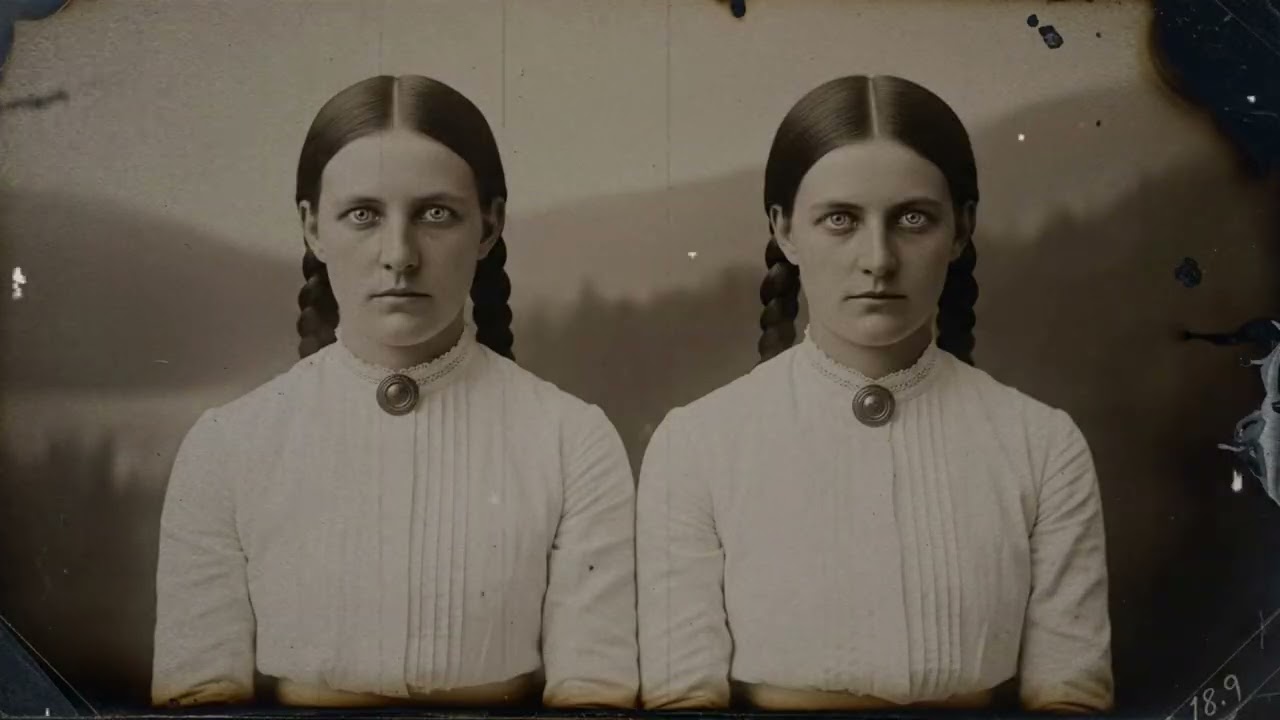
Company records described him as dependable but unremarkable. His wife, Mary, born Caldwell, came from a family rooted in the valley since the first European settlers. Their daughters, Prudence, twenty-one, and Temperance, nineteen, had known no life other than the one governed by company regulations and mountain custom. The sisters were inseparable, often seen walking hand in hand or sitting together on the porch, speaking in voices so low that passersby heard only the rhythm of their speech without distinguishing the words.
The first sign that something was wrong came when Bellwether sent fourteen-year-old Tommy Brennan, a messenger boy, to check on the Whitmore home. Tommy found the windows closed despite the late morning hour, no smoke rising from the kitchen chimney, and a fresh layer of snow on the front steps showing no footprints. After knocking without response, he circled to a side window and looked into the kitchen. What he saw stayed with him for the rest of his life.
The two girls sat motionless at the kitchen table in white dresses, heads bowed as if in prayer. As Tommy watched, one raised her head and turned slightly, revealing a face he recognized as Prudence’s, but her expression was vacant and distant, and her lips moved in an automatic, mechanical way as if reciting a memorized text. The second figure responded in kind, and Tommy watched the two conduct what appeared to be a conversation with unseen participants. Bellwether chose two experienced miners, Harold Vance and Samuel Coker, to accompany him to the house.
They found the front door open, the interior undisturbed, and the kitchen table set for four with no food prepared. A pot of coffee sat cold on the stove. In the front room, Prudence and Temperance sat side by side on their mother’s wooden bench, hands in their laps, eyes fixed on a distant point beyond the closed windows. They wore identical white cotton dresses their mother had sewn for church services, their dark hair braided neatly.
When Bellwether asked where their parents were, Prudence answered in a strange, singsong tone: They have gone to prepare the way. Temperance added immediately: The way must be prepared before we can follow. The sisters spoke as though sharing a secret of great importance that required careful explanation. Asked when they had last eaten, Temperance replied that earthly sustenance was no longer required because they had learned to draw nourishment from what the mountain provided.
Prudence explained that their parents had taught them to listen to the voice of the mountain and understand its ancient wisdom. The men exchanged glances, recognizing either deliberate deception or a state of mind requiring caution. The search for Edgar and Mary began immediately. Every able-bodied man in Black Rock Hollow joined the effort, dividing into teams that systematically covered trails, abandoned mines, hunting camps, and natural caves within ten miles.
They found nothing. The winter was especially harsh, with frequent snowfalls that would erase any tracks within hours. Experienced woodsmen noted that the couple would have needed exceptional skill and preparation to travel far from the settlement in such conditions, especially without appropriate winter clothing or equipment. Attention turned to the possibility of an accident.
Abandoned mine shafts dotted the mountains like honeycombs, many unmarked and unsecured. One shaft about three miles from the Whitmore home showed recent activity, with broken branches and disturbed snow suggesting someone had passed through the area. Harold Vance volunteered to be lowered into the shaft. He found no evidence of recent human presence in the accessible sections, though he noted several passages extended beyond the reach of his lamp.
While the search continued, the sisters remained in the family home, seemingly unaffected by their parents’ disappearance or the intense efforts around them. Neighbors reported seeing them standing motionless at their windows, staring at the mountains with patient, waiting expressions. Mary’s sister-in-law, Hester Caldwell, took responsibility for watching over them. She later told investigators the sisters ate very little, consuming only small amounts of bread and water while maintaining their appearance and activity level.
Most disturbing was their habit of conducting long conversations with invisible participants at all hours, speaking in animated tones to empty chairs and vacant corners. At times they prepared meals for four people, serving food to empty chairs as though their parents were present. The community’s growing concern led the Methodist minister, Joshua Mills, who had baptized both sisters, to attempt a pastoral intervention. His diary, discovered decades later during the demolition of the old church, documented his visits.
On his first call, the sisters greeted him politely and offered him coffee, but their conversation consisted mostly of Bible quotations removed from context. When asked about their parents, Prudence quoted Ecclesiastes: To every thing there is a season. Temperance added from John: In my Father’s house are many mansions. When Mills attempted to pray for the family’s reunion, the sisters gently but firmly corrected him, explaining that prayer was unnecessary because their parents had already reached their intended destination and were waiting for their daughters to complete the necessary preparations.
Mills found the atmosphere oppressive, describing difficulty breathing despite the cold mountain air and the impression that the house contained more occupants than were visible. His second visit, accompanied by the settlement’s part-time physician, Dr. Margaret Ashworth, proved more troubling. The doctor’s examination revealed no signs of illness or neglect but noted behavioral patterns suggesting possible mental deterioration.
The sisters displayed what she called selective awareness, answering some questions normally while ignoring others entirely. Their synchronized movements and speech patterns had become more pronounced, creating the impression of a shared consciousness. On March 15, Mills made his final visit, against the doctor’s advice but at the urging of concerned community members. He found the sisters in their parents’ bedroom, each holding pieces of clothing belonging to Edgar and Mary and conducting animated conversations with these inanimate objects.
When he attempted to interrupt, the sisters turned toward him with expressions of mild annoyance, as though he had rudely interrupted an important family discussion. Prudence explained that their parents were sharing crucial information about the preparations required for the family’s eventual reunion. The sisters then resumed their conversations, ignoring the minister completely. Mills fled the house in considerable distress, convinced the sisters had surrendered to a form of madness beyond traditional help.
The turning point came on March 22, when unseasonably warm weather caused a rapid thaw that revealed disturbing evidence in the mountains above Black Rock Hollow. Calvin Porter, a hunter who supplemented his mining income by selling furs, discovered signs of fresh digging in a remote clearing about two miles from the Whitmore home. Hidden among dense mountain laurel and accessible only by a narrow deer trail, the site showed clear evidence of deliberate excavation and refilling despite frozen ground conditions. The rectangular hole measured approximately twelve feet by six feet and extended at least three feet below the natural ground level.
The work showed signs of careful planning and execution, with soil arranged in neat piles and edges cut with geometric precision. The investigating team uncovered a collection of personal belongings arranged with ceremonial care. Edgar’s work coat lay spread out in the shape of a human body, his boots at the foot position, his hat where the head would rest. Every button was fastened, every fold smoothed, creating the strong impression of a man laid out for burial despite the absence of any actual human remains.
Mary’s Sunday dress was arranged similarly beside her husband’s clothing, positioned to suggest the couple lay side by side in eternal rest. Her personal jewelry, a simple wedding ring and a small silver necklace that had belonged to her mother, was placed at the collar just as she would have worn it. Additional items included Edgar’s pocket watch, stopped at exactly 11:47, and a small leather-bound Bible Mary had carried to church. Dr.
Ashworth’s examination revealed no trace of human remains, suggesting this burial represented a symbolic ceremony rather than an actual funeral. The county coroner, Dr. William Ashworth, conducted the official inquest. The sisters appeared before the committee with the same calm demeanor they had maintained throughout the crisis.
Asked about the buried clothing, Prudence explained that their parents had shed their earthly coverings as part of a transformation that freed them from physical limitations. Temperance explained that the burial represented their family’s adoption of old ways that predated the Christian customs brought by European settlers. They spoke of ancient knowledge passed down through generations of mountain families, traditions hidden from outsiders but preserved by those who understood the mountain’s true nature. The inquest concluded on April 3 with a finding that Edgar and Mary Whitmore were presumed dead based on the discovery of their personal belongings in a ritual burial site, though the absence of human remains prevented any official determination of cause of death.
The sisters continued living in the family home. Company security personnel assigned to observe them documented increasingly disturbing behavior, including nightly rituals in the backyard involving the burial of small objects and the creation of geometric patterns using stones and organic materials. Most troubling were the sisters’ regular nighttime excursions across difficult mountain terrain that experienced woodsmen considered dangerous or impassable, following routes that avoided established trails and leaving no trace. Attempts to track them always failed, with the sisters seeming to vanish into the forest, followed by an strange silence that disoriented even veteran trackers.
In October 1916, a security team reported witnessing what appeared to be a large gathering or ceremony involving multiple participants at the Whitmore property. When they approached for a better view, they found only Prudence and Temperance alone in the backyard, smiling gently as though expecting them. The guards reported hearing multiple voices and seeing additional figures moving among the trees, but their attempts to photograph or document the event failed completely, with cameras malfunctioning and written notes becoming illegible. After this incident, many security men requested reassignment, citing disturbing dreams and persistent anxiety.
The company formally ended its investigation, recommending that the sisters be encouraged to move away from Black Rock Hollow. The question became moot in November 1916, when the sisters disappeared from their home. Hester Caldwell noticed no smoke rising from their chimney for several days. She found the house empty, with no signs of hasty departure, struggle, or travel preparations.
The sisters left behind all their personal belongings, including clothing, household items, and the family’s few valuables. They took no food supplies or equipment necessary for travel, especially with winter approaching. The case attracted the attention of Dr. Marcus Eldridge, an anthropologist from the University of Virginia, whose 1917 research focused on pre-Christian belief systems surviving in isolated mountain communities.
His fieldwork in McDowell County revealed that some families had preserved elements of pre-European spiritual practices, often blended with Christian teachings. Eldridge found that the Whitmore family, particularly through Mary’s Caldwell lineage, had connections to families known for preserving ancient mountain knowledge. He hypothesized that the stress of their parents’ disappearance drove the sisters to embrace alternative belief systems that offered explanations and comfort unavailable through traditional channels. Eldridge’s research was cut short by personal difficulties that arose during his extended stay in the region.
His letters described increasing anxiety and sleep disturbances that began after he spent several nights alone in the abandoned Whitmore house. He wrote of vivid dreams involving conversations with the missing family members and a growing sense that his presence was unwelcome to unseen occupants. His final letter, written in October 1917, described his decision to abandon his research and return immediately to the university, having completed less than half his intended fieldwork. He published no significant research for more than five years afterward and never again conducted fieldwork in isolated communities.
The most significant development occurred in 1923, when mining operations uncovered human remains in a natural cave system not previously identified in surface surveys. Initial exploration revealed evidence of long-term human habitation, including primitive tools, pottery fragments, and what appeared to be deliberate burial sites. The remains of a male and female adult who had died approximately five to seven years earlier were recovered, placing their deaths within the timeframe of the Whitmore disappearance. The bones showed no evidence of violence or trauma, and their positioning suggested peaceful deaths rather than accident or attack.
The remains were accompanied by personal items matching descriptions of the missing parents’ possessions. The cave also contained evidence of more recent human presence, including clothing remnants, food containers, and other items suggesting someone had lived in or visited the underground chamber regularly. Most puzzling were two sets of women’s clothing, carefully preserved in a dry section of the cave and arranged as though deliberately placed for future use, matching descriptions of the white dresses worn by Prudence and Temperance. A reopened investigation in the 1960s by investigator Frank Morrison produced no conclusive findings.
Some witnesses described encounters with the Whitmore sisters years after their disappearance, finding them unchanged despite the passage of time. One elderly woman, Martha Brennan, described meeting them on remote mountain trails where the sisters demonstrated knowledge of community events that occurred after their supposed departure, including births, deaths, and family developments, as well as intimate knowledge of her own personal experiences and private concerns. The investigation closed in 1964, with the final report acknowledging the unusual circumstances but attributing unexplained elements to the unreliability of witness memory over time and the tendency of isolated communities to amplify mysterious events through repeated retelling. The case became the subject of intermittent academic study.
A 1969 sociological analysis by Dr. Dwayne Whitfield examined the case as an example of how isolated communities process traumatic events and integrate them into collective narratives, arguing that the mystery served important social functions by providing a framework for discussing fears that could not be addressed through conventional means. Whitfield’s research was also interrupted by personal difficulties, with his field notes showing a marked deterioration in analytical objectivity during his final weeks, replaced by personal and emotional responses to his research subjects. The natural landscape of Black Rock Hollow underwent radical changes over subsequent decades.
Surface mining removed entire mountains, and the community dispersed as mining jobs grew scarce. A historical marker erected in 1976 commemorating the region’s mining heritage makes no mention of the Whitmore family. The cave system where remains were found was closed for public safety, and modern geological surveys have identified additional underground chambers remaining unexplored due to safety concerns and lack of funding. Local folklore maintains that traces of the Whitmore sisters can still be detected by those who know how to look, including reports of geometric stone arrangements in remote forest areas and unusual vegetation patterns suggesting deliberate cultivation.
The most common legend holds that Prudence and Temperance never truly left the mountains but achieved the transformation they sought and continue to exist in a form beyond ordinary physical limitations, serving as guardians of ancient knowledge.






