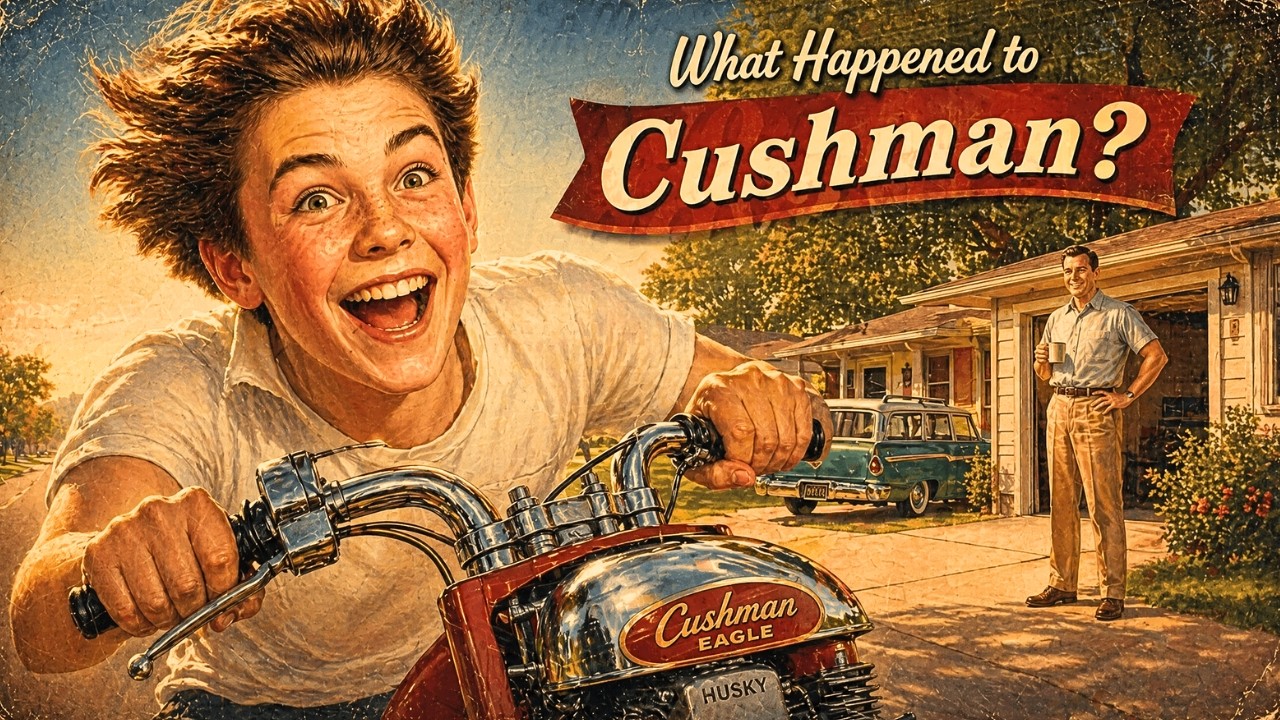
The Cushman Eagle sat in driveways across America in the 1950s with its teardrop gas tank and exposed engine exposed between the rider’s knees. It looked like a Harley-Davidson shrunk down to teenager size, and for a 12-year-old too young to drive a car and too old to pretend a bicycle was enough, it represented pure want. The chrome caught the sun, the whole machine smelled of gasoline and possibility, and every boy who saw one started doing math he had never done before. How many lawns?
How many paper routes? How many months of not buying anything until the number in the coffee can matched the price tag? The story begins in 1901 in Lincoln, Nebraska, with two cousins, Everett and Clinton Cushman, building small gasoline engines for farm equipment such as water pumps, cream separators, and washing machines. When the Depression hit and nobody was buying engines anymore, someone in the struggling factory looked at a husky engine on a workbench and asked what would happen if they put it on wheels and built a scooter.
In 1936 they bet the entire company on it. The machine they called the Autoglide cost less than a used car and got 75 miles per gallon. It sold because even when the world was falling apart, people still needed to get from one place to another. Then the war came.
The United States Army saw the Cushman scooter as something nobody else had seen: a weapon that could be dropped from an airplane. The Model 53 Airborne had a channel iron frame strong enough to survive a fall from the sky. Strapped to a parachute and dropped behind enemy lines in occupied France, a soldier and his scooter would find each other on the ground in the dark, in territory that did not belong to them, and the soldier would twist the throttle and carry messages across terrain no Jeep could reach. Roughly 5,000 scooters fell through the clouds over Europe.
Back in Lincoln, women built every single one, paid 43 cents an hour while their husbands fought overseas. Some of them knew their husbands would never come home. They still showed up at 7:00 in the morning, tightened every bolt, and tested every engine because somewhere out there somebody’s husband was counting on the machine to start on the first try in a field he had never seen. Cushman was the only manufacturer in the country allowed to sell motorized vehicles to civilians during the war.
The government decided the scooters saved so much gasoline that Americans should keep riding them. When the war ended and the boys came home, Cushman took everything they had learned building machines for paratroopers and built a scooter for the group in America who wanted speed more than anybody else: teenagers. In 1949, the Cushman Eagle changed the rules. It was not a utility vehicle anymore.
It had an exposed engine, teardrop fuel tank, sprung leather saddle, wide handlebars, and chrome fenders visible from a block away. Eight horsepower, a two-speed gearbox, and 50 miles per hour if you ducked behind the headlight. In most states you did not need a license. You just needed to be 14.
Suddenly a kid who still got hollered at for leaving his shoes by the door had a machine that could take him anywhere the road went at 50 miles per hour. There was one detail every rider remembers before anything else. The throttle twisted forward, not back like every other motorcycle. The opposite of what your body expected.
The first time you grabbed it, you twisted it the wrong way and nothing happened. Somebody standing behind you laughed. Then you twisted it the other way and the whole machine lurched and you almost fell off the back, and nobody was laughing anymore because you were already moving. You figured it out in three seconds because nothing on earth was going to keep you off that scooter, not the backwards throttle, not your mother yelling from the porch, not the $12 you had to borrow from your older brother who would remind you about it for the next three years.
By 1958, 15,000 Eagles a year rolled out of the Lincoln factory. Cushman advertised a penny a mile, 75 miles per gallon, and $300 brand new. You could buy one at a Cushman dealer or walk into a Sears store and ride out on the same machine wearing an Allstate badge. Mailmen rode them between houses.
Newspaper kids rode them before sunrise. Mechanics on airbases rode them between hangars. The husky cast iron engine could be run hard and left wet and still start on the first kick the next morning. Fathers called them toys but noticed they never once left the rider stranded.
The sound, that flat thump thump you could hear from two blocks away, became the sound of an entire youth. Cushman built stages for kids to climb. The Highlander was the entry point, a step-through frame with 5 horsepower for the kid still figuring out balance and brakes. The Super Eagle came with a full-dress cover over the rear and jet-age body styling.
The Pacemaker and Road King had fins and curves that looked like they belonged on a rocket. Every kid in America was saving, trading, and upgrading, chasing the next step up. Then Honda arrived. Quiet at first, small motorcycles in showrooms that nobody took seriously.
They were lighter, smoother, cheaper, with electric starters, four-speed transmissions, and paint jobs that looked like tomorrow. They made riding look easy. Cushman made riding feel like work you wanted to do; Honda made it feel like nothing at all. Kids who used to beg for an Eagle pointed at a Honda 50, and their fathers said yes because it cost half as much, weighed half as much, and did not leave oil spots on the garage floor.
Cushman was still building scooters around an engine design from 1936. Cast iron in a world switching to aluminum. Two speeds when the kid next door had four. A kick start when the kid across town pressed a button.
By the time Lincoln understood what was happening, it was over. The last Cushman scooter came off the line in 1965. A few leftover Eagles were badged as 1966 models, but the heart was already gone. The factory shifted to golf carts, trucksters, and industrial utility vehicles for airports and malls, machines that moved cargo instead of dreams.
That flat thump from two blocks away went quiet. No ceremony, no speech. The Cushman Eagle simply stopped being made the way a song stops playing when someone turns off the radio and walks out of the room. One day it was there.
The next day the dealership window had something Japanese in it. Decades later, a man driving past a garage sale would see one sitting in a yard, dusty, flat tires, rust where the chrome used to be, and something in his chest would move. The same thing that moved when he was 12 and saw one for the first time. He would slow down and look, and for a second he would be back on that road, 14 years old, throttle pulled forward, wind cutting his eyes.
The company kept going in ways that broke the hearts of anyone who loved the name. It was sold to Outboard Marine, then to Ransoms in England, then to Textron. Each owner was farther from Lincoln and less interested in what Cushman used to mean. The trucksters limped along until 2002.
Those little three-wheeled carts at airports and stadiums are driven by people who have never heard of the Eagle. The factory itself, 15 acres in Lincoln, 250,000 square feet, the building where women assembled airborne scooters for soldiers jumping into France, where the first Eagle was born, was torn down. Every wall, every beam, every square foot of floor where 30 years of American craftsmanship turned metal and rubber into something that felt like flying. It is a parking lot now, part of the University of Nebraska.
Students pull in every morning, grab their backpacks, and walk to class without looking down, unaware that right beneath their feet someone once built the machine that taught their grandfather what it meant to be free. The kids who owned an Eagle, the kids who borrowed one, and the kids who only watched from the edge of a driveway all remember that summer when they figured out something nobody had to teach them: a machine can make you feel alive, speed is not a number, and certain sounds once heard never really leave you, even when the factory is rubble and the engine is rust.
