On the morning of 14 April 1944, a crew from the Royal Navy opened the sea valves in a hollow concrete structure the size of a six-storey apartment block and watched it sink into the shallow waters of the River Hamble estuary on the south coast of England. The concrete walls were four feet thick. Inside, a series of watertight compartments, each sealed with a steel door, were linked by a network of pipes and valves running along the floor of the structure. The unit was 180 feet long and weighed 4,500 tons.
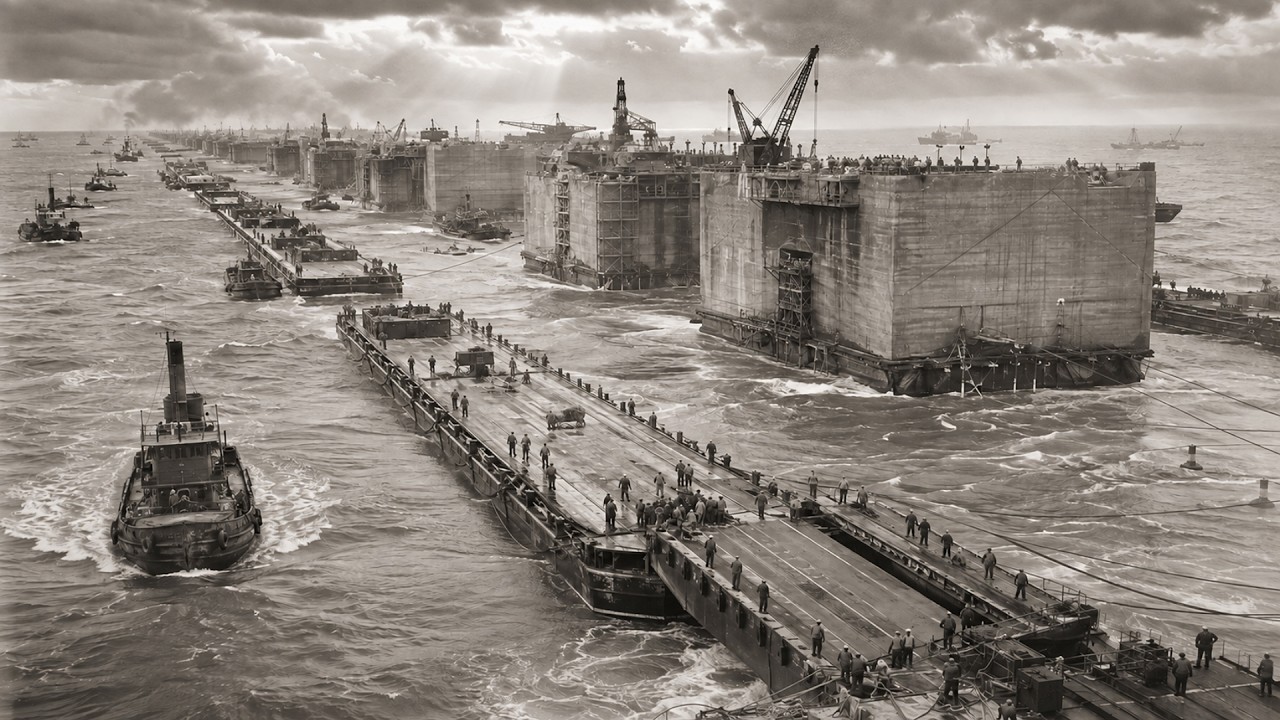
It had taken four months to build. It took fourteen minutes to sink. When the water closed over the top and the last air bubbles faded from the surface, the crew moved to a waiting boat and returned to the construction site. Another Phoenix was almost ready.
There was nothing remarkable about the moment on the surface. The Southampton estuary was crowded with military traffic, and a vessel disappearing beneath the water was not an unusual sight in wartime. What was unusual was that the vessel being sunk was not an enemy ship or a worn-out fishing boat. It was a brand-new structure, purpose-built, deliberately placed on the bottom so that the German reconnaissance aircraft that regularly photographed the English coast would not see it.
The sinking was the means of concealment. The plan was to leave it on the bed of the Hamble for six weeks, then pump it out and tow it to France. There it would join 145 other structures like it on the floor of the Seine Bay, where together they would form a wall. Behind that wall, in the waters it protected, the largest amphibious invasion in history would be supplied.
The thing sitting on the bottom of the Hamble was called a Phoenix caisson. It was one component of a prefabricated harbour known as Mulberry, and Mulberry was the answer to a question Allied military planners had been working on since 1942. How do you supply two million soldiers on an open beach with no port? To understand why the question had to be asked, you have to understand the geography of the French coast and the strategic logic of what the Allies were trying to achieve.
The plan to invade western Europe, carried out on 6 June 1944, required landing Allied forces on the beaches of Normandy and then pushing inland through the German defensive lines to liberate France, Belgium, and ultimately Germany itself. The first stage of that operation, getting troops ashore, was a complex problem that Allied planners had spent two years solving. But the second stage, supplying those troops with ammunition, food, fuel, and replacement equipment for weeks and months of continuous fighting, was a problem that received less attention in public records and was in practical terms just as important. Modern combat forces consume supplies at a rate that is difficult to grasp without numbers.
Allied forces in Normandy needed roughly 15,000 tons of supplies per day once they were fully ashore and engaged in combat. Those supplies came from Britain. They had to cross the English Channel. They had to reach the shore, and there was no port.
The nearest major port to the planned landing beaches was Cherbourg, at the tip of the Cotentin Peninsula, sixty miles west of Omaha Beach. Allied planners knew Cherbourg would be heavily fortified. They also knew, from intelligence reports and the example of the 1942 Dieppe raid, which attempted a direct assault on a fortified port and ended in disaster, that attacking a fortified port would likely produce heavy casualties and destroy the port facilities themselves. When the Germans gave up Cherbourg in late June 1944, they did exactly what the planners had expected.
They destroyed the port so thoroughly that it took Allied engineers until late July to restore even minimal operating capacity. Le Havre was farther away and even more heavily fortified. Brest was three hundred miles from the landing beaches. There was no suitable port between the invasion zone and the front lines that could be expected to survive the initial fighting in working condition.
The alternative was to do without a port. Land supplies across the open beach using landing craft, small flat-bottomed vessels designed to carry troops and vehicles directly to the shore from the sea. Landing craft could reach beaches that large ships could not approach, but their capacity was limited. Each one could carry a few vehicles or a limited load of supplies.
Moving 15,000 tons per day using landing craft alone required a number of vessels and trips that exceeded what the available fleet could provide. Landing craft were also vulnerable to weather. A storm in the Channel could halt landing craft operations for three days, leaving the invasion forces short of ammunition and fuel at a moment when a German counterattack might decide the battle. The planners needed a better solution.
Winston Churchill set the parameters for them in a memorandum dated 30 May 1942. It read in part: “Ports for use on beaches. They must float up and down with the tide. The anchor problem must be mastered.
Let me have the best solution worked out. Don’t argue the matter. The difficulties will argue for themselves. ”
The engineering teams that received that memorandum spent the next eighteen months struggling with the difficulties.
The solution that emerged by the autumn of 1943 was a prefabricated port made of five components, manufactured in Britain and assembled on the French coast in the days immediately following the invasion. The outer component was the Bombardon. It was a floating steel breakwater, cruciform in cross-section, roughly two hundred feet wide at its broadest dimension, anchored in deep water off the beach in a line designed to absorb and disperse the energy of incoming waves before they reached the harbour anchorage. A wave entering the Bombardon field broke into smaller, less energetic waves.
The energy reaching the port was a fraction of the energy in the open sea. The Bombardons were the first line of defence against Channel weather. Behind the Bombardons stood the Phoenix caissons, the main breakwater wall. A Phoenix was a hollow reinforced concrete box, sealed when its internal seacocks were closed, sinkable when they were opened.
Their sizes varied considerably. The smallest units were about sixty feet long and twenty-five feet high. The largest were 204 feet long, 55 feet wide, and 60 feet high, weighing 6,044 tons. A 6,044-ton Phoenix was larger than most buildings in London at the time it was built.
Placed in position and sunk, each one formed a section of the harbour wall. Laid in sequence, the 146 of them formed a breakwater more than a mile long, enclosing a harbour basin of several square miles. Inside the Phoenix breakwater, in the protected waters of the artificial harbour, ships could anchor without the wave action that would have made unloading impossible on an open coast. They transferred their cargo to landing craft and to the third component, the Lobnitz pierhead.
The Lobnitz pierhead was a floating steel platform about the size of a tennis court, mounted on four hollow steel legs that could be driven into the seabed. As the tide rose, the legs held their position and the platform climbed them using hydraulic jacks. As the tide fell, the platform descended. The result was that the pierhead deck remained at a constant height above sea level regardless of the tide, which in the Seine Bay could reach eighteen feet.
A supply ship moored alongside a Lobnitz pierhead found a stable loading platform at exactly the same height at high tide as at low tide. From the pierhead to the shore, cargo moved over the fourth component, the floating Whale roadway. Whale was a system of steel pontoons linked to hinged steel deck sections, so that each section could rotate at its connection points to follow the movement of the sea beneath it. When completed, the roadway ran from the pierhead to the shore as a flexible bridge several hundred feet long.
Trucks drove across it from pierhead to beach as if it were an ordinary road, while the ocean moved beneath their wheels. The fifth component, and the foundation of everything, was the decision to manufacture every piece in Britain, tow it across the Channel, and assemble it on a hostile coast in the days immediately following the invasion. The director of engineering for the project was Brigadier Bruce White of the Royal Engineers. White was not a famous man.
He is not famous now. He was a civil engineer who had spent his career building things under difficult conditions, and he had been given a problem with no precedent in the history of military engineering and about twelve months to solve it. The Phoenix represented the backbone of the harbour and its single greatest manufacturing challenge. One hundred and forty-six reinforced concrete structures, ranging from sixty to two hundred feet in length, had to be built and ready by May 1944.
There was no facility in Britain designed to build reinforced concrete structures of this size in the water. Engineers surveyed the available coastline, river estuaries, reservoirs, and dry docks across the country and commandeered any site that could be adapted. The sites that entered the programme included a stretch of the Thames near Tilbury, the estuary of the Clyde at Port Glasgow in Scotland, the harbour basin at Cardiff in Wales, the estuary of the River Hamble in Hampshire, a flooded reservoir in central England that was drained and converted into a Phoenix construction facility, a former dry dock at Richborough in Kent, and more than a dozen other locations. At each site, a temporary cofferdam was built in the water, the water was pumped out until the inside was dry, then the formwork was erected and the concrete pour began.
The workers who arrived at these sites in the autumn of 1943 were told they were building floating platforms for military use. The supervisors of the workers and the concrete, who were at the sites longer, were told slightly more. None of them were told the purpose of the structures they were building, or their destination, or their timing. The Official Secrets Act was applied at every level.
Workers who asked questions beyond their security clearance were told the information was not available. They were transferred if they insisted. The concrete workers who built the Phoenix worked inside temporary cofferdams that reduced the presence of water but did not eliminate it. Harbour sediments are saturated with water.
You could pump the water out of a cofferdam basin down to the working level, and still water would seep through the clay layers between the sheet piles, or through gaps in the timbers themselves, or through the harbour sediment at the base. The working area inside a Phoenix cofferdam was wet and smelled of salty mud, lit by portable electric lamps on cables strung over the cofferdam walls. In winter, the temperature inside the temporary cofferdam on the Thames was not much different from the temperature outside. Concrete is not poured in the cold the way it is poured in warmth.
Below a certain temperature, the hydration reaction that makes concrete set and harden slows, and below freezing it stops entirely. The winter of 1943 to 1944 was cold on the English coast. The construction schedule did not allow for slow concrete curing. The sites that worked through December and January wrapped the formwork in hessian and straw to retain the heat of curing, and in some cases used portable coal heaters inside the formwork cavities to keep the pour above the minimum temperature required for adequate strength.
When frost hit a pour that had not yet reached sufficient strength, engineers documented the failure, and that section was broken out and repoured. There were repours. The reinforcement bars that give concrete its tensile strength were cut, bent, and tied by hand by steel-fixing gangs working ahead of the pouring crews. In a Phoenix caisson with four-foot-thick walls, the reinforcement mesh inside those walls was dense.
A skilled steel-fixing crew could place and tie a section in the time it took the formwork crew to install the wooden shuttering, and the two crews had to coordinate precisely because neither could work with the other in the way. The role of the supervisor at each site was to manage this coordination through simultaneous pours of a structure built from the bottom up in stages, each stage depending on the one below hardening, and the concrete had to be poured in continuous layers. A cold joint, the seam where fresh concrete meets set concrete, was a structural weak point. In the design of a caisson meant to hold back the sea, any structural weak point in the wall was a point of failure.
When a pour began on one of the large Phoenix caissons, it did not stop until that stage was complete. The crews worked in shifts, twelve hours on and twelve hours off, throughout the pour. In winter, they worked under floodlights. They mixed concrete in conditions a modern site safety officer would not have permitted, in cold and damp, without adequate respiratory protection against the concrete dust that filled the working air inside the cofferdam.
At the larger sites on the Clyde and the Thames, multiple Phoenix units were under construction at once. The Clyde site at Port Glasgow built twelve units. The Thames site at Tilbury built more than twenty. At these sites, the concrete batching plants were permanent installations, and the supply chains for aggregate, cement, and reinforcing steel were established and reliable.
At the smaller sites, supply was more vulnerable. Any disruption in supply at one Phoenix site could delay the schedule by a full week. A lost week in the spring of 1944 could not be made up. The total volume of concrete in the 146 Phoenix units was roughly 55,000 tons.
Every ton of that concrete was mixed by hand or in small petrol-driven mixers, poured by workers using buckets and chutes, compacted in the forms with hand rods to remove air bubbles, and left to dry under whatever protection the site provided. The workers who did this work were paid according to wartime pay controls that set rates in the British construction industry. They received no additional pay for secrecy. They were not compensated for the restrictions that prevented them from discussing their work outside the site.
They were construction workers doing construction work. The only thing different about their task was that they were not allowed to say what it was. The secrecy requirement added a layer no previous British construction programme of this scale had faced. By January 1944, the sites on the Thames, the Hamble, and the Clyde contained massive concrete structures that had no innocent explanation.
German aerial reconnaissance over southern England was systematic and skilled. Luftwaffe photo-interpretation teams had already correctly identified the build-up of landing craft in the southern ports as evidence of an imminent cross-Channel operation. If they also identified the Phoenix units as prefabricated port components, they might conclude that the operation did not depend on capturing a French port, which would significantly narrow the possible landing sites. The British solution was to sink the Phoenix units as soon as they were completed and leave them on the bottom until needed.
A concrete structure resting on the bed of a tidal estuary was difficult to recognise from an altitude of 10,000 feet as anything of significance. From that height, a Phoenix unit settled in the mud looked like a mass of sediment or a wrecked ship, neither of which was unusual in British wartime waters. The sinking required precise execution. When a Phoenix unit was ready for concealment, the internal sea valves were opened in a controlled sequence, flooding the compartments from the base upward.
The pumps that had kept the interior dry during construction were switched off. The Phoenix settled at a rate determined by the flooding sequences, and if the sequence was wrong, the structure could tilt downward, making it much harder to refloat later. A Phoenix that settled at an angle in the tidal mud had to be freed from the mud at that same angle before its attitude could be corrected, and freeing a 4,000-ton concrete box from estuary mud at an angle was not a simple operation. The crews that carried out the sinkings were Royal Navy personnel trained on one of the completed Phoenix units before it was launched.
The training was brief because there was no established procedure for this particular operation. The procedures were developed by trial on the first units and refined as problems emerged. When a Phoenix sank with a slight list due to a poorly calibrated flooding sequence, engineers adjusted the sequence for the next unit. When a Phoenix settled in unusually sticky mud and resisted the first refloat attempt, engineers added a compressed air step to the refloat procedures.
The men who dealt with these problems did not document them in official reports as problems. They documented them as modifications to working procedures. The floating Whale roadways were manufactured in steel fabrication shops across Britain. The pontoons were welded steel boxes of standard dimensions that could be mass-produced in any facility with the right equipment.
The hinged deck sections connecting them required precise tolerances at the pivot points so the sections could flex without jamming as wave action moved adjacent pontoons up and down. Steel fabrication shops that had been producing structural components for other military programmes were converted to produce Whale components during the winter of 1943 to 1944. The Lobnitz pierheads were assembled from structural steel sections manufactured in factories in Scotland and Wales. Each pierhead consisted of a steel deck frame supported by four hollow steel legs, each fitted with a rack-and-pinion lifting system that allowed the deck to be raised or lowered as required.
The legs were designed to be driven into the seabed by a pile-driving attachment mounted on the pierhead itself, after which the deck could be raised to the height the tide demanded. The design was tested at a prototype facility off the Scottish coast in the autumn of 1943. The test confirmed that the lifting mechanism worked as designed under tidal conditions and that the leg structure was adequate for the loads imposed by a supply ship moored alongside. The Bombardons were built in steel yards on the River Clyde, where the working capacity and the water available for final assembly were the greatest.
They were the last component to have its design finalised, and production began later than for the Phoenix units, which meant they were completed in April and May 1944 with less margin than any other element of the programme. On 6 June 1944, Allied forces landed on five beaches along the Normandy coast and established a beachhead. The operational plan for the Mulberry harbours required towing of the Phoenix units to begin within 48 hours of the landing, before the beaches were fully secured and while German defensive positions were still active in some sectors. The towing fleet assembled in the southern English ports on 7 June.
It consisted of more than 150 deep-sea tugs from Royal Navy resources, commercial towing companies operating under the Ministry of War Transport, and vessels from the merchant fleets of several Allied nations. The tugs were matched with caissons based on towing capacity. A 6,000-ton Phoenix unit required at least two large ocean-going tugs working in parallel. The smaller units could be handled by a single tug.
The Phoenix units that had been sunk in their designated estuaries were refloated in the days immediately preceding D-Day. Refloat crews moved from unit to unit along the estuaries, connecting compressed air lines to the hull fittings, operating the pumps, and waiting for the slow upward movement that indicated the Phoenix had freed itself from the mud. The mud was the primary obstacle. A Phoenix that had rested in soft estuary sediment for six weeks had sunk into it across its entire lower surface, held by the suction force against the hull.
Compressed air was used to break the suction at the interface between the hull and the sediment before the internal pumps could generate enough upward pressure to float the structure. When the caisson rose, it rose at an angle in most cases because the mud released unevenly along the hull. Refloat crews corrected the list by selectively flooding and pumping individual compartments until the deck was level. Then the tow lines were attached and the Phoenix moved downriver toward the assembly anchorage.
The crossing of the Channel took about twenty hours at a speed of four knots. Four knots is walking speed. A man walking at a normal pace covers roughly the same distance in the same time. The crossing distance from the English assembly point to the Seine Bay was about eighty miles.
At four knots, in a difficult sea state with prevailing westerly winds pushing waves into the Channel from the Atlantic, the journey was not comfortable. A Phoenix had very little freeboard. The deck stood only a few feet above the waterline. In any significant swell, the deck was awash.
The towing crews who accompanied the Phoenix caissons stayed below in the access hatches for most of the crossing, listening to the sound of water hitting the hull and the vibration of the tow lines transmitted through the structure whenever the tugs changed speed or direction. The tug masters handling the tow dealt with loads approaching the limits of their practical experience. In cross-currents, a Phoenix caisson did not track steadily behind the tug. It yawed.
When it yawed, the tow load came at an angle, and an angled load on a tow line was a higher stress condition than a direct load. The tug masters handled the angle by adjusting the length of the line. In poor visibility and cross-tidal currents, they navigated by compass and radio coordination with the convoy control vessel. The convoy arrived in the Seine Bay in stages during the week from 8 June to 14 June.
The components of the American Mulberry harbour went to the anchorage off Omaha Beach. The British components went to Arromanches. At each site, naval construction crews were waiting. The construction operation at Arromanches was directed by naval officers who had spent months memorising the positioning charts.
Each Phoenix caisson had a site number in the breakwater plan, and each number had specific coordinates as compass bearings from survey marks on the shore. The construction officer on the working platform directed the tug masters by radio to the position, and when the Phoenix was over the mark, the sea valves were opened. It settled in place within fifteen minutes. The placement had to be timed to the right tidal window.
The tidal currents in the Seine Bay reached speeds of two knots. There was a period of roughly four hours around each tide when the current was slow enough to allow the tugs to hold the Phoenix in position while it sank to the bottom. Outside that window, the current pushed the caisson out of alignment. Construction crews scheduled every placement within the tidal window and carried out as many placements per day as the tide schedule and the arrival of Phoenix units allowed.
The first Phoenix caisson was placed on 9 June. By 14 June, enough of the breakwater was in position that the harbour anchorage inside the Phoenix line was partially protected. Supply ships entered the anchorage and began unloading. Lobnitz pierheads were placed at two of the three planned sites.
One Whale roadway was operational to the shore. Trucks were driving across it. The harbour was not complete on 14 June. It was working well enough to be useful.
The construction crews continued. On 19 June 1944, the weather forecast for the English Channel indicated deteriorating conditions. By mid-morning on the nineteenth, wave height in the open Seine Bay had reached five feet and was rising. By midnight, sustained wind speed in the Channel exceeded 25 knots.
By the morning of 20 June, wave height in the bay exceeded twelve feet in exposed areas. The tidal range, which regularly exceeded eighteen feet at Arromanches, amplified the storm’s effect on the coast. The American harbour at Omaha Beach was the hardest hit. The Bombardon breakwaters in the Omaha sector had been placed later than at Arromanches and were not fully anchored when the storm arrived.
Several broke free of their moorings in the first night and were driven out to sea by wind and current. A Bombardon adrift in a storm is a two-hundred-foot steel structure moving with current and wind at unpredictable speeds. Three of the Bombardons that broke free at Omaha collided with the Phoenix breakwater line. The impacts cracked two caissons and sank a third.
A breached Phoenix flooded, lost its buoyancy, and settled on the seabed with its upper section protruding above the water, breaking the continuity of the breakwater wall. Through that gap, wave energy penetrated the harbour basin. The floating Whale roadways at Omaha were not fully secured to the shore. The beach anchors, steel stakes driven into the sand to hold the landward end of the roadway, had not been installed on the three planned roadways when the storm struck.
The roadways, floating free on the seaward side, were caught by the waves surging through the gap in the Phoenix line and driven toward the pierheads. The weight of a Whale roadway, consisting of hundreds of feet of linked steel pontoons, striking a Lobnitz pierhead at storm speed was enough to bend the pierhead’s leg structure. Two pierheads at Omaha were put out of service. Supply ships anchored inside the harbour, which had been considered protected water, were now in open water with wave heights exceeding six feet.
Most ships held their anchors, but the motion in the anchorage during the storm was violent enough to prevent ships from mooring safely at the damaged pierheads. The ships remained at anchor, and when the storm subsided, they found that the pierheads they had relied on for unloading had been destroyed. The storm lasted three days. It subsided on the evening of 22 June.
According to weather records, it was the worst June storm in the English Channel in forty years. American engineers walked through the harbour at Omaha and took stock of what remained. The results were not encouraging. Two of the floating Whale roadways were destroyed.
Two pierheads were damaged beyond rapid repair. Three Phoenix caissons were breached or damaged. The inshore area was partially blocked by the hulls of supply ships that had run aground and broken up during the storm. The engineers concluded that rebuilding Mulberry A would take longer than the supply situation allowed.
The alternative was to salvage what could be saved from Omaha and move it to reinforce the British harbour at Arromanches. The recommendation was approved. The Mulberry B harbour at Arromanches survived better than its American counterpart. The Phoenix breakwater at Arromanches was further advanced in construction when the storm arrived, and the partial enclosure it provided reduced the wave energy inside the harbour enough to make the damage, although serious, repairable.
Three Phoenix units were damaged. Several sections of the floating Whale roadways broke loose. The Bombardon anchors held at most positions. Royal Engineers assessed the damage and began repairs immediately.
Salvage operations at Omaha moved 23 intact Phoenix units and several hundred feet of Whale roadway to Arromanches during the two weeks after the storm. The American harbour was closed. The British harbour was repaired and expanded with the salvaged components. Mulberry B operated from late June until November 1944, when the Allies had advanced far enough to make use of the major French ports.
During those five months, the harbour at Arromanches unloaded two and a half million soldiers, 500,000 vehicles, and four million tons of supplies. The daily capacity, designed for 7,000 tons, was regularly exceeded. When the harbour was decommissioned, the Whale roadways were dismantled. The Lobnitz pierheads were removed.
The Bombardon units were recovered. The Phoenix caissons were left in place. The number of workers who built the Phoenix ran into the thousands at more than twenty sites. The workforce included concrete workers, steel-fixing gangs, carpenters for the formwork, equipment operators for cranes and mixers, and labourers who performed tasks that fit no specific trade title.
They were paid under wartime wage controls. The standard rate for an unskilled construction worker in Britain in 1943 was about one pound and ten shillings a week, higher than before the war because the demand for construction labour exceeded supply. The workers were subject to the Essential Works Order, wartime legislation that prevented workers in designated essential industries from leaving their jobs without government permission. A man assigned to build a Phoenix who decided in the winter of 1943 that this was not the work he wanted could not simply leave.
He had to apply for a transfer through the Ministry of Labour, and transfer applications from essential workers were not granted readily. The practical choice was to stay or find a reason convincing enough to satisfy the ministry. The secrecy requirements imposed a social restriction with no peacetime equivalent. These workers could not discuss their duties with anyone outside the site.
They could not tell their wives what they were building. They could not explain to a friend in a pub what they had done that day. The Official Secrets Act was not a formality for them. Violations were met with prosecution.
The atmosphere of a nation at total war made any additional enforcement unnecessary in most cases. Most of these workers went home after the war and returned to construction trades. Some of them eventually saw pictures of the Normandy harbour in newspapers or documentaries and realised, perhaps for the first time, the purpose of the structures they had poured. The workers at the inland sites, where Phoenix units were built in a converted reservoir and towed to the coast, may never have made the connection at all.
The Phoenix unit they built was underwater for most of its existence. It reached France already sunk, then was refloated, towed across the Channel, and sunk again. They never saw it standing in the water at Arromanches. They never saw it doing the job it was built for.
The surviving construction records in the National Archives at Kew describe the engineering of the Phoenix programme in detail. They specify concrete mix designs, sheet pile penetration depths, sea valve specifications, and internal compartment pressures. They describe the structural tests on the initial units. They describe the modifications made to the design after early construction revealed problems.
What they do not contain in any systematic form is a list of the workers’ names. Names appear in the records only when something went wrong that required documentation. Injuries appear in accident records when they were serious enough to require medical care or affect the production schedule. Deaths appear in the records when they required an administrative response.
The total number of construction-related deaths in the Phoenix programme has not been determined from the surviving records. It is believed to be small relative to the size of the workforce and the duration of the project, because building temporary cofferdams, while dangerous, is not as consistently hazardous as working in open water. But the number remains a belief, not a known fact. The record was not kept in a way that permits an accurate count.
There is one document worth describing. The Hamble riverside site kept a foreman’s log. The log survives in fragments in a local archive in Southampton. The remaining fragments cover about four months of construction from November 1943 to February 1944.
During those four months, the log records concrete pour quantities, formwork erection times, curing delays, supply deliveries, and weather conditions. It records the dates on which specific sections of two of the Phoenix caissons were completed. It records the date on which the first of those caissons was towed to its mooring site in the river. The log does not record the names of the workers.
It records crew designations. Crew A, Crew B, Crew C. And the foreman, whose name appears on the cover of the log, is mentioned. The workers are not.
In the February 1944 entries, there is a note that Crew B was short one man for three consecutive shifts following an accident in which a worker was struck by a piece of formwork that fell on him, requiring his removal to hospital. The log notes that a replacement was obtained from the labour pool the morning after the accident, and that the crew returned to full strength. The worker who was injured is not named. The hospital he was taken to is not named.
Whether he recovered fully, whether the injury affected his life after the war, whether he ever learned the purpose of the Phoenix he was building, is not recorded. The Phoenix that Crew B was building at the Hamble site in the winter of 1944 was completed, towed to its mooring site, sunk, then refloated, towed across the English Channel at four knots, and sunk in the Seine Bay. It has been there for eighty years. The Phoenix caissons at Arromanches are still there.
The tides of the English Channel have worked on them for eighty years from every direction. The intertidal zones, the parts of each caisson’s walls exposed to air at low tide and submerged at high tide, have been colonised by crustaceans and by the brown-green algae that grows on any fixed surface in shallow Channel water. The reinforcement steel inside the concrete has corroded since 1944, and where the corrosion expanded enough to crack the surrounding concrete, pieces have spalled off and fallen away. The affected areas are visible as irregular patches of exposed aggregate on the faces of the caissons.
The original profiles of the walls at the top of each unit have been reduced by erosion. Some caissons now stand several feet lower than they did in 1944. After eighty years of this, the Phoenixes still stand. You can see them from the beach at Arromanches.
At low tide, they are not far from the shore. The grey concrete of the Phoenix walls rises above the waterline, irregular and broken at the top, covered with marine growth at the tidal zone. If you stand on the beach and look toward the northwest, you are looking at the approximate alignment of the breakwater. The structures you see are the main wall of a harbour that no longer works, but has not moved from its original position.
The Arromanches 360 museum on the cliff above the beach shows original footage filmed by military cameramen in the summer of 1944. In that footage, the Phoenix breakwater appears complete and solid, trucks move across the floating Whale roadways, and ships lie at anchor in the protected water behind the wall. You can watch that footage and then walk down from the hill to the beach and look at what remains. The gap between the two versions of the same thing is something you have to see for yourself to take in.
At Omaha Beach, the remains of the American Mulberry are different in nature. The heavy waves threw the Phoenix caissons and Whale sections that were destroyed during the storm of 19 June onto the shore. Over the decades, the sand has covered these remains. Some are visible at low tide, grey concrete blocks and rusted steel protruding from the beach.
Others are completely buried and only appear at exceptional tides. They are unmarked. Nothing explains what they are. Many visitors to Omaha Beach pass them without realising what they are.
They assume they are rock formations, or debris from the fighting, or natural features of the beach. They are the wreckage of a harbour built in secret in Britain by workers no one told the purpose of, towed across the English Channel under fire, and destroyed by a June storm in three days before it could complete its task. Brigadier Bruce White, who directed the engineering programme, was knighted in 1946 for his contribution to the war effort. He lived until 1976.
He was photographed late in his life at Arromanches, standing on the beach, staring at the line of Phoenixes in the water. In that photograph, held in the Imperial War Museum archive, he appears as an elderly man in a coat, looking at the grey concrete amid the grey water. He does not appear to be thinking about the engineering, although the engineering is what made him who he was. He appears to be looking at something that is difficult to look at directly, and yet you cannot look away from it.
The workers who built the Phoenix are not in that photograph. They were not at Arromanches in June 1944, except for the few who joined the construction crews that placed the caissons. They were in places like the Clyde, the Thames, the Hamble, and the reservoirs of the Midlands. They were pouring concrete in winter conditions inside formwork they were not allowed to describe to anyone outside the cofferdam.
They worked in Crews A, B, and C, for men whose names appear in the foreman’s log above theirs. The concrete they poured is now in the Seine Bay. The tides have moved across it for eighty years. The shellfish have grown on it.
The salt has worked on the reinforcement steel inside it. None of this has shifted it from where the construction crew placed it in the summer of 1944. If you have ever crossed the English Channel by ferry from Dover to Calais, then driven south and west on the French motorways toward Normandy, you know the quality of the light in that part of France in the morning. The sky above the Calvados coast has a particular shade of blue-grey, and the grass in the fields beside the road has a particular shade of green, and the light on the water, when you come over the hill above Arromanches, is different from the light anywhere else you have been.
You are looking at a bay where men built a harbour. The harbour is absent in the sense that it no longer works. But it is not absent in the sense that its structure is still standing. The Phoenix caissons that the refloat crews freed from the mud of the Hamble, the mud of the Thames, and the mud of the Clyde, and towed through twenty hours of open Channel, are in the water below you, curving around the bay in the formation the construction crew placed them in a tidal window in the summer of 1944.
The men who poured the concrete are not there. The men who tied the reinforcing steel are not there. The members of Crew B at the Hamble site, which was short one man for three shifts in February 1944, are not there. Their names were never in the records.
The record kept what needed to be kept, which was the engineering, and the engineering was in the concrete, and the concrete is still there. The Channel is still there. The crews are not.
