On the morning of 21 March 1900, at Miramar Castle near Trieste, Stephanie, Princess of Belgium, married Count Elemér Lónyay. She was thirty-five years old, and with that single ceremony she gave up her imperial titles, her place in the royal circle, and the last scrap of her father’s love. King Leopold II had forbidden the match in harsh words, telling his daughter she would be marrying beneath her station, and he never forgave her. He refused even to allow her to attend her own mother’s funeral two years later.
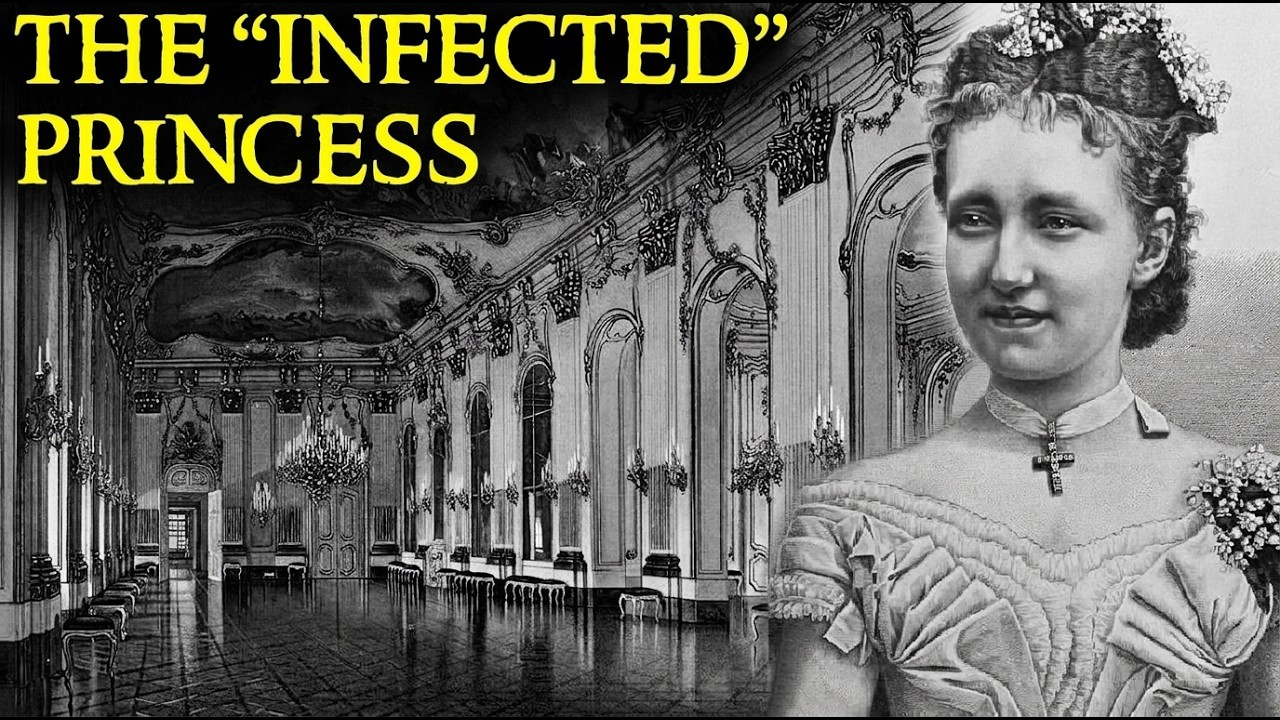
But she married anyway, the first decision of her adult life that was truly her own, and it cost her almost everything. Her story had begun twenty-one years earlier, in a different palace altogether. Stephanie was born on 21 May 1864 in the Palace of Laeken, just outside Brussels. Her father, then a prince, became King Leopold II a year and a half later.
Her mother was Marie Henriette, a Habsburg from Austria, a woman who loved horses more than court gossip. The palace ran on gold ceilings, silent servants, and strict teachers. Stephanie learned several languages, studied hard, and was never, ever spoiled. In that palace, a child was not a child.
A child was an investment. Behind the grandeur stood a secret the whole world would understand only later: her father’s great wealth was built in part on the Congo, a vast territory in Africa he ruled as his own private property. Historians have estimated that millions of Congolese people died under that system from forced labor on rubber plantations, violence, famine, and disease. The exact number is still debated, but the scale is not.
When Stephanie was born into a rising royal house, that was what the house was standing on. Her childhood cracked early. In January 1869, when she was four and a half, her only brother, Leopold, the nine-year-old heir to the throne, died. The palace went silent.
The king and queen, who had never really loved each other, now had a grave to stand beside, and after that day their marriage slowly came apart. Two years later, disease reached Brussels. It was an age when typhus, smallpox, and cholera could empty a street in a week, and Stephanie was not yet seven when typhus found her. For weeks she lay between life and death, burning with fever, barely awake.
She survived. It would become the word that followed her for the rest of her life. Long before anything else happened, she had learned that her body could be taken from her with no warning, and that no amount of royal blood could buy it back. In 1879, when Stephanie was fifteen, marriage negotiations began.
This was a world where marriages between royal houses were treated like treaties between countries, and girls were the paper those treaties were written on. The intended groom was Rudolf, Crown Prince of Austria-Hungary, twenty-one years old, the only son of Emperor Franz Joseph, destined one day to rule one of the biggest empires in Europe. The Austrians needed a bride who was Catholic, royal, and young enough to produce an heir. The Belgian king needed an alliance.
Stephanie was the answer to both problems, and nobody asked her what she thought. She was engaged in March of that year. In May 1881, days before her seventeenth birthday, she walked into a Vienna ceremony watched by crowds, wearing silver and white, smiling. She was sixteen years old.
The first months of the marriage were calm, even warm. Rudolf could be charming. He was clever, well-read, and held liberal ideas that clashed with his father’s conservative court. But he was also restless, moody, and deeply unhappy in ways nobody around him seemed able to name.
Stephanie felt like a guest in a house where everyone was whispering. She was watched constantly. Her mother-in-law, the famous Empress Elizabeth, known as Sisi, was almost never in Vienna and showed little interest in her. Her husband was often away.
The girl from Brussels, taught to follow every rule, discovered that the rules in Vienna were written for everybody except the men. In September 1883 she gave birth to a daughter, Elizabeth Marie. A healthy child, a beautiful child, and yet the court did not celebrate the way it should have. They had wanted a boy.
In an empire that could only be inherited through sons, a daughter was not the happy ending. She was a disappointment dressed in lace. Soon after her daughter was born, Stephanie became seriously ill. Doctors at the time spoke of peritonitis, a dangerous inflammation inside the abdomen.
She recovered slowly, and then it became clear that she would never have another child. What caused it? Many historians believe the real answer was a sexually transmitted infection she caught from her husband. Rudolf lived a wild life: he drank heavily, had many affairs, and was known to have had a venereal disease.
Gonorrhea is the one most often named, though some writers also mention syphilis. The idea is that gonorrhea can travel upward in a woman’s body and damage the tubes that carry eggs, leaving her unable to conceive. In plain language, an infection Rudolf may have carried could have scarred her inside, quietly, before anyone understood what was happening. She was about twenty-two.
There is no signed medical report that proves it beyond doubt. There was no blood test for syphilis yet; the Wassermann test did not exist until 1906, and the germ that causes syphilis had not even been seen under a microscope until 1905, when two German scientists, Fritz Schaudinn and Erich Hoffmann, found it. The doctors treating Stephanie were guessing in a world with almost no tools to look inside the human body. She did not know the name of what was happening to her.
She was blamed for the missing son, and she was the one who paid the price in her health, in her future, and in her place at court. The word sometimes used for her is infected. It is cruel, and it is also unfair, because it makes her the carrier. In truth, she was the one who was harmed.
By the mid-1880s, Stephanie and Rudolf barely lived like husband and wife. She stayed in the palace. He stayed out, coming home at dawn smelling of drink, with whispers of women across Vienna following him. She stopped sharing his bed.
He stopped pretending to care. Rudolf was falling apart in his own way. He was deeply unhappy with his father’s rule, had political dreams nobody would listen to, and suffered from pain, mood swings, and a restlessness that doctors today might describe in words that did not exist then. Many historians think his health was already failing, and his mind with it.
In 1888 he met a young woman named Mary Vetsera. She was seventeen; he was thirty. She came from a rich family close to the court, and she was in love with the idea of a crown prince, as young people sometimes are. Their secret relationship moved fast, faster than anyone around them understood.
They spent time at Mayerling, a hunting lodge in the forest outside Vienna, a quiet place with thick walls and thin air, a place where a man tired of being watched could finally hide. On the morning of 30 January 1889, the world heard something that did not make sense. The Crown Prince of Austria-Hungary was dead. Mary Vetsera was dead beside him.
Stephanie was twenty-four. At first the court said Rudolf had died of a heart attack. Within days the story changed: he had shot Mary and then himself. Emperor Franz Joseph’s officials tried to bury the whole affair with silence, even arranging for Mary’s body to be taken quietly from the lodge at night and buried in secret.
Rumors exploded. Some said murder, some said a political plot, some said Rudolf had been silenced because of his ideas. For decades people wrote books and arguments about it. As time passed and documents came out, most historians settled on the same hard answer: it was a murder and a suicide carried out by a man in deep despair.
In the morning there were letters. One of them was for Stephanie. It was short. It did not shout.
According to accounts that have survived, he told her she was free of him, wished her happiness in her own way, and asked her to take care of their little daughter, who was all that remained of him. The man who had hurt her, and who had likely brought illness into her life, wrote her a few quiet lines of affection on the last night he lived. Even she may not have known whether she forgave him. Rudolf died in 1889.
Stephanie died in 1945. That means she lived fifty-six more years after the morning at Mayerling, longer than the whole life of the man who hurt her, longer than many people live today. The real story is not how she was broken. The real story is what she did with the long strange years that came after.
She wanted to go home to Belgium. She was a young widow far from her country, living inside a court that now saw her mostly as a reminder of a scandal. But her daughter, little Elizabeth Marie, was a Habsburg princess, and the Austrian court would not let her leave. If Stephanie wanted to stay close to her child, she had to stay in Vienna.
So she stayed in a place that did not want her, passing people who whispered behind their hands, knowing that the only person who truly belonged to her was a girl who was not allowed to leave. She did not collapse. She tried to rebuild. She found comfort with a Polish nobleman, Count Artur Potocki, who stayed beside her through some of her darkest months.
For a short time there was warmth in her life again. Then he fell ill with cancer in his throat. A failed operation took away his voice, and by March 1890 he was dead. Two men gone in about fourteen months, both of them the closest people in her life, and in both cases she stood at the edge of a grave wearing black.
She did what many people do when the world becomes too heavy. She traveled. She sailed through the Mediterranean, visiting Malta, Tunisia, Sicily, Corfu, searching for a place where the grief would loosen its grip. Sea air, old stones, anywhere that was not the palace.
Modern psychologists know that long periods of stress, grief, and fear can affect the body as well as the mind. Doctors who study this call it chronic stress, and research has linked it to problems with sleep, the heart, and the immune system. Stephanie was not only living through sad events; her body was living through them too. And yet she was only in her twenties.
Meanwhile, her father had another plan. King Leopold II had never stopped thinking like a businessman. His daughter was young, a widow, and could marry again. He wanted her to marry the new heir to the Austrian throne, Archduke Franz Ferdinand, the nephew of Emperor Franz Joseph.
Another alliance, another treaty, another chance to turn his daughter into a bridge. It never happened. And Stephanie, for the first time in her life, started to say no. By the late 1890s she had met a Hungarian nobleman named Count Elemér Lónyay.
He was kind, steady, and not at all interested in using her for politics. He loved her, and he wanted to marry her. For the first time in her story, there was a man who did not want her for her crown. Only her father stood in the way.
Leopold refused, telling his daughter she would be marrying beneath her station. Elemér even converted to Roman Catholicism to please him. It made no difference. Leopold would not bend.
Her whole life she had been told to obey her family, her country, her father, the court. Every important decision had been made by someone else. Now, at thirty-five, she had to choose between his approval and her happiness. On 22 March 1900, at Miramar Castle near Trieste, she married Elemér anyway.
It was the first decision of her adult life that was truly her own, and it cost her almost everything. Her father never forgave her. When her mother, Marie Henriette, died in 1902, Leopold reportedly forbade Stephanie from attending the funeral. By then, much of the world knew about the horrors in the Congo.
Journalists, missionaries, and activists, including a British man named Edmund Dene Morel, pushed the world to look. In 1908, under heavy international pressure, Leopold was forced to hand over the territory to the Belgian state. He died the next year, in December 1909. The final blow to his daughters was waiting inside his will.
Stephanie and her sisters expected to share a fortune. Instead, they discovered that Leopold had married his much younger companion, Caroline Lacroix, in a religious ceremony just five days before his death, and most of his money had been moved in ways that left his daughters with almost nothing. They went to court. For about five years the sisters fought for what they believed was theirs.
In the end, Stephanie received a settlement of around five million francs. A large sum, but a small piece of what had once been a giant fortune. In the summer of 1914, in the city of Sarajevo, a young Serbian nationalist named Gavrilo Princip shot the heir to the Austrian throne. The victim was Archduke Franz Ferdinand, the very man Leopold had once hoped Stephanie would marry.
If she had obeyed her father, she would have been standing beside him. One decision in 1900, and she was not in that car. Within weeks Europe was at war. Germany marched into Belgium, a country that had promised to stay neutral.
Stephanie’s homeland was occupied for the next four years, and she, a Belgian princess, was living inside the empire that was fighting alongside the occupier. It was a strange, lonely position. She could not return home. She could not help her people directly.
She was stuck watching her country burn from a distance. She did what she could. At the family estate in what is now Slovakia, a mansion at Rusovce, she and her husband threw themselves into charity work, helping wounded soldiers and local people. For the first time in her life, she was not performing a role.
She was simply being useful. When Emperor Franz Joseph died in 1916, she and Elemér went to Vienna for the funeral and the coronation of the new ruler. Soon after, Elemér was given the title of prince within the Hungarian nobility. In October 1918 the Austro-Hungarian Empire collapsed.
Most Habsburgs were pushed out, but Stephanie and her husband were spared and remained at their estate. An empire that had once been the world’s second biggest land power was gone in a matter of weeks. The woman who was supposed to be its empress was a quiet landowner with a loving husband. Not everything in her story healed.
Her relationship with her daughter did not survive. Elizabeth Marie grew up in the shadow of her father’s death. She became a social democrat, openly sympathetic to socialist politics, and the press began calling her the red archduchess. Stephanie, a woman who had lived through the collapse of an entire world, did not approve of the choices her daughter made in love or in politics.
By 1924, after a final argument, they stopped speaking. For the rest of their lives, mother and daughter never spoke again. In 1944, Stephanie reportedly disinherited her daughter. When Stephanie died, Elizabeth Marie did not come to the funeral.
The one person in the world who shared her blood and her memory of Mayerling, and they ended their lives as strangers. In 1935, Stephanie published her memoirs. In 1937, the English version appeared under the title I Was to Be Empress. It is a phrase full of longing and a little bit of anger.
She was to be Empress and she was not. Look closely at how she told her own life. The book is organized into parts, and the last part is called The Tragedy of Mayerling. That is where it ends.
She skips almost everything that happened in the half century after Rudolf’s death: her second marriage, the charity work, the war years, the estrangement from her daughter, the long, ordinary, hard-won happiness. Why would a woman who had lived so much choose to end her story in 1889? Maybe she thought readers only wanted the scandal. Maybe her publishers pushed her.
Or maybe she believed that the only version of her life the world would ever care about was the one that included him. Even in her own book, she was still being defined by the man who had hurt her. In Stephanie’s time, a diagnosis of a sexually transmitted infection was almost a social death sentence. Doctors lacked reliable tests, and treatments were crude, some dangerous.
For syphilis, one of the main treatments for centuries involved mercury, a toxic metal that caused terrible side effects. Then came a turning point. In 1910, a German scientist named Paul Ehrlich and his Japanese colleague Sahachiro Hata introduced a drug called Salvarsan, the first modern chemical treatment for syphilis. It was not perfect, but it opened a door.
In the 1940s, penicillin turned a feared, life-changing infection into something that could be cured in most cases. The world did learn how to fix what broke so many lives in her century, but it came too late for the generation that suffered most. And the problem has not disappeared. It has returned.
The World Health Organization has estimated about 8 million new syphilis infections among adults in a single year, 2022. In the United States, the number of syphilis cases has climbed for years, and nearly 4,000 babies were born with the infection in one recent year. Public health experts in many countries say the main obstacles are not a lack of medicine; they are stigma, silence, and limited access to testing. We have the cure.
We still struggle with the shame. When the Second World War began in 1939, Stephanie was seventy-five. She and Elemér were living in Central Europe, far from the main fighting but not free from fear. Toward the end of the war, they heard that Nazi officials planned to turn their mansion into a field hospital as the Soviet Red Army pushed forward.
The home they had shared for decades was suddenly part of a military map. In the late spring of 1945, as Soviet troops reached the region, the couple left and took refuge at the Pannonhalma Archabbey in Hungary, a famous monastery built on a hill. She was eighty-one. Her body was tired.
Her world had changed three times in her lifetime. She died there on 23 August 1945. A princess born in a Brussels palace, married at sixteen, widowed at twenty-four, forbidden to bury her mother, cut off by her father, estranged from her daughter, and driven from her home by an advancing army, ended her life behind the quiet walls of a monastery. She was buried in the abbey’s crypt, and less than a year later, her husband Elemér was laid to rest right beside her.
After all the political marriages, all the cold palaces, all the betrayals, the last place she found was a grave next to a man who chose her freely. Rudolf’s last letter to her was short, and its meaning is still argued about. Was it an apology? A confession?
A final act of cruelty dressed up as tenderness? Historians have read it again and again, and still the sentences refuse to give up their full meaning. Somewhere in the archives of Vienna there are documents about Mayerling that have been closed, reopened, and fought over for more than a century. New researchers using modern forensic methods and fresh archival work keep returning to the same forest lodge, hoping that one more page, one more bullet analysis, one more handwriting study will finally settle what happened in those last hours.
Stephanie probably knew the world would never stop asking. That may be why she wrote the way she did, ending her book where the world’s questions began. She was supposed to be an empress.
Instead, she became something rarer: a survivor who was finally free.
