On 23 October 1805, the prince regent John of Portugal signed a decree that stunned the court at Lisbon. The public proclamation officially exiled his own wife, Carlota Joaquina, ordering her confined to the Palace of Queluz and later to the estate of Ramalhão. John himself withdrew to the distant Palace of Mafra. This was not a private quarrel made public; it was a calculated campaign of political warfare.
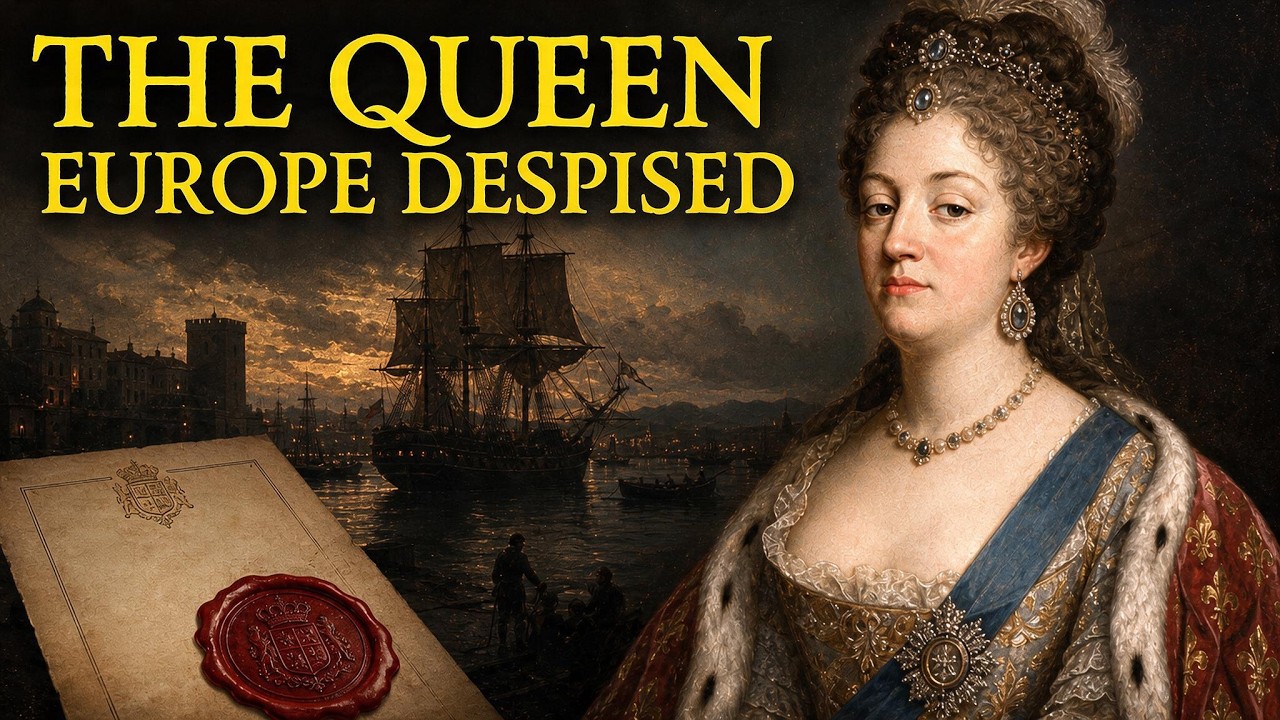
Carlota was the Spanish infanta and the future queen of Portugal and Brazil, a woman of immense dynastic influence. By reducing their arrangement to a formal royal decree, John exposed their split to the world and made her humiliation permanent. Portuguese society rushed to exploit her isolation, stripping her of political standing and reducing her to a mocking caricature: the “she-devil of Queluz. ” Yet the official decree justified the harsh measure as necessary for the safety of the crown.
The written exile reveals a keen royal anxiety, and it raises the essential question of why John feared his own queen so much that he codified her banishment into law. In late eighteenth-century Europe, princesses were diplomatic currency, exchanged between dynasties to bind competing kingdoms more firmly than any written treaty. Under this system, women had no power over their marriages, their residences, or how their new families treated them. They were instruments of statecraft.
In this global game, Spain sought advantage through its vast, if politically weak, empire stretching from California and Cuba to the tip of South America. Portugal, its neighbor, was a deeply conservative Catholic kingdom. Its geopolitical security rested on a British alliance dating back to the 1660s. To bridge the deep divides between these rival powers, negotiators crafted a grand dynastic arrangement.
This deal ultimately decided the fate of a Spanish child, earmarking her for a Portuguese prince she had never met and thrusting her into a foreign court that already viewed her homeland with deep suspicion. On 25 April 1775, in the royal palace at Aranjuez, Maria Luisa of Parma gave birth to a daughter, Carlota Joaquina. As the eldest surviving daughter of the future King Charles IV of Spain, the girl’s childhood was marked by a fragile line of succession. The early deaths of her brothers left the small child heiress presumptive to the Spanish throne for nearly a decade, a position of enormous responsibility.
She was not raised to be a decorative bride but to be a political force. Her exceptionally strict education, overseen by her domineering mother, went beyond traditional courtly arts, requiring mastery of history, geography, multiple languages, drawing, and horsemanship. This closeness to absolute power honed a sharp and ambitious mind. Although the birth of her brother Ferdinand in 1784 ended her status as heiress to the throne, Carlota remained one of Europe’s most valuable diplomatic assets.
Yet her family’s standing was already clouded by court scandal. Whispers about her mother’s alleged relationship with the rising minister Manuel Godoy, though unproven, created a damaging reputation that followed Carlota across borders, turning a highly capable Spanish princess into a target of intense foreign suspicion. In May 1785, the dynastic machinery of the Iberian empires completed its deal at the royal palace in Aranjuez. A proxy marriage ceremony bound the Spanish child to the Portuguese infante Dom John.
The bride was ten years old. The groom was eighteen. At ten, Carlota could not offer genuine consent, understanding little of the political weight settling onto her shoulders. Though the marriage contract delayed consummation for five years until she turned fifteen, her childhood was already over.
Within days of the ceremony, she was separated from her family and sent toward Lisbon. She traveled with a small Spanish retinue of twenty people, crossing the border into a land that regarded her homeland with long-standing hostility. When she arrived at the Portuguese court on 9 June 1785, she met her eighteen-year-old husband for the first time. She spoke only Spanish and French.
Placed in an environment governed by strict and unfamiliar etiquette, surrounded by strangers and heavy ceremonial expectations, the ten-year-old stood utterly alone, isolated by language and the demands of state. The court at Lisbon was not the grand environment Carlota had known in Spain. It was a world ruled by rigid protocol, extreme Catholic piety, and deeply rooted suspicion of Spanish influence. To the Portuguese aristocracy, this young stranger was a foreign interloper.
As she grew, the court did not merely watch her. They began to break her down. Satirical pamphlets and memoirs turned her physical features into political weapons. Contemporary observers singled out her short stature, smallpox scars, prominent hooked nose, and the pronounced lower jaw characteristic of the Bourbon family.
Lunon, Duchess of Abrantes, later wrote a brutal description portraying her dirty, disheveled hair, thin purple lips, uneven teeth, and thick mustache. A hostile publication from 1792 went further, describing her as the strangest savage head that could walk the face of the earth. These descriptions were not neutral records; they were deliberate, gender-based mockery. By portraying the young Spanish princess as a deformed caricature, the court found an easy way to diminish her sharp intelligence, her outspoken nature, and her emerging political ambition before she could threaten their grip on power.
On 29 April 1793, Carlota gave birth to their first child, Maria Teresa. Over the next thirteen years, she bore eight more children, securing the survival of the Braganza dynasty. Yet this biological success became a political weapon in the hands of her critics. Rumors spread through the court at Lisbon that Prince John was not the biological father of all her children, with strong suspicion surrounding the birth of Miguel in 1802, whose paternity court gossip attributed to other nobles.
No concrete evidence supports these claims in the royal records. They remain unsubstantiated accusations aimed at destroying her standing. Meanwhile, John withdrew into deep anxiety, driven by an obsessive fear of the revolutionary currents sweeping Europe. Court reports from the period describe the prince regent wandering the palace corridors at night in a state of delirium and distress.
While these accounts do not offer a definitive medical diagnosis of his mental state, they painted a picture of a weakened ruler, an opportunity Carlota sought to exploit. By 1805, their private life had become open political warfare. Carlota coordinated a conspiracy with aristocratic factions and military officers, planning a coup at the Alfeite barracks to arrest John, declare him mentally unfit, and seize the regency herself. However, the secret police intercepted her letters in July 1805, exposing the plot before it could be executed.
To avoid a public scandal that might destabilize the crown, John chose not to prosecute his wife. Instead, he imposed a permanent and strict separation. He stripped Carlota of her political privileges and confined her residence to the Palace of Queluz. This separation was not a mere family dispute.
It was the formal containment of a dangerous political rival. In November 1807, French troops under General Junot crossed the border, driven by Napoleon’s campaign to dismantle the British alliance. Rather than surrender, the Portuguese crown executed an unprecedented flight. On 29 November 1807, a fleet of fifteen warships and transports set out from the port of Lisbon.
On board was the entire structure of the state: fifteen thousand courtiers, state officials, soldiers, and the royal family itself. This mass migration changed global politics, making the Braganzas the only European royal house to rule its empire from a colony. The Atlantic crossing was brutal. The fleet struggled against severe winter storms, overcrowding, and outbreaks of disease.
According to contemporary medical records, a severe lice infestation swept through the ships, forcing Carlota and her ladies-in-waiting to shave their heads. When the fleet finally landed at Rio de Janeiro in March 1808, Carlota stepped ashore bald and utterly humiliated. Yet as she looked at the colonial capital, her perspective shifted. This distant territory would not be another prison for her.
It would become her new launching point. In May 1808, Napoleon Bonaparte forced the Spanish king Charles IV to abdicate and imprisoned his heir Ferdinand VII, placing his own brother Joseph on the throne in Madrid. This sudden collapse of the Spanish monarchy created a deep legitimacy crisis in the Americas, igniting the early wars of independence. As the eldest surviving daughter of Charles IV, Carlota saw an opportunity to preserve her family’s empire.
From her temporary residence in Rio de Janeiro, she issued a manifesto claiming her right to rule the Spanish colonies in South America as regent of the throne. This proposal found fertile ground in the Viceroyalty of the Río de la Plata, the vast region now comprising Argentina, Uruguay, and Paraguay. A faction of local elites seeking an alternative to French rule proposed installing Carlota as their leader, a political movement known as “Carlotism. ” She found an influential ally in British Admiral Sir Sidney Smith, who supported the project to secure British commercial interests in the south.
Smith even offered his fleet to transport Carlota to Buenos Aires. But this grand scheme faced immediate resistance. Dom John and the Portuguese government in exile strongly opposed her ambitions, fearing that a unified and powerful Spanish region ruled by Carlota would threaten Portuguese borders. Spanish colonial officials and local Creole elites also rejected her.
Suspicious of a queen residing abroad, the movement ultimately fractured from within. While her moderate supporters in South America wanted a symbolic constitutional figure to limit imperial power, Carlota refused to compromise, demanding absolute sovereign authority. This ideological split led to the collapse of the alliance. By 1812, the British withdrew their support and Carlotism collapsed, leaving behind only the memory of an extremely bold attempt to control an entire continent.
In Rio de Janeiro, Carlota’s frustration turned into deep contempt for her colonial surroundings. Hostile exile newspapers exploited her isolation, publishing unconfirmed reports of excessive drinking and marijuana tea consumption. Rumors also linked her to a wealthy Brazilian merchant named José Silva. However, no reliable archival evidence supports these claims of drug use or infidelity.
They remained traditional political weapons aimed at undermining a politically active woman by attacking her private life. Yet real power continued to elude her grasp. On 20 March 1816, the long-ailing Queen Maria I died in Rio at the age of eighty-one. Dom John ascended the throne as King John VI, and Carlota finally became queen consort.
She had waited thirty-one years since her childhood marriage to achieve this formal elevation. Yet the crown brought no real power, leaving her a queen in name only over an empire she despised. She remained deprived of the authority she had spent her life trying to seize. In 1820, a liberal revolution erupted in Portugal, demanding the king’s return and the establishment of a constitutional monarchy, a system that would strip the crown of its absolute power.
Facing the risk of losing his throne, John capitulated. On 26 April 1821, after thirteen years in Brazil, the royal family sailed back to Lisbon. But Carlota returned protesting. According to a note in the diary of minister José da Silva, when her feet touched the ground, she deliberately shook the dust from her shoes, declaring she would not take even the dust of that land with her.
In 1822, John formally swore allegiance to Portugal’s first constitution, which significantly limited royal power. Carlota flatly refused to sign the document, preferring political isolation over submitting to a liberal parliament. That same year, the empire split. Their eldest son, Pedro, remained behind and declared Brazil an independent empire, finally shattering his mother’s dreams in South America.
Carlota, rebellious and marginalized, turned to her youngest son, Miguel, a supporter of absolutism. Mother and son formed an alliance to overthrow the constitutional government and strip the king of his power. By 1824, Miguel led a coup, seizing the royal palace and turning his father into a royal hostage. John remained king in name only, held captive while his wife and son dictated terms.
The crisis ended only when the British navy intervened. Relying on their historic alliance, British diplomats and warships forced Miguel to yield. By October 1824, Miguel was exiled, and John regained unstable control of his capital. Once again, Carlota’s bid for power collapsed, leaving her politically isolated, her marriage shattered, and her family divided by the very crown she had sought to rule.
On 10 March 1826, King John VI died at the age of fifty-eight. Even as his life faded, the division between the royal couple remained complete. Carlota flatly refused to visit her husband during his final illness. His death sparked an immediate succession crisis between their two sons, Pedro and Miguel.
Pedro briefly claimed the throne before abdicating in May in favor of his young daughter, Maria II. When Miguel returned in 1828 to seize power, he did not summon his mother to court. Carlota remained confined at the Palace of Queluz, grieving, isolated, and stripped of the power she had spent her life seeking. On 7 January 1830, she died there alone at the age of fifty-four, initially buried at Queluz.
But the final irony of her dynastic journey came in 1854. Her remains were exhumed and reburied in the royal Braganza Pantheon in Lisbon. There, in the quiet stone vaults, she was placed directly beside her husband John, the man she had struggled against her entire life, bound together forever in death after a lifetime of hostile separation. In the end, we can only ask: what did history get wrong about the woman behind that stereotype?
For generations, history accepted the satirical image of a power-hungry, repulsive foreign queen. Anti-Spanish hostility and misogyny made it easy to reject Carlota Joaquina by attacking her appearance. But beneath those insults lay immense political intelligence. During her thirteen years at the court at Lisbon before Napoleon’s invasion, and later in her bold attempt to rule the territories of the Río de la Plata, she demonstrated a sharp understanding of imperial power.
To say she twice tried to overthrow her husband is a simplification of calculated, independent attempts to assert her authority in a world that denied women an official voice. This revision is not an absolution of her authoritarian ambitions; it is an acknowledgment of her reality. In the political system of 1800, conspiracy was often the only avenue of influence available to a queen. Labeling her a “shrew” was far easier than taking her seriously.
History remembered the stereotype and forgot the real woman. Today, the image of the “shrew” still haunts the way we judge ambitious women of the past. When a woman is denied legitimate power, her defiance is easily seen as malice. By looking past the propaganda, we do not merely recover the humanity of one queen.
We confront our own enduring discomfort with women who refuse to remain silent.
