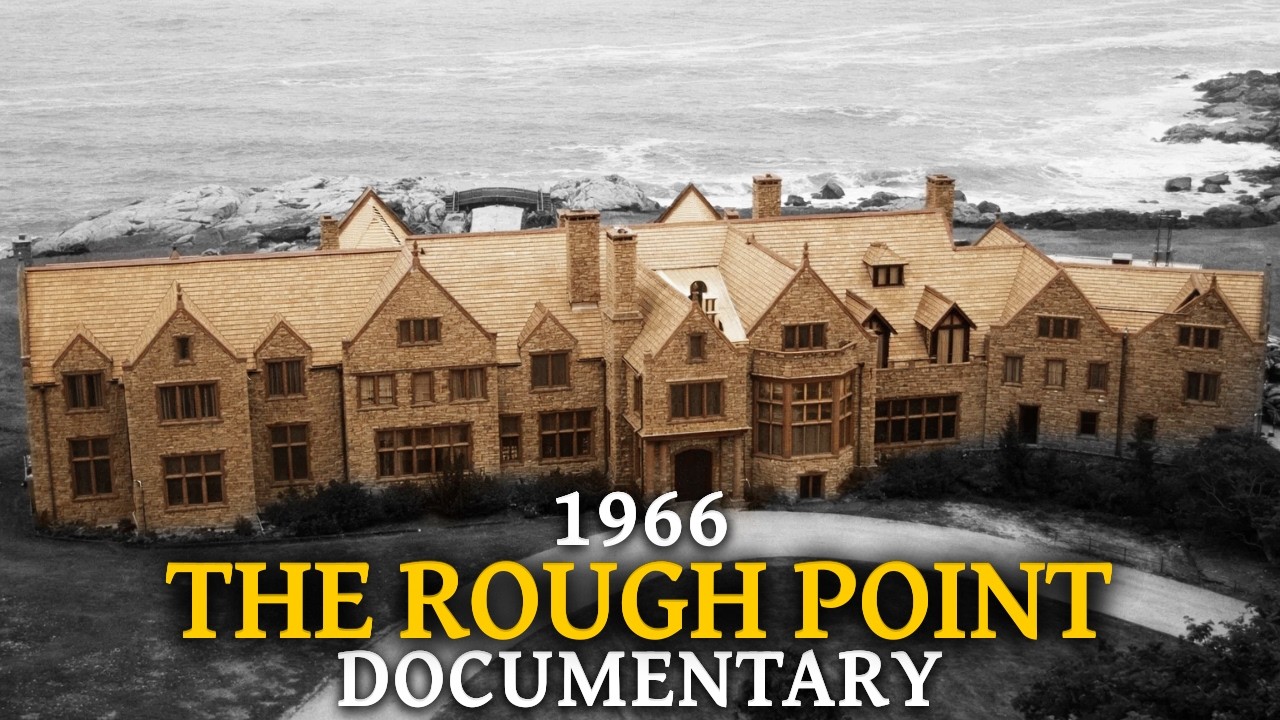
On October 7, 1966, the late afternoon sun stretched across the gravel driveway of Rough Point, the vast English manor in Newport, Rhode Island, that sat perched on cliffs above the Atlantic. A two-ton Dodge Polara station wagon idled near the iron gates. Inside sat Doris Duke, 53 years old, worth more than a billion dollars, and, within seconds, about to kill a man. Eduardo Tirella, a handsome 42-year-old designer with movie-star looks, stepped out of the passenger side to open the towering wrought-iron barriers.
He had served Duke faithfully for seven years, curating her art collection, designing her estates, traveling with her across Europe to acquire priceless treasures. But that day he had told her the truth: he was leaving her employment to pursue a career as a Hollywood set designer. What happened next became one of the most controversial deaths in American history. The station wagon lurched forward violently, its tires spinning and gouging deep marks into the gravel.
The heavy vehicle struck Tirella with devastating force, burst through the iron gates, dragged his body across Belleview Avenue, smashed through a fence, and crashed into a tree. Tirella lay beneath the wheels with crushed lungs, a shattered spine, and fatal brain damage. Death was instantaneous. The woman behind the wheel was the richest woman in America, the child the newspapers had called the richest little girl in the world from the moment she was born.
Within 96 hours, without an inquest, without a thorough investigation, and without charges, the police declared his death an unfortunate accident. The fortune that made Doris Duke untouchable began with tobacco. In the chaos after the Civil War, a North Carolina farmer named Washington Duke began selling his remaining crops to returning soldiers. His son James Buchanan Duke turned the enterprise into the American Tobacco Company, a monopoly that controlled nearly the entire industry.
James became one of the wealthiest men in America, wealthy enough to give 40 million dollars to transform Trinity College into Duke University. In 1912, his only child was born. Doris Duke entered the world in a Fifth Avenue mansion in New York City. The newspapers dubbed her the richest baby in the world.
Her childhood was a gilded cage: private tutors, personal servants, bodyguards, no regular school, no playmates. Her father, paranoid about kidnapping threats, sheltered her completely. But he adored her, taking her to Harlem where she fell in love with jazz and gospel music, and explaining the workings of his business empire. When James Duke contracted pneumonia in 1925, he lingered for months while 12-year-old Doris watched.
On his deathbed, he gave her advice that echoed through her life: trust no one. When he died, he left a fortune estimated at 100 million dollars. The inheritance unlocked in installments, but Doris demonstrated fierce independence early. At 14, she took her own mother to court to stop the sale of family properties.
She won. After discovering bags of death threats hidden from her, she made privacy her obsession and security her constant companion. When the 1929 crash devastated high society, the Duke fortune survived, and Doris quietly began helping others, paying off mortgages, donating anonymously to charities, purchasing organs for small churches. In 1933, she established her first charitable foundation, Independent Aid, through which she would give away the equivalent of hundreds of millions of dollars during her lifetime.
Her personal life was less successful. A 1935 marriage to James Cromwell, 16 years her senior, ended after the premature birth in 1940 of a daughter who lived only 24 hours. Doctors told Doris she could never have children again. The loss haunted her forever.
After the divorce, she threw herself into work: foreign correspondent during World War II, competitive surfer in Hawaii, jazz pianist, obsessive art collector. A second marriage in 1947 to a Dominican diplomat, Porfirio Rubirosa, was brief and tumultuous. Among her properties, Rough Point in Newport was one of her most treasured. The 39,000-square-foot mansion, built in 1892 for Frederick Vanderbilt, had been purchased by her father in 1922.
Eduardo Tirella was born June 8, 1924, in Dover, New Jersey, the son of Italian immigrants. He demonstrated extraordinary artistic talent young, served his country with distinction in World War II as a decorated hero, and built a career as a designer in New York and Hollywood. Charming and handsome, he moved easily among the wealthy and famous, counting Frank Sinatra, Richard Burton, and Sharon Tate among his friends. He was also gay at a time when that was dangerous, yet he navigated the prejudices of his era with grace.
When Doris Duke hired him in the late 1950s, she found exactly what she sought. He became her constant companion and artistic adviser, helping her acquire masterpieces worth tens of millions of dollars, transforming Duke Gardens in New Jersey into one of the largest indoor botanical displays in the country, and maintaining quarters in all her homes. Their relationship was complex, professional, and intimate at the same time. Hollywood had discovered him too: he worked as technical director on the 1965 film The Sandpiper, designed sets for Don’t Make Waves starring Tony Curtis and Sharon Tate, and appeared in small roles.
At 42, he was on the verge of a brilliant new career. Nobody left Doris Duke. That was what people said about her. She was possessive, jealous, and had a legendary temper.
Years earlier, during a drunken argument, she had stabbed her common-law husband with a butcher knife. The wound was not fatal, but it revealed her capacity for violence. Friends warned Tirella to be careful, but he believed he could handle the situation. He wanted to break the news gently, face to face.
On October 6, 1966, Tirella flew into Newport. Doris picked him up at the airport, and together they drove to Rough Point. That evening, he told her he was leaving. Servants later recalled raised voices, the sounds of a heated argument.
She had lost her father at 12, her only child at birth, two marriages to divorce. Now she was losing Eduardo. The next day, tension remained. Tirella had asked Doris to rent a station wagon so they could pick up an antique he had located for her.
Even as he prepared to leave, he remained professional. It was late afternoon when they climbed into the Dodge Polara, Doris in the passenger seat, Tirella driving. He stopped at the gates and stepped out to open them, his back to the vehicle, unaware that Doris had slid into the driver’s seat. According to Doris, she intended to pull the car forward once Tirella opened the gates.
She released the parking brake, shifted into drive, and claimed her foot accidentally hit the gas instead of the brake. The evidence told a different story. The deep grooves left by the rear tires in the gravel suggested far more acceleration than a simple mistake could produce. A 13-year-old paper boy named Robert Walker was nearby and heard the commotion.
He saw Doris emerge from the station wagon, bleeding from the mouth, calling out for Ed. She then made a startling admission: she had run over Ed. Police arrived within minutes. Officer Edward Angel was first on the scene and found Tirella’s body beneath the rear wheels.
The injuries were catastrophic, instantly fatal. Police Chief Joseph Radice took control of the investigation immediately, telling other officers to step aside. He walked arm-in-arm with Doris back into her mansion. She was never properly interrogated.
Within hours, she had hired the medical examiner who arrived at the hospital as her personal physician, meaning anything she said was protected by doctor-patient privilege. Key evidence was never collected. Witnesses were never thoroughly questioned. 96 hours after Tirella died, Chief Radice declared the death an unfortunate accident.
No charges were filed. No inquest was held. The richest woman in America walked away without even a traffic citation. Then the money began to flow.
Days later, Doris donated 25,000 dollars to restore Newport’s famous cliff walk, a pathway that had been a source of friction after her dogs attacked tourists. She gave another 10,000 dollars to the hospital that treated her. Over the following years, she poured millions into Newport, restoring more than 80 colonial buildings and transforming the city into a tourist destination. Critics called it blood money, payments made to a city in exchange for its silence.
Chief Radice retired just seven months after the case closed and later purchased two condominium units in Hollywood, Florida, acquisitions that seemed beyond the means of a small-town police chief’s pension. Tirella’s family, working-class Italian Americans from New Jersey, had no power to challenge the richest woman in America. But they refused to accept the verdict. In 1971, five years after his death, they filed a wrongful death lawsuit against Doris Duke, seeking a million and a half dollars.
At trial, Doris testified that she had always relied on Eduardo’s advice before buying anything for her estates and acknowledged he had counseled her on art purchases worth tens of millions of dollars. Her lawyers worked to diminish him, portraying him as a mere celebrity sycophant. The jury found Doris negligent but awarded just 75,000 dollars. Divided among his eight siblings, each received roughly 5,600 dollars.
After the trial, Doris went to great lengths to erase Tirella from her life. His name disappeared from estate records. His contributions went unacknowledged. He was simply erased.
But the story refused to stay buried. In 2018, journalist Peter Lance, an Emmy Award-winning investigator who had begun his career as a cub reporter in Newport eight months after Tirella’s death, returned to find the truth. He discovered that the police files and court transcripts documenting the case had vanished. Someone with access and authority had deliberately removed the official record.
Lance tracked down witnesses never properly interviewed, found forensic experts, and reconstructed the crash. The evidence was damning. The tire grooves indicated deliberate, violent acceleration from a dead stop, not an accident. Tirella’s injuries were all above his waist, inconsistent with being pinned against a gate.
Sergeant Fred Newton, the chief accident investigator, had actually solved the case within hours: he determined Doris had committed six intentional acts, releasing the brake, shifting into drive, pressing the accelerator, striking Eduardo, continuing through the gates, and running over his body. His findings were overruled. The evidence was buried. In 2021, Robert Walker, now an old man, came forward.
For 55 years he had carried the memory, too frightened to speak. He recalled hearing the argument before the car departed, the roar of the engine, and Doris emerging uninjured, showing no emotion as she looked at the man she had killed. The Newport Police Department reopened the case in August 2021 and found Walker credible. Five months later, it closed the case again, concluding there was no new evidence that would change the original finding.
Eduardo Tirella’s death remains classified as an accident. Doris Duke died on October 28, 1993, at her home in Los Angeles, at age 80. Her final years were marked by declining health, paranoia, and the influence of an Irish butler named Bernard Lafferty, who became co-executor of her estate. Her adopted daughter and heir, Chandi Hefner, whom she had believed was the reincarnation of her dead child, was disinherited.
An 18-month investigation into suspicions of foul play in her death concluded there was no credible evidence of murder. The Doris Duke Charitable Foundation, worth an estimated 1. 2 billion dollars at its creation, continues today. Rough Point remains a museum, preserved exactly as Doris left it, filled with the art and antiques she and Eduardo collected together.
For decades, tour guides did not speak Eduardo Tirella’s name. Now, thanks to Lance’s investigation, published in Vanity Fair and expanded into the book Homicide at Rough Point, the story is known. The evidence strongly suggests that Doris Duke deliberately ran down Eduardo Tirella in a fit of rage because he dared to leave her, then used her wealth and power to escape justice. He lies buried in St.
Mary’s Catholic Church Cemetery in Dover, New Jersey, beneath a simple headstone. He was 42, a war hero and artist who deserved to live. His story outlived both of them.
