She concentrated on the window. On the dark beyond it. She did not jump, she would insist until her last day on earth. She was pushed.
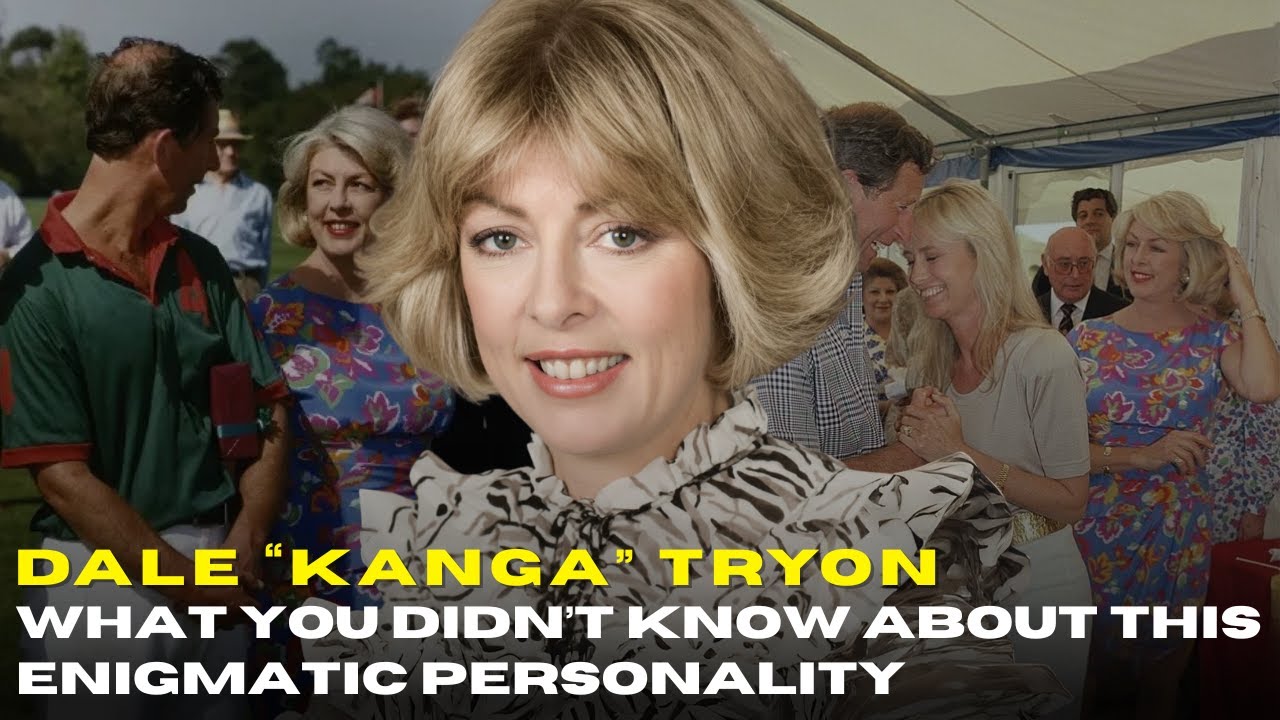
That was her story, told from a hospital bed, from a wheelchair, from a suite at the Ritz, repeated to anyone who would listen with the same unbroken certainty: someone is trying to kill me. The official account said otherwise. The official account said a broken woman, a lifetime of pain, an accident or a suicide attempt in a clinic room. Two stories, two versions of one night in May 1996, and the truth was lost somewhere in the fall between them.
A year and a half later, three months after Diana’s death, Dale, Baroness Tryan, was dead at forty-nine. The cause was given as septicaemia. To those who knew the whole story, her passing felt terrifyingly convenient. To understand the woman, you have to go back to the beginning, to the sun-drenched suburbs of Melbourne.
Dale Harper was born on January 3rd, 1948, into comfortable upper-middle-class privilege. Her father, Barry Harper, was a wealthy printing magnate, a self-made man who gave his eldest daughter a fine education, a beautiful home, and a life of apparent ease. Postwar Australia still looked to Britain as the mother country, where English traditions were revered and the royal family was spoken of with something close to religious awe. For an ambitious girl, London was the ultimate prize, the true center of the universe.
But from the outside, the Harper family portrait was one of perfect, sun-kissed prosperity. From the inside, Dale’s early life was defined not by privilege but by silent, relentless, isolating pain. As a toddler, she was diagnosed with Perthes disease, a rare condition in which the blood supply to the hipbone is cut off. For a developing child, the result is catastrophic: the starved bone softens, fractures, and dies.
For a little girl who should have been running under the bright Australian sun, it was a sentence of confinement. Her early years were a blur of white rooms and the antiseptic smell of hospitals. She spent long, lonely stretches in pediatric wards, separated from family and peers. Worse, to stop the damaged bone from collapsing, her legs were encased in heavy iron calipers.
Until the age of nine, she was bound in metal, the cold weight a constant reminder of her fragility. Every step was a struggle. Every movement was a negotiation with pain. She was also born with a mild form of spina bifida, a condition of the spine that guaranteed a lifetime of chronic back pain and simmering health complications.
That childhood of suffering did more than damage her body. It forged her character. Faced with physical limitation and the deep isolation of being the sick child who couldn’t keep up, Dale made a conscious, brilliant decision. If she could not compete physically, she would dominate socially.
She developed a ferocious, dazzling personality as a coping mechanism. She cultivated an almost aggressive joy for living, becoming the funniest girl in the room, the one with the quickest wit and the most infectious laugh. It was a mask, a brilliant suit of armor built to hide the fragility she never let the world see. She learned early that charm was a potent weapon.
She learned to conceal pain with an iron will, a habit that would serve her well in the stiff-upper-lip world of the British aristocracy she was so desperate to join. That ambition to escape Melbourne, and the shadow of her own medical history, became the driving force of her young life. London was not just a city; it was the idea of a life where she could redefine herself completely, where no one knew the girl in the iron braces, only the dazzling woman she had decided to become. After finishing school, she took a job in public relations with Australia’s national airline, Qantas.
It was the perfect choice. The role let her hone her considerable social skills, network with international figures, and project an image of effortless glamour. It was her ticket out. In 1972, she was transferred to the London office, arriving as a vibrant, ambitious twenty-four-year-old with a couple of suitcases and an arsenal of charm.
As an Australian, she was an exotic novelty, unbound by the rigid class distinctions that paralyzed the English themselves. She could talk to anyone, charm anyone, because she didn’t know the intricate rules she was supposedly meant to be following. London in the early seventies was a city in transition. The psychedelic haze of the swinging sixties had given way to a grittier, more complex decade.
It was a time of social mobility, yet the ancient unwritten rules of the class system still held immense power. At the apex stood the aristocracy, a closed, guarded world of titles, country estates, and impenetrable codes. This was the era of the Sloane Ranger, the social tribe that orbited the young royals, with its uniform of pearls, headscarves, and Barbour jackets, and its baffling shared values. This world ran on a currency far more valuable than money: bloodlines.
It didn’t matter how wealthy you were. Without the right name, the right accent, the right school, you were invisible. To enter this world as a colonial from Australia was considered almost impossible. But Dale Harper was no ordinary outsider.
She possessed laser-focused ambition and a complete lack of the deference expected of her. She didn’t tiptoe around the edges of society; she aimed a cannonball directly at its heart. Just two weeks after arriving, she attended a high-society dinner party, a calculated move to place herself in the right orbit. There she was introduced to a man who held the key to the kingdom: Anthony Tryon, Third Baron Tryon.
He was the quintessential English aristocrat. Charming, handsome, deeply traditional, part of a lineage stretching back centuries. His title represented land, history, and an effortless inherited place at the top of the social pyramid. Most importantly, he was a close friend and member of the intimate inner circle of the most eligible bachelor in the world, the Prince of Wales.
This was not a circle of acquaintances; it was a tight-knit group of fellow aristocrats who formed a protective fortress around the heir to the throne. They were the men Charles hunted with, fished with, and partied with. The connection between the reserved English baron and the vivacious Australian was instant and electric. Anthony was utterly captivated by this force of nature, so different from the demure, pedigreed English roses he was used to.
She was funny, direct, a little loud, completely unburdened by centuries of stiff-upper-lip tradition. For Dale, the attraction was a potent cocktail of genuine charm and cold strategy. Anthony was not just a handsome man; he was the perfect target, the gateway to the world she had crossed the globe to find. Their romance was a whirlwind.
Dale pursued it with the same relentless drive that had defined her life. In 1973, less than a year after arriving in London, they were married. The wedding was a spectacular statement of her arrival. It took place at the Chapel Royal in St.
James’s Palace, a prestigious venue within a working royal palace, a church one could not simply book. Marrying there was a rare privilege granted only with the permission of the queen herself. The guest list was a roll call of British high society, led by the Prince of Wales, who served as a prominent and delighted guest. The press photographers outside captured the moment of Dale’s triumph.
The girl from Melbourne with the iron braces, the ambitious PR girl from Qantas, was now Lady Tryon, a baroness with a magnificent country estate and a direct line to the heart of the monarchy. She had not just entered the closed world of the aristocracy. In less than a year, she had conquered it. But as she stood there, a newly minted baroness basking in her success, she was likely unaware that the most important relationship she had secured that day was not with her new husband, but with the best man by his side.
They settled into a life of aristocratic duty, splitting time between two very different worlds. Their fashionable London home was the stage for her social ambition. The grand family seat, Great Durnford Manor in Salisbury, was the backdrop for the traditional life: muddy Land Rovers, weekend shooting parties, long fishing expeditions on the River Avon. Dale, the consummate performer, mastered both.
In London, she was the glamorous modern socialite; in the country, she slipped into tweed and Wellington boots, proving she could hold her own amongst the landed gentry. She quickly understood that in her new world, a woman’s power was wielded in the drawing room. She became a celebrated society hostess, her parties legendary for glamour, meticulously curated guest lists, and the ability to attract the one guest everyone wanted to see: Prince Charles. Her gatherings were different from the stuffy formal affairs typical of the aristocracy.
She brought a blast of Australian informality and genuine fun, mixing old-money aristocrats, rising political figures, and interesting artists. To receive an invitation from Lady Tryon was to be guaranteed a night of real laughter and the tantalizing possibility of rubbing shoulders with the heir to the throne. Amid the social climbing, she also fulfilled her dynastic duty, giving birth to four children in quick succession: a daughter, Zoe, in 1974; a son and heir, Charles, in 1976; twins, Edward and Victoria, in 1979. In a move that signaled her astonishing royal connection, Prince Charles was named godfather to her eldest son.
In the coded world of the aristocracy, this was a masterstroke. It sent an unambiguous message that Dale Tryon was not a fleeting fancy or a colonial outsider. She was untouchable, her position endorsed and protected by the future king himself. Beneath the perfect surface of hunt balls and weekends at the manor, the marriage was a fragile arrangement, built on a silent, unspoken, deeply cynical understanding.
This was the unwritten contract of the high aristocracy, which prized the preservation of the institution above all else. Personal happiness was secondary; the maintenance of the facade was everything. It became apparent to those in their circle that the bond between the new Lady Tryon and the Prince of Wales was of unusual intensity. It went far beyond the easy friendship Charles shared with other wives.
There was a spark, a level of emotional connection impossible to hide. They shared private jokes that left others feeling like outsiders. Long confidential phone calls became a daily ritual. Most telling were the fishing trips, hours spent alone on a quiet riverbank, lost in conversation.
Charles told friends she was the only person who truly understood the pressures of his role. Insiders long maintained that Anthony was fully aware of the connection between his wife and his best friend, and chose to tolerate it. To the modern eye, his position seems almost incomprehensible. But Anthony was a man of his time and class, adhering to an old code where turning a blind eye to a spouse’s indiscretions, especially with the heir to the throne, was preferable to a scandal that could tarnish the family name and embarrass the monarchy.
A messy divorce would have been a disaster, forcing the prince to choose sides. So a pact of silence was forged. Anthony kept his title, his wife, his proximity to power. Dale got her access to the prince.
Charles got the emotional support of a woman who adored him. This tolerance came at a great private cost. The couple’s daughter, Victoria, would later recall vicious screaming arguments between her parents echoing through the grand house, fights almost always about her mother’s relationship with Charles. The fairy tale marriage was in reality a quiet tragedy unfolding behind stately walls.
Anthony may have accepted the relationship, but he likely resented the flagrancy with which Dale flaunted it: her ambition, her business named with the prince’s own pet name, her constant presence at his side. The arguments were probably not about the affair itself, but about her refusal to be discreet. The children were raised in immense wealth but profound emotional instability, in a home where the most important subject could never be discussed, where a powerful invisible third person was a constant presence in their parents’ marriage. They would bear the scars, a legacy that would become all too clear in the devastating years to come.
For a time, Dale had achieved her grandest ambitions. But her proximity to the throne, the thing she had fought so hard to achieve, was a double-edged sword. Her entire position, her power, her sense of self-worth had become dependent on the favor of one man. She had no independent power base within the aristocracy; she was not one of them by birth.
Her status was conditional, granted by the prince and tolerated by her husband. She was playing a dangerous game whose rules were written by others, rules that prioritized the stability of the monarchy above all else. In that game, any player who becomes an inconvenience, no matter how beloved, is ultimately expendable. She was flying high, but flying too close to the sun, and the fall, when it came, would be brutal.
Her ambition demanded more than being a decorative baroness. She saw her access to the Prince of Wales not just as a social triumph but as a business opportunity. In a move that would both define her success and seal her fate, she turned his intimate nickname for her into a commercial brand. In 1983, she opened a boutique in London’s chic Knightsbridge district, calling her brand Kanga, the nickname Prince Charles had affectionately given her, a nod to her Australian roots.
The name was a stroke of marketing genius: intimate, playful, carrying an unspoken royal endorsement. Kanga specialized in elegant, brightly colored dresses perfect for the Sloane Ranger set. The business was an immediate success. But the moment that catapulted Kanga from a society favorite to a global brand came in 1985, at the legendary Live Aid concert, watched by billions.
The most famous woman in the world, Diana, Princess of Wales, appeared in a stunning colorful Kanga dress. The publicity was priceless. The photograph was printed around the world. The wife of Prince Charles wearing a dress designed by her husband’s other great female confidant.
The endorsement turned Kanga into a fashion empire. Stores opened across the world, from America and Australia to Hong Kong and Spain. But her success was dogged by whispers. Critics accused her of shamelessly commercializing her royal connections, of using her friendship with Charles as a marketing tool.
Were customers buying the dresses, or buying a piece of royal magic? For Dale, her career and her relationship with the prince were inextricably linked, a fusion of ambition and affection that brought immense success but would contribute to her downfall. The true nature of that relationship remains one of the great unspoken secrets of the modern monarchy. While the world focused on the long-running affair between Charles and Camilla Parker Bowles, another equally intense relationship unfolded in parallel.
Some sources claim they first met in 1966, when Charles was a teenage schoolboy attending a term at Geelong Grammar in Australia. Most, however, agree their bond solidified in the 1970s after her marriage to his close friend. They were drawn together by a shared sense of humor and a love of country pursuits, particularly fishing. On the quiet riverbanks of the Scottish Highlands, away from the prying eyes of the court, they formed a deep and intimate connection.
Charles, a man who often felt isolated and misunderstood within his own family, found in Dale a sympathetic soul. He famously told a friend she was the only woman who ever really understood me. Royal biographers like Tina Brown and Penny Junor have described a passionate, complex affair that ran for years. Charles, they argue, was equally infatuated with both Dale and Camilla, creating a tense and bitter rivalry between the two women.
While Camilla was the earthy, horsey country woman, Dale was the glamorous, sophisticated socialite. They were, according to one insider, daggers drawn. Dale was not content to be a secret hidden away. She used her proximity to Charles to build her standing and her empire.
But it was a dangerous game, and she had a formidable rival. Ultimately, Charles made a choice, and it was not her. In the years leading up to his marriage to Diana, and especially after its breakdown, it was Camilla he turned to. The final brutal rejection came in 1997, after years of being slowly frozen out, at a polo match, the traditional playground of the aristocracy.
Dale, by then in a fragile state, reportedly pursued Charles, trying to reignite their old intimacy. He publicly and coldly snubbed her, making clear to everyone watching that she was no longer part of his life. For Dale, the public humiliation was devastating, a signal that she, like so many before her, had been used and then discarded by the institution she had dedicated her life to. The 1990s were a decade of relentless decline.
The rejection was the emotional catalyst for a devastating physical and mental breakdown. Her old health problems returned with a vengeance; the Perthes disease and spina bifida, managed for years, now caused constant excruciating pain. In 1993, she was diagnosed with uterine cancer. After grueling treatment, she fell into a deep dependence on the painkillers prescribed for her agony.
The addiction soon spiraled to include alcohol, primarily vodka and champagne. Her behavior became increasingly erratic. The vibrant woman was replaced by a figure who was fragile, paranoid, consumed. In 1996, her family checked her into Farm Place, an exclusive addiction treatment center in Surrey.
It was here, in May of that year, that the central mystery of her life occurred. One evening, Dale fell from a window in her third-floor room, plummeting twenty-five feet to the ground below. She survived, but her injuries were horrific: a fractured skull and a shattered spine, injuries that left her paralyzed from the waist down. For the last eighteen months of her life, she would be confined to a wheelchair.
The official story was a tragic accident, or a suicide attempt by a deeply depressed woman. But Dale, from her hospital bed, told a different, far more sinister story. She insisted to anyone who would listen that she had been pushed. Someone is trying to kill me, she told friends and family.
Her claims were dismissed by authorities and her husband as the paranoid delusions of an unstable addict. But her friends were not so sure. They knew she had been living in genuine fear, convinced she was being watched. The timing was deeply suspicious.
Her fall came just as the scandal of Charles and Camilla’s affair was becoming public knowledge. Was it possible that someone saw Dale, the other mistress, the one who knew just as much as Camilla, as a dangerous loose end, a potential embarrassment who needed to be silenced? The fall was the final blow. In 1997, while she was still struggling to adapt to her paralysis, her husband Anthony filed for divorce, citing her unreasonable behavior.
Shortly after, following an incident at a local pub, she was sectioned under the Mental Health Act and forcibly hospitalized for twenty-eight days. It was the ultimate humiliation, a move she saw as a final attempt by the establishment to discredit her and shut her up. Cast out by her husband and abandoned by her royal friend, she moved into a suite at the Ritz Hotel in London, a lonely, paralyzed figure, planning a fiftieth birthday party she would never live to see. After a trip to India for alternative treatment, a trip ironically suggested by Prince Charles, her health collapsed completely.
She was admitted to the King Edward VII Hospital, suffering from infected pressure sores, a common and dangerous complication of paralysis. On November 15th, 1997, Dale, Baroness Tryon, died of septicaemia. She was forty-nine. Her death came just three months after Diana’s.
To the royal family, and to Prince Charles in particular, her passing was described as a convenient end to a potentially scandalous chapter, removing another woman who could have caused trouble as he began to build a new life with Camilla. Before her death, Dale had reportedly told police her life was in danger, a warning tragically ignored. The official narrative was simple. But for those who knew the full story, her passing felt too neat, too convenient.
The debate comes down to that terrifying moment in May 1996. The official story, supported by her husband and the establishment, was a simple tragic tale of mental breakdown: a woman broken by a lifetime of pain, her chronic illnesses unbearable, rejected by the man she loved, addicted to painkillers and alcohol. Her claims of being pushed were the paranoid delusions of a brilliant mind destroyed by addiction. The fall was either a suicide attempt or a drug-fueled accident.
But there is another story, Dale’s own. In the months before the fall, her fear was specific. She told close friends she was being followed and believed her phones were tapped. She was convinced powerful people saw her as a threat.
Even after the fall, from her wheelchair, her story never changed. She told her son Charles, I didn’t jump. I was pushed. It was not a fleeting delusion; it was her steadfast testimony until the day she died.
Her fear seems less delusional when you consider the timing. In 1996 and 1997, the monarchy was in its deepest crisis. The divorce of Charles and Diana had damaged its reputation. An unstable former mistress who knew two decades of secrets was a dangerous liability.
A tell-all book from the other mistress would have been a catastrophe. Did someone decide she was a risk that could no longer be afforded? We will never know for sure, but the question hangs over her memory like a London fog. The tragedy leaves a difficult legacy for her four children.
They lost their mother and were left with a complex, painful story, forced to balance loyalty to their aristocratic father with the memory of a mother who was ultimately an outcast from his world. Her eldest daughter, Zoe, even became her caregiver in the final agonizing months. Dale’s place in royal history is a cautionary one. Her story stands in stark contrast to Camilla Parker Bowles’s.
Camilla played the long, patient, silent game and was eventually rewarded. Dale refused to play that game. She was the modern, ambitious woman who put her royal connection front and center. By drawing so much attention to the affair, she broke the cardinal rule of discretion and was cast aside.
For years, she was effectively erased from the story. The public knew the simple triangle: Charles, the wife Diana, the mistress Camilla. A third woman made the narrative messy, so she was largely forgotten. While Diana is remembered as a tragic saint, and Camilla has become queen, Dale Tryon remains a ghost, a haunting, unanswered question mark in the saga of the House of Windsor.
She is the ultimate symbol of the price of royal favor: a vibrant life cherished, used, discarded, and finally extinguished, leaving behind only the unsettling whisper of a secret that will likely never be told.
