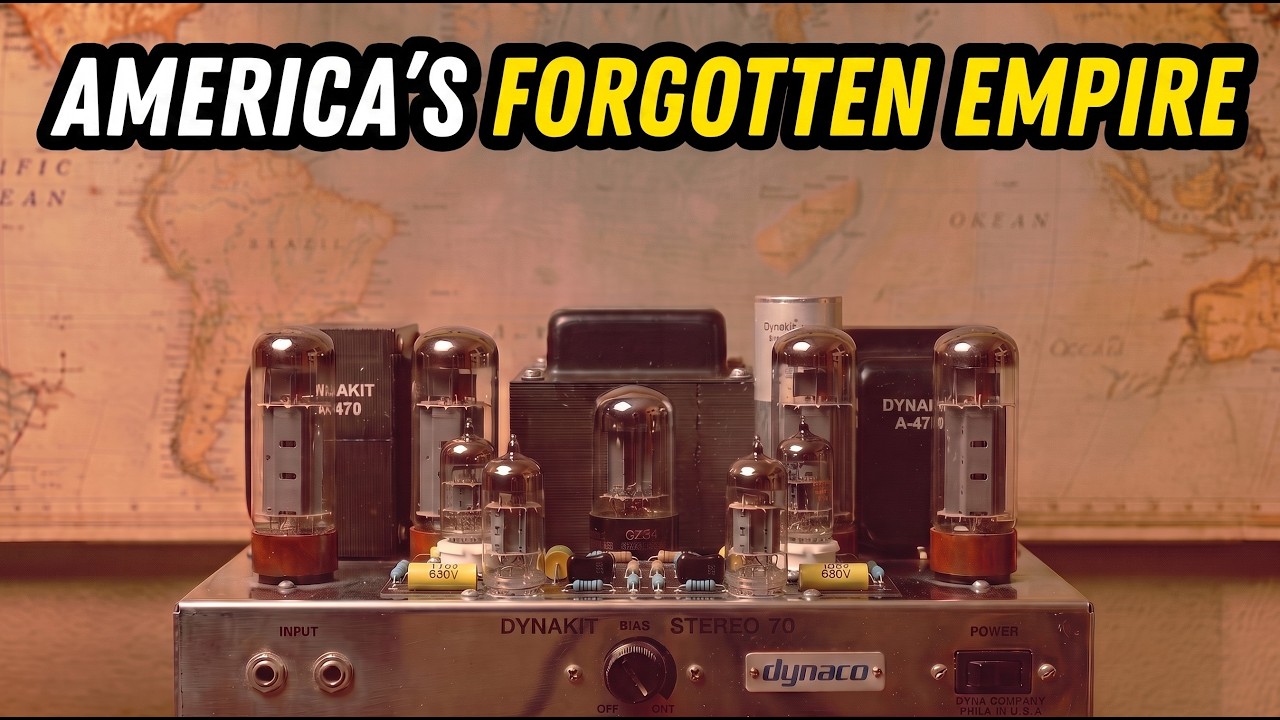
In 1959, a company in Philadelphia released a stereo amplifier that would change the American listening experience. The Dynaco ST-70 sold as a kit for $99. 95, and it delivered performance that challenged equipment costing three times as much. It was the product of a philosophy that had guided Dynaco from its founding: good electronics were not a luxury for the wealthy, and an ordinary person with a soldering iron and a free weekend could build something genuinely professional.
That philosophy belonged to David Hafler. Born in Philadelphia in 1919, Hafler studied mathematics at the University of Pennsylvania and served in World War II as a communications specialist in the U. S. Coast Guard, learning electronics by keeping wartime equipment running under pressure.
Around 1950, he co-founded Acrosound with Herbert Keros to build output transformers for the hobbyist market. Their transformers incorporated an ultra-linear output stage, an approach devised by British engineer Alan Blumlein that reduced distortion and combined the low distortion of triode operation with the higher output of pentode operation. The design became standard among home builders, and Hafler’s name became familiar in hobbyist circles. The partnership did not last.
Keros wanted to expand transformer manufacturing; Hafler wanted to move toward carefully designed, complete amplifier kits. They split in 1954. Hafler found a designer named Ed Laurent, and in October 1955 they founded the Dynaco Company in West Philadelphia. Its first product, the Mark II, was a 50-watt monaural amplifier available either assembled or as a kit.
The kit was different from anything else on the market. Other manufacturers expected customers to assemble and solder a circuit board from raw components, a task that punished the slightest error. Dynaco boards arrived pre-assembled and pre-tested. The builder handled only the mechanical connections: mounting the boards, hooking up the transformers, wiring the power supply, and fitting the chassis.
It was work a careful person could complete correctly on the first attempt. The instruction manual matched the circuit in quality. It was clear, organized, and assumed the reader was capable but not necessarily trained. At its peak, the Mark II reportedly sold at a rate of a thousand units a month.
In late 1957, the release of the first commercial stereo records changed the home audio equation overnight. Monaural amplifiers could not play stereo records, and running two of them doubled the cost and created channel-matching problems. Dynaco needed a single chassis containing two complete, identical amplifier channels at the same accessible price. Hafler, Laurent, and an engineer named Bob Tucker began work in 1958.
The result, released in 1959, was the Stereo 70. The ST-70 used four EL34 output tubes, a GZ34 rectifier, and a pair of driver tubes, delivering 35 watts per channel at eight ohms with one percent distortion. The EL34, originally developed for European radio transmitters, was known for its smooth midrange and a gradual, musical transition into clipping rather than a harsh cutoff. Listeners heard this as a kind of warmth, and it made the amplifier beloved for decades.
In December 1959, High Fidelity magazine reviewed the ST-70 and concluded that its measured performance matched or exceeded far more expensive amplifiers. Dynaco reprinted that verdict in its advertising for years, without changing a word. By 1964, a buyer could complete the picture. The PAS-2 preamplifier kit cost about $70, and the FM-3 tuner was also available as a kit.
A complete Dynaco system, consisting of an amplifier, preamplifier, and tuner, cost under $200. A phrase entered the American high-fidelity vocabulary: “the poor man’s McIntosh. ” It was never meant as an insult. A McIntosh MC-30 cost over $200 per channel; a stereo pair exceeded $400.
The ST-70 kit cost $99 and covered both channels. The performance gap was real, but narrow enough that the comparison held up in honest listening. In 1968, Tyco Laboratories acquired Dynaco. Tyco was a diversified conglomerate following the standard business logic of the era: buying profitable companies in fragmented industries and managing them for efficiency.
In 1968 alone, it acquired six companies in unrelated fields. Dynaco was one item on a balance sheet. Hafler stayed on in a consulting role until about 1974, providing continuity without operating authority. In the 1970s, production moved from Philadelphia to Blackwood, New Jersey, a move that made sense on a spreadsheet.
But not all the workers followed, and the informal knowledge that had accumulated over nearly two decades lived in people’s minds, not in documents. Some of it did not make the trip. The market was changing beneath the company’s feet. Buyers were moving toward solid-state amplification, and Japanese manufacturers were producing receivers of steadily improving quality at prices below their American counterparts.
Dynaco responded with its own solid-state line and with an innovative product designed by Hafler himself: the Dynaquad, a passive matrix system that derived rear-channel surround sound from an ordinary stereo recording without special equipment or extra amplifier channels. It was inexpensive and it worked, but it arrived at a moment when the American market had not decided whether it wanted quadraphonic sound at all. Production of the ST-70 ended around 1976, after roughly seventeen years. There was no announcement and no farewell.
By conservative estimates, more than 350,000 units had been sold; some figures approached half a million. It remained the best-selling tube amplifier in American history. Its discontinuation passed largely unnoticed at the time, but it marked something real: the product that had defined the company for two decades was no longer worth building. In 1979, Tyco sold Dynaco to ESS Laboratories, a California speaker manufacturer with genuine audio engineering background.
That background did not translate into a solution. ESS understood how to build speakers. Understanding what specifically a culturally distinct smaller company needed to remain viable after more than a decade inside a conglomerate was a different kind of knowledge, and ESS could not make the division profitable. In 1980, ESS closed the Dynaco division entirely.
The Blackwood factories shut down, and what remained of the inventory, tools, documents, and trademark rights was sold to a discount retailer called Stereo Cost Cutters, operating as Sound Values, based in Columbus, Ohio. That company sold off the remaining kit stock without developing anything new. A company that had once put more high-fidelity amplifiers into American homes than any other ended its original run as a wholesale closeout. The brand never entirely disappeared.
Around 1990, a company called Panar acquired the name and attempted a genuine revival, including an updated version of the A-25 speakers and a reissued tube amplifier called the Stereo 80, built on the original ST-70 circuit. The efforts were sincere but limited in execution. The kit model itself, the specific innovation that had made the original pricing work, was not revived. Panar’s production did not survive the 1990s, as a wave of imported amplifiers crowded into the same modest price range Dynaco had once dominated.
The brand eventually passed to Radial Engineering, a Canadian professional audio equipment manufacturer. David Hafler left his consulting role around 1974 and founded a new company under his own name in 1977. It was built on the same principles: serious performance at a price that did not require wealth, sold in both kit and assembled forms. This time the technology was entirely solid state.
In collaboration with engineer Erno Borbely, the company produced the DH-101 preamplifier and the DH-200 power amplifier, the first American commercially marketed amplifier to use a MOSFET output stage, delivering 100 watts per channel. Around the same period, Hafler promoted the idea that still bears his name: a simple method of extracting rear surround sound from an ordinary stereo recording by connecting a second pair of speakers between the existing channels rather than adding new amplifiers or special recordings. Audio engineers still refer to it informally as the “Hafler circuit. ” In 1984, he was inducted into the Audio Hall of Fame.
He sold his company to Rockford Corporation in 1987. He died in Philadelphia on May 25, 2003, at the age of 84. In the 1990s, the Dynaco Mark II, the company’s first product, was placed on display at the Smithsonian National Museum of American History. The restoration and modification community around the ST-70 remains among the most active in classic audio.
Original units in good working condition regularly sell for more than the amplifier’s original cost even after adjusting for inflation. Independent technicians across the country have built entire businesses around servicing and modifying the ST-70, including at least one begun by Bob Latino, the same man who built his first kit on a kitchen table in Worcester, Massachusetts, in 1964. Engineers who specialize in winding transformers still reproduce the original ultra-linear output transformers today because the transformer, in a literal sense, has outlived them. What Dynaco built was never really a secret circuit or exclusive technology.
The designs it used were published knowledge available to anyone willing to read. What the company actually built was an approach and a relationship with an audience that trusted it, and neither survived the transitions between owners, each of whom understood the balance sheet a little better than they understood what had made that balance sheet work in the first place. And yet, somewhere tonight, that old amplifier is still doing exactly what it was designed to do. The tubes are warm, the transformer is converting the signal the way it was wound to convert it more than sixty years ago, filling a room with music.
The building on Powellton Avenue is gone. The factory in Blackwood is no longer there. Ownership of the company changed five times after the man who founded it let it go, and none of those owners managed to preserve the thing that made it worth owning. A circuit can be copied, and a brand can be sold and resold.
What proved far harder to transfer was the patient conviction that the person on the other end of the transaction deserved the best performance available at the lowest possible price, and was capable of building it himself if given clear enough instructions. Dynaco proved that conviction could work on a large scale for a time.
