The winter of 1856 had frozen the Ohio River in sections, and for Margaret Whitfield that ice was the only road to freedom she would ever see. She gathered her husband Robert and their children and moved quietly through the darkness of late January, stepping onto the frozen surface that separated Boone County, Kentucky, from Cincinnati, Ohio. The ice cracked beneath their feet. The wind cut through their thin clothing.
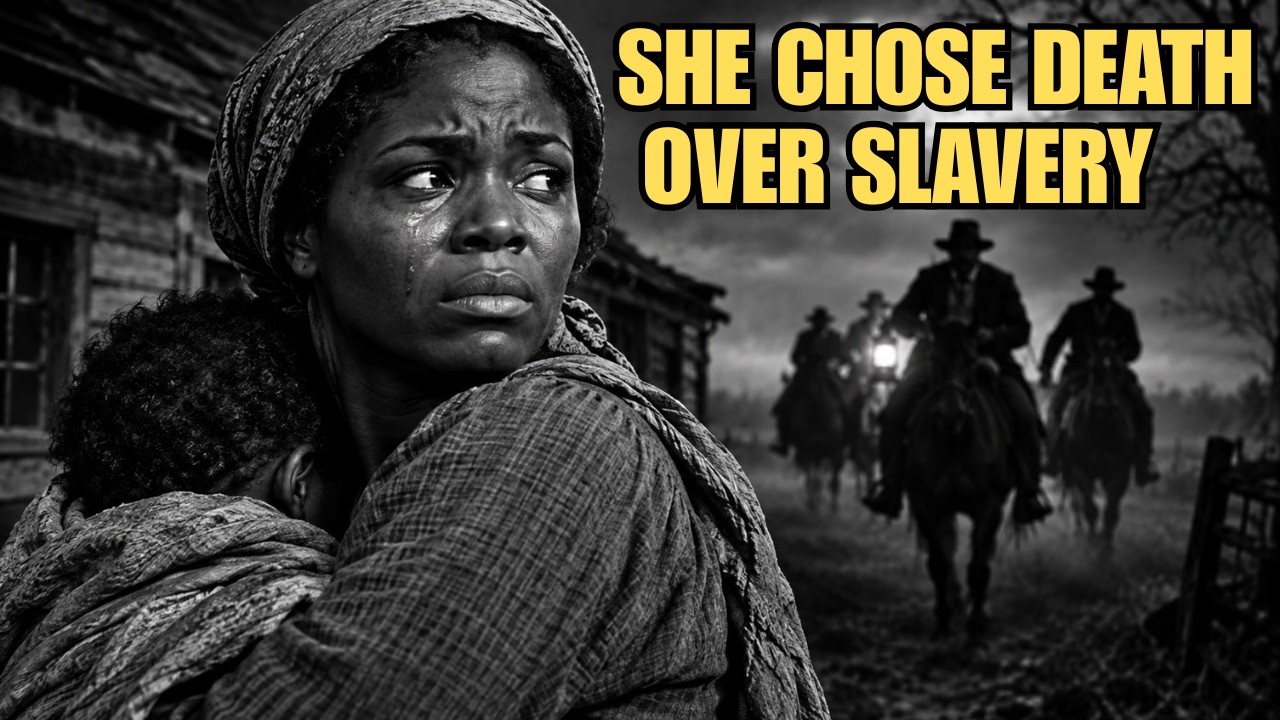
But they crossed, and for a brief moment they believed they had reached the other side of bondage. They took shelter in the home of relatives in Cincinnati. Then the Fugitive Slave Act of 1850 did what it was designed to do. Federal marshals were alerted.
Armed men surrounded the house. Inside, Margaret understood exactly what capture meant: being dragged back to Kentucky, punishment, and children growing up enslaved under the same violence she had known her entire life. When the marshals forced their way inside, chaos erupted. In that moment, Margaret Whitfield made a decision that would echo through American history.
Rather than allow her children to be returned to slavery, she took a knife and killed her young daughter. She attempted to kill her other children as well, but was stopped before she could complete the act. The room fell into stunned silence. Blood stained the floor.
Margaret did not deny what she had done. Witnesses later described her as calm, almost resolute. She reportedly said she would rather see her children dead than return to bondage. In that terrible moment, she believed death was mercy compared to slavery.
Margaret was not born with freedom in sight. She had been born into slavery in Kentucky, the child of an enslaved mother, and her own children were enslaved by law the moment they were born. She had endured years of bondage on the plantation of Archable Gaines in Boone County. Her body labored in the fields, but the heaviest weight she carried was the constant fear that her children would grow up in chains.
There were reports that one of her children had been fathered by Gaines himself, a painful reminder of how deeply slavery invaded the body and the family. Enslaved women lived under constant threat of sexual assault, and their children carried the visible evidence of that violation. For Margaret, the thought of her daughter growing up under the same system may have been unbearable. Her arrest set off a legal battle that drew national attention.
The question before the court was not only about one woman. It was about federal authority and the reach of slavery into free states. Abolitionists rallied around her, arguing that she should be tried in Ohio for murder rather than returned under the Fugitive Slave Act. If tried in Ohio, she might avoid being sent back into slavery.
Slaveholders insisted that property law took priority. Crowds gathered outside the courthouse. Newspapers printed daily updates. Politicians watched carefully.
The case forced Americans to confront a harsh reality: what kind of system drives a mother to kill her own child to prevent a return to slavery? In the end, the court ruled that Margaret Whitfield and her family must be returned to Kentucky under the Fugitive Slave Act. The law favored slaveholders. She was taken back across the river, the same river she had crossed seeking freedom.
Her surviving children were returned with her. Margaret’s story did not end there. While being transported further south by boat, the vessel collided with another ship. During the chaos, one of her remaining children drowned.
Margaret herself survived, but her life remained marked by tragedy. She later died while still enslaved. The river that had once offered escape now claimed another life. The Ohio River, which had symbolized hope on the night of the crossing, became the site of another loss.
For Margaret, the tragedy compounded itself. Loss followed her even beyond the moment that made her name known. Back in Kentucky, Margaret returned to the plantation world she had tried to escape, but she did not return unchanged. Her name had traveled across newspapers.
Her act had become political. Archable Gaines regained control over what he considered property, but he could not control the story that followed her. The plantation that once held her quietly now held a woman whose decision had sparked debate in cities far beyond Boone County. Life on the plantation resumed its harsh rhythm.
Dawn brought labor. Night brought exhaustion. Overseers enforced discipline without mercy. Yet Margaret’s existence carried a quiet tension.
Enslavers prefer obedience without question. They prefer submission without memory. Margaret had shattered that illusion. Every time she walked through the fields, she carried a story that slaveholders wished could be erased.
Grief did not free her from labor. Pain did not reduce her workload. Slavery did not pause for mourning. It demanded productivity even from those drowning in sorrow.
Her case continued to circulate in northern newspapers. Abolitionists carried her story into speeches across the North. They described her not as a monster, but as a mother driven beyond the limits of endurance. They asked audiences to confront the question that would not go away: what kind of society forces a woman to believe that killing her child is an act of mercy?
Southern newspapers told a different story. They portrayed her as criminal and unstable. They insisted that slavery was not cruel. They argued that abolitionists were exaggerating conditions to inflame public opinion.
This clash of narratives revealed how deeply divided the country had become. Margaret’s story became a mirror, reflecting two opposing visions of America. One side defended property and order. The other side demanded recognition of humanity and moral accountability.
In the years leading up to the Civil War, tensions over slavery intensified. The Dred Scott decision in 1857 declared that African Americans could not be citizens and had no rights that white men were bound to respect. That ruling reinforced the very system Margaret had fought against. It suggested that even in free states, black lives were subject to the authority of slaveholding interests.
For many abolitionists, the combination of Dred Scott and the Whitfield case revealed a pattern: the law protected slavery more fiercely than it protected life. Records suggest Margaret was later sold further south. Enslaved people were often moved like commodities when controversy followed them. Moving her would reduce attention and restore quiet control.
During transport by steamboat, tragedy struck again when the vessel collided with another ship. In the confusion, one of her children drowned. It is difficult to imagine the emotional weight she carried after that event. When the Civil War erupted in 1861, the institution that had shaped her life began to fracture.
Battles raged across states. Union armies advancing into Confederate territory created cracks in the structure of slavery. Enslaved families fled plantations seeking protection behind Union lines. Camps for escaped slaves, often called contraband camps, began to form.
Word traveled quickly. The same networks of communication that once carried whispers of rebellion now carried news of approaching freedom. By 1865, the Thirteenth Amendment formally abolished slavery in the United States. The chains that defined Margaret’s life were legally broken.
Yet freedom arrived too late to undo the suffering she endured. If she lived to see emancipation, it came after unimaginable suffering. Freedom after trauma carries its own weight. The body may be free, yet the mind holds images that do not fade easily.
After the war, during Reconstruction, the nation attempted to redefine citizenship and rights. Black men voted. Schools for freed children were established. Churches became centers of leadership and organizing.
Families once separated by sales searched for one another across counties and states. Newspapers printed ads from parents looking for children sold years earlier. In this new atmosphere, stories like Margaret’s took on renewed meaning. They were reminders of what had been endured.
They were warnings against allowing injustice to return under new names. Yet Reconstruction was short-lived. By the late nineteenth century, segregation and disenfranchisement took root across the South. Laws known as Jim Crow restricted movement, voting, and economic opportunity.
Though slavery had ended, racial control evolved into new forms. The memory of slavery, including stories like Margaret Whitfield’s, remained a quiet undercurrent shaping how communities understood freedom and vulnerability. In the twentieth century, as the civil rights movement rose to challenge segregation, historians and writers revisited earlier narratives of resistance. Margaret’s story resurfaced in scholarship and literature.
Her life became a lens through which scholars examined the psychological damage inflicted by slavery. She was not portrayed simply as a tragic figure. She was seen as someone who acted within extreme constraint, someone who seized agency in a world designed to deny her any. Historians began focusing more on the voices and actions of enslaved women.
They examined how gender shaped resistance. Margaret’s life offered a stark case study. Her act challenges modern audiences because it resists simple interpretation. It is neither easy heroism nor easy condemnation.
Some emphasize her agency, arguing that within a system designed to strip her of all power, she made a choice that asserted control. Others emphasize tragedy, focusing on the loss and the psychological toll. Both interpretations matter. They show that resistance is rarely simple.
It is shaped by circumstance, by trauma, by love, and by fear. Modern historians also emphasize that enslaved women experienced a distinct form of oppression. Their reproductive lives were controlled. Their children increased the wealth of slaveholders.
Their bodies were sites of both labor and violation. Margaret’s act cannot be separated from that context. It was shaped by a system that denied her control over motherhood itself. Her story also influenced literature decades after her death.
Writers drew inspiration from her life when exploring themes of memory, trauma, and maternal protection. Through fiction and historical analysis, Margaret’s decision was revisited not to sensationalize it, but to understand it. Her life became a lens through which to study how deeply slavery invaded the most private spaces of human experience. When compared with other acts of resistance during slavery, a broader picture emerges.
Charles Deslondes led hundreds in organized revolt. Denmark Vesey planned an uprising aimed at seizing a city. Margaret’s resistance unfolded within a family. It was intimate, immediate, and devastating.
Each of these stories reflects different strategies against oppression. Together, they reveal that enslaved people were never passive. They resisted in ways shaped by their environment and opportunity. Standing today along the Ohio River, one sees peaceful water flowing between Kentucky and Ohio.
Boats pass quietly. Bridges stretch across the current. Yet beneath that calm surface lies memory. In 1856, that river was a line between bondage and possibility.
Margaret crossed it believing she had reached safety. When marshals forced their way into her refuge, the law crossed that river with them. The Fugitive Slave Act made clear that even free soil could not fully shield a black family from slaveholding power. Her story also forces an examination of the role of law.
Courts ruled that she must be returned as property. The same legal system that proclaimed liberty upheld her bondage. That contradiction fueled abolitionist outrage and deepened sectional conflict. Margaret’s case did not cause the Civil War by itself, but it became one more piece of evidence that compromise over slavery was failing.
The moral questions surrounding her decision continue to challenge audiences. Was her act an expression of resistance? Was it despair? Was it both?
There is no easy answer. What is clear is that slavery placed her in a position where every option carried pain. Returning to bondage meant exposing her children to exploitation and lifelong captivity. Death, in her mind at that moment, appeared as the only escape.
She stood in a moment where every option was terrible. She chose what she believed would spare her child from lifelong suffering. That belief speaks volumes about the brutality she had endured. History does not ask us to celebrate her act.
It asks us to understand the conditions that produced it. It asks us to recognize how systems of oppression distort human choices. And it asks us to remember that beneath every law and policy are real people navigating impossible circumstances. Margaret Whitfield’s name remains etched into the shadows of history.
Her story is painful yet necessary. It reminds us that freedom is not simply the absence of chains. It is the presence of dignity, safety, and control over one’s own family. Without those, the word freedom becomes hollow.
Slavery was not sustained only by chains and whips. It was sustained by laws, by silence, and by a refusal to acknowledge suffering. Margaret Whitfield shattered that silence. She did not lead a march.
She did not organize hundreds. But her act forced America to confront the human cost of its laws. Her shadow stretches across centuries. It reaches into discussions about motherhood, autonomy, and justice.
It challenges us to think deeply about what freedom truly means. It asks us to confront the cost of denying humanity to others. And it reminds us that beneath every law and political debate are real lives shaped by its consequences.
