The phone call came just after dawn, and the voice on the other end carried the kind of calm that only ever prefaced catastrophe. Martha “Sunny” von Bülow lay unresponsive in the bathroom of Clarendon Court, her Newport mansion, her lips stained with blood, her body already cold. By the time the ambulance reached the hospital, her brain showed almost no measurable activity. The doctors ran their tests—CT scans, blood work, every tool modern medicine could offer—and found devastating injury.
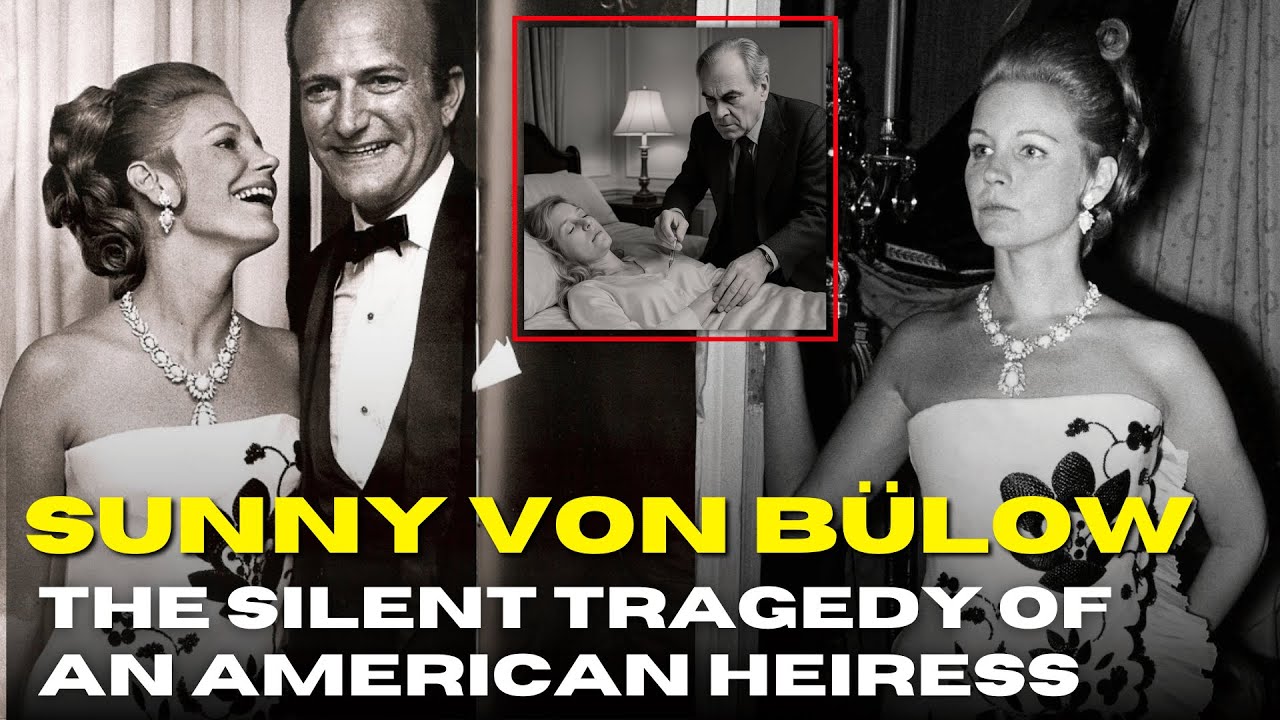
There would be no illusions about recovery this time. The woman who had once lit up every room she entered was now locked in a vegetative state, and the question that would haunt two continents for the next three decades had already begun to form: had she done this to herself, or had someone done it to her? To understand how Sunny von Bülow arrived at that bathroom floor, one had to go back to a different beginning entirely, one that unfolded on a private luxury rail car cutting through Virginia on the way to New York. She was born there, mid-journey, in circumstances so unusual and so spontaneous that her family could not resist naming her for the moment itself.
Her father, George Crawford, was a utility tycoon of immense wealth. Her mother, Annie Laurie, was a composed and gracious presence who had never expected to deliver her only child in transit. At first, the family floated the nickname “Choo-Choo. ” Quickly, though, they settled on something better: Sunny.
It suited her perfectly. She was bright, warm, approachable, possessed of an easy cheerfulness that made everyone around her feel better simply by being in her presence. That sweetness became the defining feature of her identity, and it would plant the seeds of everything that followed. Her childhood was financially privileged beyond imagination, but money could not fill every hollow.
When she was just three years old, her father died suddenly, leaving her an estate worth roughly one hundred million dollars—a sum that in modern terms staggers the mind. It was an extraordinary inheritance, but it also carved an emptiness into her earliest memories. She could barely recall her father’s face. Her mother remarried, but for Sunny, the man who had given her everything remained a mythic figure, gone before he could leave any real impression.
Her world was filled with glittering possibilities, fine dolls, armies of nannies, and lavish feasts, yet fate had already begun to fracture her reality. The absence of her father was the first sign that having everything did not make a person invincible. Still, as a child, Sunny was vibrant. She made friends with everyone, even strangers.
She was known to take household staff and visiting service workers into her heart with remarkable ease. She remembered birthdays, wrote thank-you notes, and amazed people with her unpretentious smile, as though she had never learned to wear the social masks that the wealthy of her era wore so instinctively. Old-money families of that generation prized decorum over emotional transparency, but Sunny was a blend of both. She charmed everyone, and she let people know she genuinely cared.
When someone around her was hurting, her sensitive nature stirred, even in small, quiet moments. From very early on, she carried an emotional generosity that left her wide open to injury. Perhaps her father’s death had taught her that life was fragile, and that love had to be given freely while there was still time. By the time she reached adolescence, she had grown into the perfect image of a high-society young woman: elegant, well-traveled, skilled in conversation, her face bright with a lively gaze and a ready smile.
In postwar New York, the elite circulated through famous hotels, grand parties, and private clubs, and whispers followed her wherever she went. Who was this girl with such vast wealth and such impeccable lineage? The press occasionally tried to photograph her or coax a comment from her. In an era when the Crawford name in the utility business meant enormous fortune, curiosity about the young heiress ran high.
Yet even in those golden days, storm clouds gathered. Her immense inheritance was an invisible source of friction, something others quietly maneuvered to exploit. Trust funds, protective conditions, guardianship arrangements, the management of her money—all of it lay beyond her understanding, and all of it made her a target. At twenty, she was enrolled at a distinguished finishing school and traveled frequently to Switzerland, where the children of aristocratic families from around the world refined their skills at skiing and tennis.
It was on one of those Swiss trips that fate introduced her to Prince Alfred von Auersperg. To call him her tennis instructor was technically accurate, but it concealed the more remarkable truth: he was a genuine Austrian prince from an ancient lineage. By the twentieth century, the Austrian Empire had long since vanished. The First World War, decades earlier, had destroyed most of the old monarchy’s wealth and power.
Prince Alfred bore the title, but his finances did not match it. He was, by most accounts, tall and handsome, with the athletic aristocratic bearing that made women at Switzerland’s exclusive resorts turn their heads. To Sunny, meeting someone of literal royal descent felt, at least at first, like a fairy tale. To Alfred, the advantages of connecting with an American heiress of staggering fortune needed no explanation.
Their union promised both of them social standing and security. He wanted some measure of aristocratic dignity restored. She, perhaps, was searching for the steady paternal presence she had always lacked. Amid the enthusiasm of their social circle and the murmur of a match between an American fortune and an Austrian prince, they became engaged.
In 1957, at the age of twenty-six, Sunny married Alfred and took on a new identity, along with an entirely new set of royal relatives. The couple did not waste time starting their family. Their first child, Princess Annie Laurie, called Ala, was born in 1958, and their son Prince Alexander followed in 1959. To outside observers, Sunny had achieved her dream.
A respected royal husband, two healthy children, and ample inherited money ensured that they would live like royalty, even if the Austrian monarchy was only a memory. Newspapers occasionally carried small announcements about the couple, especially when they appeared in New York or at charity events. She was described as an elegant, fashionable mother; he was described as an attractive, well-educated aristocrat. No one on the outside sensed that beneath that perfect picture, deep cracks were forming.
By 1965, the royal marriage had entirely collapsed. Rumors swirled about quarrels, disillusionment, and possible infidelity on one or both sides. The official statements were generic, citing irreconcilable differences. Still, it was an embarrassment for both families.
For all the fairy-tale illusions, the reality was a long, drawn-out heartbreak. Sunny’s dreams of a happy marriage turned to dust in less than a decade. She faced the bitterness of divorce as a young woman, before she could settle into a new rhythm of life. But scandal moved quickly, and the next sensational news captured everyone’s attention almost immediately.
Exactly one year after the divorce, in 1966, Sunny married Claus von Bülow. By then, she had developed a taste for aristocratic European men. Claus was not a prince, but he came from Danish nobility and carried European manners, moving easily through circles of the very rich. He was the chief adviser and right hand of oil tycoon J.
Paul Getty, one of the wealthiest Americans of all time. In elite society, that was a major credential. Perhaps in Sunny’s eyes, Claus was the perfect new partner, someone familiar with money, power, and social grace. Emerging from a broken marriage, she still felt the pull of new possibility.
For a time, everything seemed bright again. Claus and Sunny quickly became fixtures at dinners and parties, playing the role of a glamorous high-society couple. In 1967, Sunny gave birth to her third child, Cosima. For Sunny, this moment felt like a new beginning, a chance to build the happy family she had wanted ever since losing her father as a small child.
She now had three children: the first two fathered by Prince Alfred, and Cosima by Claus. The family moved easily between their Manhattan apartment on Fifth Avenue and Clarendon Court, the Newport mansion that was ideal for grand summer entertaining. They lunched with tycoons at exclusive clubs and occasionally mixed with the upper echelons of European society. Sometimes they relaxed behind the ornate gates of the Rhode Island mansion, the sea breeze touching their stately rooms.
From a distance, their marriage looked flawless. But appearances, as they often do, deceived. By the late 1970s, the atmosphere inside the von Bülow household had turned poisonous. There were constant arguments and theoretical disputes over everything.
Claus spent most of his time in New York on business, or, as fewer people initially knew, absorbed in personal activities. Sunny spent most of her time in Newport. Though the press occasionally caught smiling photos of them together, friends began to suspect a coldness between them. Body language told its own story.
Guests at their dinners noticed that Sunny and Claus rarely spoke to each other and rarely even stood close to one another. Over time, a suspicion took root. Perhaps Claus resented living off his wife’s money. He had his own income, certainly, but he drew large sums from Sunny’s vast fortune for personal expenses, and it clearly gnawed at him.
Then there was the matter of other women. At the edges of high society, people whispered about Claus’s relationship with Alexandra Isles, a beautiful former soap opera star. The talk was that she was no mere fling. Alexandra, it was said, was pressuring Claus to marry her, and he was effectively torn between two women.
Divorcing Sunny meant losing the financial security that allowed him to live royally. But staying with Sunny was suffocating, especially during their fights. Complicating matters further was the question of Sunny’s mental state. Claus later claimed she was emotionally unstable, and that leaving her would have been socially and financially disastrous for both of them.
The tension in that marriage was so thick it could have been cut with a knife. Then came December 1979, the moment that changed everything. The family gathered at their Newport estate. Sunny’s adult son Alexander, then in his twenties, was there, and the holiday mood was festive.
During the day, mother and son spent some time drinking eggnog, possibly laced with something stronger. Many believed Sunny had a serious problem with alcohol: she loved to drink, but seemed unable to control herself. That night, after drinking with Alexander, she became disoriented, her walk unsteady. Everyone assumed she simply needed to sleep it off.
But this was no ordinary intoxication. She lost consciousness in a way that left her family finding her deeply unresponsive the next morning. Panicked, they rushed her to the hospital, where doctors found she had slipped into a coma. Emergency measures followed, and eventually they revived her.
When Sunny regained consciousness, the medical team told her she had suffered hypoglycemia. Her blood sugar had dropped to life-threatening levels. The immediate solution, they said, was a change in diet and avoidance of certain sugary foods. It all seemed simple enough, but it was deeply worrying.
No one at that moment could imagine what horror lay ahead, or what secrets would later surface about her coma. The rest of that year at Clarendon Court passed in strange quiet. Looking back, her family’s memories took on an ominous cast. Shortly after that frightening episode, Maria, the longtime housekeeper, found sleeping pills in Claus’s travel bag.
It struck her as odd, though not initially criminal. Plenty of wealthy people traveled with sleeping medication. But then she found a syringe containing insulin. Why would Claus have it, especially since no one in the family had diabetes?
Maria quietly told Alexander, and the two of them grew uneasy. Still, they had no definitive proof of wrongdoing. Meanwhile, Sunny’s health continued to fluctuate. There were episodes of dizziness and confusion that sent her back to the hospital repeatedly.
At one point, an overdose of aspirin landed her in intensive care again. Many assumed that the strain of her failing marriage was breaking her down: she was drinking too much, mixing medications, sinking into depression. But was that the whole story? Or was something more sinister at work?
At Christmas 1980, the family gathered again at Clarendon Court. The atmosphere may have been unbearable, but holiday traditions were observed as though nothing were wrong. On December 21, they had dinner and then went to a local cinema to see a movie. The only sign of trouble was that Sunny mentioned she was feeling ill, perhaps with sinus trouble.
Alexander remembered that later that night, Sunny returned to the living room holding a glass he thought was ginger ale. She asked Claus to bring her some chicken soup. Within a short time, her voice grew faint, her muscles went slack, and she sank into that unsettling half-conscious state. Still, Alexander left her in Claus’s care and went to a local bar to meet friends, assuming she was simply tired from medication or drink and needed rest.
It was the last time he would ever see his mother conscious. The next morning, Sunny did not appear for breakfast. Claus, who claimed he had slept beside her, did not seem worried at first. Then he examined her more closely and realized something was terribly wrong.
They found her in the bathroom, motionless, blood trickling from her lips, her body cold. By the time she reached the hospital, almost no brain activity could be measured. She had descended into a deep coma from which she would never wake. All the tests, the scans, the blood work, every effort of modern medical science confirmed catastrophic brain damage.
The doctors harbored no illusions this time. The impact on her children was beyond imagination. Alexander and Sunny’s eldest daughter, Ala, sat by her hospital bed day after day, grappling with the brutal finality of her condition. Cosima, still young, was devastated too, though she likely lacked the maturity to grasp the complexities swirling around her.
In the midst of deep grief, accusations began to harden. Alexander and Ala became determined to voice what they suspected. The mysterious insulin syringe, Claus’s designs on Sunny’s inheritance, and his eerily unbothered demeanor led them to whisper to each other that their stepfather had tried to kill their mother. Even more chilling was their conversation with the chief neurologist, who stated plainly that Sunny’s condition matched the signs of an insulin overdose.
It was enough to set them searching for justice. Still, they tried to keep the tragedy out of the headlines. The family hired lawyer Richard Kuh to investigate discreetly. Their hope was that if Claus was truly guilty, they could gather conclusive evidence without turning their family tragedy into public spectacle.
But tragedy does not stay hidden in high society, especially when billions of dollars are at stake. Rumors were already spreading through the gossip networks. Within months, a grand jury indicted Claus on two counts of attempted murder: one for the December 1979 incident, and one for December 1980. Suddenly, the story exploded into public view.
The media seized on every sensational detail and painted a lurid portrait of a handsome European socialite who had poisoned his beautiful, wealthy wife. Overnight, Sunny von Bülow’s name appeared on front pages everywhere, and the family’s secrets were laid bare before the world. Beginning in February 1982, Claus’s trial dominated tabloids and serious news outlets alike. Lawyers on both sides hurled accusations, scrutinized the intimate details of Sunny’s personal habits, and called witnesses like the loyal housekeeper Maria, who tearfully recalled the black bag containing sleeping pills and the insulin syringe.
They examined medical records and argued fiercely over whether Sunny had genuinely suffered from hypoglycemia or had harmed herself through a combination of prescription drugs and alcohol. Claus’s legal team tried to portray Sunny as a troubled woman who recklessly abused substances, perhaps even with suicidal tendencies. The prosecution countered by showing how perfectly everything fit together: Claus’s extramarital affair, his potential claim to Sunny’s vast fortune upon her death, and the suspicious timeline of events. The legal battle unfolded like a twisted soap opera, strangely echoing the actress who had once captured Claus’s heart.
Among the mass of evidence, the syringe found in Claus’s bag proved the most damning. Lab tests confirmed the presence of insulin. Against the prosecution’s relentless assault, no innocent explanation for the insulin’s presence seemed possible, unless it had been kept for some vile purpose. And so the drama concluded: Claus von Bülow was found guilty on both counts of attempted murder.
It seemed like the final act of a tragic melodrama. Two children had lost their mother forever, and the man they held responsible was going to prison. Social observers called it a rare instance of justice reaching into the elite. But the story was far from over.
Claus was never one to accept a verdict quietly. He decided to appeal and hired Alan Dershowitz, the famous defense attorney and Harvard law professor known for his legal ingenuity. Dershowitz’s involvement upended the entire legal process and gave the media fresh material. With renewed vigor, he attacked the prosecution’s claims, casting doubt on laboratory procedures, questioning witness reliability, and planting seeds of suspicion around every piece of evidence behind Claus’s conviction.
He investigated whether Sunny’s routine use of sleeping pills or a massive self-administered overdose while unconscious could have caused her coma. He questioned the chain of custody of the alleged syringe. Step by step, he dismantled the argument that this was a simple case of poisoning. Finally, in a stunning turn, Claus von Bülow was acquitted on appeal.
Like a gambler who loses the first round and wins the next, he walked out of court a free man. Yet his vindication could not return him to the golden world he had once inhabited. The damage ran far too deep. In the years that followed, Sunny remained alive on life support.
Her children endured agonizing uncertainty. Some believed Claus had committed the perfect crime and gotten away with it. Others felt the justice system had ultimately corrected a wrongful conviction. Meanwhile, the civil case moved forward.
With Sunny incapacitated, her eldest children bore the responsibility of fighting on her behalf. In due course, they sued Claus in civil court for the harm done to their mother. That case ended in a settlement reached outside the courtroom: Claus formally relinquished his claim to Sunny’s estate, agreed to a separation, and withdrew from the family’s American property. He left the country and moved to England.
The rift within the family ran deep. Alexander and Ala believed Claus guilty, but Cosima—his beloved youngest daughter—refused to blame her father. That disagreement kept the siblings apart for years. Sunny’s mother, furious at Cosima’s stance, cut her off from the inheritance for a time.
The entire family was emotionally shattered, bound together only by the tragedy that had plunged Sunny into endless sleep. And what of Sunny herself? She lay in her hospital bed year after year, unaware of the fight for justice being waged around her, unaware of her own name in the headlines. She never opened her eyes, never spoke to her children, never offered any opinion on Claus’s guilt or innocence.
In one of the strangest turns, her first husband, Prince Alfred, suffered a similar fate in 1983: an accident left him permanently unconscious, and he died in 1992. The prince and princess, once married, suffered parallel tragedies without ever knowing it. Sunny remained in a coma for nearly three decades. In December 2008, she took her final breath, having spent almost half her life suspended between life and death.
After so long under close medical supervision, her heart simply stopped. She was seventy-six years old. By then, the world had largely forgotten the sensational headlines. Occasionally, a documentary or retrospective program mentioned the old von Bülow case.
When news of her death spread, a ripple of the old dread returned, stirring the uncomfortable question once more: had she brought on her own unconsciousness through excessive drinking and sleeping pills, or had her husband administered the final lethal dose? Claus, for his part, lived quietly in London for decades, rarely granting interviews or telling his side of the story at length. Occasionally he was spotted at elite gatherings or in the city’s exclusive neighborhoods. He died in 2019 at the age of ninety-two, outliving Sunny by more than a decade.
To some, his longevity was an insult, a taunt from a man who had outlived the woman whose life was taken. To others, it was simply the final outcome of a complicated story with no clear resolution. Even among those who observed the case closely, opinion remained sharply divided. Jim Cramer, the assistant attorney on Claus’s appeal, later said he remained certain Claus was entirely guilty.
But many legal experts believed the prosecution never had conclusive proof, especially given the abundant documentation of Sunny’s drinking, sleeping pill use, and depression. For those closest to her, it was a heartbreak they could likely never fully overcome. Alexander and Ala had to watch their mother’s unresponsive body for years, then bury her knowing she had spent nearly half her life in the darkness of a coma. Cosima endured the grief of losing her mother and the burden of choosing a side that created distance within her own family.
None of them could bring back Sunny’s radiant presence. The charm and warmth of that young woman who once skied in Switzerland and believed in fairy-tale love were gone, physically and spiritually. In the end, Sunny von Bülow’s story endures as a parable worthy of a Hollywood film: a princess trapped in a golden cage, undone by forces she never fully understood. The wealthy are not above sorrow, however bright they may appear from the outside.
In a world where fortune reshapes relationships, where trust becomes a commodity, and where secrets fester behind ornate curtains, the stakes are even higher. Sunny’s story reveals how illusion can become a trap, how love can curdle into bitterness, and how wealth can draw danger into its orbit. Above all, she remains the tragic figure at the center of it all, a silent witness to the darkness that chased even the brightest dreams.
