They came for her with nine men and enough rope to bind a mule. They left with three men unconscious in the dirt and six more limping toward the county doctor, carrying a story that would outlast every property record ever burned in that part of Georgia. The woman at the center of it stood close to six feet tall, built from the same red clay that colored the hills around her, and by the time the sun rose the next morning, she had done something the men who owned her never imagined possible. She was born sometime around 1805 in the red dirt hill country of central Georgia.
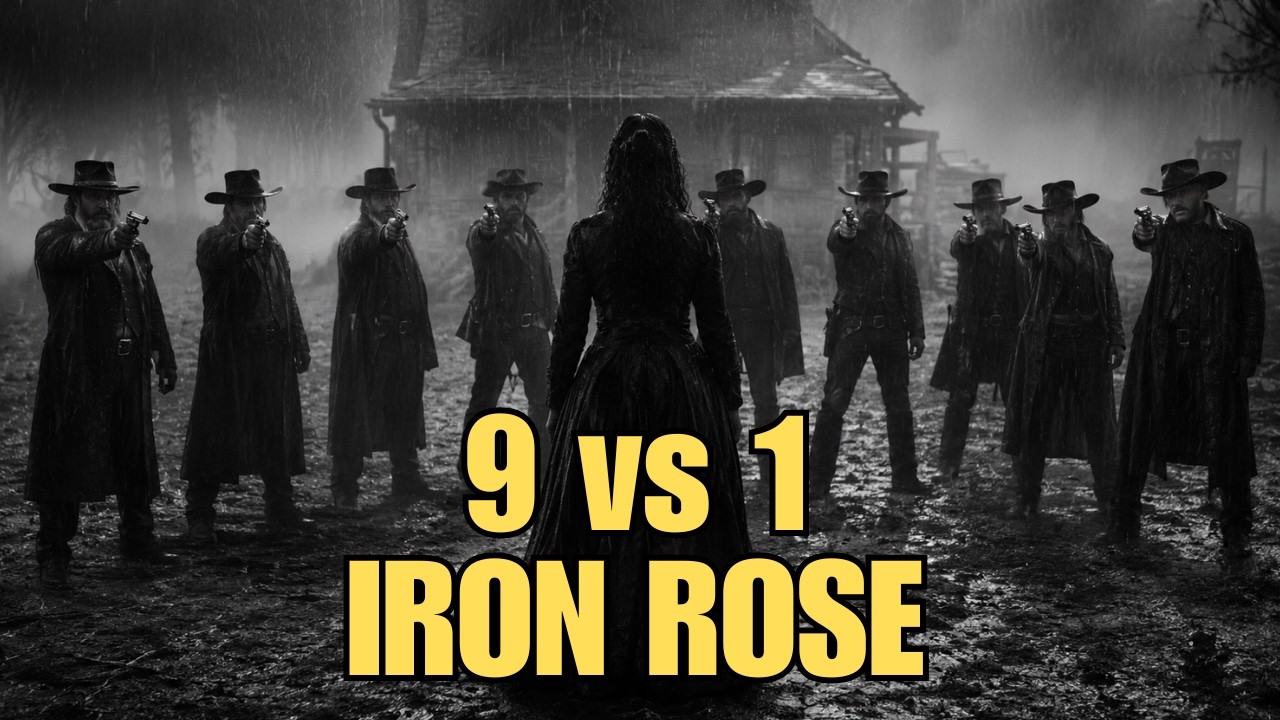
Her mother named her Martha, a plain name for a woman who would become anything but plain. By the time she was fourteen, the other women working on the property had begun calling her a different name behind the supervisor’s back, not out of cruelty but out of awe. Iron Rose. Iron because nothing about her seemed to bend the way the world wanted it to.
Rose because for all her strength, there was a softness that never left her, the way she hummed to the children in the quarters at night, the way she carried water for the elders before she carried it for herself. Her mother had come to that property as a girl herself, one of the last generation to arrive before the laws changed in 1808. She died when Martha was still young, leaving behind little but a handful of half-remembered songs and an aunt named Naomi, who would shape so much of who Martha eventually became. What Martha inherited from her mother’s memory, passed down secondhand through Naomi’s retelling, was a sense that the world she had been born into was not the only world that had ever existed.
Somewhere across an ocean she would never see, there had been a life where her family’s strength and fierce protectiveness had been a source of pride. That knowledge mattered more than the property could have understood. It gave Martha something to stand on besides the ground she worked. The supervisor noticed her before she turned fifteen, not with kindness but with calculation.
She was big, strong, capable of picking more cotton in a day than two men combined. They worked her harder than anyone and gave her the lash as a consequence for surviving it. The first time they disciplined her, the offense was slowness, though anyone who watched her work knew there was nothing slow about Martha. She had stopped for perhaps thirty seconds to help a boy half her size who had collapsed in the heat.
Thirty seconds cost her a severe beating. She did not cry out, not once. The supervisor that day, a man named Silas Boon, would later tell other white men on neighboring properties that the girl’s silence unsettled him more than any sound could have. He said it was like striking stone.
That silence became her armor. Year after year, consequence after consequence, Martha learned to fold her pain into somewhere the supervisors could never reach. And somewhere in that folding, something else was growing. Something patient.
Something that understood, long before that night in the yard, that the day would come when folding wasn’t going to be enough anymore. The cruelty did not stop when she was young. They came again when she was accused of talking back to a mistress who had wrongly accused her of taking a hair comb. They came again when she refused to hand over a blanket meant for her ailing grandmother during a cold snap that took two infants in the quarters.
Each time Martha absorbed what was done to her the same way, silent, still, her eyes fixed somewhere past the man in charge, as though she were already somewhere else entirely. But the other workers noticed something else about her. She never let the hardship turn her hard toward the people around her. Where some survivors of that kind of repeated abuse grew guarded and distant, Martha only grew more devoted to the people she loved.
She carried sick children on her back to the healer’s cabin without being asked. She gave up her own meager rations more than once so an elder wouldn’t go hungry. She sat up through the night with women in labor, humming low songs that existed only in the memory of those who heard them. It was this combination, the iron and the rose, the two halves of a name the quarters eventually settled on for her, that made her impossible to categorize.
The supervisors wanted her to be either broken or defiant, quiet or rebellious, because those were the only two boxes their understanding could hold. Martha was neither. The property where she lived and labored sat along the fall line of central Georgia, in a stretch of country where the soil turned from Piedmont clay to sandy coastal plain, land greedy owners had only recently forced into cotton production. It was brutal country to farm and brutal country to survive in.
The property owner, a man remembered in the oral history only as Master Klene, had built his fortune on speed and volume. More cotton, faster, at any human cost. Klene employed nine white overseers to manage roughly one hundred forty enslaved men, women, and children across three separate fields. Nine men whose entire purpose was to extract more labor from bodies that had nothing left to give, and to do it through fear.
Among the worker community, each of those nine men had a reputation, whispered from cabin to cabin after dark. There was Boon, quick-tempered and impulsive. There was a heavyset man named Garrett Voss who liked to use his fists instead of the whip, claiming it built character. There was a lean, quiet one named Thomas Ridley, whom everyone feared more than the loud ones, because cruelty that doesn’t raise its voice is the hardest kind to see coming.
Martha worked under all of them at different points across the years, and by the time she reached her mid-twenties, she had become the strongest laborer on the property, male or female. She could load a cotton wagon that took two men to load. She could carry sacks of grain that would stagger a mule. And she had never, not once in over a decade, attempted to run or fight back.
She had shown nothing but that same folded, patient silence. They mistook that patience for submission. That was their first mistake. What nobody outside the quarters knew was that Martha had spent those years doing more than surviving.
She had spent them watching. Studying the rhythms of the overseers, learning which ones drank before their shift and grew slow and careless, learning which ones favored their right side because of an old injury, learning the layout of every field, every fence line, every stretch of forest bordering the property. Because in the back of her mind, in the deepest part of the fold where her pain lived, she had never once accepted that this was the whole of her life. Her aunt Naomi, an elder in the quarters, was the one who first taught her something the overseers would never have imagined her capable of learning: the mechanics of the human body.
Naomi had been a healer back before she was stolen from the coast of West Africa as a young woman, and she carried with her knowledge of anatomy that had nothing to do with medicine alone. She knew where a strike could drop a grown man in a single motion. She knew how leverage could turn a smaller body into a weapon against a larger one. She knew that strength was not always about size.
It was about precision, timing, and the willingness to commit fully to a single devastating motion. Late at night, in the narrow space between the cabins, Naomi taught Martha these things in silence, using nothing but hushed words and careful demonstration. Not fighting for sport. Fighting for the day survival demanded.
“You will not always have a choice about when it comes,” Naomi told her, according to the story as it has always been passed down, “but you will have a choice about whether you are ready. ”
The lessons began small. Naomi would grip Martha’s wrist and have her practice turning out of the hold, using nothing but the rotation of her own forearm, over and over until the movement stopped feeling like effort and started feeling like breathing. She taught her how a person’s eyes betray their next move half a second before their body does.
How a man about to swing high will glance almost involuntarily at the spot he intends to hit. She taught her to fall without injury, to roll instead of crash, because a fight is rarely a single blow. It is a sequence, and the person left standing at the end is usually the one who wasted the least energy along the way. Naomi also taught her something that had nothing to do with strikes or holds at all.
The discipline of stillness. “An angel fights loud,” she would say. “It swings wide and it swings tired. What you carry, you carry quiet, and quiet never gets tired.
”
Some nights the lessons were physical. Other nights Naomi simply talked about the coast she had come from, about a warrior tradition of women in her home village who had trained for exactly this kind of moment generations before either of them had ever set foot on Georgia soil. Women who trained alongside the men of their community, who were entrusted with the defense of their villages during raids, whose strength and skill were celebrated rather than feared. Much of what Naomi carried with her had been worn thin by decades of forced separation from the culture that shaped it, fragments reassembled from memory rather than an unbroken tradition.
But fragments, she always told Martha, were enough. A fragment carried forward is still a whole thing passed on. It only becomes lost when no one bothers to carry it at all. Martha listened.
Martha trained quietly, patiently, for years, never once revealing what she was building inside herself. She practiced in the dark using nothing but a sack of grain hung from a low branch, striking it in the precise, silent way Naomi had shown her until her knuckles hardened and her instincts sharpened. She learned to read a man’s balance by the way his shoulders shifted. She learned that the throat, the knee, and the base of the skull were doorways, not obstacles.
And she waited. Because a storm that arrives too early gets extinguished. A storm that waits for its moment becomes something no one can stop. Naomi died two winters before the confrontation in the yard, never living to see the night her teachings would be tested.
But those who tell the story insist that in the seconds before Martha moved against Voss, witnesses swore they saw her lips shape a single word, too quiet to carry across the yard. A name. Naomi’s name, spoken like a promise being kept at last. That moment was closer than anyone knew.
Down in the lower fields, tension had been building for months. A poor harvest the year before. A new overseer determined to prove his cruelty could match the others. And the property owner increasingly paranoid about the whispers of rebellion spreading across Georgia and South Carolina following the trials that had gripped the South just months earlier.
Newspapers Klene received from Charleston and Savannah carried increasingly alarmed reports of unrest across the region, and men like him responded to that fear the only way they knew how. By tightening their grip. By making examples. By convincing themselves that more violence, not less, was the answer to a system that was never as stable as they wanted to believe.
In the autumn of 1832, that cruelty was about to collide with a woman who had spent her entire life preparing not to break. The incident that finally set everything in motion began with something small. A young boy named Elias, the son of one of the field hands, had been caught trying to sneak an extra ration of cornmeal to his younger sister, who had been sick for days with a fever that wouldn’t break. Under Klene’s rules that was theft, and theft under Garrett Voss’s particular brand of discipline meant a public whipping in the yard as an example to the rest of the quarters.
Martha had known Elias since the day he was born. She had carried him on her hip as an infant while his mother worked the fields. She had taught him to tie knots, to whistle bird calls, to find shade on the worst days of summer. When word reached her that Voss intended to whip the boy half to death over a handful of cornmeal meant for a sick child, something in her that had been folded for twenty years began, for the first time, to unfold.
Word of the whipping spread through the quarters that morning the way bad news always did. Fast, quiet, mouth to mouth. By the time the sun was high enough to bring the whole property out into the yard, nearly every enslaved worker had heard some version of what was about to happen, and nearly every one of them felt the same helpless dread settle into their chest. An eleven-year-old boy, already thin from the same hunger that had made his sister sick, was about to be whipped in front of everyone he knew.
And there was nothing any of them could do about it. Martha heard the news while she was hauling water near the smokehouse. She did not set the buckets down slowly. She did not pause to think it through.
Something in her simply moved, the way a held breath finally releases. By the time her mind caught up with her body, she was already walking toward the yard. She did not rush. She did not scream.
She walked calm as still water into the yard where Voss had Elias’s wrists bound to the whipping post, the other overseers gathering to watch as they always did, treating punishment like theater. Dozens of workers had already gathered at the edges of the yard, forced there as an audience, their faces carefully arranged into the practiced blankness that survival demanded, even as their hearts pounded with a dread only the powerless truly understand. Elias’s mother stood among them, held back by another worker’s hand on her arm, tears streaking silently down her face, forbidden by the threat of her own punishment from making a sound. Voss raised the whip for the first strike, taking his time, drawing the moment out for the audience the way he always did.
That was when Martha stepped out from the edge of the crowd. “Let the boy go,” she said. Just four words, but something in the way she said them made the yard go quiet. Voss laughed.
He told her to get back to the fields before she earned herself the same treatment. He raised the whip. And Martha Johnson closed the distance between them in three long strides, caught the whip mid-swing, wrapped it once around her forearm, and yanked it clean out of his hand. The silence that followed lasted maybe two full seconds.
Then it broke into chaos. Voss lunged first, furious at the humiliation of having his own whip torn from his hand in front of the other overseers and dozens of watching workers. He was a big man built like a barrel, and he came at Martha with both hands aiming for her throat. The classic mistake of a man who has never in his life had to fight someone who refused to be afraid of him.
Martha didn’t retreat. She stepped into him, a move that shocked everyone watching because every instinct in a threatened person screams to back away. Instead, she pivoted her hips, drove her shoulder into his sternum, and used his own forward momentum against him, sending Voss crashing backward into the dirt with enough force to knock the wind clean out of his lungs. It was the first lesson Naomi had ever taught her.
Never fight a bigger man’s strength. Fight his balance. Voss hit the ground hard enough to raise a small cloud of red dust, and for a moment he simply lay there staring up at the sky, unable to remember how to fill his lungs. The sound of the loudest, cruelest man on the property reduced in an instant to a wheezing heap was the sound that broke the paralysis gripping the rest of the yard.
The other overseers finally moved. Boon drew a length of rope, shouting for the others to surround her. Thomas Ridley pulled a pistol from his belt, but in the chaos of bodies closing in, he couldn’t get a clean line of fire without risking hitting one of his own men. Two overseers grabbed for her arms from either side.
She let them get close deliberately, the way Naomi had drilled into her, and then dropped her weight low and drove upward, using the combined leverage of both their grips against them, flipping one man clean over her hip and sending him crashing into a third overseer who had been rushing in from behind. Three men went down in a single motion, a tangle of limbs and curses in the red dirt. It happened so fast that several witnesses would later disagree, when the story was retold around cabin fires in the years that followed, about the exact order the men fell in. What nobody disagreed on was the sound.
The sharp percussive impact of three grown men colliding at once. A fourth man, younger and newer to the job than the others, made the mistake of trying to tackle her from behind. Martha felt him coming. She had learned to read the shift of weight in the ground beneath her feet.
The way Naomi always said, a hunted animal learns to hear danger before it sees it. She dropped her center of gravity at the last possible instant, sending him sailing over her shoulder to land hard on his back, all the air driven from his chest in one violent exhale. He did not get back up. By now the yard had descended into pandemonium.
Overseers shouting orders that contradicted each other, one screaming for rope, another screaming for the others to shoot, a third simply screaming, unable to form words at all. Workers frozen at the edges, some in terror, some quietly, carefully beginning to understand they were witnessing something that would be spoken of for the rest of their lives. Elias’s mother had gone entirely still, one hand pressed over her mouth, watching the woman who had once carried her son on her hip now standing at the center of a storm nobody had ever imagined possible. Boon finally got the rope around one of her wrists.
For a moment it looked as though the numbers were beginning to tell. Four men still standing, closing in from multiple directions, Ridley circling with the pistol raised, waiting for a clean shot. It was by every account the most dangerous point in the entire fight. This was the moment the storytellers always say where Martha Johnson stopped fighting like a woman defending herself and started fighting like a woman who had already decided she would rather die than be dragged back to that post.
She turned into Boon’s grip instead of away from it, closing the distance so fast the rope went slack in his hands, and drove her elbow into the side of his jaw with a crack that several witnesses would later describe as the loudest sound in the whole encounter. Boon dropped where he stood. One of the remaining men, seeing three of his colleagues unconscious or reeling in the dirt in under a minute, made the only rational decision left to him and turned to run for the main house to call for reinforcements. The last man standing between Martha and the post made his stand with a wooden club, swinging hard at her skull.
She caught the blow on her forearm. The story says she wore the bruise for weeks afterward, dark and swollen, a mark of that single moment of pain she allowed herself to feel. And she answered with a strike to his throat that put him on his knees, gasping, unable to draw breath. That left only Ridley and the pistol he had been waiting the entire fight to use.
Thomas Ridley was by every account the most dangerous of the nine. Not because he was the strongest or the fastest, but because he was the only one who had kept his composure through the entire chaos. While the others swung wild and grabbed blind, Ridley had circled the fight patiently, pistol raised, waiting for the one clean second when Martha’s body wasn’t shielded by one of his own men. That second finally arrived.
Martha had just freed Elias’s wrists from the post, and for one fatal instant her back was turned toward Ridley, her body still unguarded. He raised the pistol. What happened next depends on which version of the story you hear, passed down through generations of oral history, shaped and reshaped by every mouth that carried it forward. But the version told most consistently says this.
Martha heard the hammer cock behind her. She had spent her entire life learning to listen for danger, and in that half second before the shot, she threw herself sideways, pulling Elias down with her. The shot went wide, splintering the wood of the post where the boy’s wrists had been bound only seconds before. Ridley had no time for a second shot.
Martha closed the distance in a single stride and, rather than going for his gun hand, drove her palm upward into the underside of his jaw with the full force of her body behind it. A strike Naomi had once called the sleeping blow, reserved for moments when there was no time left for anything gentler. Ridley’s head snapped back, his knees buckled. He was unconscious before he hit the ground, the pistol falling from his fingers into the dirt beside him.
The yard fell silent. Nine men. Three unconscious outright, two more doubled over unable to stand, one gasping for breath he couldn’t find, one who had fled toward the main house, one bruised and shaken backing away with his hands raised, and Ridley, the last and most dangerous of them all, lying still in the dirt at Martha’s feet. The entire confrontation, start to finish, had lasted somewhere between ninety seconds and three minutes, depending on which telling you hear.
She stood in the center of that yard, chest heaving, blood on her knuckles that wasn’t her own. And for the first time in more than twenty years of forced silence, Martha understood exactly what her body had always been capable of. She had never wanted to be a symbol. She had only wanted a boy’s wrists free of rope.
But standing there, surrounded by the wreckage of nine armed men who had believed her incapable of resistance, she became something the system had no name for and no answer to. She knew, standing there in that sudden ringing silence, that whatever came next, there was no version of her life that could go back to what had been an hour before. There was only forward now, only the tree line, only the choice between the whipping post and the wilderness. She chose the wilderness.
What Martha did next reveals the most about who she truly was. She did not kill a single man in that yard. Every overseer she struck down was left alive, beaten, humiliated, several of them badly injured, but alive. Later accounts from the property suggest this was not mercy born of weakness but calculation.
Martha understood, even in the heat of that fight, that a dead white overseer in Georgia in 1832 would have brought a level of retribution down on every enslaved person on that property that no act of resistance could ever justify. She fought to survive and to free the boy. She did not fight to become a martyr for a cause that would cost others their lives. With the yard in chaos and the man who had run for the main house not yet returned with reinforcements, Martha lifted Elias onto her back, told the stunned onlookers to return to their cabins and say nothing, and ran.
She ran into the pine forest that bordered the eastern edge of the property, the same forest she had spent years quietly memorizing. Every deer trail, every creek crossing, every hollow log large enough to hide a body. Without ever knowing exactly why she was memorizing it, only that some part of her had always understood a day like this might come. What followed was eleven hours that the oral history has never fully agreed upon in every detail, but agrees upon in spirit.
A desperate flight through unfamiliar darkness. A woman carrying a child on her back through briar and creek and swamp, evading a search party that Klene organized within the hour. Torches bobbing through the trees behind them like a slow-moving constellation of fury. The first hour was the most dangerous, and Martha knew it.
Klene’s property sat within shouting distance of two neighboring properties, both of which kept their own overseers armed and their own hunting dogs kenneled and ready. If the alarm reached those dogs before she put real distance between herself and the yard, the pine forest that had always felt like sanctuary would become a trap instead. Dense, echoing, impossible to disappear into with a dog on her scent. She moved fast in those first minutes, faster than she had ever moved, carrying a child’s weight, following the deer trail she had walked a hundred times in her mind long before her feet ever touched it in the dark.
Elias, in shock, in pain from the rope burns on his wrists, said nothing. He simply held on, his face pressed against her shoulder, trusting her the way only a child who has just watched the impossible happen can trust another person. Behind them, the property had come fully alive. Klene himself, roused from the main house, was already organizing the search.
Every overseer who could still stand, several armed neighbors summoned by messenger, and worst of all, the dogs. It was somewhere in that first hour, according to the version told most consistently across the generations, that Martha reached the creek that marked the boundary of land she had ever set foot on before. Beyond it was unknown country. No memorized trail, no familiar hollow log, nothing but darkness and instinct.
She did not hesitate. She waded directly into the cold water, moving upstream rather than across, forcing her own trail to run against the current for nearly a quarter mile before she finally climbed out on the same bank she’d entered from. A maneuver meant to break any scent the dogs might pick up, to make the water itself lie to her pursuers about which direction she had gone. It was brutally cold.
She did it anyway, again and again through the night at every creek and drainage she crossed, because she understood something the search party would only realize hours too late. A woman that size carrying a child, moving through unfamiliar wilderness, should have been easy to catch. The only reason she wasn’t was because she refused to move like a woman running blind. Somewhere around the second or third hour, the dogs picked up what little scent remained on dry ground, and for a stretch of time that must have felt endless, the baying of hounds carried through the trees behind them, rising and falling with the wind, sometimes closer, sometimes farther, never quite gone.
Rather than simply running blind in terror, Martha used the wilderness itself as a weapon. She led the dogs toward a stretch of dense briar thicket she had once stumbled across while foraging years before. Wide enough to slow grown men on foot, but narrow enough that she and the boy, smaller and more careful in their movements, could pick a path through it that cost them blood and torn skin but cost the men behind them far more time. By the fourth hour, the baying had fallen distant enough that she allowed herself, for the first time since the yard, a few minutes of complete stillness, pressed into the hollow beneath an uprooted tree, Elias shivering against her chest, both of them holding their breath as torchlight flickered somewhere through the trees, moving past without ever finding them.
In that stillness, she did one more thing Naomi had taught her. She rubbed crushed pine needles and wet earth across both their skin, masking their scent as best she could with the smell of the forest itself. It was these small things, stacked one on top of another through the night, that made the difference between capture and freedom. Patience over panic, preparation over hope, every single time.
The hours after that blurred together in every version of the story. Martha’s arms, already sore from the fight in the yard, screamed with the effort of carrying Elias’s weight for mile after mile. Her feet, bare or barely shod depending on which telling you hear, bled from stone and root and thorn. She did not stop.
She could not stop. Stopping meant the torches behind her would finally close the distance that her river crossings and her briar thickets had bought her. There is one scene from this stretch of the night that appears in some form in nearly every version of the story ever told. Somewhere past the halfway point, exhausted past the edge of what either of them thought they could endure, Martha and Elias came upon a shallow cave cut into a hillside, barely large enough for the two of them to crouch inside.
She made the decision to stop, not because the danger had passed, but because she understood something Naomi had once told her about the body’s limits. Even the strongest animal pushed too far without rest eventually collapses at the worst possible moment. Better to steal twenty minutes of stillness on her own terms than to be forced into stillness by her own exhaustion when it mattered most. In that cave, in the cold and the dark, with the distant sound of hounds rising and falling somewhere behind them, Elias finally spoke for the first time since the yard.
A small, frightened whisper asking whether they were going to make it. Martha’s answer, passed down through generations exactly as it was supposedly first spoken, was simple. “We already made it. Everything after this is just walking.
”
She told him in the quiet minutes that followed about Naomi, about the training in the dark between the cabins, about a lifetime of swallowed pain that had finally found somewhere to go. She did not tell him these things to frighten him further, but because she understood that this boy was going to carry a piece of this night with him for the rest of his life. And she wanted him to carry the right piece. Not fear, but proof.
Proof that the property’s grip could be broken. Proof that someone had done it with nothing but her own two hands and twenty years of preparation nobody had known to watch for. Twenty minutes later, she rose, lifted him back onto her shoulders despite the screaming protest of muscles that had been pushed for nearly six hours straight, and kept walking. While Martha ran, the quarters she left behind were living through their own kind of terror.
Klene had ordered every worker confined to their cabins under armed guard the moment the search party rode out, terrified that Martha’s act of resistance might spark something larger. Guards patrolled between the cabins through the night, muskets loaded, nerves frayed, jumping at every sound the darkness offered. Inside those cabins, the worker community held its own vigil. Elias’s mother, permitted at last to grieve openly now that the guards’ attention was elsewhere, wept quietly for the son she did not yet know had survived.
Elders gathered in low murmurs, trading fragments of what they had witnessed in the yard, already beginning, even in that first terrified night, to shape the raw chaos of the event into something that could be carried forward. A story. A lesson. A name.
Legends are not simply born in the instant they happen. They are built deliberately and carefully in the hours and days immediately afterward by the people who witnessed them and understood almost instinctively that the moment needed to be preserved exactly because the people in power were going to try so hard to erase it. By the time the guards finally stood down at dawn, the version of the story that would be told for generations had already begun taking its first shape, whispered cabin to cabin in the dark. By the ninth and tenth hours, the search party, exhausted themselves, several of its members still nursing the injuries Martha had given them in the yard, had begun to fall back.
The dogs, footsore and confused by hours of false trails, were unwilling to press further into unfamiliar country as dawn approached. Martha did not know this. She kept moving as though the torches were still at arm’s length behind her, because stopping to hope was a luxury a hunted person could not yet afford. She used everything Naomi had ever taught her.
Not just the fighting, but the listening. She knew how to move so her footfalls didn’t carry sound the way panicked footfalls do. She knew how to cross water to break a scent trail, a trick some of the older field hands had spoken of in hushed voices, techniques carried down from those among them who remembered life before bondage, when survival in dense wilderness had been an inherited skill rather than a desperate improvisation. By the first gray light of dawn, the search party had lost her trail entirely.
Somewhere in the hills east of the property, a woman who had spent her whole life being told her body existed only for someone else’s profit finally stood still in the pale morning light, alone with a child she had refused to let the whip touch, and understood that for the first time in twenty-seven years, no one was watching her. Here the historical trail, as it has always been told in these communities, goes quiet. Not because the story ends, but because the story was never meant to be traceable. A woman who had just crippled nine armed men and vanished into the Georgia wilderness with a child on her back was not going to leave a record for the very people hunting her to follow.
What happened to Elias is at least less contested among the different tellings. The boy was returned to the property within days, found wandering near a neighboring farm’s boundary by a free black woodsman sympathetic to runaways, who made certain the child was quietly guided back toward the direction of home rather than toward capture by the search parties still combing the county. Martha, it seems, made the decision somewhere in that final stretch of the eleventh hour that the boy’s survival depended on separating from her. That a woman alone stood a far better chance of disappearing into unfamiliar country than a woman burdened with a child too young and too exhausted to keep pace much further.
The same act of fierce protection that began in the yard ended hours later in a deliberate goodbye in the dark. A boy pointed gently toward home while the woman who saved him kept walking alone into country she had never seen. Some versions of the story say Martha made her way north over the following weeks, moving only at night, surviving on what the land offered and the quiet kindness of free black communities and sympathetic strangers along hidden routes that would later become part of the broader network of resistance historians now call the Underground Railroad. These tellings describe her passing through the Carolinas under cover of darkness, taken in for a time by a free blacksmith’s family who fed her and hid her in a root cellar for nearly two weeks while the worst of the search efforts cooled.
Some say she eventually reached Pennsylvania, took a new name, and lived out the rest of her days in relative peace, working as a laundress, later some tellings insist as a healer in her own right, carrying forward everything Naomi had taught her to a new generation of women who would never know the name Iron Rose, only the quiet, capable woman who taught them how to stand their ground. Other versions of the story, darker and more uncertain, suggest she was recaptured months later in a neighboring county, betrayed by a bounty hunter’s dog after weeks of narrow escapes. Her fate afterward lost to time and the deliberate erasure that property owners were so practiced in when a story reflected poorly on the myth of their control. In these tellings, no further record survives.
A recaptured woman who had beaten nine armed men in open combat was not a story any slaveholder wanted circulating with an ending attached, triumphant or tragic. Silence in either direction served their purposes. The truth is that no single verified historical record confirms exactly what became of Martha Johnson after that night. And that uncertainty is in its own way part of what makes her story so enduring.
She belongs not to a single verified document but to an oral tradition carried forward across generations of descendants in that part of Georgia, passed down specifically because the people who lived under the same system she fought against needed her to be real. Needed to know that resistance, total, physical, unflinching resistance, was possible even against nine armed men who believed themselves untouchable. What we do know from the broader historical record of that era is that stories like hers were not isolated. Enslaved women across the antebellum South are documented, in the words of formerly enslaved people themselves recorded decades later, as having fought back against overseers with hoes, with their bare hands, with whatever the moment offered them.
Biting, striking, refusing. Martha’s story, whether every detail survived intact through a century of retelling or was shaped and sharpened by the generations who needed it most, sits within a very real, very documented pattern of resistance that history has too often minimized or erased entirely. The nine men who walked into that yard convinced of their own invincibility did not walk away from that day unchanged. Garrett Voss, the man who started it all by raising his whip against an eleven-year-old boy, never fully recovered his standing among the other overseers in the county.
The story of being the first man put on his back by a woman, in front of dozens of witnesses, followed him for the rest of his career. According to the oral history, he left Klene’s employment within the year, and some tellings say he left overseeing work entirely, unable to shake the reputation that trailed him from farm to farm. Thomas Ridley carried a different kind of mark. The blow that put him on the ground that day left him with headaches, by his own later complaints to other overseers, that never fully went away.
More than one telling of the story suggests that Ridley of all nine men was the one who most quietly warned other overseers in the years that followed never to underestimate an enslaved woman’s capacity for violence in defense of a child. Not out of any newfound respect for the people he still helped to brutalize, but out of pure humiliated self-preservation. Klene himself, humiliated by the entire episode and terrified of what it might inspire among the rest of his workforce, tightened every rule on the property in the weeks that followed. Curfews grew stricter.
Punishments grew harsher in a desperate and ultimately futile attempt to erase the story through fear alone. But fear cannot compete with a story that people need to believe. By the time the sun rose the morning after the confrontation, word of what happened in that yard had already begun spreading, carried in whispers from field to field, property to property, in the way news always traveled fastest through the very networks the enslaved were never supposed to have. Enslaved cooks who served breakfast in neighboring property kitchens overheard their owners discussing it in shocked, furious tones and carried the details back to their own quarters.
By nightfall, wagon drivers hauling cotton between farms passed the story along at crossroads and river landings. Within a week, versions of what happened in Klene’s yard had reportedly reached worker communities two and three counties away. Klene tried desperately to suppress the story. He forbade his workers from speaking of it under threat of punishment.
He told visiting planters that the incident had been wildly exaggerated, that a single overseer had merely stumbled and the others had overreacted. But you cannot silence one hundred forty witnesses. And you certainly cannot silence nine men nursing broken jaws, bruised ribs, and wounded pride in a county small enough that every doctor’s visit became its own piece of evidence. The local physician who treated Voss’s dislocated jaw and Ridley’s concussion was, by more than one account, unable to keep the details to himself over drinks with other planters.
From there, the story slipped entirely beyond Klene’s control. Within the worker communities of that county, the story took on a life that no property owner could control. Some told it as pure defiance, a warning to overseers everywhere that cruelty had a cost. Others told it as something closer to prophecy, a sign that the system built on the myth of total control had a crack in it wide enough for a single woman to walk through.
Elders folded it into the same oral tradition that carried survival knowledge, spiritual practice, and family history forward across generations who were forbidden from reading or writing any of it down. It became in effect a kind of scripture, recited quietly, reverently, in the hours after the overseers had gone to bed and the quarters belonged briefly to the people who lived in them. Children who grew up in those quarters in the years that followed were raised on whispered versions of the story before they ever learned to read. Iron Rose, who fought nine men and vanished into the trees.
Iron Rose, who saved a boy from the whipping post with her bare hands. Iron Rose, who proved that the property’s iron grip was never as unbreakable as it wanted enslaved people to believe. Mothers invoked her name to comfort frightened children during storms. Elders invoked her name during moments of despair, a reminder that endurance was not the same thing as surrender.
By the time the Civil War finally arrived three decades later, versions of Martha’s story were reportedly still being told in that part of Georgia, passed down to a generation who had never known her, who knew her only as a name and a night and a promise that resistance, however small, however costly, was never entirely futile. For generations, the dominant narrative of American slavery painted the enslaved as largely passive victims of a system too total, too violent, too well armed to meaningfully resist. That narrative was never true, and it was never accidental. It served the interests of the people who built and profited from that system to have history remember the enslaved as broken rather than resistant, as suffering rather than fighting back.
But the actual record, the interviews conducted decades later with formerly enslaved people, the court documents, the property correspondence that occasionally let the truth slip through, tells a very different story. Enslaved women in particular have too often been left out of the story of resistance altogether. Remembered by history primarily as victims of violence rather than as people who met that violence with their own. But the accounts that survive tell us otherwise, again and again.
Women who bit overseers rather than submit to a beating. Women who swung a hoe with enough force to knock a grown man flat in the dirt. Women who fought, in the words of their own testimony decades later, not because they believed they could always win, but because submission had stopped being a choice they were willing to make. Historians studying interviews conducted with formerly enslaved people decades after emancipation have documented case after case of exactly this kind of resistance.
Women who seized a hoe and struck down an overseer who threatened them. Women who fought back with their bare hands against beatings. These were not isolated incidents. They were a pattern so consistent across properties, across states, across decades that historians today argue the popular image of total unbroken submission under slavery was never an accurate reflection of what actually happened.
Martha’s story, however it survived the retelling across nearly two centuries, sits inside that very real, very human pattern. It is a story about a single night in a single yard in central Georgia, yes, but it is also a story about every enslaved woman whose name never survived at all, whose moment of defiance was never passed down around a fire, whose resistance disappeared into the same silence that swallowed so much of what was done to an entire people. Somewhere in central Georgia, the pine forest Martha Johnson vanished into that morning still stands, or something like it does, reshaped by two hundred years of logging and farming and time, but rooted in the same red clay that once bore the weight of a woman who refused to be broken. No monument marks the spot.
No plaque tells her story. The only place she has ever truly survived is in the telling. Descendants of the free black community scattered across that stretch of Georgia still trade fragments of the story today, sitting on porches at family reunions in the pauses between other conversations, the same way it has always been passed. Not as a lecture, not as a lesson, but as something closer to inheritance.
A grandmother leans forward. A child leans in to listen. And somewhere in that small, quiet exchange, Iron Rose fights her way out of that yard all over again, exactly as she did the first time, refusing once more to be forgotten.
