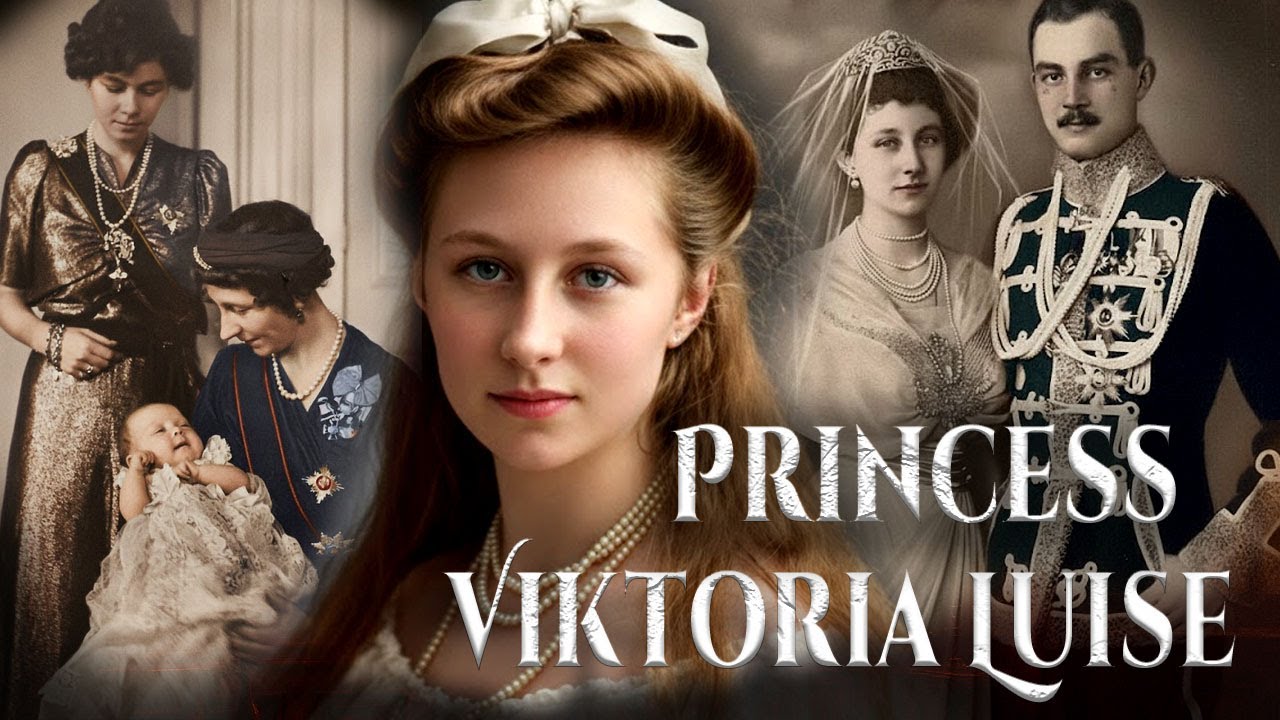
On 24 May 1913, the most powerful monarchs of Europe sat in the royal church in Berlin, dressed as uncles, cousins, and brothers, to watch the daughter of the German Kaiser marry the heir of the family that had once been his greatest enemy. King George V of Britain laughed with the Kaiser as though they were boys again. Tsar Nicholas II of Russia, who resembled his English cousin so closely that they could have been twins, stood in his gilded uniform and smiled. For a week, twenty-year-old Princess Victoria Louise of Prussia was the living symbol of peace, reconciliation, and a single royal family bound across every throne on the continent.
Fourteen months later, her father, the British King, and the Russian Tsar had plunged that continent into a war of mutual slaughter. The family was torn apart. Her husband and brothers went to the front to kill the very cousins who had raised their glasses to her health. Victoria Louise, the flower of the empire, watched her British husband’s titles stripped from him, saw herself caricatured in the Allied press as the daughter of the Beast of Berlin, and stood helpless as her perfect world burned to ash.
She survived the fall of her father’s empire, survived Hitler, and lived long enough to be the last one—the final living remnant of a world that died at her wedding. The story of Victoria Louise is defined by the man who cast the enormous shadow she lived under her entire life: her father, Kaiser Wilhelm II. And to understand the Kaiser, you have to go back to his own beginning, to the birth in 1859 that was not a celebration but a catastrophe. His mother, Victoria, known as Vicky, was the eldest daughter of Queen Victoria of Great Britain.
She was the most intelligent and liberal-minded of the British royal children, an intellect brought up to bring British-style constitutional monarchy to the rigid autocratic state of Prussia she married into. From the moment she arrived in Berlin, the conservative Prussian court, dominated by the Iron Chancellor Otto von Bismarck, hated her for it. They saw her as a dangerous foreign influence. Her first pregnancy was her chance to secure her position—to produce a perfect, healthy heir.
The birth was a nightmare. It was a difficult breech delivery lasting hours of agonizing torment, a brutal ordeal in the age before modern medicine. The doctors, panicking, struggled to save the mother; the child was secondary. When the infant Wilhelm was violently pulled into the world, he was deprived of oxygen and appeared lifeless.
Then they saw it. The attending doctors, in their stained clothes, realized with a creeping horror that the baby’s left arm was dead—the nerves connecting it to his shoulder had been torn beyond repair. For the rest of his life, the arm remained withered, shorter than the right by inches, nearly useless. For the future King of Prussia, head of the most militarized state in Europe, a state that valued physical perfection and martial prowess above all else, this was not merely a disability.
It was a profound public shame. His mother, Vicky, was devastated. A nineteenth-century woman who had failed her first and most fundamental duty. She looked at her imperfect son and was never able to fully hide her disappointment and misery, as she wrote to her own mother, Queen Victoria.
And so, from his earliest childhood, Wilhelm was subjected to a series of strange and painful treatments, each designed to fix what could not be fixed. As a small child, he was strapped into primitive electric shock devices that sent currents through his lifeless arm. He was forced into painful medieval-looking stretching appliances meant to draw his short arm out to match the length of the other. Strangest and most psychologically damaging was the animal bath.
Several times a week, a live rabbit would be brought in, killed, and its warm, fresh carcass skinned and wrapped around the boy’s withered limb. He had to sit there, the terrified little child, with hot animal entrails pressed against his skin in a vain hope that the animal’s warmth would revive his dead nerves. The torment did not cure his arm. It forged his character.
It taught the young prince two things: that he was defective, and that his mother—the one person who should have loved him unconditionally—was ashamed of him. He developed a defense mechanism that would quite literally shape world history. He overcompensated for his physical insecurity with exaggerated, loud, and arrogant aggression. He became obsessed with military uniforms, of which he owned hundreds, because they were stiff and their shoulders could hide his weak one.
He grew the famous upturned moustache to project an image of fearsome masculine power. He was anxious, insecure, quick-tempered, hungry for recognition. And he directed all his resentment and rage at a single target: his mother. And by extension, everything she stood for.
He rejected her liberal ideas. He rejected her intellectualism. Most of all, he spurned her love of her homeland, England. He turned his back on his parents and threw himself into the arms of the men who hated them—Bismarck and the old Prussian guard generals.
He became more Prussian than the Prussians. He became a military fanatic despising anything he saw as weak, emotional, or English. This created the great toxic contradiction of his life. He was Queen Victoria’s eldest grandson.
He spent his childhood summers at Windsor and Osborne House sailing with his cousins, Georgie, the future George V, and Nicky, the future Nicholas II. He craved their approval. He desperately sought the love of his grandmother, Queen Victoria. But at the same time, he hated them.
Envied them their confidence, their global empire, their effortless power. This poisonous mix of envy and arrogance defined his reign. He would write fawning letters to his dear grandmother one day and the next give a fire-breathing speech about building a new German high-seas fleet to challenge British mastery of the oceans. This was the man who became Kaiser of Germany in 1888 after his liberal father’s reign of only ninety-nine days.
He was twenty-nine years old, now the most powerful man in Europe. And his wife? The Empress Augusta Victoria of Schleswig-Holstein, whom the family simply called Dona. If Vicky, the Kaiser’s mother, had been an intellectual, liberal, complex woman, Dona was her exact opposite.
She was very simple, deeply religious, profoundly conservative. She was not a thinker. She was a presence. Her entire world revolved around the three Ks—the ideal of German womanhood.
Church, kitchen, children. In short, she was the perfect wife for Wilhelm. She did not challenge him. She was a refuge.
She adored him. She calmed his volatile moods. She shared his devout Lutheran faith. And she saw her primary duty as giving him heirs.
She was remarkably good at her task. First came Crown Prince Wilhelm in 1882, then Prince Friedrich, then Prince Adalbert, then Prince August Wilhelm, then Prince Oskar, then in 1890 Prince Joachim. A long and unbroken string of sons—six of them. The imperial nursery was full of helmets, toy soldiers, and the sounds of boys being trained for their future military careers.
The Kaiser was proud, but the family was stiflingly, relentlessly masculine. Then, on 13 September 1892, at the Marble Palace in Potsdam, the Empress gave birth for the seventh and final time. The doctors announced the news: it was a girl. They named her Victoria Louise.
In the dry, cold, unemotional court of Berlin, her birth was like sunrise breaking behind a stone wall. For the Kaiser, it was an obsession. He, who had been his mother’s disappointment, now had a daughter. She was small, perfect, and did not look at him in judgment but with pure, simple adoration.
In her eyes, he was a god, and in turn, he could finally be the loving father he himself never had. He nicknamed her Sissy, and from the moment she began to walk, she was, by his own admission, his treasure. She grew up in a world of almost unbelievable privilege and suffocating duty. Her main residence was the Neues Palais in Potsdam, a vast baroque pile of 200 rooms built by Frederick the Great—so vast and cold it was known as the golden cage.
Her life was a strict, unchanging schedule. Lessons with her tutors and her strict English governess, Nana, began at seven in the morning: languages, French, English, literature, history, music. Then Lutheran prayers with her mother, formal lunches, and endless official appearances. She was the only girl in a family of six older, rowdy, often cruel brothers.
They treated her, as she later recalled, like a toy in their hands. They were a rough, brawling gang. Her brother closest to her in age, Joachim, was a particularly sensitive and troubled boy who would come to a tragic end. But her older brothers, especially the Crown Prince Wilhelm, were arrogant, spoiled, and militaristic, exactly like their father.
Victoria Louise, by contrast, was charming and bright, inheriting her father’s blue Hohenzollern eyes. She quickly realized she possessed a unique power—one no general, chancellor, or empress had. She was the only person who could reliably control her father’s famous mood swings. The Kaiser’s tantrums were legendary.
He would scream at his ministers, face turning purple, his good arm slamming tables over the most trivial matters. His family and court lived in terror of these fits. When the storm was at its height and his advisors were at a loss, the orders would come: bring Sissy. This little girl, and then young woman, would be sent into the lion’s den.
She would walk into the Kaiser’s office, take his hand, and he would calm down immediately and visibly. My ray of sunshine, he wrote in his memoirs, looking back from the misery of his dreary exile. She adored him utterly and without reservation. To her, he was not the mad Kaiser of British propaganda or the arrogant warlord his ministers feared.
He was Papa. The man who would stop state affairs to take tea with her. The man who let her ride beside him during military parades. The man who called her his single ray of light.
This deep, unshakeable loyalty to her father would be the guiding principle of her entire life. It would be her greatest strength, the rock she clung to in the storms to come, and, in the eyes of history, her deepest moral flaw. She was raised to be the perfect nineteenth-century princess: devout, charitable, always beautiful. She was the honorary colonel of her own regiment of soldiers, the Death’s Head Hussars.
She would review them seated expertly on her horse, a small feminine figure in a sea of men in stark black uniforms. Her task was not to rule. Her task was not to have opinions. Her task was to marry, to secure a political alliance, to be a symbol of the German Empire’s softer feminine side.
In 1909, at seventeen, she was confirmed into the Lutheran faith. This was her official debut into the world, the moment she ceased to be a child and became a woman. The ceremony in Potsdam was a huge formal event. Dressed in white, she was celebrated as the absolute symbol of German maidenhood.
Immediately, the speculation began. Who would she marry? The Kaiser’s daughter was without question the most sought-after princess in the world. She was young, she was beautiful, and she was the daughter of the most powerful monarch in Europe.
Suitors and proposals came from everywhere. There was talk of a Swedish prince, a Russian Grand Duke. Her mother, Dona, hoped for a German prince from a good conservative family. But Victoria Louise, for all her charm, possessed a streak of her father’s stubbornness.
She was not interested in a purely political marriage. She had seen the cold, loveless marriages around her. She was romantic; she wanted to marry for love. Her father, surprisingly, agreed.
He, who had been forced into his own marriage, wanted his ray of sunshine to be happy. The problem was, how could she even meet a man? Her life existed inside a bubble. She was never left alone.
Then, in 1911, tragedy struck a rival family. A family that for nearly fifty years had been her father’s and the entire Prussian state’s bitterest personal enemy. This is where the story truly begins. In 1866, before the German Empire existed, her grandfather Kaiser Wilhelm I and his chancellor Otto von Bismarck did something ruthless.
In their quest to unify Germany under Prussian rule, they invaded and annexed the independent Kingdom of Hanover. The King of Hanover, George V, a cousin of Queen Victoria, was driven from his throne and fled into exile in Austria. His son, Ernst August, Duke of Cumberland, inherited the title and all his father’s deep, burning hatred of the Prussian usurpers. He lived in his vast, gloomy castle at Gmunden in Austria, a very rich and deeply bitter man.
He forbade his children ever to set foot in Germany. He refused to recognize the Kaiser’s authority. He was the head of the Guelph family, the ancient dynasty of Hanover, and considered the Hohenzollerns, Victoria Louise’s family, to be usurpers of power. This was the great unhealed wound at the heart of the German aristocracy.
In 1911, tragedy struck the exiled duke. His eldest son, Prince Georg, was driving at high speed through the German countryside, ironically on his way to a family funeral in Denmark, when he swerved off the road and was killed instantly. Kaiser Wilhelm II, in a gesture of sudden, perhaps calculated, magnanimity, saw an opportunity. He ordered two of his sons, Princes Eitel Friedrich and Oskar, to travel to Austria and attend the funeral in full Prussian military dress as a mark of respect from one royal house to another.
The exiled Duke of Cumberland, the stubborn old enemy, was stunned by this act of decency. It was the first kindness shown to his family by the Hohenzollerns in half a century. He was so moved that he decided to make a reciprocal gesture. He would send his only remaining son, another Ernst August, to Berlin to thank the Kaiser in person.
In early 1912, this young man, Duke Ernst August of Brunswick-Lüneburg, the twenty-four-year-old heir of the hated Hanoverian dynasty, put on his formal uniform and entered the lion’s den, the Neues Palais in Potsdam. There, in the great hall, he was introduced to the Kaiser’s daughter, Victoria Louise. By all accounts, it was an immediate, undeniable, and catastrophic love at first sight. He was handsome, elegant, with a trace of his exiled family’s sorrow about him.
She was nineteen, charming, the symbol of the very power that had destroyed his kingdom. By every political and historical measure, they were Romeo and Juliet. They talked and could not stop talking. Victoria Louise, surrounded her whole life by stiff Prussian officers, was fascinated by this hostile prince.
He, in turn, was utterly taken with her. She later wrote in her memoirs: We had so much to say to each other that we found it hard to part. From the very first moment, I was enormously taken with his whole personality. The Kaiser, a shrewd and sentimental man, watched this unfold with delight.
He saw everything, the furtive glances, the instant rapport. This was not a problem. It was an opportunity. It was the perfect solution.
But this was not an ordinary love story. It was a political earthquake. The two young people were in love. But for them to marry, the fifty-year-old feud had to end.
Advisors and diplomats mobilized intensely. This was not a matter of the heart. This was a matter of state. An agreement was reached—one of the last great royal deals of the old world, a final piece of nineteenth-century statecraft.
The old bitter Duke of Cumberland, Ernst August’s father, had to swallow his pride. He had to formally renounce his claim to the Kingdom of Hanover, the kingdom lost in 1866. It was a humiliating concession. In return, Kaiser Wilhelm II would do two things.
First, he would allow his only daughter, the most eligible princess in Europe, to marry young Ernst August. And second, as a wedding gift, he would grant the young couple a kingdom of their own. There was a small independent duchy in Germany called Brunswick. Its duke had died without an heir, and for decades it had been ruled by a Prussian administrator.
The Hanoverians, the Guelphs, were technically next in line. But the Prussians had refused to allow their enemies onto the throne. Now the Kaiser would agree to it. He would grant the Duchy of Brunswick to his new son-in-law.
It was perfect. The feud was over. The Hanoverians would get a crown. The Prussians would secure their empire.
Love had triumphed. And the Kaiser, in his own mind, had played the role of godlike, benevolent peacemaker. The engagement was announced. The whole German Empire rejoiced.
It was the nation’s coming-of-age, and the wedding was set for 24 May 1913. It was meant to be the party to end all parties, a celebration not just of two young people but of a new, united, unconquerable Germany. It was a display of power, a message to the world, especially to his English cousins, that the Kaiser was the dominant force in Europe, the patriarch of a new royal age. He had no idea, and none of them did, that he was simply setting the stage for the most spectacular, glittering, and tragic farewell in modern history.
And so, on 24 May 1913, Berlin witnessed it. It was an event like nothing the city had seen before. The streets were not just crowded; they were a dense, solid sea of humanity, held back by tens of thousands of soldiers in formal Prussian dress. The balconies of Unter den Linden were packed with society ladies in their finery waving handkerchiefs.
Prussian, Hanoverian, and Imperial flags fluttered from every rooftop. Then there were the guests. Look at them as they enter the royal church in procession. They are not just monarchs.
They are family. There is King George V of Britain and Queen Mary. Cousin Georgie—a stern, duty-bound naval man deeply uncomfortable in the elaborate Prussian Field Marshal uniform his honorary rank required. He did not trust his cousin Willy, whom he wrote in his diary was a bit of a bounder.
But he was here for family. There is Tsar Nicholas II of Russia. Cousin Nicky—a gentle, shy man with sorrowful eyes, bearing a striking resemblance to King George. He was a weak man, devoted to his family, obsessed with his son’s hemophilia.
He had come with his Tsarina Alexandra, a German princess sinking deeper and deeper into the influence of the mysterious mystic Rasputin. Then there was the host, the man of the hour, the father of the bride: Kaiser Wilhelm II. He was at the height of his glory. He strutted, his moustache carefully waxed to needle points, his chest thrust out under rows of medals, his good arm gripping his sword hilt.
This was his personal show. This was the new, powerful Germany—industrial, militaristic, rich—and he was showing it off to his poorer relatives from the old decaying empires. He was the host, the patriarch, the center of the universe. When nineteen-year-old Victoria Louise walked down the aisle, there was a hush of awe in the church.
She wore a dress of white satin silk, with a train made of the lace her new mother-in-law had worn at her own wedding. In her hair, glittering under the gas lights, was the magnificent Prussian diamond tiara, a family heirloom that had once belonged to Napoleon’s Empress Josephine. She was the embodiment of royal history, a living symbol of continuity. She walked toward the man she loved, Ernst August, waiting in his military uniform, a romantic, sorrowful figure of a lost dynasty.
As they stood before the altar, this was not merely the union of two people. It was the symbolic end of a fifty-year historical feud. The houses of Hohenzollern and Hanover, bitterest of enemies, were finally reconciled. The reception that followed was one of the most lavish of the twentieth century.
Twelve hundred guests dined under the paintings of the New Palace, sipping champagne from the emperor’s own vineyards. The Emperor raised a toast to his daughter, the light of his life, in a booming voice. He clapped Georgie on the back and laughed with Nicky. For those few days, Queen Victoria’s old dream that a web of royal marriages might prevent war seemed real.
But just beneath the glittering surface, the poison was already working. The British delegation was unnerved by the sheer scale of German military power on display. They found it ostentatious, over the top. They whispered that the Germans were arrivistes, nouveau riche warmongers.
King George V politely but firmly refused the Emperor’s suggestion that he wear German military uniform on an upcoming visit to London. A small slight, but a painful one. And there was the elephant in the room that everyone was politely ignoring. Only weeks before the wedding, the First Balkan War had ended, and a second was about to break out.
To the south, Austria-Hungary, the Emperor’s ally, and Tsarist Russia were grappling over the ashes of the Ottoman Empire. The tension was not just high; it was existential. These monarchs and emperors were not just a family celebrating. They were CEOs of competing corporations, eyeing each other before the inevitable hostile takeover.
And Victoria Louise? For her, all of this was background noise. She was living in a perfect moment. She, the pampered nineteen-year-old, had done what few princesses ever did.
She had married for love, and her marriage had healed a kingdom. She later wrote simply: I was so happy. She was the eye of the storm, utterly oblivious, unaware that she and her new husband were literally dancing on the edge of a volcano. As the celebrations ended and the royal guests departed on their trains back to their empires, a personal, prophetic moment occurred.
The Kaiser stood on a balcony of the palace, waving goodbye to his daughter as she left for her honeymoon. Thousands below witnessed it. The Emperor of Germany, the warlord, the man of blood and iron, stood there and wept openly. He wept from love for his only daughter.
But biographers would later see something else. One historian wrote: It looked like a premonition that he was not just saying goodbye to his daughter, but to everything. The train left Berlin, and the countdown to their doom began. Victoria Louise and Ernst August’s life in their new capital, Braunschweig, began as a genuine fairy tale.
Berlin had been a sprawling, modern, somewhat harsh center. Braunschweig was different. It was a charming, storybook town with cobbled streets, a magnificent opera house, and a palace where Teutonic knights had once walked. It was the capital of a small kingdom, and they were its young, beautiful king and queen.
When they arrived, the people went mad. These were not just a new duke and duchess. This was the return of their dynasty after fifty years of Prussian occupation. Victoria Louise, the daughter of the conqueror, was welcomed as a heroine, a symbol of peace and forgiveness.
Their life was idyllic. They were rulers. They spent their days opening hospitals, patronizing concerts, hunting in the ancient forests of the Harz Mountains. They were a golden couple.
Ernst August was a devoted husband, and Victoria Louise was madly in love with him. She was finally free of the golden cage of Potsdam. She was no longer just the Kaiser’s daughter. She was the Duchess of Brunswick, a wife and a ruler in her own right.
In March 1914, the fairy tale was complete. Victoria Louise, twenty-one years old, gave birth to her first child. It was a boy. They named him Ernst August, the heir to the dynasty.
The succession was secured. The love was complete. The peace was achieved. In early June 1914, the couple was planning a grand celebration, and the world was at their feet.
Then the world ended. On 28 June 1914, in the Bosnian town of Sarajevo, a young nationalist assassin shot and killed the heir to the Austro-Hungarian throne, Archduke Franz Ferdinand, and his wife. The intricate web of alliances that had been meant to keep the peace began to tighten. Austria-Hungary, with Germany’s backing, issued an ultimatum to Serbia.
Russia, Serbia’s ally, mobilized. Germany declared war on Russia, then on France. As the German army swept through neutral Belgium to strike at France, Britain, the motherland of Victoria Louise’s beloved English grandmother, declared war on Germany. Within weeks, every royal house of Europe was at war.
The cousins were at each other’s throats. The fairy tale was over before its first chapter had closed. The Kaiser’s parting tears on the balcony, his farewell to his daughter and to everything, had been the last act of the old world. The new world was a war of industrial slaughter.
Victoria Louise, the duchess who had married for love and reconciled a kingdom, was now the wife of a German officer and the daughter of the supreme warlord. Her fairytale life in Braunschweig shattered. She threw herself into the war effort. She immediately established the Victoria Louise Fund for soldiers’ families.
She led campaigns to sell war bonds. Most importantly, she did what queens and princesses had always done. She turned a wing of her beautiful palace in Braunschweig into a military hospital. This is crucial to understand about her.
She was not a symbolic figurehead. She did not just show up for photo opportunities. Victoria Louise, Duchess of Brunswick, put on a Red Cross nurse’s uniform. And she worked hard.
She was a devout Lutheran, and this was her Christian duty. She spent hours every day in the wards where the men of her husband’s regiment were brought, maimed and dying. She was not a surgical nurse, but her presence had an effect. She sat with young dying soldiers.
She wrote letters home to their families. She held their hands as they talked about their fears. She, the apple of the Kaiser’s eye, had become a symbol of German comfort and resilience. To the people of Braunschweig, she was a saint.
But outside Germany, a very different story was being told. In Britain, the press that had fawned over the beautiful Kaiser’s daughter and bride of peace just a year earlier had now turned on her with savage ferocity. She was no longer Victoria Louise. She became the Princess of the Huns.
She became the daughter of the Butcher. Vicious caricatures depicted her father as a monster who ate Belgian children, with her beside him as his evil cheerleader. The truth did not matter. It was a total war, and propaganda was a weapon.
To Victoria Louise, this was incomprehensible. This was her mother’s family. This was the country where she had spent her happy childhood summers. How could they believe these things?
Then in 1917 came the final symbolic break. Cousin Georgie, King George V, was under enormous pressure. Anti-German feeling in Britain was at its peak. The British royal family’s name, Saxe-Coburg and Gotha, was thoroughly German.
So, in a desperate public relations move, King George V issued a declaration. He renounced all his German titles and changed his family’s name. From now on, his dynasty would be known by a very English name: the House of Windsor. It was a public, symbolic severing.
King George was saying to the world and to his cousin Willy: we are no longer family. We are English. You are the enemy. Imagine how Victoria Louise felt about that.
Her family had publicly disowned her. She was besieged, hated by the English for being German, and, as we shall see, suspected by some Germans for being English. Meanwhile, the war that was supposed to be over by Christmas stretched into 1915, then 1916. It had become the meat grinder of trench warfare.
Millions were dying in the mud of Verdun and the Somme. At home in Braunschweig, the fairy tale had turned into a nightmare. The British Royal Navy blockade, cousin Georgie’s fleet, was strangling Germany. No food, no rubber, no oil could get in.
Germany began to starve. The winter of 1916-17 was known as the turnip winter. That was all there was left to eat: turnips. Bread was made from sawdust and potato flour.
Meat disappeared entirely. Coffee was made from roasted acorns. Her people in Braunschweig, who had cheered her on her wedding day, were gaunt and desperate. Her hospitals no longer had bandages.
They were reused. Painkillers ran out. She, the duchess, lived in her palace. She was not starving.
But she saw it every day. She watched her country, her father’s empire, bleed to death slowly and painfully. And through it all, she had her personal fears. Her husband was out there.
Her brothers were out there. Her brother Joachim, the sensitive, troubled one, was severely wounded in battle. Her brother Adalbert was also wounded. She lived in constant, gnawing fear of the telegram.
Then there was her father. She made dangerous, emotional trips to the Kaiser’s military headquarters. He was no longer in Berlin. He had moved to spa towns like Spa in Belgium near the front to play the supreme commander, but it was a sham.
When Victoria Louise visited him, she found a man she barely knew, a man crumbling from within. His generals, Hindenburg and Ludendorff, both hardline nationalists, were effectively in charge. They had established a military dictatorship, and the Kaiser was a rubber stamp. He knew it, and it was killing him.
Victoria Louise would sit with her father as he raved. He would pace and wave his one good arm, blaming everyone. He blamed the treacherous English. He blamed the politicians.
He blamed Jewish bankers. He never blamed himself. And she, the loyal daughter, would sit and listen. She tried to be his ray of sunshine.
She tried to soothe him. But she was trying to soothe a man who had lost control of his country and was losing his grip on his mind. She was trapped in a psychological trap. Her absolute devotion to her father required her to believe one thing: that Germany was the victim.
That this was a just, defensive war. That her father was a great, misunderstood leader. She had to believe in Germany’s victory, because if Germany lost, what would that mean? It would mean the millions who died had died for nothing.
It would mean her people had starved for nothing. And it would mean her father, the man she adored, the man around whom she had built her entire identity, was not a hero. He was a failure and a fool, a man the entire world despised. That was a possibility her mind could not, and would never, accept.
And so, Victoria Louise, Duchess of Brunswick, besieged in her palace in the winter of 1917, with her small children, reading the increasingly desperate reports from her husband’s front and hearing the rumble of hunger in the streets outside, clung to that loyalty as a drowning man clings to a piece of wreckage. She prayed to God for a German victory. She did not know that the war was already lost, and that her cousin Nicky’s country, Russia, had just collapsed in a bloody revolution that made her father’s war seem like a game. The Bolsheviks were in power, and a new, darker storm was sweeping through the West.
It was heading straight for her family. The news coming out of Russia in 1917 and early 1918 was initially a source of grim relief for the German high command. Cousin Nicky, Tsar Nicholas II, had abdicated. His government had collapsed.
The Bolsheviks, led by a radical named Lenin, had seized power. And the first thing they did? They asked for peace. They could not fight a civil war at home and a world war abroad.
For the German generals, Hindenburg and Ludendorff, this was the miracle they had been waiting for. The Eastern Front was closed. Millions of German soldiers could now be transferred. They would be moved to the Western Front in France to launch a final, massive, crushing offensive.
They would smash the British and French armies before the Americans, who had just entered the war, could arrive in force. For Victoria Louise, the news from Russia was far more personal and far more terrifying. Cousin Nicky and Cousin Alix, the Tsarina Alexandra, were gone. Her relatives, the family she had seen at her wedding, the family her children had played with, were under house arrest, prisoners of a brutal new atheistic ideology.
She must have heard the stories seeping out of Russia, stories of chaos, of aristocratic families dragged from their homes and shot in the streets. This was not war as she understood it, a conflict of regular armies led by kings. This was something new. This was the annihilation of her entire class.
Then in July 1918, the final, unimaginable news reached her. In a damp basement in a town called Yekaterinburg, her cousins Nicky and Alix and their five children—Olga, Tatiana, Maria, Anastasia, and the sickly young Tsarevich Alexei—had been gathered, led down, and systematically slaughtered by a Bolshevik firing squad. Their bodies had been mutilated, burned with acid, and thrown down a mine shaft. That was the end of the Romanov family.
It is impossible to overstate the psychological impact this must have had on Victoria Louise. This was not a political event. This was a family massacre. This was the terrifying dark shadow now hanging over her family.
This was what happened when you lost. This was the horror that steeled her resolve. Germany had to win. Her father had to win, because the alternative was not just defeat.
It was Yekaterinburg. It was a basement and a bullet. This terror, this new fear of Bolshevism, would become an obsession for her, for her father, and for her entire class. It would justify everything that came after.
As she absorbed this horror, the German high command launched its great gamble. The Spring Offensive of 1918, the Kaiserschlacht, the Kaiser’s Battle. It was the largest single offensive of the war. For a few desperate weeks, it nearly worked.
The German armies, swollen with troops from the Eastern Front, smashed a huge gap in the Allied lines. They were advancing. Paris was within sight. In Braunschweig, Victoria Louise read the bulletins with a surge of desperate hope.
This was it, the final push. Her husband was at the heart of the battle. Her brothers were commanding their regiments. God was finally answering their prayers.
Then it all stopped. The German soldiers were exhausted. They had outrun their supply lines. They were starving just like the people at home.
They had no reserves. The Allies, now reinforced by endless waves of fresh, well-fed American soldiers, did not break. They bent. Then they struck back.
The Hundred Days Offensive. In August 1918, the Allied counteroffensive began. And the German army, the most feared military machine on earth, did not just retreat. It cracked.
It broke. It began to disintegrate. By late September 1918, Generals Hindenburg and Ludendorff, the men who had been promising glorious victory for four years, went to the Kaiser. They did not just tell him the war was lost.
They told him it would be lost tomorrow. The army was in complete collapse. They had to sue for an armistice immediately. For Kaiser Wilhelm II, this was impossible.
His mind could not process it. Defeat. He, the Supreme Warlord. He had been betrayed.
He and his daughter were victims of a stab in the back. The stab-in-the-back legend. The army had not failed. It was the politicians at home.
The November criminals, the Socialists, the Jews who had betrayed the soldiers at the front. This was the great toxic myth that would eat away at the heart of Germany for the next twenty years. But in October 1918, the truth was undeniable. The German nation, fed on victory propaganda for four straight years, suddenly woke up to the fact that it had been decisively and catastrophically defeated.
And all that pent-up suffering, the blockade-induced starvation, the grief for millions of dead sons and fathers, it all exploded. And it exploded into one thing: rage. Rage at the generals who had lied. Rage at the industrialists who had profiteered.
And rage at the man who was the symbol of it all: her father, the Kaiser. The revolution Victoria Louise had feared was not coming from Russia. It was coming from within her own country. It began, ironically, with the group her father loved most of all: his sailors.
In late October 1918, at the port of Kiel, orders came for the German High Seas Fleet, the Kaiser’s pride, the fleet he had built to challenge Britain, to sail on a final suicide mission against the Royal Navy. It was a gesture of futile honor. The sailors were not interested in dying for the Kaiser’s honor. They had been starving for four years.
They were done. They mutinied. They refused to sail. They raised the red flag of revolution over the imperial warships.
And from Kiel, the revolution spread across Germany like wildfire. It was faster than any army. Within days, every major city was falling. Workers’ and soldiers’ councils, modeled on the Russian soviets, were formed.
They were taking over train stations, army barracks, town halls. The Empire was not just collapsing; it was evaporating. Now imagine Victoria Louise, twenty-six years old, in her palace in Braunschweig. She was no longer just a nurse to the wounded.
She was a woman besieged in a city about to explode. She had her two small children with her: Ernst, four years old, and Christian, one. Her husband was not with her. He was still with his disintegrating army at the front, trying to manage the chaos.
She was alone, protected only by a few loyal palace guards. She could hear the shouting in the streets. She could hear sporadic gunfire. A workers’ and soldiers’ council had been formed in Braunschweig.
And they were advancing toward the palace. This was the critical moment. This was Yekaterinburg. She was terrified, not for herself, but for her children.
She was the Kaiser’s daughter. She was the most powerful symbol of the old regime in the entire city. She must have imagined mobs breaking down the doors and dragging her children from their beds. Meanwhile, 200 meters away in Berlin, her mother, the Empress Dona, was alone in the Berlin palace, gripped by the same terror.
Her husband, the Kaiser, was not in the capital. He had fled to his military headquarters at Spa in Belgium, deluding himself that he could lead his loyal armies to crush the Bolsheviks in Berlin. On 9 November 1918, the end came. In Berlin, the revolution was in the streets.
To prevent a complete communist takeover, the moderate Socialists declared a republic. The Kaiser’s chancellor, Max von Baden, seeing the situation was hopeless, did something extraordinary. He announced the abdication of Kaiser Wilhelm II without telling the Kaiser first. At Spa, Wilhelm II received the news, and then his generals dealt the final blow.
They told him that the army, his army, would no longer follow him. They would not march on Berlin. They would not even protect him. The Kaiser, the man who had lived his entire life as a display of military power, was told his show was over.
His audience, his own army, had left the building. He was a broken man. He was no longer the Supreme Warlord. He was a fifty-nine-year-old man with a useless arm, at risk of arrest by his own soldiers and handed over to the Allies as a war criminal.
He did the only thing he could do. He did not go down with his ship. On the morning of 10 November 1918, Kaiser Wilhelm II, disguised in goggles, boarded a special train. He slipped across the border into neutral Holland and into exile.
He abandoned his wife, his children, his country, and his throne. He never set foot on German soil again. The German Empire was dead. Back in Braunschweig, Victoria Louise was in an impossible position.
Her father, her protector, the man who was the entire foundation of her political authority, was gone. He was a refugee, and the mob was at her door. On 8 November, one day before the Kaiser’s abdication, the workers’ and soldiers’ council in Braunschweig, led by a socialist agitator, had surrounded the palace. They demanded the abdication of her husband, the Duke of Brunswick.
Her husband, Ernst August, managed to rush back from the front, slipping through the revolutionary lines. He arrived at the palace to find his wife and children besieged. He was a realist. He was a soldier.
He knew when a battle was lost. There was no room for negotiation. He had no army. The entire city was against them.
His only priority was to save his wife and children. He met with the council leaders, and there, on a hastily written document, to the sound of the mob’s shouts outside the windows, Ernst August signed his abdication. He renounced the Duchy of Brunswick for himself and his heirs forever. The thousand-year rule of his family, the Guelphs, was over.
The five-hundred-year rule of her family, the Hohenzollerns, was over. It was done. At noon that day, with one stroke of a pen, they had lost their duchy, their titles, and their entire reason for political existence. She was twenty-six years old.
She was no longer a princess, no longer a duchess, no longer a royal highness. For the first time in her life, she was simply a citizen. A citizen. An ordinary citizen of a new, chaotic, and thoroughly hostile country that blamed her father for destroying the world.
The first part of her life, the fairy tale, was over. And the second, far harder, far longer chapter of living amid the ruins had begun. Their captors, the socialist revolutionaries, were surprisingly decent. They were not Bolsheviks.
They did not want to hurt her. They just wanted the royal family gone. They allowed the family to leave. Victoria Louise, her husband, and their two small sons gathered what they could carry.
Not state jewels or furniture, just some clothes and personal keepsakes they could hold. They were refugees. They were escorted to the railway station through the streets of their city, which were draped in red flags. They boarded an ordinary train.
They were fleeing to the only place left to them: the family castle at Gmunden in Austria. The castle of that bitter old duke of Cumberland, Ernst August’s father. The man who had hated Prussia his whole life. What a bitter irony in the end.
A Hohenzollern princess seeking refuge in the very place that was the symbol of resistance against her family’s rule. As the train rattled south out of Germany, Victoria Louise looked out the window at the country that had just disowned her. She was leaving behind her father, now a pariah in Holland. She was leaving behind her mother, still besieged, ill, and terrified near Berlin.
She was leaving behind her five brothers, scattered and defeated. Her brother Joachim, the sensitive one, was taking the shock of the abdication especially hard. He was spiraling into a deep depression. His marriage was collapsing, and his entire world had vanished.
The seeds of his personal tragedy were being sown then. For Victoria Louise, this was not a political shift. It was like an amputation. Her entire identity—as a daughter, a princess, a duchess, a ruler—had been cut away.
She arrived at Gmunden, a vast, neo-Gothic, freezing castle on a lakeshore. It was a gloomy, unwelcoming place, filled with the ghosts of Hanoverian resentment. The old exiled Duke of Cumberland, her father-in-law, was still alive. He was a blind, bitter old man, and he now had the cruel satisfaction of seeing his prophecies fulfilled.
He had warned his son never to trust the Hohenzollerns. He warned him they were poison. And here she was, the Hohenzollern, the poison, the daughter of the man who had not only stolen the kingdom of Hanover but had now destroyed the entire German kingdom as well. It was a cold, bitter, thoroughly unhappy exile.
But Victoria Louise was not made to be a victim. She was not like her fragile brother Joachim. She was her father’s daughter. She was proud.
She was tough. She was deeply Lutheran. And above all, she was loyal. Her world had now become very, very small.
It no longer consisted of empires or politics. It consisted of two things: her children and her father. Her focus in the coming years would be on her father, the exiled, pitiable, increasingly erratic Kaiser, who had settled into a small country house in Holland called Huis Doorn, and on her growing family. Life had to go on.
In exile, she gave birth to two more children, a daughter, Frederica, in 1917, who would one day become a queen, and another son. But she could not and would not ever abandon her father. Once travel restrictions loosened after the war, Victoria Louise became her father’s emotional lifeline. She was one of the few people allowed to visit him regularly.
She and her husband would make the long, arduous journey from Austria to Holland. These visits were heartbreaking. Huis Doorn was a small, quiet place. The Kaiser, the man who had once commanded millions, was now an ordinary citizen with a long white beard.
He spent his days in a frenzy of pointless physical activity. He decided to cut down almost every tree on the estate. Day after day he would go out with saw and axe, chopping and sawing maniacally as if trying to physically expel the anger and humiliation gnawing at his insides. His good arm became hugely muscular.
His staff piled the logs into massive mountain-like stacks. When he was not chopping wood, he was writing. He wrote endless letters and memoirs, full of ranting and self-pity, blaming everyone but himself for the war. He blamed his generals.
He blamed the British. He blamed the Freemasons. And he developed a new, all-consuming obsession: the Jews. He wrote that the Jews were parasites that must be eradicated from Germany.
He blamed them for his abdication, for the revolution, for Bolshevism. His anti-Semitism, always present, had now become a malignant, murderous obsession. And Victoria Louise, his apple, would come to visit him. She would bring her children, his grandchildren, to see their grandfather.
She would sit for hours in his study, surrounded by towering woodpiles, and she would listen. She would listen to his angry tirades. She would patiently absorb his fantasies that one day the German people would call him back to the throne. What was she thinking?
What did she think of his terrifying, paranoid anti-Semitism? We must look at the memoirs she wrote decades later. She describes her father in those years with a tenderness that is almost tragic. She never once used the word broken.
She never once used the word delusional or hateful. She wrote: My father bore his fate with a composure that amazed everyone. He was a deeply religious Christian and drew his strength from his faith. This inner strength alone enabled him to endure the difficult years of solitude at Doorn.
That is a classic Victoria Louise statement. It is loyal. It is loving. And it is a complete and total distortion of the truth.
This is the key to her entire personality. She simply could not, or would not, see her father’s deep and monstrous flaws. She saw his pain, but she refused to see his guilt. Her loyalty was a fortress, a thick, high wall she had built around her heart.
It protected her from a far more complex and terrible truth: that the father she adored was not a noble victim. He was a failed, arrogant, hateful old man who had helped destroy the world. While she was tending to her father’s memory, her personal life was shattered by two more tragedies, one after the other. In April 1920, her sensitive, troubled brother Joachim, the closest to her in age, was in a state of utter despair.
He could not cope with exile. He could not cope with being nothing. His wife had left him. In his severe depression, he took his military pistol and shot himself.
He was twenty-nine years old. It was a spectacular suicide. It was the first real crack in the family’s façade of noble resilience. Nearly a year later, in April 1921, her mother, the Empress Dona, died.
She had never recovered from the shock of the revolution and the humiliation of exile. She effectively died of a broken heart at Huis Doorn with her husband by her side. Victoria Louise was now twenty-eight years old. She had lost her throne, her home, her brother, and her mother.
Her father, the Kaiser, was completely lost. And just seven months later, he did something that horrified his children. He announced he would remarry. The bride was a minor German princess, Hermine von Reuss, a widow.
She was ambitious, conservative, and saw her chance. To Victoria Louise and her brothers, this was a betrayal, an insult to their mother’s memory. The new Kaiserin, as she saw herself, quickly became the new gatekeeper. She doted on Wilhelm.
She indulged his delusions, and she embraced his far-right, anti-Semitic politics. And she had a new, burning ambition: to restore her husband to the throne. She saw a rising new power in Germany. A political party that also hated the Jews, hated the communists, and promised to destroy the November criminals and restore greatness to Germany.
A man named Adolf Hitler. The family’s slide into moral compromise had begun. While her father and his ambitious new wife Hermine were flirting with the nascent Nazi party from afar, Victoria Louise and her husband Ernst August had to deal with the reality of daily life in a disintegrating country. In the early 1920s, after the worst post-revolutionary chaos had subsided, the family was allowed to return to Germany.
Their exile in the gloomy, uncomfortable Gmunden was over. They were not allowed back into their grand ducal palace in Braunschweig. That was now a museum, state property. Instead, they moved into one of the family’s private homes, Blankenburg Castle, a vast and picturesque fortress in the Harz Mountains.
Here they would live for the next two decades. And here began the second, darker chapter of their moral life. Life at Blankenburg was a strange, surreal bubble. Outside the castle gates, the Weimar Republic, the new German democracy, was a daily spectacle of chaos and despair.
This was the age of hyperinflation. A time when the nation’s money literally became worthless. People were paid twice a day and rushed to the shops with wheelbarrows full of cash to buy a single loaf of bread before its price changed by evening. Life savings evaporated.
The middle class was destroyed. It was the age of street political fighting. The communists, the Reds, and the new nationalist paramilitary forces, the Brownshirts, were brawling and killing each other in the streets of Berlin and Munich. The government was weak.
Coalitions formed and collapsed every few months. The atmosphere was electric with resentment, humiliation, and a deep, suppressed longing for a strong leader, any strong leader, to restore order. But inside Blankenburg Castle, none of this mattered much. Victoria Louise and Ernst August had recreated a small, hermetic court.
They were still, by any normal standard, extremely wealthy. They still owned vast forests, farms, and industrial properties. They were served by dozens of retainers who still bowed and addressed them as royal highnesses. Victoria Louise’s life was a strict routine of nineteenth-century aristocratic duties.
She raised her children. She had five in total, four sons and one daughter, Frederica. She insisted they be educated by private tutors, not in the godless schools of the new republic. She focused on her Lutheran faith, running her household, and overseeing her extensive charitable projects.
In her own mind, she was completely apolitical. She was just a mother, a wife, and a Christian doing her duty as she had been raised to do. But that was precisely the great deadly illusion of her class. To be apolitical in 1920s Germany was itself a profoundly political choice.
It was a choice to reject the messy reality of democracy and live in the clean fantasy of the past. Her husband, Ernst August, was less politically neutral. He, like almost every man of his class, despised the Weimar Republic. Why?
Because it was the republic of the November criminals. It was the government that had stabbed the army in the back, signed the humiliating Treaty of Versailles, and forced his father-in-law to abdicate. He and his aristocratic friends feared one thing above all: Bolshevism. They looked at the street fighting and did not see political debate.
They saw the early stages of what had happened in Yekaterinburg. They were a class of people—proud, landowning, conservative, militaristic—waiting for a savior. They were waiting for someone to crush the communists, tear up the Treaty of Versailles, rebuild the army, and restore traditional German values. And in the late 1920s, they began to hear the name of that man: Adolf Hitler.
The old aristocracy initially looked down their noses at the Nazi Party. They were street thugs, loud, uneducated, common. Hitler himself was a provincial Austrian corporal, a nobody. But they had two things in common.
Both hated the republic, and both hated the communists. In October 1931, a pivotal event occurred on Victoria Louise’s very doorstep, in the town of Bad Harzburg, not far from her castle. It was the formation of the Harzburg Front. It was a short-lived but hugely symbolic alliance.
It was the first time the new right, Hitler’s Nazi Party, and the old right—the conservative nationalists, the industrialists, the generals, and yes, the aristocracy—had appeared together publicly on one stage. They were united in their goal of bringing down the Weimar Republic. Suddenly, Hitler was no longer a vulgar street fighter. He was a potential tool.
The old conservatives, in their arrogance, thought they could use him. They thought he had the populist appeal to win the masses. And then, the educated aristocratic elite would control him, manage him, and form their own conservative authoritarian government. That was arguably the greatest miscalculation of twentieth-century politics, and the Kaiser’s family was at the heart of it.
Victoria Louise’s own brother, Prince August Wilhelm, known as Auwi, was an embarrassingly early and enthusiastic Nazi. He joined the party, wore the brown shirt, and marched in their parades, believing Hitler would restore his father to the throne. At Blankenburg Castle, the atmosphere was saturated with this new respectable nationalism. High-ranking Nazis became honored guests.
Hermann Göring, the World War I flying ace who was now Hitler’s chief lieutenant, was a frequent visitor. He was charming. He loved hunting and understood the aristocratic world. He would come to Blankenburg for grand hunting parties, flattering Ernst August and showing the utmost respect to Victoria Louise as the Kaiser’s daughter.
And what did she, the apolitical mother, think of this? She was impressed. She loved the respect. She loved the talk of restoring national pride.
These men, unlike the Weimar politicians, still revered her father. They still believed in the army. They still believed in the fatherland. They seemed to her like patriots.
Her husband, Ernst August, formally joined the Nazi Party. So did their eldest son, as soon as he came of age. It was a pragmatic, cynical move, a way to ensure the family’s lands and status were protected when the new Germany finally arrived. Victoria Louise herself, to be clear, never joined the Nazi Party.
She never wore the swastika. Her defenders and her own memoirs use this as evidence of her distance from the regime. But it is a legally flimsy defense. She did not need to join the party.
She was something far more valuable to them. She was a symbol. When Hitler and the Nazis legally took power in January 1933, there was a deep sense of relief at Blankenburg. The chaos was over.
The communists were being arrested and thrown into new protective custody camps like Dachau. The national revolution was underway. And for the first time since 1918, the Kaiser’s family was back in favor. Victoria Louise was a guest of honor at Nazi functions.
She was honorary president of Nazi-affiliated charities. She used her fame and status as the Kaiser’s daughter to raise funds for Winter Relief, the regime’s omnipresent, compulsory winter charity program. When she appeared in her elegant clothes and imperial pearls, she sent a powerful message to the German people. The noble, honorable old Germany of the Kaiser was blessing the new, revolutionary, dynamic Germany of the Führer.
In 1934, she met Adolf Hitler personally. She was taken, like so many others, with his famously mysterious eyes, but she also found him charming, respectful, and humble. He did not shout or rant. He spoke to her quietly about his plans to restore German honor.
Her father, the exiled Kaiser at Doorn, was ecstatic. He and his wife Hermine had become utterly convinced that Hitler was God’s chosen instrument. They viewed him as the broom that would sweep away the filth of the republic. They waited in feverish anticipation for the day Hitler would recall Wilhelm II from exile and reinstate him as Emperor.
Of course, that day would never come. Hitler had no intention of sharing power with an old, irrelevant monarch. He was happy to use the royal family for its legitimacy, but he despised them as symbols of a weak, failed past. But for a few years in the mid-1930s, it seemed to Victoria Louise that the world had finally begun to right itself.
The economy was booming on the back of massive secret rearmament. New autobahns were being built. The shame of Versailles was being challenged. Germany was proud again, and her family was at the heart of it.
This illusion reached its peak in 1938. Her only daughter, twenty-year-old Princess Frederica, was getting married, and she was marrying a king, Paul, the Crown Prince of Greece. The wedding in Athens was the first grand royal wedding since her own in 1913. But look at the guest of honor this time.
The guest of honor representing the new German state was Hermann Göring, now the Reichsmarschall, bedecked in medals and radiating arrogance. The wedding was a huge Nazi social event, a celebration of the powerful, respectable Third Reich, now linking its old aristocracy with the monarchs of Europe. Victoria Louise must have been overjoyed. Her daughter was a future queen.
Her family was safe. Her country was strong. The terrible interregnum of 1918 to 1933 was finally over. The good old days were back.
She was willfully, deeply, and sincerely blind. She was blind to the fact that the communists in Dachau had been joined by Jews, priests, intellectuals, and every person with a dissenting opinion. She was blind to the systematic, brutal stripping of all human rights. She was blind to the fact that the respectable new Germany was run by a gang of murderers.
Later that same year, 1938, the mask slipped, briefly. On 9 November came Kristallnacht, the Night of Broken Glass, when the Nazi thugs were unleashed across Germany. They burned synagogues, smashed the windows of 7,000 Jewish shops, and beat, arrested, and dragged 30,000 Jewish men to concentration camps. This was no longer a secret.
It was a public spectacle. Victoria Louise and her husband saw it. Everyone saw it. What was their reaction?
We have no record of her public protest. There was no condemnation. There was no cutting of ties with her Nazi friends. There was, insofar as history can tell, only silence.
The decision had been made. The family had chosen the side of the regime, and this was the price. Their moral compromise was now complete. They were complicit.
Then the relationship on which they had built this compromise began to deteriorate. In 1939, Hitler, now with absolute power, invaded Poland. Britain and France declared war. Victoria Louise was once again a mother and wife in a nation at war.
Her sons, as German princes, dutifully joined the Wehrmacht. It was not Victoria Louise’s son who was killed in 1940, but her nephew, Prince Wilhelm of Prussia. His funeral drew such huge royal crowds that it alarmed Hitler, and in 1941 led to the Princes’ Decree, forbidding members of the royal family from serving in combat roles. Hitler was furious.
It was a direct threat to his power. He realized with a shock that the old monarchist sentiment was still alive. The royal family had used him just as much as they thought they were using him. He moved immediately.
In 1941, he issued the Princes’ Decree, an order forbidding all members of Germany’s former ruling houses from serving in combat roles in the military. He was terrified of creating more royal martyrs. For Victoria Louise’s husband and sons, this was a shocking public humiliation. They, who considered themselves the ultimate patriots and the finest warrior class, were now told by this Austrian corporal that they were too politically unreliable to be allowed to fight for their country.
The illusion of partnership was shattered. They were not partners. They were just a façade. And now they were not even useful as a façade.
In that same year, 1941, her father, Kaiser Wilhelm II, died in his exile at Doorn. Victoria Louise and her husband were given special permission to travel to Holland for the funeral. Hitler, in one final act of cynical propaganda, wanted to bring the Kaiser’s body to Berlin for a huge state funeral, to portray himself as the heir of the Prussian kings. But the Kaiser had left a final, defiant instruction in his will: his body was not to return to Germany unless the monarchy was restored.
He died as he lived, in complete delusion. Hitler was furious. He ordered a small, quiet funeral at Doorn, with only a few representatives of the German army in attendance. He forbade any public displays of mourning in Germany.
As Victoria Louise stood at her father’s grave under the watchful eyes of the occupying Nazi security forces, she must have finally realized the truth. Her father was gone. His dream of restoring the monarchy was dead. And the savior her family had embraced was a tyrant who held them in complete contempt.
They were now trapped. They were trapped inside Germany fighting another world war. A war Germany, after invading Russia, was clearly beginning to lose. They were trapped by their own, very public complicity.
They had smiled for the cameras. They had hosted Göring. They had supported the regime. They could not turn to the Allies, who regarded them as part of the Nazi machine.
And now they were trapped by the regime itself, which no longer trusted them. They retreated to Blankenburg Castle, into their quiet, isolated world. They tried to become apolitical once again. But it was too late, far too late.
The war was coming home to them, and the dying Nazi state was becoming more insane and more criminal every day. Then an act by a member of their extended family placed Victoria Louise and her children in mortal danger and forced them to face the final, terrible consequences of their long, tragic blindness. The aristocratic resistance—the men who had once supported Hitler but now saw him as a madman leading Germany to annihilation—was planning to move. They were planning to assassinate Adolf Hitler.
And one of the conspirators, linked by kinship to the 20 July plot, was married to a relative of hers. The bubble had not just burst. It was about to be destroyed by the very people who had let them in. The Gestapo, the secret police, were now watching the Kaiser’s daughter.
For the next three years, from 1941 to 1944, life at Blankenburg Castle was a tense, terrified, silent performance. Victoria Louise and Ernst August went through the rituals of their aristocratic lives on autopilot. They managed their estates. They attended church.
They maintained absolute silence. They were, in effect, prisoners in their own home. The Allies despised them as symbols of Prussian militarism. And now, the Nazi regime suspected them as politically unreliable elements.
There was nowhere to go. They had to watch the war begun by her father and the war begun by this new regime turn against Germany in catastrophic fashion. They must have heard the whispers of the catastrophe at Stalingrad. They must have seen the Allied bombers, British Lancasters at night, American B-17s by day, beginning to systematically erase Germany’s cities from the map.
The nearby city of Magdeburg was about to be erased, in a firestorm that killed tens of thousands. The war was no longer something happening in a distant land. It was a raging hell in their own backyard. Victoria Louise, the woman who had nursed soldiers in the clean war of 1914, was now living through the comprehensive, industrial massacre.
She and her husband realized they were on the losing side again. But this time, the stakes were different. In 1918, the enemy was the civilized, democratic British and French, led by her cousin. The revolution at home was led by socialists who did not ultimately want to kill the royal family.
All they wanted was for them to leave. Now, who was the enemy? To the west, the Americans and British, who she knew would demand unconditional surrender and would treat her family as pariahs. To the east, an even greater terror was advancing.
The Red Army, the Soviets, the men whose forebears had slaughtered her own Romanov relatives in that basement. And this Red Army was not coming as a liberator. It was coming as an avenger, to exact retribution for the unspeakable exterminationist brutality the Nazi regime had unleashed on Russia. It was this terror that had kept the German aristocracy, even those who hated Hitler, fighting.
They were no longer fighting for the Führer. They were fighting to keep the Red Army from reaching their wives and children. In this atmosphere of pure existential panic, the aristocratic resistance finally moved. On 20 July 1944, a brave officer named Claus von Stauffenberg, a man who, like them, had once admired Hitler, planted a bomb at the Führer’s headquarters.
It was the Valkyrie plot, the final desperate attempt by Germany’s old, conservative aristocracy to save itself, kill the madman they had helped create, and sue for peace with the Allies. As we know, the plot failed. The bomb exploded, but Hitler survived. And his revenge was swift, comprehensive, and brutal.
The Gestapo unleashed a reign of terror against the entire aristocracy. This was the final, bloody divorce. Thousands were arrested. They were not just soldiers.
They were the old Prussian families. Men whose families had served the Hohenzollerns for centuries. They were tortured in Gestapo basements, subjected to show trials before the People’s Court, and then, in a final act of humiliation, taken to Plötzensee prison and slowly, painfully strangled to death with piano wire, hung from meat hooks, while a film crew recorded their final miserable moments for the Führer to watch. This was the regime Victoria Louise’s family had once considered their partner.
And the terror reached directly into her own family. One of the men arrested in the dragnet was Prince Louis Ferdinand of Prussia, the new head of the Hohenzollern family and her nephew. He was interrogated but eventually released. But another, Prince Frederick of Prussia, who was married to a relative of her son-in-law, a close family connection, was arrested.
He was deeply implicated. He was thrown into a Gestapo prison. The message was clear. No one was safe.
The name Hohenzollern was no longer a shield of protection. It was a target. Victoria Louise and Ernst August must have spent the final months of the war in a state of paralyzing fear. They were waiting for the knock on the door, the black car coming up the long castle drive.
They were caught between the Gestapo from within and the Red Army from without. In the spring of 1945, the end came. The Third Reich, the thousand-year empire, collapsed into a pile of rubble after just twelve years. The Red Army was sweeping in from the east.
The Americans and British from the west. The two armies were racing toward each other, and Blankenburg Castle was almost exactly in the middle. But the Yalta Conference had already decided their fate. The Allied leaders had drawn lines on a map.
Blankenburg, the Harz Mountains, would all become part of the new Soviet occupation zone. The Russians were coming. Victoria Louise, now fifty-three years old, had to do something she never thought she would have to do again. She had to flee for her life.
This was not the orderly, respectful departure of 1918. This was panic. She, her husband, and the children who were with them had hours, maybe a day, to leave. They could not take anything.
No furniture, no art, no state jewels. Only what they could fit in a few suitcases and what they could carry in a few cars. They packed their bags, got in their cars, and drove west as fast as they could. Down roads crowded with millions of other desperate German refugees.
All fleeing the same thing. They were just another terrified family in a nation that had become a mass grave. They drove until they were safe behind the American lines. They had escaped with their lives, and nothing else.
Blankenburg Castle, the place they had called home for twenty-five years, was lost. It was seized by the communists. All their property, their farms, their forests in what was now becoming East Germany, was gone. Their entire source of wealth had vanished.
Victoria Louise was a refugee again. She, the Kaiser’s daughter, the Duchess of Brunswick, the would-be Empress, was now a homeless, penniless woman of fifty-three, in a country that was burned to the ground, occupied by foreign armies that despised her and everything her class stood for. This was the end of the fairy tale. This was the end of the moral compromise.
This was rock bottom. The family eventually found refuge in another of their estates, one that had fortunately ended up in the new British occupation zone: Marienburg Castle near Hanover. It was a chilly, gothic-revival fantasy castle and a thoroughly impractical place to live, but it was all they had. And here Victoria Louise lived in one final, strange echo of 1918, under the direct rule of her own family.
The British military governor of the region was, in fact, her cousin, King George VI. The wheel of fortune had turned completely. The Windsors had won. The Hohenzollerns had lost.
And this time, they had lost everything. The post-war years brought one final, relentless wave of personal tragedy. It was as if fate were demanding a final payment for decades of her family’s arrogance and blindness. In 1953, her husband Ernst August died.
He was sixty-five. He had been her partner, the man she had fallen in love with at first sight, her partner in the fairy tale, and her silent partner in the moral compromise. She had been married to him for forty years. Now, at sixty-one, she was a widow.
Just eight months later, her fourth son, Prince Welf Heinrich, died of illness. She was now a broken, grieving, and impoverished matriarch. But the most devastating and public blow was yet to come. In 1954, her eldest son, Ernst August, the child born in the fairy-tale year of 1914, the heir to the House of Hanover, was driving home from a party.
He was drunk. He lost control of his car and crashed, killing a local fisherman. The scandal was enormous. The drunken prince, the grandson of the Kaiser, the head of the House of Hanover, was a killer.
He was arrested, tried before a German court, and given a suspended sentence. This was the end. This is what the glorious legacy of the Guelphs and Hohenzollerns had crumbled into. Not a heroic final stand, not a noble sacrifice, but a disgraceful, drunken, shameful car accident.
For Victoria Louise, this must have been the final humiliation. She did what she always did. She endured. She put on the black mourning clothes, which she would wear for years.
She retreated into her faith and into her role as a grieving, patient matriarch. Then something very strange happened. As the 1950s and 60s progressed, West Germany began to change with its economic miracle. It rebuilt its cities.
It became wealthy, democratic, and stable. And like all prosperous nations, it began to look backward. But they did not want to look at the 1940s. That was a black hole of shame.
They did not want to look at the 1930s. That was a nightmare. They wanted to return to the time before that, before the Nazis, before the chaos, before the humiliation. They began to feel a new, powerful, and highly sanitized nostalgia for the Kaiser’s era, the good old days of the Empire, the era of power and pride and magnificent uniforms and grand parades.
And who was the living embodiment of that lost golden world? Who was the last living link to the Kaiser himself? Victoria Louise. Suddenly, the forgotten refugee princess was a celebrity.
She was a living artifact, and the German people were fascinated by her. Magazines and newspapers sought her story. And in 1965, she finally gave it to them. She published her memoirs, titled The Kaiser’s Daughter.
It was an instant, massive bestseller. The book was a phenomenon, and it is the key to understanding her entire final legacy. It was exactly what the German people wanted. It was a warm, charming, loving portrait of her father and of the golden age of the Empire.
It was full of gentle, human anecdotes about life at court, about her brothers, about her trips to visit her grandmother Queen Victoria. It was a beautiful fairy tale. It was also, as critics angrily pointed out, a complete whitewash. It skipped over the uncomfortable parts with astonishing speed.
The war was a tragedy that befell her father. His anti-Semitism was never mentioned. Her family’s deep, public collaboration with the Nazis was completely omitted. Kristallnacht, the Holocaust—not a word.
It was not history. It was a piece of propaganda for a bygone world. It was the final act of loyalty from a daughter who could not and would not ever admit the truth about the man she worshipped. But it worked.
It cemented her final role. She became the beloved grandmother of West Germany. She was a constant, dignified presence in glossy magazines. She moved back to Braunschweig, the city that had once deposed her.
She lived in a quiet, modest house surrounded by her photographs and memories. She spent her final decades patronizing charities, opening flower shows, and becoming a symbol. Her legacy is not in what she did, but in what she saw. She was a bridge.
She was a woman born in a world of horse-drawn carriages, gas lamps, and the divine right of kings, and she lived to see the moon landing, the Cold War, and the age of rock and roll. Ironically, her lineage found its way back to the top. Her daughter Frederica, whom she had married off to the King of Greece at that Nazi-attended wedding, became one of the most powerful and controversial queens in modern Greek history. This makes Victoria Louise the grandmother of Queen Sofia of Spain, who helped guide that nation from dictatorship to democracy.
Her other grandson, Ernst August, would later marry Princess Caroline of Monaco. The dynasty survived, not as rulers, but as something they perhaps had always been: celebrities. Victoria Louise died on 11 December 1980. She was eighty-eight years old.
She was the last surviving daughter of Kaiser Wilhelm II. She was the last living link to the German Empire. So, what is the story of Victoria Louise in the end? She was not a maker of history.
She was not a strategist, a rebel, or a thinker. She was, more than anything else, a witness. She was a woman defined by one unwavering, rooted virtue: loyalty. It was a nineteenth-century loyalty.
A loyalty to her father, her husband, her family, and her class above all else. This loyalty was her greatest strength. It gave her the composure to face revolution. It gave her the resilience to endure two exiles, two world wars, and the deaths of her husband, brother, and son.
It gave her the dignity to survive. But it was also her deep, tragic, inexcusable flaw. It made her blind. It made her morally, spiritually, and intellectually blind.
It made her unable to see her father’s profound narcissistic guilt. It made her unable to understand the absolute satanic evil of the Nazi regime she had embraced. She could not, or would not, see that the order, tradition, and patriotism she cherished were just a beautiful mask for a death machine. Her life is the story of that contradiction.
She was the loving, beautiful daughter of a deeply flawed man. She was a distinguished, elegant product of a world that truly deserved to perish. But she could not help but mourn its passing. When we remember her, we should remember the image of that wedding in 1913.
The bright, promising twenty-year-old princess in her white dress dancing with the kings. She was the star of the last, loudest party in Europe. The orchestra played, the champagne flowed, and the dancers spun. They did not know the music was about to stop.
They did not know the ground was about to open and swallow them all. Victoria Louise was the one who survived. She was the one left standing in the ballroom after the lights went out, the mirrors shattered, and the music faded.
Condemned to live another seventy years in the appalling, solitary silence that followed.
