The music stopped mid-bar. Not faded, not finished—it simply died. The drummer’s hand hung in the air, the bassist’s note dissolved into nothing, the horns lowered. Marcus lifted his hands from the piano keys.
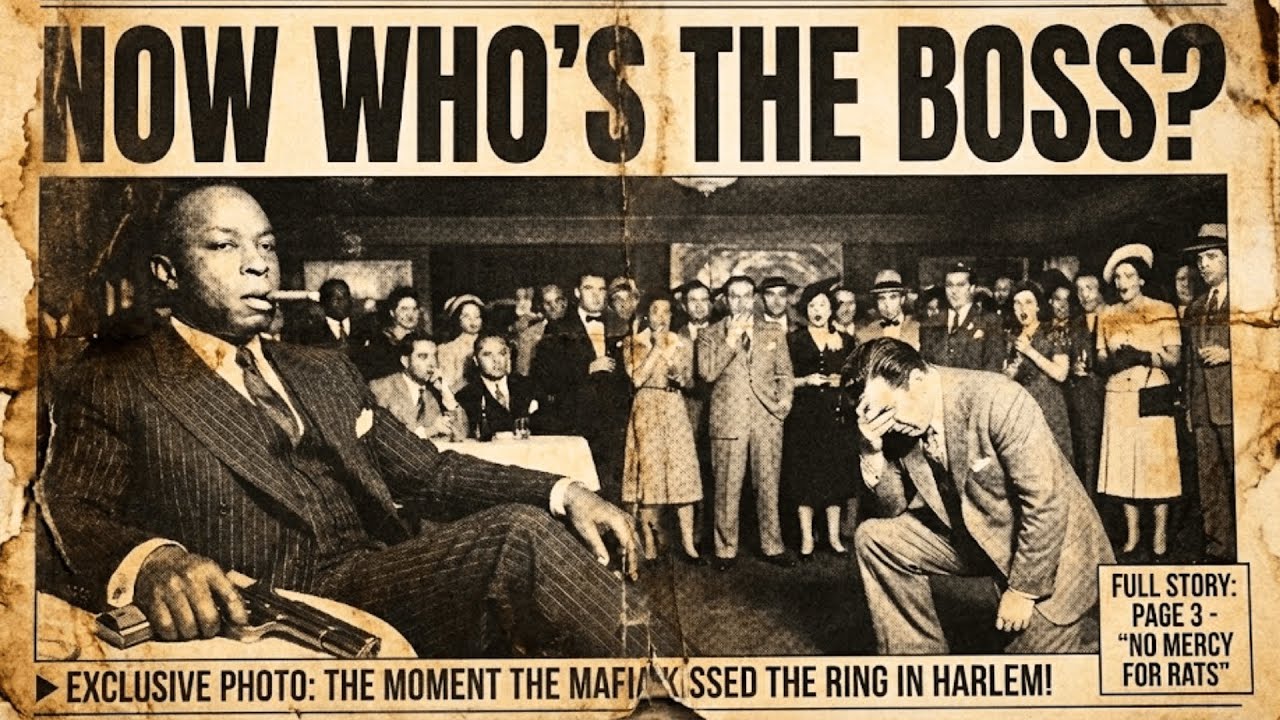
Two hundred people in the room, and not one of them spoke. Vincent Toriel looked around. “What happened? ”
Nobody answered.
He turned to the bartender. “What’s wrong with the band? ”
Samuel stood perfectly still and said nothing. A chair scraped against the floor in the back corner.
Slow. Deliberate. Ellsworth Raymond Johnson—Bumpy to everyone who knew him—rose from his table and began walking toward the bar. The room understood what was coming because the room had seen this equation before.
Someone breaks the rules. The room goes silent. Someone stands up. The rest writes itself.
—
Harlem in 1952 operated on rules no one ever wrote down. You could walk every block from 110th Street to 155th and never see a sign explaining how things worked. No posted guidelines, no handbook for survival, no manual for respect. But every person who lived there, worked there, or did business there understood the system perfectly.
Break the rules, and you’d learn them fast. Smalls Paradise sat at 2294 Seventh Avenue, wedged between 134th and 135th Streets. The building held around 500 people when it was packed. The stage had hosted Count Basie, Billie Holiday, Duke Ellington, and every other name that mattered in American jazz.
The bar served illegal liquor during Prohibition and kept serving after repeal like nothing had changed. The dance floor saw more money change hands than some bank branches. But Smalls Paradise was never really about the music. Ed Smalls opened the club in 1925 and ran it like a Swiss bank.
Neutral territory. Not because violence didn’t happen—violence happened everywhere in Harlem—but because inside those walls, different rules applied. The kind of rules that kept police captains drinking three tables away from numbers runners. The kind that let loan sharks sit next to ministers.
The kind that made politicians laugh with men who’d threatened their campaigns the week before. Everyone came to Smalls Paradise because everyone needed a place where deals could happen without witnesses who talked. Respect in Smalls Paradise wasn’t requested. It was assumed.
The moment you walked through the door, you accepted terms you’d never seen written. Keep your voice down. Keep your hands visible. Keep your problems outside.
Violate those terms, and the room would correct you before security needed to move. The regulars understood this without being told. They’d watched it happen too many times to need explanation. Marcus, a piano player who’d worked there six nights a week since 1947, had seen two men start an argument at the bar over a woman and money from a card game three months past.
Voices rose. Hands moved toward waistbands. The band kept playing, but Marcus watched the doorman drift closer. He watched two men at separate tables stand up without a word.
The argument got quieter, then stopped, then turned into a handshake and a shared drink. No one intervened. No one spoke. The room simply shifted its weight, and the problem disappeared.
That was how Smalls Paradise worked. That was how Harlem worked. The system survived because everyone with power in Harlem needed it to survive. Politicians needed the club to meet donors off the record.
Gangsters needed it to conduct business without attention. Musicians needed it for work. The community needed it as proof that despite everything else falling apart, at least one place still functioned on principles everyone could agree on. But those principles only worked when everyone who walked through the door already knew them.
—
October 14th, 1952. Tuesday night. The club was three-quarters full. Count Basie’s orchestra was scheduled for the weekend, so the house band was running through standards to warm up the crowd.
“Take the A Train. ” “In the Mood. ” “One O’Clock Jump. ” Music that let people talk at tables while dancers filled the floor.
Marcus was at the piano. Thomas was checking IDs at the door. Samuel, the bartender who’d worked there since 1925, was pouring drinks with the muscle memory of someone who’d done it ten thousand times before. Regular Tuesday.
Regular night. The kind of night where nothing was supposed to happen. The club had seen threats before. In 1948, two men nearly pulled weapons over a woman.
The entire room stood up at once—not to fight, just to stand, to be seen standing, to make clear that whatever happened next would happen in front of witnesses who remembered faces. The weapons stayed holstered. The men left. In 1950, someone tried starting a dice game in the corner.
Ed Smalls walked over without saying a word and stood there until the dice disappeared and the men walked out. In 1951, a drunk politician started making promises he couldn’t keep to people who knew better than to believe him. He got loud. Two men escorted him outside.
He never came back. No police reports document how order was maintained inside those walls. No official records describe the enforcement. No one ever wrote the rules down, because writing them down would have made them negotiable.
But the people who drank there, dealt there, danced there—they didn’t need documentation. They remembered how it worked. They remembered what happened when someone forgot. —
Vincent Toriel walked into Smalls Paradise at 11:37 p.
m. like he’d bought the building that morning. Everything about him screamed Chicago. The shoes too new, too polished—the kind you wore to make an impression before making a threat.
The suit tailored, pressed, expensive in a way that announced itself. The walk confident to the point of arrogance, the stride of someone used to rooms that went quiet when he entered them. Thomas, working the door, clocked him in two seconds. Out-of-towner.
Connected. Probably dangerous wherever he came from. Possibly harmless here. Thomas let him pass.
Toriel moved through the club like he was surveying territory he planned to take. His eyes swept the room with professional efficiency. Stage. Bar.
Tables. Exits. Clusters of men who might be problems. He’d done this walk before, probably in dozens of cities, probably in rooms a lot more dangerous than this one.
He chose a stool at the center of the bar—strategic, good sightlines, back protected. The seat of someone who’d learned to watch doors. Samuel appeared with the face he used on everyone. Friendly, professional, forgettable.
“What can I get you? ”
Toriel didn’t look at him. “Whiskey. Neat.
”
Samuel poured. Toriel took the glass without acknowledgement, drank half in one pull, and kept scanning the room. Marcus at the piano noticed Samuel’s posture shift. The bartender’s shoulders tightened.
His movements got more deliberate. The small adjustments people make when they realize they might be dealing with trouble. Toriel tapped his empty glass twice on the bar. Again, Samuel poured.
“You work every night? ” Toriel asked. “Most nights. ”
“How long you been doing this?
”
“Twenty-seven years. ”
Toriel snorted. “Twenty-seven years pouring drinks for other people. That’s a life.
”
Samuel said nothing. His face revealed nothing. He’d heard worse. “What’s your name?
” Toriel asked. “Samuel. ”
“Samuel what? ”
The bartender paused.
Not long. Just long enough. “Just Samuel. ”
“Just Samuel.
” Toriel smiled. “You know people here. ”
“Just Samuel. I know the regulars.
”
“Good. Because I’m going to be a regular now, so you better remember me. ”
Samuel nodded once, poured another drink, moved down the bar. That exchange lasted ninety seconds.
It was enough. Three people in different parts of the room registered what had just happened—not because they heard every word, the music made that impossible, but because they understood body language, tone, the way Toriel treated the bar like territory he’d claimed before spending fifteen minutes in the building. A woman named Clarice, sitting with two friends near the stage, caught the interaction. She’d been coming to Smalls Paradise since 1943.
She leaned toward her friend. “That man doesn’t know where he is. ”
“Who is he? ”
“Someone who won’t be here long.
”
Marcus kept playing piano but watched the bar. He’d seen enough outsiders come through to recognize the pattern: the confident entrance, the territorial marking, the assumption that Harlem operated like whatever city they’d left behind. It usually ended one of two ways. Learn fast and adjust, or learn slow and leave.
He’d never seen someone refuse to learn at all. The third person watching sat in a corner booth with four other men playing cards and drinking coffee. He didn’t react to what he saw. Just filed it away.
Continued his game. —
Twenty minutes passed. The band played. Toriel ordered three more whiskeys.
He’d started talking to the man on the stool next to him—a local, judging by his clothes. The conversation looked friendly from a distance. Too friendly. Toriel was leaning in, gesturing with his glass, buying rounds.
The other man kept trying to create space. Polite refusals that Toriel ignored. Samuel watched from behind the bar. Toriel’s volume was climbing.
Not shouting—just carrying farther than conversations in Smalls Paradise were supposed to carry. That was a problem. People in that room knew how to regulate their volume. They knew when they were drawing attention and when attention was the last thing they wanted.
Toriel either didn’t know or didn’t care. “I’m telling you,” he said, loud enough for three nearby tables to hear clearly. “Chicago runs different. You got a problem, someone handles it clean, fast.
None of this waiting around. ”
The man next to him nodded. Tried standing up. “Hold on.
” Toriel’s hand landed on the man’s shoulder. Not aggressive, just firm. “I’m not done talking. ”
The man sat back down.
He had no choice. “Chicago doesn’t play games,” Toriel continued. “You know who I worked for? Al Capone.
You heard of him? ”
“Everyone’s heard of him. ”
“I collected debts for that man. You know what that means?
”
The man didn’t answer. “It means when someone owed money, I went and got it. Sometimes they paid upfront. Sometimes they needed convincing.
Either way, I came back with the money. ”
Samuel drifted closer to that end of the bar. Not interfering. Just present.
Toriel noticed. “Something wrong, Samuel? ”
“No, sir. ”
“You look worried.
”
“Just doing my job. ”
“Your job’s pouring drinks. I’m drinking. So pour.
”
Samuel poured. The room was listening now. Not obviously. No one stared, but conversations at nearby tables had dropped to whispers.
Dancers were drifting toward the edges of the floor. Marcus had brought the volume down, letting the room hear itself. Toriel kept talking. “You know what the problem is with a place like this?
” He gestured at the room with his glass. “No structure. No organization. Everyone just doing whatever they want.
That’s chaos. You need someone in charge. Someone who sets the rules. ”
The man on the stool next to him was trying to leave again.
Toriel’s grip tightened. “I’m talking to you. ”
“I hear you. ”
“Then stop trying to walk away.
”
Samuel was there. “Sir, if your friend needs to—”
“He’s not my friend. ” Toriel cut him off. “He’s just some guy I’m having a conversation with.
And we’re not done. ”
Thomas, the doorman, started moving from his position at the entrance. Not running, not making a scene—just walking with the steady pace of someone who’d handled this situation before. Toriel saw him coming.
“What’s this? Need backup to pour drinks now? ”
Thomas stopped six feet away. “No trouble, sir.
Just making sure everyone’s comfortable. ”
“I’m very comfortable. ” Toriel raised his glass toward Samuel in a mock toast. “Got a great bartender here.
Real professional. Twenty-seven years behind this bar. That takes real dedication. ” He paused.
“Or maybe you’re just not smart enough to do anything else. ”
The music stopped. Not gradually. The drummer finished his rhythm and didn’t start another.
The bassist let his note fade and didn’t play a new one. The horns lowered. Marcus lifted his hands from the piano keys. Complete silence.
Two hundred people in the room. Not one word. Not one sound. Just the ghost of music that had been playing five seconds earlier.
Toriel looked around. “What happened? ”
Nobody answered. He turned to Samuel.
“What’s wrong with the band? ”
Samuel stood perfectly still. Said nothing. Toriel looked at the man next to him.
The man was staring at the bar top like it held answers he needed. “What? ” Toriel’s voice echoed in the silence. “What did I say?
”
A chair scraped against the floor in the back corner. Slow, deliberate. Bumpy Johnson stood up from his table and started walking toward the bar. —
Everything that was about to happen became inevitable in that moment—before a word was said, before a threat was made.
The room understood what was coming because the room had seen this equation before. Someone breaks the rules. The room goes silent. Someone stands up.
The rest writes itself. The silence wasn’t the absence of sound. It was the presence of attention. Two hundred people watching one man cross a room.
Every eye tracked Bumpy Johnson from his corner booth to the bar. He walked slowly, moving at the pace of someone who knew the room would wait. Fifty-four years old. Average height.
Average build. Nothing about him explained the room’s reaction. No scars, no weapons. Simple dark suit, white shirt, no tie.
Everything about his appearance said ordinary. Everything about the room said otherwise. Four men stood from his booth. Not following—just standing, being seen.
Marcus recognized three. Willie, with Bumpy since the 1930s. James, eight years in Sing Sing. Clarence, who ran numbers in three neighborhoods.
The fourth man, Marcus didn’t know. Intentional. These weren’t bodyguards. These men were the threat.
Men who understood that violence was a language, but silence was a dialect most couldn’t speak. Bumpy reached the bar. Toriel still had his hand on the other man’s shoulder. Part of his brain said local playing tough.
Another part screamed different. He ignored it. “Can I help you? ”
Bumpy looked at the man under Toriel’s hand.
“You can leave now. ”
The man stood. Stool scraped. Gone.
Toriel’s hand remained in the air, gripping nothing. “That was rude. ”
“Was it? ”
“I was having a conversation.
”
“You were. ”
“Do I know you? ”
“No. ”
“Then maybe you don’t know who you’re talking to.
”
“I know exactly. ” Bumpy’s voice was quiet. “Vincent Toriel. Chicago.
Worked collections for Capone until 1931. Moved independent after. Small jobs, some enforcement, nothing that made headlines. ”
Toriel’s face changed.
Someone who’d done research. “You’ve been asking around. ”
“Didn’t need to. You’re not difficult to know.
And you’re not important. ”
Toriel smiled—the Chicago kind. “If I’m not important, this conversation is over. ”
“Is it?
”
Samuel stopped moving. Frozen. Not from fear. From experience.
He recognized judgment about to be delivered. “Look, friend, I’m just having a drink. If I offended someone, I apologize. But I don’t do confrontations over nothing.
”
“You think this is nothing? ”
“A misunderstanding. ”
Bumpy was silent for three seconds. Letting the silence work.
Toriel made his third mistake. He reached for his inside jacket pocket. Not fast, not aggressive—just a casual movement establishing that he was armed. He never completed it.
Willie moved his hand to his jacket. Didn’t draw—just moved. James stepped forward into visibility. Clarence walked to the door, blocking the exit.
The fourth man stayed still, more threatening than any of them. Toriel froze, hand halfway, brain catching up. The room understood. One man being given a choice.
Choose wrong, and he wouldn’t make it to the door. “Take your hand away,” Bumpy said. Toriel did. Slowly.
Both hands on the bar. “Thank you. ”
People later disagreed about details. What time?
What words? How long? But nobody disagreed about hands on the bar. Nobody disagreed about the power shift so complete you could feel it.
A man who walked in owning Harlem, now waiting for permission to breathe. “I’m going to explain something,” Bumpy said. “You’re going to listen. Not because I’m threatening you, but because you walked into a place you don’t understand and broke rules you didn’t know existed.
Now you learn them. ”
Toriel nodded. Small. “Chicago taught you to collect debts.
Make people afraid. That worked there. Chicago operates on respect from reputation, from violence, from memory. ” A pause.
“But you’re not in Chicago. ”
Samuel later said this was the moment he knew—not from what Bumpy said, but from how the room responded to what he didn’t say. Threats could be defended. Violence answered.
But education without anger couldn’t be fought. Only accepted or rejected. And rejection wasn’t an option. “You’ve made three mistakes,” Bumpy said.
“I’m explaining them. Not for your apology. Not for fear. Because you need to understand what you did wrong.
And everyone saw. ”
“He’s going to make him apologize,” Clarice whispered to her friend. “He’s going to make him kneel. ”
“Both, right?
”
—
“Pour him another drink,” Bumpy said to Samuel. Samuel poured. Steady hands. “Drink.
”
Toriel drank. Hard swallow. “First mistake. Walking in like you’d bought it.
Told everyone you don’t understand. This isn’t yours. It’s nobody’s. Neutral ground, maintained by discipline and respect.
When you cross this threshold, you accept rules that have nothing to do with money or Chicago. ”
Toriel listened. Actually listened. Absorbing information that might keep him alive.
“Second mistake. How you spoke to Samuel. Twenty-seven years at this bar. Served everyone who matters.
Kept secrets that could end careers, lives, organizations. You insulted him. Publicly. In his workplace.
Told everyone his service is beneath respect. ”
Samuel’s posture changed. Straightened. “Third mistake.
Reaching for your jacket. Told me you think this gets solved with weapons. Told me you don’t understand where you are. In Chicago, maybe that gets respect.
Here, it gets you killed before you clear leather. ”
The four men hadn’t moved. Didn’t need to. Bumpy’s voice never rose.
Never hardened. Explaining. Teaching. Dispassionate.
Inevitable. “Now you choose. Leave Harlem tonight. Never come back.
Go to Chicago. Tell people you had a misunderstanding. Acceptable. Smart.
Keep your reputation somewhere it still means something. ”
A pause. “Or stay. Try to make something of this.
Tell yourself this was an insult needing answers. Convince yourself that going back empty-handed is worse than staying. That’s a mistake. Your fourth.
Your last. ”
Toriel was sweating. Understanding, finally, that he wasn’t the most dangerous person in the room. “What’s it going to be?
”
“I didn’t come here for trouble,” Toriel finally said. “I know. ” Bumpy replied. “Someone told you Harlem was unorganized.
That there was opportunity. Who told you that? ”
Toriel hesitated. In Chicago, you never gave up a name.
But he wasn’t in Chicago. “Frank Meli. ”
Bumpy’s eyes shifted. Recognition.
“Frank doesn’t know Harlem as well as he thinks. ”
“I’m realizing that. ”
“You mentioned Al Capone earlier. Used his name like it meant something.
”
“He was—”
“I know who he was. ” Bumpy interrupted, still quiet but with an edge now. “Capone built power on violence. On headlines.
On spectacle. That worked until the attention put him in prison. ” A pause. “Harlem doesn’t work that way.
Power here isn’t about making noise. It’s about making sure the right things stay quiet. The moment you need to tell someone you’re in charge, you’ve already lost. And you walked in here tonight like it wasn’t worth learning.
”
“You said I made three mistakes,” Toriel said, voice smaller. “What do I need to do? ”
“That’s the right question. ”
—
Around the room, people understood what was about to happen.
Everyone who’d spent time in Smalls Paradise recognized the pattern. Someone violated the rules. Someone explained the rules. Now, someone needed to acknowledge it publicly.
“Your first mistake disrespected this room. You treated it like territory to conquer. That affects everyone here. So everyone needs to see you correct it.
”
Toriel’s face changed. Beginning to understand. “Your second mistake disrespected Samuel. He’s not just a bartender.
He’s an institution. That correction needs to be personal. ”
Bumpy gestured toward the room. Just a small movement.
The four men from his booth moved closer, establishing position around the bar. Thomas blocked the exit completely. Marcus remained motionless at the piano, bearing witness. Everyone sat forward.
Two hundred people creating an audience. “Your third mistake was reaching for your weapon. That told me you don’t understand the difference between fear and respect. Fear is what you get when people think you might hurt them.
Respect is what you get when people know you won’t—unless you have to. ”
Toriel’s breathing changed. Shallow, controlled. “Here’s what’s going to happen,” Bumpy said.
“You’re going to stand up, face the room, and apologize. Not to me—to everyone here. For treating their space like it was yours. For insulting Samuel.
For bringing Chicago rules to Harlem. And if you don’t, then you’ll leave here a different way than you’re imagining. ”
Barely a threat. Just fact.
“After you apologize to the room, you’ll apologize to Samuel specifically. Then you’ll make a choice. Walk out that door and consider this finished. Or stay in Harlem and try to prove something.
I’m recommending the first option. ”
Silence. Five seconds. Ten.
“Do you understand? ”
“Yes. ”
“Say it back. ”
“I apologize to the room.
I apologize to Samuel. I leave. ”
“Good. ” Bumpy stepped back, creating space.
—
Toriel stood slowly. His legs were shaking. He turned to face the room. Two hundred people looked back, silent.
“I apologize,” he said. “I came in here like I owned something. I don’t. I disrespected your space.
Your rules. I was wrong. ”
Nobody responded. He turned toward Samuel.
“I spoke to you disrespectfully. You’ve worked here longer than I’ve been doing anything that matters. You deserve better. I apologize.
”
Samuel nodded once. Small. Toriel looked at Bumpy. “Is that enough?
”
“You have one more thing to do. ”
Toriel waited. “You’re going to kneel. Not for me.
Not for Samuel. For everyone in this room. So everyone who saw you walk in like you owned this place will see you acknowledge you were wrong. So next time someone from Chicago thinks about coming to Harlem with the same assumptions, they’ll hear this story.
They’ll hear about the night Vincent Toriel knelt at Smalls Paradise. ”
Toriel’s face went white. Kneeling was different. Apologizing could be spun later.
But kneeling was visual, physical, undeniable. The kind of thing that ended reputations. “I can’t. ”
“You can.
Or you can try the alternative. But that will be the last decision you ever make. ”
Willie moved his hand to his jacket. James stepped forward into clearer light.
Clarence remained at the door. The fourth man moved two steps directly in line with Toriel. Toriel looked around the room, searching for anything that might give him an out. Nothing.
Just faces watching. Waiting. Remembering. His knees bent.
Slowly. Inevitably. He knelt on the floor of Smalls Paradise. Both knees.
Head down. In front of two hundred witnesses. Nobody cheered. Nobody laughed.
Nobody made a sound. This wasn’t entertainment. This was maintenance. This was the neighborhood correcting itself.
“Stand up,” Bumpy said. “Walk to that door. Leave this city. Don’t come back.
If I hear you’re still in Harlem tomorrow, we’ll have a different conversation. ”
Toriel stood. His legs barely held him. He walked toward the exit.
The door opened. Closed. Vincent Toriel was gone. Five seconds of silence.
Then Marcus’s hands moved back to the piano. A single note. A chord. The band joined in.
“Take the A Train” again. Conversations resumed. Dancers returned to the floor. The bar served drinks.
Smalls Paradise returned to being Smalls Paradise. No shots fired. No violence delivered. Just three mistakes explained, one choice offered, and a man’s reputation destroyed by his own knees.
—
Vincent Toriel left Smalls Paradise at 12:43 a. m. Walked north on Seventh Avenue. Didn’t run.
Didn’t look back. Just walked, trying to look normal while everything inside broke. Thomas watched him disappear. Returned to his post.
Nothing had happened officially. No police. No report. No body.
October 14th, 1952 was an ordinary Tuesday. Legally. Everyone in that room knew different. Marcus finished at 2:00 a.
m. Three people came up. None mentioned what they’d seen. They thanked him for the music.
Shook hands longer. Eye contact that meant something. Samuel worked until 4:00 a. m.
Tips doubled. Extra money was acknowledgement. Respect flowing backward. Clarice left around 1:00 a.
m. Her friend asked, “Did that really happen? ”
“It happened. ”
“I’ve never seen anything like that.
”
“You won’t again. That’s the point. ”
—
By sunrise, the story moved through Harlem. Not gossip—information people needed.
The kind that determines how business gets conducted, how respect gets shown. The story fragmented through different networks, different details. Musicians focused on the music stopping, the silence as a weapon. Businessmen focused on calculation, power without prosecution.
Bartenders focused on the insult corrected, respect restored. Street operators focused on positioning—four men controlling a room without moving. By October 16th, Chicago heard. Frank Meli heard three versions.
Each agreed on the essentials: Toriel walked into Smalls Paradise, disrespected the wrong people, ended up on his knees. Meli made calls. Tried to verify. Everyone confirmed.
Exactly that bad. Worse. Toriel was gone. First train out.
Didn’t talk. When asked, said New York hadn’t worked. When pressed, changed subjects. When they kept pressing, got angry.
The silence told its own story. Three weeks later, Arthur Ree from Detroit planned a Harlem trip. Heard about opportunities mentioned at a bar. Someone told him about Toriel.
About Smalls Paradise. About the night a Chicago enforcer knelt. Arthur Ree canceled. The pattern repeated.
Men heard about Harlem. Made plans. Heard about Toriel. Changed plans.
Not all—some still came, but different. More careful. Understanding Harlem wasn’t vacant. They all knew about Smalls Paradise.
New rules. New consequences that didn’t involve police—just humiliation so complete a reputation never recovered. Inside Harlem, the consequences were permanent. Bumpy didn’t become more powerful—he already was.
But his nature became clarified. Not violence threatened. Order maintained. The power of someone who could end a threat by explaining why it was a threat.
That power was harder to fight. How do you fight someone who makes you understand, publicly, that you’ve already lost? Smalls Paradise gained something too. It had always been neutral ground.
After October 14th, that neutrality became active. Protected. Enforced by collective understanding. People treated the space differently.
More careful. Aware they were guests. The invisible rules became visible. Respected.
—
Samuel worked twelve more years. Retired in 1964. The club held a party. Two hundred people.
Marcus played piano. Played “Take the A Train”—the song playing when Toriel walked in, the song that resumed after he knelt. Nobody mentioned why. Nobody needed to.
Years passed. The story became oral history. Not legend. Instruction.
Bumpy Johnson died in 1968. The funeral drew thousands. Newspapers covered it. But people at Smalls Paradise remembered what the headlines missed.
Bumpy’s power wasn’t spectacle. It was built on nights that didn’t make news. Nights when problems were solved without violence. Nights when order was maintained by explaining exactly why someone was wrong.
Bartenders remembered. Musicians remembered. People who ran numbers remembered when they trained the next generation. They told them about October 14th, 1952.
Not as legend—as instruction. This is how power works. This is how respect is maintained. This is what happens when you forget that some places operate on rules you can’t see but better learn.
Vincent Toriel became a reference. Not a villain. Not a victim. An example of what happens when you think rules from somewhere else apply everywhere.
A cautionary tale that traveled, changed behavior, and prevented problems that never happened because people heard the story first. Smalls Paradise closed in 1986. Fifty-three years after opening. Thirty-four years after Toriel knelt.
The building still stands. Different business. Different purpose. But people who remember—and people who heard stories—still walk past and think about October 14th, 1952.
About the night the music stopped until one man’s knees hit the floor. About the night a Chicago enforcer learned the difference between fear and respect. About the night two hundred witnesses watched a reputation destroyed by calm sentences without anger. About the fact that sometimes the most powerful thing you can do is explain, quietly and clearly, exactly why someone is wrong.
Then step back and let them make the choice that proves you right. The lesson wasn’t violence. It was consequences. The understanding that every room has rules.
Every rule has enforcers. Every enforcer has methods you won’t see until you’ve broken something you can’t fix. Harlem remembered that night the way Harlem remembers everything that matters. Not in newspapers.
Not in police reports. Not in official records. In stories told at bars. In warnings given to newcomers.
In the way people lower their voices near certain corners. In the collective memory that keeps a neighborhood functioning when everything else fails. The difference between owning a room and understanding whose room you’re in. The difference between reputation built on fear and respect earned through discipline.
The difference between power that announces itself and power that doesn’t need to. October 14th, 1952. Smalls Paradise. Two hundred witnesses.
One man kneeling. Zero shots fired. The night Harlem taught Chicago how things work uptown. The night respect proved more permanent than violence.
The night everyone learned that sometimes the quietest voices carry the most weight. No shots. No bodies. No reports.
Just truth delivered calmly, and a man who learned it too late. Harlem remembered. It always does.
