Commander Joseph Rochefort could not tell the United States Navy where Japan’s aircraft carriers were on the morning of December 7, 1941. Vice Admiral Chuichi Nagumo’s strike force had crossed the North Pacific under strict radio silence, and every American intelligence organization searching for those carriers had lost them. By the end of the attack on Pearl Harbor, 2,403 American service members and civilians were dead. Six months later, Rochefort’s team would help identify Japan’s next target.
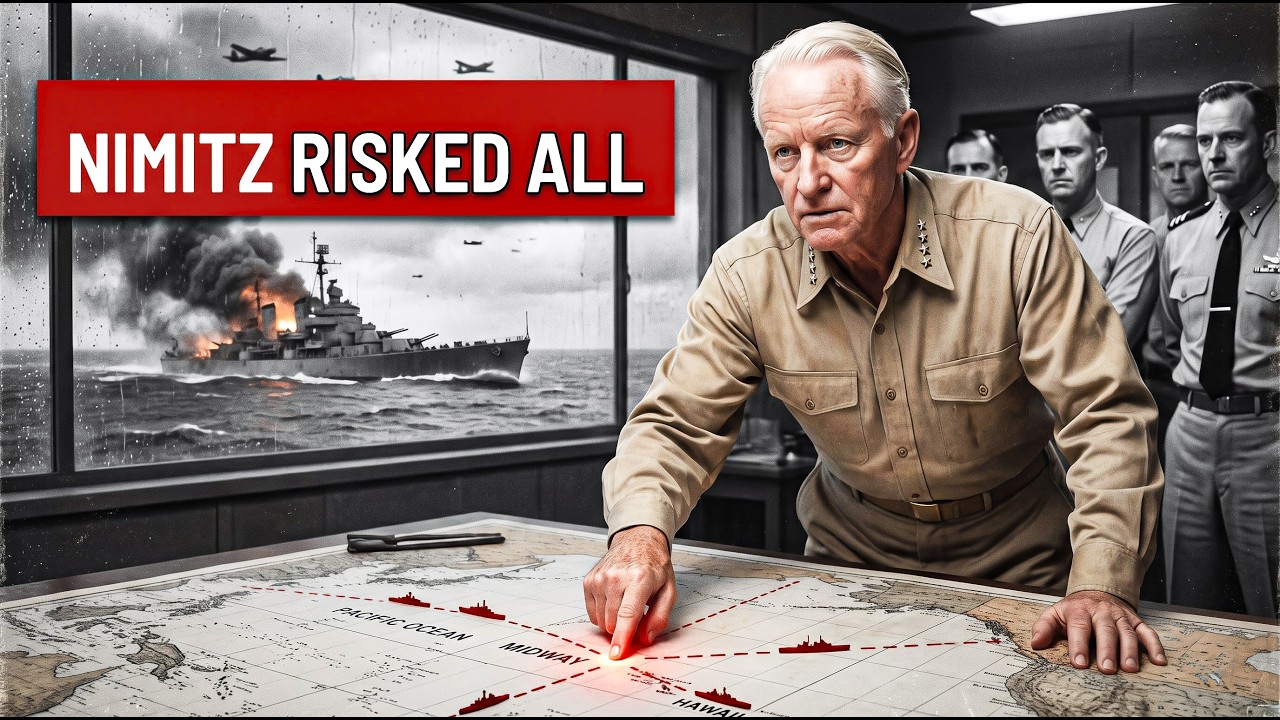
They would give Admiral Chester Nimitz the intelligence he needed to place three American aircraft carriers directly in the path of the Japanese fleet near a tiny atoll called Midway. What followed was one of the most violent reversals in naval history. In roughly five to six minutes, three Japanese aircraft carriers were mortally damaged. But the officer whose work helped make that victory possible would soon be removed from codebreaking altogether.
The Distinguished Service Medal that Nimitz endorsed for him would not reach Rochefort’s family until 44 years after the battle. The spring of 1942 belonged to the Empire of Japan. For six months, the Imperial Japanese Navy had rolled across the Pacific like a tidal wave that refused to break. Singapore had fallen.
The Dutch East Indies were gone. American and Filipino forces in the Philippines had been overwhelmed. But aboard the battleship Yamato in Japanese home waters, one man was not celebrating. Admiral Isoroku Yamamoto was 58 years old, a veteran of the Battle of Tsushima who had studied at Harvard, served as naval attaché in Washington, and traveled through the industrial heartland of America.
Unlike many senior officers, he understood the hard truth Japan’s leaders refused to confront: the American industrial machine was waking up, and Japan was running out of time. Yamamoto was reported to have warned that he could run wild for six months, perhaps a year, but beyond that he could promise nothing. Six months had now passed. The window was closing.
Yamamoto believed Japan needed to force a decisive battle against the surviving American carriers before American industrial power became overwhelming. He began drafting one of the most ambitious naval operations ever conceived, a plan involving nearly 200 ships spread across thousands of miles of ocean, designed to lure the American fleet into an ambush. The target was a tiny, unremarkable atoll in the middle of the Pacific called Midway. Thousands of miles away, deep beneath the Pearl Harbor naval shipyard, another man was beginning to reconstruct Yamamoto’s intentions from fragments of Japanese radio traffic.
Joseph Rochefort was a Navy commander in his early forties. He often worked in a dark red smoking jacket and carpet slippers, an unconventional appearance that reflected his disregard for military formality. The windowless, cold, crowded basement he worked in was perpetually hazy with cigarette smoke. The men who served there called it the dungeon.
The dungeon was officially designated Station Hypo, a combat intelligence unit buried beneath Administration Building 1 at the 14th Naval District. Roughly 40 officers and enlisted specialists worked there, cryptanalysts, translators, traffic analysts, and intercept operators, measuring time by shift changes and the growing stacks of intercepted Japanese transmissions. Among them was Lieutenant Commander Thomas Dyer, one of the finest cryptanalysts in the Navy, along with Wesley Wright, known as Ham, a quiet man with an uncanny ability to see patterns invisible to others, and Jasper Holmes, a former science fiction writer recalled to service whose imagination would become an intelligence weapon. Rochefort had learned Japanese the hard way.
Between 1929 and 1932, he had lived in Tokyo as a Navy language officer, studying until he could read newspapers, government documents, and technical manuals in the original characters. He understood not only the words but the mindset behind them. The failure to locate the carriers before Pearl Harbor shadowed every assessment that followed. Now, in the spring of 1942, the intercepts were changing.
The volume of Japanese naval radio traffic was rising in a steady, ominous curve. New units were being activated. Supply orders were surging. Something enormous was being prepared.
And buried inside the fragments of decoded messages, one designation kept appearing: AF. The Japanese combined fleet was concentrating on a target they called AF. American cryptanalysts could read only about 10 to 15 percent of Japanese naval message content, often no more than disconnected fragments. But the fragments told a story.
By analyzing which commanders were talking to which units, tracking the frequency of transmissions, studying leaked logistical demands, and cross-referencing radio bearings and call signs, Rochefort could feel the shape of the coming operation. It was massive, imminent, and aimed at the central Pacific. He believed AF was Midway. But belief was not enough.
Four thousand miles away in Washington, a different picture was taking shape. The office called OP-20-G, the Navy’s central cryptographic authority, was run by officers who distrusted Rochefort’s independence. At the heart of the opposition were two brothers, Captain Joseph Redman, director of naval communications, and his younger brother Commander John Redman, who headed OP-20-G. They viewed Station Hypo as a rogue outpost and Rochefort himself as an insubordinate maverick.
Washington remained divided, with some analysts arguing for Johnston Island, others for Alaska, Hawaii, the West Coast, or even a deception designed to draw the American fleet north while a second attack fell on Pearl Harbor itself. Standing in the middle of this intelligence war was Commander Edwin Layton, 39 years old, the Pacific Fleet intelligence officer and Nimitz’s most trusted adviser on the Japanese Navy. Layton had known Rochefort for years. He believed him, and every day he walked into Nimitz’s office and delivered the assessments that would shape the survival of the United States in the Pacific.
Chester Nimitz, 57 years old, a quiet Texan with cold blue eyes and an iron sense of duty, had inherited command of the Pacific Fleet just three weeks after the disaster at Pearl Harbor. The battleship force had been shattered, and his immediate striking power rested largely on three carriers: the Enterprise, the Hornet, and the Yorktown, which was returning from the Battle of the Coral Sea with serious bomb and structural damage. Three carriers to hold a battle line stretching from Alaska to Australia. If Nimitz placed them at the wrong coordinates, the Pacific Fleet could suffer a defeat from which it might take years to recover.
The clock was accelerating toward the end of May 1942. Yamamoto’s fleet was already beginning to move, slipping its moorings under strict radio silence. Despite the doubts coming from Washington, Rochefort could not wait any longer. Washington was unlikely to accept the Midway hypothesis without stronger confirmation, and by the time confirmation arrived through proper channels, the American carriers might already be at the bottom of the Pacific.
An idea took shape in the dungeon, coming from Jasper Holmes. The plan was simple, beautiful, almost reckless. Midway’s garrison depended heavily on its freshwater distillation plant. A serious failure would create a logistical crisis Japanese planners could not ignore.
If Midway suddenly announced that its water supply had broken down, the Japanese would react, issue orders, and talk about it on the radio. And when they did, they would tell Rochefort exactly what he needed to know. Holmes brought the idea to Rochefort. Rochefort brought it to Layton.
Layton brought it to Nimitz. Nimitz approved it. Through a secure undersea cable the Japanese could not intercept, instructions were sent to Midway. The commander there received an unusual deception order: broadcast an uncoded radio message openly announcing that the island’s freshwater distillation plant had suffered a catastrophic breakdown, on a frequency the Japanese were known to monitor.
Then Station Hypo waited. The next 48 hours were among the longest of Rochefort’s life. Then on May 22, 1942, the Fleet Radio Unit Melbourne circulated a translation of an encrypted Japanese report stating that the unit associated with AF had only enough fresh water for approximately two weeks and requested immediate resupply. Japan had repeated the clue inside its own encrypted traffic, and Allied cryptanalysts were able to read it.
Layton presented the confirming intelligence to Nimitz. The confirmation strengthened his plan. By May 27, Commander in Chief Pacific Fleet had promulgated a revised operational order, positioning Task Force 16 under Rear Admiral Raymond Spruance and Task Force 17 under Rear Admiral Frank Jack Fletcher northeast of Midway at a point designated Point Luck. But there was one enormous problem.
The Yorktown was broken. She had returned from the Coral Sea with a Japanese bomb hole punched through three decks. The shipyard’s initial estimate called for approximately three months of repairs. Nimitz gave them 72 hours.
More than 1,400 workers descended on the Yorktown, welders, riveters, steamfitters, and electricians who worked around the clock in three shifts, sleeping only where and when they could. Seventy-two hours later, Yorktown steamed out of Pearl Harbor under her own power. Repairmen were still aboard, hammering and welding as she sailed. Japanese planners did not expect her to return so quickly.
They believed they were about to face a weaker American force than the one waiting for them. American industry did not just build ships; it rebuilt them faster than anyone believed possible. And sailing directly into the trap was Rear Admiral Tamon Yamaguchi, 49 years old, commander of Carrier Division 2, flying his flag from the aircraft carrier Hiryu. In the 1920s, he had studied at Princeton and later served as naval attaché in Washington, giving him firsthand exposure to American resources and industrial capacity.
But he was not in command. The commander of the Kido Butai was Vice Admiral Chuichi Nagumo, 55 years old, a torpedo specialist by training. Four elite carriers now depended on his judgment: the Akagi, the Kaga, the Soryu, and Yamaguchi’s Hiryu. They were sailing directly toward a trap made possible by Station Hypo’s intelligence and Nimitz’s decision to act on it.
At dawn on June 4, 1942, the Pacific Ocean was calm and glass flat. Kido Butai moved forward in perfect formation, four carriers escorted by battleships, cruisers, and destroyers. On the bridge of the flagship Akagi, Nagumo stood with his staff watching pre-dawn preparations. Over 100 aircraft were ready to launch the first strike wave against the American Marines dug into the sands of Midway Atoll.
According to standard doctrine, seven reconnaissance aircraft would launch from the cruisers and battleships to sweep the surrounding waters. It was a routine safety measure, as Japanese planners did not believe an American carrier force was close enough to intervene. But at the launch station of the heavy cruiser Tone, something went wrong. Scout plane number four launched roughly 30 minutes behind schedule.
For decades, that delay was described as the moment that decided the Pacific War. Modern research suggests something even stranger: if the scout had launched on time and flown its assigned track, it likely would have flown past the American task forces entirely. At that hour, 175 miles to the northeast, three American aircraft carriers were preparing a massive strike. Their flight decks were crowded with SBD Dauntless dive bombers, TBD Devastator torpedo planes, and F4F Wildcat fighters.
Enterprise and Hornet would launch first; Yorktown would send her strike later. At 7:00 in the morning, the radio on the bridge of the Akagi crackled to life. Lieutenant Yoichi Tomonaga, flight leader of the first Japanese strike wave, transmitted a single line from high above the smoking ruins of Midway: there was need for a second attack wave. The Marines had refused to break, their anti-aircraft guns were still firing, and their runways were still functional.
Down in the hangars of the four Japanese carriers sat Nagumo’s reserve force, aircraft armed for anti-ship missions. At about 7:15, Nagumo ordered much of the reserve rearmed for a second strike on Midway. Across the carrier force, crews began changing weapons, removing torpedoes and bringing land-attack bombs forward. The process brought aircraft, fuel, bombs, and torpedoes together inside enclosed hangar spaces, a concentration that would make the carriers dangerously vulnerable to bomb hits.
Some minutes later, a scout from Tone reported ships to the northeast. Nagumo demanded clarification. The scout had not identified the ship types. For long, agonizing minutes, the bridge of the Akagi waited.
Then the pilot answered: five cruisers, five destroyers. The tension eased. And then the scout transmitted one final message: the enemy force is accompanied by what appears to be a carrier. One word changed the entire tactical picture.
An American carrier within striking distance, and much of Nagumo’s reserve was no longer configured for an immediate coordinated anti-ship strike. A few miles away on the bridge of the Hiryu, Yamaguchi received the same report. At about 8:17, he flashed an urgent visual message to the flagship: consider it advisable to launch attack force immediately. On the flagship, Nagumo faced a grim operational problem.
Tomonaga’s first strike wave was returning from Midway, dozens of shot-up aircraft circling overhead, many low on fuel. Launching first would delay recovery and place damaged, fuel-starved aircraft at grave risk. Meanwhile, land-based bombers from Midway were still attacking his ships. Nagumo chose to recover the returning aircraft first, then launch a coordinated, escorted strike.
It was a defensible decision made inside a collapsing information picture, and it helped set the conditions for catastrophe. At that exact moment, 170 miles to the northeast, the American strike waves were already in the air. The Hornet’s Torpedo Squadron 8 arrived first, led by Lieutenant Commander John Waldron, coming in low over the water without fighter escort into the guns of the entire Japanese fleet. Japanese Zero fighters descended on them.
One by one, the Devastators broke apart, spiraled into the sea, and disappeared. Waldron himself was seen going down in flames. Only one man from the squadron survived, Ensign George Gay, who watched the destruction from a life raft while hiding under a floating seat cushion. Of the 41 Devastators launched by the three American torpedo squadrons that morning, only six returned.
To the Japanese, it looked like a slaughter. But the succession of low-level attacks had disrupted the Japanese combat air patrol, drawn many fighters downward, and consumed fuel and ammunition. High above the fleet, hidden by scattered clouds, 48 SBD Dauntless dive bombers from Enterprise and Yorktown were converging on the Japanese carriers. Lieutenant Commander Wade McClusky had almost missed the fleet entirely, overshooting the Japanese force with fuel running dangerously low.
Then he spotted a lone Japanese destroyer racing north, the Arashi, hurrying to rejoin the main fleet. He followed her. She led him directly to the four Japanese carriers. At almost the same time, Lieutenant Commander Max Leslie’s dive bombers from Yorktown arrived from a different direction.
Neither squadron leader knew the other was there, but by an extraordinary coincidence, the two attacks pushed over into their dives within seconds of each other. A bomb struck the Akagi near her amidships elevator and detonated below the flight deck amid aircraft, aviation fuel, and torpedoes caught in the rearming process. One bomb did not sink the Akagi; it made her impossible to save. Chain reactions rippled through the ship as torpedoes cooked off and bombs detonated.
Almost simultaneously, Kaga and Soryu were struck by multiple bombs. Fires and secondary explosions rapidly made all three carriers impossible to save. Ships that had struck Pearl Harbor, that had ranged across the Indian Ocean, that had ruled the Pacific for six months. Within roughly five to six minutes, all three were mortally damaged.
Yamaguchi did not surrender. The Hiryu had not been hit. She was still functional and still deadly, and Yamaguchi launched the aircraft he could into two separate strikes, first a wave of Val dive bombers, then a wave of Kate torpedo bombers. Both strikes found the Yorktown.
The carrier resurrected in 72 hours at Pearl Harbor was hit and listed heavily to port, on fire, dead in the water. Her crew fought to save her for hours. Two days later, on June 6, the Japanese submarine I-168 found her and struck her and the destroyer USS Hammann, which was alongside supporting salvage operations. Hammann sank within minutes, taking many of her sailors with her.
Yorktown herself remained afloat through the night and sank at dawn on June 7. Yamaguchi’s victory was brief. By late afternoon on June 4, American dive bombers from Enterprise found the Hiryu. Direct hits reduced her to a burning wreck.
That night, Yamaguchi chose not to leave. After bidding farewell to the surviving crew, he and Captain Tomeo Kaku remained aboard. In the early hours of June 5, the Hiryu was scuttled beneath them. By the time the battle was complete, Japan had lost four fleet carriers, 248 aircraft, and more than 3,000 men.
Perhaps more damaging in the long run, Japan had lost hundreds of highly skilled aviation specialists and maintainers who could not easily be replaced. Japan would build new carriers, but it never fully restored the combination of experienced air crews, trained deck crews, and concentrated striking power lost at Midway. The Pacific War had not yet become a one-way advance, but the men who would fight in the months of savage combat around Guadalcanal had just been given a fighting chance. Roughly 1,300 miles away in the dungeon, the work continued.
There was no public ceremony and no immediate recognition. Midway strengthened Rochefort’s reputation, but it also intensified the bureaucratic struggle over who controlled American naval communications intelligence. On June 20, Joseph Redman submitted a memorandum sharply criticizing Rochefort’s leadership. Rear Admiral David Bagley recommended Rochefort for the Distinguished Service Medal, and Nimitz endorsed the recommendation.
Admiral Ernest King, commander in chief of the United States Fleet, rejected the award after opposition from Rochefort’s Washington chain of command. On October 25, 1942, Rochefort was ordered to Washington. His cryptanalytic career was effectively ended. He was reassigned to work connected with a floating dry dock in San Francisco Bay.
To the men who had served under him, it looked like exile. Rochefort did not protest publicly. He served out the war away from the field in which he had made his greatest contribution, rose eventually to the rank of captain, and retired quietly. For most of his life, the story of what he had done at Midway remained classified.
Joseph Rochefort died on July 20, 1976, in his home in Torrance, California, at age 76. His death received little public attention compared with the size of his wartime contribution. But the veterans of Midway had not forgotten. Former codebreakers, intelligence officers, and retired admirals campaigned for decades to correct the record.
The campaign finally succeeded in the mid-1980s. On May 30, 1986, at a ceremony at the White House, President Ronald Reagan presented Rochefort’s posthumous Navy Distinguished Service Medal to his family. The medal Nimitz had endorsed came 44 years after the Battle of Midway, nearly 10 years after Rochefort himself had died. Two men, two navies, two very different endings.
Rochefort had helped reveal the enemy’s plan before the battle. Yamaguchi had recognized the immediate tactical danger faster than the commander above him once the battle began. But their stories were not the same. Rochefort survived the war only to be removed from the field in which he had achieved his greatest success.
Yamaguchi struck back with the last surviving Japanese carrier and chose to die aboard her when she could no longer be saved. What connected them was a shared question: what happens when the information in front of a commander contradicts the plan already in motion. Nimitz acted on the intelligence provided by Rochefort, Layton, and Station Hypo. Nagumo chose to recover his returning aircraft before acting on Yamaguchi’s warning.
One decision helped create an ambush; the other was made inside an ambush already closing around him. The Battle of Midway was not decided by intelligence alone, nor by dive bombers alone. Intelligence placed the American carriers in the right ocean. Command decisions placed them in the right position.
The air crews who flew from Enterprise, Hornet, and Yorktown turned that advantage into victory, and many of them paid for it with their lives. Nimitz entered the battle with an increasingly accurate picture of his enemy. Nagumo entered it with a picture that was already falling apart. That difference helped turn Midway into one of the most consequential naval victories in American history.
Some of the men who did the most to save this country did not look like heroes. Some wore smoking jackets and carpet slippers. Some worked in basements. Some were pushed aside by the very institutions they helped protect.
But they were there when it mattered.
