The man was already sitting in the chair when the door opened. The living room was dim, lit only by a single lamp in the corner that cast long yellow shadows across the carpet. A grandfather clock on the far wall marked each second with the kind of deliberate precision that makes silence feel heavier than it should. The furniture was expensive dark wood, thick upholstery, oil paintings arranged with the careful intention of someone who wanted visitors to understand, immediately and without ambiguity, that they had entered the domain of a serious man.
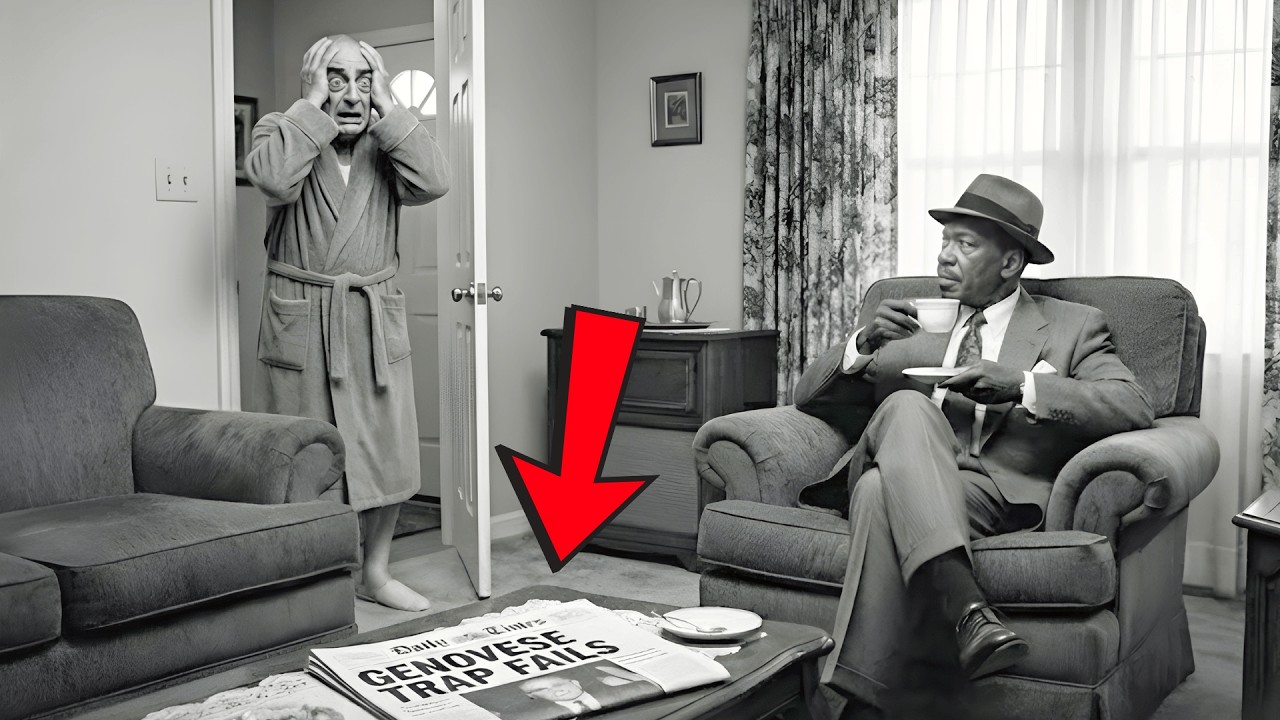
The curtains were drawn. The street outside made no sound. The man in the chair sat with both hands resting open on his knees, his dark suit pressed without a single crease, his posture carrying the particular stillness of someone who has been waiting not because he arrived early but because he chose to. He did not look up when the door opened.
He did not need to. He had known to within a margin of four minutes exactly when it would. The man who stepped through the door stopped moving the moment he registered what he was seeing. Not a slow stop, an absolute one, the kind that begins somewhere in the nervous system before the mind has finished processing the information.
His hand remained on the doorknob. His coat was still half open from the cold outside. The color that had been in his face from the autumn air drained with a slowness that suggested his body understood the situation several seconds before his mind had finished constructing a coherent response to it. For three full seconds, the only sound in the room was the clock, indifferent and steady, counting time that suddenly felt like it belonged to someone else entirely.
The seated man finally looked up. His expression contained nothing that could be read as threat, nothing that could be described as triumph. It was something more unsettling than either of those things: the calm of a person who was already finished calculating every possible outcome of the next ten minutes and found all of them acceptable on his own terms. The lamp threw half his face into shadow and left the other half in amber light.
And in that division he looked exactly like what he was: a man who had made himself comfortable in a place where comfort was supposed to be impossible. “I think,” he said quietly, “that we need to talk. ”
Three weeks earlier, Harlem had been operating on its ordinary rhythms, and those rhythms, to anyone who knew how to read them, told a story that no newspaper would print and no police report would ever accurately describe. Ellsworth Raymond Johnson, known across every block of upper Manhattan by the single name Bumpy, had built something in Harlem that did not fit neatly into the categories that outside observers typically used when discussing men of his position.
He was not simply a criminal operator in the way that prosecutors defined the term. He was not simply a community figure in the way that ministers and civil rights organizers used that phrase. He occupied a third category that had no official name, a role that existed because the legitimate structures of mid-century New York had systematically declined to serve the people who lived above 110th Street, and nature, as it always does, had moved decisively to fill the vacuum. He had arrived from Charleston, South Carolina as a young man during the years when the Great Migration was reshaping the demographic geography of the northern cities.
And he had learned Harlem the way a chess player learns a board: not just the pieces and their permitted movements, but the invisible logic that governed why certain positions were stronger than they appeared, and why certain advantages evaporated the moment you tried to press them too hard. By 1957, he controlled the numbers racket across most of upper Manhattan, a daily illegal lottery that required only small bets and generated the kind of steady, distributed economic activity that employed runners and collectors and clerks from neighborhoods where legitimate employment remained stubbornly, structurally scarce. He maintained relationships with what remained of the Democratic political machinery in the area, with judges who were accessible to reasoned conversation, with police officers who understood the value of predictable arrangements over the alternative of chaotic and unprofitable enforcement. He funded churches without announcing it.
He settled disputes before they became expensive for everyone. He was, in the precise sense of the word, a system: a functioning alternative infrastructure operating beneath and alongside the official one, providing services and a form of stability in spaces where official institutions had either never arrived, or had withdrawn so long ago that no one still living could remember their presence. None of this made him admirable in any uncomplicated moral sense. The numbers racket extracted money from people who could not afford to lose it, sustaining itself on the mathematics of hope that almost never paid out at the scale that would have mattered to the people placing the bets.
The political protection he maintained came with costs that ultimately circulated back through the community in forms it had not fully consented to. The stability he provided was real, but it was his stability, subject to his calculations and his interests in ways that genuine civic institutions, however imperfect, were constitutionally not. He understood this himself with a clarity that he rarely articulated, but that informed every significant decision he made. What distinguished him from most men operating in comparable positions was precisely that clarity: the capacity to see his own situation without the distortions that ambition or fear or the need for self-justification typically introduced into a man’s assessment of his circumstances, and to act on what he actually observed rather than on what he might have preferred to be true.
Vito Genovese saw the world through a fundamentally different lens, and understanding the precise nature of that difference was, as subsequent events would demonstrate with unmistakable clarity, the entire key to everything that followed. Genovese had been born in Naples and had arrived in New York as a teenager, carrying the particular combination of hunger and absolute ruthlessness that the city’s underworld rewarded generously in its early stages and eventually came to fear in its later ones. He had climbed through the ranks of what would become the most powerful Italian crime family in the city through a process that could be described without meaningful exaggeration as the systematic elimination of every human obstacle between himself and the next level of authority. He had fled to Italy in 1937 to escape murder charges, spent the war years in fascist-controlled Europe under circumstances that most of his associates found professionally inconvenient to examine too directly, and returned to New York in 1945 with ambitions that had only expanded and hardened during his absence.
By the autumn of 1957, he had orchestrated the removal of Albert Anastasia, a man whose own reputation for decisive action had been considered essentially definitive, and was consolidating authority among the Five Families with the methodical confidence of someone who believed, not without substantial justification, that the outcome had already been determined and that what remained was merely administrative. His worldview contained a structural assumption that would prove to be the precise location of his vulnerability. He believed that power moved in a single direction: downward from the top of his organization. Anyone operating outside that hierarchy existed, by definition, in a subordinate relationship to it.
Black operators in Harlem occupied, in his analysis, the category of middle management that had been extended a degree of informal autonomy because previous arrangements had found it convenient. That convenience had reached its natural expiration. The revenue those operations generated was tribute, and tribute by its essential nature was owed without the complication of negotiation. The collision between these two philosophies, one constructed through accumulation by destruction, the other sustained through survival by construction, had been developing beneath the surface of the city’s criminal economy for years, each man’s expanding influence pushing against the boundaries the other’s existence defined.
What gave it sudden and dangerous urgency in the autumn of 1957 was a meeting in upstate New York that neither man had attended, but that fundamentally altered the conditions under which both of them now operated. The gathering of more than fifty Italian crime figures at a rural estate in Apalachin had been conceived as a private conference to address coordination problems that had emerged following Anastasia’s removal. It became, through a state trooper’s suspicion and the subsequent undignified spectacle of expensively dressed men fleeing through cornfields and forest, the most consequential law enforcement event in the recent history of American organized crime. Federal prosecutors who had spent years frustrated by the political insulation that protected Italian family leadership suddenly possessed both the documentary evidence and the political justification for conspiracy investigations at a scale that had never previously been attempted or perhaps even seriously contemplated.
The comfortable assumption that local arrangements could permanently contain federal attention collapsed in a single afternoon. And the consequences of that collapse were still radiating outward through every connected organization in the weeks that followed. It was into this environment—federal investigators constructing new instruments of prosecution, Italian families recalculating exposures they had previously considered manageable, the entire criminal infrastructure of the city suddenly aware that the rules had shifted in ways nobody had yet fully mapped—that the message arrived at Bumpy Johnson’s door. It came through a capo who had maintained a functional working relationship with Bumpy’s organization for the better part of a decade, a man whose consistency across enough transactions had established a baseline of reliability that made his appearance at Bumpy’s door register as routine rather than significant.
He was shown in on a Tuesday morning and sat across from Bumpy in the back office of a Harlem establishment that served, depending on the hour and the nature of the visitor, as a social club, a place of business, or a location where certain categories of conversation could occur without concern for interruption or documentation. The message was delivered in the precise manner that such messages were constructed to be delivered: not as an explicit threat, which would have required a response in kind and created its own complications, but as neutral information about new arrangements that would be taking effect according to a timeline that had already been determined. The percentages Bumpy currently forwarded to Italian oversight would increase substantially and immediately. The independent relationships he had cultivated over decades with political figures and law enforcement would be restructured to pass through channels that Genovese’s organization controlled directly.
The operational autonomy that Bumpy had maintained through careful navigation of the city’s criminal landscape for thirty years would be systematically redefined into something that more accurately resembled supervised employment: gradually, but with a finality that left no meaningful room for alternative interpretation. The capo delivered all of this with the practiced neutrality of a man reading from someone else’s document, which was precisely the role he was performing. He placed a folded piece of paper on the desk between them, a written version of the terms specific enough to constitute a record of what had been communicated, and settled back in his chair with the expression of a man who had completed his professional obligation and was now simply waiting for the formality of acknowledgement. Bumpy picked up the paper.
He read it with the unhurried, complete attention of someone encountering a mildly interesting article in a Sunday newspaper, a document that merited genuine reading but did not, apparently, merit visible reaction. He folded it once precisely along its original crease and set it back on the desk surface with his left hand while his right rested entirely open and relaxed on the arm of his chair. His face during this entire sequence registered nothing that could be catalogued as surprise, anger, fear, or the kind of visible calculation that would have told an observer something useful about his thinking. All four were present.
The proportions were his alone to know. “Tell him I received it,” Bumpy said. The capo nodded and rose from his chair. At the door, his movement slowed for a fraction of a second, not long enough to constitute hesitation in any demonstrable sense, but long enough for someone paying the right kind of attention to register that the man carrying this particular message understood its full weight and was relieved to have delivered it and be leaving.
He did not look back. The door closed behind him with a quietness that itself felt deliberate. The man he left in the office remained still for a long moment after the sound of footsteps faded entirely from the hallway. Then he reached into his jacket, retrieved the paper, unfolded it, and read it a second time with the same complete and unhurried attention.
He folded it again and placed it in his inside breast pocket, where it would remain until he chose to do something with it. There are responses to pressure that announce themselves in ways that serve the person applying the pressure: raised voices, emergency meetings, visible mobilizations of resources that telegraph both the existence and the direction of resistance and allow the other side to plan accordingly. Bumpy Johnson produced none of these. In the days following the capo’s visit, he reduced his public presence rather than expanding it, appearing less frequently at the establishments where he typically conducted the visible portions of his business.
He declined social invitations that would have provided platforms for signaling. When he did speak with associates who had begun arriving with questions in their eyes, he spoke in the measured tones of a man doing private arithmetic about difficult realities, acknowledging without apparent distress that Genovese’s position in the current landscape was substantial, that the demands he was making reflected genuine power, that certain adjustments might simply represent the unavoidable mathematics of survival. Word traveled through Harlem’s informal networks with the speed and precision that had always made those networks more reliable than their official counterparts. Within a week, the assessment circulating through every level of the neighborhood’s connected world was essentially uniform: Bumpy was calculating the terms of his accommodation.
Politicians who had attended his fundraisers began accepting telephone calls from representatives of downtown interests. Patrol officers who had maintained productive understandings with his organization became difficult to reach. Several of his own operators, men who had worked within his network for years and whose loyalty had never previously been questioned, began establishing quiet secondary relationships with Italian contacts. Not betrayal in the explicit sense, but the kind of careful repositioning that experienced people undertook when they assessed that the ground beneath a particular structure was shifting in a direction that would not reverse.
Genovese received these reports with the deep satisfaction of a man watching a prediction confirm itself in real time. Each new piece of information arrived as further validation of a formula that had worked reliably across the full length of his career. The target was contracting. His support was visibly eroding.
The resolution would arrive on the schedule he had set. He turned his attention to other matters with the easy confidence of someone who had already filed the question as answered. This was the most consequential error of judgment he would ever make. And it rested entirely on a single flawed assumption: that silence meant the same thing when it came from Bumpy Johnson as it meant when it came from anyone else who had ever found themselves on the receiving end of his pressure.
It did not. What Genovese read as a man processing the reality of his own defeat was, in precise operational terms, a man who had removed himself from the field of observation specifically so that he could work without being watched. The withdrawal from public visibility was not retreat. It was the first and most essential step in a sequence that Bumpy had begun assembling in his mind before the capo’s footsteps had finished fading from the hallway outside his office door.
In fourteen days of apparent stillness, fourteen days during which nothing visible was occurring and every observer with access to the relevant information was reaching the same comfortable conclusion, the architecture of something that had no precedent in the city’s criminal history was being constructed one careful, invisible connection at a time. The world watching from the outside saw a man going quiet before he disappeared entirely. What it could not see, and what Genovese’s considerable intelligence apparatus entirely failed to detect, was that the silence itself was the strategy, and that the man inside it was already operating on a timeline and at a level of preparation that nobody watching the surface had any reason to suspect existed. In fourteen days, nothing that could be seen was happening.
But what was happening in the spaces that could not be seen would, in due course, change everything. The first lawyer Bumpy met during those fourteen days operated out of a modest office on the fourth floor of a building on Broadway whose exterior gave no indication of the quality of legal thinking conducted inside it. The meeting lasted less than an hour. No notes were taken by either party.
The conversation proceeded in the careful, layered language that attorneys who worked at the intersection of criminal defense and federal prosecution had developed over years of practice, a register in which everything important was communicated obliquely, through implication and professional inference, rather than stated in terms that could later be characterized as explicit. What emerged from that conversation, and from three subsequent ones conducted with different attorneys over the following week, was a picture of opportunity that Bumpy had suspected existed but had not previously needed to pursue with operational precision. The Apalachin disaster had done something to the federal prosecution apparatus in New York that no amount of political maneuvering had previously accomplished. It had created will: genuine, sustained, institutionally supported will to pursue organized crime leadership through conspiracy frameworks that had existed on paper for years but had never been successfully applied to figures operating above the street level.
Prosecutors in the Southern District were actively constructing cases and actively seeking the kind of detailed, verifiable, internally consistent information that could support charges against men who had spent entire careers ensuring that no direct evidence connected them to the activities that generated their wealth and authority. They needed specifics: dates, amounts, names of officials who received payments, the mechanics of systems that moved money from illegal operations into legitimate structures. They needed, in short, exactly the kind of knowledge that thirty years of operating within the Italian criminal infrastructure had deposited in Bumpy Johnson’s memory with the accumulated precision of a very complete and very carefully maintained archive. The attorneys made clear they could facilitate introductions.
They also made clear, in language that required no translation, that the value of what Bumpy possessed would be assessed against the risk that prosecutors would accept in working with a figure whose own activities invited legal scrutiny. The information would need to be specific enough to produce results, and it would need to flow through channels that insulated the source from direct identification. Bumpy listened to all of this without expression and asked three questions. Each one surgical.
Each one addressing a structural vulnerability in the arrangement that the lawyers had not yet explicitly acknowledged. By the time he left, the attorneys understood that the man across from them was not a source to be managed, but a strategist to be negotiated with on something closer to equal terms. The federal channel was one arrow. The second required different architecture entirely, and Bumpy pursued it through conversations that took place not in law offices, but in church basements and the private back rooms of community organizations whose public activities bore no visible relationship to the pressures being applied in Harlem’s criminal economy.
The ministers and political figures and civil rights organizers who participated in these conversations were not criminals and did not consider themselves to be. Several of them had spent years maintaining deliberate distance from the figures who controlled Harlem’s illegal economy, understanding that proximity carried costs that their legitimate work could not afford. What drew them into conversation with Bumpy’s representatives during those fourteen days was not loyalty to him personally, but a clear-eyed assessment of what the alternative actually meant. If Genovese succeeded in eliminating independent black operators and restructuring Harlem’s criminal economy under direct Italian control, the money that currently circulated within the neighborhood—funding churches, supporting political campaigns, employing thousands of people in capacities that the legitimate economy declined to provide—would flow downtown.
The community would retain the social costs of the illegal economy while losing the economic activity it generated. This was not a theoretical concern. It was arithmetic, and the arithmetic was sufficiently alarming that people who might otherwise have maintained their careful distance found reasons to make themselves available for conversation. These leaders could not openly support criminal enterprise, but they could do things that were entirely within the scope of their legitimate authority.
Ministers could organize meetings where residents testified about selective law enforcement and the targeting of Black-owned businesses. Political figures could demand investigations into police protection of Italian criminal operations in Harlem. Journalists at the Amsterdam News and other publications serving the community could receive information about the racial dimensions of what Genovese was attempting, framing it not as criminal competition but as economic exploitation conducted along racial lines—a characterization that, in 1957, carried the potential to attract exactly the kind of federal and media attention that the Italian families could least afford. Each of these actions taken individually would constitute modest pressure.
Coordinated and simultaneous, they would create a political environment in which moving against Bumpy became exponentially more expensive than the revenue increase it was intended to produce. The third arrow required outreach that carried its own substantial risks, because it involved men who were, in the ordinary course of their operations, competitors rather than allies. Black operators controlling numbers networks, loan arrangements, and protection operations in Brooklyn, the Bronx, and Queens had been watching the situation in Harlem with the focused attention of people who understood that what happened to Bumpy was not a local matter. The logic that Genovese was applying in Harlem—that black operators owed tribute without the reciprocal protections that genuine partnership would imply—was not geographically limited.
If it succeeded in Harlem, the same logic would arrive in their neighborhoods on the same terms, perhaps within months. Bumpy’s representatives approached each of these men through intermediaries who could not be traced back to a central coordination effort, presenting not a demand for solidarity but a calculation: if every black operator in the city simultaneously reduced payments to Italian oversight while increasing security and deepening political connections, the Italian families would face a choice between accepting diminished revenue across multiple fronts simultaneously, or negotiating revised arrangements that acknowledged the actual value of what black operators provided. The dispersed nature of the resistance would prevent any single targeted response. Genovese could not be everywhere at once.
His enforcers could not collect through intimidation from coordinated groups rather than isolated individuals without triggering exactly the kind of visible conflict that federal investigators were now positioned and motivated to prosecute aggressively. The response from the other operators was not immediate or uniform, but it was sufficient. Fear of common subordination proved, as Bumpy had calculated it would, more motivating than the competitive instincts that normally governed relationships among men in their positions. A framework for coordination emerged, loose enough to be deniable, structured enough to function—and its effects would begin appearing in Italian collection reports within weeks.
But it was the fourth arrow that would determine whether any of the others mattered. And it was the fourth arrow that nobody watching the situation from outside could have predicted, or would have believed if told. Frank Costello had survived the assassination attempt that Genovese had orchestrated against him in 1957 through a combination of fortune and the particular inefficiency of a shooter who had been chosen more for his reliability than his accuracy. He had survived politically within the Italian families through the more deliberate application of a principle he had practiced throughout a career that predated Genovese’s arrival in positions of authority by decades: that the appearance of accommodation was not the same thing as accommodation, and that a man who seemed to be retreating while actually maintaining his connections and his intelligence was not retreating at all, but repositioning.
Costello’s opposition to Genovese was not primarily personal, though personal elements were inevitably present given the circumstances. It was structural. He represented a generation of Italian organized crime leadership that had built its authority on the premise that profitable criminal enterprise required stable relationships with legitimate power—political figures, law enforcement, business interests—and that stability was only possible when the criminal infrastructure itself maintained internal discipline and avoided the kind of spectacular violence that forced official response. Genovese’s willingness to order murders of sitting family bosses, to destabilize arrangements that had taken decades to construct, and now to pursue aggressive subordination of black operators in a way that would generate street-level conflict and political attention—all of this, in Costello’s analysis, threatened the entire system that made everyone’s wealth possible, not just his own position within it.
He could not openly challenge Genovese without triggering a civil war within the families that would invite the federal attention both men were now trying to manage. But he could do something that, in the specific circumstances of late 1957, proved far more consequential than open opposition. He could provide information. And the information he possessed about Genovese’s security arrangements, his daily movements, the layout of residences he used for private business, the staffing patterns of his protection detail, and the precise gaps those patterns contained, passed through channels that preserved the deniability of its source and was worth more in operational terms than anything else Bumpy’s coalition could have assembled independently.
The communication between Bumpy and Costello never took a form that either man would have described as an alliance. It was conducted entirely through intermediaries, structured so that neither could be directly implicated in what the other was doing, and governed by the shared understanding that their interests overlapped in this specific context without extending to anything broader. Two men who had been marginalized by the same force, working in parallel toward outcomes that happened to be compatible, using instruments the other could not have accessed independently. It was, in its architecture, one of the most improbable arrangements in the history of a city whose criminal history was not short of improbable arrangements.
Through Costello’s network, specific intelligence began arriving. The secondary residence in lower Manhattan where Genovese conducted business, which he preferred to keep separate from his primary household. The pattern of his evening arrivals, typically following dinner meetings that ended between nine and eleven at night, depending on the company and the conversation. The two bodyguards who accompanied him inside, conducted their check of the premises, and departed within thirty minutes, leaving him alone in the belief that external surveillance and building security constituted adequate protection for a man of his authority.
The service entrance at the rear of the building, accessible through a shared courtyard, secured by a lock whose specifications were included in the intelligence package with a specificity that suggested the information had not been assembled by casual observation. The floor. The door. The predictable gap between the bodyguards’ departure and the moment Genovese settled into the routines of a private evening.
Bumpy absorbed all of this with the same quality of attention he brought to everything: complete, quiet, retaining detail without apparent effort, already mapping it against contingencies that he did not discuss with the people providing the information. He asked clarifying questions that revealed the precision of his thinking without revealing the conclusions it was producing. He thanked no one effusively. He simply continued working.
The trap that Genovese had constructed—the invitation to a meeting in Little Italy that had been designed to appear routine and function as a terminus—closed on empty air on the evening it had been scheduled to operate. The location had been prepared. The men had been positioned. The explanation for what would happen afterward had been constructed with sufficient plausibility to survive casual official inquiry.
Every element of an operation that had succeeded in comparable form multiple times throughout Genovese’s career had been assembled with professional care. Bumpy did not arrive. He had known about the meeting’s actual purpose, the number of men who would be present, the specific method that had been selected, and the disposal plan. All of it communicated through Costello’s channels approximately thirty-six hours before the scheduled time, with the kind of operational detail that could only have come from someone present during the planning.
He had sent word through the original intermediary citing illness, the same excuse he had used when he first declined the invitation, chosen specifically for its ordinariness. The moment Genovese understood that Bumpy had known—not suspected, not been cautious, but known with specificity—something shifted in the calculation that had governed his approach to the situation from the beginning. He had operated throughout his career on the assumption that his intelligence apparatus was comprehensive, that the insulation around his planning was sufficient, that the men around him were his. The failure of the trap did not simply mean Bumpy had survived.
It meant that someone inside the circle had talked, and that Bumpy had a source whose access was deep enough to obtain the kind of detail that should have been confined to three or four people at most. For the first time in a career built on the confidence that he controlled the information environment around him, Genovese did not know what Bumpy knew, who had told him, or how far the penetration extended. This uncertainty, more than any single act of resistance, was the first real blow Bumpy had landed. And he had done it without leaving his apartment.
What followed required the precision that all the preceding weeks had been building toward. Bumpy entered the building on a Sunday evening through the service entrance at the rear, accompanied by two men whose identities would never be established with certainty, moving through the service corridors with the careful timing that knowledge of the building’s rhythms made possible. The building was quieter on Sunday evenings than any other night of the week. The doorman’s attention ran toward the front entrance.
The lock on the service door yielded to instruments applied with knowledge of its specific mechanism. Three floors up, the apartment door presented a similar problem and received a similar solution. The living room was empty when they entered. Bumpy settled into the chair across from the door.
The two men took positions at the entry points. The lamp in the corner was the only light. The clock on the wall measured the time in increments that had no particular emotional valence for Bumpy, who had learned long ago that patience was not the absence of urgency, but its most disciplined expression. Genovese returned from his dinner meeting at the expected time, accompanied by his bodyguards, who conducted their standard check of the premises and found nothing that registered as anomalous before departing as they always did.
He closed the door behind them, removed his coat, and moved toward the living room with the reflexive ease of a man in familiar space, his attention already moving toward the end of the evening. He registered the figure in the chair before he had fully entered the room. His body processed the information before his mind had assembled a framework for it, producing that absolute stillness, hand on the doorframe, motion arrested mid-transfer, that has no good description except as the physical manifestation of a world that has suddenly reorganized itself around a fact for which no preparation existed. Bumpy looked up.
The lamp threw amber light across half his face and left the other half in shadow. He was entirely relaxed in a chair that belonged to someone else, in a room that was supposed to be unreachable. And the quality of his stillness communicated, without requiring words, that he had not arrived here by accident or desperation, but by design: that the design had worked exactly as intended, and that the man sitting across from him was now operating within a situation whose parameters Bumpy had established and would define. No weapons were visible.
No threats were spoken. None were necessary. The message was already complete, delivered not through language but through the simple, devastating fact of his presence in this specific room at this specific hour, having moved through every layer of security that Genovese had considered sufficient without disturbing a single one. “I think,” Bumpy said, in a voice calibrated to carry exactly as far as the width of the room, “that we need to talk.
”
The conversation that followed was never recorded, and neither man ever described it publicly. But its content was, in a sense, already determined. Bumpy had not come to threaten. He had come to demonstrate.
The demonstration was complete before a word had been exchanged. What remained was simply the acknowledgment by both parties of what had been proven: that Bumpy could not be reached without costs that extended far beyond the calculation Genovese had originally made, and that Genovese could not be protected by arrangements whose inadequacy had just been displayed with quiet surgical clarity. The morning that followed would require Genovese to make a decision. But the man sitting in that chair in the amber light, with his hands open and his expression containing nothing that needed to be concealed, had already ensured that whatever Genovese decided, he would be deciding it as a man who now understood something he had not understood the day before: that the person across from him had been, the entire time, operating at a level he had barely failed to account for.
And that realization, settling into Genovese’s mind in the silence of a room he had believed was his alone, was the moment the balance shifted in a direction it would not reverse. No announcement was made. No gathering was called to mark what had occurred. No message traveled through the informal networks of Harlem declaring that the pressure had lifted, that the terms had been reconsidered, that the man who had seemed to be accommodating the inevitable had instead engineered an outcome that nobody watching from the outside had believed was available to him.
The pressure simply stopped. With the same absence of ceremony with which a storm ends, the sky clearing not through any single dramatic moment but through a gradual withdrawal of force that leaves the landscape altered without providing a precise instant to point to as the turning point. Those who had been watching closely enough to notice the change understood what it meant. Those who had not been watching closely enough simply observed that things had returned to something resembling what they had been before, without ever fully understanding why.
The intermediaries who had carried threatening messages in one direction began carrying different ones. The percentage arrangements that had existed before Genovese’s attempted restructuring were restored through conversations that neither side described as concessions, because neither side required the other to use that word. Bumpy resumed his public presence in Harlem at his own pace and on his own terms, appearing at the establishments where he conducted business with the same contained, unhurried manner that had characterized him before the confrontation began. He did not explain what had happened to the associates who had quietly begun making contingency arrangements during the weeks when his position had appeared to be eroding.
He did not punish them for the calculations they had made. He simply continued operating. And his continued operation was itself the only explanation anyone needed or received. The politicians who had begun accepting calls from downtown representatives stopped returning them.
The patrol officers who had become difficult to reach became available again. The operators who had established secondary relationships allowed those relationships to quietly lapse. Everything returned to its previous configuration, and the fact that it did so without drama or explicit negotiation was itself the clearest possible signal of who had determined the outcome. This absence of visible triumph was not modesty.
It was precision. A man who announces his victory in a world structured the way Bumpy’s was invites challenges to the announcement itself, creates adversaries who might have remained neutral, and transforms a resolved situation into an ongoing contest that benefits no one who is already winning. The most complete resolutions in environments governed by power rather than law are the ones that leave the other party with enough dignity to accept the result quietly, because quiet acceptance closes a matter in ways that public humiliation structurally cannot. Bumpy had not entered Genovese’s residence to humiliate him.
He had gone to inform him, with evidence rather than words, of a set of facts that required acknowledgement and adjustment. The acknowledgement had come in silence. The adjustment had followed at the pace that Genovese’s own pride required. The matter was closed.
That was entirely sufficient, and Bumpy had known from the beginning that it would be. What was not immediately visible to anyone observing the surface of those events was the slower mechanism that Bumpy had set in motion during those fourteen days of apparent stillness. The information that had begun flowing through attorney networks toward federal prosecutors who were constructing cases with the new legal instruments that the Apalachin exposure had made politically viable. This mechanism operated on a timeline measured not in days or weeks, but in years, and it continued functioning with the steady indifference of a process that has been properly initiated and no longer requires active management to reach its intended destination.
Bumpy had understood, with the strategic patience that defined everything he did, that some instruments are most effective precisely because they operate on a schedule that the target cannot observe or interrupt. In 1959, federal prosecutors charged Vito Genovese with narcotics conspiracy. The case rested on evidence assembled through the investigative framework that had been under careful construction since the autumn of 1957, drawing on information flows whose origins were distributed across enough independent channels that no single source could be identified, isolated, or attributed without dismantling an entire network that had been specifically designed to resist that kind of unraveling. Genovese was convicted and received a sentence of fifteen years in federal prison.
He entered custody as a man who had believed, less than two years earlier, that he stood at the undisputed apex of the most powerful criminal organization the city had ever produced. He would spend the remainder of his life behind those walls, continuing to attempt direction of his organization through intermediaries who grew progressively less attentive as his authority diminished with distance and time. He died in 1969, never having returned to the streets he had once moved through with the absolute confidence of someone who had mistaken his own ferocity for permanence. The clock that Bumpy had quietly set during fourteen days of apparent inaction had simply run to its conclusion, entirely indifferent to whatever Genovese had believed about his own invulnerability.
The broader consequences extended beyond Genovese himself, following the same logic of a structure whose supporting columns have been compromised from within. Other Italian bosses who had watched his aggressive tactics generate federal scrutiny, political opposition, and street-level resistance without producing proportional benefit drew their own conclusions about the relationship between spectacular displays of dominance and actual durable authority. The arrangements that had governed relationships between Italian families and black operators in Harlem returned to something resembling the equilibrium that had existed before Genovese had decided to improve upon it. The improvement had cost him everything.
The equilibrium, imperfect and unequal as it was, had proven more resilient than the alternative he had attempted to impose. Bumpy Johnson continued operating in Harlem for another decade, maintaining the arrangements that the confrontation had preserved and the relationships that had made the confrontation possible. He died in 1968 of a heart attack in a Harlem restaurant, in the neighborhood he had navigated for four decades, at a table surrounded by the ordinary sounds of an ordinary morning—the kind of ending that, in the world he had inhabited, represented something close to grace. His funeral drew thousands of mourners from every stratum of Harlem’s life, legitimate and otherwise.
And the eulogies described him in terms that captured the genuine complexity of what he had been: a man who had provided something real to a community that legitimate structures had systematically declined to serve; a man whose methods had imposed costs on that same community that no honest accounting could minimize; a figure who occupied a position that had no clean moral resolution and had never pretended otherwise. The contradictions in those descriptions were not failures of understanding. They were accurate representations of a life lived in spaces where simple categories did not apply. What he left behind was not an institution.
Institutions require conditions of stability and legitimacy that Harlem’s criminal economy did not provide, and that the legal system was increasingly disinclined to permit. What he left was something less visible and considerably more durable: a demonstrated principle, enacted once with complete success under conditions designed to make success impossible, available to anyone with sufficient patience and honesty to understand what it actually revealed. The principle was not primarily about courage, though the kind of courage required to sit in a rival’s chair and wait for him to walk through his own door was not a common commodity. It was not primarily about intelligence, though intelligence had been the essential instrument at every stage.
It was about the architecture of power itself: specifically, about the distance between the appearance of overwhelming force and its actual structural foundations, and about what becomes genuinely possible for someone willing to take the time to map that distance with precision rather than accepting the conventional assessment that superior resources make outcomes predetermined. Genovese had possessed more men, more money, deeper political connections, and a longer unbroken record of successful coercion than Bumpy could match by any direct measurement. None of it had been sufficient, because power of the kind Genovese wielded did not exist independently of the conditions that sustained it. Political protection that could be eroded.
Internal unity that could be fractured. Federal insulation that could be dissolved. The psychological certainty among potential opponents that resistance was categorically futile. Each of these conditions was load-bearing.
Each could be addressed by someone who had correctly identified which ones mattered and had built, over fourteen quiet days, the instruments to apply pressure at precisely the points where the architecture was most exposed. Bumpy had done all of this while the world watched him appear to surrender. The surrender had been the strategy. The silence had been the weapon.
And the man sitting in that amber-lit chair, with his hands open on his knees and his expression revealing nothing, had known from the moment the capo’s footsteps faded from his hallway that the outcome had already been determined—not by force, but by the quality of thinking that had occurred in the space between receiving a message and choosing how to respond to it. Real power, Bumpy Johnson demonstrated once and completely, is not the thing you display. It is the thing that makes the other person decide, before they begin, that the attempt is not worth what it will cost. The most reliable way to possess that kind of power is to understand the system you are operating within more thoroughly than the people who believe they own it.
Because the person who understands the system most completely is never, in the end, the one who loses. And sometimes the most decisive move in any contest is the one that happens entirely inside your own mind, in perfect silence, while the other side is still congratulating itself on a victory it has not yet realized it will never collect.
