Princess Mary Adelaide of Cambridge occupied a peculiar position in nineteenth-century British royalty. She was a niece and granddaughter of kings, and she would one day be the mother of a queen, but she herself never sat close to the throne. Her family lived with royal recognition but without royal wealth, holding precedence at court while carrying crushing financial insecurity. Her four children would follow wildly different paths: one became queen of the United Kingdom, one reinvented himself as a British aristocrat, one died young leaving nothing behind, and one carried the crown across two continents as a governor general.
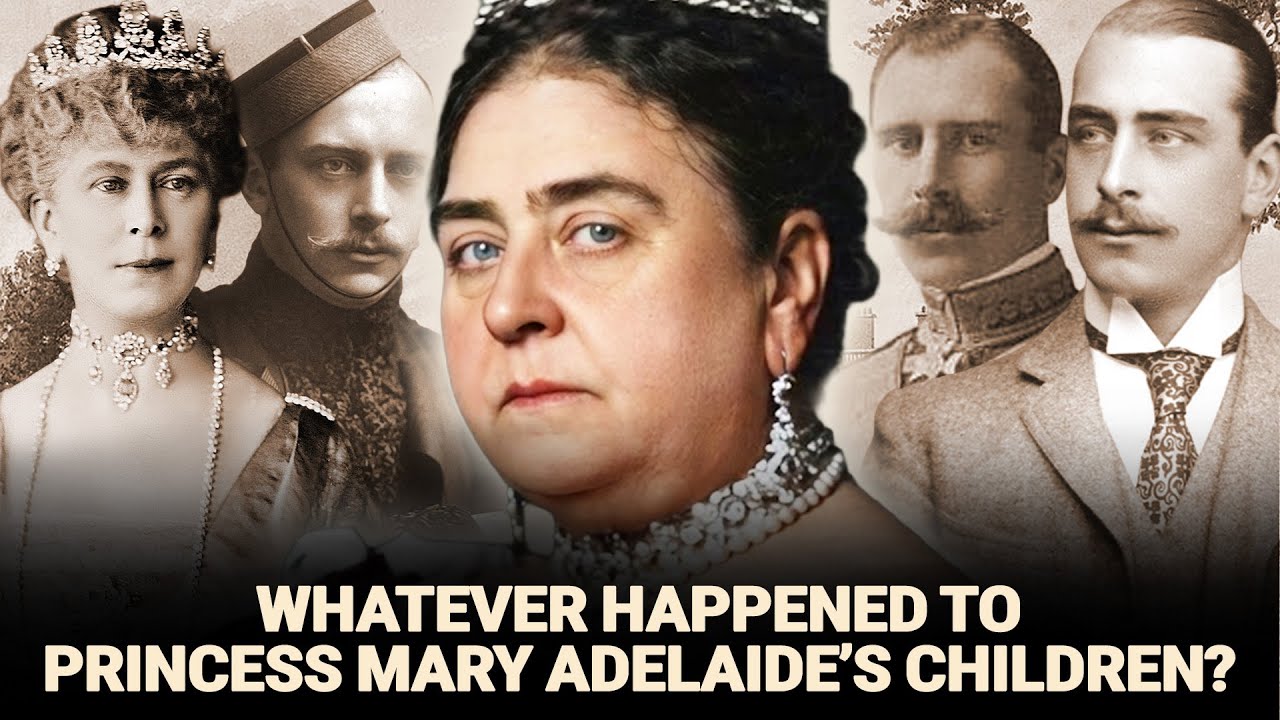
The eldest child, Victoria Mary of Teck, was born on 26 May 1867 at Kensington Palace. Through her mother she was a great-granddaughter of King George III; through her father she carried a German princely title but no British rank. She had no place in the direct line of succession and belonged to that crowded middle ground of the extended royal family: recognized, but easily overlooked. Her childhood was one of constrained privilege.
The family occupied grace-and-favour apartments at Kensington Palace, but the Duchess of Teck spent extravagantly while the Duke, though titled, had no fortune of his own. By the time Victoria Mary was a teenager, the household was in chronic debt. In 1883, when she was sixteen, the family fled to Florence to escape creditors, living for two years in reduced circumstances. Those years taught her to manage with less, to maintain dignity under financial strain, and to observe protocol without the resources to sustain it.
She received the conventional education of a royal woman, tutored at home in languages, history, and music, becoming fluent in German and French. She absorbed the values of Victorian royal duty: discipline, order, and service without seeking personal attention. By the late 1880s she was considered a suitable bride for a royal heir. In December 1891 she became engaged to Prince Albert Victor, Duke of Clarence, eldest son of the Prince of Wales and second in line to the throne.
Six weeks later, on 14 January 1892, he died of influenza at Sandringham. He was twenty-eight; she was twenty-four. Her one clear path to the center of royal life had vanished. Within a year, attention turned to Albert Victor’s younger brother, Prince George, Duke of York.
Queen Victoria and George’s parents encouraged the match, and on 6 July 1893 Victoria Mary married George at the Chapel Royal in St James’s Palace. The marriage was dynastic in origin but proved stable and functional. George was reserved, conventional, and devoted to duty, and Victoria Mary matched him perfectly. She managed his household and supported his public work, moving from the periphery of royal life to its center.
In 1901 Queen Victoria died, and George’s father became King Edward VII. In 1910 Edward died, and George ascended as King George V. On 22 June 1911 Victoria Mary was crowned Queen Mary in Westminster Abbey. As consort, she performed ceremonial duties, supported the war effort during World War I, and represented tradition and institutional loyalty through decades of upheaval.
She did not seek popularity; she commanded respect through consistency and discipline. She gave birth to six children between 1894 and 1905. The eldest, Edward, was born in 1894 and became King Edward VIII in 1936, only to abdicate in December of that year to marry Wallis Simpson. He was created Duke of Windsor and died in 1972.
The second son, Albert, was born in 1895 and became King George VI after his brother’s abdication, reigning through World War II until his death in 1952; his daughter became Queen Elizabeth II. The third child, Mary, was born in 1897, married Viscount Lascelles in 1922, and became Countess of Harewood. She had two sons and died in 1965. The fourth son, Henry, was born in 1900, became Duke of Gloucester in 1928, married Lady Alice Montagu Douglas Scott in 1935, and served as Governor General of Australia from 1945 to 1947.
He died in 1974. The fifth son, George, was born in 1902, became Duke of Kent in 1934, married Princess Marina of Greece and Denmark, and was killed in a military air crash in 1942. The youngest, John, was born in 1905, suffered from epilepsy, and lived apart from the family for much of his short life. He died in 1919 at the age of thirteen.
King George V died on 20 January 1936, and Queen Mary, now sixty-eight, remained active throughout the abdication crisis, supporting her second son’s accession. She stayed in Britain during World War II, visiting bombed areas of London. She lived to see her granddaughter Elizabeth become queen in 1952 and attended the early planning of the coronation, but did not live to witness it. Queen Mary died on 24 March 1953 at Marlborough House in London, aged eighty-five, having served twenty-five years as consort and seventeen more as queen dowager.
Her legacy was institutional continuity: she embodied the Victorian model of queenship extended into the mid-twentieth century, and she remains the template for the modern British queen consort. Her eldest brother, Prince Adolphus of Teck, was born on 13 August 1868 at Kensington Palace. As the eldest son, he inherited his father’s title and was expected to carry the Teck line forward. The family’s lack of wealth meant he would need a career, and the British army was the conventional choice.
Educated privately and at Eton, he entered the Royal Military College at Sandhurst at seventeen and was commissioned as a second lieutenant in the 17th Lancers in 1887. His service was steady but unremarkable, largely ceremonial and administrative rather than combat-focused. He advanced through the ranks without distinction. On 12 December 1894 he married Lady Margaret Grosvenor, daughter of the Duke of Westminster, one of the wealthiest men in Britain.
The match linked the financially insecure Teck family to one of the great aristocratic fortunes of the era and brought Adolphus the security his parents had never known. The couple had four children: George, born in 1895, who inherited the title and became second Marquess of Cambridge; Mary, born in 1897, who married into the peerage and became Lady Mary Abel Smith; Helena, born in 1899, who never married; and Frederick, born in 1907, who pursued a military career and was killed in 1940 during World War II. The family lived chiefly at Shotover House in Oxfordshire, where Adolphus balanced royal obligations with the life of a country gentleman. World War I created a crisis for the Teck family.
Britain was at war with Germany, and the Tecks held German titles. Anti-German sentiment swept the country, and King George V came under pressure to distance the monarchy from its German heritage. In 1917 he changed the royal family’s name to Windsor and revoked the British titles of several German relatives. For Adolphus, the contradiction was untenable.
On 14 July 1917 he renounced his German titles, giving up the title of Duke of Teck and the designation of Serene Highness. Three days later the king created him Marquess of Cambridge, Earl of Eltham, and Viscount Northallerton. The Teck line was erased from British records; the Cambridge line began. Adolphus continued his duties after the war, promoted to major general in 1920, and remained active in royal affairs until his health declined.
He died on 24 October 1927 at Shotover House, aged fifty-nine, and was buried at the royal burial ground at Frogmore. His descendants still hold the Marquessate of Cambridge. His legacy was survival through reinvention. Prince Francis of Teck, born on 9 January 1870, was the third child and second son.
As a younger son, he held no claim to his father’s title and no defined role. He followed the standard path, attending Eton and receiving a commission in the King’s Royal Rifle Corps in 1888. But his career stalled; he never rose beyond captain and held no significant position. By his thirties he suffered from recurrent health problems severe enough to limit his activities and require extended rest.
He never married and had no children. He became increasingly peripheral to royal life, dependent on his family throughout his adult years. In 1910 his health deteriorated sharply. Surgery failed, and he died on 22 October 1910 at his mother’s residence, White Lodge in Richmond Park, aged forty.
He left no estate, no heirs, and no legacy. His death passed with little public notice. He remains a footnote, remembered only as the brother who did not survive to reinvent himself as his siblings did. The youngest, Prince Alexander of Teck, was born on 14 April 1874.
His early years coincided with the family’s worst financial difficulties: when he was nine, the household fled to Florence to escape creditors, and the two years abroad taught him that privilege was precarious. He attended Eton and Sandhurst and was commissioned in the 7th Queen’s Own Hussars in 1894. Unlike his brothers, he pursued active service, and he was one of the few members of the extended royal family to see combat during the Second Boer War in South Africa. On 10 February 1904 he married Princess Alice of Albany, daughter of Queen Victoria’s youngest son.
The marriage connected him to the direct royal line and brought together two people deeply committed to public service. They had three children, but tragedy marked the family: Princess May, born in 1906, survived to marry and raise a family; Rupert, born in 1907, suffered from severe developmental disabilities and was institutionalized for much of his life, dying in 1928; and Maurice, born in 1910, died in infancy that same year. During World War I Alexander served actively, was promoted to brigadier general in 1917, and was mentioned in dispatches for distinguished service in France. That same year, as part of the king’s campaign to remove German associations from the royal family, he renounced his German titles and was created Earl of Athlone and Viscount Trematon.
In 1923 he was appointed Governor General of the Union of South Africa, serving until 1931 through a period of growing tension between African nationalism and British imperial authority. He managed the role professionally and avoided major political controversy. In 1940, during World War II, he was appointed Governor General of Canada, serving until 1946, longer than any predecessor. His tenure spanned the war years, and he played an important role in maintaining Canadian morale, visiting military bases, hospitals, and industrial centers, and hosting allied leaders including Winston Churchill and Franklin Roosevelt.
He symbolized the unity of the empire during its most critical years. After leaving Canada in 1946, Alexander and Alice retired to London, remaining active in royal functions but withdrawing from major public roles. He died on 16 January 1957 at Kensington Palace, aged eighty-two, and was buried at Frogmore. Alice survived him by twenty years.
Alexander’s life was the most successful adaptation of any of Mary Adelaide’s sons. He served with distinction in two wars, governed two dominions, and maintained the monarchy’s presence across the British Empire in its final decades. He transformed from a minor German prince into a senior representative of the British crown, and his legacy rests on service rather than descendants. Four children, four complete lives.
One shaped the modern British monarchy. One founded a new aristocratic line. One died without legacy.
One carried the crown across two continents.
