On May 13th, 1944, a young officer talked his way onto a fast attack boat leaving the French coast. He was not supposed to be on board. That day was Klaus Dönitz’s 24th birthday, and the boat never came back. His father was Karl Dönitz, the admiral who ran Germany’s entire U-boat war.
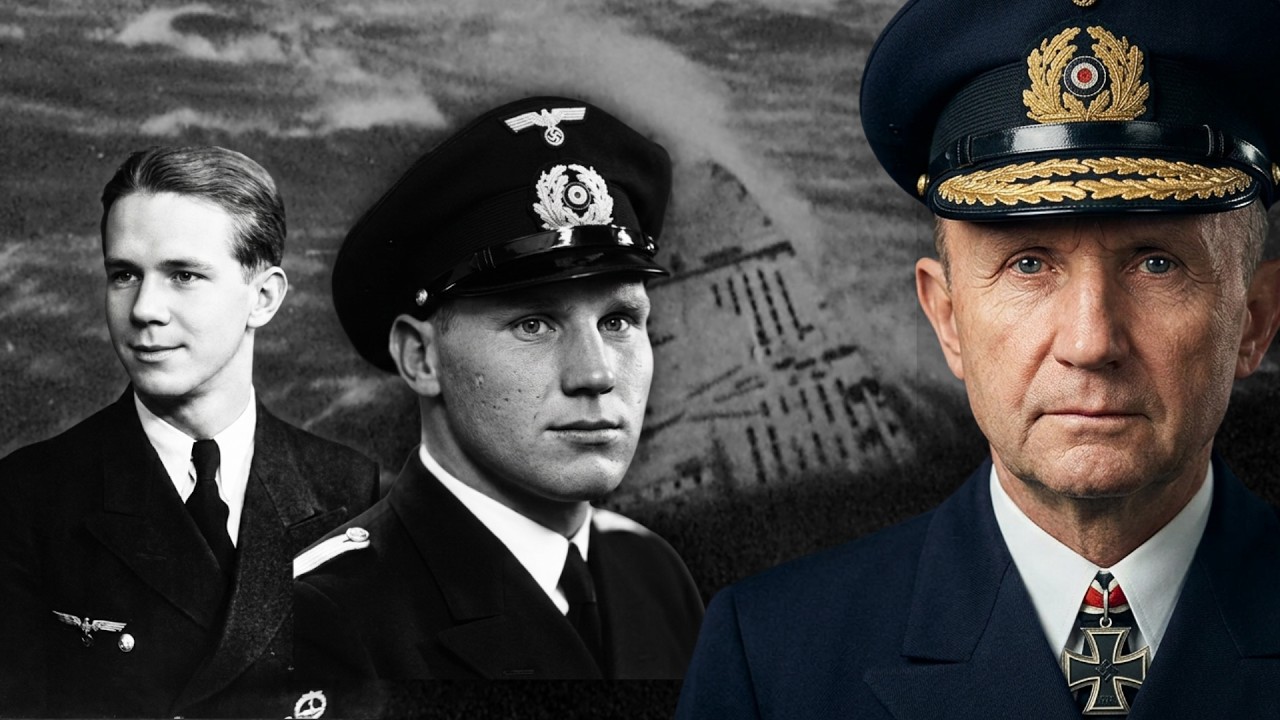
Within a single year, that war had taken both of his sons. Karl Dönitz had built his life around the sea and the men who fought on it. In 1916, he married Ingeborg Weber, the daughter of a German general, and between the wars they raised three children. There was a daughter, Ursula, born in 1917, and two sons, Klaus in 1920 and Peter a couple of years later.
Both boys followed their father into the Navy. By the time the Second World War reached its peak, the man commanding Germany’s U-boats had two sons serving in the same fleet he directed. Peter, the younger son, served as a watch officer aboard U-954. On May 19th, 1943, while operating in the North Atlantic, U-954 was sunk and everyone on board was killed.
Peter was 21 years old. His death came during what became known as Black May, a turning point in the Battle of the Atlantic. German U-boat losses had become so heavy that just days later, Dönitz called off the offensive in the North Atlantic. After Peter’s death, Klaus was taken out of frontline service.
Under Navy rules, a senior officer who had already lost one son could have his remaining sons removed from combat. Klaus was allowed to begin training as a naval doctor. He had come through the most dangerous branch of the German war effort alive, and his family had reason to believe he would see the end of it. He did not stay away.
On May 13th, 1944, his 24th birthday, Klaus persuaded friends still serving in the fast attack boats to let him ride along on a raid across the Channel. His boat, S141, pushed out toward the English coast near Selsey. There it met the Free French destroyer La Combattante, which sank it. Six men were pulled from the water.
Klaus was not among them. He was buried in France, and Karl Dönitz had now lost both of his sons to the war that he was directing. By some accounts, he showed almost no emotion when the news came. He sat through his morning staff meeting and carried on with the day, only a little less exact than usual.
Then he went home and told Ingeborg for the second time in the space of a year that they had lost a son. Dönitz kept his command. Within a year, the war would take far more than his two sons. The state he served would disappear, and the rest of his family would have to live with what followed.
Ingeborg Dönitz had spent nearly 30 years as a Navy wife and had trained as a nurse before that. In the spring of 1945, as Germany collapsed, her husband was named Hitler’s successor. On April 30th, 1945, Hitler took his own life. For about three weeks, Dönitz led what was left of the German government from the northern town of Flensburg.
He oversaw the surrender and pushed the Navy to carry as many soldiers and civilians as it could across the Baltic, away from the advancing Red Army. The effort, code named Operation Hannibal, moved well over a million people in the war’s final months, one of the largest maritime evacuations in history. On May 23rd, 1945, Allied troops arrested Dönitz and his entire administration. The 20-day government was finished, and the man who had led it was now a prisoner.
Then came Nuremberg. The submarine war charge against Dönitz was complicated by the fact that the Allies had used similar methods themselves. The American Admiral Chester Nimitz submitted a statement describing American submarine warfare in the Pacific, and the tribunal did not base Dönitz’s sentence on that aspect of the case. He was nevertheless convicted on two counts and sent to Spandau Prison in Berlin for ten years.
After the surrender, Ingeborg was left with one surviving child, two dead sons, and a husband facing trial. While Dönitz went from captivity to Nuremberg and then to Spandau, she had to rebuild an ordinary life. She went back to the profession she had trained for as a young woman and worked as a nurse, and for most of the Spandau years she held a steady job as a receptionist at a doctor’s practice in Reinbek, outside Hamburg. She supported the household through the decade her husband was in prison.
When Dönitz was released in 1956, the couple settled in Aumühle, a small town near Hamburg. They had six years together. Ingeborg Dönitz died on May 2nd, 1962. She had watched her husband command an entire navy, lead a nation for three weeks, and come home from prison an old man.
She did not live to see what became of her daughter’s husband, a U-boat commander who was about to do something almost no one on either side of the war expected. One of the most unusual post-war stories in the Dönitz family belonged not to Karl, but to his son-in-law. In November 1937, Ursula Dönitz married Günther Hessler, a career naval officer. Hessler became one of the most successful U-boat commanders of the war.
In command of U-107, he sailed from the French port of Lorient in the spring of 1941 on a single patrol that sank more than a dozen Allied ships. By tonnage, it was the highest scoring war patrol any German submarine ever made. Across his career, Hessler sank more than 20 ships, over 100,000 tons of Allied shipping. Before long, he was given a place on the staff of U-boat Command, working directly under his father-in-law.
That connection was awkward on both sides. Being the son-in-law of the U-boat chief meant every honor Hessler earned was watched for any hint of favoritism. When his Knight’s Cross came due, Dönitz was reluctant to sign it off himself, and in the end it was the Navy’s Commander-in-Chief, Grand Admiral Erich Raeder, who put his name to the award. But the family tie was real, and it placed Hessler close to the heart of the campaign itself.
When the war ended, Hessler spent more than a year in Allied captivity. At Nuremberg, he testified on behalf of the U-boat service and of his father-in-law. And then, in 1947, the British made a remarkable decision. They hired him.
The Royal Navy wanted a full account of the U-boat war written by the men who had actually fought it. They commissioned Günther Hessler, an enemy ace and Dönitz’s own son-in-law, to write it. Working alongside Alfred Höschat, another former U-boat commander, Hessler produced a three-volume study called The U-boat War in the Atlantic, finished in 1951. It became a standard reference on the whole campaign, written for the Navy that had beaten him, about the war his father-in-law had commanded against it.
For Ursula, the U-boat war was deeply personal. Her father had commanded it, and her husband had fought in it. She was also one of only three Dönitz children who would live a full life. Hessler himself lived another seventeen years.
He died on April 4th, 1968, at the age of 58. By the time his three volumes were finished, his father-in-law was still behind the walls of Spandau. When Karl Dönitz finally walked out, he would spend his own last years doing a version of what his son-in-law had already done, going back over the war he had run and defending his part in it. Karl Dönitz left Spandau Prison on October 1st, 1956, 65 years old and finished with the Navy for good.
He returned to Aumühle, to Ingeborg, and to a country that had rebuilt itself without him. Neither of his sons was there to see it. He spent his remaining years writing. His memoir, 10 Years and 20 Days, took its title from his decade in Spandau and his twenty days as head of state.
In it, he defended the U-boat service and his own conduct of the war, and he stayed loyal to the Navy he had led for the rest of his life. A second book followed. He never expressed regret for the cause he had served, and that refusal shaped how history judged him. The memoir became a standard source on the U-boat war, precisely because it came from the man in charge of it.
By now Ingeborg was gone. Günther Hessler, his son-in-law, died in 1968, and his daughter Ursula, the last of the three children, outlived them all and died in 1990. It was the grandchildren who carried the family on. Ursula and Günther Hessler had three children, a daughter, Uta, and two sons.
Among former submariners, Dönitz remained the commander they had followed, the man they called der Löwe, the lion. To much of the wider public, he stayed the figure who had led the country through its last and worst days. Both views followed him to the end. Karl Dönitz died in Aumühle on December 24th, 1980, at the age of 89.
He was the last surviving member of the leadership that had run Germany in the war, and the last man to have held its highest office. When he was buried at the forest cemetery in Aumühle, thousands of former U-boat sailors came to see off their old commander. Many wore the medals they were no longer meant to display, and the post-war German military gave the funeral no official honors of its own. The admiral who had commanded the U-boat war, lost both his sons to it, led Germany for twenty days, and served ten years in prison, was gone.
But the war remained part of the family’s story long after 1945. His son-in-law helped write its history for the Royal Navy, Dönitz defended his own record in his memoirs, and two of his grandsons were given the names Peter and Klaus.
