The radar screen aboard USS Iowa glowed with four faint returns at the far edge of the scope, blips too distant for any lookout to see. The operator’s voice echoed through the ship’s communication circuits: four contacts, closing slowly. On the plotting tables below, teams marked courses with grease pencils across transparent boards, tracing firing arcs and predicted movement, feeding everything into the heart of the battleship’s mechanical brain. Somewhere over the horizon, a Japanese light cruiser and her escorts were running for their lives, and they did not yet know that the Americans could see them perfectly.
For most of World War II, there was one place in the Central Pacific that cast a long, dark shadow over Allied strategy: Truk Lagoon. The Japanese Empire treated it like a crown jewel. Deep inside its reef ring, battleships, cruisers, aircraft carriers, submarines, and hundreds of support ships sheltered beneath thick natural defenses. It was so vast that entire convoys could repair, refuel, and regroup in secret.
Pilots trained there. Torpedoes were loaded there. Commanders planned operations that would bleed American marines across island chains where grave markers still stand. For two years, no one dared strike it directly.
Strategists called it the Gibraltar of the Pacific, a nickname earned not by concrete walls but by geography. The lagoon was enormous, calm, and deep, providing perfect protection from rough seas. Radar stations, airfields, and anti-aircraft batteries ringed the horizon like a steel crown. The Japanese believed assaulting it head-on would be suicidal.
Any attacking fleet would face hundreds of aircraft, deadly torpedo runs, and shore batteries linked to experienced gunners. Even submarines received repairs inside the lagoon, making it a beating heart for their wolf packs. American intelligence, however, was improving faster than Japan imagined. Code breakers pored over intercepted messages.
Reconnaissance flights captured grainy images showing ship movements, fuel reserves, and new construction. Analysts realized a frightening trend: if Truk remained intact, Japan could replace losses faster than American island advances could matter. It was no longer just a base. It was a nest of venom, ready to strike any convoy daring to approach the Philippines or the Marianas.
Yet something else was changing too. American carrier doctrine had matured. Pilots returning from brutal fighting learned to dismantle enemy defenses methodically. Radar-guided intercepts made Japanese air counterattacks less effective.
Logistics, the quiet killer, now favored the United States overwhelmingly. By early 1944, the Pacific balance shifted like a tide turning against a sand castle. When commanders received intelligence that large warships inside Truk would soon reposition, the opportunity was too valuable to ignore. The decision forming in American headquarters would soon unleash a storm so ferocious that the lagoon’s defenders never recovered.
The fortress was about to burn. To understand why the surface chase near Truk rattled Japanese admirals to their core, you have to understand how they believed naval battles should be fought. Since the early 1900s, their leaders studied a concept called Kantai Kessen: the idea of one glorious, decisive fleet clash that would decide a war’s outcome. They imagined battleships closing within comfortable visual distance, exchanging heavy artillery at medium range, while destroyers darted in and launched torpedoes.
It was a doctrine rooted in courage, discipline, and optical rangefinders that required human eyes to track enemy silhouettes through haze, smoke, and darkness. For decades, Japan trained obsessively for this moment. Gunnery crews practiced night engagements, believing they possessed unmatched discipline. Naval academies drilled students to prize fighting spirit above mechanical calculation.
As long as two opposing fleets closed the distance, Japan expected to punish any opponent unlucky enough to enter torpedo range. It wasn’t arrogance. They had historical precedent. Their victory against Russia at the Battle of Tsushima convinced generations that superior morale and nerve could determine naval combat.
The problem was that technology didn’t stand still. Across the ocean, American engineers and mathematicians began solving entirely different problems. Instead of betting on visibility, they built tools that could see without light: radar systems feeding analog computers capable of predicting where a moving target would be by the time a massive shell returned to Earth. Japanese planners barely invested in long-range engagement tactics.
To them, firing beyond the horizon sounded wasteful. Shells needed visual fall-of-shot corrections. Without eyes on the impact, how could you adjust? Their doctrine quietly assumed such ranges were impossible.
So Japanese shipbuilders focused on huge guns, thick armor, and torpedo superiority, perfect for medium-distance brawls. But that left a fatal blind spot. If the enemy struck from beyond eyesight, no amount of bravery could return fire accurately. When American radar-guided salvos began landing on fleeing warships in early 1944, Japanese crews were stunned.
Their rangefinders could barely see smoke on the horizon. Their torpedoes rushed toward empty ocean. No human lookout could correct for ballistic arcs that climbed miles into the sky. Doctrine met mathematics, and mathematics won.
For the first time, Japanese officers glimpsed a terrifying truth: the battlefield had widened beyond human senses, and they weren’t prepared to fight in that future. While Japanese officers still placed their faith in optics and instinct, American battleships quietly carried something the world had never truly seen in combat: a mechanical mind. Mounted high on the Iowa-class ships sat the Mark 8 fire control radar, a boxy rotating antenna that could detect enemy vessels long before human eyes could pierce sea haze. Every sweep sent pulses bouncing across the ocean surface, returning precise measurements of bearing, distance, and speed.
It didn’t blink, it didn’t sweat, and it didn’t need sunlight. But radar alone wasn’t the revolution. The true marvel lurked deeper inside the ship: the rangekeeper. This analog computer, a maze of gears, cams, spinning discs, and gyroscopic inputs, performed ballistic mathematics continuously.
It considered dozens of variables at the same time, not just where an enemy ship was, but where it would be when a broadside finally came crashing down a minute later. It compensated for the firing ship’s turn, wind, drift, humidity, and even barrel fatigue. Engineers joked that it calculated everything except prayer. Operators fed radar data into the rangekeeper, and the machine spat out firing solutions with cold precision.
Elevation gears rotated the giant 16-inch rifles. Turrets aligned like mechanical predators. When the order came, the ship didn’t guess; it executed. Japanese gunnery officers still stood behind optical sights, adjusting range based on splashes.
If smoke obscured the horizon, their accuracy fell apart. If rain blurred lenses, numbers became meaningless. At extreme range, enemy silhouettes sank below the curvature of the Earth itself. Without radar, fall-of-shot corrections became educated hope.
They were fighting physics with binoculars. The Iowa-class design was built around this system. Fire control directors at the top of the superstructure fed constant updates into the computer. Below decks, sailors listened for subtle variations in the machine’s hum, trusting it completely.
When shells left the barrel, no one watched them arc beyond blue sky. They simply waited for radar return echoes to confirm impact patterns. It was frighteningly impersonal warfare by calculation. Japanese crews who once trained to read splashes through telescopes suddenly faced salvos arriving from ships they couldn’t even see.
Their doctrine had no answer. If you cannot observe a shot, you cannot correct aim. If you cannot correct aim, you are simply wasting ammunition. In that moment, American battleships crossed a threshold: they became weapons no longer limited by human eyesight.
On February 17, 1944, fleeing Japanese ships would learn that lesson one shattering salvo at a time. While Truk Lagoon erupted behind them, one small formation of Japanese warships slipped quietly toward the open Pacific. Their commanders sensed doom long before the first American dive bomber howled overhead. Anchored ships were death traps.
Fuel tanks, ammunition magazines, and tight berthing compartments meant that one accurate bomb could gut a cruiser in seconds. So, under dim pre-dawn skies, the light cruiser Katori, accompanied by destroyers and an auxiliary transport vessel, made a desperate run north. Their hope was simple: outrun American attention. On paper, this escape looked possible.
The destroyers were fast, able to push into the mid-30-knot range. Katori, though damaged from earlier air strikes, still had enough life to limp north at more than 20 knots. Darkness and distance offered their only shield. Japanese officers prayed that the American carriers would fixate on the burning ships inside the lagoon rather than a handful of silhouettes darting toward safety.
But American reconnaissance pilots were relentless. Patrol planes from the light carrier Cowpens spotted the fleeing column from above. From their altitude, smoke trails and wake patterns stood out clearly against the deep blue ocean. Radio operators transmitted bearing, speed, and heading straight back to Admiral Spruance.
He now had two choices: let aircraft chase them until fuel became an issue, or commit surface vessels that had yet to fire a shot that day. Spruance chose the second. He quickly assembled a pursuit group built around two of the most powerful battleships afloat, USS Iowa and USS New Jersey. With them came the heavy cruisers Minneapolis and New Orleans, plus screened destroyers ready to counter torpedo threats.
Unlike the Japanese ships, this American group could sustain more than 30 knots without straining machinery. At flank speed, bow waves boomed forward like white wings. The chase was on. By early afternoon, the American task group had shortened the distance dramatically.
The horizon shimmered with heat, but on radar screens, the enemy was crisp and unforgiving. This was no longer a slow escape; it was a drag race against the inevitable. Men aboard Katori watched their wake foam violently behind them. They knew Japanese doctrine offered no comfort at such extreme range.
In their bridge charts, this distance belonged to theory, not battle. They were out of time, out of fortune, and soon out of cover. Behind them, Truk Lagoon still burned. Ahead of them, American guns waited patiently, and the ocean offered no hiding place.
Aboard USS Iowa, turret crews braced behind armored bulkheads as officers relayed the firing order down steel ladders and through speaking tubes. Deep within the ship, powder bags were lifted like sacred cargo: six silk charges for each massive 16-inch rifle, handled with a level of respect bordering on ritual. If a single spark kissed the powder, the entire turret could vanish in an instant. Every crew member knew it.
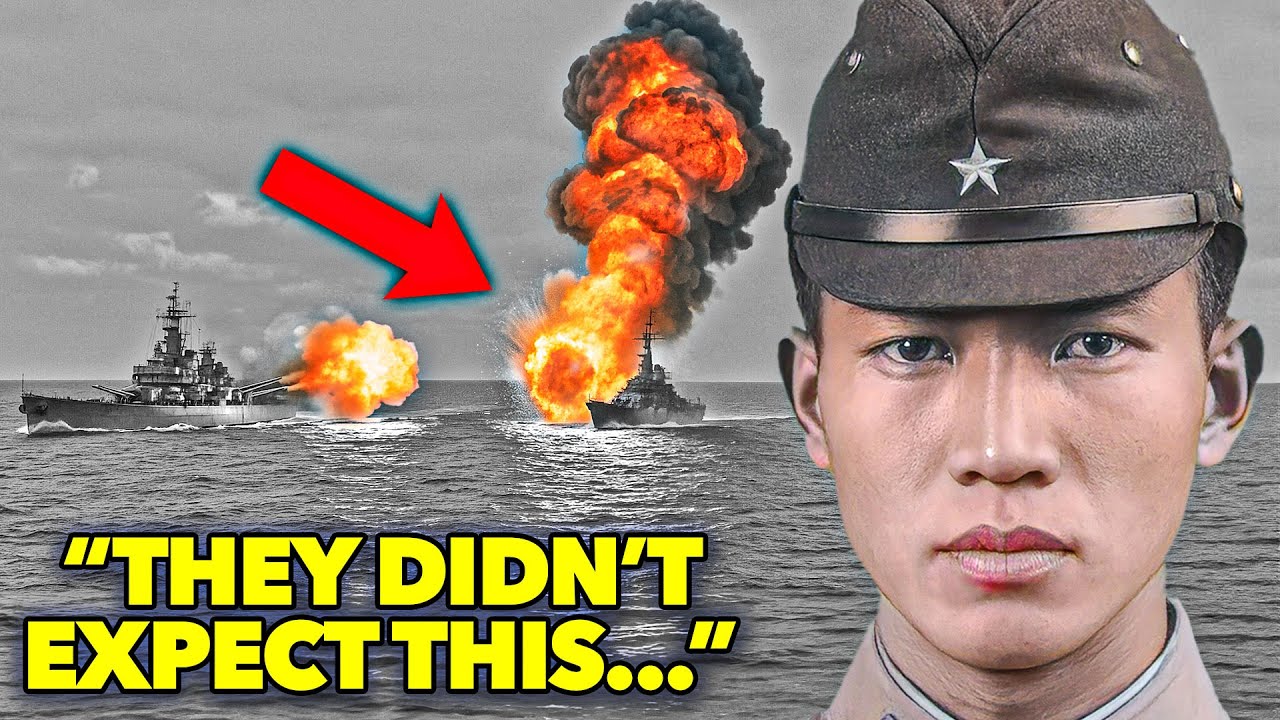
Up in the fire control director, operators stared not through glass lenses, but into the steady sweep of the Mark 8 radar display. They watched the fleeing Katori creep across a coordinate grid like a ghost being pulled into a trap. Distance: 32,000 yards. That was beyond direct human vision.
To the naked eye, the enemy didn’t exist. But the mechanical brain below decks knew better. When the order came to commence firing, Iowa unleashed its opening salvo. Three guns roared from the center turret, each projectile heavier than a small automobile engine.
The ship lurched sideways under the shockwave, and deck crew instinctively ducked from the brutal overpressure. Blast shields hummed and paint blistered from heat. A rolling column of smoke and flame curled across the deck and drifted into the sky like a thundercloud. For nearly a full minute, the ocean was silent again.
Then, on the distant horizon, a geyser of seawater erupted beside Katori. A near miss. Radar measured the splash down instantly, feeding corrections to the rangekeeper. The machine clicked and muttered like an irritated animal.
A second salvo thundered. This time, the shells walked closer, bracketing the cruiser with towering sprays that rattled her hull. Japanese gunners swung their barrels desperately, but optical sights refused to lock onto anything but haze. Their rangefinders couldn’t solve angles hidden by the curve of the Earth.
Aboard Katori, officers shouted orders over the roar of ruptured steam lines. Smoke stung eyes. Crewmen sprinted across decks slick with fuel. They fired back, more out of defiance than hope.
Their 5-inch shells arced harmlessly toward a shape they couldn’t confirm. Then came the third salvo. One shell slammed into Katori’s midship superstructure, detonating with concussive violence. Shrapnel scythed through steel bulkheads, shredding compartments like tissue.
Fires immediately roared to life, fed by ruptured fuel lines. Communications vanished. The bridge flickered with emergency lights. In that moment, Japanese sailors realized something horrific: the enemy didn’t need to see them.
Invisible eyes guided invisible math, and the ocean around them suddenly felt much smaller. Under the sudden storm of explosions, Katori’s condition deteriorated by the second. The cruiser’s captain, a veteran of decades at sea, stood firm on his collapsing bridge, issuing calm orders through choking fumes. Damage control teams scrambled below decks, dragging hoses, sealing hatches, and trying to starve rampant fires.
Steam hissed through ruptured pipes. Bulkheads groaned as heat warped steel. Every minute mattered. Seeing their flagship in distress, the destroyer Maikaze closed into the line of fire like a loyal guard dog.
Her captain understood he could not win, but he might slow death’s arrival. He throttled engines to full speed, laying thick smoke across the ocean surface, a desperate curtain meant to break the American firing solution. On his bridge, officers tightened jaw lines and prepared torpedoes. Maybe, just maybe, one hit could punish the hunters.
American radar saw straight through the smoke. As Maikaze darted across Iowa’s bow, the heavy cruisers New Orleans and Minneapolis opened up. Their 8-inch shells, smaller but faster, stitched a line of fire across the destroyer’s superstructure. Crewmen flinched as shards of steel ripped into compartments no larger than broom closets.
Through smoke, Japanese lookouts saw flashes of orange far beyond the horizon, each flash marking another American salvo incoming. Still, Maikaze refused to break off. With her torpedo tubes aligned, she launched a fan of deadly long-range weapons into the Pacific swell. These were no toys; Long Lance torpedoes could gut a battleship.
For a moment, every heartbeat aboard the American ships paused. But even here, technology tipped the balance. Aircraft overhead circled like hawks, spotting the torpedo wakes, relaying corrections through radio. New Jersey angled slightly to starboard, her bow nudging clear of the shimmering trails.
The weapons passed harmlessly into foam. Then the tide turned cruel. A perfectly timed broadside tore through Maikaze’s hull, punching a furnace-hot crater through decks stacked with ammunition. Her magazines ignited with a sound like the earth splitting open.
The destroyer buckled, cracked, and snapped in half. Sailors who leapt overboard found themselves surrounded by floating flames. Back aboard Katori, survival evaporated. Shell hits punched open her engine spaces.
Power died. Pumps stalled. Without propulsion, fire suppression collapsed. The cruiser rolled, listing hard to port as compartments flooded too quickly to control.
American guns showed no mercy. This was war without witness. When the order to abandon ship finally echoed through dying corridors, many Japanese sailors refused. Their cultural indoctrination taught them that death was honorable and surrender was shame.
Some clutched rifles even in the water. When American destroyers approached to rescue survivors, they were met with blades and fists. Horrified sailors withdrew. The sea claimed every last man.
In moments like this, technology wasn’t just advantage; it was gravity, an unstoppable pull that training, bravery, and sacrifice could not escape. With Katori burning behind them and Maikaze gone in a violent flash, only one major Japanese warship still had a chance to escape: the destroyer Nowaki. Smaller, lighter, and far faster than any battleship, she poured everything into her engines. Her stern churned white foam as she clawed past 35 knots, sprinting north toward rain squalls looming on the horizon.
Inside her engine rooms, sailors shoveled fuel with frantic urgency. A single misstep meant steam burns or worse. But Iowa and New Jersey refused to let her go quietly. Their massive rifles elevated to their highest angles, hurling shells into the sky on trajectories that looked impossible to the human eye.
Minutes later, towers of ocean erupted around the fleeing destroyer. Even without direct hits, fragments blasted across her superstructure, wounding men and ripping away antennae. Gunners aboard Nowaki fired back blindly, more out of duty than hope. American radar plotted each splash, adjusting aim with mechanical precision.
Then came the moment historians still talk about. A salvo landed so close it straddled Nowaki at more than 35,000 yards, over twenty miles away. No battleship had ever scored a straddle at such range in combat. The ocean itself seemed to shudder.
It was as though the horizon reached out and swatted at a fleeing insect. Then clouds and rainfall swallowed the destroyer whole. Radar returns faded into noise. Speed saved her where armor could not.
She vanished into the storm, limping, battered, and terrified. On the American decks, nobody cheered. They simply logged the range, confirmed the radar echoes, and prepared to turn south. The message was already written in smoke: distance no longer protected the Imperial Navy.
The line between hunter and hunted had been erased, and even ships beyond human sight were no longer beyond American reach. As the last echoes of gunfire faded across the Pacific, the deeper meaning of the engagement began to settle like ash. For decades, Japanese naval strategy revolved around a single glorious vision: a decisive clash at manageable distance where skilled gunners, disciplined crews, and devastating torpedoes would shatter an enemy battle line. It was a belief rooted in heritage, tradition, and the assumption that both opponents would fight within the limits of human sight.
But the shots fired that day proved something terrifying. Warfare had quietly evolved beyond the reach of binoculars and instinct. Radar-driven accuracy chained mathematics to gunpowder, allowing American battleships to land blows long before Japanese optics could even acquire a silhouette. Officers trained to read shell splashes suddenly found their tools useless.
Their carefully rehearsed tactics dissolved in the face of a weapon system that required no visual confirmation at all. Back in Tokyo, fragmented reports drifted into headquarters. At first, disbelief colored every discussion. How could shells land so precisely from distances once considered absurd?
Engineers studied the accounts and realized Japan lacked both the equipment and industrial capacity to replicate such systems quickly. Even if upgrades were possible, fuel shortages, limited factories, and mounting convoy losses strangled every hope. For the first time, senior planners whispered the unthinkable: fighting spirit couldn’t close range. Courage couldn’t bend ballistic arcs, and years of training meant nothing if the enemy killed you before you ever saw him.
Like a door quietly closing, the age of the traditional battleship duel was ending. Radar shattered assumptions so deeply ingrained that Japan had no time to recover. In just ninety minutes, American technology didn’t just sink ships; it sank a doctrine. And when doctrine dies, entire empires follow.
When the smoke cleared and Task Group 50. 9 turned back toward the burning horizon, something subtle and strange lingered on those steel decks. The crews of USS Iowa and USS New Jersey had just demonstrated the furthest, most accurate surface engagement in naval history. They proved their mighty guns still had a place in modern war.
But outside that brief window of roaring thunder and falling steel, the world was already changing faster than they realized. Carrier aircraft had crushed Truk before the battleships even arrived. Fighter wings dismantled air defenses. Torpedoes dropped from clouds sank transports that no shell could reach.
Submarines prowled shipping lanes, choking Japan’s lifelines. Radar didn’t just guide gunnery; it guided entire fleets. The decisive battle Japan dreamed of had quietly moved to the skies. Ironically, this stunning display would be the last time Iowa and New Jersey ever fired at surface ships in World War II.
Afterward, their role shifted to escort duty, shore bombardment, and anti-air screens. Their immense rifles became symbols more than tools, thundering mostly at beaches and fortifications rather than rival navies. Japan’s largest battleships, built to dominate such duels, would never trade broadsides with their American counterparts. Instead, they met their end under swarms of carrier-launched bombs and torpedoes, weapons born from a new age.
Decades later, the Iowa-class ships would find brief second lives, launching missiles in distant conflicts. But each time, their purpose drifted further from the roaring duels they were built to fight. Today, they rest as museum giants, silent, towering reminders of a moment when steel, steam, and analog computation ruled the seas. For ninety minutes near Truk Lagoon, the battleship stood at the top of naval warfare’s throne one last time.
And the record they set that day may never be broken, because no navy will ever build weapons like these again.
