In the winter of 1780, the man who picked the path that would decide the war was not a soldier at all. He was an ex-Quaker ironworker from a tiny Rhode Island village, a man who had never commanded troops in a major engagement until the previous summer and who now walked with a limp that officers were expected to hide, not flaunt. When Nathanael Greene took command of the remnants of the American army in the South, he found a command that existed in name only. His soldiers were starving.
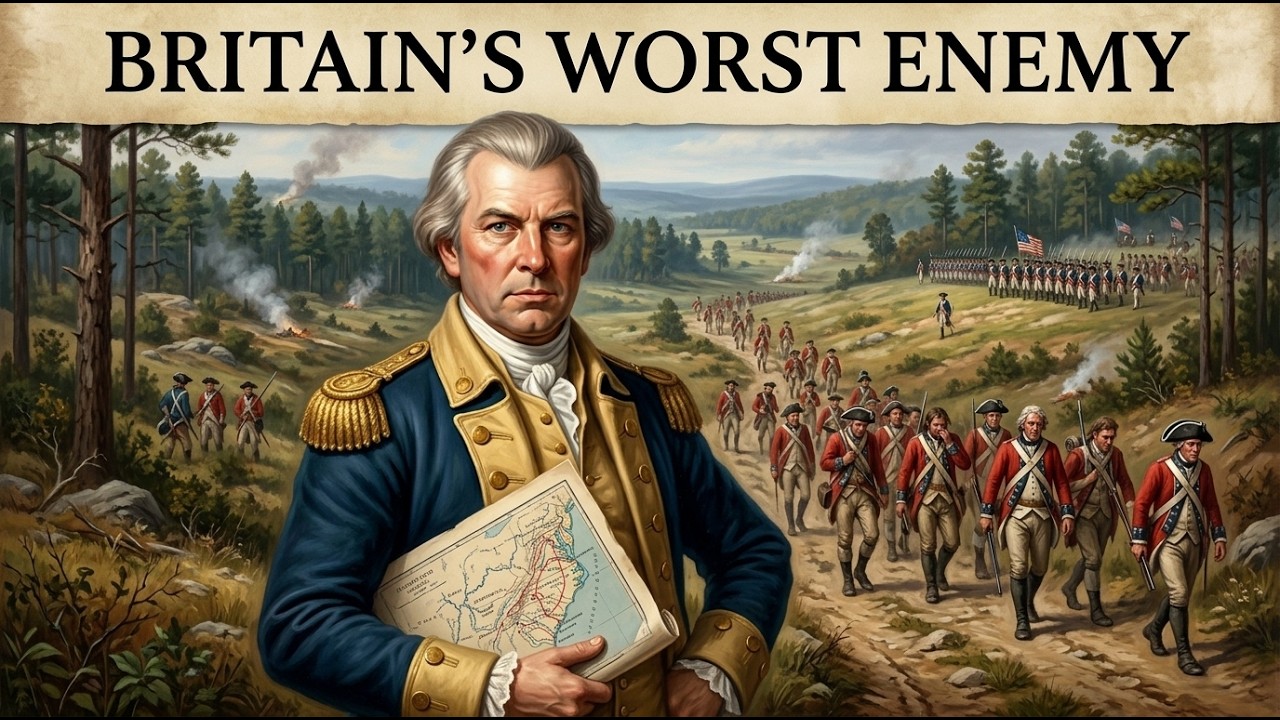
Many had no shoes. Discipline had collapsed to the point where desertion was an everyday occurrence, and the countryside had been so ravaged by the partisan war between patriot and loyalist militias that the roads were dangerous for anyone in uniform, whatever flag they carried. The government back home had almost nothing left to send him. A third of his force had already melted away before he even arrived.
What Greene did next violated every conventional rule of eighteenth-century warfare, and it would ultimately decide the fate of the American Revolution. But to understand how a limping, self-taught Quaker bookworm came to command the entire southern wing of the Continental Army, you have to go back to where he started. Greene was born in 1742 in Potowomut, a small coastal settlement in Rhode Island, where his family ran a forge and anchor foundry. His father was a prosperous Quaker merchant and preacher, and the Quakers were pacifists.
They did not believe in war, they did not believe in violence, and they certainly did not believe in studying it. Young Nathanael could not stop reading about it. He traded for books on military history and strategy, smuggled texts on tactics and fortification into the family home, and studied the campaigns of Julius Caesar and Frederick the Great by candlelight while his father assumed he was reading scripture. He read Henry Knox’s favorite military texts, studied the great European strategists Turenne and Saxe, and taught himself geometry because he knew it was essential for understanding fortifications and artillery placement.
By the time the first shots were fired at Lexington and Concord, Greene had absorbed more military theory than most serving officers in the British Army, and he had never commanded a single soldier or heard a cannon fired in anger. He also carried something else with him his entire life, something that would have ended most military careers before they began. He had a pronounced limp. Historians debate the cause.
Some say it was a stiff knee from birth. Others suggest an old injury from the forge. Whatever the source, he walked with a noticeable hitch that never went away. In an era when officers were expected to cut imposing figures on horseback and march at the front of their columns, Greene did not look the part.
His own church eventually expelled him for attending a military parade. When tensions between the colonies and Britain boiled over in 1775, Greene did not hesitate. He helped organize the Kentish Guards, a local militia unit in Rhode Island, and he enlisted as a private, not a captain, not a colonel. A private.
Within months, the Rhode Island General Assembly promoted him to Brigadier General and gave him command of the Rhode Island Army of Observation, a force of roughly 1,500 men tasked with joining the siege of Boston. When he arrived outside Boston, he immediately caught the attention of the one person whose opinion mattered more than anyone else’s. George Washington noticed Greene almost immediately. The Rhode Island troops were among the best organized and best disciplined units in the ragtag Continental Army camped around Boston.
While other militia commanders struggled to keep their men from wandering off or fighting among themselves, Greene ran a tight operation. His camps were clean, his soldiers drilled regularly, and his supply chains, as basic as they were, actually functioned. Washington saw a man who understood the full picture of what it took to keep an army alive and fighting, not just the glamorous parts of leading charges and drawing swords. Over the months that followed, Washington and Greene developed the most important military partnership of the entire revolution.
Washington trusted Greene more than any other general in his command. He sought Greene’s counsel on strategy, relied on his judgment in moments of crisis, and when the hardest jobs needed doing, he turned to Greene first. That trust was tested immediately. Greene fought at the Battle of Trenton on the freezing night of December 26, 1776, when Washington’s army crossed the ice-choked Delaware River to surprise the Hessian garrison.
Greene commanded one of the two main columns in that assault, leading his men through a blinding snowstorm to attack the town from the north. The victory at Trenton saved the revolution at a moment when the entire cause seemed about to collapse. He fought again at Princeton days later, at Brandywine in 1777, and at Germantown shortly after. The results were mixed.
Greene made mistakes, including a costly one at Fort Washington in New York, where he advised holding a position that was ultimately overrun by the British with heavy American losses. That failure haunted him. But what set Greene apart was how he responded. He did not make excuses.
He studied what went wrong, adjusted, and came back sharper. Then came the job nobody wanted. In the winter of 1778, the Continental Army was camped at Valley Forge, Pennsylvania, and it was falling apart. Soldiers were starving, freezing, and dying of disease.
Men wrapped their feet in rags because they had no boots, and bloody footprints marked the paths between the log huts. The supply system had completely collapsed. Wagons rotted for lack of repair. Horses died for lack of feed.
Flour shipments Congress promised never arrived, and when they did, the barrels were often rotten or short-counted. The officers responsible for logistics had either quit or proven incompetent. Washington needed someone to take over as Quartermaster General, the officer responsible for feeding, clothing, equipping, and moving the entire army. It was the least glamorous job in the military.
There was no glory in counting barrels of flour and negotiating with wagon drivers. Greene did not want the position. He told Washington as much. He wanted to fight, not push paper.
But Washington asked him directly, and Greene accepted because he understood something that most ambitious officers did not. An army that cannot eat cannot fight. An army without shoes cannot march. An army without tents and blankets and gunpowder and wagons is just a mob waiting to dissolve.
He threw himself into the role with the same intensity he brought to everything else. He reorganized the supply chain from the ground up, established a network of depots and magazines throughout the states, haggled with merchants, pressured state governments, and personally tracked down everything from horseshoes to cartridge boxes. It was grueling, thankless work, and Greene did it brilliantly. The army survived Valley Forge in large part because of what he built during those miserable months.
By 1780, the war in the American South had turned into a catastrophe. The British had captured Charleston, South Carolina in May of that year, taking an entire American army prisoner in one of the worst defeats of the Revolution. Congress sent General Horatio Gates, the so-called hero of Saratoga, to fix the situation. Gates marched his army straight into a British force under Lord Charles Cornwallis at the Battle of Camden in August of 1780, and his army was utterly destroyed.
Gates himself fled the battlefield on horseback, riding over 160 miles in three days to escape. His military reputation was finished. The southern states were on the verge of being lost entirely, and with them possibly the entire war. Washington did not hesitate.
He sent Greene. When Greene arrived at the remnants of the southern army in Charlotte, North Carolina in December of 1780, what he found would have broken most commanders. He had roughly 1,400 men fit for duty, most of them poorly armed and barely clothed. Many had not been paid in months.
Discipline had collapsed along with morale, and desertion was an everyday occurrence. The countryside had been ravaged by years of brutal partisan warfare between patriot and loyalist militias, a civil war within the larger war that had turned neighbor against neighbor across the Carolinas. Farms were burned, families displaced, and there was almost no functioning supply infrastructure. Greene wrote to a friend that the appearance of his troops was wretched beyond description.
He told another correspondent that he had never witnessed a more deplorable situation. But Greene did not panic, and he did not rush into battle the way Gates had. Instead, he did something that violated every conventional rule of eighteenth-century warfare. He split his army.
He divided his already tiny force into two parts, sending roughly 600 men under General Daniel Morgan west toward the frontier, while he took the rest east toward Cheraw, South Carolina. Military orthodoxy said never divide a smaller army in the face of a larger one. It was considered suicidal. But Greene understood something about the terrain and the strategic situation that his critics did not.
By splitting his forces, he forced Cornwallis to split his own army to counter both threats. If Cornwallis ignored Morgan, Morgan could sweep through British outposts in the western Carolinas. If Cornwallis ignored Greene, Greene could threaten British supply lines and communications. Cornwallis had to respond to both, and that meant he could concentrate his full strength against neither.
Cornwallis sent his most aggressive and feared cavalry commander, Colonel Banastre Tarleton, after Morgan with roughly 1,100 troops. On January 17, 1781, at a place called the Cowpens in upcountry South Carolina, Morgan turned and fought. He arranged his troops in three lines on an open field, using the psychology of his own men against British expectations. He placed his least reliable militia in the front line and told them to fire just two volleys, then retreat.
Behind them stood the Continental regulars, and behind the regulars, cavalry waited in reserve. When Tarleton’s British infantry charged forward and the American militia broke and ran, the British assumed the battle was already won. They surged ahead in pursuit, and they ran directly into the disciplined fire of the Continental line. Morgan’s cavalry swung around and hit them from the flanks.
In less than an hour, Tarleton’s force was virtually annihilated. Over 800 British soldiers were killed, wounded, or captured. Tarleton himself barely escaped with a handful of cavalry. Morgan had shattered the myth that Tarleton’s cavalry was invincible, a reputation the British had carefully cultivated to terrorize the southern countryside into submission.
Greene’s gamble of splitting his forces had paid off in the most dramatic fashion possible. Cornwallis was furious. And now he made the decision that would ultimately cost him everything. He decided to chase Greene across the Carolinas and destroy the American army once and for all.
To move faster, he ordered his own army to burn its supply wagons, its extra baggage, and even its reserve supplies of rum. He was going light and fast, betting everything on catching Greene before the Americans could escape across the Dan River into Virginia. Greene had anticipated exactly this move. He had already sent scouts ahead to gather boats along the Dan River, and he appointed a rear guard under Colonel Otho Holland Williams to slow the British pursuit while the main army raced ahead.
Williams and his light troops played a dangerous game of cat and mouse with Cornwallis’s vanguard, staying just close enough to draw the British after them and just far enough ahead to avoid being overwhelmed. Greene marched his exhausted army north through freezing winter rain, staying just ahead of Cornwallis’s pursuing columns, racing nearly 200 miles across North Carolina in a desperate bid to reach the river crossings before the British caught him. His men marched through mud and ice, forded swollen creeks, and collapsed from exhaustion at every halt. They made it.
Greene’s army crossed the Dan River into Virginia on February 14, 1781, with Cornwallis arriving at the empty riverbank just hours too late. The British general had burned his supplies, exhausted his army, and chased Greene across an entire state, and he had nothing to show for it. Most generals would have stayed in Virginia to rest and rebuild. Greene went back.
He recrossed the Dan and marched back into North Carolina, picking up reinforcements along the way. By mid-March, he had assembled a force of roughly 4,400 men, a mix of Continental regulars, Virginia militia, and North Carolina militia. He chose his ground carefully, selecting a position near a rural courthouse called Guilford Courthouse, in what is today Greensboro, North Carolina. On March 15, 1781, Cornwallis attacked with roughly 1,900 British regulars.
The Battle of Guilford Courthouse was savage. Greene arranged his forces in three lines, similar to Morgan’s setup at Cowpens. The North Carolina militia in the front line fired a single volley and then ran, just as they were expected to. The Virginia militia in the second line held longer, fighting fiercely in the woods before being driven back.
The battle eventually reached Greene’s third line, the Continental regulars, and the fighting became hand-to-hand in places, bayonets and musket butts in the trees and underbrush. At one point, the battle hung in the balance. Cornwallis, in a moment of cold desperation, ordered his own artillery to fire grapeshot into the melee, hitting his own soldiers along with the Americans. It broke the American assault, and Greene, seeing that his army was at risk of being destroyed, ordered a retreat.
The British held the field. Cornwallis had won the battle, but the cost was staggering. He lost over 500 men killed and wounded, more than a quarter of his entire force. These were not militia replacements he could drum up from the countryside.
These were trained British regulars and elite units, irreplaceable soldiers shipped across the Atlantic at enormous expense. Greene lost around 1,300, but most of his casualties were militia who would reform and return within weeks. A British Member of Parliament, Charles James Fox, heard the news and reportedly said that another such victory would ruin the British Army. He was right.
Cornwallis had won the battle and effectively lost the campaign. He could not replace his losses. He could not feed his army in the hostile Carolina back country. He could not maintain his supply lines with Greene still in the field threatening them.
So Cornwallis made the fateful decision to abandon the Carolinas entirely and march his battered army to the coast at Wilmington and then north into Virginia. That march would eventually lead him to a small tobacco port called Yorktown, and at Yorktown everything would end. But Greene did not follow Cornwallis to Virginia. That was not his job, and he knew it.
Instead, he turned his attention back to South Carolina and went to work dismantling the network of British outposts and forts that still dotted the interior. The British had established a chain of fortified posts stretching from the coast deep into the Carolina back country, garrisoned by Loyalist militia and British regulars. Each post controlled the surrounding territory. Together, they formed a web of occupation.
Greene intended to tear that web apart one post at a time. He did not do it alone. Throughout the Southern campaign, Greene worked closely with partisan leaders who had been fighting the British in the swamps and forests of South Carolina for months before he arrived. Francis Marion, known as the Swamp Fox, operated in the low country around the Pee Dee and Santee rivers, ambushing British supply convoys and disappearing into the cypress swamps before the redcoats could respond.
Thomas Sumter, the Gamecock, led raids along the Broad and Catawba rivers. Andrew Pickens organized Patriot militia in the upcountry. These men and their irregular fighters made British control of the countryside nearly impossible, and Greene coordinated his conventional campaigns to complement their guerrilla operations. While Greene engaged the main British field forces, the partisans cut supply lines and picked off isolated garrisons.
Over the next several months, Greene fought a grinding campaign across the low country and Midlands of South Carolina. At Hobkirk’s Hill outside Camden in April 1781, the British counterattacked at a critical moment, and Greene’s line broke, forcing another retreat. Then he besieged the fortified Loyalist post at Ninety Six in June. After nearly a month of digging trenches and building siege works in the sweltering South Carolina summer, a British relief force arrived, and Greene was forced to withdraw.
Another loss, and still Greene kept going. He rested his army through the worst heat of the Carolina summer, letting his men recover in the shade of the high hills of Santee, while disease and heat punished the British troops hunkered down in their coastal garrisons. Then he struck again in September at the Battle of Eutaw Springs along the banks of a creek in the South Carolina low country. Once more, the Americans attacked aggressively and initially drove the British back through their own camp.
Greene’s soldiers, some of them half-starved and fighting barefoot, pushed the redcoats out of their tents and through their cooking fires. But once again, the attack lost cohesion in the final phase. Some of Greene’s troops stopped to loot the abandoned British camp, the British rallied behind a fortified brick house and counterattacked, and Greene withdrew from the field. Another tactical defeat.
The pattern was remarkable and, on the surface, deeply confusing. This man lost every single time he took the field against the British. How was he winning the war? Because Greene understood something about the math of war that Cornwallis and the other British commanders did not fully grasp until it was too late.
Every time Greene lost a battle, he retreated in good order, preserved the core of his army, and came back stronger within weeks. Every time the British won a battle, they suffered casualties they could never replace, burned through supplies they could not replenish, and found themselves holding a slightly larger patch of hostile territory with a slightly smaller army to defend it. Greene was trading space for time and battles for attrition. He was not trying to destroy the British army in one glorious engagement.
He was trying to bleed it dry, one expensive victory at a time. That is exactly what happened. After Eutaw Springs, the British pulled back to Charleston and never came out again. Greene and his Patriot forces, aided by partisan leaders like Francis Marion, Thomas Sumter, and Andrew Pickens, had effectively liberated the entire interior of South Carolina and Georgia without winning a single pitched battle.
The British still held Charleston and Savannah, but those cities were islands in a sea of hostile territory, and everyone knew the game was over. Meanwhile, Cornwallis and his army sat trapped at Yorktown, Virginia, surrounded by Washington’s combined American and French forces. The siege ended in October 1781 with the British surrender that effectively concluded the war. Washington and the French rightfully received the glory for Yorktown, but the deeper truth is that Cornwallis would never have been at Yorktown if Greene had not driven him out of the Carolinas.
Cornwallis marched to Virginia because he had nowhere left to go in the South. Greene had made the Carolinas a death trap for the British army, and Cornwallis chose escape over annihilation. He walked straight into the jaws of Washington’s trap at Yorktown because Greene had closed every other door. What makes Greene’s story even more remarkable is what happened after the war.
A man who saved the Southern states and was arguably the second most important general in the entire revolution might be expected to retire to wealth and honor. He did not. Greene had spent enormous amounts of his own personal fortune to feed and supply his soldiers during the Southern campaign, at times personally guaranteeing loans from merchants when Congress and the states failed to send money. He signed promissory notes with his own name to keep his army fed when the government sent nothing but excuses.
After the war, he was deep in debt. The government was slow to reimburse him, and several of the merchants he had guaranteed came after him for payment. He petitioned Congress for relief, explaining in letter after letter that he had pledged his personal credit to sustain an army fighting on behalf of the entire nation. The responses were sympathetic, but slow.
A grateful Georgia gave him a confiscated loyalist rice plantation called Mulberry Grove near Savannah. Greene moved his family there in 1785, hoping to rebuild his fortunes through farming. He never got the chance. On June 19, 1786, Nathanael Greene died at Mulberry Grove.
He was 43 years old. The cause was likely heatstroke, possibly complicated by exhaustion from trying to manage the plantation in the brutal Georgia summer. He had spent his body and his wealth in the service of a country that had not yet figured out how to properly thank him. His wife, Catherine, was left with massive debts that took years to resolve.
Congress eventually awarded her a settlement, but it came far too late to matter for Nathanael. In an odd footnote to history, Mulberry Grove would later become the place where a young Yale graduate named Eli Whitney, staying as a guest of Catherine Greene, invented the cotton gin, a machine that would reshape the entire American South. Greene never had a famous last stand. He never had a signature victory with his name on it like Washington at Yorktown or Morgan at Cowpens.
He never held the presidency or became a political figure. He died young and broke, and history gradually moved on without giving him his proper due. But the officers who served with him knew. Washington knew.
The Continental Congress knew, even if they did not pay their bills. And military historians who study the Revolution know it today. Greene’s Southern Campaign is studied at West Point and military academies around the world as one of the finest examples of strategic attrition in the history of warfare. He proved that war is not won by the general who holds the most battlefields at the end of the day.
It is won by the general who understands what the war is actually about, and who refuses to lose the thing that matters most, which is the army itself. The general who never won a battle ended up winning something far more important than any single engagement. He won the war. He kept his army alive when everyone expected it to die.
He kept fighting when any reasonable commander would have surrendered or retreated permanently. He turned the entire southern theater of the revolution around with almost nothing, using brilliance and patience and an absolute refusal to let the British define the terms of the contest. Nathanael Greene, the limping Quaker who taught himself war from stolen books, turned out to be the most strategically gifted general America produced in its fight for independence.
