The surveyor entered the valley in 1889, and the moment he crossed the ridgeline, every official map of Missouri became a document of lies. He had been hired to map land claims along the western edge of the Ozark Plateau, a region so dense with limestone bluffs and old-growth timber that even the most experienced loggers avoided certain hollows after dark. His full name was never recorded. The county ledger lists him only as E.
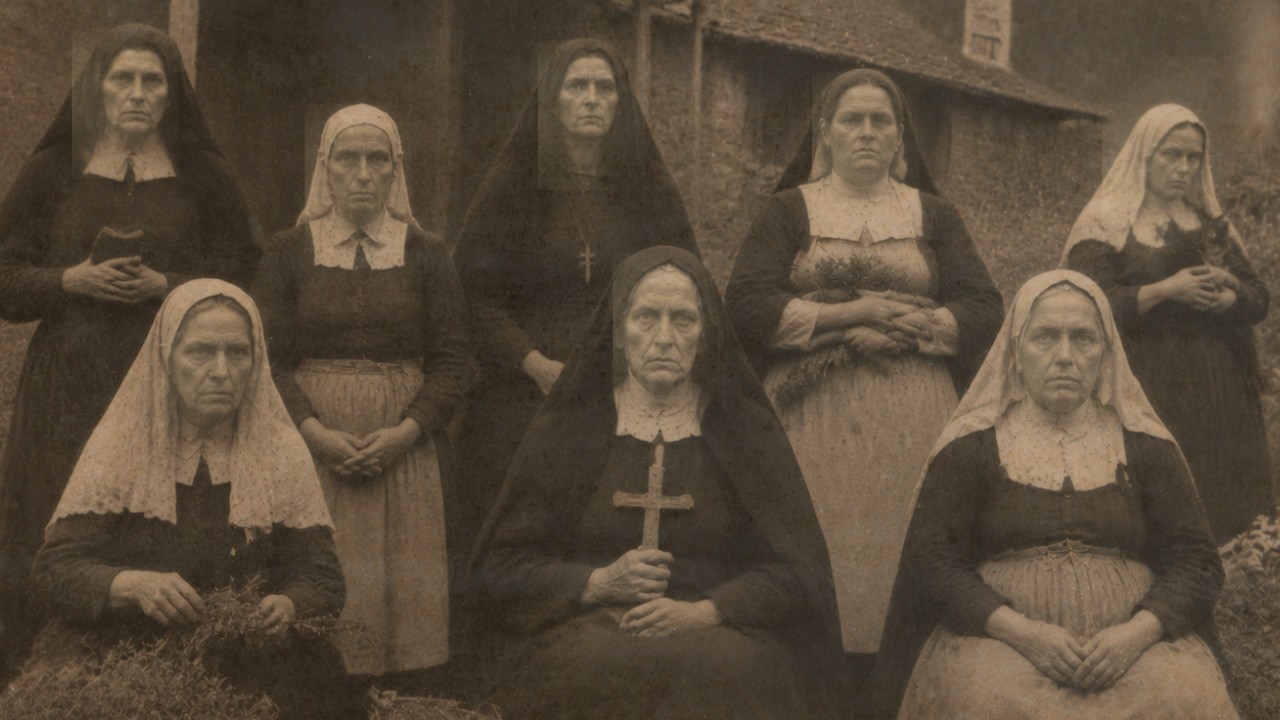
Haldane, and beside his name someone wrote two words in pencil that have never been fully explained. They found them. What Haldane found at the bottom of that valley set off a brief storm of newspaper coverage, a hurried investigation by the county sheriff, three contradictory reports from the Bureau of Indian Affairs, and then something far stranger than any of that. Silence.
Complete, deliberate silence. Within eighteen months, every official document relating to the discovery had been either reclassified, lost, or, according to one clerk who spoke to a journalist in 1903, burned in a file room that showed no other signs of fire damage. The discovery was a settlement, not a camp, not a temporary shelter. A permanent, functioning, self-sufficient settlement of forty-seven women living in a remote Ozark hollow with no men among them.
They called themselves the Sisters of Calvary. They did not look like refugees. They did not appear to be fleeing anything. They had cattle.
They had crops. They had stone structures built into the hillside with a precision the surveyor himself described as unsettling, not because the construction was primitive, but because it was too advanced. In a letter to his employer, he noted that the mortar work in the largest building rivaled anything he had seen in St. Louis, and that the women appeared to have been living this way for a very long time.
When Haldane first entered the valley, he had expected to find nothing. The area was classified as uninhabitable on the old territorial maps. The nearest known settlement lay more than forty miles to the east, and the terrain between was a maze of sinkholes, closed valleys, and limestone cave systems that could swallow a horse and rider without a trace. There was no road into the valley.
No trail. Not even a footpath worn into the forest floor. Yet when Haldane emerged from the treeline and looked down into the clearing, he saw chimney smoke rising from seven separate structures, a garden spanning nearly two acres, and a group of women working the earth in clothing he could not classify as belonging to any known American tradition. He did not approach immediately.
His private notes, which survived only because they were sent in a personal letter rather than an official report, describe a period of about two hours during which he watched the settlement from a high ridge. During that time, he counted thirty-one women moving freely within the compound. He noted that they appeared healthy, well-fed, and organized. He observed that they spoke to one another in a language he did not recognize.
He also noted one detail that appeared three times in his letter, underlined each time, as if he could not believe what he was seeing. There were no children. Forty-seven women, not a single man, not a single child, and a settlement that appeared to have stood there for decades. The county sheriff at the time was a man named Gideon Pruitt, and his involvement in the Calvary Sisters case would become one of the most scrutinized elements of the affair, though only years later.
Pruitt received Haldane’s report on November 4, 1889, and assembled a small party of five men to head toward the coordinates Haldane had provided. The journey took three days. Pruitt later told a journalist that on the second night, one of his men refused to continue, claiming something was wrong with the forest. When pressed for what he meant, Pruitt said the man kept repeating that the birds had stopped singing two miles back and never started again.
They reached the valley on November 7. What they found largely matched Haldane’s description, but with several crucial differences that fueled speculation for years. First, the number of women had changed. Haldane had counted thirty-one visible women during his observation.
Pruitt’s party counted forty-seven. That meant sixteen additional women had either arrived during the intervening days or had been hidden from Haldane’s vantage point. Given the complete absence of any trace of entry or exit from the valley, the question of where those additional women came from never found a satisfactory answer. Second, the women did not react to the arrival of five armed men the way anyone would have expected.
They did not flee. They showed no fear. They showed no hostility. According to Pruitt’s report, the women simply stopped what they were doing and began to watch.
One of them, whom Pruitt described as older than the others but impossible to age, stepped forward and addressed the group in clear, accentless English. She said, “You are early. ”
Pruitt asked her what she meant by that. She did not answer the question.
Instead, she invited the men to share a meal with them. Pruitt declined. He told her he was there in an official capacity and needed to understand who they were, how long they had been there, and whether they were on state land. The woman, who gave no name during that first encounter, told him they had been there before the state itself existed.
He took that as a figure of speech. He should not have. Over the next several hours, Pruitt conducted what he later described as the most bewildering interrogation of his career. The women were cooperative.
They answered questions. They freely showed Pruitt and his men around the settlement. But every answer they gave seemed to raise three more questions, and every building they showed him contained details that did not fit any logical explanation for how this community had come to be. The settlement consisted of seven main buildings, all constructed from locally quarried limestone.
The largest was a communal hall roughly sixty feet long and thirty feet wide, with a vaulted ceiling supported by timber beams assembled without nails. Inside, Pruitt found a long table seating at least fifty people. Walls lined with shelves holding glass jars of preserved food, and a hearth large enough for a man to stand inside. He noted that the craftsmanship was exceptional.
Then there was the question of water. Every settlement requires it, and in the Ozarks, water could be abundant or entirely absent depending on the specific geology of the valley. Pruitt noted that a stream ran through the eastern edge of the compound, emerging from a fissure in the limestone bluff, flowing clear and cold over a bed of smooth stones before disappearing into another opening about two hundred yards downstream. He tested the water himself and described it as the purest he had ever tasted, with a slight metallic quality that reminded him of deep well water rather than surface streams.
The women had constructed a small stone system beside the stream, collecting water and channeling it through a series of carved stone troughs that carried the flow to the garden, the animal pens, and the communal hall itself. The engineering was simple in concept but precise in execution. Pruitt noted that the stone troughs showed no signs of leakage despite the absence of any visible sealant or mortar between the joints. The stones simply fit together, each one shaped to interlock with its neighbors so precisely that water flowed through the system without losing a single drop along the way.
This level of stonework was not something Pruitt associated with frontier construction methods. He had seen comparable precision in pictures of Roman aqueducts and in descriptions of Inca stonework from South America, but he had never seen it in the Missouri hills. Beside the communal hall were four smaller residential buildings, each containing sleeping quarters for roughly ten to twelve women. These buildings were modest but not primitive.
The beds had wooden frames with rope supports stuffed with dried moss. The floors were packed earth covered with woven mats. Each building had a chimney and a stone hearth. Each building had a door that locked from the inside.
The sixth building was a workshop. Inside, Pruitt found tools he recognized and tools he did not. There were spinning wheels, looms, and leatherworking stations entirely consistent with frontier life. But there were also tools Pruitt could not name.
He described one as a copper cylinder about eighteen inches long, fitted with glass lenses at both ends, mounted on a wooden tripod stand. He described another as a flat stone disk roughly three feet in diameter, with symbols carved across its surface that he said reminded him of something between a clock face and a star chart. He was not educated enough to know what those symbols meant, and when the women were asked, they only said the objects were there when they arrived. The seventh building was locked.
The woman who had greeted Pruitt told him it was a place of quiet, and that visitors were not permitted inside. Pruitt considered forcing the door, but decided against it. The women outnumbered him nearly ten to one, and despite their apparent friendliness, there was something in their demeanor that made him uneasy. He described it in his report as a feeling that they were all performing a role for his benefit, and that behind the performance was something he was not meant to see.
Perhaps the agricultural operation was the most striking feature of the settlement. The garden Haldane had seen, on closer inspection, was far larger than two acres. Pruitt estimated it closer to five. The women were growing corn, squash, beans, potatoes, and several plants Pruitt did not recognize.
One of his men, a farmer himself, examined the soil and declared it the richest he had ever seen in the Ozarks, unusual because the region’s limestone geology typically produced thin, rocky soil unsuitable for large-scale agriculture. When Pruitt asked how they had obtained such productive soil, the eldest woman gave an answer he recorded faithfully but clearly did not understand. She said they had been feeding the land for a very long time, and that the land remembered what it had been before the stone came. Pruitt took this as a colloquial reference to fertilization.
Later analysts were not so sure. The livestock consisted of goats, chickens, and two cows. All appeared healthy. There were no horses and no dogs.
When Pruitt asked about this, he was told that horses attract attention and dogs attract wolves. It was a practical answer, and Pruitt accepted it. But the absence of horses also meant these women had no means of transport other than walking. If they needed supplies they could not produce themselves, they would have to walk more than forty miles through some of the harshest terrain in the state.
Pruitt asked if they made such journeys. The eldest woman said they had no need to. During his visit, Pruitt attempted to gather basic biographical information from the women. Where were they from?
When did they arrive? Why were they there? The answers were consistent from every woman he spoke to, which he found both reassuring and unsettling. They said they came from the east.
They did not specify where. They said they arrived together, at the same time, and that none had joined and none had left since. They said they were there because this was where they were supposed to be. When pressed on what authority had directed them to this location, they said the location had called them.
This last answer appeared in Pruitt’s notes with the word “madness” written beside it, then crossed out. Pruitt left the valley on November 9 with more questions than he had arrived with. His official report, filed with the county clerk on the fifteenth, was remarkably brief for what he had witnessed. It stated that a group of women had been found living in a remote area, that they appeared healthy, that they were not in distress, and that no crime appeared to have been committed.
He recommended contacting the Bureau of Indian Affairs, not because the women were indigenous, but because the land they occupied had never been surveyed or claimed and fell within a gray area of federal jurisdiction. What happened next is where the Calvary Sisters story begins to fracture into competing narratives that have never been fully reconciled. The Bureau of Indian Affairs sent an agent named Charles Whitfield to the site in December 1889. Whitfield’s report, which was not published to the public until 1947 when fragments of it were found in an unrelated archive in Oklahoma City, contradicted Pruitt’s account in several significant ways.
Whitfield counted fifty-three women, not forty-seven. He noted that many of the women appeared to be of different ethnic backgrounds, including at least three he identified as possibly indigenous, two he described as having features consistent with Mediterranean origins, and one who spoke with an accent he associated with Eastern Europe. The rest he classified as white, though he noted their skin was unusually tanned and weathered in a way that made precise racial classification difficult. Whitfield also documented the daily routine of the settlement in greater detail than either Haldane or Pruitt had managed.
He observed that the women rose before dawn and gathered in the communal hall for a meal consisting of bread, preserved fruit, and a thick porridge made from a grain he could not identify. The grain was dark, almost purple in color, and had a nutty flavor Whitfield found pleasant but could not compare to any crop he knew. After the morning meal, the women divided into work groups without any visible discussion or assignment. Some went to the garden.
Some went to the workshop, some went to tend the livestock, and several disappeared into the forest along paths that were invisible to Whitfield until the women walked them, at which point the roots became visible briefly before seeming to close behind them as the underbrush returned to place. Whitfield followed one of the groups to the forest edge and watched them collect plants, bark, and fungi from specific locations they reached without hesitation. As if they had walked the same foraging routes a thousand times. They worked in silence, communicating through gestures so subtle that Whitfield initially thought they were not communicating at all.
Only after observing them for more than an hour did he realize that every movement was intentional, every glance carried meaning, and the women were coordinating their activities with an efficiency that required no spoken language whatsoever. Most importantly, Whitfield reported that the seventh building, which Pruitt had been barred from entering, was open during his visit. He was permitted inside. What he found there occupied nearly half of his entire report, and it is this section that has generated the most controversy and the most determined attempts at suppression.
The building was a library. Not a collection of books like a simple farmhouse might have, a Bible and an almanac on a shelf. A library. Whitfield described shelves running floor to ceiling on all four walls, containing what he estimated to be between four hundred and six hundred volumes.
He could not read most of them. The majority were in languages he did not recognize. Some appeared to be handwritten rather than printed. Many were bound in materials he had never encountered, materials he described as resembling leather but not from any animal he knew.
Among the volumes he could partially read, he identified texts in Latin, French, German, and what he believed to be Greek. He found maps that matched no known geography. He found schematic drawings of mechanical devices he could not identify. He found astronomical charts that appeared to track the movements of celestial bodies over thousands of years.
In the center of the room, on a stone pedestal, he found a single book bound in dark red material and chained to the pedestal with iron chains. Whitfield asked to examine this book. He was told it was not for reading. It was for keeping.
When he asked what that meant, the woman assigned to escort him said that some knowledge was not created to be consumed but to be preserved, and that the book would be read when the time was right to read it. He pressed. He asked who had written these books. He asked where they had come from.
He asked how a group of women living in a remote hollow in the Ozarks could possess what appeared to be an academic library that would have been exceptional at any university in the country. The answer he received was the same one Pruitt had received, delivered with the same quiet certainty. The books were there when they arrived. The building was there when they arrived.
Everything in the valley had been there waiting for them, and they had simply come to take their place in it. Whitfield did not believe this. His report makes that clear. He speculated that the group had been assembled over many years, perhaps by a previous resident of the valley, and that the women had inherited or discovered the collection.
But this explanation had its own problems. The books showed no signs of water damage, mold, or insects, which would have been inevitable in a cave or hollow in the Ozarks over any extended period. They appeared to be in perfect condition. Many of the handwritten volumes used ink that Whitfield described as still appearing wet to the eye, though it did not smudge when touched.
The maps were perhaps the most disturbing element of the library. Whitfield described three maps in detail. The first showed a landmass he said resembled North America, but with a coastline that matched no known geography. The Great Lakes were absent.
The Mississippi River followed a different course. The Appalachians extended much farther south than they actually do. And along the western edge, a series of symbols indicated cities or settlements in locations where no cities had ever existed. The second map showed what Whitfield believed to be Europe and North Africa, but again with significant geographical differences.
The Mediterranean Sea was much smaller. A land bridge appeared to connect what is now Spain with what is now Morocco. And in the center of the Sahara Desert, the map showed a large body of water surrounded by green terrain and more city symbols. The third map was the one Whitfield spent the most time describing, and the one that seemed to unsettle him the most.
It showed the entire globe drawn in a projection he had never seen before. The continents were arranged differently. Antarctica appeared ice-free. And in the middle of the Pacific Ocean, where today there is only open water, the map showed a large landmass roughly the size of Australia, covered in detailed annotations in a script Whitfield could not read.
He asked the women about these maps. Were they historical documents? Were they speculative? Were they religious in nature?
The eldest woman, whom Whitfield referred to in his report as “the Speaker” because she was the only one who communicated with outsiders while the others rarely spoke, told him the maps were accurate. She did not say they had been accurate at some point in the past. She did not say they were accurate according to a particular tradition. She said they were accurate.
Whitfield asked her when. She said the maps did not depict a time. They depicted a place, and the place they depicted was here, but not the “here” that Whitfield understood. This exchange appeared in Whitfield’s report without any editorial comment.
He simply recorded it and moved on to his physical descriptions of the settlement. Whether because he did not know how to interpret it or because he thought the statement spoke for itself, no one can say. The third visitor to the Calvary Sisters was a journalist. His name was Thomas Beckworth, and he arrived in March 1890, about four months after Whitfield’s visit.
Beckworth was a correspondent for a newspaper based in Springfield, Missouri, and he had heard about the settlement through an indirect account from one of Pruitt’s men who had been drinking in a tavern and talking more freely than he should have. Beckworth’s account, published in three installments in April 1890, is the only public record of the Calvary Sisters that most people read at the time. It is also the most sensational, the most incomplete, and in several verifiable respects, the most inaccurate. But it is the version that cemented the story in the public imagination.
For this reason, it demands examination. Beckworth traveled to the valley alone, a decision he later admitted was foolish. He did not find the settlement easily. Despite having approximate coordinates from Pruitt’s account, he spent two full days lost in the forest before stumbling into the correct depression.
He described being lost in those woods in language approaching hallucination. He wrote that the trees seemed to lean toward him after dark, that he heard singing from an indeterminate direction, and that on the second night, he woke to find his campfire had gone completely out despite having been carefully tended with no wind or rain. When he finally reached the settlement, he was in poor condition. Dehydrated, disoriented, and by his own admission, afraid.
The women received him, fed him, and gave him a bed in one of the residential buildings. He stayed for three days. His published account focused on the most dramatic elements of what he observed. The library, the mysterious tools, the women’s refusal to explain their origins.
But Beckworth also recorded several details that neither Pruitt nor Whitfield had mentioned. Details that would become central to later investigations. The first was the singing. Beckworth described hearing the women sing together every evening after the final meal.
He described it as the most beautiful and terrifying sound he had ever heard. He said the harmonies were complex, interweaving in ways he associated with cathedral choirs rather than folk singing. He said the language resembled nothing he had ever heard, though certain phrases appeared to repeat in patterns suggesting ritual structure. He added that during the singing, the air in the communal hall seemed to change, becoming warmer and heavier, as if the sound itself had physical properties.
The second was the garden at night. Beckworth could not sleep on his second night, so he went out and walked toward the farmland. He wrote that the plants appeared luminous, emitting a faint green light he initially attributed to moonlight reflecting off dew. But the moon was behind clouds, and when he approached, he saw that the light was coming from the plants themselves, from their leaves and stems, pulsing slowly with a rhythm he compared to breathing.
He asked about this the next morning. The Speaker told him the garden was old, and that old things sometimes remembered how to glow. The third detail concerned the women themselves. Beckworth noted, as Whitfield had, that determining the women’s ages was nearly impossible.
Some appeared young, some appeared old, but the distinction seemed arbitrary, as if age were something they wore on the surface without affecting their inner essence. He described watching two women carrying a block of limestone he estimated at over three hundred pounds, lifting it between them as if it were a laundry basket. He described another woman threading a needle in near-total darkness from across the room, her vision apparently unaffected by the lack of light. He also described the Speaker herself in terms that would later be exploited by believers and skeptics for entirely different reasons.
He wrote that her face seemed to contain all ages at once, that when she spoke, her words reached his mind a fraction of a second before they reached his ears, and that she once answered a question he had not yet asked aloud. Beckworth’s articles generated significant public interest. Letters poured into the Springfield newspaper demanding more information. Several groups announced their intention to visit the settlement themselves.
The county received inquiries from as far away as New York and Chicago. For a brief moment in the spring of 1890, the Calvary Sisters were the most discussed mystery in the American Midwest. Then, quite suddenly, they were not. In June 1890, the county clerk’s office issued a statement saying the settlement described in Beckworth’s articles had been investigated and found to be nothing more than an ordinary small farm occupied by a group of widows who had pooled their resources after losing their husbands to various accidents and epidemics.
The statement said these women were ordinary citizens practicing subsistence farming, and that the sensational accounts in the press bore no relation to reality. Beckworth protested loudly. He published a response stating that he had visited the site, that he had seen what he had seen, and that the county’s description was a deliberate lie. The newspaper’s editor, under pressure from sources Beckworth was unable to identify, refused to publish any further articles on the subject.
Beckworth was reassigned to cover livestock auction news. Pruitt refused to discuss the matter when other journalists contacted him. He said only that his report was in the archives and spoke for itself. Whitfield’s report, as noted, was never published to the public at all.
It simply disappeared from the Bureau of Indian Affairs records and did not resurface for nearly sixty years. The erasure was thorough. Within a year of Beckworth’s articles, the Calvary Sisters had been effectively wiped from public records. The valley was not included in subsequent surveys.
County maps were redrawn to show the area as uninhabited forest. As for the women themselves, forty-seven or fifty-three depending on which count one accepts, no government agency ever made official contact with them again. But this does not mean they were forgotten. In the decades that followed, the stories of the Calvary Sisters entered the oral tradition of the Ozarks in a way that official records could not contain.
Hunters, trappers, and timber crews working in the remote hollows passed down stories that accumulated slowly over the years. Each story added a new layer to a narrative the authorities had tried to erase. A trapper named Willis Kane claimed in 1902 that he had passed through the valley while tracking a wildcat and found the settlement still inhabited, the gardens still productive, the buildings still maintained. He said the women appeared exactly as they had been described twelve years earlier.
He said he could not tell whether they were the same women or different women who resembled them. He did not stay long enough to find out. A timber survey crew reported in 1911 hearing singing in the forest near the valley’s coordinates. They described the sound as seeming to come from underground.
Their foreman, a man named Douglas Hart, recorded in his journal that his compass behaved strangely within two miles of the area, and that two of his men suffered headaches and nosebleeds that ceased immediately upon leaving the area. In 1915, a schoolteacher named Martha Clements from a small town in Christian County recorded a story told to her by an elderly patient at the county poor farm. The old woman, who identified herself only as Nell, claimed that when she was twelve years old she had gotten lost in the forest west of the James River fork, wandering for two days before being found by a group of women who fed her, cleaned her wounds, and escorted her to within sight of the nearest road. Nell said the women wore simple undyed linen clothing and spoke English with an accent she had never heard before or since.
She said they told her the forest was not a safe place for children and that she should not return. She mentioned that one of the women placed a small stone in her hand and told her to keep it close, because it would help her remember the way home. Nell said she kept that stone her entire life, and that whenever she held it in her palm, she could see the road to her house as clearly as if someone had drawn it on a map inside her mind. Clements asked to see the stone.
Nell produced it from a pouch she wore around her neck. Clements described the stone as a flat oval pebble of dark green material, warm to the touch, with a single symbol carved on one face resembling a spiral with a dot in the center. Clements drew the symbol in her notebook. That drawing still exists in the archives of the Christian County Historical Society, and the symbol it depicts is identical to one later found carved on the walls of a chamber discovered by Robert Gaines in 1967.
Nell died three weeks after telling her story. The stone was not among her possessions when the poor farm staff inventoried them. A geologist named Anna Fairchild, working for the Missouri Bureau of Mines in 1923, requested permission to survey the valley for mineral deposits. Her request was denied without explanation.
She submitted the request three more times over the following two years. Each time, it was denied. On her fourth submission, she received a letter from a department she had never heard of, postmarked Washington, informing her that the area in question fell under federal jurisdiction and that unauthorized entry was prohibited. She asked what federal jurisdiction applied to an area that was not classified as a military installation, national park, or Indian reservation.
She received no reply. The question of jurisdiction proved to be one of the most enduring mysteries of the Calvary Sisters case. The land occupied by the settlement was, according to all available records, unclaimed. It had never been owned under the Homestead Act.
It had never been purchased. It had never been included in any land grant or treaty. It existed in a legal vacuum, a piece of the American landscape that belonged to no one and no entity. Yet whenever anyone attempted to interact with it officially, they encountered resistance from a source that could never be quite identified.
This pattern repeated across the first half of the twentieth century with a consistency that belied coincidence. In 1936, a local historian named Florence Mitchum attempted to include the Calvary Sisters in a book about Ozark communities. Her publisher received a letter from a lawyer representing an unnamed client threatening legal action if the article was included. Mitchum removed the chapter.
The book was published without it. In 1941, a University of Arkansas anthropology professor submitted a grant proposal to study what he called “maternal isolation” in the western Ozarks. His proposal was returned with a single word written in red ink on the cover page. Withdrawn.
He had not withdrawn it. In 1952, an amateur radio operator in Taney County reported receiving a signal on a frequency that was not supposed to be in use, consisting of a repeated pattern of tones he described as musical rather than mechanical. He triangulated the signal to a point less than five miles from the Calvary Sisters valley. He reported it to the FCC.
The FCC responded that they had detected no unauthorized broadcasts in that area. When the operator pointed out that he had detected one, he was told his equipment was probably malfunctioning. These individual incidents, taken in isolation, might be explained as coincidences or misidentifications or bureaucratic incompetence. But taken together, they form a pattern that is difficult to explain without acknowledging that someone, or some institution, was actively monitoring and preventing any attempt to investigate or document the Calvary Sisters and their settlement.
The question is why. If they were merely widows practicing subsistence farming, as the county clerk claimed in 1890, there would be no reason to hide the fact of their existence. Isolated communities were common in the Ozarks during that period. The region was home to dozens of remote settlements that never attracted any official attention at all.
The deliberate, sustained effort to erase the Calvary Sisters from the records suggests that something about them, or their knowledge, or their possessions, or their very nature, was considered dangerous or sensitive by parties with significant institutional power. The library described by Whitfield is the most obvious point of convergence. Four to six hundred volumes in multiple languages, including texts that appeared handwritten on unrecognizable materials. Maps showing geographical features that exist on no modern chart.
Astronomical calculations spanning thousands of years. Mechanical schematics for devices no one could name. A single book chained to a stone pedestal, not for reading but for keeping. This is not a collection that could have been assembled by a group of frontier widows.
This is not a collection that could have been obtained through any commercial channels or natural inheritance in that era. The question of where these books came from is inseparable from the question of who these women really were. Let us examine the books themselves, or rather, what we can piece together from the fragmentary descriptions that survived the suppression. Whitfield’s report, recovered in 1947, provides the most detailed account.
He listed twelve titles he was able to partially read. Among them, a Latin treatise on what he translated as “the engineering of living earth,” a French manuscript that appeared to deal with cultivating plants using light rather than soil, a German text on the properties of sound and its effects on physical matter, and a Greek work he could not translate, though its illustrations depicted human figures in what he described as stages of transformation. Each figure differed slightly from the next in ways suggesting gradual physical change over time. The handwritten volumes were the most troubling to him.
They were written in scripts he could not identify, but the quality of the writing was exceptional. Every page was dense with text, illustrations, and marginal notes. The illustrations included botanical drawings of plants he had never seen, anatomical diagrams of human bodies that were not quite human, with proportions differing slightly from what he knew, and geometric patterns so intricate that he said prolonged looking at them made him dizzy. He spent nearly two hours in the library before the women asked him to leave.
He was told that prolonged exposure to certain books could cause discomfort. He initially took this as a polite way of saying he had overstayed his welcome, but he noted in his report that he did develop a headache while in the room, and that when he exited, the headache faded within minutes. The chained book he mentioned only briefly in his official report, but he wrote about it in greater detail in a personal letter to a colleague that surfaced in 1968. He described the binding as dark red, almost black, made of a material that was warm to the touch.
He said the chains were old and corroded, clearly having been there for a very long time. He said the book was thicker than any Bible he had ever seen, and when he reached out to touch it, the woman escorting him placed her hand on his arm and said, “Not yet. ”
“Not yet. ” The same words the Speaker had used with Pruitt.
“You are early. ” “Not yet. ” As if the Calvary Sisters were operating on a timeline extending far beyond the immediate present, a timeline in which the arrival of outsiders was expected but premature. This theme of premature contact recurs throughout the historical record of the Calvary Sisters.
It is one of the most compelling arguments that what was happening in that valley was not the product of simple eccentricity. When Beckworth asked the Speaker why they had settled in such a remote location, she told him the valley was a place of preservation. When he asked what was being preserved, she said knowledge. When he asked whose knowledge, she said everyone’s.
When he asked when this knowledge would be revealed, she said when the world was ready for it. Beckworth, being a journalist, pressed her on what that meant. What does readiness look like? What are the criteria?
Who decides? The Speaker smiled at him. It was the only time during his three-day visit that she showed any expression beyond calm neutrality. She said the world had tried to be ready several times before, and each time it had destroyed the knowledge rather than learning from it.
She said the library they kept was not the first of its kind. There had been other libraries in other places and other times, and each one had been burned or buried or forgotten when the surrounding civilization collapsed or decided the knowledge it contained was too dangerous. She said the Calvary Sisters existed to ensure that did not happen again. They were guardians.
They were preservers. They would remain in the valley until the knowledge they protected was no longer necessary, or until the world was finally ready to receive it. Beckworth asked how long that might take. She said she did not know.
She said the other libraries had lasted for centuries before being destroyed. She said this one might last longer because they had learned from the mistakes of the past. They had learned how to hide. They had learned how to be invisible, and they had learned that the most dangerous thing in the world was not ignorance, but the fear of knowledge.
This conversation appears in Beckworth’s unpublished notes, found among his personal papers after his death in 1929. The notes were not included in his published articles, perhaps because he considered them too strange for his readers, but they are consistent with the other accounts, and they provide the most coherent explanation any of the Calvary Sisters ever gave for their existence. The implications are staggering. If taken seriously, the Calvary Sisters were claiming to be part of a tradition of knowledge preservation spanning multiple civilizations, each of which possessed information about the natural world far exceeding contemporary understanding.
They claimed this knowledge had been suppressed, destroyed, or lost repeatedly, and that their role was to preserve it as a trust until a future generation was capable of using it responsibly. This claim raises obvious questions. If such a tradition existed, where did it originate? How was the knowledge transmitted across centuries and civilizations?
What was the nature of the knowledge itself? And perhaps most importantly, why were the guardians always women? The last question is what attracted particular attention from researchers who have examined the Calvary Sisters case in the context of broader historical patterns. Indeed, once you begin looking at the evidence, the recurrence of all-female communities associated with hidden knowledge and advanced capabilities appears in the historical record with a frequency that cannot be easily explained as coincidence.
In ancient Greece, the priestesses of Delphi were the ones who maintained the Oracle, and were said to possess knowledge of past and future. The Pythia, the priestess who served as the voice of the Oracle, entered a trance state that modern researchers have attributed to geothermal gases, but the accuracy of many of the Oracle’s predictions has never been satisfactorily explained by this theory alone. In pre-Roman Britain, the Druids maintained communities of priestesses on islands off the west coast, women said to possess knowledge of astronomy, medicine, and the natural world that exceeded anything in the Mediterranean civilizations of the era. Julius Caesar himself wrote that the Druids possessed scientific knowledge they refused to commit to writing, transmitting it instead through oral tradition across generations.
In medieval Europe, the Beguines were communities of women who lived together without taking religious vows, supporting themselves through textile work and medicine. They were persecuted repeatedly by the Church, not for heresy in the traditional sense, but for possessing and transmitting knowledge the Church considered dangerous. Many Beguine communities were found to contain libraries of texts officially condemned and destroyed elsewhere. In pre-Columbian Mesoamerica, certain Maya and Aztec traditions describe communities of women who served as guardians of the Long Count calendar, possessing astronomical knowledge spanning tens of thousands of years into the past and future.
These women were regarded as separate from the general population, living in structures that functioned simultaneously as observatories and repositories of sacred texts. The pattern is consistent across cultures and centuries. There appear to have been communities of women who served as guardians of knowledge that the dominant civilization could not understand or actively sought to suppress. The Calvary Sisters, if we believe their account, were simply the latest iteration of this tradition operating on American soil in the post-Civil War era.
But there are elements of the Calvary Sisters story that do not fit neatly into this framework. Elements suggesting something stranger than a simple tradition of female scholarship. The physical abilities described by Beckworth, women lifting three-hundred-pound stones, threading needles in near-total darkness, do not correspond to any natural human group, no matter how organized or knowledgeable. The glowing garden does not correspond to any known botanical phenomenon.
The singing that seemed to alter the physical properties of the air does not correspond to any known acoustic effect. And the maps, those showing continents in configurations matching no known period of Earth’s geological history, suggest a source of information beyond anything that could have been transmitted through human oral or written tradition. These anomalies have led some researchers to suggest that the Calvary Sisters were not merely guardians of advanced knowledge, but were themselves something other than ordinary humans. This is a hypothesis that the available evidence neither confirms nor denies, but the specific details supporting it deserve examination.
The age problem is the most frequently cited anomaly. From Haldane’s first observation in 1889 to Willis Kane’s report in 1902, a period of thirteen years, the women of the settlement were consistently described with the same descriptions. Their ages could not be determined. They appeared neither young nor old.
They did not appear to change between visits. This is a small data set, and thirteen years is not a long time, but it is long enough for some visible aging to occur, especially in women living a frontier existence requiring physical labor. The knowledge problem is equally difficult. The library Whitfield described would have required multiple lifetimes to assemble through ordinary channels.
The languages represented, Latin, French, German, Greek, and multiple texts he could not identify, suggest a level of education that was effectively inaccessible to American women in the late nineteenth century. The astronomical charts spanning thousands of years suggest either access to ancient reference materials or observational data collected over periods far exceeding any human lifespan. The isolation problem is the most practically confounding. The settlement had no road, no trail, no visible connection to the outside world.
The women had no horses. They claimed they needed nothing from outside the valley. They were completely self-sufficient in a location that was not supposed to support a community of that size. The soil was unreasonably rich for the region.
The crops included plants no one could identify. The livestock appeared healthy in an area known for poor grazing conditions. Then there is the question of numbers. Haldane counted thirty-one women.
Pruitt counted forty-seven. Whitfield counted fifty-three. The women themselves, when asked how many they were, always gave the same answer. “Enough.
” They said, “The number is sufficient. ”
What does “sufficient” mean in this context? Sufficient for what? Sufficient to maintain the settlement, sufficient to guard the library, sufficient to do whatever it was they were really doing in that valley, the thing that none of the visitors had ever managed to fully see.
Because that is the consistent impression left by all three accounts. Haldane, Pruitt, and Whitfield all felt that they were being shown only a surface. The settlement, the gardens, the buildings, even the library. These were the visible components of something larger, something the women could not or would not reveal to outsiders.
The seventh building, which Pruitt was barred from entering, was the most obvious symbol of this hidden dimension. But even when Whitfield was allowed inside and found the library, his report indicates he felt the library itself was a kind of antechamber, a display of what the women knew rather than the full extent of what they were. The singing may provide a clue. Every visitor who heard it described it in terms beyond ordinary musical performance.
The harmonies were too complex. The sound had physical effects. The air changed, the temperature rose. These descriptions are consistent with what some acoustic researchers call resonance engineering.
The deliberate use of specific frequencies and harmonic relationships to produce physical effects in the environment. This concept is not as strange as it might initially seem. Modern research in cymatics, the study of visible sound and vibration, has demonstrated that sound waves can organize physical matter into geometric patterns. Certain frequencies can shatter glass, move water, and create standing waves in air visible to the naked eye.
The idea that a group of trained singers could use harmonic frequencies to produce physical effects is not impossible. It is simply unexplained. But unexplained according to what framework? That is the question the Calvary Sisters case ultimately poses.
Our current scientific understanding offers no explanation for glowing plants, impossibly fertile soil, or women who do not appear to age. But our current scientific understanding is itself the product of a specific historical tradition. A tradition that has systematically excluded and suppressed other forms of knowledge for centuries. What if the Calvary Sisters were guardians of exactly the kind of knowledge that had been excluded?
What if their library contained not myths or fantasies, but real science? Science developed by a civilization or tradition we have been taught never existed. What if the maps showing different continents were not speculative but historical, depicting the world as it was known to people who had studied it for far longer than our civilization has existed? These are not comfortable questions.
They challenge fundamental assumptions about the limits of human knowledge and the reliability of historical records. But the evidence of the Calvary Sisters, fragmentary and suppressed as it is, suggests they deserve to be asked. Let us return to the physical evidence and trace what happened to the settlement after the initial period of public interest and subsequent suppression. After the county clerk’s dismissive statement in 1890 and the silencing of Beckworth, the Calvary Sisters effectively vanished from official records.
But the oral tradition continued, and the reports coming from hunters and surveyors over the next few decades paint a picture of a settlement that not only survived but appeared to thrive in its isolation. Willis Kane’s 1902 account has already been mentioned. He described a settlement that appeared unchanged from descriptions thirteen years earlier. But he added two details that did not appear in earlier accounts.
The first was that the forest surrounding the valley looked different from the forest beyond it. He described the trees closest to the settlement as larger, older, and denser than the surrounding woods. He said the vegetation was so thick that the forest floor received almost no direct sunlight, and yet the undergrowth was dense and green, rather than the sparse shade-tolerant plants he would have expected. He described finding fungi growing on fallen logs that glowed with a faint light, reminiscent of the glow Beckworth had reported in the garden.
The second detail concerned sound. Kane, like the timber survey crew that would come nine years later, reported hearing singing. But he identified its source differently. He said it was not coming from the settlement itself.
It was coming from underground. He said it sounded as if the earth itself were humming. A low, continuous tone he felt in his chest more than heard with his ears. He said it was loudest near a limestone outcrop at the eastern end of the valley, where a cave entrance was partially obscured by vegetation.
This cave entrance does not appear in any of the earlier accounts. Haldane did not mention it. Pruitt did not mention it. Whitfield did not mention it.
Either they did not notice it, or it was not shown to them, or it did not exist during their visits and appeared sometime between 1889 and 1902. The significance of the cave lies in the fact that the Ozark Plateau is one of the most cave-rich regions in North America. Groundwater has dissolved the limestone bedrock over millions of years, forming an extensive network of caves, sinkholes, and underground rivers. Some of these systems are enormous.
Caves extend beneath the Ozarks for hundreds of miles, and large portions of them have never been explored or mapped. If the Calvary Sisters had access to an extensive cave system beneath their valley, it would explain several puzzling aspects of their situation. It would explain how additional women could appear or disappear without using any surface trail. It would explain where supplies or materials might come from without visible means of transport.
It would explain the sound that seemed to come from underground. And it might explain the library itself, because cave environments provide almost perfect conditions for the preservation of sensitive materials like books and manuscripts. Constant temperature, stable humidity, total darkness. These are exactly the conditions archivists seek to replicate in modern conservation facilities.
The possibility that the Calvary Sisters were using the cave system beneath their valley as a repository, as a vault for the knowledge they were protecting, reframes the entire story. Perhaps the surface settlement, with its gardens and livestock and communal hall, was exactly what Pruitt and Whitfield suspected it was, a facade. Perhaps the real operation, whatever it was, was happening underground in chambers no outsider was ever permitted to see. This theory received unexpected support in 1967 when a caver named Robert Gaines entered an unexplored section of a cave system about twelve miles from the location traditionally associated with the Calvary Sisters valley.
Gaines, an experienced caver who had been mapping Ozark cave systems for over a decade, discovered a passage leading to a large chamber approximately two hundred feet below the surface. What he found in that chamber was, according to his written record, impossible. The chamber was roughly circular, one hundred feet in diameter, with a vaulted ceiling rising forty feet above the floor. The walls were smooth, unlike the irregular surfaces typical of natural limestone caves, polished to a sheen Gaines compared to marble.
The floor was flat and level, again unlike the uneven terrain of natural cave formations. In the center of the chamber was a stone structure Gaines described as an altar, though he admitted the word was inadequate. It was a rectangular block of black stone, about six feet long, three feet wide, and three feet high, with perfectly flat surfaces and precise right angles. The stone was not limestone.
Gaines, who had a background in geology, said it appeared to be basalt, which does not occur naturally in the Ozarks. Around the altar, arranged in a concentric circle, were twelve stone seats, each carved from a single block of the same black basalt. They were smooth, unweathered, and showed no signs of tool marks. On the walls of the chamber, extending from floor to ceiling, were carvings.
Gaines described them as a combination of text and images, executed with a precision he said exceeded anything he had seen in any cave in the world. The carvings depicted human figures, celestial bodies, botanical specimens, geometric patterns, and what appeared to be maps. The maps showed landmasses and waterways in configurations he did not recognize. Gaines photographed the chamber extensively.
He took thirty-six images on two rolls of film. When he returned to the surface and developed the film, twenty-nine of the thirty-six images were blank. The seven remaining images showed the chamber, but with such poor contrast that the carvings on the walls were barely visible. He returned to the cave three times over the following month, using different photographic equipment each time.
Each time, most of his photos failed. He eventually brought a professional photographer with him. The professional photographer’s results were the same. Cameras that worked perfectly in every other section of the cave system produced images that were either blank or severely damaged inside the chamber.
Gaines also noted that his compass was useless inside the chamber. It spun constantly without settling. His watch, a mechanical timepiece, ran backward throughout his visits and resumed normal operation upon leaving the chamber. He also experienced the same deep humming sound that Willis Kane had described sixty-five years earlier, a tone that seemed to emanate from the stone itself.
Gaines described the air inside the chamber as different from the air in the rest of the cave system. Caves at that depth typically maintain a constant temperature near thirteen degrees Celsius, with still, humid air carrying a faint metallic scent of wet limestone. The air in the chamber was warmer, approaching twenty-one degrees Celsius by Gaines’s estimate. The air was dry, and carried an odor Gaines had difficulty describing, eventually settling on the phrase “like old paper and honey.
” This is a peculiar detail because it matches exactly the way librarians describe the smell of very old books, an odor produced by the slow chemical decomposition of cellulose and lignin in paper and binding materials. Had the chamber once contained a collection of books or manuscripts, the scent might have lingered in the sealed, still environment long after the materials themselves had been removed. The carvings on the walls were not random. Gaines noted that they appeared to follow a deliberate sequence, beginning near the entrance passage and winding clockwise around the chamber toward the altar in the center.
He could not read them, but he realized they were organized into panels, each panel containing text and imagery, suggesting a narrative or instructional sequence designed to be read in order. The imagery grew more complex as it approached the altar. Near the entrance, it depicted simple scenes, human figures, plants, and celestial bodies in recognizable configurations. By the time the sequence reached the wall directly behind the altar, the imagery had become dense and multi-layered, depicting structures, mechanisms, and processes Gaines could not interpret.
He said they reminded him of engineering schematics, but for machines or systems he had no frame of reference to understand. Gaines reported his discovery to the Missouri Geological Survey. The Survey sent a team to investigate. The team spent two days in the cave system and reported that they had found the passage Gaines described, but that it ended in a natural dead end about sixty feet from where Gaines said the chamber was located.
There was no chamber. No altar. No carvings. Gaines returned to the cave after receiving this report.
He found the chamber in the same place it had always been. He brought three witnesses with him on separate occasions. All three confirmed the existence of the chamber. He contacted the Geological Survey again.
They refused to conduct any further investigation. They said the passage had been thoroughly examined. It ended in solid rock. Gaines was advised to consult a physician about the possible effects of prolonged exposure to cave gases.
The connection between Gaines’s chamber and the Calvary Sisters is circumstantial, but compelling. The chamber was within the cave system underlying the area where the Sisters’ valley was located. The carvings included maps that matched descriptions of the maps in the Sisters’ library. The humming sound matched eyewitness reports from multiple sources over seventy years.
And the deliberate suppression of Gaines’s discovery, the Geological Survey finding nothing where something demonstrably existed, mirrored the pattern of institutional denial that had surrounded the Calvary Sisters from the beginning. If the chamber was part of the same underground complex the Sisters had been using, then the scale of what was being hidden becomes far larger than a settlement of eccentric women. It suggests an underground facility of considerable size and sophistication, constructed with materials imported from elsewhere, carved with knowledge predating any known civilization in the region, and operated by a community whose true nature and capabilities far exceeded anything any of the surface visitors had understood. The construction question is particularly significant.
Basalt does not occur naturally in the Ozarks. The nearest basalt formations are hundreds of miles away. Transporting blocks of basalt weighing several tons each through dense Ozark forest, into a cave system, and assembling them in a precisely constructed chamber would be a major engineering feat. It would require either advanced technology or stone-handling methods we do not currently understand.
And here, again, the words of the Calvary Sisters themselves become relevant. They said the buildings were there when they arrived. They said the library was there when they arrived. They said everything in the valley had been waiting for them.
If the underground chamber was part of the same complex, it too was not built by the Sisters. It was built by someone else at an earlier time, for a purpose the Sisters had inherited but not necessarily created. Who built it? When?
And why the Ozarks? The Ozark Plateau is one of the oldest exposed landmasses in North America. The rocks forming its foundation are over a billion years old, among the oldest on the continent. The region has remained above sea level with few exceptions for hundreds of millions of years.
It is geologically stable, seismically quiet, and structurally sound in a way matched by few other regions. The bedrock beneath the plateau has survived every major extinction event, every ice age, every climate disruption that has reshaped the surface of this planet over the past billion years. It is, geologically speaking, one of the most permanent places on Earth. If you were choosing a location to build a repository designed to last for thousands of years, designed to outlast civilizations and geological disturbances, the Ozark Plateau would be an excellent choice.
The deep limestone caves provide natural protection from surface events. The geological stability reduces the risk of destruction from earthquakes or volcanic activity. The remote, densely forested terrain provides natural protection from accidental discovery. In other words, the location was not a random choice.
Someone chose this place with full knowledge of its geological properties and its capacity for long-term preservation. The Calvary Sisters, whether they were the original builders or the latest guardians, were part of a project operating on a timescale that makes ordinary human history look like a footnote. Here the traditional narrative of American history has no place for the Calvary Sisters, and no framework for understanding them. In the traditional narrative, the Ozarks before European settlement were home to indigenous peoples who left behind stone tools, pottery, and the occasional burial mound.
There is no place in that narrative for rooms of polished basalt two hundred feet underground, or libraries of ancient texts in multiple languages, or women who do not age, or gardens that glow in the dark. But the traditional narrative is itself a construction, assembled from selected evidence and maintained by institutional consensus. When evidence does not fit the narrative, it is not the narrative that is questioned. It is the evidence that is suppressed.
The Calvary Sisters were suppressed. Their settlement was erased from maps. Their visitors were silenced. Their library was never catalogued, never studied, never acknowledged.
And the cave system beneath their valley, which might contain physical evidence that would reshape our understanding of North American history, has never been systematically explored. The obvious question is: what happened to them? Did the Calvary Sisters eventually leave the valley? Did they die?
Are they still there? The oral tradition offers conflicting answers. One strand of Ozark folklore claims the Sisters left the valley in the 1930s during the Dust Bowl era, taking their library and their knowledge with them. According to this account, they sealed the cave entrances behind them and vanished into the forest, leaving behind only the stone buildings that the forest gradually reclaimed.
No one knows where they went. This version has a kind of narrative neatness that makes it suspect. It provides a definitive ending without evidence. A second strand claims the Sisters are still there.
This version remains particularly current among families who have lived in the western Ozarks for generations. These families tell stories of encounters with women deep in the forest who appear suddenly, speak briefly, then disappear. They tell stories of hearing singing at night in valleys no one inhabits. They tell stories of finding stone foundations in places where no settlement was ever recorded.
Foundations made of limestone blocks fitted so precisely that a knife blade cannot be inserted between them. A third strand, the darkest and least often mentioned, claims the Sisters were removed. This account suggests that at some point in the early twentieth century, a government agency, perhaps the same one that sent the anonymous letters preventing research and investigation, conducted an operation to remove the Sisters and seize the contents of the library. This account is based on the pattern of continuous suppression as evidence of institutional knowledge and action, arguing that you do not devote decades of effort to hiding something unless you intend to control it.
If this account is accurate, the Calvary Sisters’ library, with its ancient texts and impossible maps and red chained book, may exist today in a government repository, classified and unavailable. Its contents known to a small number of people who have no intention of sharing them. There is one additional piece of evidence to consider, the strangest of all. In 1984, a woman walked into the public library in Fayetteville, Arkansas, and asked to see the local history collection.
She spent three hours reviewing materials related to the Ozarks in the late nineteenth century. The librarian on duty, a woman named Patricia Goodwin, later described the visitor as middle-aged, well-dressed, and extremely knowledgeable about the region’s history. The visitor asked specifically about the Calvary Sisters. Goodwin later recalled that the woman moved through the archive with an familiarity that seemed unusual for a first-time visitor.
She knew where newspaper files were stored without being directed. She located specific volumes on the reference shelves without consulting the card catalog. She handled the oldest materials with the expert care of someone who had spent their life working with fragile documents, turning pages from the corner, never touching the text, supporting the spine with her other hand. Goodwin, who had worked as a professional librarian for twenty-two years, said she had never seen anyone handle old paper with such innate skill.
Goodwin told the visitor that the library had very little information on the subject. A few newspaper clippings, a footnote in one local history book, nothing substantial. The visitor thanked her and prepared to leave. As she was leaving, Goodwin asked why she was interested in the Calvary Sisters.
The woman stopped at the door, turned, and said something Goodwin repeated for the rest of her life. She said, “We wanted to see what you remember. ”
Goodwin asked who she meant by “we. ” The woman smiled and walked out.
Goodwin followed her to the parking lot. There was no car. The woman had vanished. This incident, documented in Goodwin’s personal diary and confirmed by a colleague who was present in the library that day, is either a fabrication, a coincidence, or evidence that the Calvary Sisters, in some form, had continued to exist nearly a century after their discovery, and that they had continued to monitor what the outside world knew about them, and that they had continued to operate according to a plan whose goals and timeline remained opaque to everyone outside their circle.
“We wanted to see what you remember. ”
The sentence carries implications beyond the Calvary Sisters themselves. It suggests that remembering is itself a form of guardianship. That the act of preserving knowledge, whether in a library deep in the Ozarks or in the oral traditions of a region, is not passive but active.
And that those who remember are participating in the same project to which the Sisters had devoted their existence. Which raises the final question, the one to which every account of the Calvary Sisters ultimately leads. What did they know that we have forgotten? The maps in their library showed a world that does not match our current geography.
Continents in different configurations. An ice-free Antarctica. A landmass in the Pacific that no longer exists. These are not random fantasies.
They correspond in general principle to what we know about Earth’s geography in deep geological time. The land bridge between Spain and Morocco that Whitfield described existed during periods of lower sea level. The green Sahara with its central lake existed as recently as six thousand years ago. The different course of the Mississippi matches geological evidence of the river’s ancient channels.
If the maps in the Sisters’ library were accurate depictions of the earth at various points in its geological past, they were created by someone with knowledge of geological history that we did not begin to assemble until the twentieth century, through satellite imaging, deep-sea drilling, and radiometric dating. The Sisters, or whoever created their library, knew things about the physical history of this planet that our civilization only discovered very recently. And they had known them for centuries, perhaps millennia. The botanical knowledge suggested by their garden is equally evocative.
Plants no visitor could identify. Soil of incredible fertility in a region known for poor agricultural conditions. Bioluminescence in living plants, a phenomenon now understood to occur in certain marine organisms but not in terrestrial plants under any known conditions. Whatever the Sisters were doing with their garden, it involved techniques or knowledge falling outside the bounds of conventional agriculture and botany.
The construction techniques evident in both the surface settlement and the underground chamber deserve further examination. The stone fitting that Pruitt observed in the water troughs, blocks interlocking without mortar and retaining water without leakage, is a technique appearing in only a few places on Earth. The most famous examples are in Peru, where the walls of Sacsayhuamán and other Inca sites feature stones weighing hundreds of tons, fitted with such precision that a piece of paper cannot be inserted between them. Similar stonework appears at certain pre-dynastic sites in Egypt, at Puma Punku in Bolivia, and at the megalithic sites of the western Pacific islands.
In each case, the traditional explanation for how these structures were built relies on massive labor forces and simple tools used over long periods. But the traditional explanation has never satisfactorily explained the precision, or the ability to shape irregular stones to meet perfectly in three dimensions without gaps or deviations. The Sisters’ settlement, if the descriptions are accurate, used the same technique on a smaller scale, applied to practical infrastructure rather than monumental architecture. This suggests not just knowledge of the technique, but mastery and familiarity with it.
The kind of familiarity that comes from long practice, not casual imitation. The acoustic phenomena, the chants that changed the temperature of the air, the humming from underground, the compass disturbances, suggest familiarity with principles of sound and electromagnetism that we are only beginning to explore in modern physics. The idea that sound can affect physical matter is established science. The idea that specific harmonic frequencies can be used to produce targeted physical effects is cutting-edge research.
The Sisters, it appears, were practicing this as a matter of routine. And the women themselves. Their apparent resistance to aging. Their physical strength.
Their ability to see in the dark. Their knowledge of events that had not yet occurred. If these accounts are accurate, they describe humans whose physical and cognitive capabilities exceeded the natural range by a significant margin. What does all this mean?
What kind of community possesses ancient maps, unknown plants, acoustic engineering, advanced construction techniques, a library of priceless texts in dead and unknown languages, and members whose physical abilities exceed ordinary human standards? It is a community that possesses knowledge and practices that our current civilization does not have, has never had, and may not have the conceptual framework to understand. The Calvary Sisters were not eccentrics. They were not cult members.
They were not frontier widows playing at homesteading in the woods. They were guardians of something that predates our complete understanding of human history. And they chose the Ozarks, with its billion-year-old rocks and its endless cave systems, to be the vault in which they kept it. The fact that they were women is not incidental.
Across every culture that has recorded this kind of knowledge guardianship, the guardians have been female. The priestesses of Delphi. The Druid priestesses of Britain. The Beguine sisters of medieval Europe.
The calendar keepers of Mesoamerica. The Calvary Sisters of the Ozarks. There seems to be something about the capacity for patient, collective preservation across generations that makes women the natural choice for this role. Not as a matter of ideology, but of practical effectiveness.
Men build kingdoms, and kingdoms fall. Women build communities, and communities endure. This is not a statement about the superiority of one approach over another. It is an observation about endurance.
Kingdoms are designed for expansion. Communities are designed for survival. And survival is what the Calvary Sisters were created for. The Calvary Sisters endured for at least a century in the documented record, and possibly far longer before Haldane stumbled upon their valley.
Their traditions, if we believe the Speaker’s account, extend across multiple iterations of civilization itself. In the traditional narrative, the Ozarks before European settlement was home to indigenous peoples who left behind stone tools and pottery. There is no place in that narrative for rooms of polished basalt two hundred feet underground, or libraries of ancient texts in multiple languages, or women who do not age, or gardens that glow in the dark. But the traditional narrative is itself a construction, assembled from selected evidence and maintained by institutional consensus.
When evidence does not fit the narrative, it is not the narrative that is questioned. It is the evidence that is suppressed. The Calvary Sisters were suppressed. Their settlement was erased from maps.
Their visitors were silenced. Their library was never catalogued, never studied, never acknowledged. And the cave system beneath their valley, which might contain physical evidence that would reshape our understanding of North American history, has never been systematically explored. What was in that chained red book?
What knowledge was written on the walls of the underground chamber in a script no one today can read? These questions remain unanswered. They will remain unanswered as long as the institutions that suppressed the original investigation continue to control access to the evidence. As long as geological surveys report solid rock where witnesses walked through open chambers.
As long as letters from unnamed agencies block research proposals. As long as libraries lose documents that were catalogued and preserved and then simply ceased to exist. But the evidence that survived the suppression, the fragmentary accounts, the oral traditions, the diary entries and personal letters that escaped official destruction, tells us something important. It tells us that the Ozarks, this quiet, overlooked region in the heart of America, may contain one of the most significant repositories of pre-modern knowledge on the planet.
It tells us that this knowledge has been protected by women who understood its value and its danger. And it tells us that the efforts to suppress this knowledge were not the product of ignorance, but of fear. Fear of what this knowledge might reveal. Fear of how it might change our understanding of who we are and where we came from.
Fear of the questions it would force us to ask about the civilizations that preceded us and what happened to them. Fear of the answers. The Calvary Sisters knew the answers. They had the books.
They had the maps. They had the schematics and diagrams and the red volume chained to its stone base. They had the chamber underground with its basalt altar and carved walls. They had the garden that glowed, and the singing that shook the air, and the knowledge to make the soil remember what it had been before the stone came.
And they had patience. Patience measured not in years or decades, but in centuries. Patience of waiting in a hidden valley while the world outside destroyed itself, rebuilt itself, and destroyed itself again. Always forgetting.
Always losing. Always burning the libraries and burying the evidence and insisting that nothing existed before the current version of civilization. The Calvary Sisters waited because they knew something most of us have forgotten. They knew that knowledge is not fragile.
It is durable. It survives fire and flood and institutional suppression. It lives in the stones and the soil and the songs that echo through chambers underground. It lives in the memory of places that remember what they were.
It lives in the women who carry it generation after generation through the centuries, through the silence and the darkness, waiting for the world to be ready. Are we ready? This is not a rhetorical question. It is the question the Calvary Sisters have been asking for over a century, perhaps much longer.
And the answer we give, not with our words but with our willingness to look at the evidence, to follow the threads, to demand access to the records that have been hidden from us, will determine whether the knowledge they protected will survive for another generation or be lost again as it has been lost so many times before. In a hidden valley in the Ozarks, there are stone buildings the forest is slowly reclaiming. There is a cave entrance behind a limestone outcrop, where the air hums at a frequency that makes compass needles spin. And perhaps there is, somewhere in the deep chambers beneath the oldest bedrock in North America, a library containing answers to questions we have not yet learned to ask.
The Calvary Sisters found those answers. They kept them safe. And they told every visitor the same thing, in different words, but with the same meaning. You are early.
Not yet. When the world is ready. One day, we will return to that valley. One day, we will find the passage the geological surveys said ended in solid rock.
One day, we will stand in the chamber with the basalt altar and the carved walls and the deep humming sound that comes from the bones of the earth itself. And on that day, we will finally open the chained book and read what is written there. The story of who we were before we forgot. The story of what we knew before we lost it.
The story the Calvary Sisters carried through the darkness for all of us. Until then, the valley waits. The books wait. The Sisters wait.
And the question remains. What did they know that we have forgotten?
