The envelope lay open on the table, and the title stopped him cold. It was a letter written in December 1863, and on its folded pages was a heading he had never seen before: The Exhumation of Washington’s Remains. Not John Augustine Washington. Not the young man whose death he had come to investigate, the last of the Washington family to own Mount Vernon, the aide who had fallen in western Virginia in the autumn of 1861 while scouting for Robert E.
Lee. This was about the body of George Washington himself, the first president, the founder of the country, the general of the Revolutionary Army. And what the letter described was something Ron of Military Images had never encountered in all his years of Civil War research: a witness account of the moment the coffin of George Washington was opened, nearly four decades after his death. It had all started with a trip to a real library.
Most of his research was done online, or by contacting archives that sent him digital copies of their holdings, so walking through the doors of an actual reading room felt like a genuine pleasure. The destination was the Fred W. Smith National Library for the Study of George Washington, part of the Mount Vernon complex, a beautiful building about ten years old that held everything a researcher could want. The director, Dana Stefanelli, had pulled the requests Ron had submitted before arriving: a number of letters written and signed by Robert E.
Lee that he had long wanted to see, items that were indexed but not available digitally. For a few hours he worked through the material, collecting the information he needed. As the visit wound down, Stefanelli asked if there was anything else he was looking for. Well, Ron said, if you have anything that describes how the family felt in the aftermath of the news of John Augustine Washington’s death, I would like to know about it.
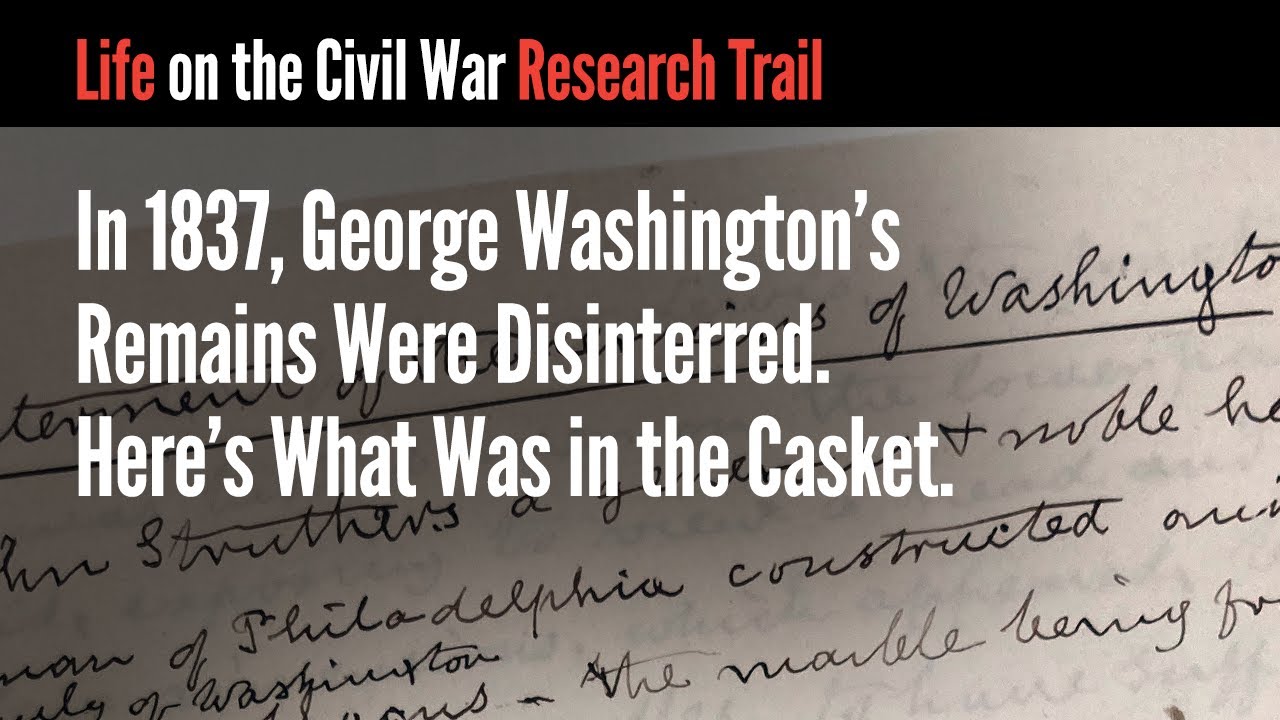
Stefanelli did not know of anything offhand, but he remembered a collection of letters written in the 1860s. They decided to take a look, thinking there might be something interesting inside. What Ron found was not at all what he had expected. It was this letter here.
The title stopped him in his tracks. The Exhumation of Washington’s Remains. It was not John Augustine Washington. It was the remains of the first president, and he read on in complete astonishment, seeing information he had never laid eyes on before.
The letter was written in 1863 and included transcribed excerpts from an earlier letter dated 1858. That 1858 letter was an eyewitness account of the burial—or rather, the disinterment—that had taken place in 1837. An intriguing chain of events had led to this document. He had not known that anyone had looked upon Washington’s body in 1837, almost four decades after his death in 1799.
Before getting into the details, he wanted to introduce a few names so the background would be clear, figures that might be unfamiliar. One was John Struthers, a Philadelphia merchant who had made the marble sarcophagus and donated it to the family. Lawrence Lewis was one of George Washington’s nephews. And the writer of the letter was Benjamin Silliman, a chemist and professor of science, founder of the American Journal of Science.
That was the background. The letter began with its title: The Exhumation of Washington’s Remains. Mr. John Struthers, a generous and noble Scottish gentleman of Philadelphia, had made a marble sarcophagus and presented it to the Washington family.
The marble had been quarried in Pennsylvania. Major Lawrence Lewis had commissioned Mr. Struthers to undertake the task of transferring the remains from the old family vault. The following details were drawn from a private letter dated Philadelphia, February 25, 1858.
Ron paused there, because the letter, as he had mentioned, was written on February 25, 1858, and it described an eyewitness who had been present in 1837. Reading between the lines, it seemed that Silliman, the letter’s author, had corresponded with Mr. Struthers at some point, and that this description was actually Struthers’ account of what had happened. That was only an inference based on what he saw here, because the excerpt from the 1858 letter itself was unidentified.
The writer of that letter was unknown. But here was the eyewitness account of the proceedings of 1837, which happened on Saturday, October 7, 1837. When the door of the vault was opened, we entered with Major Lewis and his son. The coffin containing the remains of Washington was at the further end of the vault, and it was necessary to remove those which were in front.
After removing the outer decayed covering which enclosed the remains of Washington, it was discovered that the inner leaden coffin lid had sunk considerably, from the head to the foot. This sinking of the metal had probably caused the soldering at the top and widest end of the coffin to crack. The coffin was collapsing. At Major Lewis’s request, the broken part of the lower portion of the lid was turned back, bringing into view the head and breast of large proportions, which in the dim light of the candles seemed to be untouched by time.
The eye sockets were large and deep, and the width of the temples with the forehead appeared to be of an unusual size. There was no trace of the burial shroud. The chest was broad, the skin dark, with the appearance of dried flesh adhering firmly to the bones. No hair was visible, and there was no offensive smell from the body.
A hand was placed on the head and immediately withdrawn. The leaden lid was restored to its place. Six men carried the body and placed it in the marble sarcophagus. After the heavy lid had been set and secured with cement, it was hidden from our sight, on Saturday, October 7, 1837.
He had died in December 1799, and had spent more than 38 years in the grave. Among the relatives present were Major Lawrence Lewis, Lorenzo Lewis, John Augustine Washington, George Washington, the Reverend Johnson and his wife, and Miss Jane Washington, who all returned to the mansion house after the transfer. Signed by B. Silliman, December 8, 1863.
That was the text of the letter. After reading it, Ron thought he would go to newspapers. com, his favorite database, and see if he could find anything more. He did.
There was a description of a version of this letter, or at least a version of its contents, phrased a little differently, as would soon become clear. The article was not long. It had first appeared in the Philadelphia Gazette and was reprinted in The Madisonian, a Washington, D. C.
, newspaper, dated December 28, 1837. It read as follows. General Washington. The remains of this great man, the father and savior of his country, were recently placed in the sarcophagus made by Mr.
Struthers of this city, from whom we learn that upon opening the vault and the coffin in which he was buried, the sacred body of Washington was found in an astonishing state of preservation. The pale high forehead wore a calm and serene expression, and the closed lips still wore a grave and solemn smile, like that which was no doubt upon them when the first president surrendered his innocent mortal life to immortal existence, when his last quiet breath returned with pain to the elements once more. The man entrusted with the task of transferring the sacred remains to their final resting place was overcome with emotion, unable to hide his feelings before the majesty of the great departed one. He placed his hand upon the broad forehead that had once led the ranks of battle, or that had been furrowed with the cares of a nascent nation.
And we cannot doubt, he said, that the fame of glory will not bring life back to the silent body, nor breathe the tones of resurrection into the cold deaf ear of death. And so the final farewell rites were accomplished, and this figure, whom we can scarcely separate from the status of deification, was placed in its dark resting place, to be hidden from view again until mortality passes from the garments of decay into the robes of eternal immortality. Reading that newspaper article, as you could see, carried a certain direction. The immortal Washington.
The deification. The smile on his lips. His broad forehead. The hand that rested there for a moment.
Everything except the lips echoed in the letter. The article suggested to Ron that Struthers was the one who had relayed the experience, that he was the one who had written the letter Silliman was copying here in December 1863, which was, in fact, the date Silliman had written the letter. There was another thing worth mentioning. December 1863.
The country was in the midst of the Civil War. Gettysburg had been fought and the Confederates had retreated. They were now on the back foot in the war. Vicksburg had closed the Mississippi River.
And the idea of Washington, the founder of the country, the founder of the United States of America, sat in the middle of all of this. The Confederate States of America. Virginia, home of Mount Vernon. Washington the slaveholder.
All those threads tangled together here. Washington’s legacy. The idea claimed by both sides. So who owned his memory?
Who owned Washington? The idea of Washington had been the subject of intense debate. And this letter from December 1863 suggested that the debate was still raging, still occupying the attention and imagination of everyone.
That was the story of what he found in a library on a research trip that had begun with a search for the last of the Washingtons, and ended with the first.
