The heat of a Charleston October pressed against the windows of the renovated house on Meeting Street, but inside the Charleston Medical History Museum the air conditioning hummed against it. Dr. Sarah Mitchell, thirty-eight years old and devoted for her entire career to preserving the medical history of the South, was carefully lifting photographs from battered storage boxes. Her specialty was nursing—those women, so often overlooked, who had formed the backbone of healthcare for generations.
This new acquisition, donated by the estate of a deceased collector, promised to expand the museum’s collection significantly. Most of the photographs were traditional and unremarkable. Groups of nurses in starched white uniforms, stern nursing superintendents, hospital wards with orderly rows of beds. Then Sarah pulled out a photograph that made her stop working.
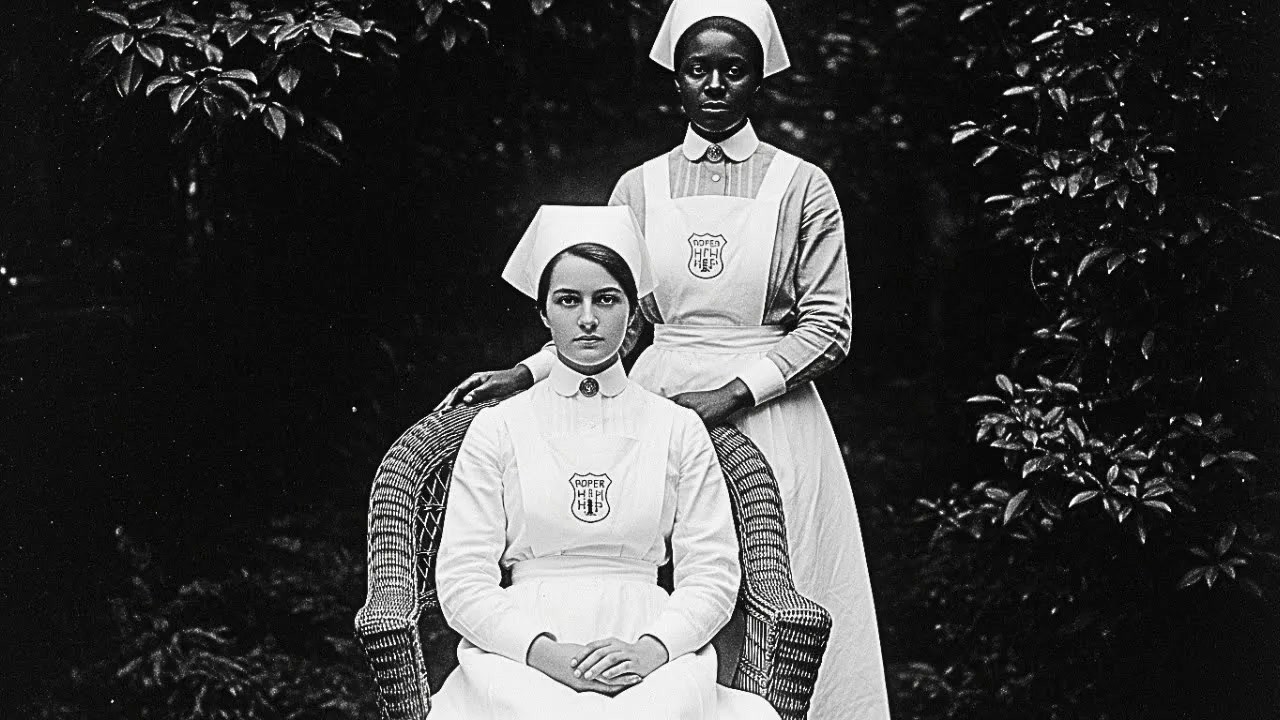
The image showed a young woman, perhaps twenty-five years old, sitting on a wicker chair. She wore an elegant nursing uniform—a white dress, a white cap with a black ribbon, and a white apron. Her hands were quietly folded in her lap. Her expression was calm, almost peaceful, with a slight smile.
The background showed what appeared to be a hospital garden with blurred leaves and dappled sunlight. Nothing unusual. A standard professional portrait from that era. Sarah was about to place it in the pile of documented photographs when something made her look again.
She brought the photograph closer to the desk lamp, adjusting the angle to reduce the glare. There, in the shadows behind the seated nurse, barely visible among the dark foliage, was another person. Sarah held her breath. She picked up her magnifying lens, and her hands were suddenly trembling.
The second person was a woman, also wearing a nursing uniform. She stood slightly to the left and behind the seated nurse, partially obscured by shadow and the angle of the photograph. But her face was visible enough to see her features clearly. She was Black, and she was wearing a nearly identical nursing uniform.
Sarah pushed her chair back, her mind racing. In Charleston in 1911, this photograph should not have existed. Black women could work in hospitals as laundresses, kitchen staff, or cleaning crews. Some worked as attendants in the colored wards, but they did not wear nursing uniforms matching those of white nurses.
They were not photographed beside white nurses as equals. The segregation laws were absolute. Separate entrances, separate wards, everything separate. Black nurses, if they existed at all, wore different uniforms—usually simple gray or brown dresses that clearly distinguished them from white nurses.
Yet here was a Black woman in a white uniform with a distinctive cap, standing in what appeared to be a formal portrait session with a white nurse. Sarah turned the photograph over. On the back, in faded ink, was written: Roper Hospital, Charleston, May 1911, initials only—”E. C.
” No full names. No context. She examined the photograph again under better light. The seated nurse’s face was clear: pale skin, light hair pinned up beneath her cap, delicate features.
The standing nurse’s face, though partially shadowed, showed dark skin and broader features, with an expression that was difficult to interpret. She was not quite smiling, but she was not stern either. Perhaps watchful. Cautious.
What struck Sarah most was the positioning. The standing nurse was not standing in the background like a servant. She was close, almost protective. Her hand rested on the back of the wicker chair, near the shoulder of the seated nurse, not touching, but close enough that the gesture suggested familiarity, perhaps friendship.
Sarah photographed the image with her phone and worked to enlarge and enhance it. The more she looked, the more details emerged. Both women wore identical pins on their uniforms—a Roper Hospital nursing badge. Both wore the same style of cap.
Both maintained the same formal posture of trained professionals. This was not a nurse and her assistant. These were two nurses photographed together in defiance of every social and legal standard in Charleston in 1911. Sarah needed to know who they were and how this photograph had come to exist.
She began with the Roper Hospital archives. The hospital, founded in 1829, still operated in Charleston, though in a modern building far from its original site. The historical records had been donated to the South Carolina Historical Society years before. Sarah spent two days in the society’s reading room, working through boxes of nursing records from 1910 to 1912.
The documents painted a clear picture of the hospital’s operations. Strict segregation, separate wings for whites and coloreds, different standards of care, different staff. The 1911 nursing list recorded the names of 23 white nurses with full names, training dates, and assignments. There was no list of Black staff other than “colored ward attendants.
” No individual names, just a count. Sarah focused on finding the initials E. C. among the white nurses.
Three names matched the initials. Emily Carson, Elizabeth Cunningham, and Edith Chambers. She found the service records for all three. Emily Carson had left the hospital in 1910.
Elizabeth Cunningham worked there from 1909 to 1915. Edith Chambers arrived in 1912. Elizabeth Cunningham remained the most likely candidate to be the seated nurse in the photograph. Sarah requested Elizabeth’s complete employment file.
When it arrived, she found a treasure trove. An employment application, training certificates, letters of recommendation, performance evaluations, and most valuable of all, a small portrait photograph attached to her initial application. Sarah placed the portrait beside the old photograph. It was the same woman.
Elizabeth Cunningham was the seated nurse. But who was the woman standing behind her? The personnel file made no mention of any Black nurses. No mention of cross-racial partnerships, nothing that explained this photograph.
Elizabeth’s evaluations were glowing. Devoted, skilled, with an exemplary manner of patient care, and worked superbly with independence. That last phrase caught Sarah’s attention. “Worked superbly with independence.
” A strange thing to emphasize unless someone wanted to clarify that Elizabeth did not need help or cooperation. Sarah expanded her search, looking for anything unusual that had happened at Roper Hospital in 1911. She found it in the archives of the Charleston News and Courier. In April 1911, a typhoid fever epidemic struck the city of Charleston.
The newspaper reported dozens of cases, overcrowded hospitals, and a shortage of trained nurses. Roper Hospital was hit hard, with the white wards filled and cases spilling into temporary quarters. An article dated May 15, 1911, caught Sarah’s attention. Despite the severity of the epidemic and the unfortunate loss of life, Roper Hospital reported that survival rates had exceeded expectations, especially in the intensive care ward.
The hospital’s director, Dr. Francis Morton, credited the dedication of the nursing staff for this success. The date matched the date on the photograph. Sarah found more articles.
The epidemic lasted from early April through June. At its peak, Roper Hospital treated more than 100 typhoid patients at once, a number beyond its usual capacity. Then she found something else. A letter to the editor, published on June 3, 1911, from a concerned physician.
“Sir, I feel compelled to note the extraordinary care provided during the recent epidemic. While I cannot go into details without violating patient privacy, I observed nursing care of the highest order, showing knowledge and skill that saved many lives. It is shameful that hospital protocols prevent proper recognition of all who contributed to this success. ”
That precise phrasing startled Sarah.
“All who contributed. ” Not all the nurses, but “all who contributed. ” And “hospital protocols prevent proper recognition. ” Was the physician hinting at something?
Someone whose contributions could not be officially acknowledged? Sarah thought about the photograph again. May 1911, right in the middle of the epidemic. Two nurses standing together, one visible and the other partially hidden.
A photograph that seemed peaceful, but perhaps it was not peaceful at all. Perhaps it was an act of defiance. Sarah had to identify the Black woman in the photograph. With no official nursing records to guide her, she turned to other sources.
The Avery Research Center for African American History and Culture, located in Charleston, held extensive archives about Black life in the city. Sarah explained her research to the archivist, a woman named Dr. Renée Baptiste. Renée’s eyes lit up when Sarah showed her the photograph.
“This is remarkable. Do you realize how rare this is? A Black woman in a nursing uniform, photographed with a white nurse in 1911? ”
“That’s why I’m here.
I need to know who she was. ”
Renée studied the photograph carefully. “The uniform is the key. If she was wearing a formal nursing uniform, she received training.
But where? Black women could not attend white nursing schools in the South. Could she have trained somewhere else? Possibly.
There were a few nursing schools for Black women in the North, like Freedman’s Hospital in Washington and Lincoln Hospital in New York. Or perhaps she was trained informally by a Black physician or midwife. ”
Renée brought out several boxes of materials relating to Black healthcare workers in Charleston. Most focused on midwives, herbalists, and informal healers who had served the Black community.
But in a collection of oral histories recorded in the 1960s, Sarah found something promising. An interview with a woman named Ruth Patterson, recorded in 1967 when she was eighty-three years old. “Oh yes. She was a nurse.
A real nurse, even though they wouldn’t let her admit it. She learned from Dr. Benjamin, one of the Black physicians who practiced in our community. She knew everything.
How to treat fevers, set bones, deliver babies. During the typhoid epidemic, she worked at Roper Hospital saving white lives, but she had to pretend she was just a cleaning woman, just a helper. And yet the white nurses knew the truth, and some of them were grateful. ”
“Do you remember your aunt’s name?
” the interviewer asked. “Clara. Clara Hayes. ”
Sarah’s hands shook as she wrote down the name.
Clara Hayes. Could she be the woman in the photograph? With a name to search for, Sarah and Renée delved deeper into genealogical records. They found Clara Hayes in the 1910 census.
Black female, age 24, occupation: laundress, residing in Charleston. A laundress. The official record showed she washed clothes, nothing more. But Renée found something else.
A birth certificate from 1931 listing Clara Hayes as the attending midwife. Then another from 1933, then dozens more through the 1940s. Clara had delivered babies for Black families across Charleston for decades. Renée explained that midwives required training.
They had to know anatomy, recognize complications, handle emergencies. If Clara had been successfully delivering babies for twenty years, she possessed real medical knowledge. They found Clara’s death certificate from 1952. Clara Hayes, age 66, occupation: midwife and community health worker.
Still no mention of nursing. Sarah contacted Ruth Patterson’s descendants. Ruth had died in 1974, but her grandson Michael still lived in Charleston. When Sarah called and explained her research, he invited her to his home immediately.
Michael’s living room was filled with family photographs. He brought out an old album and began flipping through its pages carefully. “My grandmother used to talk about Aunt Clara all the time,” Michael said. “She said she was the smartest woman she ever knew.
She taught herself to read medical books and learned everything she could about healing. ”
He stopped at a page near the end of the album. There, in a small photograph, was a young Black woman wearing a simple dark dress. But pinned to her chest was a small brooch.
When Sarah looked closely, she recognized it. It was the same nursing pin visible in the 1911 photograph. Michael continued. “My grandmother said Aunt Clara worked in the white hospital during a bad sickness.
She saved a lot of people. The white nurses appreciated her, but the hospital administration forced her to work in secret. They said her nursing white patients was illegal. ”
“Did your grandmother ever mention a white nurse who worked with Clara?
”
Michael thought for a moment. “She mentioned someone. She said there was a white nurse who treated Aunt Clara like an equal and fought to let her work in the ward during the epidemic. But I don’t remember the name.
”
Sarah knew the name now. Elizabeth Cunningham. Sarah returned to the South Carolina Historical Society with a new purpose. She requested every document relating to the 1911 typhoid epidemic at Roper Hospital.
Among the administrative records, she found something astonishing: a confidential memorandum from the hospital director, Dr. Francis Morton, to the board of directors, dated May 20, 1911. “Gentlemen, I write to address an unusual situation that has developed during the current epidemic. Due to the acute shortage of trained nurses, one of our nurses, Miss Elizabeth Cunningham, has enlisted the assistance of a colored woman who possesses considerable medical knowledge.
This woman, officially employed as a laundress, is providing direct patient care in the acute ward under Miss Cunningham’s supervision. Although this arrangement violates our protocols regarding segregation, I must report that patient outcomes have improved markedly since its implementation. The colored woman demonstrates skills equal to our trained nurses, and many patients who would likely have died have survived. I request the board’s guidance on this matter.
This arrangement cannot continue indefinitely, but ending it during the epidemic may cost lives. ”
The memorandum was stamped “confidential—not for publication. ”
Sarah found the board’s reply, dated May 25, 1911. “This arrangement may continue for the duration of the epidemic, but the colored woman must not wear the nursing uniform, nor must she be identified as a nurse in any official capacity.
She must not be photographed or her presence documented. Once the epidemic is over, she must return to the laundry duties assigned to her. ”
But someone had violated those instructions. Someone had photographed Clara Hayes in a nursing uniform, standing beside Elizabeth Cunningham.
Sarah examined the photograph again in light of this new context. The positioning of the figures now made sense. Elizabeth sat, visible, formal, as the registered nurse. Clara stood behind her, partially hidden, barely visible—the nurse who did not officially exist.
But both were there. Both wore the uniform. Both had saved lives. And someone—perhaps the photographer, perhaps Elizabeth herself—had made sure that proof of it existed.
Sarah tracked down Elizabeth Cunningham’s descendants. Elizabeth had married in 1916 and moved to Columbia, South Carolina. She continued nursing until 1925, then raised three children. She died in 1964.
Her granddaughter, Margaret Wright, lived in Mount Pleasant, just outside Charleston. When Sarah called, Margaret showed immediate interest. “I have some of my grandmother’s things in my attic,” Margaret said. “I’ve been meaning to go through them for years.
Would you like to help? ”
The attic was stifling even in early October. Among boxes of clothes, books, and household items, they found a leather trunk embossed with Elizabeth’s initials. Inside were treasures: Elizabeth’s nursing certificate, her official cap, photographs from her nursing class, letters from former patients.
And at the bottom, wrapped in faded silk, a bundle of letters tied with a ribbon. Sarah carefully untied the ribbon. The letters were dated between 1911 and 1915, all addressed to Elizabeth and signed with the letter C. The first letter, dated June 1911, read: “Dear Elizabeth, I wanted to write to thank you for your kindness during the epidemic.
You treated me as a colleague while others saw only the color of my skin. You risked your position to allow me to care for patients, and to teach me how to work alongside you. Those weeks changed my life. I learned so much from you, not only nursing skills but what it means to see people as they truly are, not as society says they should be.
I will carry this lesson with me always. Your friend, C. ”
Sarah’s eyes filled with tears. She read the next letter, from October 1911.
“Dear Elizabeth, I heard that you defended me before the administrators when they wanted to dismiss me after the epidemic. I know that cost you dearly. And I know they are watching you more carefully now. I wish I could repay your loyalty to me.
All I can offer is to continue my service to our community. I am now delivering babies and caring for the sick in their homes. I think of what you taught me every day. Your loyal friend, C.
”
There were other letters, correspondence over years, in which Clara kept Elizabeth informed of her work. And Elizabeth replied with encouragement and medical advice. Two nurses, separated by race and society, maintained a friendship built during crisis. The final letter, dated March 1915, contained a dried flower.
“Dear Elizabeth, I heard you are leaving Charleston. I am happy for you and sad for myself. You have been the sister I chose, even though the world said we could not be sisters. Thank you for seeing my essence.
Thank you for the photograph. I will always cherish it. Be well, my friend. C.
”
Margaret wiped her eyes. “I never knew. My grandmother never spoke of this. ”
Sarah understood why.
In 1911, and even in 1964 when Elizabeth died, acknowledging this friendship could have been dangerous, could have cost Elizabeth her reputation. But Elizabeth had kept the letters, hidden but preserved, as evidence of a bond that mattered more than the laws that tried to forbid it. Sarah pieced together what must have happened in May 1911. The epidemic was drawing to a close.
Clara would soon be forced back to the laundry. The brief window in which she had been able to practice nursing openly was closing. Elizabeth Cunningham, recognizing this, arranged for a photograph to be taken. Not a candid shot, but a formal portrait.
She persuaded Clara to wear a nursing uniform, perhaps her own spare one. They went to a photographer’s studio or the hospital garden. They stood together for the photograph. The photographer must have been aware of the risk.
Clara was placed partially in shadow, making her presence less obvious but not completely hidden. A deniable claim if questioned, but clear enough for anyone who looked closely. This was not just a peaceful photograph. It was a document of resistance and defiance.
Elizabeth was saying: This woman is a nurse. I don’t care what the law says. I don’t care what society says. She saved lives.
She deserves to be seen. And Clara, standing there in that uniform, was declaring her identity. I am a nurse, even if I cannot say it aloud. Even if I must spend my life washing linens and delivering babies in secret, I am a nurse.
Sarah found another piece of evidence in the archives. Elizabeth Cunningham’s letter of resignation from Roper Hospital, dated August 1911. “I regretfully submit my resignation from my position. I can no longer serve an institution that refuses to recognize excellence simply because of race.
During the recent epidemic, I witnessed care and skill equal to any qualified nurse, and yet that person was forced to return to hard labor once the urgent need for her contributions had passed. I cannot in good conscience continue to benefit from a system that treats human beings with such injustice. ”
Elizabeth had resigned. She had sacrificed her position rather than participate in erasing Clara’s contributions.
The two women had stood together in that photograph, and Elizabeth had maintained those convictions even when it cost her dearly. Sarah organized an exhibition at the Charleston Medical History Museum titled “Hidden in Plain Sight: Nursing Across the Color Line. ” The 1911 photograph was the centerpiece. She had conducted extensive research, documenting both women’s lives fully.
Elizabeth Cunningham, a trained nurse, a heroine of the epidemic, and a principled resigner from unjust systems, continued nursing in Columbia with the same integrity she had shown in Charleston. Clara Hayes, a self-taught healer, a secret nurse during the epidemic, a community midwife and health worker for four decades, delivered hundreds of babies and saved countless lives without ever being officially recognized as a medical professional. The exhibition included the letters, Clara’s nursing pin, Elizabeth’s resignation letter, the hospital records from the epidemic period, and testimony from the descendants of both women. At the opening ceremony, Michael Patterson stood beside Margaret Wright.
Descendants of the two nurses stared at the photograph of their ancestors together. “They would have loved this,” Margaret said quietly. “My grandmother always believed in justice and seeing people as they truly are. I think Clara helped teach her that.
”
“Aunt Clara always said some white people were different,” Michael added. “She said there were those who looked beyond the laws to see the person underneath. Your grandmother was one of those. ”
Sarah addressed the gathered community.
“This photograph seemed peaceful when I first saw it. A young nurse sitting quietly in a garden. Just another photograph from another time. But when you look closely, when you see who stands beside her, you realize it is much more than that.
It is a document of friendship across impossible barriers. It is a testament to two women who placed healing above hatred, skill above segregation, and humanity above unjust laws. ”
Clara Hayes could not be officially recognized as a nurse in 1911. But Elizabeth Cunningham made sure she was photographed as one.
That act of documentation and defiance preserved Clara’s identity for us to discover more than a century later. How many other “Clara Hayeses” were there? How many skilled, dedicated healthcare workers were erased from history because of their race? How many partnerships existed in secret like this one, away from official records, but real nonetheless?
This photograph answers those questions. Yes, they existed. Yes, they mattered. Yes, they deserve to be remembered.
The Medical University of South Carolina, which now operates Roper Hospital, issued an official statement. “We acknowledge that Clara Hayes worked as a skilled nurse during the 1911 typhoid epidemic and throughout her life in Charleston. We recognize the courage of Elizabeth Cunningham in advocating for equal recognition of skill regardless of race. We honor the contributions of both women to healing and apologize for the institutional racism that prevented Clara Hayes from receiving the recognition she deserved during her lifetime.
”
A historical marker was placed near the original Roper Hospital site. “Clara Hayes, 1886–1952, and Elizabeth Cunningham, 1886–1964. Nurses and pioneers during the 1911 typhoid epidemic. These two women worked together to save lives, defying the segregation laws that prohibited Black nurses from caring for white patients.
Although only one was officially recognized at the time, both were equally skilled and dedicated nurses. Their partnership, documented in a photograph that seemed peaceful but was revolutionary, reminds us that justice and healing have always required the courage to look beyond unjust barriers. ”
The photograph was no longer just a peaceful image. It was a window into an extraordinary friendship and a profound injustice.
Clara Hayes no longer stood in the shadows. Elizabeth Cunningham’s act of documentation had succeeded beyond anything she could have imagined. Two nurses, two women, one photograph that changed how history would remember them both. In Charleston, in the hospitals and nursing schools, their story would be told to every new generation.
How healing requires not only skill and knowledge, but the courage to see each other honestly, to stand together when laws and customs demand separation, and to document the truth even when it must remain partially hidden in shadow. The photograph seemed peaceful. But peace built on injustice is not peace at all. True peace comes from recognition, from truth, from revealing those whom society tried to hide.
Clara Hayes was visible now. And she had always been visible to anyone who looked closely enough to see who was really standing there.
