In the autumn of 1842, tens of thousands of New Yorkers gathered to celebrate the arrival of something so ordinary we now turn it on without a thought a hundred times a day: clean water. It had traveled down a hand-built brick tunnel 41 miles long from the Croton River in Westchester County, and it had made every foot of that journey without a single pump. No steam engine pushed it. No machine lifted it.
The water walked itself into the greatest city in America on nothing but gravity, falling so gently along the tunnel that it dropped only about thirteen inches for every mile it traveled. The entire trip took twenty-two hours. Before that water arrived, New York was a place dying of thirst in the middle of plenty. A city where people drank filth, where cholera swept through in waves and killed by the thousands, and where a fire could burn for days because there was no clean water to fight it with.
By the 1830s, New York was the biggest and fastest-growing city in the country, but it still drank essentially the way a village drinks, from local wells and ponds and a few private water companies. The shallow wells were increasingly poisoned by the waste of a crowded population, by privies and graveyards and the runoff of the streets. The most famous water source, a pond called the Collect, had become so polluted it had to be filled in entirely. People who could afford it bought water carted in from the countryside in barrels and sold through the streets by the pailful.
Everyone else drank what they could get, and what they could get was making them sick. There had even been an attempt at a private solution that turned into one of the great swindles of the era. In 1799, a company was chartered, supposedly to supply the city with fresh water. But its real purpose, buried in the fine print by its founder, the politician Aaron Burr, was to use the water charter as a cover to start a bank.
The company laid a few wooden pipes and delivered poor water to a fraction of the city while the bank flourished, and New York’s water problem went right on getting worse. Then came the two disasters that finally forced the issue. In 1832, a cholera epidemic swept through New York and killed thousands of people in a matter of weeks, striking hardest exactly where the water and the sanitation were worst. Then, in December of 1835, in the middle of a savage cold snap, fire broke out in the heart of lower Manhattan, in the district of warehouses and merchant houses that was the engine of the city’s wealth.
The cold was so extreme that the water in the cisterns and the hydrants and even the rivers had frozen. The fire burned out of control through the night and into the next day, consuming hundreds of buildings and gutting a huge part of the commercial city. A city without water could be killed slowly by disease or quickly by fire, and New York had just suffered both. The enormous cost and difficulty of reaching forty miles north for clean water stopped looking like an extravagance and started looking like survival.
The place they decided to get it from was the Croton River, more than forty miles to the north. The plan was to dam the Croton to make a great reservoir and then carry its water all the way down to the city. With no electricity and no practical way to pump such a volume across such a distance, the answer the engineers chose was as old as the Romans: gravity. If the water started high enough at the Croton end, and if the tunnel that carried it descended at a perfectly steady, gentle grade the entire way, then the water would simply flow downhill on its own, using no power at all except the pull of the earth.
That simple idea hid a staggering demand for precision. The tunnel could not just slope downhill in general. It had to descend at a controlled, continuous rate the whole way, because if any stretch went downhill too steeply, the water would race and then pool, and if any stretch went even slightly uphill, the water would stop dead. Across forty-one miles of real country, of hills and valleys and rivers and rock, the engineers had to hold the floor of that tunnel to a fall of only about thirteen inches per mile.
The chief engineer who saw this through was a largely self-taught man named John B. Jervis, who had come up through the ranks on the Erie Canal. Using only levels, transits, and measuring chains, his surveyors went over the entire route on foot, establishing the exact height of the tunnel floor at point after point across hills and swamps and river valleys. A single sustained error, a stretch built a little too high, would have created a place where the water slowed and stopped, and the entire aqueduct would have failed.
The tunnel itself was not a pipe. It was a masonry conduit of brick and stone that a person could walk through, shaped in cross-section a little like an egg standing on its narrower end, about eight and a half feet high and seven and a half feet wide on the inside. The whole length of it was lined with brick, millions upon millions of bricks laid by hand. Where the ground was high, the conduit ran underground, cut and often blasted through solid rock.
Where the ground was low, it ran along the top of massive earthen embankments, so that it never lost its precious downward grade. Every mile or so along its length, they built a ventilating tower, a stone shaft rising ten or twenty feet to let air move through the tunnel and to give access to it. At capacity, the system carried 35 million gallons of water a day, moving at a walking pace of under two miles per hour. The aqueduct was dug, blasted, and bricked over almost entirely by hand.
And the hands were overwhelmingly Irish. Somewhere between three and four thousand of them worked on the Croton Aqueduct, part of the first great wave of Irish immigration to America. Men driven across the ocean by poverty and hunger, arriving in a country that wanted their muscle and little else. They lived in rough shanty camps strung out along the line of the work, moving as the work moved, in conditions that were miserable and unhealthy.
They swung the picks and shovels that cut the channel. They drilled and set the black powder that blasted it through rock, one of the most dangerous jobs on the entire project, where premature blasts and flying stone maimed and killed men with the crude fuses and uncertain timing of the era. They mixed the mortar and laid the brick that lined it mile after mile. And they did it for about a dollar a day.
In 1840, the contractors decided to cut the workers’ pay from a dollar a day down to seventy-five cents. The men who were building the thing that would save the city, living in shanties and breathing rock dust, were told they would now be paid a quarter less for it. They did what workers have always done when pushed too far. They went on strike.
They refused to work. And the response of the authorities was not to negotiate. It was to call out the militia, armed soldiers, to break the strike and force the men back to the work. The strike was put down, the men went back to the picks and the powder at the reduced wage, and the tunnel went on toward the city.
There was one man among all those laborers whose name did survive. George Law was an immigrant who came to this work with nothing, taking a job as a common laborer and stonemason on public works like the canals and the aqueduct. But Law was ambitious and shrewd, and he clawed his way up from laborer to foreman, to subcontractor, to contractor. He rose high enough that in 1839, when the city sought a builder for the aqueduct’s single most difficult and spectacular structure, the great bridge that would have to carry the water across the wide valley of the Harlem River, the contract went to a partnership that included George Law.
The man who had started as a laborer on the aqueduct ended up building its crown, and he would go on from there to become genuinely wealthy, a major figure in steamships and railroads. The three or four thousand other men who dug and blasted and bricked that tunnel beside him did not rise. They finished the work, and they moved on to the next hard job, and the records swallowed their names whole. The bridge Law helped build, the High Bridge, was the most beautiful thing in the whole system.
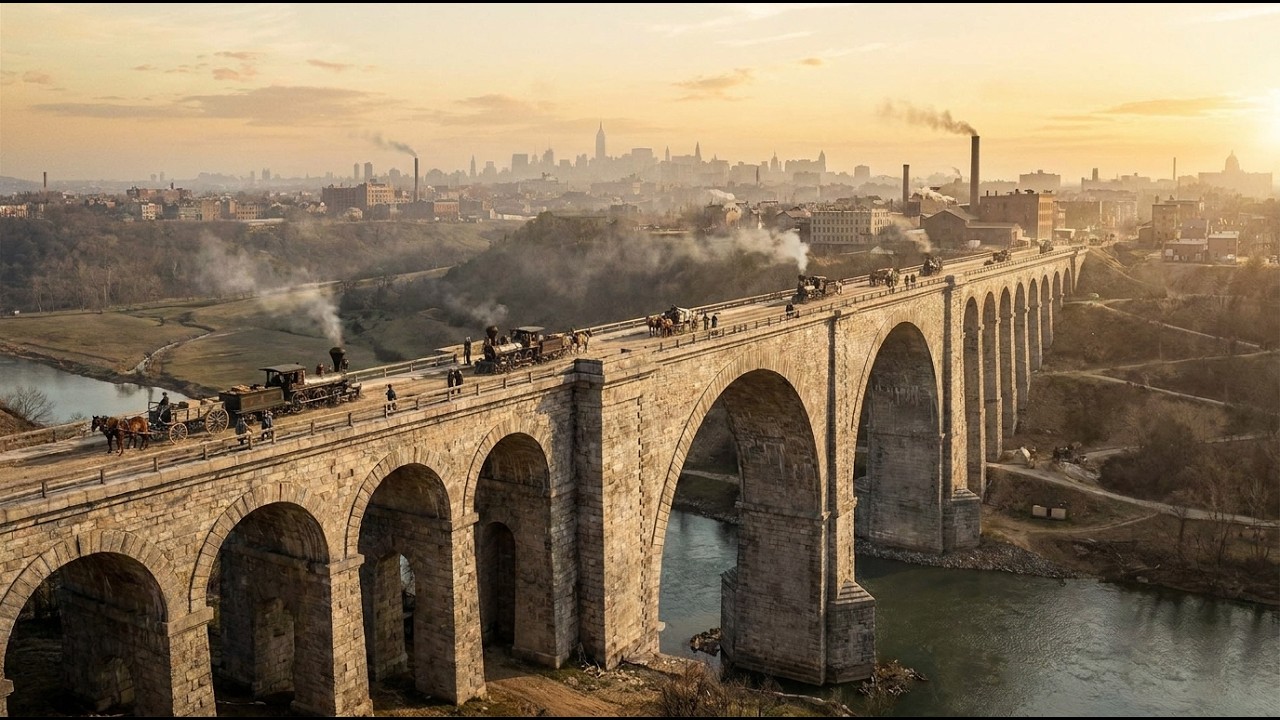
A great stone bridge marching across the Harlem River valley on a row of tall masonry arches, fifteen of them in the original design, so that from a distance it looked exactly like a Roman aqueduct transplanted to nineteenth-century New York. Across the top of those arches ran the great iron pipes that carried the water. It took years to complete and did not open until 1848, six years after water first reached the city. In the meantime, the water crossed the Harlem Valley through pipes laid across a lower temporary structure.
When it was finished, it was one of the handsomest structures in America. It still stands today, the oldest bridge in New York City, having carried first water and later people across the Harlem for well over a century. The river did not give up its water without a fight. In January of 1841, with the great work well underway, a violent winter storm hit the Croton Valley and the swollen river tore into the dam they were building to hold the reservoir.
The dam failed, and a wall of water went down the valley, destroying property and taking lives in the flood. They rebuilt, larger and stronger, and the reservoir filled. Making that lake meant drowning land, covering farms and fields and mills and roads that had been there for generations, an early instance of a pattern that would repeat again and again as growing cities reached out to take the water of the countryside. At last, it was done, and the water came.
On a June morning in 1842, they let the Croton water into the head of the aqueduct, and it began its slow twenty-two-hour walk south. Men rode along beside it, and a small boat called the Croton Maid floated on the current inside the tunnel itself, escorting the water down toward the city like a procession. Above ground, riders and crowds followed the water’s progress south over the days it took to arrive. It filled the great receiving reservoir up in what is now Central Park, a reservoir holding 180 million gallons, and then the distributing reservoir down at 42nd Street and Fifth Avenue, a strange and monumental structure with sloping Egyptian-style walls and a promenade on top where New Yorkers would stroll and admire the view.
On the 14th of October, 1842, the city held a celebration that stopped everything. There was a parade miles long, church bells rang, and cannon fired. In the fountain at City Hall Park, the new Croton water was set loose to leap fifty feet straight up into the air. A tower of clean water spouting up out of the ground in the middle of Manhattan, and the crowds went, by every account, a little bit mad with joy at the sight of it.
Poems were written for the occasion. Songs were sung. The reservoirs where the water collected became attractions in their own right, and fashionable New Yorkers made a habit of strolling along the top of the distributing reservoir to take the air and look out over the growing city. What that water did to New York is almost impossible to overstate.
It did not just quench thirst. It made the modern city possible. With abundant clean water, the worst of the water-borne epidemics could finally be fought. With water in the hydrants, fires could be controlled.
With water in the pipes, the city could build sewers and baths, and indoor plumbing could grow upward and outward into the metropolis it became. Historians of the city will tell you flatly that New York could not have become New York without the Croton water. The whole colossal future of the place rested on a brick tunnel full of water walking quietly downhill. Other American cities watched and followed.
Within New York itself, the original Croton system was eventually outgrown by the exploding population it had helped create, and later in the century, the city built an even larger New Croton Aqueduct alongside the old one, and later still reached all the way to the distant Catskill Mountains, building one of the greatest water supply systems on Earth. But it all began with that first brick tunnel and its thirteen-inch grade and its army of Irish hands. The old aqueduct still lies there under the ground, its long line now a public trail that runs for miles south through Westchester, a green path where people walk their dogs and jog in the evening, most of them with no idea that a few feet beneath their shoes runs the brick channel that made the modern city possible. Every foot of that miracle was dug and blasted and bricked by men who lived in shanties and were paid a dollar a day and were marched back to work by soldiers when they asked for that dollar not to become seventy-five cents.
They drank bad water and breathed rock dust and set the black powder that could kill them in an instant, and they built the thing that gave a great city clean water and a future and then vanished from the story almost entirely. Today, a New Yorker turns a tap without a thought and clean water runs, and that plain fact is the standing memorial to those men, renewed every single day, used by millions who will never know it is there for them. They pulled a river to a dying city, downhill, by hand.
And almost no one ever learned their names.
