The story of the world’s first modern corporation begins not with a stock certificate but with a gunshot in 1584. William of Orange, the leader of the Dutch revolt against Spain, lay dying in his home at Delft, his final words a plea for pity on his people. His seventeen-year-old son, Maurice of Nassau, inherited a war that could not be won by courage alone. Maurice studied the military texts of ancient Rome and concluded that the Spanish could only be beaten by science: professional armies, mobile artillery, and disciplined siegecraft.
But such an army demanded money on a scale no feudal treasury could provide. The House of Orange needed capital, and the merchants of Amsterdam needed protection. The solution they forged together would redraw the map of the world. In 1595, Amsterdam was alive with the profits of the spice trade.
A single successful voyage to the Indonesian islands could return four hundred percent on investment. Nutmeg bought for three gilders in the Banda Islands could sell for three hundred in European markets. The problem was that too many Dutch traders were chasing the same prize. Independent companies competed against each other, driving up purchase prices in Asia and flooding European markets with spices until sale prices collapsed.
Indigenous rulers exploited the division, playing Dutch rivals against one another. Portuguese and English merchants pressed their own advantages. Holland’s chief minister, Johan van Oldenbarnevelt, recognized the crisis: individual merchants lacked the capital to establish permanent settlements, provide military protection, or enforce coordinated policy. The remedy he proposed was revolutionary.
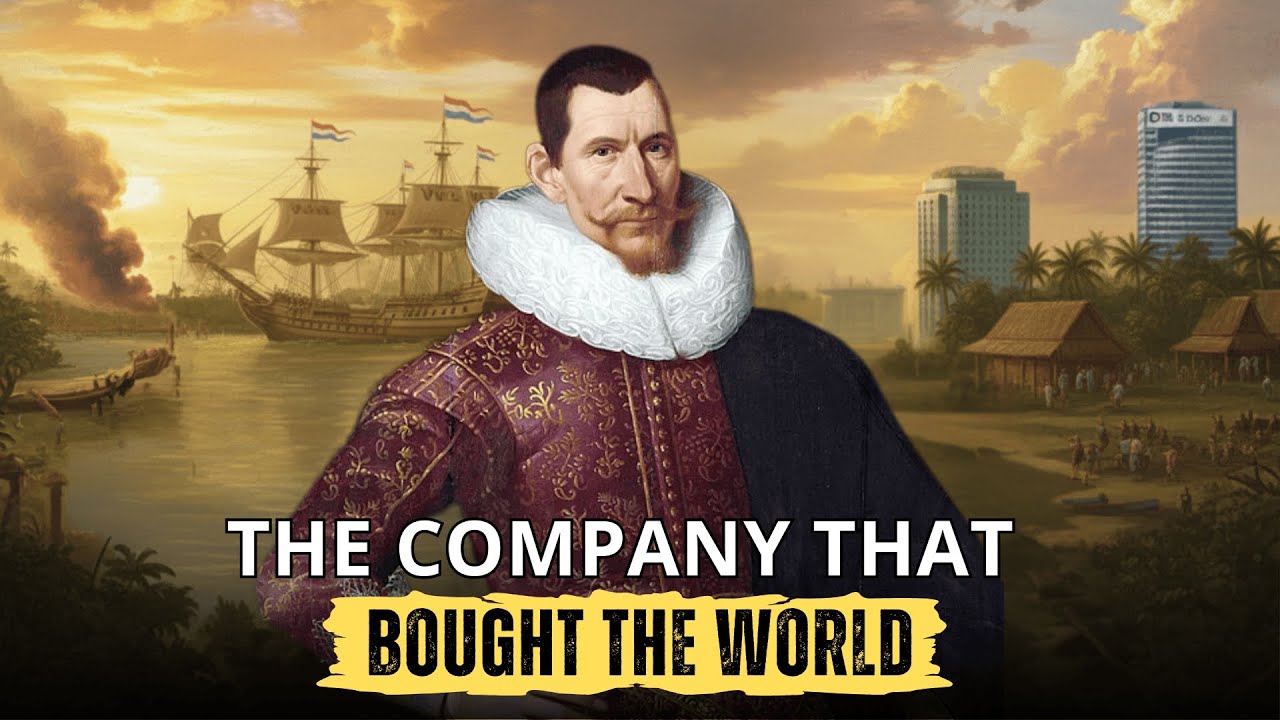
Consolidate every competing Dutch company into a single corporate entity, and grant it the capital, the military force, and the political authority to secure a permanent monopoly over Asian spice production. On March 20, 1602, seven Dutch merchants signed the charter of the Verenigde Oostindische Compagnie, the Dutch East India Company. No European state had ever bestowed such authority on a commercial enterprise. The VOC was permitted to govern colonies, maintain standing armies and navies, declare war, negotiate treaties, mint its own currency, and impose taxes on conquered populations.
Its initial capitalization reached 6. 4 million gilders, roughly one hundred million dollars today, a sum greater than the reserves of most European governments. Ownership was divided into shares that investors could trade freely. Limited liability protected shareholders from personal responsibility for the company’s debts or crimes.
Amsterdam merchants took fifty-seven percent of the shares, Zealand twenty percent, Delft and Rotterdam fourteen, and the smaller cities nine. The structure ensured Amsterdam’s leadership while securing broad political support across the Republic. The company’s first governor-general, Pieter Both, received explicit instructions: establish permanent control over spice production by whatever means necessary. Rival European merchants were to be excluded entirely from Dutch domains.
Cooperative rulers would receive protection and payment. Resistant rulers would face severe military consequences until cooperation was achieved. Both sailed east with twelve warships and one thousand professional soldiers, equipment for fortifications, and gifts valued at over two hundred thousand gilders. It was not a trading mission.
It was a corporate invasion. The first major test came in 1609 at Banda Neira, the administrative heart of the Banda Islands, the only place on earth where nutmeg and mace grew wild. The islands were home to roughly fifteen thousand people who had preserved their independence for centuries, selling spices to Portuguese, English, Chinese, and Japanese buyers who competed for their trade. The VOC demanded an exclusive monopoly at prices the Dutch would dictate.
The Bandanese refused. The Dutch responded with a six-month siege designed to terrorize the population into submission. They blockaded the islands, burned nutmeg groves and food crops, executed captured leaders, and deliberately brutalized civilians. A VOC medical officer documented the strategy: military operations prioritized civilian terror over traditional battlefield success.
The psychological warfare worked. In August 1609, surviving Bandanese leaders signed a treaty granting the VOC exclusive rights to all nutmeg and mace at prices set solely by Dutch officials. But the treaty did not end resistance. Producers smuggled spices to non-Dutch buyers.
Leaders sought aid from the English and Portuguese. Jan Pieterszoon Coen, appointed governor-general in 1618, concluded that partial control was insufficient. His proposal to the directors, the Heeren XVII, was explicit: complete profit maximization required the systematic elimination of the indigenous Bandanese population and its replacement with enslaved labor. The directors authorized whatever population control measures proved necessary for permanent commercial advantage.
In May 1621, VOC forces began the systematic murder of Bandanese men, the enslavement of women and children, and the destruction of evidence of the pre-Dutch civilization. Twentieth-century excavations later uncovered mass graves on the islands. The new workforce, enslaved Javanese, Chinese indentured laborers, and Dutch settlers, had no ties to the land and no capacity for resistance. Nutmeg production soared, and with the local population gone, the company could restrict exports to manufacture artificial scarcity.
Spice that cost one gilder to produce sold for three hundred in Amsterdam. Between 1621 and 1625, VOC stock prices rose by one hundred ninety percent. The success at Banda established the template for the entire empire. The VOC expanded its naval forces from twelve ships in 1603 to one hundred fifty warships by 1630, a fleet larger than most national navies, operating under corporate rather than government authority.
In 1622, Admiral Piet Heyn led twenty-two warships against Portuguese Macau, routed the defenders in six hours, and then demanded exclusive trading privileges from Chinese authorities, who agreed rather than risk similar aggression. In 1623, Coen ordered the elimination of the English trading post at Ambon. Twenty English merchants were tortured and executed, and accounts of their suffering were circulated throughout the archipelago. Local rulers across Indonesia expelled competing European merchants rather than risk Dutch retaliation.
The English East India Company withdrew from Indonesian markets entirely and concentrated on India. By 1625, the VOC had achieved complete monopoly control over the world’s most valuable spice-producing territories. The empire the company administered bore little resemblance to traditional European colonies. VOC territories were managed by company employees answerable only to shareholders in Amsterdam.
Regional administrators were evaluated on their success in maximizing extraction while minimizing expenses. Administrators who exceeded production quotas received bonuses; those who failed were dismissed. The Maluku Islands were reorganized around clove plantations worked by enslaved laborers who labored sixteen hours daily during harvests, received rations calculated only to maintain work capacity, and were replaced rather than treated when they became sick or injured. Company medical officers monitored worker health solely to optimize productivity.
The company maintained detailed genealogies of enslaved families to track inherited traits suited to different plantation work. Javanese farmers were forced to devote up to sixty percent of their land to coffee cultivation for export, creating a food dependency that left them vulnerable to famine whenever rice imports were disrupted. By 1660, the entire empire, governing millions of people across three continents, was administered by fewer than three thousand Dutch officials. The financial system that supported this enterprise was as innovative as its military campaign.
The Amsterdam Stock Exchange, established for VOC share trading, became the world’s first modern financial market. The company pioneered futures contracts, short selling, transfer pricing to minimize taxes, and the deliberate manipulation of supply to create scarcity. It developed letters of credit accepted throughout Europe and Asia, sophisticated currency management across multiple monetary systems, and insurance policies that covered maritime losses but excluded damage caused by corporate military operations. Between 1602 and 1650, shareholders received average annual dividends of eighteen percent, with peak years exceeding twenty-five percent.
Special distributions sometimes included actual commodities. The dividends frequently surpassed the total government budgets of sovereign European nations. The empire peaked around 1690, when the VOC controlled ninety percent of global spice production, seventy percent of Asian textile exports to Europe, sixty percent of the global coffee trade, and forty percent of worldwide sugar distribution. European governments negotiated treaties directly with company representatives, recognizing VOC territorial sovereignty as the equal of any kingdom.
But the foundations were already rotting. Maintaining the empire consumed resources faster than the monopoly could generate them. Local resistance, increasingly sophisticated, targeted plantations, warehouses, and supply lines. The Javanese War of Succession from 1741 to 1743 demonstrated that corporate armies could control specific locations but could not suppress pervasive popular resistance.
By 1750, administrative and military costs consumed over sixty percent of corporate revenues. Corruption was systematic, with officials engaging in private trading that competed directly with company commerce. The Fourth Anglo-Dutch War from 1781 to 1784 cost the company over forty-three million gilders in damages as English forces seized VOC installations and severed the shipping lanes connecting the empire. By the end of the eighteenth century, the company carried eighty-five million gilders in debt against assets valued at roughly sixty million.
The Dutch government attempted a rescue, but no amount of subsidy could restore the corporate autonomy that had enabled the system. On December 31, 1799, the Dutch East India Company officially ceased operations and transferred all territory and authority to the Dutch state. The world’s first multinational corporation had collapsed after 197 years by the same logic that created it. It had proved that a private company willing to use unlimited violence could establish an empire more efficiently than any monarch, but maintaining that empire required governmental resources that no corporation could sustain indefinitely while channeling profits only to private shareholders.
The House of Orange, which had built its power on the company’s money, adapted. When Napoleon was defeated in 1815, the family returned, not as servants of the republic but as kings. The new monarchy stumbled through a series of disastrous rulers, including the gambling-addicted William II and his son William III, whom the international press called King Gorilla. The male line was dying out.
The dynasty was saved by a succession of women. Queen Wilhelmina became the voice of Dutch resistance against Hitler, broadcasting from exile. Her daughter Juliana rebranded the monarchy as the bicycle monarchy, with royals pictured cycling to work and sending children to public schools. The public image was repaired, but the family’s financial roots remained underground, with holdings in Philips, Royal Dutch Airlines, and Royal Dutch Shell, the latter operating in the same territories the VOC once ruled.
The legacy extends beyond the monarchy. The corporate structures the VOC pioneered, limited liability, transfer pricing, regulatory arbitrage, market manipulation, remain the standard tools of global capitalism. Modern multinational corporations use the same legal shields to protect shareholders from accountability for environmental destruction, labor exploitation, and collaboration with military forces that suppress resistance. The international institutions that enforce corporate-friendly policies against developing nations operate through the same logic as the treaties the VOC forced on local rulers.
The psychological distance that allowed Dutch shareholders to celebrate dividends while ignoring genocide is identical to the distance that allows modern investors and consumers to profit from or purchase goods produced by enslaved labor without confronting the cost. On July 1, 2023, King Willem-Alexander stood before the world and apologized for the royal family’s role in slavery, acknowledging that his ancestors did nothing to stop it. The apology came four centuries too late for the Bandanese, and it could not undo the structural inheritance of a system built on the principle that systematic brutality, properly disguised as legitimate enterprise, could generate extraordinary returns.
The history of the VOC is the history of how seven merchants in a chamber in Amsterdam created the blueprint for modern capitalism: a system engineered to transform mass suffering into shareholder profit while insulating those who profit from any responsibility for the cost.
