On a February morning in 1870, the divorce court on the Strand in London was packed to capacity, every seat in the gallery taken. The public had been electrified for weeks, not because of the aggrieved husband or the young wife at the center of the case, but because the heir to the British throne had been subpoenaed as a witness. The Prince of Wales, son of Queen Victoria and future king of the British Empire, was about to be questioned under oath about his relationship with another man’s wife. Nothing like this had ever happened before.
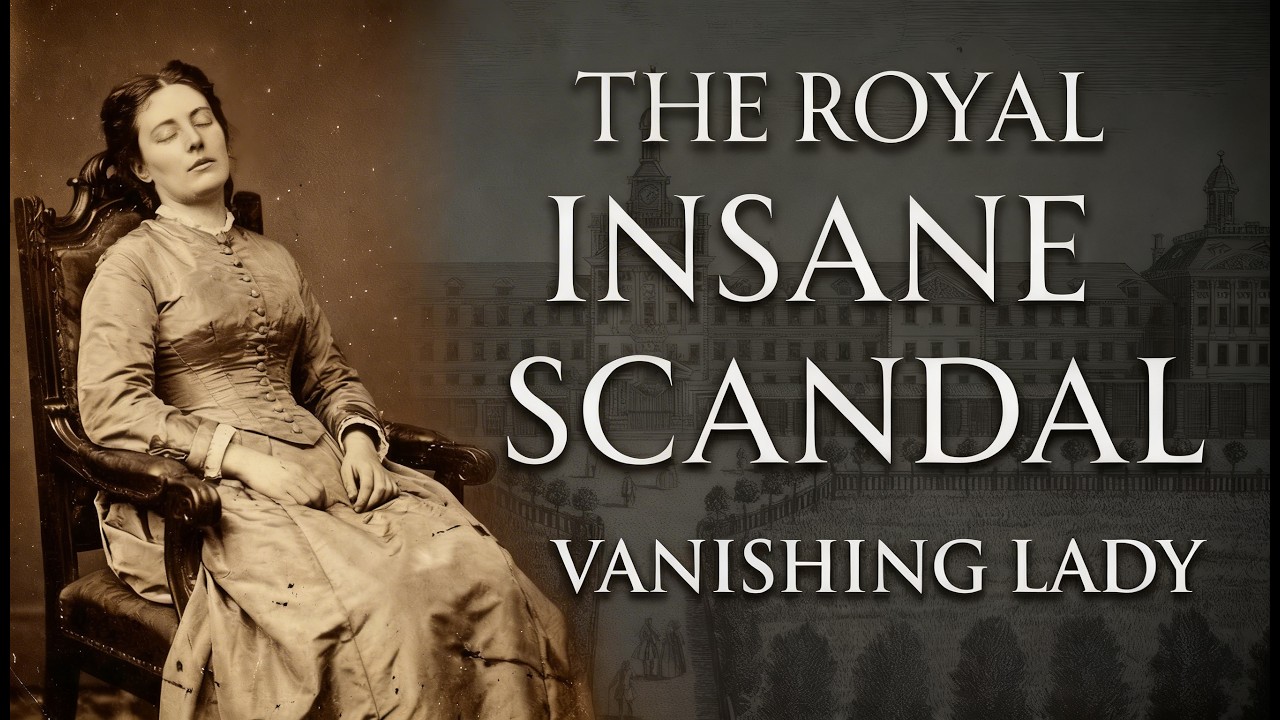
The woman at the center of the storm was Harriet Mordaunt, a 21-year-old Scottish aristocrat who had confessed to her husband that she had been unfaithful, often, in open day, and who had named three men, including the Prince himself. Within months, her own family would have her declared insane. She would not be seen in public again for 36 years. Born in 1848 on a Highland estate in Perthshire, Harriet was the daughter of Sir Thomas Moncreiffe, a baronet whose social ambition treated his daughters less like people and more like currency.
In 1866, that ambition found its bidder in Sir Charles Mordaunt, the 10th baronet of a Warwickshire dynasty, a sitting Conservative Member of Parliament with Walton Hall, political connections, and money. What he apparently lacked was personality. Harriet was 18, Charles was 29. They married that same year, and a teenager from the Scottish Highlands became Lady Mordaunt of Walton Hall.
Victorian aristocratic marriage was not designed around companionship. It was designed around access. Sir Charles spent much of his time in London for Parliament, on shooting weekends, or managing his estates. Harriet was left at Walton Hall with the servants, the silence, and an open calendar.
But she was not isolated. The Mordaunts moved in circles that orbited the very top of British society, house parties and hunting weekends where guest lists read like a roll call of the aristocracy. The unwritten rule of this world was simple: you could do almost anything behind closed doors, as long as you never acknowledged it in daylight. Discretion was survival.
The heir to the throne was at the center of this universe. Albert Edward, Prince of Wales, known as Bertie, was Queen Victoria’s eldest son. Barred by his mother from any meaningful political role and blamed, somewhat unfairly, for the death of his father Prince Albert, Bertie filled his time with women, banquets, horse races, and a rotating carousel of house parties where moral standards were flexible. His inner circle operated like a private club with one unwritten commandment: whatever happens at the country house stays at the country house.
The women in his orbit understood the arrangement. You could enjoy the Prince’s attention, his charm, his influence. All it cost was your silence. After her marriage, Harriet was absorbed into this social universe.
Through gatherings at Abergeldie Castle, a royal retreat near Balmoral where Bertie hosted intimate parties away from the press and his mother’s gaze, she became acquainted with two other men who would later be named in her confession: Viscount Lowry Cole and Sir Frederick Johnstone. Both were fixtures in Bertie’s circle, young, titled, and socially reckless. Then, in February 1869, Harriet gave birth to a daughter named Violet. Within days, the infant developed a severe eye infection, the kind that in the 19th century could lead to permanent blindness.
Doctors were summoned, treatments attempted, and Harriet, watching her newborn suffer, spiraled into terror. In Victorian medicine, one of the known causes of such infections in newborns was ophthalmia neonatorum, a condition associated with certain intimate diseases a mother could unknowingly pass to her child. Harriet connected the dots. If Violet’s eyes were infected, it might mean Harriet carried a disease, and if she carried it, it had not come from her husband.
Historians have debated for over a century whether her medical reasoning was sound or whether it was the product of a mind already fracturing under postpartum distress. The diagnostic tools of 1869 were crude. The infection may have been ordinary and unrelated. But Harriet did not have the luxury of hindsight.
She had a sick baby, a guilty conscience, and a mounting conviction that the evidence of her private life was now written on her daughter’s face for anyone with medical knowledge to read. She decided to tell her husband herself. What followed was not a measured conversation. It was an unraveling.
Harriet did not hint at indiscretion. She opened her mouth and let everything pour out. Standing before Sir Charles at Walton Hall, still recovering from childbirth, still terrified about her daughter’s condition, she told him she had done wrong. She said she had been unfaithful often and in open day.
And then she named the men: Viscount Lowry Cole, Sir Frederick Johnstone, and the Prince of Wales. Sir Charles did not respond with compassion. He left the room, contacted his solicitors, and began assembling the legal machinery of a divorce petition. He searched Harriet’s belongings and found letters, cards, and Valentines from the men she had named, including correspondence from the Prince himself.
Nothing in those letters proved an affair explicitly. Bertie was far too careful for that. But they proved proximity, familiarity, and a warmth that would be difficult to explain in a public courtroom. By the end of 1869, Sir Charles filed for divorce on the grounds of adultery, naming Cole and Johnstone as co-respondents.
The palace intervened to keep the Prince from being formally named, but his shadow loomed over every page of the petition. When Bertie took the stand, the courtroom reportedly fell into absolute silence. The barrister was direct: had there ever been any improper familiarity between the Prince and Lady Mordaunt? Bertie’s answer was seven words.
There has been nothing improper between us. There was no follow-up interrogation, no confrontational cross-examination. The Prince was treated with deference bordering on reverence. He stepped down and left the court, reportedly greeted with applause by sympathetic crowds outside.
The next day, he attended a London theater as though nothing had happened. The denial convinced almost no one who understood how Bertie’s world worked, but the court was not interested in testing his credibility. The system needed his denial to hold, and it held. By the time the Prince testified, a different legal strategy had already been deployed, one that would silence Harriet far more effectively than any verdict.
Her own family had declared her insane. The Moncreiffes faced a brutal calculus. If her confession stood, every detail would be picked apart in open court, and the family that had spent generations climbing the social ladder would be forever associated with the woman who publicly humiliated the future king. So they argued that Harriet was not responsible for her words because she had lost her mind.
The legal term was puerperal mania, a severe form of postpartum psychosis, a real and medically recognized condition. They did not need to prove Harriet was permanently insane, only that she was unfit to participate in the trial. If she could not plead, the divorce could not proceed, and no official verdict on adultery would ever be rendered. The accusation would float in legal limbo.
Everyone would be protected. Everyone except Harriet. After seven days of hearings, the jury sided with the Moncreiffes. Harriet was declared unfit to plead or defend herself.
The divorce petition was dismissed. No finding of adultery was entered against anyone. Sir Charles walked away with his grievance, Bertie with his reputation technically intact, Cole and Johnstone unnamed in any verdict. Harriet walked away with nothing.
She was no longer a wife, a mother, or a witness. She was a certified lunatic. After the trial, Harriet Mordaunt did not go home. She was transferred from Walton Hall to a privately rented house under the supervision of appointed attendants.
Then another house. Then another. Eventually, she entered the network of private lunatic asylums that served as Victorian England’s most discreet solution for inconvenient people. There were no public records of admission, no visitor logs, no mechanism for appeal, no independent review.
Once the paperwork was signed, the door closed. And it stayed closed. Harriet entered this system in 1870. She would not leave it until she was dead.
Thirty-six years. No photographs survive from this period. No letters written by her hand entered the public record. No journalist interviewed her.
She became, for all practical purposes, a ghost with a pulse. Whether Harriet genuinely suffered a psychiatric breakdown from which she never recovered remains an unanswerable question. Puerperal mania is real and can be severe. But it is equally possible that a woman who was temporarily unwell was permanently confined because releasing her would have reopened a scandal that powerful people had spent considerable effort to bury.
In Victorian England, the line between this woman needs help and this woman needs to be silenced was dangerously thin. Once you crossed it, there was almost no coming back. Every man connected to the scandal went on to live exactly the life he wanted. Bertie barely registered the affair as a speed bump.
He returned to the races, the dinner parties, and the company of beautiful women. Viscount Lowry Cole continued his military career, rose to prominence, and married respectably. Sir Frederick Johnstone remained in Bertie’s social orbit for years. Sir Charles mounted a second attempt to divorce Harriet in 1874, and this time the courts permitted it.
The marriage was dissolved. He never remarried, retreated to Walton Hall, and died in 1897 at age 60. By then, Harriet had been confined for 27 years. She would outlive him by nearly a decade without ever knowing he was gone.
In 1901, the man who swore under oath that nothing improper had happened became King Edward VII. Queen Victoria had died after a reign of 63 years, and Bertie, now 60, finally received the crown he had spent his adult life waiting for. The coronation was a spectacle, streets lined with cheering subjects, glowing tributes in the press. Not a single newspaper mentioned Harriet Mordaunt.
While Bertie adjusted to his throne, Harriet was still alive, still confined, still moving through the silent corridors of private institutions. She was 53 years old. More than half her life had been spent in rooms she did not choose. On May 9th, 1906, Harriet Sarah Mordaunt died in Suddon, Surrey, at age 58.
The cause of death was recorded as liver and kidney failure. There was no grand funeral, no public mourning, no obituary that treated her as more than a footnote. She was buried in Brompton Cemetery in London. Bertie outlived her by four years, dying in 1910, mourned by an empire, remembered as a king who had charmed a nation.
Harriet Mordaunt’s real crime had nothing to do with what she did in private. It was what she did out loud. Victorian England did not punish adultery; half the aristocracy conducted affairs behind drawing-room doors. Adultery was the national pastime of the upper class.
Confession was the unforgivable act. Harriet broke the one rule that held the entire structure together. She spoke. She named names.
And for that, she was not simply punished. She was unmade. She was not imprisoned by enemies. She was committed by her own parents.
She was not silenced by the crown. She was silenced by a medical diagnosis her own family requested. The system did not need to conspire in dark rooms. It simply reclassified her.
She was not a whistleblower. She was a lunatic. She was not telling the truth. She was having an episode.
And the most unsettling part is that we still cannot say with certainty which version is true. Harriet was 21 years old when she sat in that drawing room and told the truth as she understood it. She had no lawyer coaching her, no publicist managing the fallout, no support system waiting to catch her. She simply opened her mouth and refused to pretend.
In a world built entirely on pretending, that was the most dangerous thing a woman could do. She was not mad because she confessed. She was declared mad because the alternative was believing her.
