She was not a general, not a politician, not a bureaucrat. She held no formal title in the Third Reich, no office in the Reich Chancellery, no seat at the conference tables where Europe’s fate was decided. And yet Emmy Göring spent more than a decade at the very center of the Nazi world, presiding over state banquets, hosting foreign dignitaries, collecting stolen art, and calling herself, without apparent irony, the first lady of the Third Reich. She lived in a fairy tale of power and luxury while her husband directed the systematic looting of an entire continent.
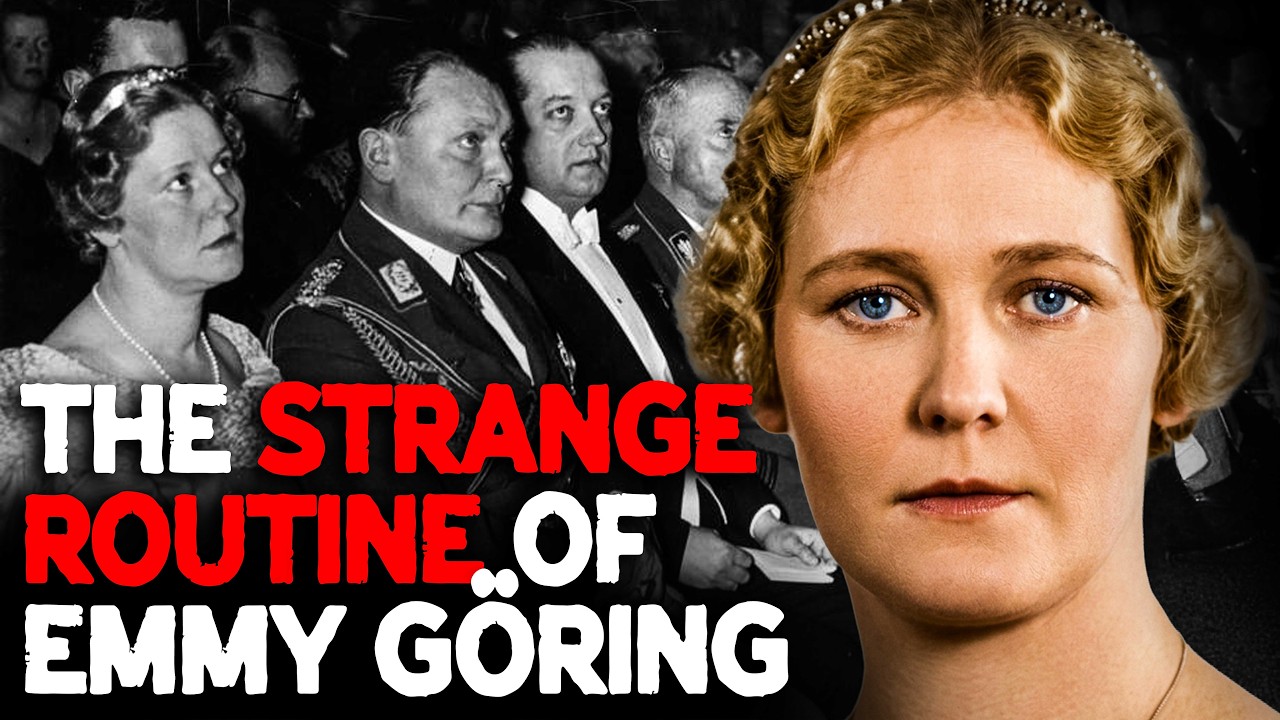
She watched the war come, watched it unfold, and watched it consume everything around her. When the curtain fell in 1945, she faced a reckoning of her own. How did a divorced actress from Hamburg become the second most powerful woman in Hitler’s Germany? What did she know, and what did she choose to ignore?
Emmy Johanna Sonnemann was born on March 24, 1893, in Hamburg, the daughter of Carl Ernst Sonnemann, a prosperous merchant, and his wife Goda. The family was comfortably bourgeois, respectable, and financially stable, and Emmy’s early life was marked by the kind of provincial security that made it easy to dream of something grander. She was a bright, attractive, and ambitious young woman, and by her teenage years she had fixed her sights firmly on a career in the theater. This was not a typical aspiration for a merchant’s daughter in Wilhelminian Germany, where respectability still demanded a certain conformity.
But Emmy possessed both the talent and the stubbornness to pursue it. She trained as an actress and began building a career that took her to stages across Germany, first in smaller repertory theaters and eventually to larger companies in Weimar and elsewhere. She was not a star of the first magnitude, not a figure who commanded headlines or packed out grand opera houses, but she was a competent and respected professional who earned a steady living doing work she loved. Her personal life was more turbulent.
In 1916, during the upheaval of the First World War, Emmy married actor Karl Kostlin, a union that seemed at the time to offer both romantic fulfillment and professional companionship. Two people of the theater, building a life together in difficult times. But the marriage did not last. The couple divorced in 1935, and Emmy found herself at forty-two, unmarried, still working, and about to walk into the most consequential encounter of her life.
She had been working at the National Theater in Weimar since 1919. It was there, in the early 1930s, that she first encountered Hermann Göring. By this point Göring was already one of the most powerful men in Germany: a war hero decorated with the Pour le Mérite, a founding figure of the Nazi Party, and since January 1933 the president of the Reichstag and minister president of Prussia. He was broad, loud, theatrical, and utterly magnetic in his way, a man who loved grand gestures, expensive uniforms, and the company of performers and artists.
He adored the theater and attended it frequently. At a performance in Weimar he first saw Emmy on stage. He was immediately captivated. He began attending her performances repeatedly, sending flowers and notes backstage, pursuing her with the same relentless determination he brought to everything else in his life.
Emmy was cautious at first, wary of a man of his political prominence, but Göring was persistent, and gradually the relationship deepened into something genuine. By the time they were seen publicly together in 1934, there was little doubt about where this was heading. Göring had been married before. His first wife, Karin von Kantzow, a Swedish noblewoman, had captured his heart in the early 1920s, and their marriage had been a passionate one.
Karin was a committed believer in National Socialism, a woman who shared Göring’s political obsessions as well as his personal ones. She had died in October 1931 after years of serious illness, and Göring had mourned her with a fervor that bordered on the operatic. He built a vast hunting estate northeast of Berlin and named it Carinhall in her memory, a monument in carved timber and stone to the woman he claimed to love above all others. That he was now pursuing a relationship with a divorced actress from Hamburg did not trouble him in the least.
Göring was not a man who allowed sentiment to interfere with appetite, and by 1934 his appetite had settled decisively on Emmy Sonnemann. The wedding took place on April 10, 1935, in Berlin. It was a spectacle on a scale that even the Nazis, not known for their understatement, found remarkable. Göring was by now not merely a minister but one of the three or four most powerful men in Germany, and the event was planned accordingly.
Adolf Hitler himself acted as best man. The ceremony was preceded by a military parade. Luftwaffe aircraft flew over Berlin in formation. Twelve thousand members of the police force and various Nazi organizations lined the streets.
The reception was held at the State Opera, and the guest list included the cream of German political and military life. For Emmy, this was not simply a wedding. It was a coronation. One day she had been a respected but not especially prominent actress in Weimar.
The next, she was the wife of the commander in chief of the Luftwaffe, the president of the Reichstag, and the master of the German hunt. What did that mean in practical terms? What did Emmy Göring actually do all day once she had become Emmy Göring? The answer begins with the houses.
The number and grandeur of the Göring residences was staggering, even by the standards of the Third Reich’s leadership, a class of men not given to modest living. Göring occupied multiple properties simultaneously, each staffed with servants, decorated at enormous expense, and maintained regardless of cost. There was the palatial official residence in Berlin on Leipziger Straße, refurbished and expanded to suit Göring’s tastes at public expense. There was Carinhall, the hunting estate in the Schorfheide forest northeast of Berlin, continuously expanded throughout the 1930s and 1940s until it had grown into something approaching a private palace, complete with a vast art gallery, a model railway that Göring played with like an enormous child, a zoo of exotic animals, and facilities for the hunting parties he hosted for foreign dignitaries and Nazi colleagues alike.
There was a mountain villa at Obersalzberg near Berchtesgaden, close to Hitler’s own Berghof. There was a hunting lodge in Rominter Heath in East Prussia. There were other properties scattered across the territories Germany had annexed or conquered. Emmy had to manage, or at least preside over, this empire of real estate, and managing it was itself a full-time occupation.
The staff at each property was considerable. Carinhall alone employed dozens of servants, groundskeepers, gamekeepers, cooks, valets, and secretaries. Emmy’s day typically began with consultations with household staff about the day’s requirements, whether for a formal dinner, a hunting party, a reception for foreign visitors, or simply the maintenance of domestic life on the scale at which the Görings operated. She oversaw menus, managed the social calendar, handled the correspondence relating to her own engagements, and dealt with the constant stream of visitors, petitioners, and well-wishers who presented themselves at the door of a house that was simultaneously a private home and one of the most important nodes in the social network of the Nazi state.
Emmy took this role seriously. She was not merely decorative. She was an active manager of what was in effect a small court. The social obligations were immense and unceasing.
As the wife of the second most powerful man in Germany, Emmy was expected to attend and often to host a continuous round of state functions, party events, diplomatic receptions, theater and opera performances, military ceremonies, and private gatherings of the Nazi elite. She was present at the great theatrical moments of the Third Reich’s public life: the Nuremberg rallies, the Olympic Games of 1936, the parade of foreign visitors who came to pay their respects to the new Germany. She dressed for these occasions with care and considerable expense, wearing the kind of gowns that the Nazi leadership both affected to despise as manifestations of bourgeois decadence and simultaneously demanded of their wives as symbols of German prosperity and taste. Emmy navigated this contradiction without apparent difficulty.
She liked beautiful clothes, beautiful surroundings, and beautiful things, and she surrounded herself with all three without apparent qualm. But the role Emmy seemed to relish most, the one that gave her the clearest sense of her own identity and importance in the Nazi world, was the role of hostess. She organized and presided over the state dinners at which Göring entertained foreign leaders, ambassadors, industrialists, and military figures. These were not small affairs.
A dinner at the Göring residence or at Carinhall might include dozens of guests, elaborate multicourse meals prepared by professional chefs, wines of the finest quality, entertainment by leading musicians or performers, and the kind of sustained social performance that required genuine skill to orchestrate. Emmy was good at this. Her years in the theater had taught her how to manage an audience, how to move through a room, how to put people at ease and make them feel they were the most important person in her world at that moment. She deployed these skills in service of her husband’s political and diplomatic ambitions, and she did it with considerable effectiveness.
Among the guests who passed through the Göring household were some of the most significant figures of the era: foreign ministers and heads of state, military commanders from allied and neutral nations, industrialists whose cooperation Göring needed for his rearmament program, artists and performers he wished to patronize or impress. Emmy presided over all of them. She spoke intelligently about art, theater, and music. She was genuinely knowledgeable about these subjects, not merely performing knowledge.
And this made her a more effective hostess than many of her counterparts among the Nazi wives. She could hold a conversation with a Swedish diplomat or an Italian general or a French art dealer on something like equal terms. She had built a life in the theater on her own intelligence and talents. Now she applied those same qualities to a very different stage.
Yet Emmy’s role as hostess brought her into territory that would define her historical legacy and her postwar difficulties. The dinners she organized, the receptions she presided over, the relationships she facilitated, all took place against a backdrop of systematic crime. The art that decorated the walls of Carinhall and the Berlin residence was not purchased honestly. It was looted, confiscated from Jewish collectors and dealers who had been stripped of their property under the Nuremberg Laws and subsequent measures, or seized from occupied territories across Europe.
The beautiful objects that surrounded Emmy Göring in her daily life—the paintings, the sculptures, the tapestries, the silver, the fine furniture—were the material fruits of a program of cultural theft on a scale Europe had never seen. Did Emmy know this? Did she ask where the art came from? Did she wonder why priceless works that had belonged to respected Jewish families in Frankfurt or Amsterdam were now hanging on the walls of Carinhall?
The historical record does not provide a clear answer. But it provides enough evidence to make certain conclusions unavoidable. Emmy Göring was not stupid, and she was not uninformed. She lived at the center of the Nazi world.
She heard the conversations. She saw the confiscations. She lived in houses filled with property that had belonged to others. She cannot have failed to understand, at least in general terms, what was happening around her.
Whether she engaged with this knowledge at a moral level, whether she ever lay awake at night confronting the source of her comfort and security, is something only she could know. What we know is what she did. She continued to live in those houses, to wear those jewels, to preside over those dinner tables, and to describe herself as the first lady of the Third Reich. That self-description was itself a source of considerable friction within the Nazi hierarchy, and it points to one of the more revealing aspects of Emmy’s character.
She was not the only woman who might have claimed the title of first lady. There was, of course, Eva Braun, Hitler’s long-standing companion, kept almost entirely out of public view before the very end of the war. Eva was the woman closest to the Führer, but she occupied no public role and was unknown to most Germans until 1945. This created a vacuum that Emmy, as the wife of the second most powerful man in Germany and a woman with a professional background in public performance, was very willing to fill.
She hosted state functions in Hitler’s name. She played the gracious consort at diplomatic events. She positioned herself as the social center of the Third Reich’s leadership class, and she was very good at it. Hitler initially seems to have tolerated and even appreciated Emmy’s social function.
She was charming, presentable, and effective, and the elaborate hospitality she organized served a genuine diplomatic purpose. But Emmy made a crucial error. She treated Eva Braun not merely with competitive coolness but with open contempt. She referred to Eva dismissively, excluded her from social events, and made clear in various ways that she regarded herself as the appropriate social superior to the Führer’s unacknowledged companion.
Eva was furious, and Hitler was not pleased. He demanded that Göring instruct Emmy to treat Eva with proper respect. Emmy was then excluded from the Berghof, Hitler’s mountain retreat, for a period—a social and political humiliation that was felt acutely in a world where access to the Führer was the supreme currency of power. The birth of Emmy’s daughter Edda on June 2, 1938, was another moment of Göring theatrical excess.
Hermann Göring ordered five hundred Luftwaffe aircraft to fly in formation over Berlin to mark the occasion, telling anyone who would listen that he would have doubled the number had the child been a boy. Edda was the couple’s only child, a late arrival for Emmy at forty-five, and she was doted on with a ferocity that was both touching and revealing. Göring showered his daughter with gifts and attention. Among the gifts were items of considerable historical significance: paintings, jewels, and objects of art that would later become the subject of prolonged legal disputes about their true ownership.
Edda grew up surrounded by beauty and luxury at Carinhall, photographed frequently for the Nazi press as a symbol of the healthy, wholesome family life the regime liked to project to the German public. Emmy was at the center of this domestic performance, a devoted and attentive mother who seems to have genuinely loved her daughter deeply. As the 1930s gave way to the 1940s and the war began in earnest, the texture of Emmy’s daily life changed in ways that were both subtle and profound. The great diplomatic receptions continued, but their character shifted.
The foreign guests now came not as potential partners to be courted but as allies to be managed or neutralized. The looting of occupied Europe was proceeding at industrial scale, and Göring was its chief architect. He had established a special organization, the Einsatzstab Reichsleiter Rosenberg, and worked alongside it with his own agents to strip museums, private collections, and cultural institutions across France, the Netherlands, Belgium, Poland, and the Soviet Union of their most valuable contents. Trainloads of art, furniture, wine, textiles, and precious objects rolled eastward toward Germany, much of it destined for Carinhall.
Emmy was present as this treasure accumulated. She was there when the paintings arrived, when the sculptures were installed, when the tapestries were hung on the walls of the great halls. She entertained guests in rooms whose contents represented the cultural heritage of subjugated nations and the stolen property of persecuted peoples. Whatever she told herself about the provenance of these things, whatever mental barrier she maintained between the world of dinner parties and the world of confiscation and deportation, she was physically present in the material evidence of her husband’s crimes every single day.
She was not a perpetrator in any direct sense. She gave no orders. She ran no camps. She signed no deportation lists.
But she was a beneficiary of the system in the most intimate and immediate possible way, and she does not appear to have found this troubling enough to act on. The war brought other changes to Emmy’s daily routine as Germany’s military situation deteriorated after the disaster at Stalingrad in early 1943 and the mounting Allied bombing campaign thereafter. The atmosphere of triumph and celebration that had characterized the early war years gave way to something more anxious and defensive. Göring had promised the German people that the Luftwaffe would protect them from bombing, a promise he was catastrophically unable to keep, and his standing with Hitler declined sharply as the British and American air forces began systematically destroying German cities.
The grand social occasions became less frequent, or at least less publicly prominent. Carinhall remained a refuge and continued to operate on its extraordinary scale, but the world outside its walls was growing darker and more dangerous. Emmy continued her domestic and social duties throughout these years, managing the household, overseeing her daughter’s upbringing, attending the performances and events that still continued despite the war, and maintaining social connections that were both personally meaningful to her and politically useful to her husband. Accounts of her from this period consistently describe her as warm, gracious, and apparently contented, a woman who had found the life she wanted and was determined to enjoy it regardless of what was happening beyond the walls of her magnificent homes.
But the walls were closing in. By early 1945, with Soviet forces advancing from the east and Anglo-American forces from the west, even Emmy’s considerable capacity for selective attention could not entirely screen out the reality that the Third Reich was collapsing. In February 1945, the Görings began the process of evacuating Carinhall, removing the most valuable pieces of art and sending them south toward Bavaria by truck and train, a desperate effort to preserve at least part of what had been accumulated over more than a decade. Emmy and Edda relocated to the family’s villa at Obersalzberg near Berchtesgaden, one of the last safe places in a rapidly shrinking Reich.
Hermann Göring himself was engaged in his final political maneuvers, attempting to assume leadership of Germany as Hitler withdrew into the Berlin bunker, an effort that would end with his arrest on Hitler’s orders and a charge of treason that stripped him of all his offices and came close to resulting in his execution by the SS before the end of the war. Emmy was at Obersalzberg when American forces arrived in the spring of 1945. She was with her daughter, surrounded by what remained of the Göring household, when the world she had inhabited for a decade finally, definitively ended. Hermann Göring had by this point surrendered to American forces and was being transported to Nuremberg, where the greatest war crimes trial in history was being prepared.
Emmy’s life as the first lady of the Third Reich was over. What remained was the reckoning. She was fifty-two years old in 1945, in good health, possessed of considerable intelligence and social skill, and utterly bereft of any power base independent of her husband. Everything she had, every comfort she enjoyed, every identity she had built over the previous decade derived directly from her relationship with Hermann Göring.
The Göring name, which had opened every door in Germany and much of occupied Europe, was now a burden of a different kind entirely. Emmy’s arrest came quickly. She was detained by American forces in May 1945 at Obersalzberg along with her daughter Edda. The immediate experience was humiliating and disorienting for a woman who had spent years surrounded by deference and luxury.
She was held for interrogation, questioned about her husband’s activities, about the art collection, about the financial arrangements that had sustained the Göring empire, about who she had met and what she had known. Emmy was cooperative up to a point, but her fundamental strategy throughout the postwar process was consistent and never really wavered. She presented herself as a wife, a mother, and an actress who had supported her husband without any detailed knowledge of or involvement in his official activities. She knew about the dinner parties.
She knew about the houses and the art. She did not know, she insisted, about the crimes. While Hermann Göring stood trial at Nuremberg, Emmy lived in a kind of limbo, moving between different forms of detention and restricted residence as the denazification machinery ground through its processes. She was able to attend the Nuremberg trial proceedings and to visit her husband during the trial, and accounts of those visits describe a couple who maintained genuine warmth and affection even in the shadow of what was coming.
Göring performed brilliantly at the trial, outmaneuvering the prosecution’s questioning with a combination of intelligence, arrogance, and theatrical skill. But the outcome was never really in doubt. On October 1, 1946, Hermann Göring was found guilty on all four counts: conspiracy to wage aggressive war, crimes against peace, war crimes, and crimes against humanity. He was sentenced to death by hanging.
Emmy’s reaction to the verdict and sentence has been described by those who observed it as one of controlled devastation. She visited him after the verdict, and they spoke for some time. Göring had already determined that he would not allow himself to be hanged, a death he regarded as beneath him, and he had concealed a cyanide capsule for exactly this purpose. On the night of October 15, 1946, two hours before his scheduled execution, Hermann Göring bit down on the capsule and died in his cell.
He had cheated the hangman and, in his own mind at least, preserved some form of dignity. Emmy received the news at Strub Farm in the Bavarian Alps, where she was then living under a form of house arrest. She was told that her husband was dead, that he had taken his own life, and that the chapter of her life that had begun on a stage in Weimar in the early 1930s was definitively, irrevocably over. The German denazification courts established by the Allied authorities took up Emmy Göring’s case in 1947.
This was a different process from the Nuremberg trial, with different standards and different stakes. The denazification process was not primarily about criminal punishment but about assigning degrees of responsibility and determining what restrictions, if any, should apply to an individual’s civic life going forward. Emmy was classified as a Belastete, an activist or militant, which placed her in the second most serious category of the five. She was found guilty of being an active Nazi, not simply a passive participant or follower, but someone who had positively embraced and benefited from the regime.
The sentence that followed reflected this classification. Emmy was required to serve one year in prison. She would not hang, would not spend decades behind bars, but one year was one year, and it was a real imprisonment that fell on a fifty-four-year-old woman who had spent the previous decades surrounded by luxury. She served the sentence.
What is clear is that she emerged from it in reduced circumstances, both materially and socially, and that the process was not yet finished even when the imprisonment ended. The financial penalties were in some ways more enduring than the imprisonment. As a convicted Nazi activist, Emmy was subject to asset confiscation, and thirty percent of her remaining assets were taken. She was also prohibited from working in her profession, from performing on stage, for a period of five years.
For a woman who had built her entire identity first as an actress and then as a social figure, the prohibition on performance was not merely a financial blow but a personal one. It stripped away the last independent role she had outside the context of being Göring’s widow, and it left her genuinely poor in a way that she had not been at any point in her adult life. There is one episode from Emmy’s life before and during the war that complicates any simple picture of her as either complicit monster or innocent bystander. Emmy Göring did, on at least one documented and meaningful occasion, use her position and her influence with her husband to try to protect individuals from the Nazi system’s worst depredations.
This was not a pattern of systematic resistance. It did not add up to anything like opposition to the regime. But it happened. The case most frequently cited involves Emmy’s theatrical connections.
In the world of German theater and film in the 1930s and 1940s, many of the most talented and prominent figures were Jewish or had Jewish family members, or were connected by friendship and professional loyalty to people being persecuted. Emmy, who remained genuinely attached to the world of theater throughout her life, encountered these connections regularly, and on a number of occasions she intervened with her husband on behalf of individuals in danger: Jewish colleagues, family members of theater friends, people caught in the machinery of persecution who appealed to Emmy for help. Göring, for his part, was not above issuing what became known informally as exemptions, using his political authority to protect specific individuals from deportation or worse when it suited him. Emmy’s intercessions were a genuine factor in at least some of these cases.
It would be wrong to make too much of this. The scale of Emmy’s interventions was tiny relative to the scale of the destruction around her. But they add a layer of complexity to what might otherwise be a simple story, and they suggest that Emmy was not entirely without conscience, that she felt something when she saw people in danger, even if what she felt was not enough to make her question the world she was living in. What was Emmy’s daily life actually like at Carinhall?
The estate had begun as a relatively modest hunting lodge in the Schorfheide forest, about seventy kilometers northeast of Berlin. Göring had first established it in the early 1930s as a retreat and a memorial to his first wife, naming it for Karin and burying her remains there in a purpose-built mausoleum in 1934. But the estate grew continuously throughout the Nazi period, driven by Göring’s inexhaustible appetite for grandeur and his access to essentially unlimited resources, both public and looted. By the time Emmy was living there regularly in the late 1930s and early 1940s, Carinhall had grown into an extraordinary complex.
The main house was enormous, decorated with carved timber and stone in a style that blended Germanic romantic nationalism with genuine artistic quality. The halls were hung with old masters: works by Rubens, Cranach, Van Dyck, and dozens of other artists of the first rank, gathered from across occupied Europe. The dining rooms could seat dozens of guests served by liveried staff from kitchens stocked with the finest ingredients available in wartime Germany and occupied Europe. There was a vast library, an art studio, a cinema room, greenhouses, stables, and a small zoo where Göring kept exotic animals, including lion cubs, with which he was photographed regularly for the Nazi press.
There was a model railway layout of enormous scale and complexity, which Göring operated himself and which visitors were expected to admire as charming evidence of the great man’s playful side. There was a swimming pool, a gymnasium, and grounds of several thousand acres encompassing forest, lakes, and formal gardens. Emmy moved through all of this every day. She woke in the morning in a bedroom furnished with objects that would be at home in a major European museum.
She ate breakfast in a room hung with paintings that had belonged to Jewish art dealers in Paris or Amsterdam two or three years earlier. She spent her mornings consulting with the head housekeeper, reviewing the day’s menus, checking on the correspondence, preparing for whatever social or domestic obligations the day held. She spent time with Edda, who was growing up in this extraordinary environment as if it were the most natural thing in the world. In the afternoons, Emmy might receive callers, review the social calendar, correspond with friends and acquaintances in the theater world, or attend to the organizational details of upcoming events.
In the evenings, if there were guests, she presided over dinner with skill and apparent enjoyment, the consummate hostess in the most extravagant setting in Germany. The relationship between Emmy and Hermann Göring is itself worth examining carefully. Hermann Göring was by any measure a difficult man to be married to. He was physically massive, increasingly corpulent as the war years progressed, and given to elaborate self-dramatization in everything from his uniforms to his gestures to his domestic arrangements.
He was addicted to morphine, an addiction that had begun during the chaotic years following the failed Beer Hall Putsch of 1923 and that continued in varying degrees throughout his life. He was vain, mercurial, capable of great warmth and great cruelty in rapid succession, and his professional life was one of enormous and unceasing complexity. He was simultaneously running the Luftwaffe, overseeing the Four Year Plan for German economic mobilization, managing the looting of occupied Europe, maintaining his position in the complex politics of the Nazi leadership, and conducting the relentless social life that was both his pleasure and his political instrument. Emmy navigated all of this with what appears to have been genuine equanimity and genuine affection.
She loved Hermann Göring, or at least she said she did, and behaved as though she did, with a consistency that spanned the entire period of their relationship from the early 1930s to his death in 1946. She was not naive about his faults. She knew about his morphine addiction, though this was not something she discussed publicly. She knew about his appetite for luxury and his capacity for excess.
She dealt with the practical consequences of his political life, the sudden changes of schedule, the unexpected guests, the constant demands that the Nazi political world made on his time and attention. She seems to have genuinely believed in him as a man, as a husband, and as a political figure. And this belief appears to have been resistant to evidence that might have disturbed it. After Göring’s death, Emmy entered the next phase of her postwar life, which would last for almost three decades until her own death in 1973.
A woman who had lived at the pinnacle of European power was reduced to a small apartment in Munich, writing her memoirs and spending her time in a kind of enforced ordinariness that was the precise inverse of everything she had known since 1935. She emerged from prison and the denazification process in the late 1940s to find herself in a Germany that had been physically and morally destroyed. The Munich apartment that became Emmy’s home in the postwar years was a world away from Carinhall. It was small, simply furnished, and located in a city still in the process of being rebuilt from the devastation of Allied bombing.
The paintings and sculptures and tapestries that had filled the Göring residences were now mostly in the hands of Allied authorities, subject to restitution claims from the families and institutions they had been stolen from, or dispersed in ways that made recovery difficult or impossible. It was in this context that Emmy wrote her autobiography, published in German in 1967 under the title Mein Leben mit Göring. The book is a fascinating document less for what it reveals than for what it chooses not to reveal. Emmy writes about her husband with unmistakable warmth and genuine feeling.
She describes the romantic beginning of their relationship, the grandeur of their wedding, the domestic details of life at Carinhall, the birth of Edda, and the final years of the war and its immediate aftermath. She presents Hermann Göring as a man of artistic sensibility and personal generosity, a devoted husband and father, a man who was in some respects the victim of circumstances and associates beyond his control. She does not dwell on the evidence of his crimes, does not engage systematically with the findings of the Nuremberg tribunal, and does not attempt any serious reckoning with her own position and knowledge during the years of the Third Reich. What is striking about the autobiography is not its dishonesty so much as its extraordinary selectivity.
Emmy was an intelligent woman, and she knew perfectly well what had happened and what her husband had done. She had sat in the Nuremberg courtroom while the prosecution laid out the evidence. She had heard the verdict and the sentence. She chose, in writing her memoirs, to focus on the personal and domestic aspects of her life with Göring and to set aside almost entirely the political and criminal context in which that life was embedded.
The art restitution disputes that dominated much of Emmy’s postwar existence were a persistent and painful reminder that the world was not willing to allow her the luxury of that selective attention. Many of the artworks that had decorated Carinhall and the other Göring residences had been seized by Allied forces at the end of the war and held pending restitution claims. Emmy was involved in several of these disputes, sometimes as a claimant seeking to recover objects she regarded as legitimately hers, and sometimes as a defendant against restitution claims from the original owners or their heirs. The most significant case involved a painting that had been given to Edda at birth as a personal gift: a work attributed to Lucas Cranach the Elder depicting the Madonna and Child, presented to the baby Edda by Nazi officials as a kind of state gift to the Göring family.
The painting had passed through various hands during and after the war and became the subject of a prolonged legal dispute that was not resolved until 1968, when the German courts ruled against Edda and ordered the painting’s return. Emmy had to watch her daughter lose this case, and the loss represented not merely a financial blow but a symbolic defeat, a legal affirmation that the gift had not been legitimately Göring property to begin with. Emmy’s relationship with her daughter Edda was clearly the most important personal relationship of her postwar life. Edda Göring, born in 1938 and thus only seven years old when the Third Reich collapsed, grew up under the weight of one of the most notorious names in German history.
She had spent her early childhood at Carinhall, surrounded by luxury and photographed for the Nazi press as a charming symbol of the regime’s domestic ideals. She had then watched her world collapse, accompanied her mother through detention and restricted residence, and grown up as the daughter of a man who had been convicted of crimes against humanity and died a suicide in his cell at Nuremberg. Edda maintained throughout her adult life a posture toward her father’s memory that was striking in its contrast to the approach taken by the children of some other Nazi leaders. She defended her parents in private, maintained that her father had been a good man who had been misrepresented by history, and declined for the most part to engage in public discourse about Nazi crimes and their legacy.
She broke her silence in a 1986 Swedish television interview to express deep affection for both her parents, and she remained throughout her life convinced that the world’s verdict on Hermann Göring was too simple and too harsh. She died in December 2018. The question of what Emmy knew about specific Nazi crimes is worth returning to in the context of her diplomatic and social role. The Kristallnacht pogrom of November 1938, in which thousands of Jewish businesses, homes, and synagogues across Germany were attacked and destroyed, Jewish men were beaten and murdered, and tens of thousands were arrested and sent to concentration camps, occurred while Emmy was at the height of her social prominence.
The historical record is silent on Emmy’s personal response to this event, which is itself revealing. Kristallnacht was neither subtle nor secret. Hermann Göring’s response to it is well documented: he was furious not about the violence itself but about the economic consequences of the pogrom. He complained bitterly that the destruction of Jewish businesses and the disruption of economic life was contrary to the needs of his Four Year Plan, and he imposed an enormous collective fine on the German Jewish community, a fine of one billion Reichsmarks.
He also used the occasion to accelerate the process of Aryanization, the forced transfer of Jewish-owned businesses to German owners, in ways that directly benefited himself and his associates. Emmy was Göring’s wife and lived with him through these days. She cannot have been ignorant of his response or of the economic and political calculations that underpinned it. The evacuation of Carinhall in early 1945 was a logistical undertaking of considerable complexity.
Dozens of trucks were loaded with artworks, furniture, silverware, and personal belongings. Trains were commandeered to carry the most valuable pieces to Bavaria. Göring’s personal train, a luxurious private consist of several cars, was used to transport Emmy, Edda, and selected household staff to Obersalzberg as American forces advanced through Germany. Emmy arrived at Obersalzberg in February 1945, joining the community of Nazi families who had gathered in the area around Berchtesgaden as Berlin became increasingly untenable.
The atmosphere was surreal: a community of people connected to the most powerful government in Europe, trying to continue something like normal life in the shadow of total defeat. American forces reached Berchtesgaden in early May 1945. Göring himself, having made his ill-fated attempt to assume leadership of Germany from Hitler, having been arrested by the SS on Hitler’s orders, having been rescued by the advancing Americans, had by this point surrendered to the United States Army. Emmy was at the villa when the Americans arrived.
She was calm, according to accounts from that period. In the years after the autobiography’s publication, Emmy became something of an occasionally sought-after historical witness to the Nazi period, though she always appeared reluctant to engage beyond the personal and domestic. Journalists and researchers sometimes sought her out. When she did speak, she was consistent in her characterization of her husband as a man who had been misunderstood by history and in her own characterization of herself as a woman who had simply lived the life of a devoted wife.
She did not seek the spotlight. She did not make inflammatory public statements. She did not become a cause célèbre for the West German far right. She seemed genuinely to want to be left alone, to live quietly in Munich, to maintain her friendships, to be with her daughter, and to keep the memories of her life with Göring alive in whatever private way she could manage.
There was, however, one significant area of postwar activity that Emmy maintained consistently. She remained throughout the postwar decades in contact with a network of former Nazi acquaintances and sympathizers, people who had been part of the world she had inhabited and who maintained various degrees of attachment to the ideology and personnel of the Third Reich. This was not unique to Emmy among the Nazi wives. Ilse Hess, the wife of Rudolf Hess, maintained similarly extensive connections to the postwar far right and was involved with the Stille Hilfe, the charitable organization that provided support to former SS members.
Margarete Himmler, the wife of Heinrich Himmler, lived for years under a false name while maintaining contact with former associates. Emmy’s connections were perhaps less politically explicit than some of these, but they existed, and they were part of the context in which she spent her postwar decades. What did Emmy Göring actually do all day in the twenty-seven years between the end of the war and her death in 1973? She maintained her apartment in Munich.
She attended church. She kept up with friends and former acquaintances. She followed theatrical and artistic events as best she could on a restricted income. She supported her daughter through the legal and personal challenges of growing up as Edda Göring.
She worked on her autobiography. She managed her finances, which required careful attention given the significant reduction in her assets that the denazification process had imposed. She received occasional visitors. She was photographed occasionally for newspapers or magazines that ran retrospective pieces on the Nazi period.
She got older. This description of an ordinary domestic life in a small Munich apartment is striking precisely because of the contrast it presents with the life that preceded it. Emmy had spent a decade as one of the most socially prominent women in Europe, presiding over events of international significance in settings of extraordinary grandeur. She had been photographed with heads of state and foreign ministers, had organized dinners at which the fate of Europe was informally discussed, had lived in houses that were in some cases larger and more lavishly appointed than the palaces of actual monarchs.
And then, in 1945, all of that had simply stopped. She was eighty years old when she died in Munich on June 8, 1973. She outlived many of her contemporaries from the Nazi period and outlived the denazification process that had judged her by more than two decades. The historical question of how to evaluate Emmy Göring is one that becomes more complex, not less, the more closely it is examined.
She was convicted by a German denazification court and served time in prison. She lost a significant portion of her assets through confiscation. She was prohibited from pursuing her professional career for five years. These are not trivial outcomes.
At the same time, the punishment was clearly not commensurate with the scale of what her daily life had been embedded in. A year in prison and the loss of thirty percent of her assets, while genuine consequences, are not equivalent to the accounting demanded by the scale of the crimes that the Göring household had sustained and celebrated. The art alone that Emmy had walked past every day of her life at Carinhall represented a cultural theft of incalculable magnitude. In the years between the end of the war and her death, Emmy was occasionally asked directly about the Holocaust and about the specific crimes documented at Nuremberg.
Her responses, on the rare occasions when she gave them, were consistent and revealing. She did not deny that terrible things had happened. She did not claim that the Holocaust was a fabrication or a misrepresentation. But she consistently placed these events at a distance from her own experience and her own knowledge, presenting herself as someone who had been insulated from the worst aspects of the regime by virtue of her domestic role and her husband’s care to shield her from disturbing information.
This position was difficult to sustain in the face of what is actually known about the Göring household and about Emmy’s daily life. But she sustained it consistently until the end. The assessment of Emmy Göring that history has settled on is not one of the harsher verdicts that the Nazi period has produced. She is not remembered as a monster.
She is remembered, when she is remembered at all, as a woman who made a particular set of choices in a particular historical context, choices that allowed her to live very well for a decade while the world around her was destroyed, and who then spent the rest of a long life finding ways to live with those choices without fully confronting them. This is not an admirable story, but it is a recognizably human one. And it is told in the specific details of her daily life, in the dinner parties and the art galleries and the diplomatic receptions and the Munich apartment, with a clarity that makes it more disturbing, not less, than a simpler story of straightforward villainy would be. The story of what Emmy Göring actually did all day is ultimately a story about the domestic life of the Third Reich told from the inside.
It is a story about the social machinery that sustained the Nazi elite, about the role of women in that machinery, about the way in which personal warmth and genuine human feeling can coexist with participation in criminal systems, and about the particular kind of moral failure that consists not in active evil but in the sustained, systematic, and apparently comfortable avoidance of a truth that is present in every room of the house you live in, in every painting on the wall, in every dinner you serve to the men who are directing the destruction of an entire civilization. Emmy Göring looked at all of this every day and found ways not to see it. And when the Third Reich ended and the reckoning came, she spent the rest of her life finding ways not to look back at it either.
That choice, too, was something she did all day, every day, until the day she died.
