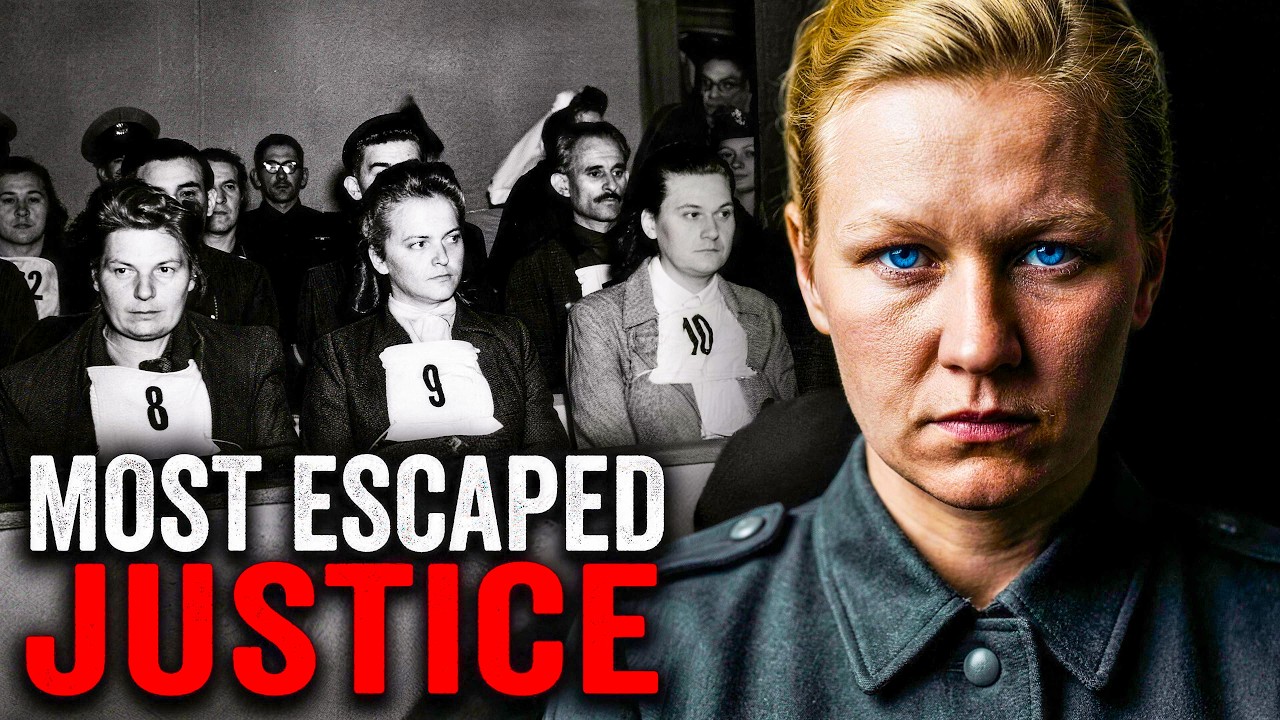
The gallows at Hamelin Prison were busy on the morning of May 2, 1947. British executioners hanged thirteen former staff members of the Ravensbrück concentration camp in a single coordinated session, a speed of justice that surprised even the survivors who had waited two years to see it done. Among them were Dorothea Binz, the camp’s chief wardress, barely 26 years old, and Vera Salvequart, the nurse who had administered poison to prisoners in the infirmary under the guise of medical care. The condemned women had built their careers on Ravensbrück’s muddy roll call square, where they swung leather whips and wooden clubs at prisoners half starved and barely able to stand, and where they selected the sick and the weak for the gas chamber built in the war’s final winter.
The hangings closed the first and most severe chapter of postwar justice for the camp. But they left a far larger question unresolved: what happened to the hundreds of other women who had guarded Ravensbrück, and how many of them ever faced a courtroom at all? Ravensbrück was the largest concentration camp built specifically for women in the entire Nazi system. To run it, the SS needed a workforce, and that workforce was made up almost entirely of women.
Ordinary German women, recruited from factories, farms, and unemployment offices, were trained in a matter of weeks to become Aufseherinnen, female overseers, and sent out to inflict a level of cruelty that still defies easy explanation. Some became notorious even in their own time, their names whispered by survivors with a mixture of fear and hatred that never faded. Others slipped back into anonymous postwar lives, their pasts buried so deeply that neighbors and even husbands never knew what they had done. The woman who built the system arrived in the spring of 1939, just weeks after the camp opened its gates.
Johanna Langefeld had been born in 1900 in Kupferdreh, now part of Essen, and had trained as a deaconess, working in social welfare before the war. In the early 1930s she had briefly been imprisoned herself on charges connected to an abusive marriage, an experience that gave her a perspective few of her later colleagues shared. When the SS recruited her to help staff the new women’s camp, she brought a background that was on paper at least closer to social work than to soldiering. She was appointed the camp’s first Oberaufseherin, its chief wardress, responsible for training the waves of new female guards who would pass through Ravensbrück’s gates in the years that followed.
Survivors who encountered Langefeld described a woman who could be harsh and who unquestionably enforced the brutal disciplinary structure of the camp, yet who was also remembered more than almost any other Ravensbrück guard for occasional acts that ran against the camp’s logic of dehumanization, moments where she intervened to soften a punishment or looked past an infraction that should have brought a beating. In 1942 she was transferred to Auschwitz to organize the women’s camp there, bringing with her the systems and the staff she had trained at Ravensbrück. At Auschwitz, Rudolf Höß and the senior SS command increasingly sidelined her, unhappy with what they saw as her insufficient ruthlessness. She clashed repeatedly with Maria Mandl, who by then had risen through the ranks and would go on to become one of the most feared women in the entire camp system.
Langefeld returned to Ravensbrück in 1943, demoted and increasingly marginalized. By 1945 she had largely faded from real power. When Ravensbrück was overrun by Soviet forces in the final days of April 1945, Langefeld was captured and turned over to Polish authorities. She was scheduled to stand trial in Kraków alongside other Auschwitz staff, the very people she had once worked with and in some cases clashed against.
While awaiting trial, several former Auschwitz prisoners, women who remembered specific instances of Langefeld showing them leniency or protecting them from harsher punishment, intervened on her behalf. It was an almost unheard-of turn of events in the history of postwar reckonings: camp survivors actively working to secure the release of a former SS overseer. In January 1946, largely as a result of this testimony, Langefeld escaped from custody. She spent the following years living quietly in West Germany under difficult and impoverished circumstances, never formally tried for her role at either camp.
She died in 1974 in Augsburg, one of the very few senior Ravensbrück staff members who never faced a courtroom for what had happened under her watch. If Langefeld represented the camp’s contradictory beginnings, Dorothea Binz represented what Ravensbrück became. Born in 1920 in the village of Dürenberg, not far from Ravensbrück itself, Binz came from a modest rural background with almost no education beyond the basics when she applied for work at the newly built camp in 1939, drawn like so many young women by the promise of steady wages and the prestige of a uniform. She started as an ordinary guard, but her aptitude for cruelty, difficult to describe any other way given the surviving testimony, saw her rise quickly through the ranks.
By 1943 she had become the camp’s chief supervisor, a position of enormous authority over the daily suffering of tens of thousands of women. Survivors describe Binz as someone who did not merely enforce the camp’s brutal rules but seemed to derive genuine personal satisfaction from inflicting pain. She was closely associated with the camp’s notorious bunker, the punishment block where prisoners were subjected to beatings, starvation, and isolation. Multiple survivor accounts describe her personally administering floggings, sometimes continuing well past the point where camp regulations, brutal as they already were, technically permitted.
She carried a whip almost constantly and was known to unleash her dog on prisoners for minor infractions. As the war ground toward its conclusion and Ravensbrück’s conditions deteriorated catastrophically, with the camp becoming severely overcrowded as prisoners were evacuated westward from camps closer to the advancing Red Army, Binz’s brutality reportedly intensified rather than waned. She was present for the construction and operation of the gas chamber built in the camp’s final months, a facility that claimed thousands of lives in the closing weeks of the war. When the camp was finally evacuated in late April 1945, Binz fled westward with much of the remaining SS staff, attempting to blend into the chaos of collapsing Germany.
British forces captured her in the early summer of 1945, and she was identified relatively quickly given how well known she had become among surviving prisoners now able to testify. She stood trial at the first Hamburg Ravensbrück trial, which opened in December 1946 before a British military tribunal alongside more than a dozen other former camp staff. The testimony against her was overwhelming, survivor after survivor describing specific sustained acts of violence stretching back years. She offered little in the way of defense.
The tribunal found her guilty and sentenced her to death. On May 2, 1947, Dorothea Binz was hanged at Hamelin Prison. She was 26 years old. Not every guard who stood in the dock at Hamburg met the same fate, and few cases illustrate the unpredictability of postwar justice as vividly as that of Carmen Mory.
Born in Bern, Switzerland in 1906 to a well-connected family, Mory had worked as a journalist before the war, and her path to Ravensbrück ran through Nazi Germany’s intelligence apparatus rather than its camp administration. Recruited into work connected to German intelligence, she fell out of favor, or possibly became caught in her own web of deception, and was arrested and sent to Ravensbrück as a prisoner in 1940. Inside the camp, her transformation occurred. Despite arriving as an inmate, Mory quickly ingratiated herself with the SS staff and was appointed a block senior, a prisoner functionary given authority over her fellow inmates in exchange for privileges and better treatment.
It was a position that created some of the most morally fraught figures in the entire history of the Holocaust: prisoners who wielded genuine power over other prisoners and who in far too many documented cases used that power just as brutally as the SS guards who had appointed them. Mory earned a horrifying reputation among her fellow prisoners, who came to know her as the “Butcher of Ravensbrück. ” Survivor testimony described her using her position to torment, beat, and in some accounts contribute to the deaths of women under her supervision within the camp’s medical block, where she had gained particular influence. She was also implicated in facilitating some of the camp’s most gruesome secrets, including allegations connected to the notorious medical experiments performed on Polish prisoners, women known among the inmate population as the “rabbits,” subjected to surgical mutilation in the name of German military medical research.
When the war ended, Mory’s position was uniquely precarious. She was neither purely a perpetrator in the SS sense nor purely a victim. Arrested and brought before the first Hamburg trial in December 1946 alongside Binz, she attempted to reframe her actions as those of a prisoner acting under duress, but the tribunal found the evidence of her cruelty too extensive to accept that defense. She was sentenced to death.
But Carmen Mory would never hang. In a final act that fit the theatrical, deceptive pattern of her entire life, she took her own life in her cell at Hamelin Prison in April 1947, just hours before her scheduled execution, having somehow smuggled in the means to do so. The medical staff at Ravensbrück occupied a particularly dark corner of the camp’s machinery. Vera Salvequart had trained as a nurse before the war, and her path into the camp system came through her work in the medical block, a place that should have represented whatever small mercy the camp allowed but which under the SS command structure became instead an instrument of selection and death.
Survivor and staff testimony from the postwar trials described her direct involvement in poisoning prisoners in the camp’s infirmary, administering lethal doses to patients under the guise of medical treatment in cooperation with the camp doctors who oversaw the killing program. She was also connected to the operation of Ravensbrück’s gas chamber, constructed in the camp’s final winter as the SS scrambled to eliminate prisoners who could no longer work and whom Berlin no longer wished to feed. The testimony against her carried a particular horror precisely because her role as a nurse represented such a grotesque inversion of what that profession was supposed to mean. She was sentenced to death and was among the thirteen hanged on May 2, 1947.
Elisabeth Marschall served as the head nurse of the Ravensbrück infirmary, a position of genuine authority with direct oversight of the medical treatment given to thousands of sick and injured prisoners. She was significantly older than many of the guards, having been born in the 1880s, bringing decades of nursing experience from before the Nazi period, training that made her participation in what followed all the more damning to the tribunal. Survivor testimony described her as central to the selection process that determined which sick prisoners would be sent to their deaths rather than treated, working closely with the camp’s SS doctors to identify women too weak or too ill to be of further use to the labor system. She was directly implicated in the operation of the camp’s euthanasia and gassing program during the final year, with transports of selected prisoners sent to their deaths, some to the camp’s own newly built gas chamber and others to the Bernburg euthanasia facility further south.
The prosecution’s case rested heavily on the argument that her medical training made her selections a matter of deliberate informed choice rather than blind obedience. The tribunal agreed, and she was hanged on May 2, 1947. Greta Bösel’s involvement in the killing program placed her alongside Marschall as one of the trial’s most significant defendants, though her path into the camp had begun in circumstances that looked almost mundane. Before the war she had run a small business, and like many women recruited into the guard system, she came to Ravensbrück seeking steady employment during a period of economic uncertainty.
She rose to a position with responsibility over the labor allocation of prisoners, a role that put her in direct control over which women were assigned to which work details, a seemingly bureaucratic function that in practice determined who survived the camp’s brutal working conditions and who did not. As the war progressed and Ravensbrück’s population swelled, Bösel’s responsibilities expanded into darker territory. She became directly involved in the selection process for the camp’s killing program in its final year, helping identify prisoners for transport to death, working in tandem with the medical staff and camp doctors. Survivor testimony described her as someone who carried out these selections with a coldness that shocked even other camp staff.
Her defense attempted to frame her role as purely administrative, arguing that she had merely processed paperwork rather than personally condemned anyone to death, but the tribunal found this unpersuasive given the clear evidence that she had known precisely what those transport lists meant for the women whose names appeared on them. She was sentenced to death and hanged on May 2, 1947. What happened to the guards whose crimes, while still severe, fell short of direct participation in the killing program? Herta Ehlert’s case offers one answer.
Ehlert served as a deputy to Dorothea Binz within the camp’s disciplinary structure, and survivor accounts placed her at the scene of numerous beatings and punishments carried out in the punishment block, though her role never reached the same level of singular notoriety. When she stood trial at Hamburg in December 1946, the tribunal weighed her culpability against that of the most severe offenders and determined that while she had unquestionably participated in the camp’s system of brutality, she had not been shown to have personally selected prisoners for death or engaged in the kind of sustained singular sadism that defined Binz’s reputation. She was convicted of war crimes but received a sentence of 15 years imprisonment rather than death. Ehlert served a portion of her sentence before being released in the early 1950s as part of the broader wave of clemency that swept through occupied and then sovereign West Germany during the period.
Little is documented about her life after release. Elisabeth Volkenrath’s career traced a path that took her from Ravensbrück through some of the most infamous camps in the entire Nazi system. She began her SS career at Ravensbrück, where she trained alongside many of the women who would go on to staff other camps, before being transferred to Auschwitz-Birkenau, where she rose to become the camp’s chief supervisor, the most senior female guard position in the entire complex. It was an extraordinary rise for a woman still in her 20s, placing her in direct command over the treatment of tens of thousands of female prisoners at the height of the Holocaust’s most lethal period.
Survivor testimony described her as personally involved in selections that sent prisoners to the gas chambers and known for beatings carried out with a riding crop she carried as a mark of authority. As Auschwitz was evacuated in January 1945, Volkenrath was transferred to Bergen-Belsen, where she continued in a senior supervisory role during the camp’s catastrophic final months, a period when Bergen-Belsen, never designed as an extermination camp, became a charnel house of disease, starvation, and death as the collapsing German transport system flooded it with prisoners evacuated from camps further east. When British forces liberated Bergen-Belsen in April 1945, they found conditions of such horror that the images captured there became some of the defining visual evidence of the Holocaust. Volkenrath became one of the defendants at the Belsen trial, a separate but related proceeding held in the autumn of 1945.
She was sentenced to death and hanged on December 13, 1945, one of the first Ravensbrück-trained guards to face execution, well before Binz and the others stood trial at Hamburg the following year. Hertha Bothe’s story ran in close parallel to Volkenrath’s. Bothe had worked as a nurse’s aid before the war and joined the camp guard service in 1942, receiving her initial training at Ravensbrück before being transferred to a subcamp and eventually to Bergen-Belsen. Survivors described her as capable of extreme violence, recalling beatings inflicted with clubs and other implements that left prisoners with lasting injuries.
She became known among some survivors by a nickname reflecting the particular savagery of her conduct. Captured by British forces, she became a defendant at the Belsen trial. The tribunal’s case included specific testimony about beatings that had resulted in serious injury and in some accounts contributed to the deaths of prisoners. Unlike Volkenrath, however, Bothe was not sentenced to death.
The tribunal sentenced her instead to 10 years imprisonment. She served several years before being released in the early 1950s, going on to live a long life under her married name, largely out of public view, until a British journalist tracked her down decades later in the 1990s and confronted her about her wartime conduct in a widely discussed interview. She died in 2000, having lived for more than half a century after her release. Irma Grese was just 20 years old when the war ended, but she had already become, by the testimony of survivors and the judgment of the tribunal that eventually tried her, one of the most sadistic individuals to serve anywhere within the Nazi camp system.
Born in 1923 in the small town of Rechlin, Grese came from a modest rural family and left school at 15, drifting through a series of unskilled jobs before applying for work at Ravensbrück in 1942, drawn by the same promise of steady wages and uniform status that attracted so many young women. She received her initial training at Ravensbrück under the same disciplinary culture that had shaped Binz and Volkenrath before her, and it was here that she first developed the reputation for casual, almost theatrical cruelty that would define the rest of her short life. Later that same year she was transferred to Auschwitz-Birkenau, where she rose with startling speed to become one of the camp’s senior female overseers by the age of just 21. Survivor testimony described accounts of prisoners beaten to death, of a guard dog she deployed against inmates, of selections for the gas chamber carried out with what witnesses described as visible enjoyment rather than grim duty.
She cultivated a striking, well-groomed appearance that survivors found particularly disturbing given the context. As Auschwitz was evacuated in January 1945, Grese was transferred first to Ravensbrück briefly and then on to Bergen-Belsen, where she continued her supervisory duties through the camp’s catastrophic collapse. When British forces liberated Bergen-Belsen, she was among the staff captured and became one of the most closely watched defendants at the Belsen trial, her youth and the sheer volume of testimony against her making her something of a symbol for the proceedings. She was sentenced to death and hanged on December 13, 1945, the same day as Volkenrath, reportedly walking to the gallows with a composure that further unsettled the British officials present.
Not every guard connected to Ravensbrück served in the main camp itself. The story of Uckermark, a satellite facility attached to Ravensbrück that was repurposed in the war’s final year into a dedicated killing site for young female prisoners, produced some of the most disturbing individual cases to emerge from the entire complex. Ruth Neudeck ran Uckermark during this final murderous phase, and her name became synonymous among survivors with a level of institutionalized cruelty that shocked even veterans of the main camp. Neudeck had transferred into the guard service relatively late in the war and was placed in charge of Uckermark at precisely the moment the SS decided to convert the youth camp into an extermination site for prisoners selected as too weak or too sick to continue working.
Survivor testimony described conditions at Uckermark under Neudeck’s command as almost unimaginably brutal, with systematic starvation, beatings, and direct participation in the killing operations that sent thousands of women to their deaths in the war’s final weeks, some shot, some gassed, some simply left to die of exposure and starvation in the camp’s overcrowded barracks. When the war ended, Neudeck was captured, and the tribunal, presented with detailed and consistent survivor accounts of her direct involvement in the killing program, found the evidence overwhelming. She was sentenced to death and executed. Margarete Rabe’s case at Uckermark offers a different, more legally contested outcome.
Rabe worked as a nurse at Uckermark during the same period Neudeck commanded the camp, and she was implicated in the selection and killing process that claimed so many lives there in early 1945. Survivor testimony placed her at the scene of numerous killings, though the specific nature and extent of her personal responsibility, whether she acted as a direct participant or under close supervision from more senior staff, became a matter of extended dispute during her trial. She was convicted and initially sentenced to death alongside several other Uckermark staff. But unlike Neudeck, Rabe’s sentence was ultimately commuted to a term of imprisonment following an appeal, a relatively rare outcome among the death sentences handed down in the Ravensbrück-related trials.
She served a portion of her reduced sentence before being released, and like so many other former guards who avoided execution, she largely disappeared from the historical record afterward. Louise Danz’s career traced yet another version of the well-worn path from Ravensbrück training into service at Auschwitz and beyond, and her postwar experience would prove to be one of the longest and most closely followed of any former Ravensbrück guard, stretching across nearly five decades after the war’s end. Danz joined the camp guard service in 1943 and following her initial training was posted to several camps, including a period of service connected to Auschwitz’s subcamp network, where she was involved in the brutal treatment of prisoners forced into slave labor for German industry. She was known among survivors for beatings carried out with particular viciousness and for her role in the selection processes that determined which prisoners would continue working and which would be marked for death.
When the war ended, Danz was captured and initially stood trial in Poland, convicted and serving a lengthy prison term before eventually being released and returning to West Germany. But Danz’s legal troubles did not end there. In the 1990s, German prosecutors reopened investigations into her wartime conduct as part of a broader wave of renewed efforts to prosecute aging former camp personnel. Danz stood trial again in Germany in the 1990s, one of the last former Ravensbrück-trained guards to face judicial proceedings connected to her wartime service.
She died in the mid-2000s. The men who directed the female overseers were not spared the postwar reckoning. Fritz Suhren served as Ravensbrück’s final commandant, overseeing the camp during its most lethal period in 1944 and 1945 when the gas chamber was constructed and the killing program reached its peak intensity. Suhren fled westward as the camp was evacuated and attempted to disappear using false identity papers, working for a period under an assumed name before French occupation authorities eventually identified and captured him.
He stood trial before a French military tribunal and was found guilty and executed in 1950. Johann Schwarzhuber served as the camp’s protective custody camp leader, a role with direct authority over the guards, including Binz and her colleagues, who carried out the daily disciplinary regime. Schwarzhuber had previously served at Auschwitz before his transfer to Ravensbrück, and survivor testimony connected him directly to the operation of the gas chamber and the broader killing program in the camp’s final months. He stood trial at the first Hamburg proceedings and was sentenced to death and executed alongside the female defendants convicted in that same proceeding.
Percy Treite represents one of the most contested cases connected to Ravensbrück’s medical apparatus. Treite served as a physician at Ravensbrück and was implicated in the selection process that sent sick and injured prisoners to their deaths, as well as in medical decisions that survivor testimony described as contributing directly to preventable deaths among the prisoner population under his supposed care. He stood trial at the first Hamburg proceedings and, unlike Schwarzhuber, was not sentenced to death, receiving instead a sentence that some survivors and later historians viewed as disproportionately lenient. Treite did not serve out his sentence.
He took his own life in his cell shortly after the verdict was announced, joining Carmen Mory as one of the defendants connected to the Ravensbrück trials whose case ended in suicide. The Hamburg trials and their various successor proceedings convicted several dozen former Ravensbrück personnel, of whom a substantial cluster faced execution while a larger number served prison sentences ranging from several years to over a decade before eventual release. Set against this figure, historians estimate that Ravensbrück employed somewhere in the range of several thousand female guards over the course of its operation between 1939 and 1945. A number that makes unmistakably clear just how partial and incomplete the postwar accountability process ultimately proved to be.
The chaos of Germany’s collapse in 1945, when identity documents were destroyed, records were lost, and millions of people were displaced, meant that a guard who discarded her uniform, adopted a maiden name or a married name that obscured her wartime service, and relocated to a different region of Germany could often avoid detection entirely, particularly once Allied attention shifted by the late 1940s away from lower-level camp personnel and toward the practical challenges of rebuilding West Germany as a Cold War ally. Survivor testimony remained the primary tool for identifying former guards in the years immediately after the war, and that testimony depended heavily on individual survivors recognizing individual faces, a system that inevitably left countless perpetrators unidentified simply because no surviving witness happened to encounter them again. Many of the men and women most directly responsible for the suffering inflicted there lived out ordinary, undisturbed lives in the decades that followed, their neighbors and in some documented cases even their own children entirely unaware of what they had done during the war. The legal framework under which the Hamburg tribunals operated shaped every verdict.
The trials were conducted under British military law, applying charges connected to violations of the laws and customs of war rather than the more expansive charges of crimes against humanity being developed simultaneously at the Nuremberg proceedings against senior Nazi leadership. This meant that Ravensbrück defendants were judged primarily on the basis of documented individual acts of violence or direct participation in killing established through survivor testimony, rather than on a broader theory of collective responsibility for having served within a criminal organization. This individual-act-based standard explains why guards like Ehlert, Bothe, and others whose documented conduct, however brutal, fell short of direct participation in killing received prison sentences rather than death, while Binz, Salvequart, Marschall, and Bösel, against whom the prosecution could establish direct involvement in specific killings or in the systematic killing program, faced the gallows. The trials took place in the Curio House, a building in Hamburg that British authorities had requisitioned for the purpose.
The courtroom was packed with defendants who ranged from women in their early 20s to men in their 50s who had held senior command positions. Survivors who had traveled from across Europe, some from as far as Poland and France, gave testimony in a proceeding that was for many of them their first opportunity to confront their former captives directly since the moment of liberation. Contemporary press accounts describe scenes of visible emotional distress on both sides, from witnesses who broke down while recounting specific atrocities to defendants who frequently maintained composure bordering on indifference throughout even the most damning testimony. The most common defense employed to varying degrees by nearly every defendant centered on the claim of superior orders, the argument that guards had simply been following commands from their superiors.
British military tribunals generally rejected this defense as an absolute shield against criminal liability, though they did sometimes weigh it as a mitigating factor in determining sentence severity. A second common strategy involved outright denial or minimization, a defense that proved difficult to sustain given how frequently multiple independent witnesses corroborated specific accounts of the same guard’s conduct. A third strategy, employed particularly by defendants connected to the medical apparatus, attempted to reframe clearly lethal actions as legitimate medical judgments, an argument the tribunal consistently rejected once presented with clear evidence that these actions had been undertaken specifically to kill rather than to treat. Ravensbrück’s day-to-day brutality generated far less documentary evidence than the administrative machinery of deportation and mass killing at extermination camps further east, which had been documented through transport records, camp registers, and administrative correspondence.
This meant that the Hamburg tribunals relied overwhelmingly on survivor testimony to establish guilt, a reliance that inherently shaped the trials’ outcomes by which survivors happened to be available, willing, and able to testify, and by which guards those survivors happened to recognize and remember clearly enough to identify by name years after their imprisonment had ended. Some limited documentary evidence did survive and prove useful, including partial camp records that had not been destroyed during the evacuation, transport lists connected to the killing program, and in a few cases photographic evidence. But the overall prosecutorial burden rested far more heavily on human memory and testimony than would be the case in many other Holocaust-related trials conducted in subsequent decades. What remains constant across every single case, whether the guard in question ultimately hanged, served a prison term, or disappeared entirely, is the testimony of the survivors themselves, the women who lived through what these guards inflicted and who in the years and decades after their liberation made the difficult choice again and again to speak, to testify, to remember, ensuring that even the guards who escaped formal justice could never fully escape the historical record of what they had done.
That reckoning, imperfect and incomplete as it was, remains an essential part of how the world came to understand not just Ravensbrück, but the wider machinery of the Holocaust itself and the countless ordinary people who chose again and again to become instruments of its cruelty.
