In the winter of 1905, an old woman stood at the top of a marble staircase in the largest private ballroom in New York, wearing a fortune in diamonds, greeting guests who were not there. The newspapers would call it a sad ending. They missed the story. For more than thirty years, this woman decided which American families existed and which did not.
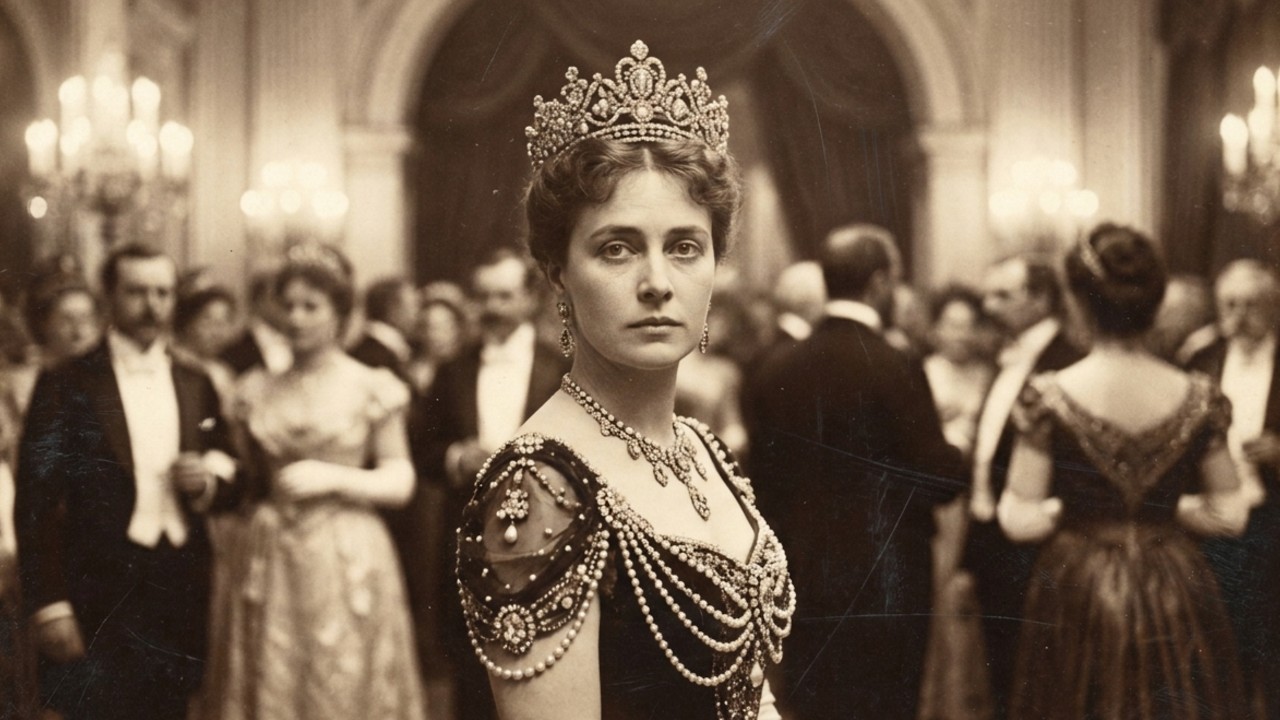
She never held office. She never cast a vote. Yet senators’ wives begged for her invitations, and the richest men in America rebuilt their lives around her approval. Her name was Caroline Astor, and long before the empty ballroom, she ruled America.
Before she ruled anyone, Caroline Schermerhorn owned the one thing the richest men in New York could never purchase. She owned a past. Caroline Webster Schermerhorn was born in New York City on September 22, 1830. She was the youngest of nine children in a family that had been trading, shipping, and buying Manhattan land since the 1600s.
Her father, Abraham Schermerhorn, was a merchant worth about half a million dollars—a serious fortune in a city where most families lived on a few hundred dollars a year. But the money was not the point. The name was the point. The Schermerhorns belonged to the old Knickerbocker order, the tight circle of Dutch-descended families who had run New York society since before the Revolution.
In their world, wealth was supposed to be old, quiet, and slow. A gentleman did not discuss money. A lady appeared in the newspapers three times in her life: at her birth, at her marriage, and at her death. Caroline grew up inside those rules the way a future general grows up inside an army.
She learned the grammar of calls and cards, of who visited whom and in what order, of precisely how long a bow should last. She learned that the rules were not decoration. The rules were the weapon. And she learned it at exactly the right moment, because the world those rules governed was about to be invaded.
By the time Caroline reached her twenties, new money was pouring into New York at a speed no Schermerhorn had ever imagined. Railroads, banking, shipping, and speculation were minting fortunes that dwarfed the old Dutch estates. The invaders had everything. They had marble houses, fast horses, and bank accounts that made the Knickerbockers look like caretakers.
What they did not have was standing. No name. No past. No way in.
Caroline watched that collision form, and somewhere in those years, she grasped the insight that would define her life. In a republic with no king, no court, and no titles, somebody would still decide who counted. The position was empty. The Americans had simply never filled it.
A young woman could not own a railroad and could not vote for a congressman, but the gate between money and respectability had been left unguarded, and the person who held it would hold power over everyone trying to pass through. She had the name to claim that gate. What she did not yet have was the fortune to fortify it. The Schermerhorn money was respectable, not overwhelming, and a gatekeeper without a treasury is just a snob.
Then, when she was twenty-three years old, an offer arrived from a family that had more money than any family in America—and a past they were desperate to bury. In 1853, she signed the most strategic contract of her life, and it was a marriage license. The groom was William Backhouse Astor Jr. , grandson of John Jacob Astor, the German-born fur trader who had clawed his way to the top of American commerce and died in 1848 as the richest man in the country, leaving a fortune of about $20 million.
The Astor strategy was brutally simple and brutally effective: buy Manhattan land, lease it, never sell. By the 1850s, the family collected rent from thousands of parcels across the growing city, including some of its worst tenements. New Yorkers called them the landlords of New York. It was a perfect trade, and both sides knew it.
The Astors had money two generations deep, but a founder remembered for wiping his fingers on his dinner companion’s sleeve. Caroline had two centuries of pedigree and a modest inheritance. Her name washed their money. Their money armed her name.
Family lore even holds that she found her husband’s middle name, Backhouse, too crude to print and pressed him to shrink it to a single discreet initial. The story may be polished, but it is true to the woman. She edited the family she married into, starting with its name. The marriage produced five children.
Emily came first, then Helen, then Charlotte Augusta, then Caroline, called Carrie, and finally, in 1864, a son, John Jacob Astor IV. It produced very little else. William had no interest in drawing rooms. He bred racehorses at Ferncliff, his estate on the Hudson, and spent months at a time aboard his yachts, including the Norma, one of the largest private vessels afloat.
While other husbands escorted their wives, William simply sailed. Asked where he was, Caroline answered with composed evasions and changed the subject. His absence was a wound, and she converted it into an operational advantage. There was no husband at home to consult, to embarrass her, or to overrule her.
The household, the children, the season, and the strategy were hers alone. And the treasury behind her kept growing. When her husband’s father died in 1875, he left an estate commonly estimated at $45 million, divided principally between his two sons. Caroline now stood on one of the great fortunes of the age, fed by rents that arrived whether the markets rose or fell.
A perfect name. A bottomless treasury. A vacant throne. By the early 1870s, every piece was in place except one.
An empire of manners would need machinery—lists, committees, rituals, and publicity—and a great lady could not be seen building any of it herself. She needed an architect who would do the visible work while she held the invisible power. She found him in a round little man from Savannah who had spent his whole life studying exactly one subject. Every queen needs a prime minister, and hers was a Savannah lawyer who had studied aristocracy like a science.
Ward McAllister was born in Georgia in 1827, made a quick fortune practicing law in Gold Rush San Francisco, and then retired in his twenties to devote his life to society. He toured the courts of Europe taking notes on how dukes seated their dinners and how English butlers announced a guest. He came home convinced that American society failed for one reason: it had money and no system. McAllister was a man with a system and no sovereign.
Caroline Astor was a sovereign without a system. Their alliance formed in the early 1870s built an empire. The machinery came first. In 1872, McAllister organized the Society of the Patriarchs, a committee of twenty-five gentlemen drawn from the oldest families in New York.
Each patriarch could invite four ladies and five gentlemen to a series of exclusive subscription balls, and each was personally answerable for every name he submitted. One unsuitable guest could disgrace the sponsor. It was a vetting engine disguised as a dance, a credit bureau for human beings. And everyone understood who stood behind it.
McAllister adored Caroline with the devotion of a courtier, calling her his “mystic rose,” a title he borrowed from Dante—the still point around which the whole heaven of society revolved. The division of labor was exact. McAllister did everything visible. He negotiated with chefs and florists, lectured the newspapers on etiquette, auditioned new families, and supervised the cotillions.
Caroline did everything that mattered. She made the rulings. A family seeking admission might spend two or three years being inspected, sponsored, and seasoned. At the end of it all, only one verdict counted.
If Mrs. Astor received them, they existed. If she did not, no amount of McAllister’s coaching could save them. Consider what she had actually built, because it is easy to miss under the chandeliers.
In the 1870s, an American woman could not vote in any state. In New York, the Married Women’s Property Acts were barely a generation old, and the legal doctrine of coverture still shadowed everything a wife owned. Women were barred from the professions, the exchanges, and the party machines. Every formal channel of power was closed.
So Caroline Astor took the one channel nobody had thought to guard—the power of recognition itself—and she institutionalized it. She gave it committees, rituals, a calendar, and an enforcement arm. By the end of the decade, the conquest was complete. The old Knickerbocker families accepted her as their general.
The new millionaires accepted her as their judge. Her invitations ranked the republic. All the throne lacked now was the thing every government eventually needs, the thing that turns authority into law. It needed a census.
And the census she approved would become the most feared document in America. The most feared document in America was never published by any government, and for years almost no one had seen it. It was a guest list. In 1888, Ward McAllister told a newspaper interviewer that there were only about four hundred people in fashionable New York society.
Go beyond that number, he explained, and you struck people who were either not at ease in a ballroom or who made other people not at ease. The figure, the story ran, matched the capacity of Mrs. Astor’s ballroom at 350 Fifth Avenue, which was said to hold four hundred guests comfortably. That ballroom arithmetic is probably legend rather than measurement, but the country believed it instantly because it captured the truth.
Society was whatever fit inside Caroline Astor’s house. The criteria were never printed, but everyone in New York could recite them. Money alone was nothing. The ideal was at least three generations of wealth, long enough for the original sins of its making to fade.
Active trade was disqualifying—a man who still stood behind his own counter could be richer than the Astors and remain invisible. Divorce was disqualifying. Scandal was disqualifying. Manners, lineage, and discretion weighed more than millions.
By those rules, she excluded for years the single richest railroad family on Earth. The Vanderbilts commanded a fortune larger than the Astor fortune, and Caroline declined to know them because their money was too new and their late patriarch, Commodore Vanderbilt, too coarse. One woman’s refusal to leave a calling card held a hundred million dollars outside the gates. Pause on the scale of what was being excluded, because the numbers are the story.
Between the Civil War and 1900, the number of American millionaires rose from a few hundred to several thousand. A single new fortune could run to twenty, fifty, or a hundred million dollars in an era when a skilled workman earned about five hundred dollars a year. Families worth more than entire state budgets waited years for one nod from one woman in one brownstone on Fifth Avenue. Some never received it.
Some gave up and sailed for Europe to buy titled sons-in-law instead. Some, in documented cases, simply abandoned New York. Exclusion had teeth, and the teeth were practical. Outside the list, your daughters could not meet the right men, which meant entire bloodlines were rerouted by omission.
Your sons were blackballed from the clubs where partnerships formed. The opera boxes at the old Academy of Music were closed to you. The newspapers, which printed her guest lists like court circulars, recorded your absence for the whole country to read. This is why the language around her turned governmental.
Editors called her court a despotism, and they were not entirely joking. Her list had no constitution, no appeal, and no term limits. On February 16, 1892, McAllister finally handed the actual list to the New York Times, and America discovered that the Four Hundred contained barely more than three hundred names. Even the number had been theater.
But the list was only the law on paper. The enforcement happened in person, one January night each year, in a room where the whole country was ranked. On the third Monday of January, the most powerful people in America stood in line to be approved by one woman. That was the Astor Ball, the certifying event of the New York season, held at her brownstone at 350 Fifth Avenue at the corner of Thirty-Fourth Street.
Outside, carriages stacked up for blocks in the winter dark, footmen stamping against the cold. Inside, the chosen Four Hundred moved through rooms banked with hothouse flowers toward the only moment of the evening that truly counted. At the head of the room, beneath a life-sized portrait of herself by the French society painter Carolus-Duran, stood Caroline Astor, receiving. She dressed like what she was.
Contemporary accounts describe her in dark velvet, sometimes purple, sometimes black, carrying diamonds valued in the hundreds of thousands of dollars—a stomacher across her bodice that legend, never verified, claimed had once belonged to Marie Antoinette. She wore the balance sheet of an empire on her body. And she stood beneath her own painted image, so that each guest, bowing to the woman, bowed to the institution at the same time. The receiving line was the whole point of the night.
Whoever Mrs. Astor received existed. The dancing afterward was merely celebration. Then came the second instrument, quieter and sharper.
Dinner. Seating at her table was a published ranking of American families, and she composed it the way a chancellor composes a cabinet. Who sat at her right hand? Who sat below whom?
Who had been moved three places down since last season—and what that meant, and who noticed. Everyone noticed. The next morning, newspapers across the country printed the guest lists and the details. Hostesses in Chicago, San Francisco, and Philadelphia studied them like statutes, then built their own little Four Hundreds on her model.
She was not running a party. She was running a national franchise. The money underneath it was staggering and worth counting. A single great ball of that era could swallow $10,000 in an evening, and the grandest ran past $100,000 once the orchestras, the imported chefs, the champagne, and the party favors were tallied.
Hostesses gave away jeweled trinkets as dance favors that cost more than a schoolteacher earned in a year. The average American worker brought home under $500 annually. One January night on Fifth Avenue could burn through the lifetime earnings of an entire factory floor. And the system demanded it, year after year, as the price of staying ranked.
Even rebellion proved her power. In 1883, new millionaires who could not get boxes at the old Academy of Music simply built their own opera house, the Metropolitan, with seventy box seats for the excluded rich. They could build around her wall. They could not tear it down.
And her hold rested finally on something smaller than any opera house. Her boldest claim to power fit on a piece of pasteboard small enough to hide in a glove. In the etiquette of the Gilded Age, the calling card was the currency of existence. A lady drove out in the afternoon and left cards at chosen doors.
A card from a social superior was recognition, an opening of relations, a fact that could be reported and verified. The absence of a card was a verdict. Caroline understood earlier and more completely than anyone that this little ritual was a ledger of rank, and that whoever issued the most valuable card in New York effectively printed the city’s social currency. So she made her card priceless.
And then she made it audacious. By the 1880s, the card read simply: The Mrs. Astor. No first name, no address, no husband’s initials.
The claim was breathtaking if you slowed down to read it. There were several Mrs. Astors in New York—including Augusta, the wife of her husband’s elder brother, and Mary, called Mamie, the wife of her husband’s nephew, William Waldorf Astor. Caroline’s card declared them all subordinate.
There was one Mrs. Astor, the way there was one Queen of England, and she was it. Letters addressed simply to “Mrs. Astor, New York” found their way to her door, and every delivery ratified the claim.
She had turned the postal service into a herald. The genius of the system was its deniability. She never raised her voice. She never published a ruling.
A family on the rise simply noticed that her card had appeared on their hall table, and their world changed. Invitations followed. Doors opened. Or the card never came.
And a silence settled over their name that no amount of money could break. Power that loud usually needs an army. Hers needed a footman and an afternoon. Inside her own family, though, the card was an act of war.
William Waldorf Astor, born in 1848, was the head of the senior Astor line—richer on paper than Caroline’s branch, ambitious, thin-skinned, and tired of watching his aunt by marriage reign while his own wife went unrecognized in her own name. He held that Mamie, as wife of the senior heir, was entitled to be the Mrs. Astor. Caroline did not argue.
Arguing would have acknowledged a dispute. She simply went on being the Mrs. Astor. And the world went on agreeing with her.
Every season of her silence ground his claim into dust. The feud stayed cold while the old generation lived. Then, in 1892, Caroline’s husband died in Paris, and the restraints came off. William Waldorf now controlled the senior fortune outright, and he had stopped thinking like a courtier and started thinking like a developer.
If he could not take his aunt’s title, he would destroy the ground she stood on. Literally. With thirteen stories of brick and steel built right against her garden. But before that war began, Caroline had already fought the defining battle of her reign, against an invader far more dangerous than any nephew.
Her name was Alva. In March of 1883, a woman Caroline refused to know spent a quarter of a million dollars on a single night. Alva Vanderbilt, born in Mobile, Alabama, in 1853, had married into the richest railroad family on Earth and discovered that in New York it bought her nothing. Caroline Astor had never called on her.
By the iron grammar of the card system, the Vanderbilts therefore did not exist. And they had not existed for years, no matter that their fortune outweighed the Astor fortune itself. The Commodore’s money was too new, his manners too rough, his heirs too eager. Other families accepted the verdict and waited.
Alva studied the system, found its one weak point, and aimed a party at it. The occasion was the housewarming of her new mansion at 660 Fifth Avenue, a white limestone chateau designed by Richard Morris Hunt that made the old brownstones look like servants’ quarters. The party was a costume ball set for March 26, 1883. The reported numbers stunned the country: roughly 1,200 invitations, a reported total cost of about $250,000 in a year when the average American worker earned less than $500.
Hostesses planned costumes for months. Quadrilles were drilled like military parades. The newspapers covered the preparations the way they covered presidential campaigns. All of fashionable New York understood that this would be the night of the decade.
Then Alva closed the trap. Caroline’s youngest daughter, Carrie, had been rehearsing for weeks with her friends in a star quadrille to be danced at the ball, taking her invitation for granted. Word now reached the Astor house, deliberately and regretfully, that no invitation could be sent. Mrs.
Vanderbilt explained that she could not invite Miss Astor because Mrs. Astor had never called on her. The families, formally speaking, did not know each other. It was Caroline’s own law, quoted back to her by an invader holding her daughter’s happiness as collateral.
Twenty years of rules had been reverse-engineered into a siege engine. Watch what Caroline did next, because it is the most revealing move of her career. She did not rage, did not negotiate, did not send an emissary. She weighed the position like a chess player.
If she stood firm, her daughter wept, the ball of the decade went on without the Astors, and every newspaper in America asked whether society had a new queen. If she yielded, she lost a battle she had already lost—and kept the war. So one afternoon, a liveried Astor footman climbed the steps of 660 Fifth Avenue and delivered a small piece of pasteboard. The Mrs.
Astor. The invitation arrived at once. Carrie danced her quadrille. The papers called it a surrender, and in a sense it was—the only one of her reign.
The Vanderbilts were inside, and the wall had been breached by sheer audacity and a checkbook. But notice what did not happen. No rival court formed. Alva entered the system instead of replacing it, and Caroline remained its acknowledged head for nearly two more decades, having absorbed her conqueror.
She had given ground once, on her own terms, with her own card. The next attacks would not come from strangers. They would come from inside her own house. For thirty years, Caroline Astor enforced a code with three capital crimes: trade, divorce, and scandal.
The enforcement made her invincible in public. In private, the code was a loaded gun in her own hallway, because no family of five children gets through the Gilded Age unmarked. Not even the family of the woman who wrote the rules. The first blows were grief.
In 1881, her eldest daughter Emily died after childbirth in her twenties, leaving a small daughter behind. Caroline mourned in the prescribed black, missed a season, and returned to her post because the throne had no provision for absence. Then, in 1893, her daughter Helen died as well. Two of her four girls were gone before either reached middle age.
The newspapers that printed her guest lists printed the funerals, too. And the receiving line went on. Because the receiving line always went on. The deeper wound was Charlotte.
In the early 1890s, the marriage of Charlotte Augusta Astor Drayton collapsed in an adultery scandal that detonated across the front pages, complete with letters, accusations, and a humiliated husband. It was precisely the kind of disgrace Caroline’s court existed to punish—the offense for which she had erased other families without a second thought. Her own rules demanded that Charlotte cease to exist. Caroline did not apply them.
She stood by her daughter privately, absorbed the whispers, and dared society to say to her face what it said behind its fans. Nobody did. But everyone understood what they had seen. The law of the Four Hundred had met the love of a mother, and the law had blinked.
Through all of it, she was alone in the way only a married woman can be alone. William Backhouse Astor Jr. had spent the better part of four decades elsewhere—on his yachts, at his stables, in Florida, anywhere but beside her. The marriage that founded the empire had become a polite fiction maintained for the public.
One more performance in a life made of performances. When he died in Paris in 1892, she buried him as a devoted widow. And whatever she actually felt went unrecorded, like everything else she actually felt. Count the cost as carefully as the power.
Two daughters dead. A third dragged through scandal. A husband who was a rumor in his own house. Decades of standing for hours under pounds of diamonds, of managing thousands of cards and calls, of never once being seen to falter, because the institution could not falter.
Historians who sift her life keep arriving at the same trade. The throne gave her purpose, authority, and a kind of immortality. It cost her intimacy, privacy, and rest. She paid without complaint, in public at least, for thirty years.
She might have expected, at sixty-two, a widowhood of dignified command. Instead, 1892 opened the most vicious decade of her life. Her husband was barely buried when her own nephew moved to take her name, and when that failed, he reached for a wrecking crew. William Waldorf Astor pressed his claim the moment the funeral ended.
With William Jr. dead, he argued, the headship of the family passed to him, and the title of the Mrs. Astor belonged to his wife, Mamie. Caroline answered the way she always answered challenges, with serene, total silence.
Her card still read “The Mrs. Astor. ” The mail still came to her door. Society, given a choice between a legal argument and thirty years of habit, chose habit.
William Waldorf had lost a war without his aunt firing a shot, and he did not take it gracefully. He declared that America was no place for a gentleman and moved to England. But first, he took revenge in the language Astors understood best: real estate. He demolished his own mansion, which stood directly beside Caroline’s house at Thirty-Fourth Street and Fifth Avenue, and in 1893 opened the Waldorf Hotel on the site—thirteen stories of crowds, carriages, kitchens, and commerce looming over her garden.
A hotel where anyone with money could buy a room. He had taken the most exclusive address in America and made it public on purpose. Her house was now unlivable, and everyone knew exactly why. Caroline’s counterprotest was to build.
She moved four miles up the avenue to a double mansion at Sixty-Fifth Street, numbers 840 and 841 Fifth Avenue, a French Renaissance chateau designed by Richard Morris Hunt, shared with her son, John Jacob Astor IV. Its ballroom and art gallery could reportedly hold more than a thousand guests—over twice the sacred Four Hundred. Her old home came down, and in 1897, her son raised the Astoria Hotel on the site, taller than his cousin’s. The two buildings joined, and the family feud fused into a single name the world still knows: the Waldorf-Astoria.
While the family war raged, her old prime minister fell. Ward McAllister had committed the one unforgivable crime: explaining the machine in public. His 1890 memoir, Society as I Have Found It, made him a national joke, and handing the actual list to the New York Times in 1892 finished him. Society did not denounce him.
It did something colder. It stopped inviting him. When he died in January of 1895, Caroline attended the funeral—a last card left at a ruined door—while the world he built barely paused its season. Beneath everything, the ground itself was shifting.
After 1900, there was simply too much money for any list to contain. Younger hostesses like Mamie Fish ran shorter, louder, more amusing courts and openly mocked the old solemnity. The Four Hundred had become a punchline as much as a register. The single gate Caroline had guarded for thirty years was dissolving into a dozen turnstiles, and no card, however magnificent, could close them again.
The world that had needed her permission was learning, year by year, to stop asking. What remained was the Queen herself, the ritual, and one last ballroom with no one in it. Her last guests were the ones only she could see. The final great entertainments at 841 Fifth Avenue came around 1905, when Caroline Astor was seventy-five years old and had been receiving New York for more than three decades.
After that, the invitations stopped. The official explanations were the polite ones of the era: fatigue, age, delicate health. Behind the doors, her mind had begun to fail. The condition her contemporaries called senility, and ours would likely call dementia, was loosening her grip on the calendar, the names, the faces—everything except the one thing that had gone deepest.
The ritual. Out of those last years comes the most famous image of her life, the one her competitors love to end on. Family and society accounts describe an old woman dressed in her jewels, standing in her vast empty ballroom, moving graciously along an invisible receiving line, greeting guests who were not there. Welcoming the dead and the vanished by name.
Presiding over the great years one more time. Honesty requires a flag here. The scene comes from retellings polished across a century, lore more than clinical record. But the testimony behind it is real, and the truth it carries is real.
Strip everything else away from Caroline Astor—memory, family, the city itself—and what remained at the bottom was a woman receiving. The throne had outlasted the mind that built it. The newspapers and the biographers reached for pity. Pity is the wrong instrument.
Measure the reign instead. She took power in the early 1870s and held it past the turn of the century, roughly the span of six presidencies. No rival unseated her. Alva Vanderbilt, the one challenger who ever beat her, won a single night and then joined the system.
Her own family attacked her with lawyers and a thirteen-story hotel and failed. She lost her throne to the only enemies no gatekeeper has ever beaten: time, arithmetic, and the sheer multiplication of American money. Kings have ended far worse. She died at home at 841 Fifth Avenue on October 30, 1908, at the age of seventy-eight, with the season’s first frosts on the park across the avenue.
The obituaries ran across the front pages of the country she had ranked. They called her the queen of American society. And for once, the newspapers were being precise. There was no successor.
There could not be one. The position she had invented required a unified society to govern, and that society had dissolved beneath her. The gate closed behind her because she had been the gate. The world she left took astonishingly little time to erase the evidence.
Within four years, her son was dead in the North Atlantic. Within a generation, wrecking crews stood on the exact spot where America had once lined up for her nod. The dismantling began almost immediately. In April 1912, her son, John Jacob Astor IV, went down with the Titanic—the richest man aboard, his fortune commonly estimated near $87 million.
He had been the last master of her house at Sixty-Fifth Street, and the newspapers that had printed her guest lists now printed his name on the list of the drowned. The dynasty that had funded the throne was passing into headlines and probate. Then the addresses themselves went. The Waldorf-Astoria, the double hotel born of her family’s feud at Thirty-Fourth Street, reigned over New York hospitality for three decades, then met the city’s only true sovereign: real estate.
Demolition began in 1929. On the site—on the exact ground where her brownstone had stood and her receiving line had formed—rose the Empire State Building, opened in 1931: 102 stories of speculative office space with an observation deck open to anyone holding the price of admission. Read that as history’s joke, because it is one. The most exclusive threshold in America became the most public one on Earth.
The spot where the Four Hundred were chosen now admits four million visitors a year. Yet look closer, and her fingerprints are everywhere. The hotel name her family’s war created still operates on Park Avenue, one of the most famous brands in the world. Her summer cottage, Beechwood, still stands on the Newport cliffs, where guides in costume spent years reenacting her receptions for paying guests.
Her rituals turned into theater. The phrase she made, “the Four Hundred,” survives in American English as shorthand for any closed elite. And the template she invented never died at all. It just changed clothes.
The charity gala with its tiered tables, the benefit committee, the membership list, the velvet rope outside the club—every one of them runs on her operating system. Recognition granted or withheld by someone empowered to decide. Even her conqueror ended up proving her point. Alva Vanderbilt, who had stormed the gates with a quarter-million-dollar ball, spent her later decades and her divorce settlements funding the women’s suffrage movement—marching, publishing, and bankrolling the fight for the vote.
The woman who beat the gatekeeper concluded that gatekeeping was not enough and went after the gates of the republic itself. It is hard to imagine a cleaner line of succession. Caroline proved a woman could govern a closed world. Alva demanded the open one.
Historians have circled back to Caroline Astor in recent decades with new respect, reading her less as a snob in diamonds and more as a case study in how women exercised real authority when every formal channel was sealed. Which leaves the final question—the one this whole story has been building toward. What exactly was her power? And what did it make possible?
She never held an office, and yet she governed. Strip away the velvet and the violins and look at the mechanics. She controlled admission to the only aristocracy America had. Admission controlled marriages, partnerships, fortunes, and futures.
Her rulings were enforced without police, obeyed without statutes, and reported without question by the national press. Political scientists have a word for an authority that decides membership, ranks subjects, and punishes defiance with erasure. The word is government. Caroline Astor ran a government—a private one, a strange one, but a real one.
And she ran it for thirty years without a single successful coup. Remember the world she did it in. When she took power, an American woman could not vote in any state. The law of coverture still shadowed every wife’s property.
Women were barred from the exchanges, the courts, the party machines—every formal lever of the republic. The system left women exactly one unguarded door: the social one. And most saw a parlor behind it. Caroline saw a capital.
She walked through that door and built a state on the other side, with a census, a court calendar, a foreign policy for new money, and an army of footmen carrying pasteboard. She took the only power available and pushed it to its absolute limit, which is the most any ruler in history has ever done. The cost is part of the ledger, and she paid it in full. A husband who was a stranger at sea, two daughters buried, a third dragged through the scandal pages, decades of performance without a single public stumble, ending in an empty ballroom among phantom guests.
Her competitors tell that ending as a tragedy of loneliness. Told honestly, it is the standard biography of power. Kings die confused in palaces, too. We do not lead with their pity.
We lead with their reigns. And the reign mattered beyond the ballroom because of what it proved. She proved that gatekeeping is a form of rule, and that a woman could exercise it as coldly and as competently as any man exercised his. Every woman who came after her inherited that proof: the club women who turned guest lists into political networks, the hostesses who turned dinner tables into negotiating rooms, Alva Vanderbilt, who took the audacity she had used against Caroline and aimed it at the Constitution.
The board chairs, the founders, the women who decide to this day who gets funded, who gets seated, who gets heard. She did not ask for permission. She did not wait for an invitation, because she was the invitation. She found the one door in America left unlocked for a woman, and she did not just walk through it.
She put her chair in the doorway and made the richest nation on earth line up. Stand one last time where her ballroom stood. The walls are gone. The list is a punchline.
The Empire State Building soars over the spot, full of strangers no one vetted. Everything she built was temporary, except the lesson. Power is not only the law and the dollar. Power is also the list, the door, and the nod.
A woman discovered that when she was allowed to own almost nothing else. And for thirty years in the loudest, richest, most ambitious city on earth, nobody mattered until she.
