When she died in room 1801 of the Drake Hotel, the wealthiest woman in America had less than $9,000 left to her name. She was a Rockefeller. Her father owned the world. Her husband owned the machines that fed America, and she had buried two of her children before either of them turned five.
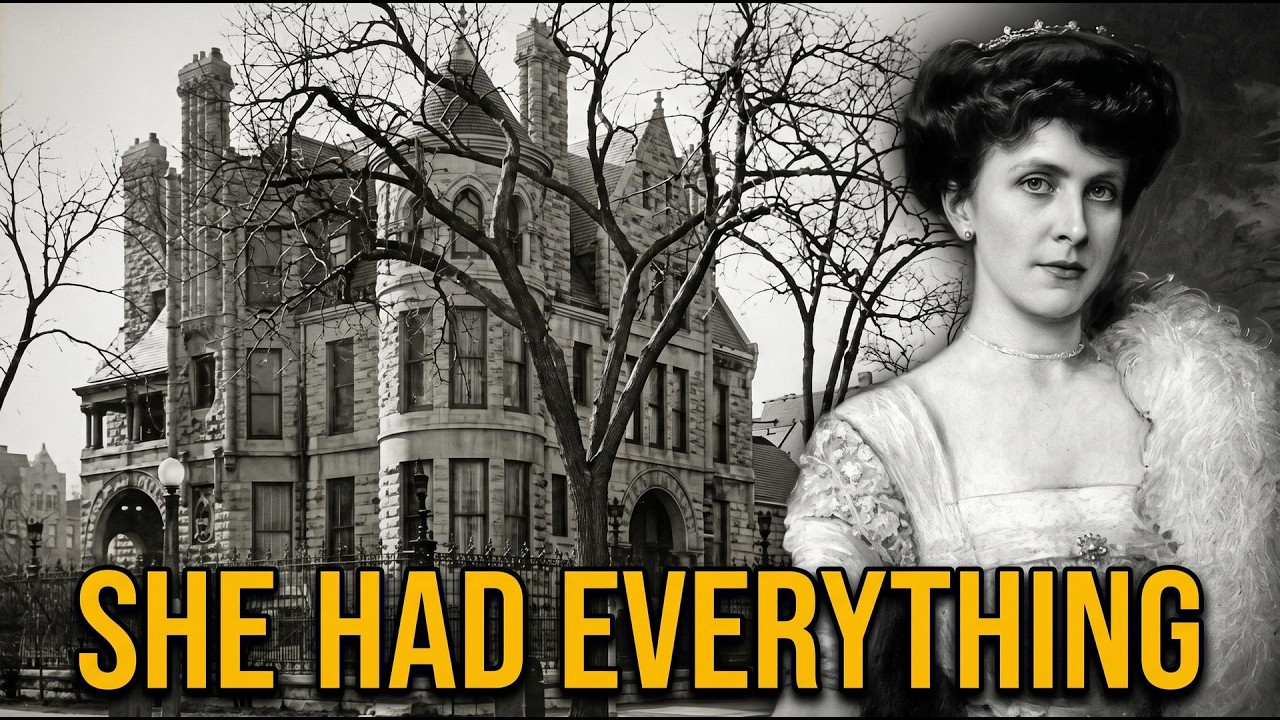
Her name was Edith Rockefeller McCormick, and the story of what she did to her five children, what she allowed to happen to them, what she forced upon them, and what she hid from them until the very end remains one of the most carefully buried tales of the entire Gilded Age. It begins with a promise Edith made to herself at the age of six. The year was 1878. In a modest brick house on Euclid Avenue in Cleveland, Ohio, John D.
Rockefeller sat across the kitchen table from his fourth daughter and taught her to count pennies. He was 41 years old, and within ten years he would become the richest man on earth. He pushed a small stack of coins across the wood and told her to divide them: one part for spending, one part for saving, one part for the church. When she finished, she looked up and said, “Father, I will never count pennies when I am grown.
I will only count what I give away. ”
John D. Rockefeller simply stared at his daughter. That same week, he had just signed the contract that would create Standard Oil.
Edith did not know it, but the world she was about to inherit was being built around her in real time. She was the fourth of six Rockefeller children, though only four would survive. Her older sister Alice had died as an infant before Edith was even born. Her sister Bessie was distant and bookish.
Her sister Alta was the favorite. Her younger brother John Junior, the only son, would inherit everything. Edith was the middle child, the strange one, the one her mother called too clever for her own good. She was educated entirely at home.
She read Latin, Greek, and German by the age of twelve. She memorized the Old Testament. She was forbidden from balls and did not attend finishing school. And she developed a habit her father found disturbing: she began collecting things.
Not toys, but symbols—old coins from Egypt, carved jade from China, a small Etruscan figurine her father bought her in New York that she carried in her pocket for the next forty years. Somewhere between the ages of ten and fifteen, Edith Rockefeller began to believe something about herself that she would never tell her parents, something that would eventually take her 3,000 miles away from her own children. She was 23 years old when she met Harold Fowler McCormick in the spring of 1895. Harold was the heir to another American empire.
His father, Cyrus McCormick, had invented the mechanical reaper, the machine that fed nineteenth-century America. The McCormicks were old Chicago money; the Rockefellers were new oil money. Their union would not just be a marriage but a merger of two of the largest fortunes the country had ever produced. The wedding took place on November 26, 1895, at the Rockefeller home in Pocantico Hills, New York.
Edith wore a white silk gown imported from Paris, a veil of Brussels lace, and carried orchids flown in by private railcar from a Florida greenhouse owned by Henry Flagler. There were no guests outside the family. The combined net worth of the two families that day, in today’s money, exceeded $23 billion. There were fewer than thirty people in the room.
The newlyweds spent their first two years in a small house in Council Bluffs, Iowa, where Harold was learning the family business. Edith, a young woman raised in mansions, kept her own books, planted her own garden, and gave birth to her first child in a bedroom upstairs. His name was John Rockefeller McCormick, born in March 1897. He was named for his grandfather, and from the moment he opened his eyes, his grandfather adored him.
The family then moved to Chicago, and Edith’s real life began. By 1901, the McCormicks were the most powerful young couple in the city. They threw legendary dinners. They funded the first opera house Chicago would ever have.
They bought paintings, sculptures, manuscripts, jewels. Edith ordered tablecloths embroidered by nuns in Belgium and silver flatware engraved with the family crest by a workshop in Florence. By 1905, she had given birth to four more children: Harold Fowler Jr. , born 1898; Muriel, born 1902; Editha, born 1903; and Mathilde, born 1905.
Five children, two empires, one marriage that on paper looked perfect. Within three years, two of those children would be in the ground. Within twenty years, the marriage would be over. Within thirty years, the empire would be gone.
But in the spring of 1905, none of that had happened yet. Edith Rockefeller McCormick stood at the top of a marble staircase in her new mansion on Lakeshore Drive, looked down at her four living children playing on the carpet below, and believed, truly believed, that she had been chosen by God. Some accounts suggest she kept a private journal. In it she recorded the date, the weather, and a single sentence: “Today I have everything a woman could possibly want.
” She would never write that sentence again. To understand the woman Edith Rockefeller McCormick became at her peak, you must understand Villa Turicum. In 1908, she and Harold purchased 300 acres of land directly on the shore of Lake Michigan in Lake Forest, Illinois. They commissioned the architect Charles A.
Platt to design a country house in the style of an Italian Renaissance palace. It had 44 rooms, 15 bathrooms, marble imported from Tuscany, a private theater, a formal Italian garden cascading down to the lake, and a swimming pool fed by spring water. It cost $3 million to build in 1908, roughly $100 million today. She would live in it for less than a single full summer.
After 1913, Villa Turicum stood mostly empty. After her death, it was abandoned. By 1950, it was a ruin. By 1956, it was bulldozed.
But on the day in May 1912 when Edith first walked through the front doors of her own private palace with her children behind her, her husband beside her, and 28 servants lined up in the entrance hall to greet her, she had reached a height that few women in human history have ever touched. She had married the most powerful young industrialist in America. She had borne five children. She had built the largest private home on the Great Lakes.
There is a photograph from that summer of 1912. It shows Edith standing in the formal garden at Villa Turicum, dressed in white, with her four surviving children grouped around her: Fowler, age 14; Muriel, age 10; Mathilde, age seven. And in the very front, her arms wrapped around her mother’s leg, there is no fifth child. Editha had been dead for eight years.
In the photograph, no one is smiling. No biographer has ever fully explained why, in nearly every family photograph taken at Villa Turicum after 1904, Edith placed her surviving children in the exact same positions: always Fowler on her right, always Muriel on her left, always Mathilde at her feet, and always an empty space directly beside her where Editha would have stood. It would take her psychiatrist twelve years to convince her to move that empty space out of every family portrait. By then, Edith had a new obsession: a small object she carried in her purse everywhere she went.
An object that, in 1923, she would publicly claim to have remembered owning 3,000 years before she was born. Before going further, you need to understand one thing about Edith Rockefeller McCormick. She did not believe she was a woman of her own time. She believed, long before her psychiatrist confirmed it, long before the press mocked her for it, that her soul had lived many lives—that she had been a queen in Egypt, that she had walked through the gardens of Babylon.
That she was, in the deepest part of herself, ancient. The autumn of 1900 was the happiest season of Edith Rockefeller’s life. She was 28 years old. She lived in a townhouse on the corner of Erie Street and State in the most fashionable district of Chicago.
She had been married for five years. She had two children: a healthy son named John, who had just turned three, and a baby boy named Harold Fowler Jr. , who was learning to walk. Her husband came home for dinner every evening at 7:00.
Her father wrote her letters every Sunday. Her brother John Jr. visited from New York twice a year and always brought toys for the boys. The household was modest by Rockefeller standards—just nine servants, a French chef, and an Irish nanny named Margaret who had been with John since the day he was born, and who the family would later say loved that little boy as if he were her own.
John had inherited his grandfather’s red hair. He had his father’s quick laugh. He could already recite the names of every animal in his picture book in English, in German, and in three words of French. The Rockefellers and the McCormicks both believed he was the most extraordinary child either family had ever produced.
In late September of that year, Edith hosted a small birthday gathering for him. He had just turned three and a half, though the family insisted on celebrating every six months because, as Harold would later write in a letter, “The boy is so quick that no single year seems enough to contain him. ” One detail from that party almost no biographer has recorded: Harold did not stay the entire evening. He left after the cake, alone by carriage, to a meeting downtown that he refused to discuss with his wife.
It would not be the last time. By Christmas of 1900, Edith was pregnant with her third child. By January, she was decorating the nursery in pink. She was certain, somehow, that this one would be a girl.
It began with a rash on his neck. It was the morning of February 24, 1901. John was playing on the rug in the upstairs sitting room when his nanny Margaret noticed three small red spots beneath his right ear. She did not panic.
Children that age develop rashes constantly. She took him into the bathroom, washed his neck with cool water, and dressed him in a soft nightshirt. By that evening, the rash had spread across his chest. By the following morning, it had reached his face.
The family doctor, Dr. Gunn Saulus, the most respected pediatrician in Chicago, arrived at the house just before noon on February 25. He took one look at the boy, turned to Edith, and said the two words every mother in 1901 dreaded: scarlet fever. That year, scarlet fever killed roughly one out of every four American children who contracted it.
There was no antibiotic, no vaccine, no treatment beyond cool compresses, quiet rooms, and prayer. The combined Rockefeller and McCormick fortunes, the largest pool of private wealth in human history up to that point, could buy anything in the world. They could not buy a cure for streptococcus. For the next eleven days, Edith did not leave her son’s bedside.
She refused to sleep in her own bed. She refused to eat at the table with her husband. She had Margaret moved into the bedroom adjoining John’s. She sat hour after hour, day after day, holding the small hand of a boy whose temperature climbed to 105 degrees and would not come down.
Telegrams were sent to Cleveland, to New York, to every infectious disease specialist on the East Coast. Three doctors arrived from Johns Hopkins by private railcar. A specialist from Boston traveled in a snowstorm. None of them could do anything.
On the morning of March 2, 1901, John Rockefeller McCormick, three years and eleven months old, opened his eyes one final time. He looked up at his mother. According to Margaret, who would tell this story for the rest of her life, he said one word: “Mama. ” He died that afternoon at 3:47.
And here is the part of the story that every biographer races past. Edith was four months pregnant. When she was told her son was dead, she stood up from the bedside chair, walked into the next room, and collapsed onto the floor. The doctors who attended her that night recorded something in their notes that the family later asked to be removed from the official record: something about the way she kept repeating one phrase over and over in a voice that was no longer entirely her own.
John was buried in a small Episcopal cemetery in Tarrytown, New York, eight days after he died. His grandfather John D. Rockefeller, who had refused to attend his own mother’s funeral two years earlier because of a business dispute, wept openly at the graveside. He would later write to his son John Jr.
: “I have lost the brightest soul this family will ever know. ”
But the most haunting account of John’s funeral comes from Edith’s brother John D. Rockefeller Jr. He recorded it in his private diary on March 11, 1901.
Three sentences. That was all. Edith did not cry. She did not speak.
She placed a small Egyptian carving in the coffin before they closed it. That carving was a turquoise scarab beetle, approximately 3,000 years old. Edith had purchased it at an antiquities auction in New York the previous summer for $42 and had carried it in her purse every day since. In Egyptian belief, the scarab is the symbol of rebirth, of a soul that returns.
She did not place it on his chest as a memento. She did not slip it into his folded hands as a keepsake. According to her brother’s diary, she pressed it firmly into the boy’s mouth the way the ancient Egyptians had once placed amulets in the mouths of their dead pharaohs. She believed her son was coming back.
This was the first verifiable moment when Edith Rockefeller began to act on a belief she had been hiding for almost twenty years: the belief that death was not final, that the soul moved, that a child who had died at four would, in some form, return. Three days after the funeral, she returned to Chicago. She took to her bedroom. She refused all visitors.
She refused her husband. She refused her father, who had traveled from New York to comfort her. She locked her door. For nineteen days, no one but Margaret was allowed in that room.
When she finally emerged on April 2, 1901, the staff said she looked thirty years older. She was 28. The phrase the doctors had heard her repeat the night her son died, the phrase the family had asked to be removed from the official record, was a single sentence spoken in a language she had never formally studied: “He will be Khufu. ” Khufu was the name of the pharaoh who built the Great Pyramid.
That evening, she made a decision she would never reverse. She removed every photograph of her son from every wall in the house. She wrote his name on the back of each one in pencil. And she placed all of them, along with the small Egyptian carvings she had been collecting since childhood, into a single locked cedar trunk that she would carry with her for the next 31 years, to every house she ever lived in, including, eventually, room 1801 of the Drake Hotel.
To the public, nothing changed. Edith was photographed at the Chicago Symphony four weeks after her son’s death. She was photographed at a charity gala in May. She was photographed at her brother’s wedding in October.
She wore black for thirteen months. She was always, always smiling. In private, she had begun to read. She read the Egyptian Book of the Dead.
She read the Tibetan Book of the Dead. She read Madame Blavatsky and Carl du Prel and the early German theosophists. She wrote to a London occultist asking about the doctrine of metempsychosis, the transmigration of souls. She was searching for a doorway, a way to bring her son back.
In November 1901, she gave birth to her third child, a girl. She named her Muriel after a character in a romantic novel—but also, she would later admit to her psychiatrist, after the Egyptian word Mary, which means beloved. She did not place the new baby in the nursery John had used. She had that nursery sealed.
Three years later, in the spring of 1904, a second small coffin would be carried out of the Chicago house. And the press of that year, the press that loved nothing more than a Rockefeller scandal, would refuse, for reasons that have never been fully explained, to print a single word about it. He was named Editha, with an A. Edith chose the spelling herself.
She told her husband she wanted the child to carry her name forward, but with something added, something her own mother had not given her. Editha McCormick was born on December 17, 1903. She had her father’s blue eyes and her mother’s small, narrow hands. She weighed 7 pounds 4 ounces.
By her first Christmas, she was the most photographed baby in Chicago. The McCormick household received gifts from the Astors, the Vanderbilts, the Whitneys, and a personal silver rattle from the wife of President Theodore Roosevelt. She lived eight months. The infant mortality rate among American children in 1904 was approximately 120 per thousand live births.
Among the children of the Rockefeller and McCormick families, the rate by that year was 400 per thousand. Two of Edith’s first four children would not see their fifth birthday. The cause of Editha’s death was never publicly recorded. The death certificate, filed in Cook County on August 19, 1904, lists the cause as “natural causes—infantile.
” No physician’s name appears beside the entry. The line for attending doctor is left blank. This is unusual. In 1904 Chicago, the death of an heiress to two of America’s largest fortunes would have been attended by no fewer than three physicians, and the certificate would have been signed by all of them.
There is no signature. And here is what almost no biography of Edith Rockefeller McCormick has ever explored. Editha did not die in the family townhouse. She did not die in a hospital.
She died in a small private cottage on the grounds of a country estate forty miles north of Chicago, a cottage that had been built six weeks earlier on Edith’s specific instructions as what the household staff called “the quiet house. ”
According to a memo written by the household manager, discovered in the McCormick family papers in the 1980s, the quiet house was “a place where the youngest child can be cared for without disturbance, in keeping with Mrs. McCormick’s belief that the child requires absolute stillness for her constitution. ” In other words, Editha had been removed from the main house, placed with two nurses and a doctor in an isolated cottage on a private estate, and she had died there.
The press of August 1904 printed almost nothing about Editha. The Chicago Tribune gave her a single paragraph on page 11. The New York Times gave her one sentence. There were no funeral photographs, no public service.
She was buried in Tarrytown in the same cemetery as her brother John, in a coffin so small that the gravediggers later said it could have been mistaken for a hatbox. The reason the press refused to print more was a single phone call placed by John D. Rockefeller himself on the morning of August 20, 1904, to the publishers of every major newspaper east of the Mississippi. He did not want this story told.
And no one defied John D. Rockefeller in 1904. What he was hiding remains, even today, a matter of speculation. But the household manager’s memo contains one final line, written six weeks before Editha was moved to the quiet house, a line that has haunted every researcher who has ever read it: “Mrs.
McCormick has expressed concern that the child does not respond to her presence in the manner of the others. ”
Edith did not weep at Editha’s funeral. She did not visit the grave for thirteen years. The household staff at the McCormick mansion would later report that in the autumn of 1904, Edith Rockefeller McCormick stopped speaking for almost six weeks.
She communicated through written notes. She took her meals alone. She did not enter the nursery where her two surviving children, Fowler, aged six, and Muriel, aged two, slept. Her hair, which had been chestnut brown, began to turn gray at the temples.
She was 32 years old. A maid named Bridget O’Connor, who worked in the household from 1903 to 1908, gave a deposition many years later in connection with a probate dispute. She described what Edith looked like in the winter following Editha’s death: “The mistress wore the same black dress for 41 days. I counted.
The lace at the cuffs began to fray. She would not let us take it from her, even to wash it. ” She said the dress had been near the child. In the spring of 1905, against the explicit warnings of two physicians, Edith became pregnant for the fifth time.
The pregnancy was difficult. She was bedridden for the final three months. She refused to allow Harold into the bedroom. She insisted the child be delivered by a midwife rather than a doctor.
She demanded the room be filled with white flowers—gardenias specifically, flown in from a greenhouse in Florida—and that no man other than the obstetrician be permitted in the house during the birth. Mathilde McCormick was born on August 8, 1905. She was healthy, with her mother’s pale skin and her father’s strong frame. She would live to the age of 42.
But Edith had now experienced five pregnancies in eight years and buried two children. Something inside her, something her brother John Jr. would later describe as the ordinary connection between a mother and her living children, had been damaged in a way that money could not repair. She began to spend longer and longer hours alone in her library.
She began to correspond with academics in Vienna, in Munich, in Zurich. She began to send telegrams in cipher. And to understand what happened next, to understand why in the autumn of 1913 Edith Rockefeller McCormick boarded a steamship to Europe with her three surviving children and did not return to the United States for nearly eight years, we have to introduce a man whose name almost no Rockefeller biographer is comfortable mentioning, a man Edith would call in private letters “the only physician of the human soul I have ever met. ” His name was Carl Gustav Jung.
She left for Switzerland on October 11, 1913. She told her husband it was for a season of rest. She did not return for seven years and ten months. She brought with her her son Fowler, age 15; her daughter Muriel, age 11; her daughter Mathilde, age eight; six steamer trunks; the small cedar trunk containing John’s photographs and her Egyptian carvings; a maid, a governess, a French chef, and $40,000 in gold.
She rented a suite at the Hotel Baur au Lac in Zurich, suite 308. She would live in that suite for the next eight years. She enrolled the children in Swiss boarding schools. She enrolled herself in the analytical psychology seminars of Carl Jung.
And here is where the story turns from private grief into public catastrophe. In 1915, in an interview with a Swiss reporter, Edith stated that she had recovered, through Jungian analysis, clear and detailed memories of three previous incarnations. She had been an Egyptian queen named Ankhesenamun, the wife of King Tutankhamun. She had been the child bride of a Babylonian prince.
And she had been, in her most recent past life, a Renaissance noblewoman in Florence who had died giving birth to twin sons. The American press, which had been tracking her European exile from a respectful distance, exploded. The Chicago Daily News ran the headline: “Rockefeller heiress claims she was queen of Egypt. ” The New York World called her “the most expensive lunatic in modern history.
” Her father, by then the richest man on earth and a deeply religious Baptist, refused to comment. But in a private letter to her brother, recovered after his death, he wrote one sentence: “I am ashamed before God of what my daughter has become. ”
She did not come home. And the press humiliation that followed her every public statement was somehow only the beginning.
Because in 1917, while she was sitting in suite 308 of the Baur au Lac lecturing visitors on the symbology of ancient Egyptian funerary rites, her husband Harold, alone in Chicago, was beginning a love affair so reckless, so public, and so financially catastrophic that it would eventually consume nearly half of the McCormick fortune. Her name was Ganna Walska. She was 29 years old, Polish, and by every documented account possessed of one of the most spectacularly mediocre singing voices ever to attempt a career in opera. Harold McCormick, the heir to the International Harvester fortune, the husband of Edith Rockefeller, the father of three living children, fell so completely in love with her that he would, over the next decade, spend the equivalent of more than $100 million in today’s money trying to make her a star.
He paid for her singing lessons. He bought her costumes. He purchased opera houses for her to perform in. He bribed conductors, reviewers, and audiences.
When the Chicago Opera Company refused to cast her in the lead role of Leoncavallo’s Zaza in 1920, Harold personally guaranteed the company’s losses for the entire season and forced the casting himself. The opening night was a disaster. The audience laughed. The critics destroyed her in print the following morning.
Harold married her anyway. Edith Rockefeller McCormick filed for divorce on December 29, 1921. The proceedings took less than four hours. Harold Fowler McCormick married Ganna Walska in a civil ceremony in Zurich exactly fourteen days later.
Edith attended the wedding. She wore black. And those meetings Harold had been quietly leaving early to attend twenty years earlier, when his small son was learning to count animals in three languages—those meetings, the household manager would later confirm in a private letter, had been the beginning of Harold McCormick’s lifelong inability to remain in any room that contained his wife. He had been escaping her for the entire marriage.
The divorce was negotiated quietly. Edith received a settlement of approximately $5 million, a fraction of what she was entitled to. She did not contest it. She did not, according to the lawyers who handled the proceedings, even read the documents before she signed them.
She was 49 years old. She had been married for 26 years. She had lost two children, and the husband she had lost was already, on the day the ink dried on the divorce papers, in another woman’s bedroom three floors above hers in the Hotel Baur au Lac. But if you think this is the worst part of Edith Rockefeller’s story, you are not ready for what comes next.
Because what happened in 1922, the year she finally returned to America, the year she walked into the abandoned grandeur of Villa Turicum for the first time in nine years, is the part of her life her descendants still refuse to discuss publicly. It begins with her youngest daughter, Mathilde. It begins with a Swiss riding instructor. And it begins with a number: 32.
Mathilde McCormick had grown up in Switzerland. She spoke four languages. She had been educated at one of the most exclusive girls’ schools in Europe. She was, by every contemporary account, a serious child, quieter than her older sister Muriel, more bookish than her brother Fowler, and so intensely attached to her mother that the household staff at the Baur au Lac called her “the shadow.
”
In the summer of 1922, in the small Alpine village of Pontresina, Mathilde was sent to take riding lessons. Her instructor was a Swiss horseman named Max Oser. He was 48 years old. The age difference between Mathilde McCormick and Max Oser was 32 years.
He was older than her own mother. He was older than her father. When Mathilde turned 18 in August 1923, Max Oser was 50 years old and had two grown children of his own. Their engagement was announced in February 1923.
The international press detonated. The New York Times ran the story on the front page for nine consecutive days. The London Daily Mail sent three reporters to Switzerland. The Chicago Tribune, which had once been forbidden by John D.
Rockefeller from printing the death notice of Edith’s daughter Editha, now devoted entire pages to mocking the engagement of her surviving daughter. Mathilde was called “the heiress who fell for her stable boy. ” Max Oser was called “the most expensive horse trainer in European history. ”
And Edith Rockefeller McCormick, the mother who had spent eight years in Zurich allegedly searching her own soul for the wisdom of past lives, gave the engagement her full and public blessing.
The press blackout that had once protected the death of her youngest daughter in 1904 was now nowhere to be found. John D. Rockefeller was 84 years old in 1923. He no longer made phone calls to newspaper publishers.
He no longer controlled what was printed about his own family. Mathilde and Max Oser were married on April 12, 1923, in a small civil ceremony in Lausanne. Edith attended. She gave the bride a wedding gift of $1 million and a small turquoise scarab beetle that she had carried in her purse since 1900.
Mathilde would later tell her own daughter, born in 1925, that she did not understand the meaning of the gift until she was an adult. By then, her mother was dead. Max Oser was not a fortune hunter. He was, by every surviving account, a quiet and devoted husband.
He and Mathilde had one daughter together. Their marriage lasted six years, until his death from a heart attack in 1929. Mathilde was widowed at 24. She would never remarry.
She survived her mother by only fifteen years, dying in 1947 at 42 of complications related to depression and alcoholism—the same age, almost to the year, that her mother had been when Mathilde first introduced her to Max Oser on a riding trail in the Swiss Alps. Edith returned to Chicago in August 1921, two months before her divorce was finalized. She had been gone for almost eight years. Villa Turicum had stood empty for the entire duration of her exile.
The marble had cracked, the fountains had filled with leaves, the formal gardens had grown wild. Three of the original 28 servants were still on the property; the rest had been let go years earlier. She moved into a smaller house on Lakeshore Drive in the city. She was 49 years old.
She no longer had a husband. Two of her children were dead. Her son Fowler was married and living in New York. Her daughter Muriel was unmarried and traveling in Europe.
Her daughter Mathilde was in Switzerland preparing for a wedding the entire world was mocking. Edith was, for the first time in her adult life, alone. She did not go quietly. Between 1922 and 1929, she became one of the most aggressive cultural patrons in American history.
She founded the Chicago Civic Opera Company. She funded an entire wing of the Field Museum dedicated to ancient Egyptian artifacts. She paid for the first English translation of Carl Jung’s Psychological Types and personally distributed copies to every major American university. She purchased and renovated a townhouse on East Lakeshore Drive that became one of the most intellectually serious salons in the city.
She held weekly dinners attended by writers, artists, philosophers, and visiting Europeans. She lectured publicly on reincarnation, on dream symbology, on the spiritual meaning of money. The reason Edith Rockefeller McCormick became in the 1920s one of the most generous and visible patrons in American cultural life was not generosity. It was grief.
She was building in public and at enormous cost the same parallel inner world she had begun building in private after the death of her son in 1901. She was constructing a museum of meaning, a monument, a pyramid. She was preparing, exactly as the Egyptian pharaohs she had studied for thirty years had once prepared, for her own death. In the spring of 1932, Edith Rockefeller McCormick was diagnosed with cancer.
She was 59 years old. The cancer had originated in her breast and spread to her bones. The pain was, by every account of the physicians who attended her, severe. She refused morphine for the first three months, partly because she did not wish to dull her mind and partly, she told her psychiatrist in a letter, because she believed pain was a final teacher.
She moved into the Drake Hotel on Lake Shore Drive in May 1932. She took suite 1801 on the 18th floor, with a view of the lake she had once owned 300 acres along. She did not move into a hospital. She did not return to Villa Turicum.
She did not summon her surviving children. She had given approximately $35 million to charitable, educational, and cultural causes during her lifetime. By the summer of 1932, in her hotel suite at the Drake, she had less than $100,000 in liquid assets remaining, and the Great Depression had destroyed nearly all of her remaining investments. The wealthiest woman in America was paying her hotel bill week to week.
In July 1932, her brother John D. Rockefeller Jr. , the only sibling she had remained close to throughout her life, boarded a private train in New York and traveled to Chicago. He was 58 years old.
He had been suffering from a serious respiratory illness for nearly a year. His doctors had advised him not to travel. He went anyway. He sat at her bedside in suite 1801 for three days.
What they discussed has never been publicly recorded. But in the diary John Jr. kept throughout his life, now held in the Rockefeller Archive Center in Sleepy Hollow, New York, there is a single entry dated July 18, 1932. It contains only one line: “She asked me to forgive her.
I told her there was nothing to forgive. She did not believe me. Neither did I. ”
She died at 4:23 in the afternoon on August 25, 1932, six days short of her 60th birthday.
The official cause of death was carcinoma. The attending physician was Dr. Alfred Strauss. The only family member in the room at the moment of her death was her son Fowler, who had arrived from New York the previous evening.
Her last documented words, as recorded by her nurse, were spoken in a language the nurse did not understand. The nurse wrote them down phonetically. A scholar of ancient languages consulted by the Rockefeller estate three weeks later identified the words as Middle Egyptian. They were a fragment from the Book of the Dead, specifically from spell 30B, the spell spoken by the deceased to ensure that the heart would not testify against the soul during the final judgment.
The fragment translates approximately as: “Oh my heart of my mother, do not stand against me as a witness. ”
When the maid entered suite 1801 the following morning to begin packing Edith’s personal effects, she found three objects arranged on the bedside table: a photograph of John Rockefeller McCormick, age three, taken in 1900; a small turquoise scarab beetle, identical to the one Edith had given Mathilde at her wedding and identical to the one she had once placed in her dead son’s mouth; and a handwritten note in Edith’s own writing, addressed to her brother John Jr. The note has never been published, but its existence is documented in the official inventory of the McCormick estate. According to the inventory, the note consisted of four sentences, and the final sentence was a request that the cedar trunk she had carried for 31 years be buried with her, unopened, and that no one, including her brother, be permitted to read its contents.
John D. Rockefeller Jr. honored the request. The trunk is buried with her in Tarrytown, New York, beside the graves of her children, John and Editha.
Its contents have never been cataloged. Three of Edith Rockefeller McCormick’s children outlived her. Their fates would not be kind. Harold Fowler McCormick Jr.
, known as Fowler, was 34 years old when his mother died. He had married a woman named Anne Fifi Stillman in 1931. She was fifteen years older than him and had been previously divorced from one of the wealthiest banking heirs in America. The marriage was Fowler’s attempt, his sister Muriel would later say, to find a mother who would actually look at him.
It lasted fifteen years. Fowler died in 1973 at 75, having spent most of his adult life in seclusion on a horse farm in Virginia. Muriel McCormick never married until the age of 28. She suffered throughout her adult life from what her doctors at the time called chronic melancholia, a condition we would today recognize as severe depression.
She lived alone for most of her life, surrounded by her mother’s collection of Egyptian artifacts, which she had inherited and refused to display. She died in 1959 at 56 of a heart condition aggravated by alcohol. Mathilde McCormick Oser died in 1947 at 42. And the granddaughter Mathilde left behind—the daughter she had named Anita, born in 1925—would decades later give the only on-the-record interview any descendant of Edith Rockefeller McCormick has ever given about the family inheritance.
The interview was published in a small Swiss historical journal in 1991. In it, Anita described what her mother Mathilde had told her late one night in 1944, three years before Mathilde’s death. Mathilde told her daughter that Edith had whispered something to her on a riding trail in the Swiss Alps in the summer of 1922, a whisper that explained everything: why she had married Max Oser, why she had stayed in Switzerland, why she had named her own daughter Anita, and why none of the surviving Rockefeller McCormick children would ever fully recover. The “curse of the brilliant Rockefeller daughters” John D.
Rockefeller had once feared was not a curse at all. It was a pattern: mothers who had been raised to believe they were destined for greatness, and who could not, in the ordinary daylight of family life, find any greatness equal to the inner life they had been promised as children. For nearly fifty years after her death, Edith Rockefeller McCormick was remembered, when she was remembered at all, as an embarrassing footnote in the Rockefeller dynasty. The eccentric daughter.
The Egyptian queen heiress. The woman who had abandoned her children for Carl Jung. This began to change in 1979, when the Rockefeller Archive Center received, by donation from a Swiss family, a collection of approximately 400 letters that Edith had written to Carl Jung between 1913 and 1923. The letters had been kept in a private vault in Zurich for 56 years.
When the first scholar to study them, a historian of psychoanalysis named Sonu Shamdasani, finally published his analysis in the early 2000s, the picture of Edith that emerged was almost unrecognizable from the press caricature of the 1920s. She had not been mad. She had not been frivolous. She had been, by Jung’s own private assessment in the case notes that survived, “one of the three most psychologically gifted patients I have analyzed in my entire career.
” The reincarnation claims were not delusions. They were, in Jung’s framework, archetypal images, symbolic expressions of grief and loss, a woman trying to construct a personal mythology that would allow her to live with the deaths of two children before either had reached the age of five. The most heartbreaking discovery in the Jung letters was a single passage Edith had written in March 1916, fifteen years after the death of her son John, twelve years after the death of her daughter Editha. The passage reads, in Jung’s own translation: “I do not believe my children have died.
I believe they have hidden themselves in me. And I believe that if I can become quiet enough, I will be able to hear them again. ”
The household servant who had traveled with Edith to Switzerland, a Hungarian woman named Clara Vargas, whose private memoir was finally published in Budapest in 2000, confirmed what the Jung letters suggested. Edith had spoken to her dead children every single night, out loud, for 31 years.
So what did Mathilde whisper to her daughter Anita in 1944, three years before her own death? It was a question. A question her mother Edith had asked her on a riding trail in the Swiss Alps on a summer afternoon in 1922. Edith had asked her 16-year-old daughter: “If you could choose any life, would you choose to be my child again?
” Mathilde had not answered her mother that day. She had married Max Oser the following spring, a man older than her father, a man who would never demand anything of her, a man who would let her be quiet. The answer to her mother’s question, the answer Mathilde had been unable to give in 1922, was the answer she finally whispered to her own daughter Anita twenty-two years later, on the night before Anita’s own engagement: “My mother was not a bad woman. My mother was a woman who had lost too much too young in a family that did not know how to grieve.
She did not abandon us. She abandoned the world that had taken her children from her. And the only thing I cannot forgive her for, the only thing, is that she could not see until the very end that she still had three of us left. ”
The cedar trunk that Edith Rockefeller McCormick had carried for 31 years, the trunk that contained the photographs of her dead son John, the small Egyptian carvings she had collected since childhood, and the four-sentence note her brother had agreed never to read, was buried with her in Sleepy Hollow Cemetery in Westchester County, New York, in the autumn of 1932.
Remember the promise Edith Rockefeller made to herself when she was six years old, the promise her father overheard at the kitchen table in Cleveland, Ohio, in the autumn of 1878: “Father, I will never count pennies when I am grown. I will only count what I give away. ” By the time she died in Suite 1801 of the Drake Hotel, she had given away $35 million. She had less than $9,000 left.
She had kept her promise. She had inherited the largest private fortune in American history. She had married into the second largest. She had built a palace on Lake Michigan, a salon in Chicago, an opera company, a museum wing, and a relationship with the most important psychiatrist of the twentieth century.
And in the end, in the room where she finally died, she had three objects on her bedside table: a photograph, a scarab, and a note her brother would never read.
