The photograph was taken sometime around 1870, and almost nobody has ever really looked at it. It is not the famous portrait of Mary Todd Lincoln in the white gown with flowers in her hair, the one taken for the inaugural ball in 1861. It is not the formal studio portrait in which she stares forward with the expression people always described as imperious, difficult, impossible. In this photograph she is seated, hands folded in her lap, dressed in deep black that she had been wearing more or less continuously for nearly a decade.
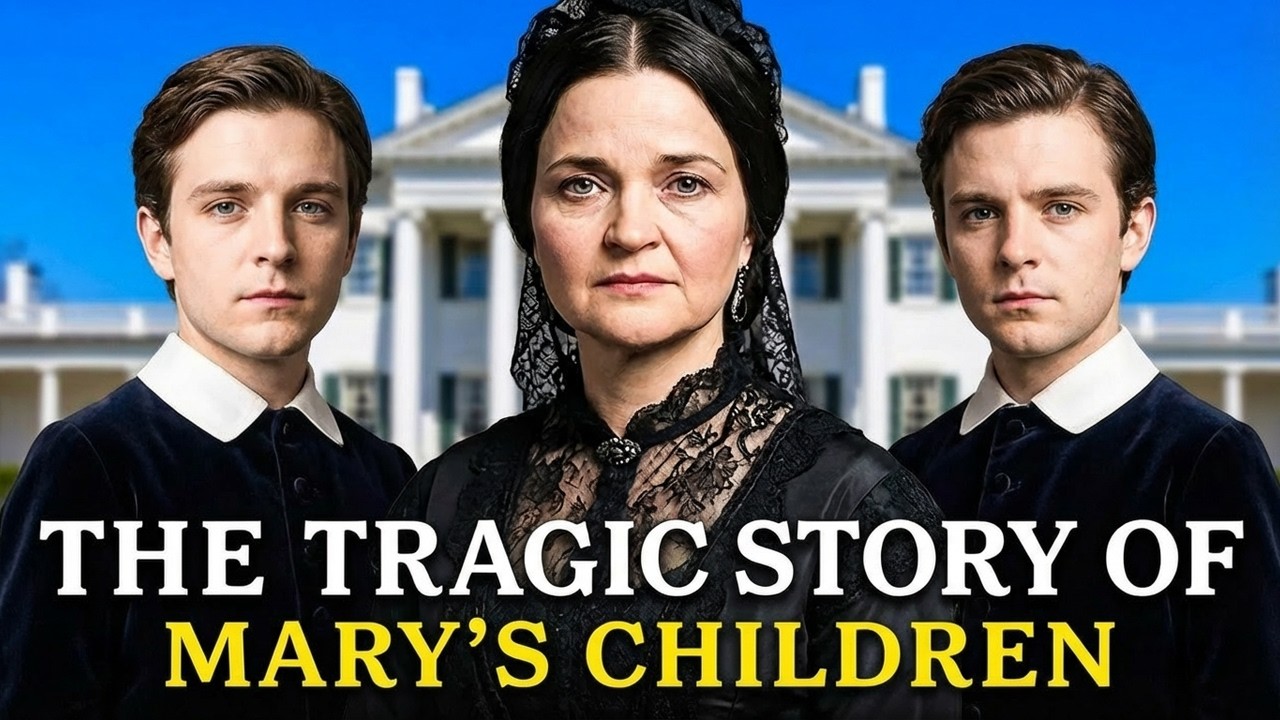
By then the morning crepe had stopped being a choice and become something closer to a second skin. If you look at it for long enough, what the photograph captures is not a difficult woman. It is not the woman who argued with her husband’s cabinet secretaries, or overspent the White House budget by twenty percent, or reportedly screamed loud enough to be heard in the East Room. What it captures is something more specific and more terrible.
It is the face of a woman who has been told, repeatedly and with brutal precision, that the people she loves most will be taken from her, and who has been told this so many times that she has stopped being surprised. She is not shocked in that photograph. She is simply enduring. Abraham Lincoln is remembered as a martyr, one of the most iconic figures in American history: the emancipator, the savior of the Union, the man who held the country together through its worst catastrophe and died in the moment of victory.
His wife is remembered as difficult, a spendthrift, a hysteric, perhaps mentally ill, possibly disloyal, or at least insufficiently loyal. She has been remembered in the shorthand of popular history as the problem standing behind the great man. Their sons are barely remembered at all. Edward Baker Lincoln died at three years old, before his father had entered national politics, before the country had any idea who Abraham Lincoln was, before any of the catastrophes that would follow had yet begun to arrange themselves on the horizon.
He died of tuberculosis in a rented house in Springfield, Illinois, with his mother at his side, and the city moved on. William Wallace Lincoln—Willie, the one his father loved with a particular openness that he rarely showed anything or anyone—died in the White House at eleven years old, while his parents were upstairs hosting a state dinner that three separate people had advised them to cancel. He had been sick for weeks. The Potomac River ran directly behind the White House and had not been properly dealt with from a sanitation standpoint, and the water that fed the White House pipes in February of 1862 was carrying something that Willie could not survive.
He died while his father was a hundred feet away hosting generals and diplomats, because canceling the dinner was politically impossible at a moment when the Union needed to project confidence it did not fully possess. Thomas Lincoln—Tad, the one who ran through the White House corridors like it was his own personal property, who kept goats in the garden and a turkey in the state dining room, who once drove a cart through a funeral reception—died at eighteen, six years after his father was shot in the back of the head at Ford’s Theater. He died of what the doctors called pleurisy, a condition of the lungs, and his mother had predicted it from the beginning, because Tad had never been physically strong, because she had already buried two sons, and because she had learned by that point to recognize the particular texture of impending loss. Robert Todd Lincoln survived them all.
He became Secretary of War under President Garfield. He became president of the Pullman Company, one of the most powerful private corporations in the Gilded Age. He became wealthy, respected, and deliberately obscure. He had his own mother committed to a psychiatric institution largely against her will, after a trial that lasted less than a day and that his mother described for the rest of her life as a betrayal.
He spent the last decades of his existence refusing to speak about his family, declining interviews, burning correspondence, and shredding documents. He destroyed most of his father’s personal papers before he died. Nobody knows what was in them. That is the story of Mary Todd Lincoln’s four sons.
But before the lives of each can be told in the detail they deserve, it is necessary to understand the woman who bore them, because Mary Todd Lincoln is one of the most misunderstood figures in American history. She has been remembered badly. She has been remembered, when she has been remembered at all, as an obstacle, an embarrassment, and eventually a madwoman. The actual shape of her life—what she came from, what she understood, what she carried—is something else entirely.
Mary Ann Todd was born on December 13th, 1818, in Lexington, Kentucky, into a family that was, by Southern standards, prosperous, educated, and deeply political. Her father, Robert Smith Todd, was a wealthy merchant and politician, a man with strong opinions about law and public life, and the kind of standing in Kentucky society that meant his opinions were regularly solicited. The Todds were the kind of family that produced people who expected to be consequential. Mary absorbed this expectation from birth.
Her childhood, however, was not the comfortable story that wealth might suggest. Her mother, Eliza Parker Todd, died when Mary was six years old. She left behind seven children, and Robert Todd responded to this loss with a speed that was common in the nineteenth century and devastating in every era. He remarried within two years.
His new wife, Elizabeth Humphreys Todd, was not cruel. She was also not particularly interested in the seven children she had inherited alongside the house and the social position. She had her own children soon enough, and the household grew, and Mary—sharp, opinionated, already the girl who read too much and talked back when she should have been quiet—felt the distance that had opened in her family like a wound she was expected not to mention. She was close to her father.
She haunted his office, listened to his political conversations, absorbed more Kentucky Whig politics than most grown men in Lexington could claim to know. Her father recognized her intelligence in a way that her stepmother did not, and this recognition became the organizing principle of Mary’s early identity. She was sent to excellent schools. She spoke French with genuine fluency, which was rare for an American woman of the period and rarer still in Kentucky.
She read widely, had opinions about everything, and expressed those opinions with a directness that charmed some people and alarmed a great many others. She was not, by the standards of what was expected of well-bred Southern women in the 1830s, easy to manage. She was not designed to be decorative. She moved to Springfield, Illinois, in 1837 to live with her older sister Elizabeth, who had married Ninian Edwards, one of the most politically prominent men in Illinois.
The Springfield social world she entered was the world that mattered, the world where politicians and lawyers and ambitious young men gathered. And Mary Todd, twenty years old and better educated than most of them, found herself at the center of it by virtue of who she was and where she had landed. She met Abraham Lincoln at a cotillion in the winter of 1839. Lincoln was twenty-nine, a self-educated lawyer from the Kentucky backwoods, already a member of the Illinois state legislature, ungainly in a way that his contemporaries described with a kind of helpless precision: too tall, too angular, with hands that seemed to have been designed for a larger body than the one he had grown into.
He was not the kind of man Mary Todd’s family had in mind for her. He had no social standing, no money, no family name worth speaking of. Her brother-in-law, Ninian Edwards, who had been carefully watching the most eligible men in Springfield on Mary’s behalf, found Lincoln baffling as a prospect. What Lincoln had was a mind.
What he had was language—the specific gift of knowing how to make words do exactly what he needed them to do, and of understanding, in a way that very few people in any era fully grasp, that clarity is a form of power. Mary recognized this. She had been surrounded by politicians her entire life, had listened to her father’s conversations since before she was old enough to understand them, and had acquired a sense for the difference between men who were performing intelligence and men who actually had it. Lincoln was not performing anything.
He was simply quietly, unmistakably brilliant, and he was interested in her. The courtship was not smooth. There was a broken engagement in 1841, possibly at Lincoln’s instigation, possibly mutually agreed upon, possibly—this is a theory that has been argued and disputed for 180 years—forced by family pressure and social concern. They reunited in 1842 and married on November 4th of that year, in a ceremony arranged with approximately twenty-four hours of notice in the parlor of Ninian and Elizabeth Edwards’s home in Springfield.
It was not the wedding Mary’s family had imagined for her. What followed was not the life her family had imagined either. Lincoln was away for months at a time riding the circuit, which was how Illinois lawyers made their living, traveling from county to county, taking cases wherever they found them, sleeping in taverns and boarding houses, building the relationships that would eventually translate into political capital. Mary was in Springfield managing a household on a lawyer’s erratic income, raising children, maintaining the social presence that Lincoln’s career required—doing all of this with an intelligence and a ferocity that the historical record has consistently undervalued.
She was his political partner in a way that the nineteenth century had no good vocabulary for describing. She kept track of his correspondence when he was traveling. She cultivated the relationships that he, constitutionally unsuited to the performance of social ease, found difficult to sustain. She read the newspapers and briefed him on what he needed to know.
She had opinions about his speeches, and he listened to them, which was not something many men of that era did with their wives, and which Lincoln did without apparent effort, because he had married a woman whose political judgment he respected. They had four sons. Robert Todd Lincoln was born in 1843, the year after the wedding. Edward Baker Lincoln, called Eddie, was born in 1846.
William Wallace Lincoln was born in 1850, named after the husband of Mary’s older sister Francis. Thomas Lincoln was born in 1853, the last of them. And then, beginning in 1850 and extending without interruption for the next twenty-five years, everything else that defines the story of this family began. Edward Baker Lincoln was born on March 10th, 1846, and he was from the beginning the quiet one.
Where Robert, the eldest, was serious and watchful, already acquiring at age three the particular gravity that would define him for the rest of his long life, Eddie was gentle, sweet-tempered in a way that people who knew the family in Springfield recalled specifically decades later, when they were interviewed by Lincoln biographers who were really looking for information about Abraham and found themselves unexpectedly moved by the memories of a child who had been dead since 1850. He was sickly from an early age. The specific diagnosis has been contested. Some medical historians looking at the evidence believe it was pulmonary tuberculosis.
Others have argued for something called strumous disposition, which was nineteenth-century medical shorthand for a constitutional weakness in the chest that predisposed a child to respiratory illness. What is not contested is that Eddie was never fully robust, that there were periods during the winters of 1847, 1848, and 1849 when his breathing was labored and his energy was diminished, and the family watched him with the particular careful attention that parents of the era—who had lost more children than the twenty-first century mind easily comprehends—recognized as the attention that precedes loss. During this period, Abraham Lincoln was serving his single term in the United States Congress, elected in 1846, seated in 1847. He was in Washington for most of the congressional session, leaving Mary in Springfield with the two small boys in a city where she had strong ties, but where the house on 8th and Jackson felt, by her own description in letters to her husband, very empty in ways that the presence of the children did not fully address.
Mary Lincoln’s letters from this period are remarkable documents. They are funny frequently, in the way that very intelligent people who are lonely sometimes become funny—the humor as a pressure valve, as a way of converting the weight of ordinary days into something that can be communicated without being a burden. She writes about the children with specific alert attention. She notices what they do and how they do it.
She writes about Eddie in ways that suggest she was already on some level bracing herself—not dramatically, not with the theatrical doom that popular history has sometimes projected backward onto Mary Lincoln’s life, simply with the careful attention of a woman who had been raised in a household where death arrived without announcement, and who had learned to hold the people she loved with a slight but constant awareness of their fragility. Eddie’s condition worsened in the winter of 1849. By January of 1850, he could not keep food down. He had a persistent fever.
He was three years old. Abraham Lincoln was back in Springfield by then, having decided not to seek a second congressional term, a decision complicated by politics and by the clear evidence that his family needed him present. He was in the house on 8th and Jackson when Eddie died on February 1st, 1850, fifty-two days short of his fourth birthday. Mary’s grief was, by the accounts of people who were present and who wrote about it afterward, total.
Not performative, not dramatic in the way that the word drama sometimes gets attached to Mary Lincoln’s emotional life. Total in the sense of complete, of occupying every available space inside her, of leaving very little room for anything else for a period that stretched into months. She wrote a poem about Eddie. It was published in the Illinois State Journal, the Springfield newspaper, in February of 1850.
It is a formal poem, metrically regular, with the particular controlled anguish of a person who has decided to express grief through a structure precise enough to contain it. She writes about angels receiving the child. She writes about the certainty of reunion in a way that suggests the certainty was something she was working very hard to achieve rather than something she had arrived at easily. Lincoln’s grief is less legible in the documentary record.
He left less correspondence from this period than from most others, which could mean several things, and probably means that he was simply not writing letters in the weeks after Eddie died. A man who was managing his own grief while trying to manage his wife’s grief and earning his living at the law does not necessarily leave a documentary trail. What people who knew him in Springfield recalled, when they were asked much later, was that Lincoln looked hollow during those weeks, that the leanness that was always characteristic of his appearance took on a different quality, that you could see something had been taken from him. Within a year, Mary was pregnant again.
William Wallace Lincoln was born on December 21st, 1850. And this detail—the proximity of Willie’s birth to Eddie’s death—is one of those facts that appears in biographies and then disappears, subsumed by the narrative momentum of Lincoln’s rising political career and the inexorable approach of the war. It does not disappear from the experience of the family. You do not lose a child and have another child eleven months later and have the second child exist independently of the first.
They exist in relation. They always exist in relation. William Wallace Lincoln was the child that both his parents loved with a specific and openly acknowledged intensity that made the people around them slightly uncomfortable. Lincoln said once, in a remark that was recorded by a member of his staff at the White House and that has been cited by every Lincoln biographer who has gotten to the chapter on Willie, that he was the best of us all.
Willie grew up in Springfield during the years that shaped his father’s national identity. He was present as a small child during the Lincoln-Douglas debates of 1858, not at the debates themselves, but in the orbit of a household that had become the center of Illinois Republican politics, where men came and went at all hours, and conversation was conducted with the constant urgency of people who understood that something large was being decided. He absorbed this atmosphere with what everyone who described him agreed was a precocious and entirely natural ease. He was curious about everything and burdened by nothing, and these two qualities together produced a child who was pleasant to be around in a way that was entirely his own rather than performed.
He read early and widely. He wrote poetry as a child, not the careful formal poetry of his mother, but something more improvisational, more interested in sound than structure, more concerned with what it felt like to read a line than with whether the meter scanned correctly. He wrote a poem about the death of a family friend when he was nine years old that his father apparently kept in his desk and showed to people, which is the kind of thing fathers do when they are proud in a way they cannot adequately articulate. When Lincoln was elected president in November of 1860, Willie was ten years old.
The family moved to Washington in February of 1861, traveling by train from Springfield through a country that was already fracturing in ways everyone could see and nobody quite knew how to stop. Willie and his younger brother Tad were on the train. Robert, the eldest, was at Harvard and would join the family later. The two younger boys experienced the journey as an adventure, which was the kind of grace available to children—the ability to be on a historic journey without knowing that it was historic, without knowing that the world they were moving through was in the final weeks before its most catastrophic transformation.
The White House in 1861 was not what it is now. It was larger than most houses in Washington and smaller than its responsibilities required. It had not been renovated in years, and the previous occupants had left it in a condition that Mary Lincoln, who arrived in Washington with very strong opinions about what the executive mansion of the United States should look like, found mortifying. She spent the first months of the Lincoln presidency lobbying Congress for a renovation budget, and then spending significantly more than the renovation budget provided, which became the first of several financial controversies that would follow her for the rest of her life, and which were reported with a consistent hostility that reflected partly genuine shock at the expenditures and partly the specific animus of Washington political society toward a woman from Kentucky who was doing things in ways Washington political society had not sanctioned.
Willie and Tad did not share Washington political society’s reservations about their mother. They shared the White House with a freedom that was probably not entirely authorized, and certainly not anticipated by the staff, the security arrangements, or the various dignitaries who found themselves unexpectedly sharing corridors with two small boys who had commandeered whatever they could reach. Tad was the instigator. Willie was the one who made the ideas viable, who turned Tad’s wild suggestions into something that could actually be executed.
They were, as a team, formidably effective. In January of 1862, Willie became ill. The White House’s water supply in 1862 drew from the Potomac River, and the Potomac in the vicinity of Washington was not, to put it as directly as possible, safe to drink. The city sanitation infrastructure was inadequate for its population, and the wartime expansion of that population had made the situation worse.
Willie and Tad were both sick by early February. Tad recovered. Willie did not. Mary and Abraham Lincoln were scheduled to host a state dinner on February 5th, 1862.
Three separate advisers, by different accounts, suggested to the president and the first lady that the dinner should be postponed given the state of Willie’s health. The advice was not taken, not because Lincoln and Mary were indifferent to their son’s condition, but because the political reality of February 1862 made canceling a state function involving the senior military leadership of the Union feel like a luxury that the country could not afford. The war was going badly. Public confidence was fragile.
The dinner was held. Willie died on February 20th, 1862. He was eleven years old. Abraham Lincoln was seen weeping in the East Room on the day of Willie’s death.
Open, visible weeping, the kind of grief made public not by choice, but by an anguish that exceeded his considerable capacity for containment. People who were present in the White House that day left accounts of it that are among the most affecting descriptions of grief in the documentary record of the nineteenth century. This was not a man who wept easily or frequently or in front of witnesses. He wept that day in a way that left the people who saw it permanently altered.
Mary could not attend her own son’s funeral. She had collapsed. The word collapse was used by the doctors who attended her, and by the staff, and by the members of the household who described what happened in the days following Willie’s death. And it means something more specific than a theatrical faint.
It means a person whose systems of coping, however elaborate and however hard won, had encountered something for which they had no prepared response. She had buried Eddie. She had survived Eddie’s death, had moved through it and come out the other side, and had Willie and Tad in a life that was, for all its political pressure and social complexity, full. The death of Willie unmade something in her that her previous grief had not touched.
She wore black for the rest of the war. She could not visit the room where Willie died for months. She could not look at the Green Room, where his body had been laid for the viewing, without experiencing what the household staff described as violent distress. She consulted spiritualists in the hope of making contact with her dead son, a practice that Lincoln tolerated and that Washington society found both scandalous and pathetic in approximately equal measure.
The scandalous and pathetic framing has followed Mary Lincoln ever since, through every subsequent account of her spiritualist activities, despite the fact that she was doing what millions of bereaved people throughout human history have done when the more conventional consolations of religion failed to reach the specific depth of her loss. Lincoln did not have the option of stopping. He had a war to run. The same capacity for compartmentalization that had always characterized his internal life—the ability to keep the public self and the private self in separate rooms, and to move between them without allowing one to contaminate the other—was now being tested at a level it had never previously encountered.
Four months after Willie died, Lincoln showed the first draft of the Emancipation Proclamation to his cabinet. Four months. Every major Lincoln biographer has noted the proximity. Nobody has fully accounted for it.
There are theories. Perhaps the loss clarified something, stripped away whatever remaining ambivalence he had about the most radical action his presidency could take. Perhaps it was coincidental in the way that the timing of history is often coincidental. One large thing happening near another large thing without the proximity being causally meaningful.
What is certain is that in the summer of 1862, Abraham Lincoln was a man who had lost a child he loved with uncomplicated intensity, who was presiding over a war that was killing thousands of other people’s children, and who was in the process of redefining the terms under which human beings in the United States of America could be held as property. Those things were all happening in the same man at the same time. The photograph that Matthew Brady took of Lincoln in 1862 shows something that the photographs from 1860 do not. It shows what carrying that particular combination of things looks like in the face of a person who has been carrying it for a while.
Thomas Lincoln—Tad, a nickname his father gave him as a baby because he said the infant’s large head and small body reminded him of a tadpole, which is the kind of detail that makes Abraham Lincoln more real and more human than any of the statues—was born on April 4th, 1853, and was from the beginning of his life a force of nature operating at an entirely different frequency from the rest of the household. He had a cleft palate, which was not surgically correctable in 1853, and was only partially correctable throughout his childhood. He spoke with a lisp that was significant enough that strangers sometimes could not understand him, though his family had no difficulty at all, and Lincoln in particular seemed to have a way of hearing Tad that bypassed the speech impediment entirely and landed directly on the meaning. He was dyslexic in a way that the nineteenth century had no vocabulary for.
He could not read properly until he was twelve, and the tutors that came and went through the Lincoln household in Springfield and later in Washington tended to leave after relatively short periods, in part because Tad had identified exactly which educational obligations were mandatory and which were theoretically mandatory but practically optional, and had adjusted his behavior accordingly. He was, however, not lacking in intelligence. He was intelligent in the specific way that children with significant verbal and reading challenges sometimes develop—spatially, practically, in terms of understanding people and reading rooms, and knowing how to get what he wanted from a situation. He understood power.
He understood the difference between authority that was real and authority that was ceremonial. He had a relationship with his father that was one of the most openly affectionate documented relationships in Lincoln’s biography, which is saying something given that Lincoln’s biography contains a remarkable amount of warmth in the record, if you know where to look. Lincoln used to allow Tad to fall asleep in his office in the evenings. Staff members who came to brief the president would find Tad stretched out on a sofa or on the floor, occasionally directly on top of documents, and Lincoln would be working around him with the particular attention of a man who understood that the documents would always exist, and that this specific version of his child would not.
He would wake Tad up at the end of the evening and carry him upstairs to bed. People who witnessed this wrote about it, because in the context of a president managing a war that was consuming the country, it was startling. It was also the most ordinary thing in the world. It was a father and a small boy.
After Willie’s death in February 1862, Tad became the focus of whatever parental attention could be directed away from the war and from the grief that had installed itself permanently in the household. He had lost his closest companion. Willie had been his co-conspirator, his executive officer, the one who made the plans work. And he processed this loss in the way that Tad processed most things: by remaining in motion.
He became more extroverted, if that was possible. He befriended soldiers. He acquired a commission—honorary, but taken entirely seriously by Tad himself and by many of the officers who received his orders—as a lieutenant in the Union Army. He inspected troops.
He collected stray animals. He had two goats named Nanny and Nanko, who had the run of the White House grounds and occasionally of the White House itself. He was present at Ford’s Theatre on the night of April 14th, 1865. This is the detail that most accounts of that evening mention and then pass over quickly, because the primary narrative of what happened at Ford’s Theatre is about Abraham Lincoln and John Wilkes Booth and the single shot that transformed a president into a martyr.
But Tad was there. He was eleven years old. He was not in the presidential box. He was in part of the theater watching a different performance with a White House aide, while his parents were upstairs in the flag-draped box with Major Henry Rathbone and Clara Harris.
When the shot was fired, Tad heard it. He heard the screaming that followed. He did not know immediately what had happened, only that something terrible had happened, only that people were moving toward the presidential box with the particular controlled urgency of people who were managing a catastrophe rather than responding to one. He was taken out of the theater.
He was taken back to the White House. He was told that his father had been shot. Lincoln died the following morning, April 15th, 1865, in a boarding house across the street from the theater, in a bed too short for his long body. He was fifty-six years old.
Tad was eleven years old, and had now lost his brother and his father within the space of three years. He had also, though this would take time to become fully apparent, effectively lost his mother—not to death, but to grief of a completeness that made her, for the years immediately following Lincoln’s assassination, barely functional as a parent to anyone. Mary’s situation after Lincoln’s death was by any objective measure dire. She was a widow with no income in a period when widows had few legal mechanisms for financial independence.
Lincoln had not made a formal will, and the estate proceedings took years. Congress debated whether to provide her a pension, and the debate was not gentle. There were members of Congress who argued publicly that she was not deserving of financial assistance, that she had been insufficiently loyal, that her Kentucky relatives and her spending habits disqualified her from the government’s generosity. The pension bill failed the first time it was introduced.
She left Washington almost immediately after the assassination, unwilling and possibly unable to attend the state funeral, returning to Chicago with Tad and with Robert, who had resigned his commission to be with his mother. She lived in a series of rented rooms, managing her finances with a tightening desperation that would consume most of the next decade and produce several of the incidents that later became evidence for the case that she was unstable. She spent years in Europe with Tad, partly for economy—European cities were cheaper than American ones for a widow on a restricted income—and partly because the United States had become a place where she was simultaneously famous and homeless, and no private grief was permitted to remain private. Tad spent those European years acquiring what his Springfield childhood and his White House years had left incomplete, which was primarily a formal education.
He had learned to read properly, finally, sometime around his twelfth year, and in Frankfurt and London he attended school with a diligence that surprised people who knew his history. He grew into a young man who was quieter than the boy he had been, who had processed the losses he had experienced in the way that people sometimes process enormous loss when they are young and resilient and have no other option: by growing around the holes rather than trying to fill them. He returned to the United States with Mary in 1871. He was eighteen years old.
Within weeks of arriving in Chicago, Tad became ill. He had never been physically strong—the cleft palate, the early childhood illnesses, the respiratory vulnerability that Mary had always watched with the alert attention of a woman who knew exactly what it looks like when the people she loved were running out of time. His symptoms were described as pleurisy, which is an inflammation of the tissue around the lungs that in 1871, without antibiotics, without the interventions that might have addressed the underlying cause, could spiral in ways that were not retrievable. He died on July 15th, 1871.
He was eighteen years old. Mary was at his bedside. She had been at Eddie’s bedside. She had not been at Willie’s bedside—had been downstairs at the state dinner.
And this specific fact, that she had been a hundred feet away while her son was dying and had not known, had been pouring wine for generals, was something that she carried with her for the rest of her life with a precision that grief does not soften but sharpens. She was at Tad’s bedside. It did not make it better. She had now buried a husband and three sons.
She had one child left. Robert Todd Lincoln was born on August 1st, 1843, the first child and the eldest son, and he was from the beginning the one who did not fit easily into the emotional register of his family. This is not a criticism. It is an observation.
The Lincoln household, for all its warmth and its genuine affection, was not a household of even temperaments. Abraham Lincoln alternated between periods of deep, quiet engagement and periods of melancholy so complete that his law partner, William Herndon, described them as a form of collapse. Mary Lincoln lived her emotional life at a volume that her contemporaries found overwhelming and that her family had learned to navigate with the specific skills that children develop when they grow up in a household where the weather changes quickly. Robert learned early to be self-contained.
He learned to keep his interior life interior, to manage his reactions, to present to the world a surface that was composed and correct and gave away as little as possible. His contemporaries described him as cold. His father’s biographers, who were trying to explain the emotional gulf between Robert and the father who was already becoming the most beloved figure in American history, reached for words like reserved, formal, difficult to know. The words were accurate.
They were also incomplete. A child who has learned to be self-contained has learned something. The question worth asking is what prompted the learning, not whether the learning happened. Robert was away at school during most of the White House years.
He was at Phillips Exeter Academy in New Hampshire in 1860 and 1861, partly because his academic preparation in Springfield had been inadequate for Harvard and he needed the intervening year, and partly because the Lincoln household in the years of the president’s rise had become a place where solitude was not available and privacy was not possible, and Robert Lincoln at seventeen and eighteen needed both. He enrolled at Harvard in the fall of 1860. He was at Harvard when Willie died. He came home for the funeral, and he managed his mother’s grief, and he returned to Harvard because the world continued and the semester continued, and Robert Lincoln managed things.
He was at Harvard when his father was inaugurated for the second time. He was finishing his Harvard degree in the spring of 1865, preparing to enlist in the Union Army. He had wanted to enlist earlier. Mary had begged Lincoln not to allow it, had argued with a ferocity that the historical record describes as frantic, that she had already lost enough and could not lose another son to the war.
Lincoln had negotiated with General Grant, and Grant had taken Robert onto his staff as a captain, in a position that was reasonably safe and that allowed Mary to believe, more or less, that she had preserved something. Robert was at Appomattox when Lee surrendered. He was with Grant’s party. He witnessed the end of the war as a staff officer who had arrived in time for the conclusion.
He then traveled to Washington to see his parents, arrived at the White House on the evening of April 14th, 1865, had dinner with his parents, declined to accompany them to Ford’s Theatre because he was tired, and went to bed. He was awakened sometime after ten o’clock with the news that his father had been shot. He went to the Petersen House. He was present in the room where his father died.
He was twenty-one years old. He helped manage his mother’s transportation back to the White House. He sat with her through the night. He managed the correspondence, the notifications, the practical requirements of a death that was also a state event of the first order.
He did this while processing the loss of his father, which he did, as he did most things, internally and without visible evidence of doing it. This pattern continued for the rest of his life, and it is what makes Robert Todd Lincoln one of the most frustrating and most tragic figures in the entire Lincoln story. He had an enormous interior life that he had decided at some early point to keep private—not from calculated coldness, but from the specific defensive posture of a person who has learned that emotional exposure is followed by emotional devastation, and who has decided that the only way to stop the devastation is to stop the exposure. He was twenty-one years old.
He had lost Willie at eleven. He had lost his father. He would lose Tad in six more years. In the meantime, he had his mother.
Mary Lincoln’s financial situation in the years after the assassination was genuinely precarious, and her response to that precariousness was, by any fair accounting, a mixture of reasonable anxiety and catastrophic judgment. She sold her clothes. She sold items from the White House years. She wrote letters to prominent Republicans asking for financial assistance that were then leaked to the press, which converted private desperation into public embarrassment and confirmed the Washington narrative that had been building for years about her instability.
Congress eventually passed a pension bill. It was not generous. Robert spent years trying to manage his mother’s public image, which was a project that resembled trying to manage the weather. Mary was not interested in being managed.
She was not interested in performing the quiet widowhood that Victorian convention required of women in her position. She was not quiet about anything, had never been quiet about anything, and she was particularly not quiet about the financial insecurity that she believed disgraced the memory of her husband and the country that her husband had died serving. Robert had married in 1868. Mary Harlan was the daughter of a United States senator from Iowa, a marriage that was by the social standards of the time appropriate, and that was, by the personal evidence of what Robert Lincoln’s life became, genuinely happy in a way that Robert allowed himself happiness, which was with one eye always toward the exits.
They had three children: Mary, Abraham, and Jessie. Robert was attentive to them in the specific controlled way that he was attentive to everything, and the household he built was the opposite in almost every dimension of the household he had grown up in. Orderly, quiet, private, deliberately shielded from the attention that the Lincoln name made otherwise impossible to avoid. The crisis that history has never fully resolved came in 1875.
By 1875, Mary Lincoln had been acting, in Robert’s assessment and in the assessment of the people closest to her, in ways that suggested mental instability serious enough to constitute a danger to herself. She was spending money in ways that had no logical relationship to her needs or her income, purchasing quantities of lace curtains in hotel rooms, making large financial transactions that made no sense, keeping enormous amounts of cash sewn into the lining of her petticoats because she did not trust banks. She was reporting physical symptoms that her doctors could not confirm—sensations of heat, of being watched, of her son Robert conspiring against her. She was grieving still, in a way that had not diminished in the decades since Lincoln’s assassination, but had instead fermented into something that affected her functioning in ways that were increasingly visible.
Robert consulted doctors. He consulted lawyers. He arranged a sanity trial, and the word trial is important because it was conducted as a legal proceeding, with witnesses and a jury and a judge, though the jury was impaneled and heard testimony and returned a verdict of insanity in approximately an hour and forty-five minutes, which suggests that the procedural thoroughness of the process was somewhat less than its formal structure implied. Mary was committed to Bellevue Place, a private sanitarium in Batavia, Illinois, on May 20th, 1875.
She was not violent. She was not incapacitated. She was, by the accounts of the staff at Bellevue Place, a difficult patient who was fully coherent, fully capable of managing her daily life, fully able to articulate with precision and force exactly what she believed had been done to her and by whom. She wrote letters—to her friends, to her sister Elizabeth, to lawyers she hoped might help her, to newspapers she thought might publish her account.
Many of the letters were intercepted by the sanitarium staff. The ones that were not intercepted formed the evidentiary basis for the campaign to have herself released. She was released after four months, on September 10th, 1875. She returned to the custody of her sister Elizabeth in Springfield, which was effectively a different kind of confinement, but one that she had agreed to because it was the available alternative to Bellevue Place.
She pursued legal proceedings to have herself declared legally sane, which succeeded. She never forgave Robert. The historical debate about what Robert did in 1875 has not been resolved in 150 years, and is unlikely to be resolved, because the evidence does not support a clean verdict. It is possible that he genuinely believed his mother was a danger to herself and acted from concern for her welfare.
It is possible that he was motivated partly or primarily by embarrassment, by the desire to contain the public spectacle that his mother had become, by the calculation that a Lincoln in a sanitarium was less damaging to the Lincoln legacy than a Lincoln behaving as Mary was behaving publicly. It is possible that both things were true simultaneously, which is the most uncomfortable possibility and probably the most accurate. What is certain is that Mary never spoke to Robert again in any real sense. She communicated when legal or financial necessity required it.
She did not resume the relationship. She died on July 16th, 1882, in the same house in Springfield where she had grown up, in the room where she had slept as a girl. She was sixty-three years old. She was found to be in significant physical deterioration.
She had been largely confined to her room for months, unwilling to be seen in public, having accumulated in the darkened room an extraordinary quantity of trunks and cases and boxes that she had never fully unpacked. The physical hoarding, the darkened room, the refusal of social contact—these are the symptoms of something that the twenty-first century would have a better vocabulary for addressing than the nineteenth century did. Robert attended the funeral. He wore black.
He said nothing for the public record. He lived for fifty more years after his mother’s death. He became, as has been noted, Secretary of War. He became president of the Pullman Company.
He argued before the Supreme Court. He was offered the Republican presidential nomination and declined. He watched two more presidents get shot. He was present at the Washington train station when Garfield was shot in 1881.
And he was at the Pan-American Exposition in Buffalo in 1901 when McKinley was shot. He reportedly said at some point in his later years that he was a jinx, that he should not be invited to public events with presidents, that the pattern had become too clear to ignore. Whether this was said with dark humor or with genuine superstitious dread is not clear from the sources, and probably was not clear to Robert either. He destroyed papers throughout the later decades of his life.
He destroyed his father’s personal correspondence. He destroyed letters, memoranda, documents that historians have been mourning ever since. He gave a reason, when he gave a reason at all, that amounted to this: that Abraham Lincoln’s private life was private; that the country had made his father into a monument, and monuments do not require private lives; and that the private life that had existed was not the country’s property. This position was not entirely without merit.
It was also not the complete reason. Robert Lincoln had spent his entire life managing the relationship between the private reality of being a Lincoln and the public requirements of what being a Lincoln meant. The destruction of the papers was the final act of that management. He was controlling the archive the way he had spent sixty years trying to control everything else.
He died on July 26th, 1926, at the age of eighty-two, at his Vermont home, Hildene, which he had built as a deliberate retreat from the world of public life. He was the last surviving son of Abraham and Mary Lincoln. He was the last person alive who had been in the Petersen House on the morning of April 15th, 1865. He was the last person alive who remembered Willie and Tad as boys, who had seen his mother as something other than a historical controversy, who had known Abraham Lincoln as a father rather than as a symbol.
When he died, the things he had known died with him, and some portion of those things—the portion that had been in the papers he had burned, in the letters he had not sent, in the interior life that he had spent eighty years maintaining as private property—will not be recovered. There is a pattern in Mary Todd Lincoln’s life that is easier to see from the outside, from this distance, than it was for any of the people who lived inside it. She was a woman of exceptional intelligence who was born into a historical moment that had very few uses for the specific kind of intelligence she had. She was political in an era when women were not permitted to be political in any formal sense, only in the informal sense that meant doing the work without receiving the credit.
She was opinionated in an era when opinionated women were regularly described as hysterical. She was financially unsupported in an era when widows were structurally dependent on the generosity of governments and relatives and had limited recourse when that generosity was insufficient or conditional. She was also a woman who had been marked by loss in a way that the nineteenth century had no framework for addressing. The nineteenth century knew about grief.
The nineteenth century produced some of the most elaborate cultural rituals ever developed for the purpose of acknowledging and managing grief: the mourning clothes, the memorial jewelry made from the hair of the dead, the elaborate gravestone sculpture, the funeral poetry published in newspapers. The nineteenth century understood that people died and that the people who remained were changed by it. What the nineteenth century did not understand, or did not have the vocabulary to understand, was the cumulative effect of repeated catastrophic loss on a single person’s nervous system. Mary lost her mother at six.
She lost her closest childhood friend in early adulthood. She lost a child in 1850. She lost a child in 1862. She lost her husband in 1865.
She lost a child in 1871. She was sixty-three years old when she died, and she had lost four of the six people closest to her to death, and had lost the fifth to estrangement so complete it amounted to the same thing. The symptoms that were used to justify her commitment in 1875—the disordered spending, the physical complaints without organic cause, the suspicion, the hoarding, the inability to function normally in social and domestic contexts—are not symptoms that require a diagnosis of insanity to explain. They are symptoms that appear in people who have experienced repeated trauma without adequate support, in people whose internal regulatory systems have been overwhelmed by a sequence of losses that exceeded their capacity to process.
This is not to say that Mary Lincoln was not ill. She probably was ill, in the sense that her behavior by 1875 represented a significant departure from what it had been when her internal resources were more intact. It is to say that the illness, if that is the correct word, was not mysterious. It was a consequence of what had happened to her, and of the absence of anything that might have addressed the consequences.
She was a woman who had been handed more grief than most people encounter in a lifetime, and who had been expected to manage it with the tools of personal fortitude and Victorian convention, neither of which was designed for the scale of what she was carrying. She said at various points in her life things that suggest she understood this. She said that she had been unfortunate. She said, and this is a direct quotation from a letter to a friend written in the early 1870s, that she was beginning to believe that no happiness was permitted to her.
She did not say this with the melodrama that her contemporary critics would have expected from her. She said it with the flatness of a woman noting a fact. She had sufficient evidence for the conclusion. She was not wrong.
What she wanted, running through everything she said and wrote and did from the Springfield years through the final darkened room in the Springfield house where she had started, was simple and almost impossible to provide. She wanted to be seen clearly. Not the difficult wife, not the embarrassing widow, not the convenient evidence for the argument that great men are weighed down by lesser women. She wanted to be seen as what she was: a person of significant capability who had been placed inside a historical drama not of her choosing, and who had done more than survive it.
She had shaped it. She had shaped him. She had sat up late in Springfield rooms and argued politics and read newspapers and told her husband what she thought, and been listened to. She had been there.
She had been there from the beginning for all of it, and she had lost more than anyone who writes about the Lincoln presidency is required to contemplate. Abraham Lincoln is remembered as one of the greatest presidents in American history. The statues and the memorials and the penny and the five-dollar bill encode the public man—the one who held the Union together, the one who signed the Emancipation Proclamation, the one who gave the Gettysburg Address. Behind all of that, there was a family.
Edward Baker Lincoln died at three years old in a Springfield house with his mother at his side. William Wallace Lincoln died at eleven in the White House while his parents were hosting a dinner downstairs. Thomas Lincoln died at eighteen in Chicago, having survived the war and his father’s assassination and six years of watching his mother carry what she was carrying, and having run out of time just when it seemed like time might finally be on his side. Robert Todd Lincoln survived.
He built a life of the kind that the other three were not given the opportunity to build. He was powerful and successful and guarded and, by every available indication, permanently altered by what he had seen and what he had carried and what he had done and what he could not undo. He burned the papers. He went to Vermont.
He died in 1926, the last of them, carrying into silence whatever it had actually been like to be Abraham and Mary Lincoln’s son. Mary Todd Lincoln spent twenty years as a widow and died in the room where she had been a girl. The country did not give her a monument. The country gave her a reputation.
It gave her a role in the story that it had already decided to tell, and the role was secondary and difficult and not quite right. These are the people who were there. These are the lives that were shaped by the thing we call history. These are the ones we forgot to look at.
It is worth looking.
