When the Japanese surrender was signed aboard the USS Missouri in Tokyo Bay on September 2, 1945, the broadcast that carried the news to the world went out on equipment built by Collins Radio. Twenty-six years later, to the very day, the same company lost its independence forever. The story of what happened in between, and how one of the most respected engineering firms in American history collapsed with stunning speed, begins in a basement in Cedar Rapids, Iowa. In 1931, a 22-year-old named Arthur Collins was hand-building shortwave radio transmitters out of his family home.
This was not a hobby. Three years later he incorporated the Collins Radio Company with a single obsession: build communications equipment to the highest possible standard of reliability and precision. Not the most affordable, not the easiest to mass-produce. The most reliable, the most precise.
In a commercial landscape already drifting toward cost-cutting and mass production, that was a consequential philosophical choice. For a while, the market did not particularly care. Through the early 1930s, Collins remained a small operation of roughly 200 employees, respected in technical circles but not famous. That changed in 1933, when Admiral Richard Byrd selected Collins to supply communications equipment for his second Antarctic expedition.
The challenge was severe. The equipment had to survive brutal transport, function in temperatures far below zero, and operate amid the atmospheric unpredictability of the auroral zones. Collins supplied a complete shortwave broadcasting station built around the 20B transmitter. On February 3, 1934, from a base camp called Little America on the Ross Ice Shelf, that equipment transmitted the first live voice radio broadcast ever made from the Antarctic continent, carried across the Pacific and the United States to a national audience on CBS Radio.
The factory that built it had existed for less than a year. Military contracts followed, then commercial broadcasters. By the time the United States entered the Second World War, Collins was no longer a boutique operation. The war transformed it into something else entirely.
Aerial combat created a problem no one had solved. Radio operators aboard bombers needed to change communication frequencies quickly, under fire, at altitude. The standard procedure for retuning a high-frequency transmitter required manually adjusting variable capacitors across multiple amplifier stages, a process that took several minutes. In a B-29 Superfortress at 25,000 feet with enemy fighters pressing in, several minutes was not available.
Collins solved this with what became known as the autotune system. An electromechanical assembly of electric motors, positioning cams, slip clutches, and limit switches physically drove every tuning element in the transmitter to a preset position with mechanical repeatability that did not depend on human steadiness under stress. The radio operator selected one of ten preset channels on the ART-13 airborne transmitter, and the machine did the rest in under 25 seconds. The system even reduced power by half above 25,000 feet to prevent high-voltage arcing in the thin air.
By the end of the war, approximately 90,000 ART-13 units had been manufactured, serving aboard B-29s, B-24 Liberators, and TBF Avenger torpedo bombers. Collins equipment maintained contact from Corregidor during the darkest weeks of the Pacific campaign. Captured units had been reverse-engineered by Axis technical teams during the conflict, an unusual form of recognition. After the war, Collins moved into the commercial and amateur markets.
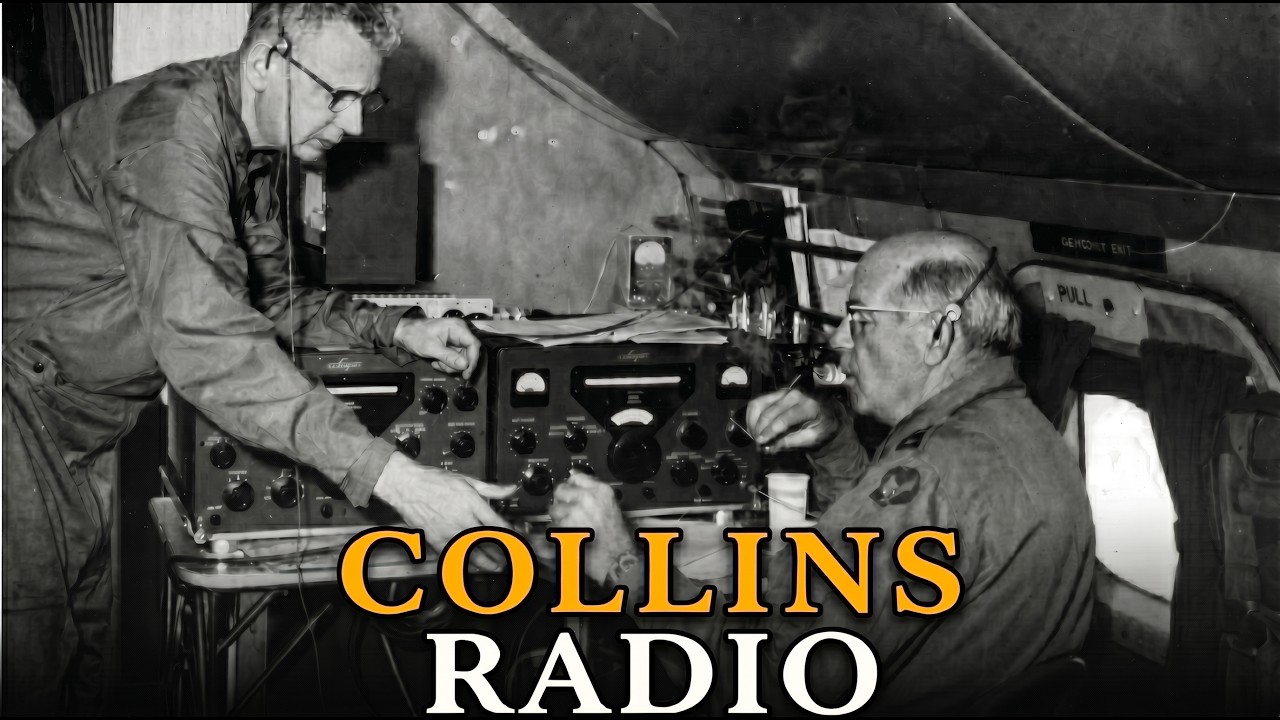
The equipment produced through the late 1940s and 1950s became known as the black boxes, named for the stark utilitarian cabinets finished in black crinkle paint. In 1954, Collins introduced the R-390A receiver for military and government intelligence use. It became one of the finest tube-based receivers ever manufactured. The key was what Collins called mechanical filter technology.
Instead of achieving signal selectivity through electrical circuits, Collins engineers converted radio signals into physical vibrations, passed them through precision-machined metal discs made from a nickel alloy, and converted them back into electrical signals. Because mechanical resonance achieved quality factors far higher than electrical circuits, the result was a receiver with what engineers described as brick wall selectivity. The military contracted not just Collins, but several other manufacturers, to build the R-390A to exact Collins blueprints. Over 55,000 units were produced across a production run that lasted thirty years, and surviving units still perform to their original ratings.
In 1958, Collins turned the same philosophy toward the civilian amateur radio market with the S-Line. Every unit was hand-wired using Teflon-coated wire and military-specification components, burned in for twelve hours at the factory, and tested for shock and vibration. In the fall of 1959, Collins released the KWM-2 transceiver, combining the full capability of the S-Line transmitter and receiver into a single chassis weighing just over eighteen pounds. Military operators used it from the jungles of Vietnam to remote embassy backup links.
The equipment worked when they needed it most. As the 1960s opened, NASA was preparing for what had never been attempted. Collins became an indispensable partner across the Mercury, Gemini, and Apollo programs. Every American astronaut’s voice transmitted from space during those programs passed through Collins equipment.
For Apollo, Collins served as prime subcontractor for NASA’s unified S-band system, a radio architecture that consolidated voice, television, telemetry, command, and ranging data onto a single coherent link. Collins also received a contract worth over $25 million to design and install a global ground station network: fourteen stations with 30-foot antennas, plus partial systems for three massive 85-foot parabolic dishes at Goldstone, California, Madrid, Spain, and Honeysuckle Creek, Australia. As the Earth rotated, at least one of those dishes would always have an unobstructed line of sight to the moon. On July 20, 1969, when Neil Armstrong stepped onto the lunar surface and spoke, the words traveled 240,000 miles and arrived at a Collins-equipped ground station.
Everything Collins had built pointed toward that moment. And that moment, in a specific way, marked the beginning of the end. Arthur Collins was not a man who looked backward. What drove him was the next problem, the unsolved thing.
By the mid-1960s, he was consumed by a vision he called the C system. In retrospect, it was something functionally close to local area networking, and in broader strokes, to the architecture that would eventually become the internet. He was not wrong about the direction the world was heading. He was wrong about when it would arrive.
The computer hardware of the 1960s was too expensive, too large, and too slow to make the C system commercially viable. The market was not there yet. But Collins poured resources into it regardless. Engineering hours that had previously gone to the profitable divisions, avionics, amateur radio, and communications equipment, were redirected to fund C-system development.
The people who built the R-390A and the KWM-2 were increasingly occupied with a product that had no viable market. Government contracts that had sustained Collins through Vietnam and Apollo were drying up. Competitors were releasing fully solid-state equipment, and the performance gap was narrowing. Collins, its best minds focused elsewhere, was not moving quickly enough to close it.
The scale of the financial damage became visible in the books for the fiscal year ending August 31, 1971. Net loss: $46. 6 million on sales of $287 million. Between 1969 and 1971, Collins cut approximately 40 percent of its workforce.
Thousands of engineers and production workers who had spent careers building equipment that went to the moon and into combat lost their jobs in two years. It was not enough. On September 2, 1971, North American Rockwell invested $35 million in Collins Radio in exchange for convertible stock. Effective control of the board passed to Rockwell.
Arthur Collins was forced out as president and CEO in November 1971 and resigned from the board shortly after. By November 1973, the company had been fully absorbed into Rockwell International. The independent company that sent a live broadcast from Antarctica, equipped B-29 bombers, and carried astronauts to the moon was gone. Arthur Collins spent the remainder of his life in technical advisory work.
He did not build another company. He died in 1987 at the age of 78. What happened to Collins Radio was not primarily a failure of engineering. It was a failure of timing and capital.
The C system was a real technical vision aimed in a direction the world was heading, but Collins ran out of time before the world caught up. The company failed before the world was ready for what it was trying to build. That is a different thing from failing because the idea was bad. The engineering remained.
The R-390A units maintained by collectors still perform to their original specifications. The KWM-2 commands serious money in the collector market not as a nostalgic artifact but as working equipment that operators still use on the air. The unified S-band architecture designed for NASA became the template for deep space communications infrastructure, the framework for the Deep Space Network that continues to operate today. The 85-foot dishes at Goldstone and Honeysuckle Creek outlasted the company itself.
The mechanical filter technology influenced receiver design for a generation of engineers. The radio architectures Collins developed are still studied in engineering programs. The equipment outlasted the company by fifty years, and continues to outlast it.
