The court of Henry VIII had only one legitimate heir, and she was a girl. Princess Mary, born in 1516, was the sole surviving child of the king’s marriage to Catherine of Aragon, and her sex left the Tudor succession dangerously uncertain. At the same time, the king was spending treasury money on private guards and royal tutors for another child, a boy born outside marriage. Henry FitzRoy, the acknowledged son of the king and a provincial gentlewoman named Bessie Blount, was being raised not as a shameful secret but as a figure of real political weight.
The favor shown to this boy created a practical risk that the court fully understood: a bastard could be chosen as king instead of a legitimate princess. The woman who made this possible had long since left the king’s bed, married a country lord, and built a quiet life far from Westminster. But the healthy son she had given Henry VIII would cast a shadow over the English succession for seventeen years. Bessie was born between 1498 and 1502 in Kinlet, Shropshire, near the Welsh Marches.
This was no comfortable aristocratic circle. The region functioned as a heavily militarized frontier zone, where local families were expected to defend the territory and maintain strict loyalty to the crown. The Blounts were provincial gentry with a strong history of royal service. Her grandfather, Sir Thomas Blount, had fought for Henry VII at the Battle of Stoke in 1487 and was knighted on the battlefield.
He later served as canopy bearer at Prince Arthur’s funeral in 1502. Bessie’s father, Sir John Blount, maintained this close relationship with the Tudor monarchy. He fought alongside Henry VIII at the Battle of the Spurs in 1513 and eventually became a King’s spear, a member of the elite unit responsible for the monarch’s personal protection. Her mother, Katherine Peschall, came from a similar background.
She was the daughter of Sir Hugh Peschall, a knight of the body to Henry VII. The marriage of John and Katherine had been arranged remarkably early, formalized in 1491 when both were still children, a typical consolidation of property, inheritance, and regional influence among landholding families. Bessie was their eldest daughter, and her usefulness to the family was not limited to marriage. A daughter who could enter the royal household could provide access to patronage, court connections, and advantageous alliances.
The Blounts therefore invested heavily in preparing her for that environment. She received an unusually strong education for a provincial gentry woman. She learned to read and write, developed familiarity with courtly manners, and became highly accomplished in music. Singing and playing the lute were particularly valuable skills in the Tudor court, where music was an important part of elite social life.
Her surviving connections with literary manuscripts, including works associated with John Gower and Geoffrey Chaucer, suggest her education extended well beyond basic domestic training. Around 1512, Bessie was sent to London, still very young, probably between twelve and fourteen. Her family wanted her to obtain a position as a maid of honor in the household of Catherine of Aragon. The Blounts could not rely on status alone; many families with greater wealth and higher rank wanted the same positions.
Securing a place required patronage. One of the family’s most useful connections was William Blount, fourth Baron Mountjoy, a respected humanist who had studied under Erasmus and held the important position of Chamberlain to Queen Catherine. Another relative, Sir Edward Darrell, served as the Queen’s vice Chamberlain. Through these connections, Bessie was able to enter a household that would otherwise have been difficult for a provincial gentry girl to reach.
The position of maid of honor was not ordinary domestic service. Maids of honor were unmarried young women of respectable families who lived close to the Queen and participated in court ceremonies, entertainments, and social events. Their presence also served a political function: by taking the daughters of loyal families into the royal household, the monarchy strengthened its connections with the provincial elite. For the girls themselves, the position offered extraordinary opportunities.
They lived in an environment where marriages, offices, financial favors, and political relationships were constantly negotiated. Bessie initially received a reduced salary because of her youth, but she adapted quickly. By the autumn of 1513, she had become a full maid of honor with the standard salary. Catherine of Aragon’s household was a complicated environment.
The Queen was deeply religious and maintained a disciplined devotional life. Yet the same chambers were part of the political and cultural theater of the Renaissance court. Foreign ambassadors had to be entertained, royal marriages and diplomatic alliances discussed, all in settings where formal ceremony mixed with music, dancing, poetry, and carefully controlled forms of courtly flirtation. The ability to sing well, dance confidently, and participate in courtly entertainment could make a young woman highly visible.
Bessie excelled precisely in these areas. The chronicler Edward Hall later described her as a woman who surpassed others in singing, dancing, and in all goodly pastimes. At this time, Henry VIII was still very different from the image most commonly associated with his later years. During the 1510s, he was a young king in his twenties, physically strong, exceptionally tall by contemporary standards, and deeply invested in demonstrating his athletic and martial abilities.
He competed in tournaments, hunted frequently, played music, and cultivated the image of a Renaissance warrior prince. European visitors often commented on his physical presence. The enormous, unhealthy king of his final years had not yet emerged. The social organization of the palace was designed, at least in theory, to limit unrestricted contact between the king’s male household and the women serving the queen.
Female honor was closely connected to family reputation, and the court maintained separate spaces. But court entertainment created opportunities to cross those boundaries. One of Henry’s favorite forms was the masque: elaborate costumes, disguises, music, dancing, and carefully staged entrances. The king and selected male courtiers could appear disguised and enter spaces associated with the queen and her attendants under the pretense of theatrical entertainment.
The identities were often hardly secret, but the conventions allowed behavior that would have been difficult under ordinary protocol. During the Twelfth Night celebrations of 1514, Henry participated in one of these events. Bessie appeared dressed in white satin lined with blue velvet. According to the chronology preserved in contemporary records, this was the occasion when the young maid of honor became the particular focus of the king’s attention.
From that point, the relationship developed into something far more significant than a single courtly flirtation. The enormous difference in power between them defined their dynamic. Henry was the King of England. Bessie was a teenage daughter of a provincial gentry family, whose position at court depended directly on royal favor.
No letters or private conversations survive, so whatever personal feelings existed cannot be reconstructed. There is no reliable basis for describing the relationship as a great romance, nor can Bessie’s choices be treated as though she possessed the freedom of someone outside the Tudor court system. Rejecting the king could have consequences extending far beyond her own position. Her father’s advancement, her family’s access to patronage, and their standing within the royal household could all be affected.
The relationship was managed with extreme discretion. One of the central figures in maintaining that secrecy was William Compton, a close companion of Henry VIII with unusually intimate access to the king. Compton could act as an intermediary between Henry and women whom the king wished to meet privately. The palace contained controlled entrances, private staircases, and restricted passages that allowed movement away from the formal public spaces.
Through this system, Bessie could meet Henry without creating a public scandal that might reach Catherine of Aragon or foreign diplomats. Secrecy mattered because the queen was not merely Henry’s wife. Catherine was the daughter of Ferdinand of Aragon and Isabella of Castile, and her marriage carried major diplomatic importance. Open humiliation of the queen could have consequences well beyond the royal household.
Bessie seems to have understood the limits of her position unusually well. She did not publicly challenge Catherine. She did not attempt to present herself as an alternative queen. She did not use her access to the king to create an obvious political faction around herself.
That restraint may explain why the relationship lasted much longer than many of Henry’s other extramarital relationships, approximately four or five years. The surviving evidence consists not of romantic letters but of changes in the Blount family. In July 1514, Sir John Blount received a substantial payment of 146 pounds from the king. Over the following years, his status continued to improve.
By 1518, he had become an esquire of the body, placed among the men with regular access to Henry’s private household. During those years, Bessie occupied an unusual position. She remained subordinate to the queen while privately maintaining a relationship with the queen’s husband. She could benefit from royal favor, but the relationship gave her no formal security.
There was no legal status attached to being the king’s mistress. If Henry lost interest, Bessie could be removed from court with little ability to influence what happened next. For several years, however, the arrangement remained stable. Then, late in 1518, that stability ended.
Bessie became pregnant. Pregnancy transformed a carefully concealed private relationship into a political problem. A royal mistress could be hidden. A child potentially fathered by the king was more difficult to manage, particularly when the legitimate royal marriage was already defined by repeated reproductive disappointment.
Princess Mary, born in 1516, remained the only surviving legitimate child of Henry VIII. The absence of a surviving son created a serious dynastic problem. The Tudor dynasty itself was relatively young, and Henry understood the political dangers of a disputed succession. The Wars of the Roses remained part of living political memory.
Bessie’s pregnancy had to be concealed from the queen’s household while also being protected because the child might have direct importance to the king. Cardinal Thomas Wolsey, Henry’s chief minister, became involved in managing the situation. Bessie was quietly removed from Catherine’s household. Rather than remaining in London, where pregnancy would soon become obvious, she was sent to the Augustinian Priory of St.
Lawrence at Blackmore in Essex. The place was comfortable enough for someone receiving royal protection, but distant enough from the center of court to provide privacy. Within Henry’s circle, Blackmore was associated with the name Jericho. There Bessie effectively disappeared from public court life.
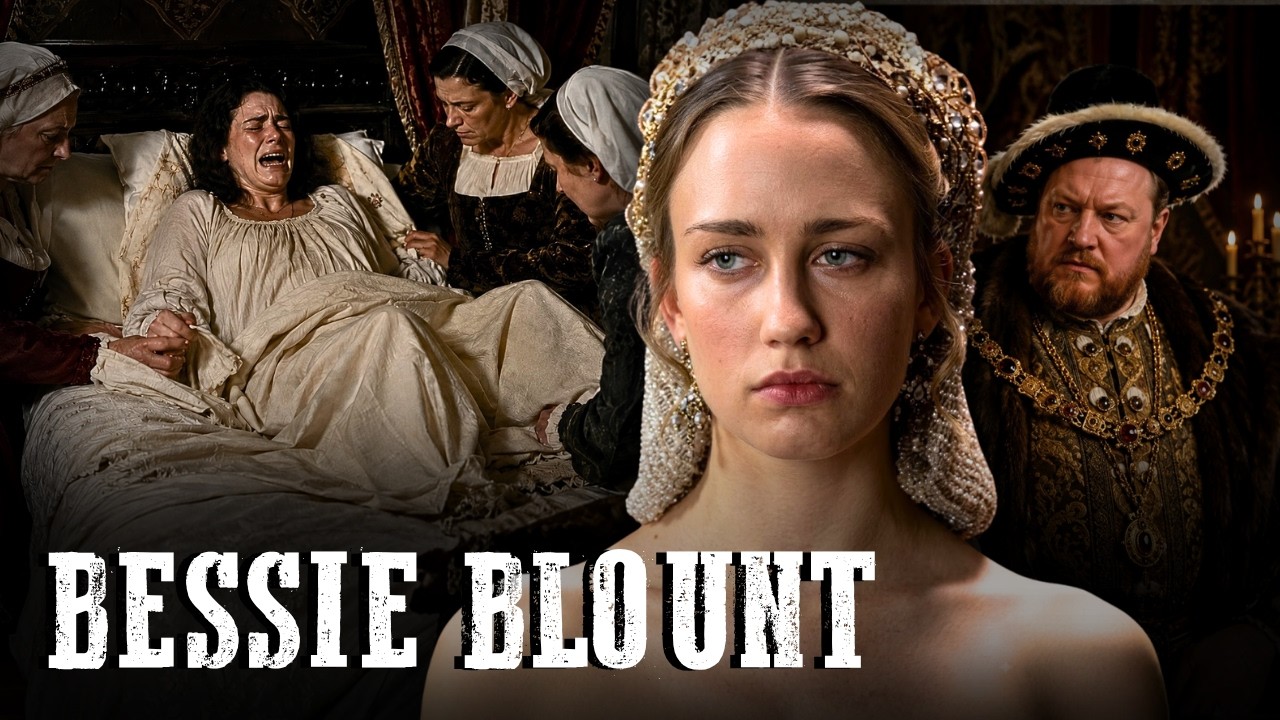
For years she had been visible among the queen’s maids, singing, dancing, and participating in the elaborate social world surrounding the Tudor monarchy. Now she was isolated while Wolsey and the king waited to discover whether the pregnancy would produce another daughter, a child who died shortly after birth, or something far more consequential. On June 15, 1519, Bessie went into labor. The child was a boy, and unlike the sons Henry had previously lost, this infant survived.
The birth of Henry FitzRoy immediately changed Bessie Blount’s position. Until that moment, her relationship with Henry had been private and politically manageable. The arrival of a healthy male child made secrecy much more difficult because the baby represented something the king had repeatedly failed to obtain within his marriage: a surviving son. Henry chose not to conceal the child completely.
Instead, he acknowledged him openly and gave him a name that made his parentage unmistakable. The boy was called Henry FitzRoy. The first name directly connected him to his father, while FitzRoy, derived from Norman French, literally indicated that he was the son of a king. Henry VIII was therefore doing more than privately accepting responsibility.
He was publicly identifying the child as royal blood. Cardinal Thomas Wolsey became FitzRoy’s godfather, further demonstrating that the boy was not being treated as an embarrassing secret. The king’s most powerful minister was personally involved in his early life. This did not make FitzRoy legitimate.
Under English law, he still stood outside the normal succession because he had been born to an unmarried woman while Henry remained married to Catherine of Aragon. Nevertheless, legitimacy and political usefulness were not exactly the same thing in the Tudor world. A recognized royal bastard could still receive titles, estates, education, and an important place within the monarchy. More importantly, FitzRoy’s existence affected how Henry interpreted the increasingly serious problem of the succession.
Catherine of Aragon’s well-documented miscarriages and stillbirths now stood in stark, humiliating contrast to this triumph. His legitimate son, born in 1511, had barely survived weeks, convincing Henry his marriage was cursed. Now a provincial mistress had delivered the biological proof he craved. Princess Mary remained Catherine’s only surviving child.
Henry loved and publicly valued her, but a daughter did not provide the dynastic certainty he wanted. The Tudor dynasty remained relatively new. Henry VII had won the throne at Bosworth in 1485 after decades of civil conflict. Memories of the Wars of the Roses were still powerful among the political elite.
For Henry VIII, producing a male heir was not simply a matter of personal preference. He increasingly treated it as a political necessity. FitzRoy therefore carried unusual symbolic weight. His survival showed Henry that he was capable of fathering a healthy son.
According to the assumptions about reproduction common in the sixteenth century, this encouraged Henry to look more critically at Catherine. Medical understanding of fertility was limited, and reproductive failure was often blamed disproportionately on women. The implications became more serious as Catherine grew older. With each passing year, the likelihood of another pregnancy declined.
The existence of an acknowledged male child outside the marriage made the contrast increasingly difficult for Henry to ignore. Bessie herself did not use the birth to challenge Catherine. There is no evidence that she attempted to establish herself as a rival to the queen or demanded political recognition because she had produced the king’s son. Her role in Henry’s private life effectively ended after FitzRoy’s birth.
This restraint separated her from later royal mistresses, particularly Anne Boleyn, who became deeply entangled with factional politics. With FitzRoy securely absorbed into the royal machinery, Henry’s physical relationship with Bessie ceased to serve any dynastic utility. The king possessed the biological proof he craved and a son whose upbringing could be controlled directly by the crown. The mother of this child now required immediate extraction from the court’s inner circle to maintain diplomatic peace.
Bessie, meanwhile, needed a respectable future outside the position of royal mistress. For the next several years, FitzRoy was carefully raised under royal supervision. His childhood was not that of an ordinary illegitimate child. Henry invested heavily in his education, household, and public status.
By the middle of the 1520s, the failure of the legitimate succession had become impossible to overlook. Catherine was approaching forty, and the likelihood of another successful pregnancy was becoming extremely small. On June 18, 1525, when FitzRoy was six years old, he participated in a major ceremony at Bridewell Palace. Henry granted him the titles Earl of Nottingham and Duke of Richmond and Somerset.
The scale of the elevation was extraordinary. He was no longer simply the acknowledged illegitimate son of the king. He was being placed among the highest-ranking aristocrats in England. The titles themselves were carefully chosen.
Richmond carried a direct association with the Tudor dynasty. Before becoming king, Henry VII had been Earl of Richmond. Somerset also had dynastic significance because of its association with the Beaufort line, through which the Tudors traced part of their claim to the throne. Henry was deliberately clothing FitzRoy in titles connected with royal ancestry.
The elevation placed the six-year-old boy above almost every nobleman in England. Only the king himself held unquestioned precedence over him. At the time, England had very few dukes, making FitzRoy’s status even more conspicuous. The ceremony inevitably raised questions about Henry’s intentions.
Was FitzRoy being prepared merely for a distinguished aristocratic career, or was the king considering him as a possible successor? Henry never publicly settled the question at this stage, but his actions ensured that it remained open. The king then sent him north to Sheriff Hutton Castle in Yorkshire. FitzRoy became the nominal head of the Council of the North and was also associated with the defense of the Scottish frontier.
A six-year-old obviously could not personally govern northern England or command military operations. Experienced officials performed the practical work. The importance lay in symbolism. By placing his son at the head of the northern administration, Henry was presenting FitzRoy as a representative of royal authority.
FitzRoy’s household was enormous, reportedly containing around 245 servants, officials, tutors, and attendants. His annual income exceeded £4,000, funded partly by estates in Yorkshire and Lincolnshire. In practical terms, this made a small child one of the wealthiest individuals in England. FitzRoy was not being raised quietly on the margins of society.
He was being trained and displayed as a prince in everything except legal legitimacy. Education formed a central part of this preparation. Richard Croke taught him Latin, Greek, and elements of political philosophy. John Palsgrave instructed him in French, an essential language for diplomacy and international court culture.
His education also included physical preparation: horsemanship, archery, hunting, and other martial skills considered essential for aristocratic men. Henry had built much of his own early image around physical strength and athletic performance. FitzRoy was trained according to the same ideals. As the boy grew older, his existence became increasingly connected with the king’s larger marital crisis.
Henry’s concerns about his marriage to Catherine had been developing over time, but during the 1520s they became more focused. He began to argue that the marriage itself might never have been valid because Catherine had previously been married to his older brother Arthur Tudor. Henry increasingly relied on a passage in Leviticus that warned against marrying a brother’s widow and associated such unions with childlessness. The argument was complicated because Catherine had always maintained that her marriage to Arthur had never been consummated, and a papal dispensation had allowed her to marry Henry.
Nevertheless, Henry came to believe, or at least insist, that his failure to obtain a legitimate surviving son was evidence that the marriage had offended divine law. FitzRoy strengthened Henry’s personal certainty. Whatever theological arguments surrounded Catherine’s pregnancies, the king could point privately to an undeniable fact: another woman had given him a healthy son. This did not mean that FitzRoy alone caused the attempt to annul the marriage.
The great matter developed from a mixture of dynastic anxiety, theology, law, personal desire, and Henry’s later relationship with Anne Boleyn. But FitzRoy’s existence mattered because it removed one possible explanation for the crisis. Henry could no longer easily believe that he himself was incapable of producing male children. The boy also provided a possible emergency solution.
As negotiations over Catherine’s marriage became increasingly difficult, European diplomats and church officials considered several unusual ways of resolving the Tudor succession. One of the most extraordinary emerged in 1528, when the papal representative Lorenzo Campeggio discussed the possibility of obtaining a dispensation that would allow FitzRoy to marry his half-sister, Princess Mary. The proposal appears astonishing. Even in the sixteenth century, such a marriage would have required exceptional papal authorization.
Yet the fact that it could be discussed at all demonstrates the severity of the succession problem. A marriage between Mary and FitzRoy would theoretically have united Henry’s legitimate daughter with his acknowledged son. Their descendants would have carried royal blood from both sides, potentially reducing the danger of competing claims. The proposal was never implemented, but FitzRoy’s involvement in such discussions shows how seriously his political importance was taken.
While her son was moving closer to the center of dynastic calculations, Bessie was building a very different life. Her relationship with Henry had ended, and the crown needed to establish her securely within respectable aristocratic society. Leaving a former royal mistress unmarried and financially dependent could create problems. A suitable marriage would protect her reputation, reward her family, and remove any possibility that she might become a source of political embarrassment.
Cardinal Wolsey again played a central role. Around 1522, Bessie married Gilbert Tailboys, heir to the Tailboys family of Kyme in Lincolnshire. The marriage was advantageous but complicated. Gilbert came from a substantial landholding family, yet his father, George Tailboys, had suffered from severe mental illness.
As a result, the family estates were entangled in questions of wardship and royal control. The crown took unusual measures to strengthen her financial security. In 1523, an act of Parliament released significant portions of the Tailboys estates to provide Bessie with a jointure, meaning she would possess income and property rights capable of supporting her even if she became a widow. The arrangement was generous.
Rather than simply giving Bessie a temporary payment, Henry’s government helped establish her within an important landed family and secured her long-term independence through property. Bessie moved to South Kyme in Lincolnshire and began the next stage of her life. Gilbert’s career also advanced. He was knighted in 1524, served as High Sheriff of Lincolnshire in 1526, and in 1529 was elevated to the peerage as Baron Tailboys of Kyme.
This promotion formally transformed Bessie into Lady Tailboys and placed her among the titled aristocracy. Bessie and Gilbert had three children together: Elizabeth, George, and Robert, fully legitimate members of the Tailboys family. Meanwhile, Henry FitzRoy remained separated from her. The boy belonged politically to his father’s world.
His household, education, titles, and future were controlled by the monarchy rather than by Bessie. Her biological connection to him did not give her authority over his upbringing. By the end of the 1520s, the lives of mother and son had moved in opposite directions. Then Bessie’s circumstances changed again.
In April 1530, Gilbert Tailboys died. Bessie was still only in her early thirties, but she was now a wealthy widow with substantial property rights, aristocratic status, several legitimate children, and a unique connection to the king through FitzRoy. For the first time in her adult life, she possessed significant financial independence and a degree of personal choice that had been almost impossible when she entered Catherine of Aragon’s household. That independence became clear in 1532, when Lord Leonard Grey attempted to marry her.
Grey was a considerably older aristocrat, a grandson of Elizabeth Woodville and therefore connected by blood to the Yorkist and Tudor royal families. On paper, he represented the kind of match many widowed noblewomen might have been expected to accept. He approached Bessie with substantial financial inducements. She refused him.
Property had given her the ability to reject a politically useful marriage without risking financial ruin. Instead, Bessie chose Edward Clinton, the ninth Baron Clinton, who was considerably younger, about twenty years old while she was in her early thirties. He was also still technically a royal ward, meaning the crown retained legal influence over his marriage and estates. Despite the age difference, the match made practical sense.
The Clinton and Tailboys estates lay close to one another in Lincolnshire. Combining their local interests strengthened both families. The fact that Bessie rejected Leonard Grey and married the much younger Clinton suggests that personal preference played a larger role than it had in her first marriage. The marriage appears to have been successful.
Bessie and Edward had three daughters together: Bridget, Catherine, and Margaret, all of whom later married into important aristocratic families. Henry VIII did not obstruct the marriage. The king granted them an annual allowance of three tons of Gascon wine from the port of Boston, a modest but visible sign that Bessie remained within the wider network of royal patronage. By this stage, Henry’s personal life had changed beyond recognition.
The effort to end his marriage to Catherine of Aragon had become an international political struggle. When papal approval for an annulment failed to materialize, Henry progressively rejected papal authority in England. He married Anne Boleyn, and Parliament passed a series of measures that transformed the constitutional and religious relationship between England and Rome. Bessie was no longer at the center of these events, but the son she had given Henry remained closely connected to the succession problem that helped drive them.
FitzRoy was now a teenager. He had grown up with the status, household, education, and privileges of a royal prince. His position became even more important as Henry’s legitimate family became politically unstable. Anne Boleyn gave birth to a daughter, Elizabeth, in September 1533.
Henry had expected a son. Although Elizabeth was healthy, the arrival of another daughter failed to solve the succession problem. Anne subsequently experienced unsuccessful pregnancies, leaving Henry once again without the legitimate male heir he wanted. At the same time, Princess Mary’s position had deteriorated dramatically.
Because Henry had declared his marriage to Catherine invalid, Mary was stripped of her status as legitimate princess, legally treated as illegitimate and removed from the direct succession. FitzRoy therefore occupied an increasingly unusual position. He was illegitimate but openly acknowledged, male, enormously wealthy, and raised in a manner resembling a legitimate prince. His existence offered Henry an alternative if every other solution failed.
The king strengthened FitzRoy’s political connections through marriage. FitzRoy married Lady Mary Howard, daughter of Thomas Howard, third Duke of Norfolk. The Howard family stood among the most powerful aristocratic houses in England. Mary Howard was also a first cousin of Anne Boleyn.
The marriage connected Henry’s illegitimate son to one of the strongest noble networks in the country. The marriage itself remained unusual. FitzRoy and Mary Howard were still young, and Henry reportedly prevented them from immediately living together as husband and wife. One concern was their age and the possible physical consequences of an early consummation.
As a result, the marriage produced no children. During the early 1530s, Henry still had several possible solutions to the succession crisis. He could hope that Anne Boleyn would eventually produce a son. He could reconsider the status of Princess Mary.
He could attempt to secure Parliament’s acceptance of another arrangement. Or, under sufficiently desperate circumstances, he could attempt to place FitzRoy in the line of succession. What he intended to do cannot be established with certainty. Henry frequently altered his dynastic policy according to changing political circumstances.
Nevertheless, the legal developments of 1536 brought FitzRoy unusually close to becoming a realistic candidate for the throne. Anne Boleyn’s position collapsed rapidly in the spring of that year. She was arrested, accused of adultery and other serious offenses, tried, and executed in May 1536. Her marriage to Henry was annulled.
Elizabeth, like Mary before her, lost her legitimate status. Henry now had two living legitimate-born daughters who had both been legally declared illegitimate. He still had no legitimate son. Shortly after Anne’s fall, Parliament passed the Second Succession Act.
The legislation confirmed the exclusion of both Mary and Elizabeth from the immediate succession and, importantly, granted Henry broad authority to determine the future succession through letters patent or his will. That provision significantly increased the theoretical importance of FitzRoy. For the first time, Henry possessed a clearer legal mechanism through which he might potentially nominate someone outside the conventional legitimate line. There is no surviving document proving that Henry had definitely decided to make FitzRoy his heir.
It would be too strong to claim that the boy was already destined to become king. But by 1536, the possibility could no longer be dismissed. Henry’s behavior toward FitzRoy throughout his childhood had already gone far beyond ordinary paternal generosity. The king had elevated him above almost every nobleman in England, established him in regional government, provided an exceptional education, and arranged a marriage into the Howard family.
If the king had wanted only to provide comfortably for an illegitimate child, much less would have been necessary. The political circumstances of 1536 made FitzRoy more valuable precisely when his physical health began to fail. During the summer, the seventeen-year-old Duke fell seriously ill. The speed of his physical collapse defied all expectations.
FitzRoy had been relentlessly trained for an active aristocratic life, showing no prior signs of chronic weakness. Yet his vitality vanished in a matter of weeks. On July 23, 1536, Henry FitzRoy died at St. James’s Palace.
He was only seventeen. The contemporary explanation given for his death was consumption, a term commonly associated with tuberculosis. Tuberculosis could certainly kill adolescents and young adults, sometimes after a prolonged decline and sometimes more rapidly. But the circumstances following FitzRoy’s death also encouraged speculation about whether another infectious disease may have been involved.
The burial arrangements were unusually restricted and hurried. FitzRoy was not given the kind of elaborate public funeral that might have been expected for a Duke of Richmond and Somerset, the acknowledged son of the king and one of the highest-ranking aristocrats in England. Henry ordered the body removed quickly. Public participation was sharply limited, and Bessie did not attend her son’s burial.
Contemporary chronicles present one possible explanation: FitzRoy may have died from a highly infectious form of disease, potentially pneumonic plague, which would have made rapid burial necessary. This remains an interpretation rather than a proven diagnosis. The available evidence does not allow the exact medical cause to be determined with certainty. Contemporary records continued to identify consumption as the official explanation.
Whatever killed him, the political consequences were immediate. For more than a decade, Henry had possessed an acknowledged male alternative to his daughters. FitzRoy’s legal illegitimacy was a serious obstacle, but one that the increasingly powerful Tudor state might conceivably have attempted to overcome. With the boy’s death, that option disappeared completely.
Henry was now approaching forty-five. Catherine of Aragon was dead. Anne Boleyn had been executed. Mary and Elizabeth had both been excluded from legitimacy by their father’s policies.
There was no acknowledged royal son left. Only weeks before FitzRoy’s death, Henry had married Jane Seymour. The future of the Tudor dynasty now depended heavily on whether Jane could accomplish what Catherine and Anne had not: give the king a legitimate son who survived. For Bessie, however, FitzRoy’s death was not merely another development in Henry’s succession policy.
She had lost her eldest child. The circumstances of FitzRoy’s upbringing had already kept mother and son largely separate. He had been taken into the royal system from infancy and raised according to the king’s dynastic needs. Yet none of that changed the fact that FitzRoy was her firstborn son.
His death also permanently altered Bessie’s relationship to national politics. As long as FitzRoy lived, Bessie possessed a unique connection to a possible future ruler. If Henry had eventually named his son as successor, Bessie could have become the mother of the next king of England. With FitzRoy dead, that possibility vanished.
Henry did not replace him with another illegitimate son. No other acknowledged male child existed outside his marriages. The succession question therefore returned entirely to Henry’s legitimate household and the uncertain ability of Jane Seymour to produce an heir. The timing was particularly striking.
FitzRoy died in July 1536 during one of the most turbulent years of Henry’s reign. Catherine of Aragon had died in January. Anne Boleyn had fallen and been executed in May. Henry had married Jane Seymour almost immediately afterward.
The Second Succession Act had reorganized the legal future of the crown. Now the king’s only acknowledged son was also gone. Within a few months, almost every major element of Henry’s family structure had been rearranged. Bessie did not respond by returning to court politics.
She remained with Edward Clinton and continued managing her aristocratic household. Her wealth and status did not disappear when FitzRoy died. Unlike her position during her youth, her adult security no longer depended on the king’s romantic interest or on her son’s dynastic value. She still controlled substantial interests in Lincolnshire.
Her children from the Tailboys and Clinton marriages connected her to several important families. Her second marriage remained intact, and royal favor toward her had not been withdrawn. The following years also brought opportunities created by Henry’s religious policies. The dissolution of monasteries transferred enormous quantities of church land into royal hands, some of it sold, granted, or redistributed to members of the political and landed elite.
In 1539, Bessie received further grants of former monastic lands. The acquisition strengthened a position she had spent two decades building. The young maid of honor who once depended entirely on a place in Catherine of Aragon’s chambers had become a substantial landholder in her own right. She had survived the end of her relationship with Henry, the death of her first husband, remarriage, and now the loss of FitzRoy without being pushed into financial or political obscurity.
But her connection with the Tudor court was not completely finished. In 1540, nearly three decades after she had first entered Catherine of Aragon’s household, Bessie returned to royal service. This time she would not encounter the athletic twenty-something king who had once entered the Queen’s chambers in elaborate masks. The Henry VIII she was about to see was a very different man.
That year brought Bessie back briefly into the royal household when she entered the service of Anne of Cleves, Henry VIII’s fourth wife. The return placed her once again inside the world she had first entered as a young maid of honor nearly three decades earlier. The contrast must have been enormous. The Henry VIII Bessie had known in the 1510s was young, athletic, competitive, and highly conscious of his physical appearance.
By 1540, that version of the king had largely disappeared. Henry was now approaching fifty and had undergone a severe physical decline. He had gained substantial weight, suffered from chronic problems with his legs, and experienced recurring ulceration that limited his mobility. His temperament had also hardened after years of political conflict, failed marriages, executions, and religious upheaval.
Anne of Cleves had arrived in England as part of a diplomatic marriage designed to strengthen Henry’s position in Europe. The marriage was arranged after the death of Jane Seymour, who had finally given Henry the legitimate son he had wanted for so long. Prince Edward had been born in 1537, solving the immediate succession problem that had dominated much of Henry’s adult life. Jane, however, died shortly after childbirth.
The search for another wife eventually led to Anne of Cleves, whose family controlled strategically important territories in the German states. The marriage was shaped largely by foreign policy rather than personal attraction. When Anne arrived, Henry quickly became dissatisfied. Their marriage began in January 1540 but deteriorated almost immediately.
Within months, Henry was seeking a way to end it. Bessie entered Anne’s household during this unstable period. Her precise responsibilities are not described in detail in the surviving account, but serving as a lady-in-waiting brought her once again close to the machinery of royal domestic life. She would have been present within a household where everyone understood that the Queen’s position was uncertain.
For Bessie, this return also created an unusual personal situation. She was now serving another wife of the man whose mistress she had once been and whose son she had borne. Catherine of Aragon, the Queen Bessie had served as a teenager, was dead. Anne Boleyn had been executed.
Jane Seymour had died after childbirth. Now Anne of Cleves was struggling to preserve her position only months after marrying Henry. Bessie herself had survived the same court without ever becoming politically ambitious enough to attract the king’s hostility. She had never tried to become Queen.
She had never publicly challenged Catherine of Aragon. She had never built a faction around her relationship with Henry. Once their affair ended, she accepted marriage away from court and established an independent aristocratic household. Even when FitzRoy became politically important, Bessie did not attempt to convert her status as his mother into direct political power.
This did not make her unimportant. It made her less dangerous. By 1540, Henry had eliminated or broken many people who had once stood extremely close to him. Thomas Wolsey had fallen from power and died in 1530.
Thomas More had been executed in 1535. Anne Boleyn had been executed the following year. Thomas Cromwell, the minister who had played a central role in Henry’s religious and administrative revolution, was moving rapidly toward his own destruction. Bessie had survived because she had largely remained outside that competition.
Her brief service to Anne of Cleves did not last long. Within approximately four months, Bessie became seriously ill and left court. She returned to Lincolnshire, where her condition deteriorated. The surviving evidence does not provide a definitive medical diagnosis.
One possibility is tuberculosis, the disease contemporary sources associated with Henry FitzRoy’s death. If Bessie suffered from the same illness, her decline may have been gradual before becoming serious enough to force her withdrawal from court. Another possibility is that her final illness followed complications associated with childbirth. Bessie had continued having children during her marriage to Edward Clinton, and the source connects her death with the possibility of postpartum infection following the birth of her youngest daughter, Margaret.
Either explanation is plausible within the limits of the surviving material. Bessie died shortly after leaving Anne of Cleves’ household, probably in May 1540. She was approximately forty years old. Her death came at another turning point in Henry’s reign.
The king’s marriage to Anne of Cleves was annulled in July 1540. Thomas Cromwell was executed that same month. Henry then married Catherine Howard, whose own fall would follow less than two years later. Bessie therefore died before witnessing the final phase of Henry’s marital history.
She did not see Catherine Howard’s execution in 1542, Henry’s final marriage to Catherine Parr in 1543, or the king’s death in 1547. Nor did she live to see the extraordinary succession that followed. Prince Edward became Edward VI after Henry’s death, but he died in 1553 at only fifteen. Mary, once pushed aside and declared illegitimate, became Queen Mary I.
After her death in 1558, Elizabeth, Anne Boleyn’s daughter, became Elizabeth I. The Tudor succession eventually passed through both daughters Henry had once legally excluded. The son Bessie had given him never entered that sequence. Henry FitzRoy’s early death ensured that historians could never know whether Henry VIII would ultimately have attempted to place him in the succession.
It is possible that FitzRoy would have remained simply an extremely powerful royal duke. It is also possible that, had Jane Seymour failed to produce Edward, Henry might have tried to use the legal authority granted to him in 1536 to nominate FitzRoy. The evidence does not allow certainty. What is clear is that Henry had invested far more in FitzRoy than he would have needed to invest in an ordinary illegitimate son.
Titles, enormous estates, regional authority, elite education, and marriage into the Howard family all gave the boy a political profile that could have supported a much larger future role. Bessie Blount’s life is best viewed through this lens. She was neither an insignificant mistress nor a hidden architect of the English Reformation. Both extremes simplify the evidence.
She was a woman whose private relationship with Henry VIII produced an unusually important dynastic consequence and whose family benefited substantially from royal patronage. Her greatest historical significance lies in Henry FitzRoy. His birth proved to Henry that he could father a son. His childhood offered the king a potential alternative to an uncertain legitimate succession.
His titles and education showed how seriously Henry regarded him. His death in 1536 removed that alternative at precisely the moment when Henry still lacked a legitimate male heir. Bessie’s role was therefore central to one of the most persistent problems of Henry VIII’s reign without making her a central political actor herself. Her story shows that the Tudor succession crisis was not shaped only by statutes, marriages, ministers, and religious arguments.
It was also shaped by childbirth, fertility, disease, and survival. The political future of a dynasty could depend on whether a particular child lived for a few weeks, several years, or long enough to inherit a crown. While Catherine of Aragon prayed for a male heir and Anne Boleyn bled to secure one, a provincial gentry daughter achieved the impossible in utter silence. Bessie Blount left no monumental tomb, claimed no political faction at court, and faced no executioner’s blade.
Yet by quietly providing Henry VIII with the one healthy son his anointed queens could not, she forced the English Parliament to redefine the succession and granted the king a living, breathing alternative that haunted his dynastic calculations for seventeen years.
