The Gestapo officer opened the file and read the name aloud. Christine Granville. He looked up, waiting to see what she would do. Silence before the first question—that was the technique, a way to measure the person sitting across the desk.
The room was small, with a lamp shining down so that only he could read what was written there. Andrzej Kowerski was somewhere else in the same building, interrogated separately, as the rules of the trade demanded. They separated couples to find contradictions, to test each one without the other’s support. Christine Granville, born Krystyna Skarbek, did not sit in silence.
She spoke first, in English, with the accent of the British nobility she had polished over the years, in the tone of someone who did not sit at the desk but ran the office. She said the words “consular rights” with the coldness of a lawyer who knows she has time and the man opposite her does not. By international convention, any citizen arrested in a foreign country had the right to demand that their embassy be contacted. The British embassy in Budapest knew who she was.
It could intervene, demand explanations, and create a diplomatic incident. In 1941, in a Hungary that was not yet at war, that mattered. The officer noted something in the file and said they would verify. That could mean anything—days, hours, or nothing at all.
Someone higher up could decide the verification was unnecessary. In that moment, between one breath and the next, Christine made a decision she had not planned. She bit her tongue, hard, without flinching, until she felt the warm metallic taste of blood. She let it pool in her mouth, then coughed deeply, with her whole body, pulled out a handkerchief, pressed it to her lips, and lowered it, stained red.
In a changed voice she said: “Tuberculosis. I have tuberculosis. Please call a doctor. ”
It worked.
It had to work. Tuberculosis in 1941 was the disease of the century—slow, contagious, deadly, transmitted through the air by coughing, by prolonged presence in the same room. A tuberculosis patient in an interrogation room was not a legal problem; it was an immediate biological threat to everyone there, and no one wanted to stay in that room. A doctor was called.
He examined her briefly, saw the handkerchief, asked routine questions, and confirmed that the symptoms were consistent with an active lung condition. The lie was not entirely a lie. A decade earlier, working at an FIA car dealership in Warsaw and inhaling engine fumes day after day, she had developed shadows on her lungs that showed up on X-rays. Her father had died of tuberculosis.
She had borrowed the disease from her own history. They released her, and they released Kowerski along with her. Without her, his file suddenly became thin, and no one wanted to find out whether he had been exposed too. They walked out of the Gestapo’s hands alive, but Budapest had become too small for them.
The Gestapo did not forget, and the tuberculosis ruse could only be used once in a lifetime. They went straight to the British Embassy. Ambassador Owen O’Malley assessed the situation in minutes. They had to leave immediately.
He issued them new, genuine British passports. Kowerski officially became Andrew Kennedy, a British citizen with a clean identity. Christine kept the name she had used since leaving London—Christine Granville—but now it was backed by the full legal weight of the British Crown, a document with no fakes. The papers also said she had been born in 1915; she had actually been born in 1908.
The escape was planned in two cars, two routes, the same objective. A driver from the embassy took Christine across the Hungarian border in the trunk of the ambassador’s diplomatic Chrysler. By international convention, an embassy car could not be searched without creating a serious incident. The border guard saw the diplomatic plates, raised the barrier, and saluted.
Kowerski crossed separately at the wheel of his own Opel, a British citizen in plain sight, with the calm of a man who had nothing to hide. They reunited in Yugoslavia. That escape took place before Operation Barbarossa, and it marked the end of their operations on Hungarian soil. Krystyna Skarbek had come a long way to reach that interrogation room.
She was born in Warsaw in 1908, the daughter of Count Jerzy Skarbek, a Catholic nobleman generous to a fault who paid off his debts with his wife’s dowry. Her mother, Stefania Goldfeder, came from a wealthy family of assimilated Jews; her father had been a banker. It was an unusual combination for that era—Catholic noble blood and Jewish money, and between the two, a girl who resembled them both. From her father she inherited a love of horses, movement, and freedom.
She rode like a cavalry captain and loved the mountains, skiing, and the wind, anything that meant adrenaline. At the age of ten, in her family’s stables, she had first met Andrzej Kowalski, the son of family friends, a boy who would appear again decades later as a key figure in her story. Life had a way of bringing people face to face, years in advance, with those who would matter most. The world she was born into collapsed quickly.
The 1920s brought poverty; the Goldfeder financial empire disintegrated, and the family sold their country estate and moved to Warsaw. In 1930, when Krystyna was twenty-two, her father died. She did not want to be a burden to anyone and looked for work. She found a job at an FIA car dealership, but the fumes made her sick, and she had to quit.
Doctors first thought the shadows on her X-rays were tuberculosis, the same disease that had killed her father. Their advice was to live outdoors as much as possible. She chose nature, spending more and more time hiking and skiing in the Tatra Mountains. In 1930 she had come second in the Miss Poland contest.
In April of that same year she married a young businessman, Gustav Gietler. The marriage fell apart shortly afterward. A second relationship failed because her suitor’s mother refused to accept a divorced woman with an old noble name but no money. She dedicated herself to her health and to sport, above all to skiing, and there was no better place than Zakopane.
That was how the next eight years of her life passed. She became a remarkable ski instructor, and her health improved in the mountains. Love appeared on the slopes in 1938, when she lost control of her skis and was saved by a giant man who threw himself over her to stop her fall. His name was Jerzy Giżycki, an eccentric from a wealthy family in Kamianets-Podilskyi, a region of former Poland then under Soviet control.
At fourteen he had argued with his father, run away from home, and worked as a cowboy and gold prospector in the United States before becoming an author who traveled the world. He knew Africa well and hoped to return. On November 2, 1938, Krystyna and Jerzy married in Warsaw. Soon after, he accepted a diplomatic posting as Polish consul general in Ethiopia.
When Germany invaded Poland on September 1, 1939, they were in Africa. They took the first plane back to London. No one had asked them to, but in Krystyna’s mind there was no other option than to do something for her native country. Poland had been attacked from two directions—by Germany from the west on September 1 and by the Soviet Union from the east on September 17, under the secret Ribbentrop-Molotov Pact by which Hitler and Stalin had divided Eastern Europe.
Poland fell in thirty-five days. It never officially capitulated, but the government and army fled into exile, first to Romania, then to London. President Ignacy Mościcki crossed into Romania on September 17, was interned under German pressure, and transferred power to a legal successor in accordance with the Polish constitution. Władysław Sikorski became prime minister and supreme commander of the Polish forces, the central figure of Poland in exile.
He would die in a plane crash at Gibraltar in 1943, under circumstances never fully clarified. Tens of thousands of Polish soldiers escaped through Romania, Hungary, and the Baltic states, reorganized in France, and after France fell in 1940 were evacuated to Britain, settling especially in Scotland. In London, the government in exile rebuilt the entire apparatus of a functional state without territory. Krystyna went straight to the door of the British Secret Intelligence Service.
She was met with polite skepticism—she had arrived without a recommendation and without documented experience in espionage. But the journalist Frederick August Voigt introduced her within SIS, and in December 1939 she was described in the files as a fiery Polish patriot, an expert skier, and a great adventurer. Her plan was simple and bold: she would go to Budapest, cross into Slovakia, ski across the Tatra Mountains into occupied Poland, collect intelligence on German military movements, contact the Polish resistance, and return through the mountains she knew during the harsh winter. The service noted that she was extraordinarily attractive, with a remarkable personality, and absolutely fearless.
They approved the plan. She arrived in Budapest on December 21, 1939, and there she met Andrzej Kowerski again. He was now a Polish officer who had lost part of his leg in a hunting accident, but he moved on a prosthesis so well that it disoriented those who did not know him. He was helping Polish military personnel escape to the West.
Between the childhood playmates, something more than collaboration blossomed—a partnership and a love that would last for decades. Her husband Jerzy remained in London. He appears nowhere in the story during this period; he was a writer, an explorer, an intellectual, and did not seek to get involved in intelligence work. There is no documented scene of their separation.
She simply left, and he remained behind. Hungary was the closest espionage base to Poland. Budapest was a gray zone, a city where spies from all sides coexisted—British diplomats, German agents, Polish refugees, Soviet couriers—all knowing about one another and spying on one another. The border with Poland was relatively accessible, and the networks were working.
In February 1940, Christine crossed the Tatra Mountains for the first time on skis, during one of the harshest winters on record, with temperatures at minus thirty, winds reducing visibility to a few meters, and German patrols on both sides. Jan Marusarz, an Olympic skier and a known figure in the small Zakopane skiing community, joined her operation. The courier network across the Tatras already existed; Polish mountain guides had been crossing the border from the first weeks of the occupation, taking people out and bringing messages. Christine joined it, carrying microfilmed documents hidden in her equipment.
Microfilm was new and invaluable for espionage: a piece the size of a fingernail could contain photographs of dozens of pages of documents, hidden in a shoe heel, a button, a face cream tube, or sewn into the lining of a coat. On one of her crossings that winter, she carried documents describing German preparations for the invasion of the Soviet Union—Operation Barbarossa, conceived and planned months before it was launched in June 1941. The microfilm reached Churchill, who warned Stalin. Stalin refused to believe it, considering it a British attempt to sow discord; the pact with Hitler was the cornerstone of Soviet security, and anything that contradicted it was automatically suspect.
When Hitler attacked on June 22, 1941, with over three million soldiers along a front of nearly three thousand kilometers, Stalin suffered a nervous breakdown and retreated to his dacha, not appearing in public for days. He had been warned months in advance and had chosen not to listen. On those crossings, Christine also wanted to see her mother, who had stayed in Warsaw. Stefania taught at an unofficial Polish school and refused to leave.
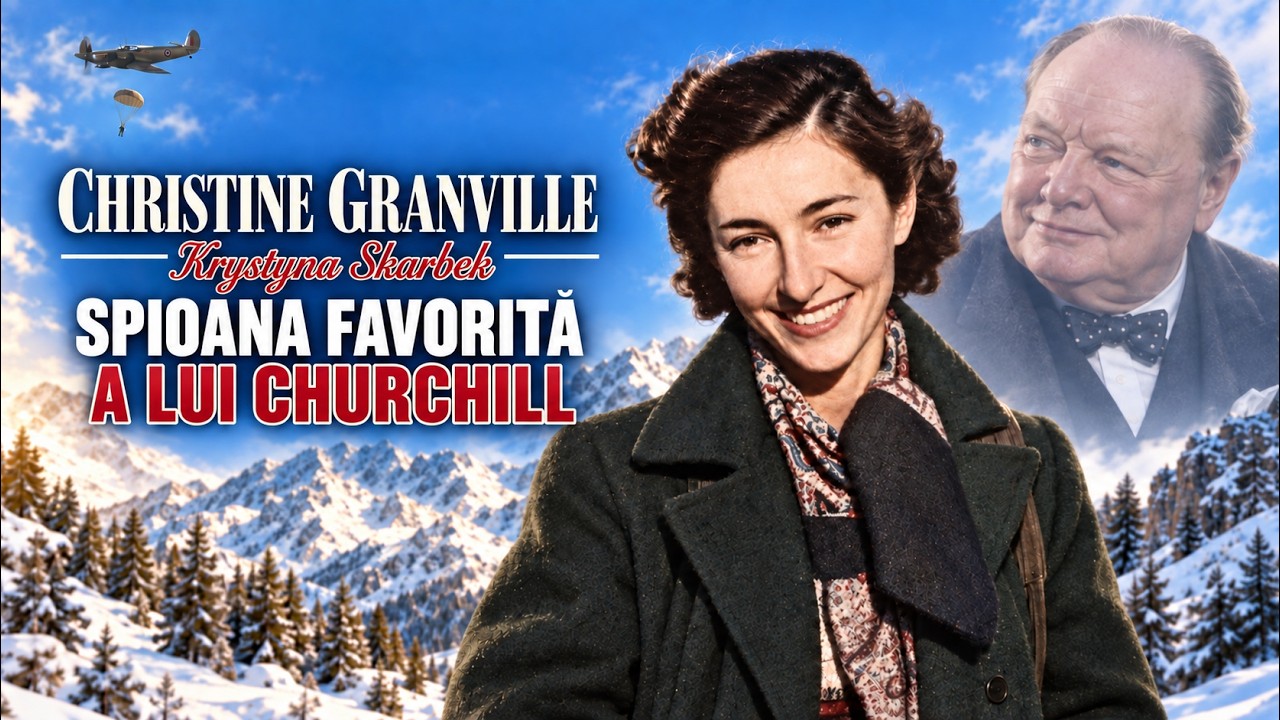
She was arrested in January 1942 as a Jew and disappeared in Pawiak prison—a prison designed, with a cruel irony of fate, by Christine’s own great-grandfather. In Poland, Christine worked with the Musketeers, a resistance network that obtained military intelligence and helped Polish combatants escape to the West. Churchill named her his favorite agent. The Gestapo had expanded its operations to Budapest.
It had identified a young woman who crossed the mountains too often, with papers showing a British name, Christine Granville, and a tip that she spoke perfect Polish and had another name, Krystyna Skarbek, daughter of a Polish count, and Jewish. That was why she and Kowerski were arrested. And that was why she bit her tongue in the interrogation room. From Budapest, through Yugoslavia, Bulgaria, Turkey, Syria, Lebanon, and Palestine, they made for Cairo, hundreds of kilometers through territory friendly to Germany, with documents that would not withstand serious scrutiny.
In Sofia, at the best hotel among Nazi officers, they met a British attaché and handed over rolls of microfilm—photographs of German military movements at the borders with the Soviet Union, produced by the Musketeers and described in detail what Germany planned to call Operation Barbarossa. Those microfilms reached Churchill. In Istanbul in March 1941, something unexpected happened: Jerzy Giżycki was there, at the same hotel as his wife and her lover, Kowerski. What happened in that hotel was never documented, but the result was that Christine and Kowerski convinced Giżycki to return to Budapest—where they could no longer go—and take over the role of British contact for the Polish resistance.
He accepted, left for Budapest, and Christine continued to Cairo with Kowerski. Later, when she told her husband she had fallen in love with Kowerski, Giżycki returned to London and from there went to Canada, agreeing to an official divorce in August 1946. He was just glad she was surviving somewhere. Christine and Kowerski reached Cairo in May 1941.
There, three years of zero field missions followed. She had office work and radio messages, the exact kind of job she detested. She was too British for the Poles and too Polish for the British. She refused to learn Morse code, the standard task for all agents: if you want a radio operator, find someone else—I am going into the field.
In June 1944, the SOE finally sent her somewhere: the south of France. The Normandy landings had taken place on June 6, 1944, but the Allies were planning a second landing, Operation Dragoon, scheduled for August 15. Someone had to prepare the ground from within: organize the local resistance, sabotage German communication lines, and create chaos behind the German front. Along the Franco-Italian border there were Polish soldiers conscripted by force into the German army—men who wore German uniforms but spoke Polish at home, in their thoughts, in their dreams.
Christine Granville was the only British agent in the region who spoke Polish, German, and French, and her mission explicitly included contacting them and convincing them to desert or sabotage from within. On the night of July 6–7, 1944, she parachuted into the south of France, into an area heavily patrolled by German forces. She reported to Francis Cammaerts, the son of a Belgian poet, a former schoolteacher and pacifist who had joined the SOE in 1942 after seeing what Nazism was doing to Europe. He had built a resistance network called Jockey that covered three French departments, coordinated thousands of fighters, organized parachute drops, and sabotaged railway lines.
For two years his network had survived, an absolute rarity in a world where the SOE lost network after network with agents captured, tortured, and executed. In the summer months of 1944, Christine crossed German territory disguised as a local, carrying messages, money, and instructions between resistance groups, negotiating with leaders of divergent interests and difficult temperaments who, for reasons hard to explain, listened to her. On August 13, she set off alone toward Col de Larche, a mountain pass on the Franco-Italian border, where a German fortress was defended by 150 soldiers. Christine knew that out of those 150, 63 were Polish—men of mixed heritage who had acknowledged Germanic origins to save their lives and now wore the German uniform out of obligation and survival, not conviction.
She approached the fortress, asked to speak to the Polish soldiers, and spoke to them in their language, with the voice of someone coming from the same place they came from. She told them who she was, and what they did not know: the Allies had landed and were on their way, Germany was losing the war, and it was only a matter of time. She gave them instructions: when the Maquisards approached, they were to desert, turn their weapons around, and destroy the fortress from within. She left, not expecting success.
Six days later, when a small force of Maquisards approached, the German commander found the Polish soldiers turning their weapons on him. The fortress surrendered. The Poles joined the resistance. There was no fight, no casualties.
A fortress won with words in the Polish language. That same day, August 13, Christine received news that changed everything. Francis Cammaerts had been arrested. At a roadblock near Digne-les-Bains, the Gestapo had stopped a car containing Cammaerts, Xan Fielding, another SOE agent who had previously operated in Crete, and a French officer, Christian Sorensen.
Their forged documents failed inspection. With the Allies advancing and time running out, executions were accelerating. Christine had finished her own mission, but she could not abandon her teammates. The prison was forty kilometers away, and she had no transport.
She took someone’s bicycle. Sources say she did not know how to ride it, but over forty kilometers she learned. A woman on a bicycle was invisible in rural France in 1944. She pedaled for seven hours.
At the prison she circled the walls humming “Frankie and Johnny,” an old American song that she and Cammaerts had established as a recognition signal. He answered from inside, confirming he was there and alive. She went to the Gestapo headquarters alone, without a weapon, without support. This was not her first time in their offices, though the tuberculosis ruse could not be used twice.
Her name was Christine Granville, the British agent. She knew the town behind her would be liberated in a few days. She knew that anyone working for the Germans was calculating their own survival. She asked to speak to the commander and was received by Captain Albert Schenck, an Alsatian serving as liaison between the local French prefecture and the Gestapo.
In his office she spun one of the boldest lies in the history of wartime espionage. She declared she was the niece of Field Marshal Bernard Montgomery, supreme commander of the Allied ground forces in the West, and said the three prisoners worked directly for her. The Allies were only days away. Schenck listened and took her to a superior, Max Waem, a Belgian in the service of the Gestapo, the man with real authority to order a release.
She added an offer: two million French francs for the release of the three. It was not an improvised promise. Christine had contacted the SOE in London, explained the situation, and requested the funds. London approved, and the money was being sent through operational channels, most likely dropped by parachute at a preset point and brought to her in time.
The only lie that could not be verified was the Montgomery part, but the money was real. For three hours she negotiated with Waem. She threatened, promised, and used everything she knew about the psychology of a man who understood his war was ending and that how it ended would count for everything that followed. Waem knew the Allies were forty kilometers away.
He knew the Resistance knew the face of every Gestapo officer—him included—and that after liberation every file and every signed order would be brought to light. She offered him a way out: real money and the promise that the British would not pursue him if he released the three. He would not release them until he saw the money. She set a deadline of two days.
On August 17, Christine returned to Schenck’s office with two million francs in a suitcase. That evening, Cammaerts, Fielding, and Sorensen were pulled from prison by Waem himself, dressed in his SS uniform, as if leading them to execution. The three believed that was exactly what was happening. They climbed into the car in silence.
The car stopped on the bank of a river, where Christine was waiting. She got in without a sign of recognition, so that even they thought she too was a prisoner. Waem got out, buried his SS uniform, grabbed the bag of money, and disappeared into the night. Only then did the three understand: they were not heading for execution.
They were free, with a car at their disposal. Cammaerts later said that at that moment he could not speak; he could not find words for what had just happened. Digne was liberated on August 19, two days later. Cammaerts survived the war and lived until 2006.
He spoke about Christine Granville at every opportunity and named his daughter Christine, born in 1948. “She saved my life,” he would constantly say. Max Waem did not get to enjoy the money. The French francs were worth little after the war, and he was convicted by Belgian justice.
The British kept their side of the bargain, but they had nothing to do with the Belgian courts. Kowerski did not follow Christine to France. Their operational paths diverged in Cairo; as often happens in war, people who have survived together too long must part. He continued to work in Polish military structures in the West, in operations the files of the time never fully recorded, with the same prosthesis and the same calm.
After the war, the Poland he had been born into no longer existed—it was a communist state controlled by Moscow—and a former British agent was not welcome there. He settled in Mainz, West Germany, as one of thousands of Poles who found the country they had fought for could not take them back. They stayed in touch, not as agents, but as two people who knew things about each other that no one else could know. Christine Granville received the George Medal, one of the highest British civilian honors for courage in extreme danger, and the French Croix de Guerre.
She was Britain’s most decorated female agent of the war and its longest-serving, with a career that began in the winter of 1939. She was only thirty-one years old at the end of it. Xan Fielding wrote in his 1954 book, dedicated to her memory, that after the physical hardships and mental strain she suffered for six years in the service, she probably needed protection more than any other agent they had employed. A few weeks after the armistice she was dismissed with one month’s salary and left for Cairo to fend for herself.
Too proud to ask for assistance, she requested the protection of a British passport, because since the Anglo-American betrayal of her country at Yalta she had been practically stateless, and her naturalization papers were bureaucratically delayed. She received her citizenship in December 1946, under the name she could never detach from herself: Christine Granville. She requested a position at the Foreign Office and was refused. She requested any position that would let her use her languages—Polish, French, German, English—and received diplomatic advice to find something more suitable for a woman in peacetime.
Poland had become a communist state; she could not return as a British agent. She worked as a saleswoman, a telephone operator, and a stewardess on a cruise ship. The last suited her best; it involved movement, people, and conversation in several languages. On one ship, the crew was required to wear the medals they had won in the war.
The witness who wrote about it said the ribbons on Christine’s chest would have flattered a general. It caused resentment among the crew and accusations that she was lying about her past, since she had learned not to speak. A steward named Dennis Muldowney defended her. Something had begun between them, a small romance, an attraction, but Christine had been through too much to live with a simple steward of stifling principles.
She ended the relationship. Muldowney refused to accept it; he could not see beyond a coworker, a woman who simply worked like him. She later described him as stubborn and terrifying. He followed her, harassed her, terrorized her.
In June 1952, Christine was staying at the Shelbourne Hotel in London, expecting to meet Andrzej. She was happy and relaxed. When she came down the stairs, Muldowney was waiting in the lobby. He stabbed her.
She died on the spot, at the age of thirty-seven—the age on her British passport. Muldowney was caught immediately because he had not even tried to run. He was tried, convicted, and executed by hanging. Christine Granville, Krystyna Skarbek, remained buried in London.
Andrzej Kowerski paid for the funeral and was present. The gravestone read: Christine Granville, British soldier, 1915–1952. After her death, Kowerski led a group of men dedicated to ensuring her name would not be tarnished, successfully blocking several press reports and two books that tried to defame her. The writer Madeleine Masson said that twelve men who had all loved Christine united to make sure no one would write trash about her.
Masson received support from the group to publish a sanitized version of Granville’s life. Kowerski died in 1988 in Mainz. His ashes were brought to London and buried at the foot of her grave. We do not know who requested it, but his wish was carried out exactly.
In 1971, the Shelbourne Hotel was purchased by a Polish group. In a storage room they found her luggage—her clothes, her papers, and the dagger issued by the SOE. They are kept today at the Polish Institute in London. Krystyna Skarbek is celebrated as a great heroine of Poland, and institutions and researchers still work to preserve an authentic biography.
The woman peace forgot so quickly remained known as Winston Churchill’s favorite spy. Perhaps history forgets, but the story of what she did in the frozen mountains, in the Gestapo office, and on that riverbank in France did not die with her.
