Forty-seven years before her case was solved, a woman named Evelyn Cross drove into the foothills of the Cascade Mountains and never came back. She was not on a hiking trip. She was not lost. She was thirty-six years old, an accountant from the small Washington town of Cle Elum, and on the morning of Saturday, August 19, 1972, she drove to a specific trailhead to meet a specific person.
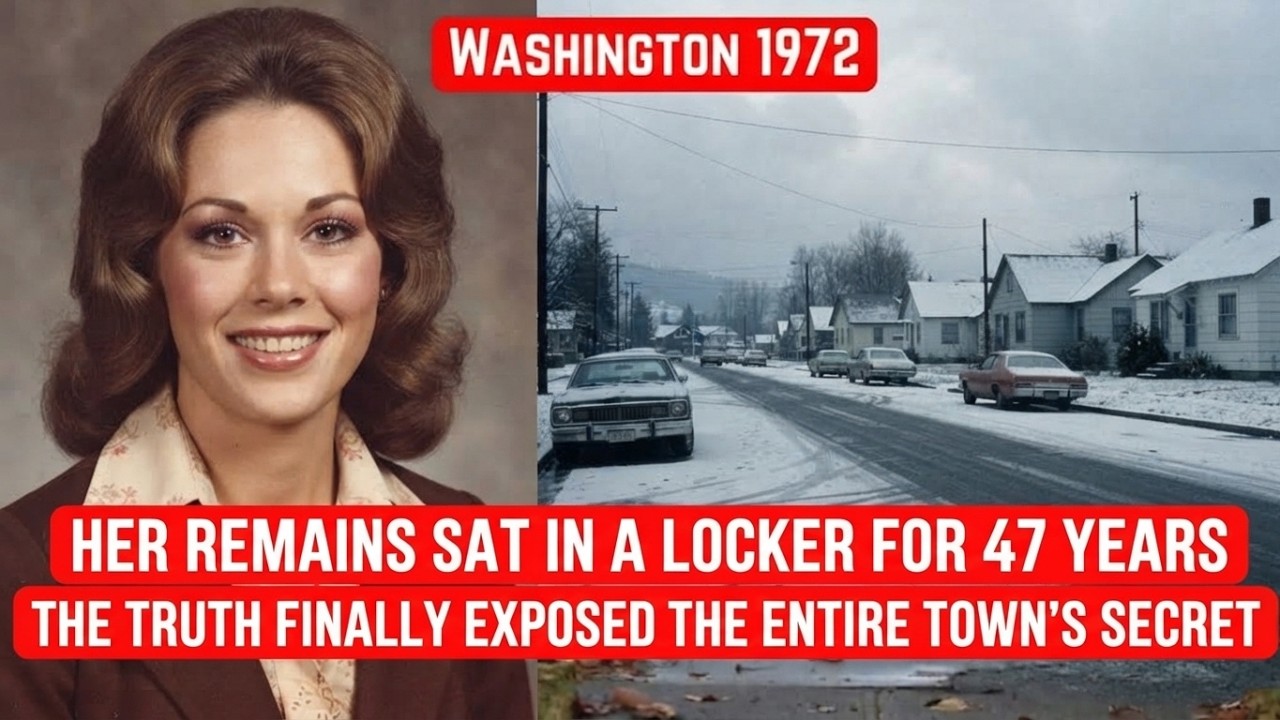
That person’s name was recorded nowhere. That meeting was never explained. Evelyn Cross vanished from the trailhead parking lot, leaving behind her unlocked car, her purse, and her reading glasses folded on the dashboard. She left behind a husband who would spend the rest of his life asking questions no one could answer.
And without knowing it, she left behind one piece of physical evidence that sat in a Kittitas County evidence locker for forty-seven years before anyone understood what it meant. Cle Elum in 1972 was a former coal-mining town that had reinvented itself as a gateway to the Cascade recreation areas, a stop for hikers, a service town for the surrounding farming communities, and home to about eighteen hundred people who knew each other with the particular closeness of small mountain towns where winters were long and community was everything. Evelyn Cross had lived in Cle Elum for nine years. She had come from Ellensburg to the east after marrying Robert Cross, who ran a small engine repair shop on First Street.
She was organized and precise in everything she did. She kept the books for Robert’s shop and two other local businesses. Her ledgers were so accurate that one client, a local lumberyard owner, once told her that having her do his books was like having a second pair of eyes he could completely trust. She was also a walker, not a mountain hiker exactly.
She did not climb peaks or carry heavy packs, but she walked the foothill trails regularly, alone or with her friend Dorothy Pearson, and she knew the paths around Cle Elum and the Teanaway River valley as well as she knew her own kitchen. She carried a worn paperback in her jacket pocket and would stop to read on flat rocks whenever she found a view she liked. Robert Cross told investigators later that Evelyn had told him Friday evening before her disappearance that she had an errand to run Saturday morning and would be home by noon. He did not ask what the errand was.
It did not occur to him to ask. In nine years of marriage, Evelyn’s errands had always brought her home. On Saturday, August 19, 1972, she kissed him on the cheek, took her keys, and drove north toward the Teanaway River trails. She did not return by noon.
She never returned at all. Robert Cross called the Kittitas County Sheriff’s Office at 2:47 p. m. on August 19, 1972.
Deputy Lawrence Finn handled the initial response. Evelyn’s white 1968 Rambler American was found in the Teanaway Road trailhead parking lot at 3:55 p. m. The car was unlocked.
Her purse was on the passenger seat. Her reading glasses were folded on the dashboard. The paperback she had been reading, a Dorothy Sayers mystery, was on the back seat. The search began in the nearby trail area at 4:30 p.
m. and expanded the next day to include a twenty-member volunteer search team coordinated with the Kittitas County Search and Rescue unit. The Tanum River basin area was combed for four days. The surrounding trail network was covered.
Nothing was found. Finn interviewed hikers and trail users who had been in the area that Saturday morning. A couple from Roslyn reported seeing a woman matching Evelyn’s description in the waiting area at about 9:15 a. m.
They said she seemed to be waiting for someone. She was standing near her car. She was not on the trail. The couple noted a dark-colored truck in the waiting area at that time.
They thought it was a small pickup, possibly black or dark blue, which was there when they arrived and left when they returned from their walk at 11:30 a. m. There was no license plate recorded. No clear model year.
Among the physical evidence collected from Evelyn’s car, one item would prove, decades later, to be everything. A partial handprint on the driver’s side exterior door, on the metal surface just above the door handle, consistent with the position of a palm against the top edge of the door frame, the way someone standing very close might grip the frame while the window was open. The handprint was not Evelyn’s. It was documented, photographed, and lifted as a partial print.
In 1972, the partial handprint yielded nothing. It was placed in the case evidence box. Deputy Finn worked the file for two years before transferring to another county. A new lead investigator handled the case for eighteen months.
The case went cold in 1975. The evidence, including the handprint documentation, was stored. Robert Cross continued to run his engine repair shop on First Street. He continued to live in the same house on Wright Street.
Asked once in 1980 by a reporter writing a retrospective article on unsolved local cases whether he had any theory about what had happened, he said he had many theories. He said none of them helped. Dorothy Pearson, Evelyn’s walking companion, organized a small private memorial every August 19 at the Teanaway trailhead. She did this from 1973 until 2004, when her health made driving difficult.
She did it for thirty-one years. Some years Robert came. Most years, Dorothy was alone with one or two others who had known Evelyn and could not quite let it go. By 1995, twenty-three years had passed.
Robert was sixty-five. The repair shop was sold. He retired to a quiet life in Cle Elum, tending a garden Evelyn had planted in 1969, maintaining it with the care of someone protecting something important long after the reason for it was gone. By 2010, Dorothy Pearson had died.
The August memorials stopped. Robert Cross wrote a letter to the Kittitas County Sheriff’s Office in 2014. He was eighty-four. He said he was writing because he did not know how much longer he would be able to write.
He asked whether the physical evidence in Evelyn’s case had been reviewed using modern technology. He included a description of the partial handprint as he remembered it from the 1972 investigation documents, copies of which he had kept in a folder in his office for forty-two years. He received a reply four months later indicating the evidence was still intact and that a review had been requested. Detective Patrick Yoon of the Kittitas County Sheriff’s Office was assigned cold case files in January 2019.
The partial handprint, preserved among the case evidence since 1972, was sent to the Washington State Patrol forensic laboratory in February 2019. New ridge detail enhancement technology, a computational process that reconstructs partially degraded or smudged fingerprint evidence, was applied to the original documentation. What the 1972 analysis had considered approximately forty percent of a usable print was expanded through the enhancement process to approximately seventy-two percent. That was enough.
The enhanced print was entered into state and national fingerprint databases in March 2019. On April 14, 2019, Detective Yoon received notification of a match. The match returned a name: Boyd Francis Hemmer, seventy-four years old, currently residing in Yakima, Washington. Hemmer’s prints were in the national database as a result of his 1994 conviction for violent assault in Yakima County, for which he served three years in prison.
In 1972, Hemmer was twenty-seven years old, working as a logging contractor with a crew that operated throughout Kittitas County. His work regularly took him through the Teanaway River valley during the summer and fall. A dark blue small pickup truck was his primary work vehicle. He had no criminal record in 1972.
Yoon extracted Hemmer’s full history. In the early 1970s, Hemmer lived in the Cle Elum area seasonally. His name appeared nowhere in the 1972 case file. He was never interviewed.
Deputy Finn never looked at him. Whether Hemmer and Evelyn knew each other, or whether the errand she had told Robert about was with him, cannot be determined from available records. What the enhanced handprint proved was that he placed his hand on the outside of Evelyn’s car door on the morning of her disappearance. On May 2, 2019, Boyd Hemmer was arrested at his home in Yakima.
He was in his yard. He looked at the officers and the arrest warrant, then looked at the mountains visible on the northwest horizon toward the Cascades. He said nothing until his lawyer arrived. Robert Cross was notified by Detective Yoon by phone that afternoon.
He was eighty-nine. He had kept the folder containing the copied investigation documents in his office for forty-seven years. He thanked the detective. He asked whether they knew what had happened to Evelyn.
Yoon told him they were working on it. Evelyn’s remains were found in September 2019 in a remote drainage area off the upper Teanaway River. Through a combination of ground-penetrating radar and cadaver dog search, it was determined she had been there for forty-seven years. Boyd Hemmer was charged with first-degree murder.
Through his attorney, he offered a guilty plea in January 2020 in exchange for a sentencing recommendation. He was sentenced to life in prison. He made no public statement. Robert Cross died in March 2020 at the age of ninety, three months after the guilty plea was entered.
His neighbors said that in his final weeks he seemed more at peace, as if something he had been carrying had been set down. He had kept the file in his office for forty-seven years. He had written the letter at eighty-four because he did not know how much time he had left to write. He had been right about the handprint.
He had kept the correct copy. Evelyn Cross was thirty-six years old. She carried an old book in her jacket pocket and stopped to read on flat rocks whenever she found a view she liked. She kept records so precise that people trusted her like a second pair of eyes.
She drove north one Saturday morning in August to run an errand she said she would explain when she got home by noon. She had forty-seven more years of life ahead of her, taken from her in a trailhead parking lot in the Cascade foothills. Boyd Hemmer placed his hand on her car door. He drove his dark blue truck away and built forty-seven years of ordinary life in Yakima.
He was seventy-four when the knock came at his door. A partial handprint enhanced by technology that did not exist in 1972, read carefully by a detective in 2019, and matched through a database created from a 1994 conviction. That is what solved the case. Not drama.
Not a witness coming forward. A ridge pattern on a piece of metal that survived forty-seven years in a box because a deputy in 1972 did his job properly, classified it, and stored it, confident that someday someone would know what to do with it. Justice found Evelyn Cross after forty-seven years.
