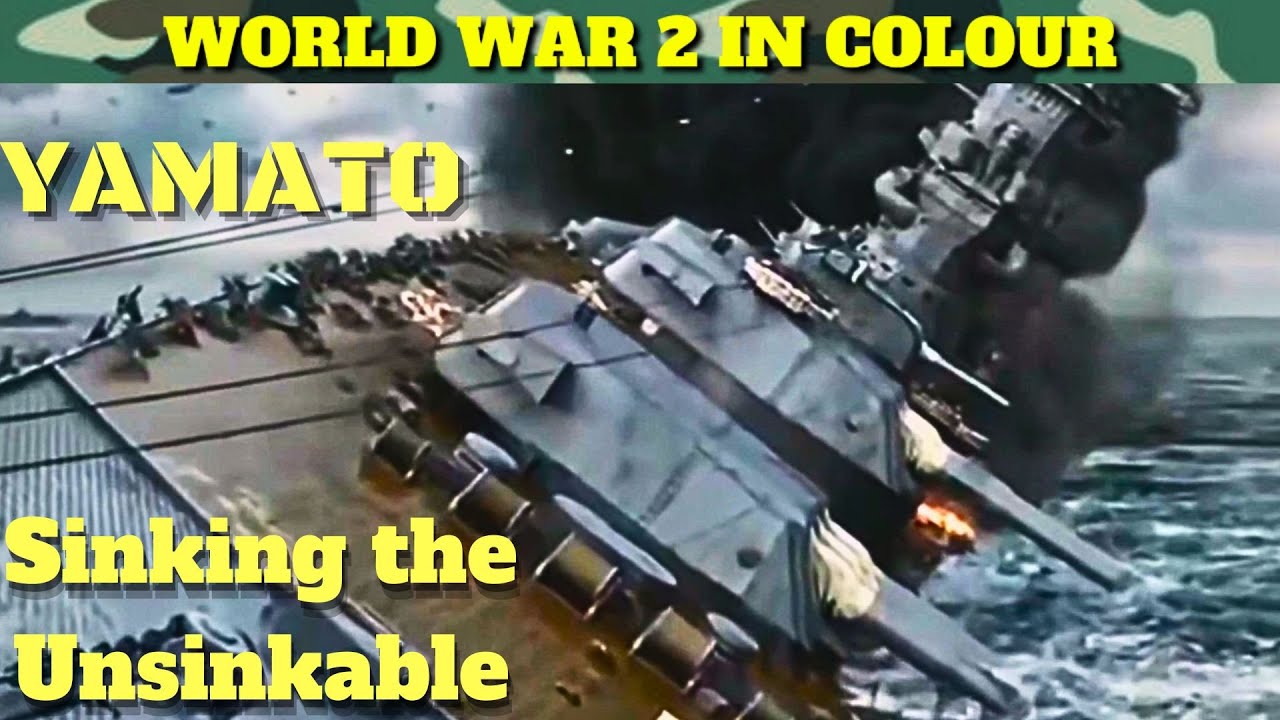
On April 7, 1945, the Imperial Japanese Navy’s super battleship Yamato, the heaviest and most powerfully armed battleship ever constructed, slipped beneath the waves of the Pacific Ocean. The ship that had been designed to be effectively unsinkable was destroyed by American carrier-based aircraft, taking nearly all of her crew with her. The sinking marked the end of an era in which battleships were seen as the ultimate arbiters of naval power, and it raised a question that would echo for decades: how did the U. S.
Navy manage to overcome the most advanced armor protection system ever built? The story of the Yamato began with a sobering strategic calculation. Japanese naval planners compared their nation’s industrial capacity to that of the United States and found the outlook grim. America produced roughly nine times as much industrial output as Japan, and Japanese strategists estimated that for every warship Japan could build, the United States could build three.
Unable to match the Americans in numbers, Japanese designers devised a different solution: build a class of battleship so large, so heavily armed, and so heavily armored that a single ship could take on multiple American battleships at once. The result was the Yamato, a vessel displacing 72,000 tons, armed with nine 18-inch guns, the largest naval guns ever installed on a warship, and protected by belt armor 16 inches thick. The design philosophy was known as all-or-nothing armor. The most critical parts of the ship, including the magazines, engine rooms, and command facilities, were enclosed in a heavily armored citadel.
Everything else was left comparatively unprotected. The Yamato’s citadel was the thickest ever constructed, and her deck armor, at 8 inches, was also the thickest of any ship ever built. The armor was angled to increase its effectiveness against incoming shells. Japanese designers calculated that the Yamato would be immune to direct hits from the 16-inch guns carried by the most powerful American battleships of the time, the Colorado class.
Beyond the belt armor, the Yamato featured a sophisticated anti-torpedo bulge designed to absorb the force of underwater explosions before they could reach the critical inner hull. Experiments on the armor suggested that an 880-pound charge of TNT detonating against it would not penetrate. That was significantly more powerful than the 507-pound warhead carried by the American Mark 14 torpedo then in service. The ship was also divided into 1,147 watertight compartments to contain flooding and isolate damage, and she carried an advanced counter-flooding system intended to keep her on an even keel after multiple torpedo hits.
The designers did not necessarily believe the Yamato was literally unsinkable in the strictest sense. But they intended her to be impervious to the weapons and tactics of the era in which she was conceived. When design work began in 1936, the full impact of naval aviation was not yet understood. The prevailing doctrine still held that battleships would decide the outcome of naval engagements, and aircraft were seen as auxiliaries best used for reconnaissance or, at most, torpedo attacks.
Level bombing of ships had proven notoriously difficult, and so the Yamato was built to fight other battleships. She was, however, given substantial anti-aircraft defenses. Twelve 5-inch dual-purpose guns and twenty-four 25mm light anti-aircraft guns were considered a strong defensive array at the time the ship was commissioned. Her main guns could also fire a special anti-aircraft shell, a type of incendiary projectile designed to explode at a pre-set altitude.
By the standards of the late 1930s, this was a formidable defensive suite. Two major factors undermined the designers’ ambitions. The first was a set of vulnerabilities rooted in the limitations of construction technology. The second was the inability of any designer to foresee how rapidly naval warfare would change during wartime.
When construction began on the Yamato, torpedo-carrying aircraft were slow biplanes. By the time she sank, jet-powered aircraft were already engaged in combat over Europe. The threats she had been designed to resist were no longer the threats she faced. The American Mark 14 torpedo had been plagued by serious design flaws at the start of the Pacific War, but by 1945 a modified version, the Mark 14 Mod 3, had entered service.
Not only did it function reliably, but its warhead had been increased by 62 kilograms and its explosive filler had been replaced with Torpex, a highly volatile substance roughly 50 percent more powerful than TNT. The result was a significantly greater explosive force than the Yamato’s designers had anticipated. The sheer power of these warheads could overwhelm the anti-torpedo bulges and protective systems that had been intended to mitigate such blasts. Compounding this was a weakness in the Yamato’s armor that stemmed from Japanese construction methods.
In the late 1930s, welding was becoming common in shipbuilding, but the technology was not yet advanced enough to handle plates as thick as the Yamato’s. Japanese naval engineers lacked the specialized tools and techniques required to weld 16-inch armor plates, so they relied on riveting, a method in which they had extensive experience. The disadvantage was that the strength of the joint depended on the toughness of the rivets themselves. Moreover, drilling holes into the armor to perform the riveting compromised the structural integrity of the seams.
On December 25, 1943, while sailing from Truk Naval Base, the Yamato was intercepted by the American submarine Skate, roughly 180 miles out at sea. A torpedo struck the battleship, ripping open the joint between the upper and lower armored belts and causing significant flooding. A crew member later recalled that the armor itself remained intact, but the rivets were blown off and water began flooding in around the joints. The Yamato took on approximately 3,000 tons of water before reaching Truk for temporary repairs.
The damage revealed a key weakness in the design: the blast effect of an underwater explosion could literally shake the armor plates apart, even when the armor was not penetrated. During the Yamato’s final battle on April 7, 1945, American aircraft struck her repeatedly. The best estimates are that between nine and eleven torpedoes hit the ship before the order to abandon ship was given, and all but one of those hits struck the port side. This was deliberate.
Concentrating the damage on one side increased the likelihood of capsizing, reducing the number of hits needed to sink the ship. The Yamato’s counter-flooding system was meant to offset such an imbalance, but by the time water began washing over the decks, most of the watertight compartments that should have contained the flooding were no longer functioning. Examination of the wreck later revealed small holes in the deck armor that offered a clue to the failure. In the late 1930s, a new bombing tactic known as dive bombing was being perfected.
Instead of dropping bombs from high altitude in level flight, aircraft dove directly at their targets, which simplified the bomb’s trajectory and dramatically improved accuracy. Dive bombers could strike smaller targets such as ships that were nearly impossible to hit with conventional level bombers. Using armor-piercing bombs, they managed to breach the Yamato’s deck armor. The steep dive angle meant the bombs struck at a near-perpendicular angle, punching holes through the armor and reaching critical internal compartments before detonating.
The best estimates suggest at least twelve 1,000-pound bombs struck the Yamato, destroying bulkheads and allowing flood water from the torpedo hits to spread throughout the ship. Surviving crew members described absolute carnage below decks, with fires raging uncontrollably. The Yamato’s anti-aircraft defenses had been steadily increased throughout the war. By 1945, the number of 5-inch dual-purpose guns had doubled to twenty-four, and the number of 25mm anti-aircraft guns had grown from twenty-four to 132.
But while the number of guns had increased, Japanese targeting technology had not improved. The United States had fielded radar-guided guns and proximity fuses capable of detecting nearby aircraft, but the Japanese continued to rely on antiquated manual procedures. Aiming the Yamato’s anti-aircraft guns essentially involved a crewman pointing at a target and shouting for the gunners to fire at it. This explained why the Yamato’s guns performed so poorly despite the sheer volume of fire they threw into the sky.
The Yamato sank in one piece, but the wreck site today shows debris scattered across a large area. The condition of the wreck, survivor statements, and modern recreation all point to a massive magazine explosion. The Yamato had sailed on her final mission carrying her entire ammunition stockpile, including more than 100 tons of gunpowder. When fires spread to the magazines in her final moments, the crew attempted to flood the compartments, but the pumps that would have done so had already been destroyed by earlier damage.
As the ship capsized, the heat detonated the explosives, producing one of the largest explosions of the war. A massive column of smoke rose high into the stratosphere and was visible from the coast of Japan. The sinking of the Yamato carried profound implications for the future of naval warfare. The most heavily armored ship in history had proved unable to withstand the power of American carrier-based air power.
The lessons drawn from her loss influenced postwar naval strategy, emphasizing the central role of aircraft carriers and submarines and ushering in an era of naval strategy and technology that continues to define modern maritime conflict.
