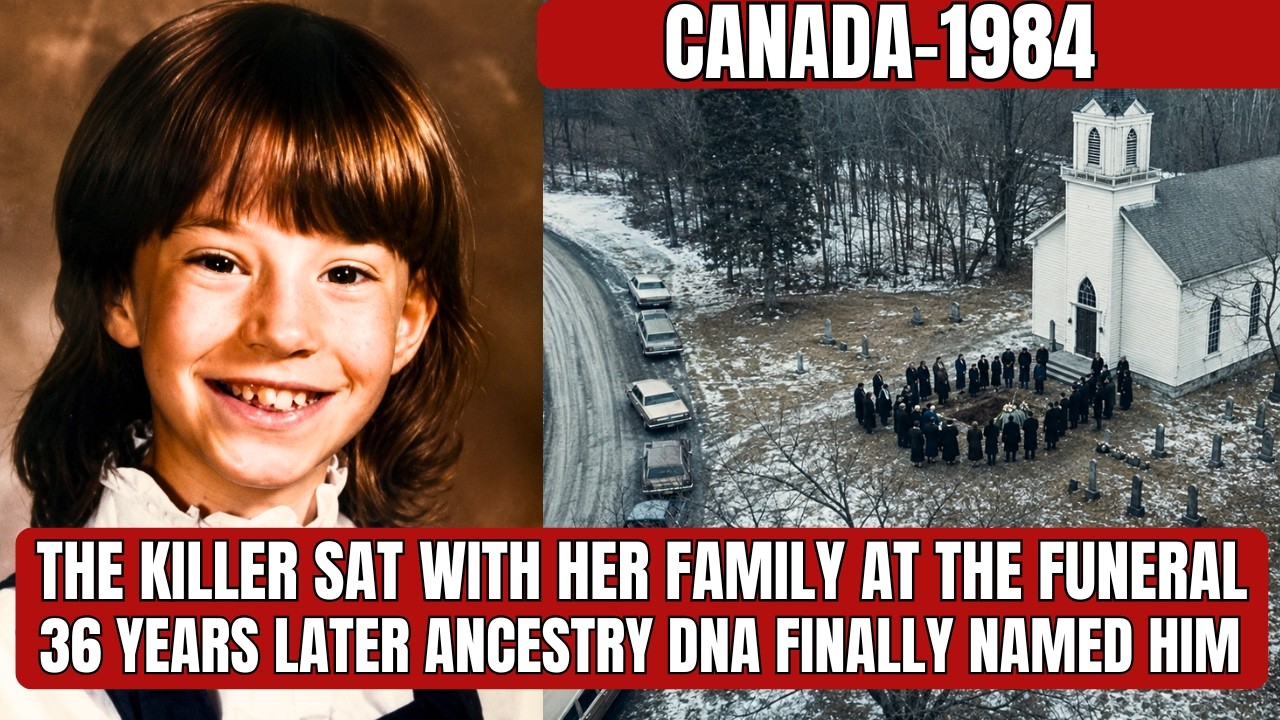
On October 3, 1984, nine-year-old Christine Jessup stepped off her school bus in Queensville, Ontario, a rural community of a few hundred people about sixty kilometers north of Toronto. She walked home, picked up the mail, hung up her jacket, fished a nickel from the change dish, and went to the country store to buy a piece of bubble gum. A witness saw her at the intersection, smiling, with a plastic recorder from her music class still in her hand. She never came home.
That afternoon, Christine’s father, Bob Jessup, was serving an eighteen-month sentence at the Toronto East Detention Center for misappropriating funds. Her mother, Janet, had driven her older brother Kenny into Toronto for a dentist appointment, after which they planned to visit Bob. Christine, at nine, was too young to be allowed inside the detention center, so she stayed home alone. That was the window.
It was the only afternoon that week she would have been home by herself, and whoever took her knew exactly how long it would last. When Janet and Kenny returned at around 4:10, the house felt normal at first. Then Janet noticed details that did not fit. Christine’s red bicycle was lying on its side by the shed with a damaged kickstand.
Christine loved that bicycle and never left it that way. Her jacket hung on a hook well above her reach. Her backpack was in her bedroom. The mail was on the counter.
There was no daughter. Janet began making dinner, assuming Christine was out playing, but as evening fell, she called friends, called parents, checked the park, checked the store. At around seven o’clock, she called the police. The search was massive.
Hundreds of volunteers combed a thirty-square-mile zone. Helicopters flew low over farm fields, divers searched ponds, K-9 units tracked through bushland. Bob Jessup was released early on compassionate grounds on October 6. Three months passed.
Christmas came with no tree in the Jessup home, because Janet later said decorating would have felt like giving up. On December 31, 1984, day ninety of the search, a man walking through a wooded field near Sunderland, about fifty-six kilometers east of Queensville, found Christine’s body. The recorder from her music class lay beside her, her name still taped to it. Her blue corduroy pants and small Nike shoes were nearby.
Her knitted blue sweater was gone and never found. The case now belonged to Durham Regional Police. Two detectives, Bernie Fitzpatrick and John Shepard, took charge. Their theory settled on a neighbor who lived thirty feet from Christine’s bedroom window.
His name was Guy Paul Moran, a quiet young man in his mid-twenties who worked as a furniture finisher, kept beehives, played the clarinet and saxophone in local community bands, and fixed old cars. He was reserved and deeply attached to his family. In a small town in 1984, that was enough to make him seem strange. Janet described him to detectives as reserved, different, not like the other neighbors.
Fitzpatrick wrote in his notebook, “Paul Moran, clarinet player, weird type guy. ”
On February 14, 1985, the detectives invited Moran for a friendly chat in their car. He agreed. They asked about Christine.
He said he had barely spoken to her, once helping her catch her runaway dog. The detectives recorded him, found nothing incriminating, and then claimed that after the tape stopped, Moran said something strange about innocent little girls growing up to be corrupt. From that moment, he was the only suspect. An undercover policewoman posing as a hairdresser snipped strands of his hair.
Lab analysts reported the hair was microscopically similar to hair found on Christine. Fibers found in his car were also reported as microscopically similar to fibers on Christine’s clothes. The neighborly connection explained both: the families lived next door and used the same laundromat. That explanation did not fit the case theory.
On April 22, 1985, Moran was pulled over on his way to band practice. Told he was under arrest for the murder of Christine Jessup, he said the officers must be kidding. One replied, “No, Guy, we’re not. We know what we’re doing.
We don’t make mistakes. ” He was interrogated for six and a half hours. Police showed him a blown-up photograph of his fingerprint, claiming it had come from Christine’s clothing. It had actually come from one of his clarinets.
He did not confess. He repeated the same sentence over and over: “I did not do this. ”
His parents mortgaged their home to raise nearly half a million dollars in bail. His defense lawyer was Clayton Ruby, one of Canada’s most prominent criminal defense attorneys.
At the first trial, which began January 7, 1986, Ruby presented a timeline that made conviction impossible. Moran had clocked off work in Toronto at 3:32 p. m. He could not have reached Queensville before 4:15.
Christine had already vanished by then. His parents testified he arrived home that afternoon carrying groceries. The crown ignored the groceries. But there was a problem.
Janet and Kenny had originally told police they arrived home at 4:10. Detectives went back to them repeatedly, suggesting the kitchen clock must have been wrong. Under pressure, Janet revised her arrival time to closer to 4:00. That single revision opened a twenty-minute window for the prosecution.
The crown called two jailhouse informants who claimed Moran had confessed. Both had made deals for lighter sentences. One was later described as a pathological liar. An undercover officer testified Moran had made alarming statements referencing horror novels.
On February 7, 1986, the jury returned a verdict of not guilty. The Jessups sat in stunned silence. Bob Jessup told reporters, “We’ve lived a year and a half of hell, and now the hell goes on. ”
The crown appealed, arguing the judge had misstated reasonable doubt.
The appeal succeeded. A second trial was scheduled. In 1992, prosecutors presented an even more elaborate theory: that Moran had seen Christine with her recorder, taken out his clarinet, and lured her to his car with music. The jury believed it.
On July 30, 1992, Guy Paul Moran was convicted of first-degree murder and sentenced to life in prison. While he sat in a penitentiary, DNA analysis was maturing as a forensic science. Four small biological samples had been preserved from Christine’s clothing. Three had degraded, but one still contained enough material for testing.
The result was unambiguous. The DNA did not belong to Guy Paul Moran. It could not belong to him. On January 23, 1995, the Ontario Court of Appeal set aside his conviction and entered an acquittal.
Moran walked free, telling cameras exactly what he had said for a decade: “I know I didn’t do it. I did not kill Christine Jessup. It’s as simple as that. And finally, DNA has exonerated me 100%.
”
The government ordered a public inquiry. Justice Fred Kaufman chaired the commission, which ran 146 days, heard from 120 witnesses, reviewed over 100,000 pages of evidence, and produced nearly 1,400 pages of recommendations. His findings were devastating. The investigation demonstrated, in his words, “tunnel vision in the most staggering proportions.
” The hair evidence was essentially valueless. The fiber evidence had been contaminated in the lab, and scientists had known about the contamination as early as 1986 without telling the defense. Kaufman concluded: “An innocent person was convicted of a heinous crime he did not commit. Science helped convict him.
Science exonerated him. ”
The case inspired reforms across Canada: new restrictions on jailhouse informants, new forensic standards, training against tunnel vision, and the creation of what became Innocence Canada. Moran rebuilt his life, married, had two sons, worked as a baggage handler, and later repaired pianos. But the real killer was still free.
The case sat in a filing cabinet at Toronto Police Headquarters for twenty-five years. Tips came in, detectives followed them, and every lead dead-ended. In the late 2010s, Detective Sergeant Steve Smith took over the cold case. He decided to try forensic genetic genealogy, a technique that had recently identified the Golden State Killer in California.
In December 2019, the killer’s DNA profile was sent to a laboratory in Houston, Texas. A genealogist uploaded the genetic code to a public ancestry database. It returned 33,000 distant relatives. For eight months, the team traced backwards through census records, obituaries, and marriage certificates, narrowing the list to two family trees, then to a single common ancestor born in 1804, then forward again through generations until they arrived at one name: Calvin Hoover.
Smith typed that name into the searchable case file. The file lit up. Calvin Hoover had been listed as a friend of the family since October 1984. His wife had access to the Jessup home.
No detective had ever questioned him. Calvin Hoover had met Bob Jessup at a telecommunications company where both men worked. The families became close. Their children played together.
Heather Hoover sometimes babysat Christine and Kenny. Christine had known Calvin her entire life. And two days before her disappearance, on October 1, 1984, Janet had mentioned, in passing at the Hoover home, that she would be driving Kenny to Toronto for a dentist appointment on the third and that Christine, being too young, would be left home alone. Police later concluded that only three people outside the immediate family knew Christine would be alone that afternoon: Bob’s lawyer, Bob’s boss, and Heather Hoover, and by extension her husband.
There was one more detail. Why had Christine’s body been found in that remote field near Sunderland? Because Calvin Hoover had an old school friend who lived there. Hoover visited regularly, knew the bushland, and knew where a body could rest undisturbed.
Calvin Hoover died in 2015, leaving a note that said only, “I hope you all have a good life. ” He never confessed. But the Ontario Center of Forensic Sciences had retained two small vials of his blood from his autopsy. On October 9, 2020, the samples were tested.
The DNA was a complete match. Six days later, Toronto Police announced that if Calvin Hoover were alive, he would be arrested for the death of Christine Jessup. Janet Jessup lived long enough to know the truth. She died on March 15, 2024, at eighty-one.
Her son Ken buried her on October 3, 2024, exactly forty years after Christine disappeared, in the small Queensville cemetery beside her daughter. Guy Paul Moran, cleared thirty years earlier, told reporters he had always believed DNA would reveal the real killer. The case became the subject of a documentary, and the Jessup family spoke publicly for the first time. Christine Jessup is still buried in the small cemetery next to the field where she used to ride her bicycle.
Her recorder, with her name still taped to it, was found beside her. It was there when an innocent man was accused, tried, convicted, and cleared. It was there when DNA identified the killer his family had known for years.
It took forty years, but the little girl with the recorder was finally heard.
