The poker clattered against the polished floor, the sound swallowed almost immediately by a crack of thunder that shook the windows of Witmore Plantation. Edmund Whitmore’s arm hung limp at his side, the rage that had propelled him toward Harriet draining out of him as completely as the color had drained from his guests’ faces. She stood motionless, watching him with an expression of almost serene acceptance, and in that moment the full weight of what she had done settled over the dining room like a shroud. The morning of that Easter Sunday had dawned with an unseasonable chill, a gray sky threatening rain that never seemed to fall.
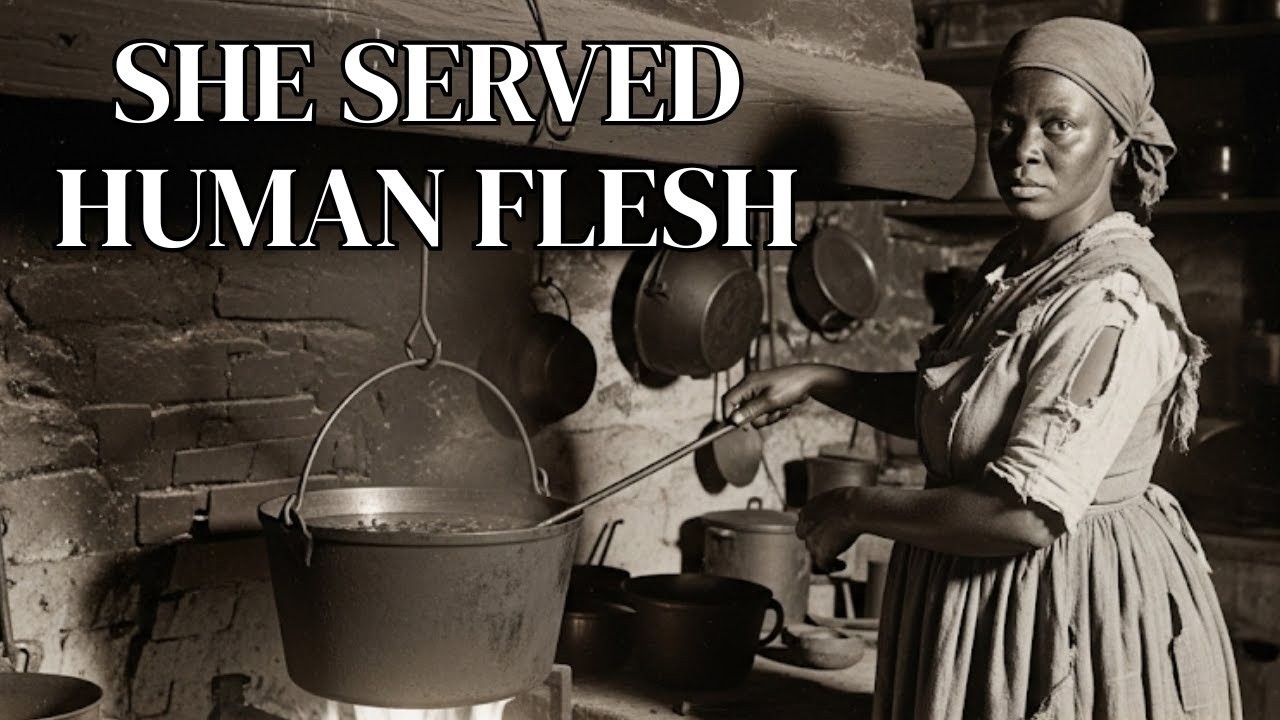
The dogwood and azaleas that bloomed across the Georgia countryside could not mask the darkness that festered within the white columns of the main house. Harriet had risen before dawn, as she had every day for the seven years of her enslavement, but this morning was different. As she dressed in her cleanest work dress and tied her hair back with a strip of faded cloth, she felt a strange calm settle over her—the kind of peace that comes when one has finally accepted their fate and chosen their path. At nineteen, Harriet’s face bore the premature lines of someone who had witnessed horrors beyond her years.
Her dark eyes, once bright with childhood dreams, now held a depth that spoke of calculated patience and simmering rage. She moved silently through the kitchen quarters, her bare feet making no sound on the worn wooden floors, and set about preparing coffee for the master of the house. “Harriet, where’s my morning coffee, girl? ”
The voice of Edmund Whitmore boomed from the dining room, carrying the familiar edge of irritation that preceded his violent outbursts.
She poured the steaming liquid into the fine china cup—the same cup she had watched him drink from while ordering the whipping of her younger brother just weeks before. Edmund Whitmore was a man whose reputation for cruelty extended far beyond the borders of his plantation. Standing six feet tall with graying hair and cold blue eyes, he ruled his domain with an iron fist wrapped in the veneer of southern gentility. His neighbors whispered about the screams that echoed from his property on moonless nights, but none dared interfere with a man of his standing in Savannah society.
As Harriet entered the dining room, she found him reading correspondence, his breakfast of eggs and ham growing cold. The morning light streaming through the tall windows illuminated the scars on her wrists—reminders of the shackles he had forced her to wear during her first escape attempt three years prior. “The Reverend Patterson will be joining us for Easter dinner this Sunday,” Edmund announced without looking up from his letters. “Along with the Caldwell family and Judge Morrison.
I expect everything to be perfect, Harriet. You know what happens when I’m disappointed. ”
She knew all too well. The last time she had displeased him, he had sold her closest friend Sarah to a plantation in Alabama, separating her from her own children.
The memory of Sarah’s desperate cries as she was loaded onto the wagon still haunted Harriet’s dreams. “Yes, master. Everything will be perfect,” she replied, her voice betraying nothing of the plan that had been forming in her mind for months. For the past year, she had been documenting every cruelty, every injustice, every moment of suffering inflicted by Edmund Whitmore in a small leather journal hidden beneath the loose floorboard in her quarters.
But more importantly, she had been planning something that would ensure he never hurt another soul again. The other slaves had begun to notice changes in Harriet. Old Moses, the head stablehand, observed how she had started spending long hours in the root cellar, claiming to be organizing supplies. Young Rebecca, who worked in the main house alongside her, noticed how Harriet had begun asking strange questions about the master’s eating habits and preferences.
“That girl’s got something brewing in her mind,” Moses whispered to his wife, Celia, as they sat by their small fire that evening. “I seen that look before, back when I was young. It’s the look of someone who’s decided they got nothing left to lose. ”
Celia nodded gravely, her weathered hands working on mending a torn shirt.
“Lord, help us all if she does something foolish. You know how the master gets when he’s angry. ”
But Harriet was far from foolish. Every detail of her plan had been carefully considered, every possible outcome weighed.
She had studied Edmund’s routines, his guests’ preferences, and most importantly, his absolute trust in her culinary skills. For years, he had boasted to his friends about his talented kitchen girl, who could prepare the finest meals in all of Georgia. As the week progressed toward Easter Sunday, Harriet began her preparations. She sent word to the local butcher requesting specific cuts of meat for the holiday feast.
She gathered herbs from the plantation’s garden, selecting each one with the precision of an apothecary. To any observer, she appeared to be simply preparing for an elaborate dinner party. But in the darkness of her quarters each night, she would retrieve her journal and add new entries, her handwriting growing more determined with each page. The final entry, written on the Saturday before Easter, contained just four words: “Tomorrow, justice will be served.
”
The guests began arriving around noon on Easter Sunday, their carriages crunching up the gravel drive. Reverend Patterson, a portly man with thinning hair and a tendency toward lengthy sermons about the divine order of society, was the first to arrive. Judge Morrison followed, his stern countenance and reputation for harsh sentences making him a fitting companion for Edmund Whitmore. Finally, the Caldwell family—Thomas, his wife Eleanor, and their twin daughters—completed the party.
Edmund greeted his guests with the practiced charm of a southern gentleman, his earlier cruelty toward his slaves hidden behind a mask of hospitality. He led them to the parlor, where they discussed politics, the cotton market, and the growing tensions between North and South over the slavery question. “I tell you, Edmund,” Judge Morrison declared, accepting a glass of bourbon, “these abolitionists are getting bolder by the day. Just last month, we had to deal with another Underground Railroad incident in Savannah.
Caught three runaways trying to board a ship to Philadelphia. ”
“What did you do with them? ” Thomas Caldwell inquired, his voice carrying the casual interest of a man discussing livestock. “Made an example of them, naturally,” the judge replied with satisfaction.
“Public whipping followed by sale to the sugar plantations in Louisiana. Word spreads quickly when justice is swift and visible. ”
In the kitchen, Harriet could hear their laughter drifting through the house as she continued her preparations. Each cruel word, each casual discussion of human suffering, only strengthened her resolve.
She had spent the morning in the root cellar retrieving the special ingredients she had been preparing for weeks—ingredients that would make this Easter dinner truly unforgettable. As the afternoon wore on, the aroma of roasting meat began to fill the house. The guests commented approvingly on the delicious smells emanating from the kitchen, with Reverend Patterson declaring that he could hardly wait to sample the feast. “Your Harriet certainly knows her way around a kitchen,” Eleanor Caldwell remarked to Edmund as they moved to the dining room.
“Where did you acquire such a skilled cook? ”
“Bought her from a plantation in South Carolina when she was just twelve,” Edmund replied with pride. “Trained her myself. She’s been worth every penny—obedient, skilled, and knows her place.
A perfect example of how proper discipline creates the ideal servant. ”
The dining room had been transformed for the occasion. The long mahogany table gleamed under the light of crystal chandeliers, set with Edmund’s finest china and silver. Fresh flowers from the plantation’s garden served as centerpieces, their sweet fragrance masking the darker scents that would soon emerge from the kitchen.
As the sun began to set, casting long shadows through the tall windows, Harriet made her final preparations. She had dismissed Rebecca and Martha earlier, claiming she wanted to handle the final presentation herself. Now alone in the kitchen, she carefully arranged the main course on the serving platters. The meat was perfectly cooked, tender and aromatic, seasoned with herbs that would complement its unique flavor.
To any observer, it appeared to be a magnificent roast, the kind of centerpiece that would be the talk of Savannah society for weeks to come. But Harriet knew the truth of what lay beneath the carefully crafted exterior. As she carried the platters toward the dining room, she whispered a prayer—not for forgiveness, but for the strength to see her plan through to its conclusion. The guests were already seated when she entered, their faces flushed with wine and animated conversation.
Edmund sat at the head of the table, his eyes gleaming with satisfaction as he surveyed his domain and his distinguished guests. “Ah, here comes our feast,” he announced as Harriet approached with the first platter. “Ladies and gentlemen, prepare yourselves for the finest meal you’ve ever tasted. My Harriet has outdone herself tonight.
”
As she set the platter before him, Harriet met Edmund’s eyes for just a moment. In that brief exchange, something passed between them—a flicker of recognition, perhaps, or simply the acknowledgement of a moment that would change everything. “Shall I carve, master? ” she asked, her voice steady despite the magnitude of what was about to unfold.
“Please do,” Edmund replied, gesturing grandly to his guests. “And be generous with the portions. We want our friends to experience the full extent of your culinary talents. ”
As Harriet began to carve the roast, the guests leaned forward in anticipation, their mouths watering at the sight of the perfectly prepared meat.
The first slice fell away from the bone with perfect precision, revealing the tender, well-seasoned flesh within. The aroma that rose from the platter was rich and complex, promising a dining experience unlike any other. “Magnificent. Simply magnificent,” Reverend Patterson declared, adjusting his spectacles to better examine his plate.
“Harriet, you’ve truly outdone yourself. What cut of meat is this? The marbling is extraordinary. ”
Harriet stood beside the serving table, her hands clasped behind her back, watching as each guest prepared to take their first bite.
“It’s a special preparation, Reverend. Something I’ve been perfecting for quite some time. ”
Edmund raised his glass in a toast, his voice booming with satisfaction. “To fine food, fine company, and the natural order that makes such evenings possible.
May we always remember our place in God’s grand design. ”
The guests echoed his sentiment, their glasses clinking together in a chorus of crystal. Judge Morrison was the first to cut into his portion, the knife sliding through the tender meat with ease. He brought the morsel to his lips, chewed thoughtfully, and his eyes widened with surprise.
“Good Lord, Edmund, this is exceptional. The flavor is unlike anything I’ve ever tasted. There’s something almost familiar about it, yet entirely unique. ”
Thomas Caldwell nodded in agreement, savoring his own bite.
“Indeed, there’s a richness to it that’s quite remarkable. Harriet, you must share your secret. My Eleanor would love to have our cook attempt something similar. ”
Eleanor Caldwell delicately cut a small piece, her refined manners evident in every movement.
“It’s certainly well seasoned. There’s an almost sweet undertone that’s quite pleasant. ”
As the guests continued to eat and praise the meal, Harriet remained motionless, her dark eyes fixed on Edmund as he consumed bite after bite with obvious relish. Each chew, each swallow, each expression of satisfaction sent a cold thrill through her body.
Years of planning, months of preparation, and now the moment of truth had finally arrived. “Harriet,” Edmund called out, his mouth still full, “bring us some of that excellent wine from the cellar. The Burgundy, I think. This meal deserves proper accompaniment.
”
“Of course, master,” she replied, her voice carrying an odd note that made Rebecca, who was serving the side dishes, glance at her with concern. As Harriet descended into the wine cellar, her mind drifted to the events of three weeks prior—the night that had sealed Edmund’s fate and her own. She had been returning from the quarters after tending to sick children when she heard the screams coming from the barn. Inside, she had found Edmund and his overseer, Jake Morrison, torturing a young slave named Samuel, who had been caught trying to learn to read.
The image was burned into her memory: Samuel suspended from the rafters, his back a canvas of bloody welts, while Edmund stood below him with a red-hot branding iron. The smell of burning flesh had filled the air as Edmund pressed the iron against Samuel’s shoulder, marking him permanently as a runaway. “This is what happens to slaves who think they’re equal to white men,” Edmund had snarled, his face twisted with sadistic pleasure. “Reading is for civilized people, not animals.
”
Samuel had died three days later from his injuries, his body buried in an unmarked grave behind the slave quarters. That night, Harriet had made her final decision about the special ingredient that would make her Easter feast truly memorable. Returning to the dining room with the wine, Harriet found the guests deep in animated conversation about the meal. Their plates were nearly empty, the evidence of their enthusiastic consumption clear in the satisfied expressions on their faces.
“Ah, perfect timing,” Edmund declared as she began refilling glasses. “We were just discussing how this might be the finest meal ever served in this house. Judge Morrison was saying he’s never tasted anything quite like it. ”
“Indeed,” the judge confirmed, patting his substantial belly.
“There’s something about the texture, the flavor. It’s almost primal in its appeal. Quite satisfying in a way that’s difficult to describe. ”
Reverend Patterson nodded sagely.
“Perhaps it’s the care and attention that went into its preparation. When food is prepared with proper dedication, it nourishes not just the body, but the soul. ”
“Speaking of dedication,” Thomas Caldwell interjected, “you really must tell us your secret, Harriet. My wife is quite the accomplished hostess, and she would be thrilled to learn your techniques.
”
All eyes turned to Harriet, who had finished serving the wine and now stood at the foot of the table. For a moment the room fell silent, except for the soft crackling of the fire in the hearth and the distant rumble of thunder as the promised storm finally began to approach. “The secret,” Harriet said slowly, her voice carrying clearly through the room, “is in choosing the right source for your meat. ”
“Ah, of course,” Edmund laughed.
“I’ve always said that quality ingredients make all the difference. Where did you source this particular cut? I don’t recall authorizing any special purchases. ”
Harriet’s lips curved into something that might have been a smile, but her eyes remained cold and distant.
“Oh, I didn’t need to purchase anything, master. The source was much closer to home than you might think. ”
Something in her tone made Eleanor Caldwell pause with her wine glass halfway to her lips. A subtle shift in the atmosphere seemed to settle over the room, like the pressure change that precedes a violent storm.
“What do you mean by that? ” Judge Morrison asked, his legal mind beginning to sense that something was amiss. Harriet looked directly at Edmund, her gaze unwavering. “Three weeks ago, you killed Samuel in the barn.
You tortured him for the crime of wanting to read, and then you left his body to rot like he was nothing more than a diseased animal. ”
The color began to drain from Edmund’s face as understanding started to dawn. “Harriet, what are you saying? ”
“I’m saying that Samuel didn’t go to waste after all,” she replied, her voice growing stronger with each word.
“I made sure he served a purpose. I made sure he fed the very people who considered him less than human. ”
The silence that followed was deafening. Eleanor Caldwell’s wine glass slipped from her nerveless fingers, shattering on the floor in a spray of red that looked disturbingly like blood in the candlelight.
Reverend Patterson’s face had gone ashen, his mouth opening and closing soundlessly like a fish gasping for air. “You’re lying,” Edmund whispered. But his voice lacked conviction. Deep down, he knew she was telling the truth.
“Am I? ” Harriet asked, her composure absolute. “Think about the flavor you all praised so highly. Think about how tender the meat was, how it seemed to melt in your mouth.
Think about how satisfied you felt with each bite. ”
Judge Morrison lurched to his feet, his chair toppling backward. “This is impossible. This is madness.
”
“This is justice,” Harriet corrected him. “You’ve all spent years treating human beings like animals, buying and selling them, torturing and killing them without a second thought. Tonight, you discovered what it’s like to consume human flesh. Tonight, you became the monsters you’ve always been inside.
”
The storm outside had arrived in full force, lightning illuminating the windows as thunder shook the very foundations of the house. But the tempest outside was nothing compared to the horror unfolding within the dining room. Thomas Caldwell was the first to break, stumbling toward the corner of the room where he violently expelled the contents of his stomach onto the Persian rug. The sound of his retching seemed to break the spell that had held the others frozen in place.
“No, no, no,” Eleanor Caldwell whispered, her hands pressed against her mouth as if she could somehow force the consumed flesh back out. “This cannot be happening. This cannot be real. ”
Reverend Patterson had fallen back into his chair, his face the color of old parchment.
His lips moved in what might have been prayer, but no sound emerged. The man who had spent countless Sundays preaching about divine justice now found himself face to face with a justice far more immediate and terrible than anything in his sermons. Edmund rose slowly from his seat, his movements deliberate and controlled despite the rage building behind his eyes. “You lying witch,” he snarled, his southern gentleman’s facade cracking like a broken mask.
“You’re trying to drive us mad with your sick fantasies. ”
But even as he spoke the words, doubt gnawed at him. The taste lingered in his mouth—that strange, almost sweet flavor that had seemed so familiar yet impossible to identify. The texture that had been so perfectly tender, so satisfying in a way that defied explanation.
“Look at your plates,” Harriet said calmly, gesturing toward the remnants of their meal. “Look at how clean they are. Look at how much you enjoyed every bite. You praised the flavor, the tenderness, the perfect preparation.
You consumed Samuel with the same enthusiasm you’ve always shown for your other pleasures. ”
Judge Morrison, his legal mind still functioning despite his horror, pointed a shaking finger at her. “Even if what you’re saying is true—and I pray to God it isn’t—you’ve confessed to murder. You’ve admitted to the most heinous crime imaginable.
”
“Have I? ” Harriet asked, tilting her head slightly. “Samuel was already dead when I found his body rotting in that unmarked grave. I simply ensured that his death served a purpose.
I gave him the dignity of being remembered, even if none of you knew his name when you were savoring his flesh. ”
The storm outside intensified, rain lashing against the windows with increasing fury. Lightning illuminated the dining room in stark white flashes that made the scene appear even more nightmarish. In those brief moments of harsh light, the guests looked like figures from a medieval painting of hell, their faces twisted with horror and disbelief.
Thomas Caldwell had managed to stop retching long enough to speak. “We have to get out of here,” he gasped, wiping his mouth with a trembling hand. “We have to leave this place immediately. ”
“And go where?
” Harriet asked, her voice carrying a note of genuine curiosity. “Back to your plantations, back to your comfortable lives where you can pretend this never happened? Do you think you’ll ever be able to eat meat again without wondering what—or who—you’re consuming? ”
Eleanor Caldwell let out a strangled sob.
“Why? Why would you do such a thing? We never harmed you directly. ”
Harriet’s composure finally began to crack, revealing the years of accumulated pain and rage beneath.
“You sat at this table countless times, discussing the buying and selling of human beings like they were livestock. You laughed at stories of whippings and brandings. You praised the natural order that kept my people in chains. ”
She turned to face each guest in turn, her eyes blazing with an intensity that made them shrink back in their chairs.
“Reverend Patterson, you preached that slavery was God’s will, that we were meant to serve our betters. Judge Morrison, you sentenced runaway slaves to tortures that would make demons weep. Mr. and Mrs.
Caldwell, you’ve built your fortune on the backs of people you consider less than human. ”
Edmund had been listening to this exchange with growing fury, his hands clenched into fists at his sides. “Enough! ” he roared, his voice echoing through the room.
“I don’t care if you’re telling the truth or spinning lies. You’ve gone too far, and now you’ll pay the price. ”
He lunged toward the fireplace, grabbing a heavy iron poker from the hearth. The other guests scrambled away from the table as he advanced on Harriet, his face twisted with murderous intent.
“I should have killed you years ago,” he snarled, raising the poker above his head. “I should have known that kindness was wasted on your kind. ”
But Harriet didn’t flinch or try to run. Instead, she stood perfectly still, watching him approach with an expression of almost serene acceptance.
“Go ahead,” she said quietly. “Kill me. Beat me to death like you’ve done to so many others. But it won’t change what you’ve done tonight.
It won’t take Samuel’s flesh out of your stomach or erase the memory of how much you enjoyed eating him. ”
Edmund hesitated, the poker trembling in his raised hand. Something in her calm acceptance gave him pause, as if he sensed that striking her down would only complete some larger design he didn’t understand. “You’ll never be able to forget,” Harriet continued, her voice growing stronger.
“Every meal for the rest of your lives, you’ll wonder. Every piece of meat that passes your lips will carry the possibility of being human flesh. You’ll taste Samuel in every bite, and you’ll remember this night until the day you die. ”
The truth of her words hit them like a physical blow.
Judge Morrison sank back into his chair, his face buried in his hands. Eleanor Caldwell continued to sob quietly, her entire body shaking with revulsion and horror. Thomas Caldwell stood frozen by the wall, his eyes wide with the realization that his life had been irrevocably changed. Outside, the storm reached its peak, thunder crashing overhead like the judgment of an angry god.
In the flickering candlelight of the dining room, the remnants of their Easter feast seemed to take on a sinister quality. The empty plates and scattered bones told a story that would haunt them forever. Edmund still held the poker aloft, but his arm had begun to shake with the effort. The rage in his eyes was slowly being replaced by something far worse—the dawning understanding that Harriet had achieved a victory more complete than any physical violence could have accomplished.
She had not just served them human flesh. She had forced them to confront the true nature of their own humanity, and in doing so, she had ensured that they would carry the weight of this night with them for the rest of their lives. The poker fell from Edmund’s nerveless fingers, clattering to the floor with a sound that seemed to echo through eternity. The fight had gone out of him as completely as air from a punctured balloon, leaving behind only a hollow shell of the man who had terrorized his slaves for so many years.
“You’ve destroyed us all,” he whispered, his voice barely audible above the storm. “You’ve damned us all to hell. ”
“No,” Harriet replied, her voice carrying a strange note of sadness. “You damned yourselves long ago.
I simply made sure you understood the price of your choices. ”
Judge Morrison was the first to speak, his legal training finally overcoming his shock. “This… this cannot become public knowledge. The scandal would destroy us all.
Our families, our reputations, our entire way of life. ”
“Now you understand what it feels like to live in fear,” Harriet said, a bitter smile playing at the corners of her mouth. “Now you know what it’s like to have your very existence threatened by forces beyond your control. ”
Thomas Caldwell had managed to compose himself enough to rejoin the group, though his face remained ashen.
“What do you want from us? Money? Freedom? Name your price and we’ll pay it.
”
“My price? ” Harriet laughed, but there was no humor in the sound. “My price was paid in full the moment you swallowed the first bite. There’s nothing you can give me now that would equal what you’ve taken from my people over the years.
”
Eleanor Caldwell looked up from her hands, her eyes red with tears. “But surely there must be something—some way—to make amends for what’s happened here. ”
“Amends? ” Harriet’s voice grew cold again.
“Tell me, Mrs. Caldwell, how do you make amends for eating a human being? How do you apologize for consuming the flesh of a man who died because he wanted to read? ”
The question hung in the air unanswered because there was no answer.
They all knew that what had been done could never be undone, never be forgiven, never be forgotten. Reverend Patterson finally found his voice, though it came out as little more than a croak. “What happens now? What becomes of us?
”
“That’s up to you,” Harriet replied. “You can try to pretend this never happened. You can go back to your plantations and your comfortable lives and attempt to forget. But you’ll never succeed.
Every time you sit down to a meal, you’ll remember. Every time you see meat on your plate, you’ll wonder. Every time you taste something that reminds you of tonight, you’ll be right back in this room, realizing what you’ve done. ”
She moved toward the window, gazing out at the storm that was beginning to subside.
“Or you can face the truth of what you are. You can acknowledge that you’ve spent your lives treating human beings like animals, and tonight you discovered what it feels like to be on the other side of that equation. ”
Edmund had slumped into his chair, his head in his hands. “You’ve made us into monsters,” he mumbled.
“No,” Harriet corrected him firmly. “You were already monsters. I just made sure you could taste it. ”
Judge Morrison spoke again, his voice stronger than it had been since the revelation.
“I need to know if you’re telling the truth. Show us proof. Show us evidence of what you claim to have done. ”
Harriet turned from the window, studying his face in the dim light.
“You want proof? Very well. ”
She walked to the serving table and picked up the carving knife she had used to slice the roast. The blade gleamed in the candlelight, still stained with the juices from the meat.
“Three weeks ago, I found Samuel’s body in the unmarked grave behind the slave quarters. I waited until the middle of the night. Then I dug him up and brought him to the root cellar. I spent two days preparing the meat, aging it properly, seasoning it with herbs from the garden.
”
Her voice was clinical, matter-of-fact, as if she were describing the preparation of any ordinary meal. “I removed the bones carefully, saving them to be ground into meal for the other slaves. Nothing was wasted. Samuel fed his people one last time, just as he fed you tonight.
”
Thomas Caldwell made a strangled sound and turned away, but Harriet continued relentlessly. “The hardest part was the presentation. I wanted it to look perfect, to taste perfect. I wanted you to enjoy every bite, to savor the flavor, to compliment the preparation.
And you did. You praised Samuel’s flesh as the finest meat you’d ever tasted. ”
Eleanor Caldwell let out a wail of despair, but Harriet wasn’t finished. “If you need more proof, go to the root cellar.
You’ll find Samuel’s bones there, cleaned and prepared for grinding. You’ll find the tools I used, the herbs I selected, the journal where I recorded every step of the process. ”
The silence that followed was absolute. Even the storm outside seemed to have paused, as if nature itself was holding its breath in the face of such terrible truth.
Finally, Edmund raised his head, his eyes hollow and defeated. “What happens to you now? You’ve confessed to… to this abomination. You know we can’t let you live.
”
Harriet asked, tilting her head slightly. “Think about it carefully, master. If you kill me, you’ll have to explain why. You’ll have to tell people what I did, and that means admitting what you ate.
Are you prepared for that conversation? ”
The trap was perfect, and they all saw it clearly. To punish Harriet for her crime, they would have to reveal their own unwitting participation in it. The scandal would destroy them all—their families, their social standing, everything they had built their lives upon.
“Besides,” Harriet continued, “killing me won’t change anything. The deed is done. Samuel’s flesh is already digesting in your stomachs. My death won’t bring him back, and it won’t erase what you’ve consumed.
”
Judge Morrison stood slowly, his movements those of a man who had aged decades in a single evening. “Then what? We just let you go? Pretend this never happened?
”
“That’s exactly what you’ll do,” Harriet said with quiet confidence. “Because you have no choice. You’ll go back to your homes, and you’ll try to forget. But you won’t succeed.
This night will follow you for the rest of your lives. ”
She moved toward the door, pausing to look back at the group of broken, horrified people who had once held absolute power over her life. “There’s one more thing you should know,” she said softly. “Samuel wasn’t the first.
Over the past year, I’ve prepared similar meals for other occasions. That Christmas dinner you enjoyed so much. The birthday celebration for Judge Morrison. The harvest feast last autumn.
”
The implications hit them like physical blows. How many times had they unknowingly consumed human flesh? How many of their slaves had they eaten without ever realizing it? “Sweet dreams,” Harriet said, and then she was gone, disappearing into the storm-torn night like a ghost returning to the shadows from which she had emerged.
The guests sat in stunned silence for a long time after her departure. Eventually, they would leave Witmore Plantation, returning to their homes with a secret that would poison the rest of their lives. They would try to forget, but they would fail. Every meal would be a reminder, every piece of meat a potential horror.
Edmund Whitmore would never recover from that night. Within a year, he would sell his plantation and move north, but the memories followed him. He died alone in a boarding house in Philadelphia, having wasted away from his inability to eat solid food. Judge Morrison resigned from the bench and became a recluse, living on nothing but bread and water until his death five years later.
The Caldwell family left Georgia entirely, but their marriage crumbled under the weight of their shared secret. Reverend Patterson continued to preach, but his sermons took on a darker tone, filled with warnings about the wages of sin and the terrible justice that awaited those who oppressed the innocent. And Harriet—she vanished into the night and was never seen again. Some said she escaped north on the Underground Railroad.
Others claimed she was taken by the spirits of all the slaves who had died on the plantation. But the truth was simpler and more terrifying than any ghost story. She had achieved something that no amount of violence or rebellion could have accomplished. She had forced her oppressors to confront the true nature of their humanity, and in doing so, she had ensured that they would carry the weight of their crimes with them forever.
The Easter dinner of 1852 became a legend whispered in the darkest corners of the South—a reminder that even the most powerless could find a way to exact a terrible and perfect justice. The storm passed, but the horror remained, carved into the very soul of everyone who had sat at that table. They had learned too late that there are some hungers that can never be satisfied, and some truths that can never be digested.
In the end, Harriet had served them exactly what they deserved—a feast of their own making, seasoned with the bitter herbs of justice, and garnished with the terrible knowledge of what they had become.
